Eating gluten-free at Walt Disney World: what Disney’s special-diets page says and how to use it
Short answer
Disney says its table-service and quick-service restaurants will do their best to accommodate a request for a meal without gluten17, but it cannot guarantee that any item is completely free of allergens8. The special-diets page gives four steps at the restaurant:
- Tell the Cast Member assisting with your order about your request; at table service that is your server1.
- Ask for the menu with allergen information, which table-service and select quick-service restaurants have, or the guide at a buffet2.
- Look for the visual marker on an order that followed the allergy request process: a pick, a designated tray or, to go, a sticker3.
- Confirm the order when it is delivered, even if you see the marker4.
Part of Travel planning and logistics, 22 guides

Key points
- With 4 or more allergy-friendly requests, a pureed-meal need or a medically restrictive diet, Disney asks you to contact its Special Diets team after booking dining, and no sooner than 14 days before arrival5, 6.
- Disney says this process applies to Disney-owned and -operated restaurants only7.
- Disney says many carts and kiosks have no allergy-friendly menus, and recommends table-service restaurants for special dietary requests11, 12.
- Disney says it does not weigh “may contain” or shared-equipment statements when it evaluates ingredients for its allergy-friendly menus10.
- Menus, recipes and ingredients change, so Disney tells guests to check with a Cast Member at the location on the day13.
What Disney’s special-diets page tells you to do at the restaurant
Disney’s allergen menus and buffet guides show items made without the most common allergens “plus gluten”2. The page gives the process in four steps:
- Tell us. Say you have a special diets request to the Cast Member taking your order. When the change is more than a taste or texture preference, that Cast Member tells the kitchen to use the allergy request process, which involves a Special Diets-Trained Cast Member1.
- Ask about menus. Table-service and select quick-service restaurants offer an allergen menu, and buffets provide a guide2. Disney says most table-service and select quick-service restaurants list allergy-friendly options in their online menus, so you can look before you go22.
- Look for the marker. A pick, a designated tray or a to-go sticker means the order followed the allergy process; with no marker, Disney says to ask a Cast Member3.
- Verify. Disney’s own example of the check is asking your server, “Is this the pasta made without gluten?”4
Menus, recipes and ingredients are subject to change. Disney says to check with a Cast Member at the location for the current offerings on the day you dine13.
Before the trip: when to write to Disney, and what the process does not cover
Disney names three cases for advance contact: 4 or more allergy-friendly requests in your party, pureed meals, or a medically restrictive diet that needs specialized planning, such as very low protein. In those cases it asks you to email Special.Diets@DisneyWorld.com to ask for a Special Diets Request Form5. A single request such as gluten is not one of the cases the page lists5; for it, the page’s instruction is to tell the Cast Member when you order1.
Timing matters: Disney asks you to contact the team after you book dining arrangements, and not sooner than 14 days before you arrive. The team may pass your request to the restaurants you plan to visit6.
Two limits to plan around. The process applies to Disney-owned and -operated restaurants only7, so for any other restaurant you will need to ask that restaurant how it handles gluten. And Disney’s chefs and Cast Members may not store, prepare, cook, heat or reheat food that guests bring in16.
Table service: the conversation that matters most
Disney says table-service restaurants are better equipped to handle special dietary requests than carts and kiosks12, and a sit-down meal gives you a server, an allergen menu and the marker check in one place1, 2, 3.
Disney’s page does not describe how a kitchen handles fryers or grills18. The Gluten Intolerance Group (GIG) suggests these questions when eating out, and you can put them to your server. Disney also says that if you cannot find the allergy-friendly items you want, you can ask to speak with a special diets-trained Cast Member at the dining location15:
- Whether there is a dedicated fryer for gluten-free foods27, or whether the fries share oil with breaded items30.
- Whether the grill is separate or shared with gluten foods, and if shared, how it is cleaned and how often; and whether your meal can be cooked in a separate pan28.
- Whether sauces are certified gluten-free or made in-house, since Worcestershire-type sauces and soy sauce could contain gluten29.
In a page written for parents and caregivers of gluten-free children, GIG lists a few reasons to eat elsewhere or stick to pre-packaged, pre-verified items: staff saying a little gluten will not hurt, kitchen staff hesitating to check the ingredient labels on packaged sauces or mixes, and confirmation that gluten-free foods share cooking oil or grill space with heavily breaded items31. See also our guide to eating out with celiac disease.
Quick service, mobile order and carts
Mobile ordering runs through the My Disney Experience app36: you choose a location, set an arrival time and choose items19, and Disney says it is available at more than 60 locations across the parks and Disney Springs21. The mobile-order page itself lists no allergy or gluten option20. For allergies, the special-diets page says:
- If you cannot find the allergy-friendly items you want, ask to speak with a special diets-trained Cast Member at the location; guests with more than one allergy request are encouraged to order from the allergy-friendly menu there15.
- You have to speak to a Cast Member to pick up a mobile order, which lets you confirm it, and a to-go order is marked with an allergy-friendly sticker on the box and bag14.
Carts and kiosks are different. Disney says many do not have allergy-friendly menus; for some items, such as ice cream bars or frozen lemonade, you can ask to see the product packaging to check it against your dietary needs11.
A short script for counter and table
GIG notes that busy servers respond best to short, direct explanations32. These lines are ours; the last check follows Disney’s own example4.
| When | Say | Why |
|---|---|---|
| At the counter or the table | “Someone in our party needs a meal made without gluten: no wheat, barley or rye. Can I see the allergen menu, and can you use your allergy request process?” | Disney says to tell the Cast Member that you have a special diets request and to ask about menus1, 2. |
| Before you order a fried or grilled item | “Is this cooked in a dedicated fryer, or on a separate grill or pan?” | Questions from GIG’s restaurant list27, 28. |
| For sauces and seasonings | “Are the sauce and seasoning gluten-free? Does the dish contain flour or a roux?” | GIG’s list asks about sauces, and notes that Worcestershire-type sauces and soy sauce could contain gluten29. It also asks about flour or roux, and about marinades and seasonings37. |
| When the food arrives | “Is this the meal made without gluten?” | Disney says to confirm the order when it is delivered, even with the marker4. |
What Disney says it cannot promise
Disney is direct about the limits of its process, and these are Disney’s statements about allergens in general, not a gluten-specific limit18:
- Restaurants take reasonable efforts to accommodate dietary requests, but Disney cannot guarantee that they will be able to meet all requests35.
- Disney takes steps to prevent cross-contact but cannot guarantee that any item is completely free of allergens8.
- Its allergy-friendly recipes may use highly refined oils, such as soybean oil, and ingredients processed in facilities that also process allergens9.
- It does not reference “may contain”, “processed in a facility with” or “made on shared equipment” statements when it evaluates ingredients for its allergy-friendly menus, and says the FDA does not regulate them10.
The last point matters for gluten: Disney evaluates ingredients for those menus without reference to such statements, so a shared-equipment warning on an ingredient’s packaging is not part of that evaluation10. Disney says it is ultimately the guest’s discretion to make an informed choice9; ask the Special Diets-Trained Cast Member what you need to know.
“Allergy-friendly” and “gluten-free” are not the same claim
In the US, a food that says “gluten-free”, “no gluten”, “free of gluten” or “without gluten” must, among other criteria, contain less than 20 parts per million of gluten under FDA’s rule24, and a food that bears the claim without meeting the rule is deemed misbranded26. For restaurants, FDA says their use of gluten-free labeling should be consistent with the federal definition, and that state and local governments play an important role in overseeing restaurants25.
Disney’s special-diets page describes menus of items made without common allergens “plus gluten”2; it states no gluten limit in parts per million18. So read an “allergy-friendly” listing as what Disney says it is, not as a promise of a number.
One study of restaurant food analysed 5,624 tests by 804 users of a portable gluten-detection device and detected gluten in 32% of foods labeled gluten-free33. Its authors note that the device may detect gluten below 20 parts per million, at levels of unknown clinical significance, and call their findings a potential concern34. The tests were results that users chose to share, collected across the United States, and the abstract reports no breakdown by chain, so the study is not a measure of Disney’s food38.
Park foods people look for: what our verdicts cover
Our verdict pages cover each of these foods in general, not Disney’s recipes. Disney’s special-diets page names none of them except ice cream bars at carts and kiosks11, 18, so we state no gluten status for a Disney churro, funnel cake or fry. Use the verdict to know what to ask, then ask at the location.
| Food | Our verdict | What to ask |
|---|---|---|
| Churros, funnel cake | Churros, funnel cake | What it is made from and whether the fryer is dedicated27. |
| French fries | French fries | Whether the fries are cooked in a dedicated fryer or share oil with breaded items30. |
| Corn dogs, chicken nuggets | Corn dogs, chicken nuggets | The coating, and the same fryer question27. |
| Mac and cheese | Mac and cheese | Whether an allergy-friendly version is on the allergen menu2. |
| Popcorn, pretzels | Popcorn, pretzels | At a cart or kiosk, whether you can see the packaging11. |
| Ice cream | Ice cream | For items like ice cream bars at a kiosk, to see the packaging11. |
| Turkey | Turkey | What seasonings and marinades are used37. |
Our gluten scanner looks for gluten ingredient names in a photo of a label or in pasted text.
A plan for a park day
- Before you go: book table service where you want it, look at the online menus22, and if your party meets one of Disney’s three advance-contact cases, email Special Diets after booking and within the 14-day window5, 6.
- Breakfast and dinner: a table-service meal gives you the server, the allergen menu and the marker check1, 2, 3; confirm when the plate arrives4.
- Park lunch: use a quick-service location that offers an allergy-friendly menu. If you mobile order, you will speak to a Cast Member at pick-up to confirm the order14.
- Snacks: at a cart or kiosk, ask to see the packaging11.
- Every time: speak to a Cast Member, because Disney says guests must speak to a Cast Member about their allergy request8.
Verdicts in this guide
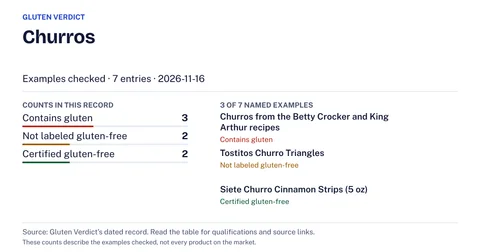 ChurrosContains glutenchecked Nov 16, 2026
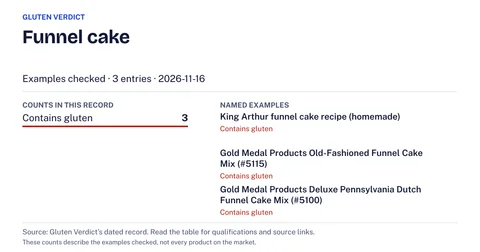 Funnel cakeContains glutenchecked Nov 16, 2026
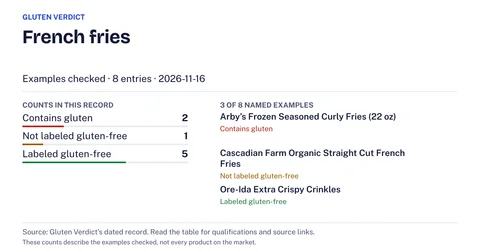 French friesDepends on the product2 of 8 products we checked contain gluten: Arby’s Frozen Seasoned Curly Fries (22 oz) and Checkers Frozen Crispy Seasoned Fries (28 oz)checked Nov 16, 2026
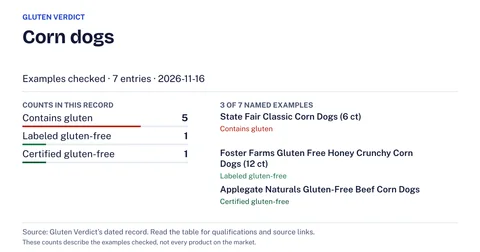 Corn dogsDepends on the product5 of 7 products we checked contain glutenchecked Nov 16, 2026
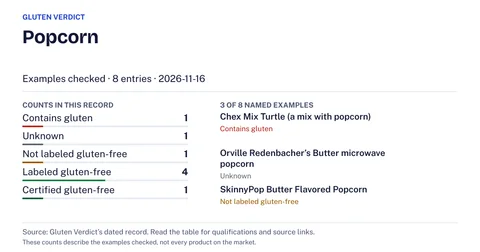 PopcornNaturally gluten-free1 of 8 products we checked contains gluten: Chex Mix Turtle (a mix with popcorn)checked Nov 16, 2026
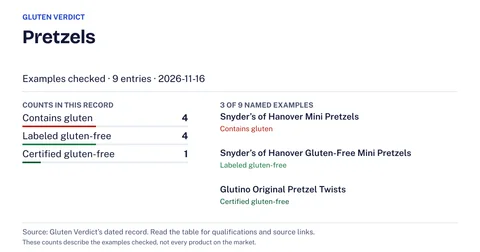 PretzelsDepends on the product4 of 9 products we checked contain glutenchecked Nov 16, 2026
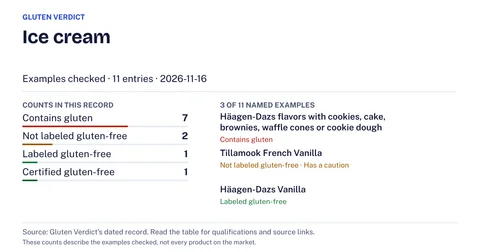 Ice creamDepends on the product7 of 11 products we checked contain glutenchecked Nov 16, 2026
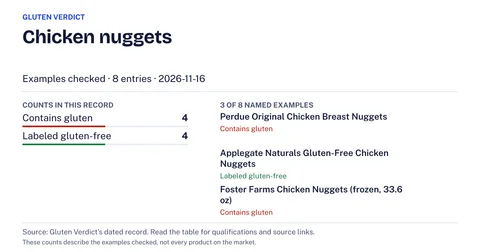 Chicken nuggetsDepends on the product4 of 8 products we checked contain glutenchecked Nov 16, 2026
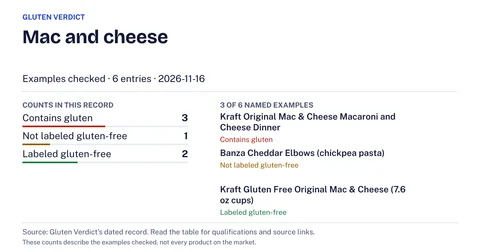 Mac and cheeseContains glutenchecked Nov 16, 2026
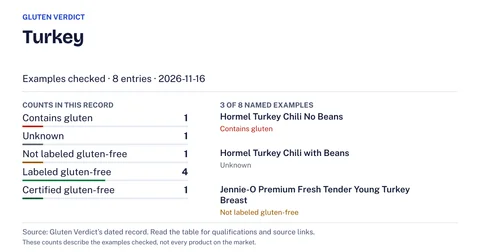 TurkeyNaturally gluten-free1 of 8 products we checked contains gluten: Hormel Turkey Chili No Beanschecked Nov 16, 2026
Questions people ask
Do I have to email Disney before my trip for a gluten-free meal?
Disney’s page asks you to contact its Special Diets team in advance if you have 4 or more allergy-friendly requests, need pureed meals or follow a medically restrictive diet5. For other requests, the page says to tell the Cast Member assisting with your order1.
Can Disney cook or heat food I bring from home?
No. Disney says its chefs and other Cast Members may not store, prepare, cook, heat or reheat food items that guests bring16.
Does Disney consider “may contain” warnings for its allergy-friendly menus?
No. Disney says it does not reference precautionary statements such as “may contain” or “made on shared equipment” when it evaluates ingredients for those menus10.
Can a cart or kiosk make an allergy-friendly meal?
Disney says many carts and kiosks do not have allergy-friendly menus; for some items you can ask to see the packaging, and it recommends table-service restaurants for special dietary requests11, 12.
Do the paper straws at Disney World contain gluten?
Disney says the paper straws currently used at its owned-and-operated food and beverage locations are not made with ingredients containing gluten, and adds that products can change at any time23.
More in Travel planning and logistics
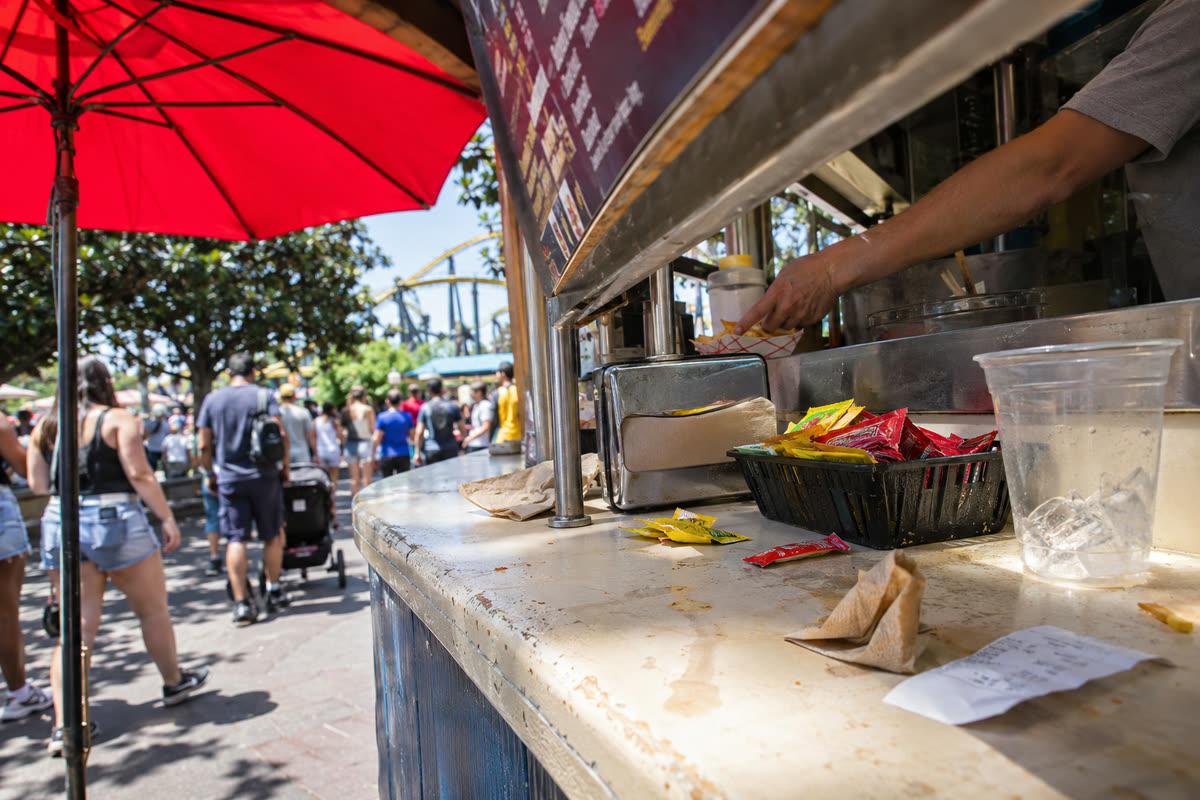 Gluten-free at US theme parks outside Walt Disney World: what each park publishesWhat Universal, Disneyland, SeaWorld, Busch Gardens, Cedar Point and Knott’s each publish about food allergies and gluten, and what to ask.
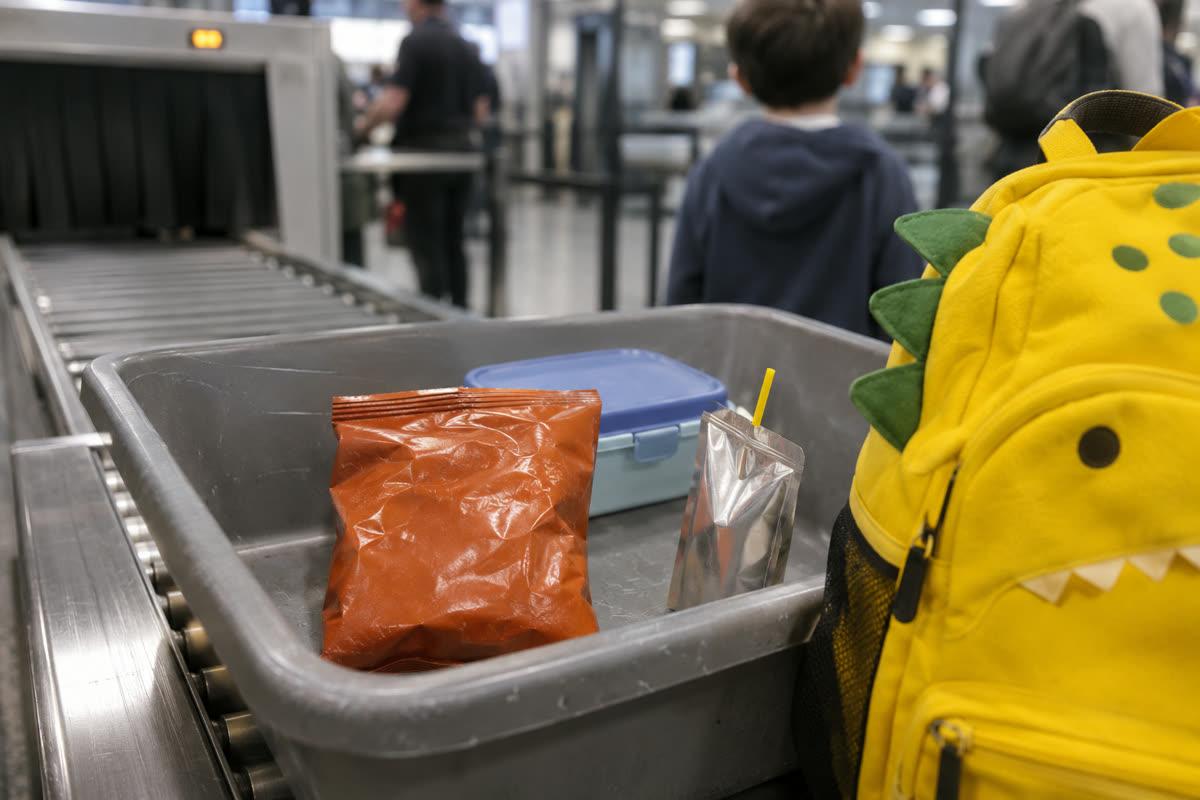 Traveling with a gluten-free child: TSA’s rules for children’s food and what to packWhat TSA says about a child’s food and screening, how to pack the snack bag, and how to brief the adults who will feed a gluten-free child.
 Gluten-free airline meals: what each airline’s own page says and how to request oneWhat Delta, American, Air Canada, Qantas, Virgin Atlantic and JetBlue say on their own pages about gluten-free meals: where to ask and by when.
 Gluten-free cruising: request channels, notice windows and port daysHow six cruise lines take a gluten-free request, the notice each page states, and what to plan around for buffets, snacks and port days.
 Gluten-free on long-distance trains and buses: your own food, onboard menus and stopsWhat Amtrak, Greyhound and FlixBus say about your own food, gluten-free meals and stops, and how to pack for a long train or bus day.
 Gluten-free dining at national park lodges: what to ask and what to packHow national park lodge dining works on a gluten-free diet: what each operator's own page says, what to send before you arrive, and what to pack.
Related guides
 Eating out with celiac disease: what to check, ask and watch forPlan a restaurant meal with celiac disease: what to check before you go, the questions to ask in order, how to read the answers, and what studies measured.
 Planning a gluten-free trip: what to arrange, in orderA gluten-free trip in order: how you will eat, what to tell hotels and airlines, which cards and notes to carry, and what food to pack.
 Gluten-free travel packing checklist by trip typeWhat to pack for a flight, hotel, rental kitchen or road trip, with TSA and airline limits and what sensors and enzyme pills do not show.
 A gluten-free kid at a birthday party: the host text, the cake knife and the snack tableA parent’s plan for a celiac child at a party or sleepover: the host text, own food, cake and snack-table cross-contact, and hand washing.
Sources
- [1, 2, 3, 4, 5, 6, 7, 8, 9, 10, 11, 12, 13, 14, 15, 16, 17, 18, 22, 23, 35] Walt Disney World Resort, Special Dietary Requests, checked Nov 17, 2026.
Read on 2026-11-17: under the heading “Less Common Allergy or Intolerance Requests”, the page says table-service and quick-service restaurants “will do their best to accommodate” requests for meals prepared without a food or ingredient that is not one of the most common allergies, and its examples list gluten, lactose, corn, citrus, nightshades and MSG.
Read on 2026-11-17: the page names no dedicated-fryer or grill practice for any restaurant, gives no parts-per-million or other gluten limit, and names no individual park snack such as churros, funnel cake, french fries, corn dogs, chicken nuggets, mac and cheese, popcorn, pretzels or turkey legs; its only named frozen items are ice cream bars and frozen lemonade, in the answer about carts and kiosks.
- [19, 20, 21, 36] Walt Disney World Resort, Mobile Food and Beverage Ordering, checked Nov 17, 2026.
Read on 2026-11-17: the page describes choosing a location, setting an arrival time, choosing and paying for items, tapping “I’m Here, Prepare My Order” and picking up at the counter; it names no allergy or gluten option.
- [24, 25] US Food and Drug Administration, Gluten and Food Labeling, checked Nov 17, 2026.
- [26] eCFR, 21 CFR 101.91, Gluten-free labeling of food, checked Nov 17, 2026.
- [27, 28, 29, 37] Gluten Intolerance Group, What are some of the most important questions to ask the wait staff or management of a food service or restaurant?, checked Nov 17, 2026.
- [30, 31, 32] Gluten Intolerance Group, Questions to Ask When Eating Out, checked Nov 17, 2026.
Read on 2026-11-17: under the heading “Quick Red Flags and When to Walk Away”, the page advises considering eating elsewhere or sticking to pre-packaged, pre-verified items on hearing or seeing: staff saying “A little bit of gluten won’t hurt, right?”; kitchen staff refusing or acting hesitant to check ingredient labels on packaged sauces or mixes; and confirmation that gluten-free foods share cooking oil or grill spaces with heavily breaded items.
- [33, 34, 38] PubMed (American Journal of Gastroenterology), Detection of Gluten in Gluten-Free Labeled Restaurant Food: Analysis of Crowd-Sourced Data, checked Nov 17, 2026.