Traveling with a gluten-free child: TSA’s rules for children’s food and what to pack
Short answer
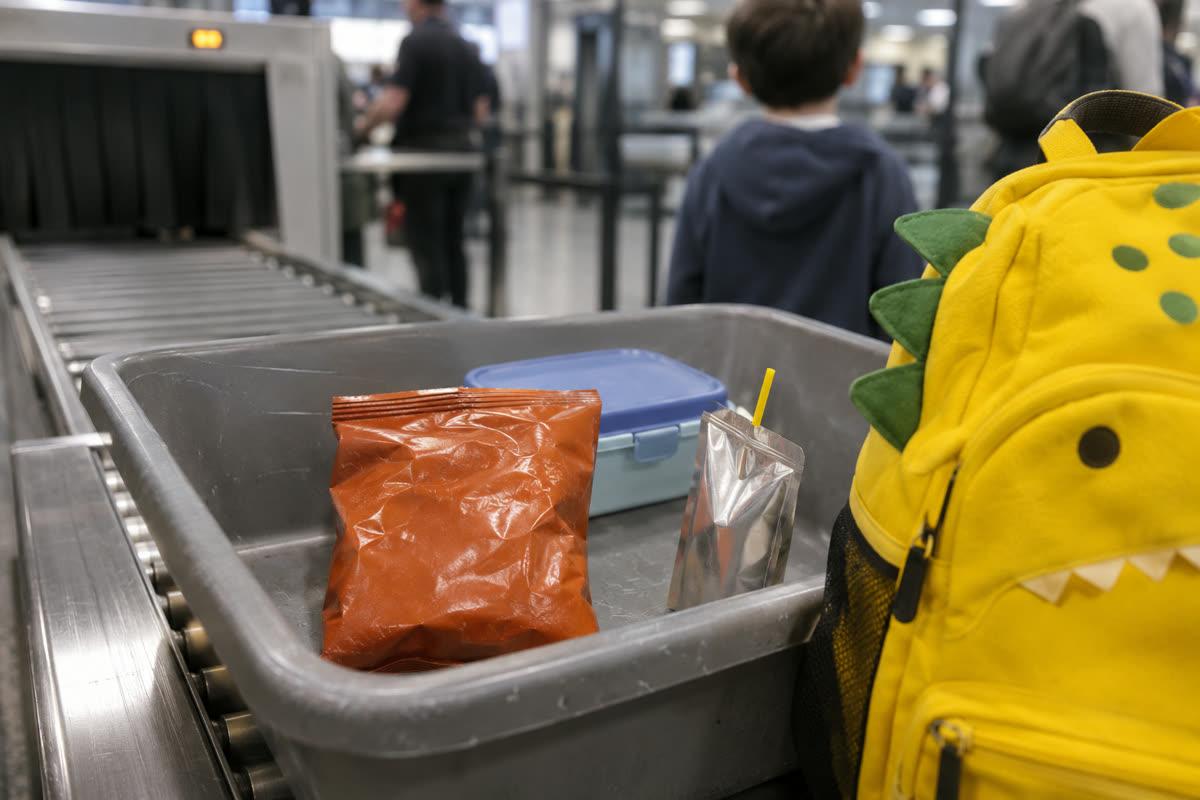
Pack the child’s food yourself: TSA lets formula, toddler drinks and baby or toddler food, puree pouches included, exceed 3.4 ounces in a carry-on1, and solid food goes in carry-on or checked bags2. The TSA pages we read do not name celiac disease, and the liquids page lists “infant and child nourishments” without detail3, 4, so the child travels on the food in your bag.
- At the checkpoint, tell the officer at the start if you carry formula, toddler drinks or baby or toddler food over 3.4 ounces, and take it out of the bag5. Tell the officer too if the child has a medical condition6.
- Pack solid food; liquid or gel food over 3.4 ounces outside those groups belongs in a checked bag if possible2.
- Read each label again before the child eats it: on a food FDA regulates, a gluten-free claim is voluntary and means less than 20 parts per million7, 8.
- Ask the airline about a meal when you book, and carry backup food anyway9, 10.
- Tell every adult who will feed the child before you go, in a note of your own.
Part of Travel planning and logistics, 22 guides
Key points
- TSA applies modified screening to children who appear 12 or younger and standard screening from 1311, 12.
- Formula, toddler drinks and baby or toddler food over 3.4 ounces may go in a carry-on1; the liquids page lists “infant and child nourishments” as an exemption without detail4.
- None of the TSA pages we read mentions celiac disease or a doctor’s note; the Celiac Disease Foundation suggests a note3, 13.
- In the US, on a food FDA regulates, a gluten-free claim is voluntary and means less than 20 parts per million, so read the label each time7, 8.
- The Gluten Intolerance Group says many young children cannot say they feel ill, so the adults who feed them need your plan14.
What TSA publishes for children
TSA says every passenger is screened, with modified procedures for children who appear to be 12 or younger11. Standard procedures apply from 13 on12, which matters for the teen in your group.
For a child with a medical condition, TSA’s children’s page tells you to inform the officer6. For questions before the trip it points to TSA Cares, which it asks you to call 72 hours ahead15.
What the page does not do is name celiac disease, gluten or a doctor’s note: its text contains none of those words3, and neither does TSA’s food page16. The Celiac Disease Foundation, writing for travelers of any age, suggests getting a doctor’s note for “medical foods”13. That is the charity’s suggestion; we found no TSA page that requires one.
Which of the child’s food goes through security
TSA’s pages sort a child’s food into a few groups. Its Food page adds that the final decision on whether an item is allowed rests with the TSA officer17.
| Food | What TSA’s pages say |
|---|---|
| Formula, breast milk, toddler drinks, baby or toddler food (puree pouches included) | More than 3.4 ounces (100 milliliters) is allowed in a carry-on and need not fit the quart bag1. Tell the officer at the start and take these items out of the bag for separate screening5. |
| Ice packs and gel packs for those items | Allowed in a carry-on; partially frozen or slushy ones get the same screening18. |
| Baby food | TSA’s Baby Food page allows it in reasonable quantities in carry-on bags19. |
| Solid food | Carry-on or checked bags2. |
| Liquid or gel food that is not in the groups above | TSA says liquid or gel food larger than 3.4 ounces is not allowed in carry-on bags and should go in checked bags if possible2. The ordinary limit is a quart-sized bag of containers of 3.4 ounces or less20. |
| An older child’s drink or pouch | TSA’s liquids page lists “Infant and child nourishments” as an exemption without detail4. TSA’s FAQ page names juice alongside formula and breast milk21, while TSA’s Baby Formula page says “toddler drinks”1. If your child’s drink does not clearly fit, ask before you travel: AskTSA answers questions every day of the year22. |
If you would rather the formula, toddler drinks or baby food not be X-rayed or opened, TSA says to tell the officer, and that extra screening steps follow23.
Building the snack bag
Read every label again on the trip. In the US, a “gluten-free”, “no gluten”, “free of gluten” or “without gluten” claim on a food FDA regulates means less than 20 parts per million of gluten8. The claim is voluntary7, so a plain food without it may still have none24. NIDDK’s advice for people with celiac disease: read food labels for wheat, barley, rye and ingredients made from them25, and do not eat a food when you are not sure it is gluten-free; if possible, contact the maker26.
Carry more than you expect to need. The Celiac Disease Foundation advises non-perishable backup food in case you are somewhere without gluten-free options10, and the Gluten Intolerance Group suggests small, shelf-stable snacks at all times27. Its cooler list names plain yogurt, aged cheese, hard-boiled eggs, hummus and more28; it is a general travel list that does not mention children, so check each label yourself.
Our verdict pages show what the makers’ own pages said when we read them. They are dated snapshots, and recipes change, so the package in the child’s hand has the final word.
| Food | What our page covers |
|---|---|
| Goldfish | The versions we read and what each maker’s page says about gluten. |
| Crackers | Which flour each cracker uses and which makers claim gluten-free. |
| Pretzels | Regular and gluten-free pretzels, with the ingredient lists we read. |
| Cheerios | What General Mills says about its oats and its gluten-free claim. |
| Granola bars | Oats are the question; the bars whose makers call them gluten-free are named. |
| Popcorn | Plain compared with flavored and mixed popcorn. |
| Chicken nuggets | The breading decides it; nuggets whose makers call them gluten-free are named. |
| Mac and cheese | Wheat pasta boxes and the versions that say gluten free. |
For anything with oats, NIDDK’s advice is that if you do eat oats, make sure they are gluten-free29. For a child who is learning the labels, see teaching a child to read gluten-free labels and lunchbox swaps.
On the flight
The Celiac Disease Foundation says to request a gluten-free meal when you book and to confirm with the airline at check-in9. The Gluten Intolerance Group adds that not all airlines offer gluten-free food30 and that most require a special meal to be pre-ordered 24-72 hours ahead31.
A child’s meal can be a separate request from a diet meal. On Qantas’s page, baby and child meals are not added automatically and must be requested32, and for a child on a specific diet it says you may wish to request one of the other options on the page instead33. That is one airline’s page; another airline may work differently, so read its own page. Our guide to what each airline’s own page says is the place to start.
Qantas also welcomes food brought on board for dietary needs or suitable for children, subject to local screening rules, and says it cannot refrigerate or heat it34. Whatever the airline, pack the child’s food: it is the only food you have read. More in flying gluten-free, food through TSA and airport dining.
Car days and hotel nights
For a car day, the Gluten Intolerance Group’s cooler list is a starting point28. For the room, the Celiac Disease Foundation says to call the hotel and ask whether the room has a refrigerator and microwave35. The Gluten Intolerance Group points to a vacation rental with a kitchen as one way family meals stay routine36.
More detail: a gluten-free road trip, the hotel breakfast buffet, all-inclusive resorts and cruises.
Telling the adults who will feed the child
Relatives, a hotel kids’ club or a babysitter will not know what you know. The Gluten Intolerance Group’s guide for preschool and childcare, written for caregivers of young children, makes these points:
- Other children should not “feed” the gluten-free child or put hands in the child’s mouth or on their food37.
- The child’s snacks and meals should be prepared before others’, or at least with fresh gloves38.
- Many young children cannot say they feel ill and will not mention a cracker eaten off the snack table, so the group says adults are the child’s advocates14.
NIDDK defines cross-contact as foods or products that contain gluten coming into contact with gluten-free foods39, and advises keeping gluten-free food prepared and stored separately from other family members’ food40. For a gathering, NIDDK says to let the host know about the diagnosis and ask whether gluten-free food will be available41. The Gluten Intolerance Group suggests checking in with the host about food options or offering to bring a gluten-free dish42. See also a gluten-free kid at a birthday party.
The Gluten Intolerance Group offers letter templates to explain a child’s restrictions to a teacher or other responsible adult at school43. For a trip, a short note of your own does the same job.
A note for other caregivers (our template, not a source’s)
Write it in your own words, one page at most, and put the following in it:
- The child’s name, age and a one-sentence description of the diet.
- That the child eats only food from the bag you packed, and nothing else without a call to you.
- Who to call, with a phone number that works at the destination.
- What to do when unsure: ask, do not guess.
- Where the child’s food is kept, and that it is prepared before anyone else’s, with clean hands and utensils.
Older children and teens
From 13, TSA applies standard screening procedures12, so the teen is screened as an adult is. Decide before you leave who reads each label on the road.
The Gluten Intolerance Group’s party advice for teens is to practice polite ways to ask what is in the food or where it was prepared44, and for parents to help pack gluten-free snacks or a meal together45. For a restaurant meal, NIDDK says to tell the server about celiac disease and ask about ingredients, preparation and a gluten-free menu46.
If the wrong food is eaten away from home
This guide gives no treatment advice. FDA says people who think a food made them ill, including people with celiac disease, should first seek appropriate medical care and afterward contact FDA47. NIDDK says a doctor or a registered dietitian can guide what to eat and drink48.
Verdicts in this guide
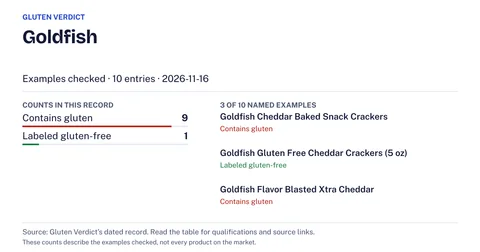 GoldfishContains glutenPepperidge Farm · checked Nov 16, 2026
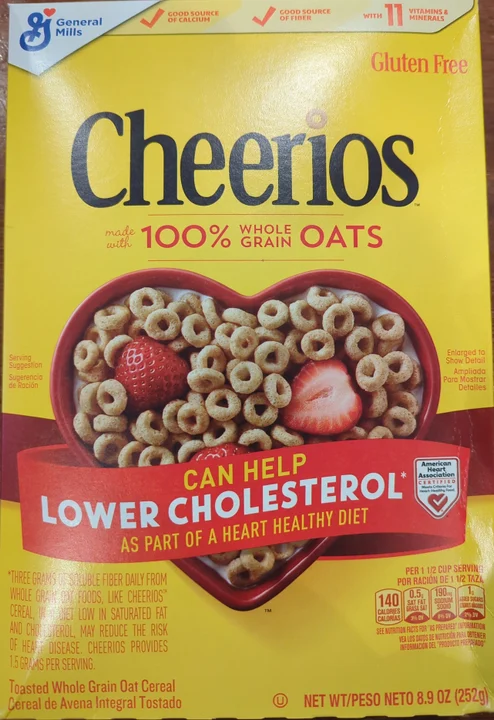 CheeriosLabeled gluten-freeWheat warning on 1 of 8 varieties we checkedGeneral Mills · checked Nov 16, 2026
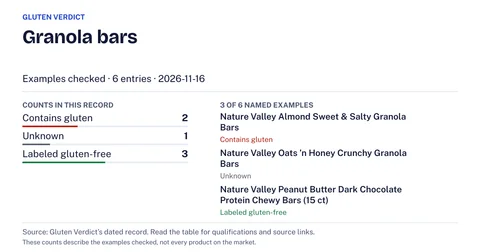 Granola barsDepends on the product2 of 6 products we checked contain gluten: Nature Valley Almond Sweet & Salty Granola Bars and Nature Valley Cinnamon Brown Sugar Soft-baked Oatmeal Squareschecked Nov 16, 2026
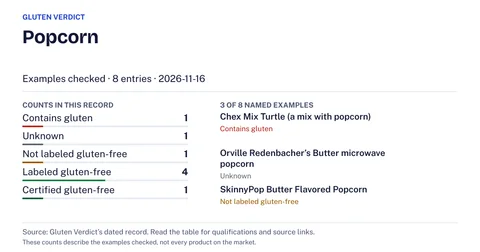 PopcornNaturally gluten-free1 of 8 products we checked contains gluten: Chex Mix Turtle (a mix with popcorn)checked Nov 16, 2026
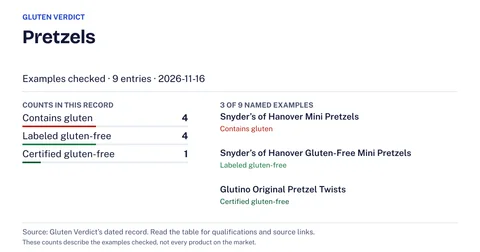 PretzelsDepends on the product4 of 9 products we checked contain glutenchecked Nov 16, 2026
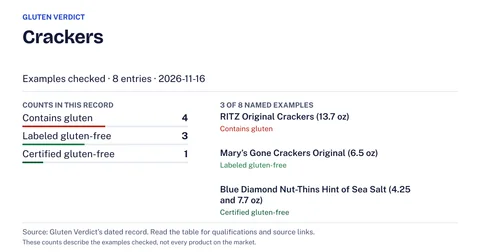 CrackersDepends on the product4 of 8 products we checked contain glutenchecked Nov 16, 2026
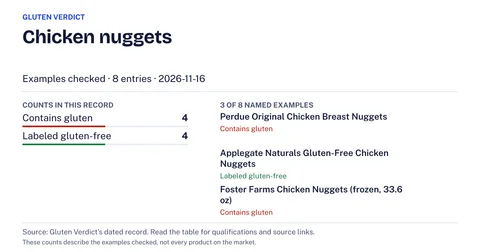 Chicken nuggetsDepends on the product4 of 8 products we checked contain glutenchecked Nov 16, 2026
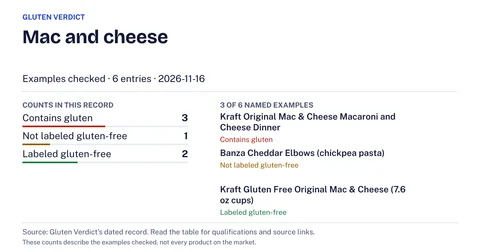 Mac and cheeseContains glutenchecked Nov 16, 2026
Questions people ask
Can I bring a child’s gluten-free snacks through TSA?
Solid food can go in a carry-on or checked bag2. Formula, toddler drinks and baby or toddler food over 3.4 ounces are allowed in a carry-on1. For other liquid or gel food over 3.4 ounces, TSA’s Food page says to use checked bags if possible2, and that the final decision rests with the officer17.
Do I need a doctor’s note?
The TSA pages we read do not mention one3. The Celiac Disease Foundation suggests a note for “medical foods”13.
Are puree pouches allowed?
TSA’s Baby Formula page names baby or toddler food, puree pouches included, as allowed over 3.4 ounces in a carry-on1.
Does a child’s airline meal count as gluten-free?
Qantas’s page lists child meals separately from its gluten intolerant meal and says a child with a specific diet may wish to request one of the other options instead33. Check the airline you fly.
Should I tell the TSA officer my child has celiac disease?
TSA’s children’s page says to inform the officer if the child has a medical condition6.
More in Travel planning and logistics
 Gluten-free food through TSA security: what carries on and what goes in a checked bagWhich gluten-free foods go in a carry-on or checked bag under TSA’s own pages, and how the 3.4-ounce liquid limit applies to spreads, soups and dips.
 Gluten-free travel packing checklist by trip typeWhat to pack for a flight, hotel, rental kitchen or road trip, with TSA and airline limits and what sensors and enzyme pills do not show.
 Gluten-free on long-distance trains and buses: your own food, onboard menus and stopsWhat Amtrak, Greyhound and FlixBus say about your own food, gluten-free meals and stops, and how to pack for a long train or bus day.
 Gluten-free at US theme parks outside Walt Disney World: what each park publishesWhat Universal, Disneyland, SeaWorld, Busch Gardens, Cedar Point and Knott’s each publish about food allergies and gluten, and what to ask.
 Eating gluten-free at Walt Disney World: what Disney’s special-diets page says and how to use itHow to ask for a gluten-free meal at Walt Disney World through Disney’s own special-diets process, with a script and what Disney says it cannot promise.
 Gluten-free airline meals: what each airline’s own page says and how to request oneWhat Delta, American, Air Canada, Qantas, Virgin Atlantic and JetBlue say on their own pages about gluten-free meals: where to ask and by when.
Related guides
 Flying gluten-free: what to arrange, pack and ask, from booking to landingA gluten-free flight in order: the airline's special-meal request, what TSA allows through the checkpoint, and the food to carry as a backup.
 Gluten-free on a road trip: stops, snacks, cooler and hotel nightsPlan each driving day: chain stops with dated verdicts, snacks read at the gas station, a cooler packed to USDA time limits and hotel fridge questions.
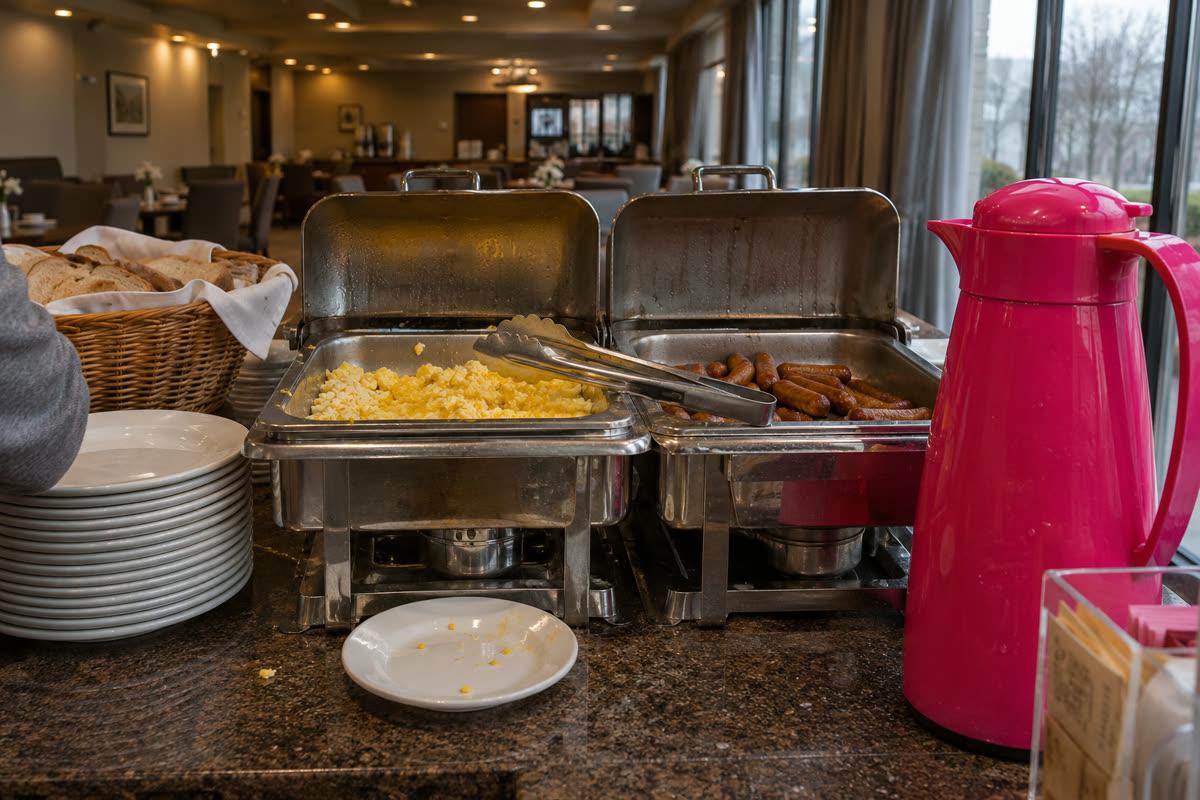 Gluten-free hotel breakfast: what to email ahead and what to ask at the buffetA hotel breakfast buffet can mean shared utensils, toasters and waffle irons. What to write the hotel before you arrive, and what to ask at each station.
 A doctor’s letter or travel card for celiac disease: what TSA, airlines and customs sayWhether to carry a doctor’s letter or a card when flying, crossing a border or booking a cruise, with what TSA, airline and customs pages say.
Sources
- [1, 5, 18, 23] Transportation Security Administration, Baby Formula, checked Nov 17, 2026.
- [2, 16, 17] Transportation Security Administration, What Can I Bring? Food, checked Nov 17, 2026.
Read on 2026-11-17: the page lists 59 food items; none of its text mentions gluten, celiac disease, a diet, an allergy or a doctor’s note.
- [3, 6, 11, 12, 15, 22] Transportation Security Administration, Traveling with Children, checked Nov 17, 2026.
Read on 2026-11-17: the page covers modified screening for children, medical conditions, TSA Cares, and formula, breast milk, toddler drinks and baby/toddler food; its text does not contain the words gluten, celiac, diet, allergy or doctor.
- [4, 20] Transportation Security Administration, Liquids, Aerosols and Gels Rule, checked Nov 17, 2026.
Read on 2026-11-17: the list headed “Exemptions” names Medications, Infant and child nourishments, and Inbound International Flights; the page gives no further detail on infant and child nourishments.
- [7, 8, 24, 47] US Food and Drug Administration, Gluten and Food Labeling, checked Nov 17, 2026.
- [9, 10, 13, 35] Celiac Disease Foundation, Tips for Traveling Gluten-Free, checked Nov 17, 2026.
- [14, 37, 38] Gluten Intolerance Group, Pre-School, Childcare, and Gluten Risks, checked Nov 17, 2026.
- [19] Transportation Security Administration, Baby Food, checked Nov 17, 2026.
- [21] Transportation Security Administration, Is Breast Milk, Formula and Juice exempt from the 3-1-1 liquids rule?, checked Nov 17, 2026.
- [25, 26, 29, 39, 40, 41, 46, 48] NIDDK (NIH), Eating, Diet, & Nutrition for Celiac Disease, checked Nov 17, 2026.
- [27, 36] Gluten Intolerance Group, Traveling Gluten-Free with Confidence, checked Nov 17, 2026.
- [28, 30, 31] Gluten Intolerance Group, Traveling Gluten-Free (educational bulletin), checked Nov 17, 2026.
- [32, 33, 34] Qantas, Dietary required meals, checked Nov 17, 2026.
- [42, 44, 45] Gluten Intolerance Group, Supporting Gluten-Free Kids at Parties, checked Nov 17, 2026.
- [43] Gluten Intolerance Group, School Letters, checked Nov 17, 2026.