Gluten-free at Meijer: Meijer-brand packs, True Goodness and the pharmacy aisle
Short answer
A Meijer trip puts four kinds of product in your basket, and each follows a different rule:
- Packaged food that FDA regulates: a “gluten-free” claim is voluntary, and where it appears it means FDA’s definition, including less than 20 parts per million of gluten6, 7.
- Dietary supplements: FDA’s gluten-free rule and the allergen labeling law both include them5, 13.
- Medicines: FDA’s gluten-free rule applies only to the labeling of foods, and FDA’s enforcement of the allergen law does not include drugs, so read the Drug Facts label, the Description section or DailyMed11, 13, 24.
- Unpackaged counter and bulk-bin food: FDA’s gluten-free rule applies to packaged foods, so these need questions rather than a label12, 33.
Part of Store guides: regional supermarket chains, 15 guides
Key points
- On a packaged food FDA regulates, a “gluten-free” claim has to meet FDA’s definition, and the claim is voluntary5, 6.
- The True Goodness page we read lists what the line is free from, and the word “gluten” does not appear on it1.
- Meijer’s gluten-free collection page (a direct request was refused; a second reader returned it on 2026-11-17) is headed “Gluten Free (6,276)” and lists many products whose titles do not use the words “gluten free”4.
- FDA’s gluten-free rule and the allergen law both include dietary supplements5, 13; FDA’s gluten-free rule applies only to the labeling of foods, and FDA’s enforcement of the allergen law does not include drugs11, 13.
- FDA’s gluten-free rule applies to packaged foods; FDA says it will monitor reports about unpackaged food12.
What Meijer says about gluten, and what we could not read
Meijer’s community site describes True Goodness® by Meijer® as a line in which every product is free from more than 100 unwanted ingredients2. It then lists six things customers can expect1: no high fructose corn syrup or artificial sweeteners, no hydrogenated oils, no artificially derived food colorings, no artificial food flavorings, no artificial preservatives, and no antibiotics or steroids in the raising of its meats and seafood. The word “gluten” does not appear on the page1.
The page points to a longer list of the 100+ ingredients on meijer.com1. That page refused our request on 2026-11-17, both directly and through a second reader, so we could not read it3. Meijer’s own gluten-free collection page also refused a direct request, but opened through the second reader. It is headed “Gluten Free (6,276)” and lists many products, among them Meijer Hardwood Smoked Bacon, Meijer Granulated Sugar and Meijer Baking Soda, whose titles do not use the words “gluten free”4. The text we read states nothing about how products are chosen for the collection, so this guide says nothing about that.
We read no statement on the collection page or the True Goodness page about what a listing or a brand name means for gluten. Look for the words “gluten-free” on the pack itself.
How to read a Meijer-brand pack, in order
- The claim. “Gluten-free” is voluntary. FDA treats “free of gluten”, “without gluten” and “no gluten” the same way, so a pack using any of the four has to meet the same rule6, 8.
- The Contains line or the parentheses. The allergen law names wheat among the major food allergens; barley and rye are not on that list14. The source is shown either in a “Contains” statement printed next to the ingredient list17 or in parentheses after the ingredient18.
- The full ingredient list. Because barley and rye do not appear in a Contains line, read the whole list. Our guide to reading food labels covers the names to stop on.
- Any may-contain line. Advisory statements such as “produced in a facility that also uses [allergen]” are not required by law16, and one may sit beside a gluten-free claim when it is truthful and not misleading9.
A claim on one product says nothing about the rest of a range. FDA states that a manufacturer using the claim on some of its foods does not make every food it makes gluten-free10. That is worth remembering with a line such as True Goodness: check each pack.
Food, supplements and medicines: which rule applies
| What you buy | FDA’s gluten-free rule | Allergen labeling law | Where the ingredients are |
|---|---|---|---|
| Packaged food | Applies to FDA-regulated packaged foods5 | Enforced in most packaged food13 | The ingredient list and Contains line on the pack17 |
| Dietary supplement | Dietary supplements are named among the foods it covers5 | Dietary supplements are included13 | The Supplement Facts panel, and an “Other Ingredients” list when the maker has one19, 20 |
| Medicine | Applies only to the labeling of foods11 | Drugs are not in what FDA enforces it on13 | Nonprescription: “inactive ingredients” on the Drug Facts label. Prescription: the “Description” section. Both can be looked up on DailyMed24 |
So FDA’s gluten-free claim rule covers a supplement as it covers food5, but its rule applies only to the labeling of foods, which leaves medicine labels to the lookup above11, 24.
Checking a medicine or supplement
FDA says the majority of orally administered drug products either contain no gluten or virtually no gluten21. For the very rare cases where gluten may be present, FDA estimates from drug formulation information that wheat starch and other wheat-derived ingredients would contribute no more than 0.5 mg of gluten to a unit dose of an oral drug product22. FDA’s page carries a 2017 date23.
For the lookup itself, FDA says nonprescription ingredients are on the Drug Facts label and prescription ingredients are generally in the Description section24. DailyMed can be searched by drug name, NDC code, manufacturer name, drug class or SET ID28, and the NDC code is on the outside of the packaging29. FDA’s caution is to check that the label you are reading matches the product, including its name and its manufacturer or distributor25.
FDA states that if a drug’s ingredient list does not mention wheat gluten or wheat flour, the product should not contain gluten in an amount that would harm a typical (non-refractory) individual with celiac disease26. FDA’s draft guidance also recommends a statement makers may print when it is truthful and properly supported: “Contains no ingredient made from a gluten-containing grain (wheat, barley, or rye)”27. The Gluten Intolerance Group notes the draft is not a requirement31.
For supplements, the Gluten Intolerance Group says gluten is not a common ingredient in medications but is more prevalent in supplements30. That is why a supplement gets the full food-label check first: a claim, then the Supplement Facts panel and any Other Ingredients list. When in doubt about a medication, the group’s advice is to consult a pharmacist and/or check with the manufacturer32.
Bakery, deli and bulk bins
FDA’s gluten-free rule applies to packaged foods. For unpackaged food, FDA says it will monitor reports and share complaints with state and local partners12.
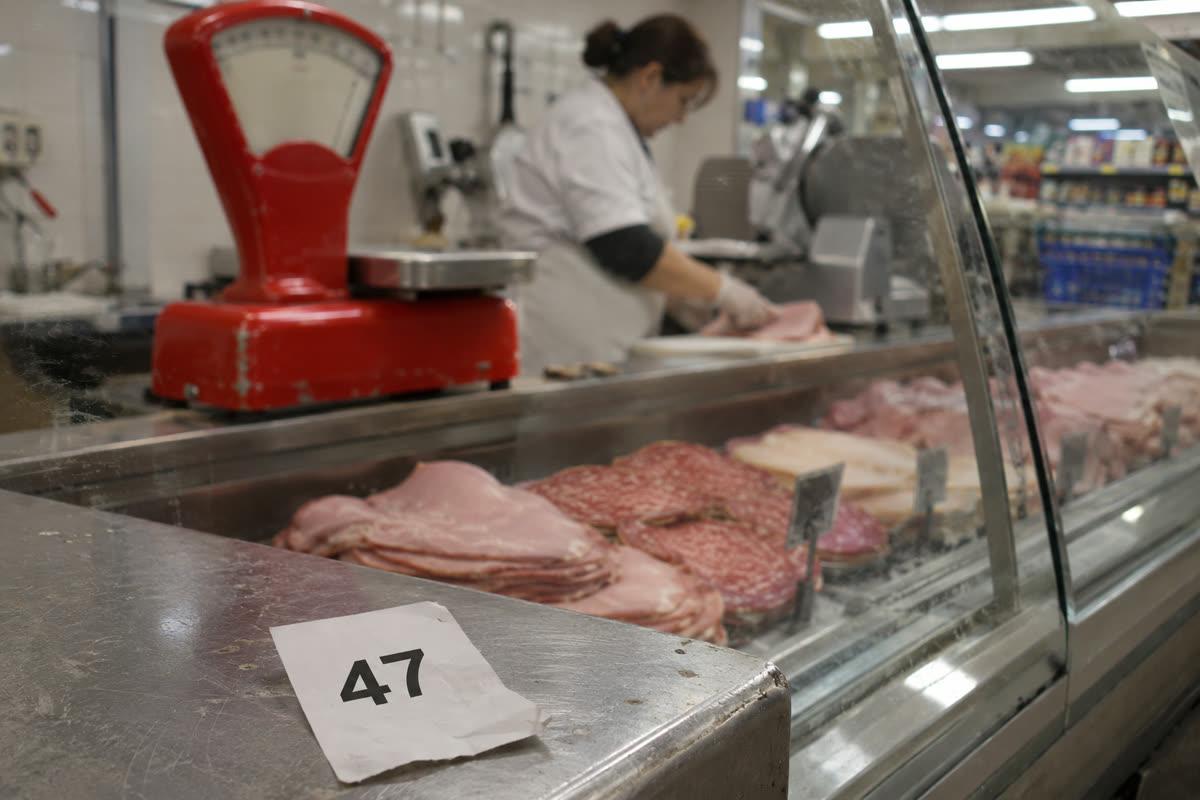
The allergen labeling law does reach a store’s own packaged items: its requirements extend to retail and food-service establishments that package, label and offer products, but not to food placed in a wrapper or container after a customer’s order15. So an item the store packages and labels ahead of time is covered; an item wrapped after your order is not.
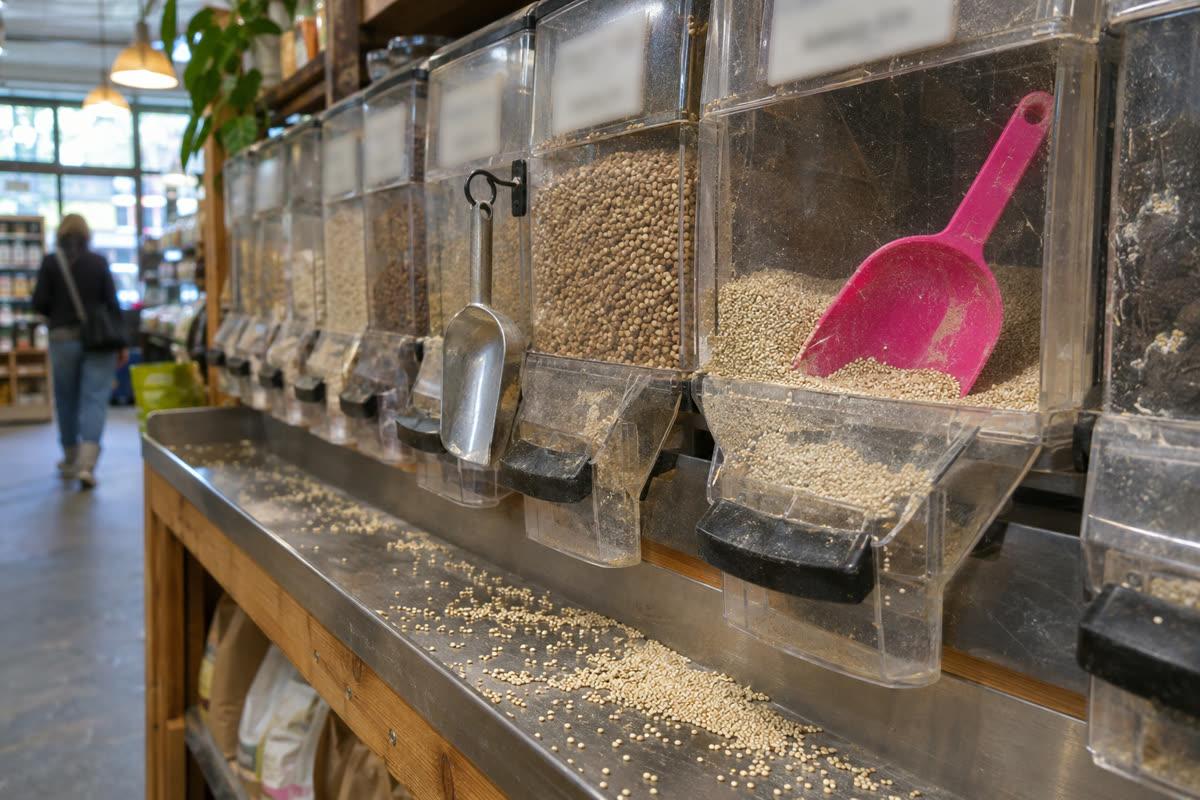
For bulk bins, the Gluten Intolerance Group advises staying clear: gluten-containing ingredients could linger on scoops or surrounding bins, leading to unavoidable cross-contact33.
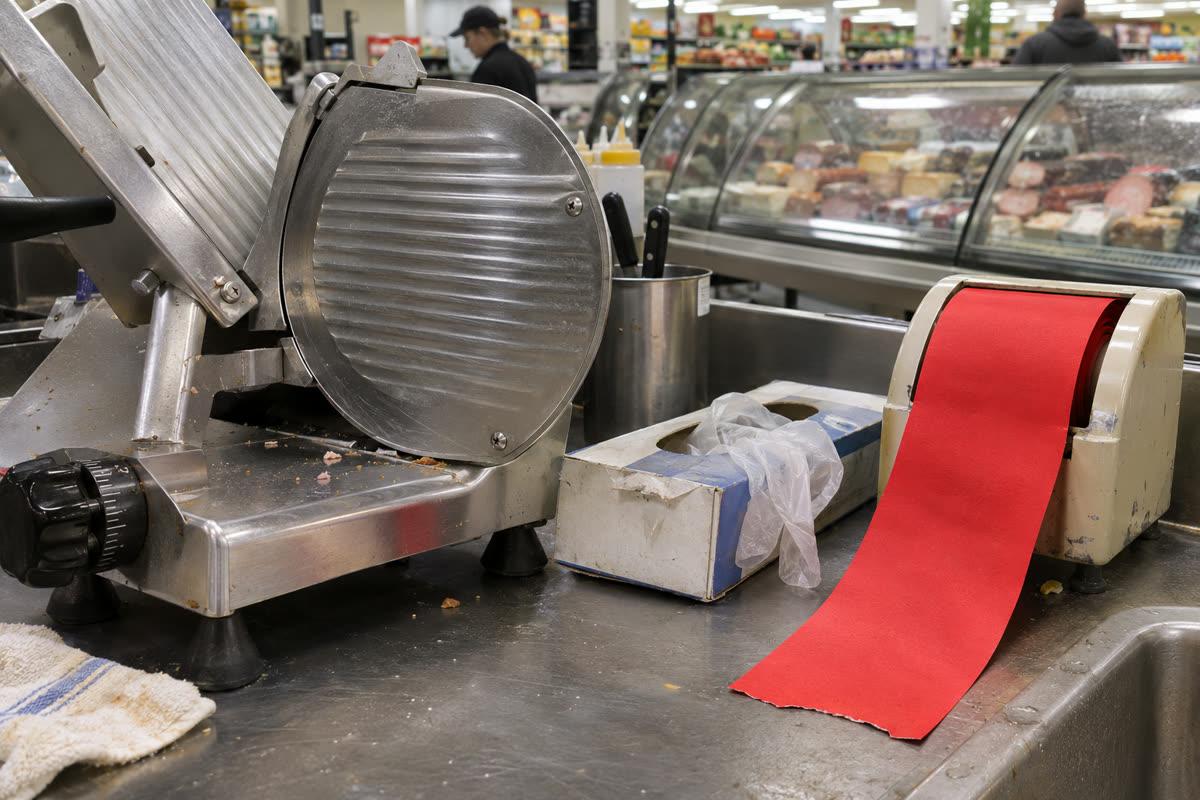
This guide cites no Meijer page on how its bakery, deli or bulk areas handle gluten. At a counter, ask what shares the slicer, the scoop or the surface. Our verdicts for deli meat and bread show what we found for those foods.
A first shop, aisle by aisle
| Where | What to check | Our verdict |
|---|---|---|
| Bread and tortillas | Look for a “gluten-free” claim on the pack6. Without one, read the Contains line and the full ingredient list, because barley and rye are not on the allergen list14. | Bread, tortillas |
| Cereal | Same order: claim, Contains line, full list6, 14. Cheerios is a brand-name example to compare a store-brand pack against. | Cereal, Cheerios |
| Deli counter | An item the store packages and labels ahead of time is covered by the allergen law; an item wrapped after your order is not15. | Deli meat |
| Pharmacy aisle | Supplements: the claim, then Supplement Facts and Other Ingredients19. Medicines: the Drug Facts label or DailyMed24. | No food verdict applies; see the rules above |
For a longer list, see our gluten-free grocery list. If you use pickup or delivery, read the label of any substitute at home: a substitute is a different product with its own label.
Verdicts in this guide
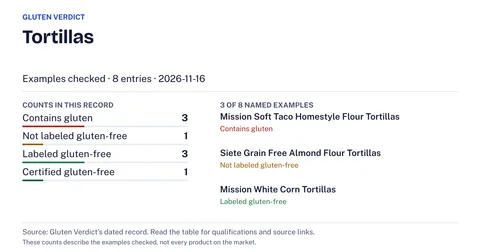 TortillasDepends on the product3 of 8 products we checked contain gluten: Mission Soft Taco Homestyle Flour Tortillas, Guerrero Riquisimas Soft Taco Flour Tortillas (24 ct), and Guerrero Corn and Wheat Tortillaschecked Nov 16, 2026
 BreadContains glutenchecked Nov 16, 2026
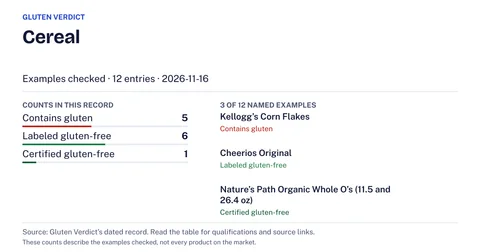 CerealDepends on the product5 of 12 products we checked contain glutenchecked Nov 16, 2026
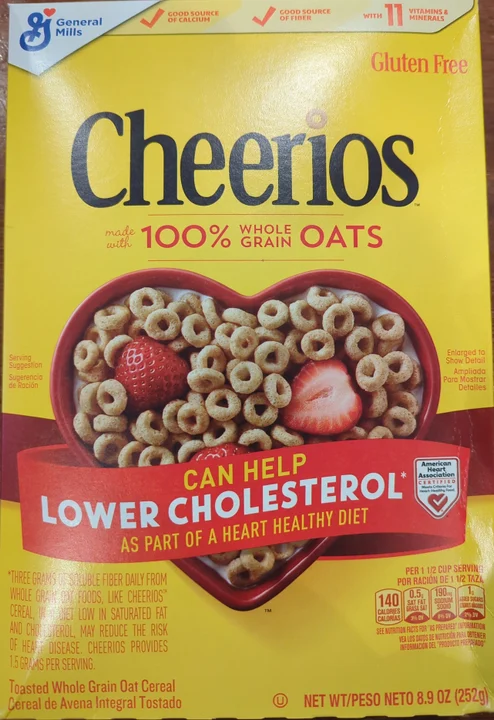 CheeriosLabeled gluten-freeWheat warning on 1 of 8 varieties we checkedGeneral Mills · checked Nov 16, 2026
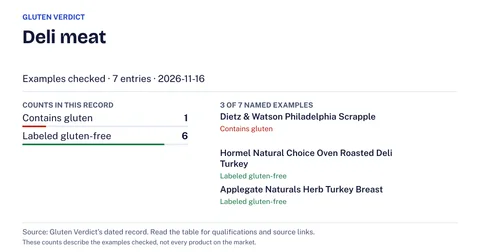 Deli meatDepends on the product1 of 7 products we checked contains gluten: Dietz & Watson Philadelphia Scrapplechecked Nov 16, 2026
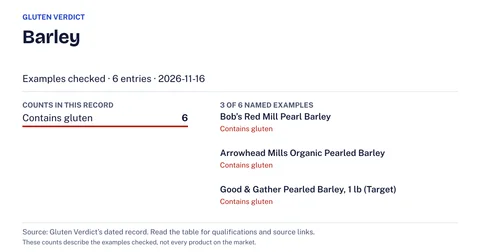 BarleyContains glutenchecked Nov 16, 2026
Questions people ask
Does True Goodness mean gluten-free?
The True Goodness page we read lists what the line is free from, and the word “gluten” does not appear on it1. Look for the “gluten-free” claim on the pack, which FDA defines7.
Does the allergen labeling law cover vitamins and medicines?
FDA says the law is enforced in most packaged food products, which includes dietary supplements and does not include drugs13.
Does FDA require a medicine to say whether it contains gluten?
FDA’s gluten-free rule only applies to the labeling of foods11. FDA has issued a draft guidance with a recommended statement27, and the Gluten Intolerance Group notes the draft is not a requirement31.
Does FDA’s gluten-free rule cover food from a deli or bakery counter?
FDA says its gluten-free rule applies to packaged foods; for unpackaged food it says it will monitor reported information and share complaints with state and local partners12.
More in Store guides: regional supermarket chains
 Gluten-free at Schnucks: the app filter, the counters and the pharmacyWhat the Schnucks Rewards app’s Gluten Free filter is built on, how to check a pack, and why the counters and pharmacy need their own checks.
 Gluten-free at Publix: the shelf icon, GreenWise packs, and the deli and bakery countersWhat Publix says about its gluten free icon, GreenWise packs and the Deli and Bakery, and what to ask at each counter before you order.
 Gluten-free at Stop & Shop and Giant: shelf tags, website highlights and own-brand packsWhat a gluten-free shelf tag or website highlight at Stop & Shop and Giant stands behind, how to read an own-brand pack, and a substitution checklist.
 Gluten-free at Kroger and Harris Teeter: reading own-brand packs and the counters the label rule does not coverHow to read a Kroger or Harris Teeter pack for gluten, what FDA's claim covers, and which counters sit outside it, with Kroger's own advice.
 Gluten-free at Food Lion: the shelf-tag symbol, own-brand claims and a first tripWhat Food Lion says about gluten: the shelf-tag symbol, Food Lion-brand claims, and a two-category first trip that leaves the counters for later.
 Gluten-free at ShopRite: check your branch, read the pack, ask at the countersHow to check a ShopRite branch’s gluten-free items online, read a Wholesome Pantry pack against FDA’s rule, and what to ask at the deli and bakery.
Related guides
 A gluten-free grocery list by aisle for US supermarketsAn aisle-by-aisle gluten-free grocery list for US stores: what needs no label, what needs a check, and what stays off the list.
 Store-brand gluten-free: what the tag, claim or seal rests onSort a store-brand item into certified, maker-stated or ingredient-only, see what each lets you conclude, and know what to ask the store.
 Deli, bakery and bulk-bin counters on a gluten-free dietFor each store counter (deli, bakery, bulk bins, bars): skip it, ask first, or buy the packaged item, and what a store’s own statement tells you.
 How to read a US food label for glutenWhere gluten shows up on a US food label: the gluten-free claim, the Contains line, the ingredient list and may-contain lines, and what each means.
Sources
- [1, 2] Meijer Community, True Goodness by Meijer, checked Nov 17, 2026.
Read on 2026-11-17: the page says what customers can expect from True Goodness products: no high fructose corn syrup or artificial sweeteners; no hydrogenated oils; no artificially derived food colorings; no artificial food flavorings; no artificial preservatives; and no antibiotics or steroids in the raising of its meats and seafood. The word “gluten” does not appear on the page.
- [3] Meijer, True Goodness: free-from list (meijer.com), checked Nov 17, 2026.
Tried to read this page on 2026-11-17 (the page the Meijer Community True Goodness page links to for its list of 100+ ingredients): a direct request and a request through Exa both answered “Access Denied”, so we read nothing from it.
- [4] Meijer, Gluten Free collection, checked Nov 17, 2026.
Read on 2026-11-17: a direct request answered “Access Denied” (HTTP 403), but the same URL opened through Exa. The page is headed “Gluten Free (6,276)” and lists products, among them “Lucky Charms Gluten Free Breakfast Cereal With Unicorn Marshmallows”, “BARILLA Gluten Free Penne Pasta, 12 Ounce”, “Meijer Hardwood Smoked Bacon, 16 oz”, “Meijer Granulated Sugar, 4 lbs” and “Meijer Baking Soda, 16 oz”. Many titles on the page do not contain the words “gluten free”. The text returned states nothing about how products are chosen for the collection.
- [5, 6, 7, 8, 9, 10, 11, 12] US Food and Drug Administration, Questions and Answers on the Gluten-Free Food Labeling Final Rule, checked Nov 17, 2026.
- [13, 14, 15, 16] US Food and Drug Administration, Food Allergies (FDA consumer page), checked Nov 17, 2026.
- [17, 18] US Food and Drug Administration, Food Allergen Labeling and Consumer Protection Act of 2004 (FALCPA), checked Nov 17, 2026.
- [19, 20] US Food and Drug Administration, Dietary Supplement Labeling Guide: Chapter V. Ingredient Labeling, checked Nov 17, 2026.
- [21, 22, 23, 24, 25, 26, 27] US Food and Drug Administration, Medications and Gluten, checked Nov 17, 2026.
Read on 2026-11-17: the page footer reads “Content current as of: 12/12/2017”.
- [28, 29] National Library of Medicine, DailyMed help, checked Nov 17, 2026.
- [30, 31, 32] Gluten Intolerance Group, Are Your Medications and Supplements Gluten-Free?, checked Nov 17, 2026.
- [33] Gluten Intolerance Group, 25 Ways Cross-Contact Could Happen (And How to Avoid It), checked Nov 17, 2026.