Alcohol and celiac disease: what a gluten-free label does and does not settle
Short answer
Whether a drink contains gluten is one question, and a label or a celiac charity's drink list speaks to it18, 10. Whether alcohol itself suits a person with celiac disease is a second question that neither answers4, 14, and NIDDK says a doctor or registered dietitian can guide what to eat and drink to maintain a balanced diet3.
Part of Drinks and alcohol, 18 guides
Key points
- NIDDK and the National Celiac Association pages we read cover whether drinks contain gluten but give no amount of alcohol for people with celiac disease4, 14.
- A “gluten-free” claim on alcohol is tied to FDA's definition of the term18; it is a statement about gluten, not about alcohol.
- NIAAA, writing for the general public, says alcohol can contribute to a ‘leaky gut’ and can damage the lining of the GI tract20, 21.
- Three studies on celiac disease and alcohol or beer each ask a narrower question than “how much is fine”, and none is a drinking guideline23, 26, 29.
- Symptoms after a drink do not point to gluten or to alcohol on their own: NIDDK says symptoms vary widely and lists look-alike conditions9, 7.
Two questions that get mixed together
Two things get mixed together here. One is a food question: is there gluten in this drink? The other is a health question: what does alcohol do for, or to, a person with celiac disease? A label, a certifier's list or a maker's statement can only help with the first.
On the first, NIDDK says drinks such as beer, lagers, ale, flavored liquors and malt beverages may contain gluten1, and that FDA's gluten-free rule does not apply to most alcoholic beverages, which fall under the Treasury Department2. The wording a bottle may carry is covered in our guide to gluten-free alcohol labels.
On the second, NIDDK's eating page says that a doctor or registered dietitian can guide what to eat and drink to maintain a balanced diet3. Its page does not say whether or how much alcohol a person with celiac disease may drink4, and neither does the National Celiac Association's alcohol page14. This page lays out what the sources do say, and does not fill that gap.
The gluten question: what each source says about drinks
| Source | What it says |
|---|---|
| NIDDK | Beer, lagers, ale, flavored liquors and malt beverages may contain gluten1. |
| National Celiac Association | Considers distilled spirits free of gluten protein even when made from wheat, barley or rye10. Its lists put wine, true hard cider and labeled gluten-free beer among fermented alcohols it considers gluten free, and beer, other malted beverages and malt-containing coolers among those it does not11. Gluten-reduced beers, it says, should be avoided by those following a gluten-free diet12. |
| Gluten Intolerance Group (GFCO) | Says any alcoholic beverage derived from gluten-containing grains, but not distilled, cannot be certified gluten-free15. It adds that an alcoholic beverage could still encounter gluten or traces of gluten after distillation, for example whiskey aged in a beer barrel17. |
| TTB (federal alcohol regulator) | Authorizes “gluten-free” on a label if the product would qualify under FDA's definition18. A fermented drink made from gluten-containing grain that says gluten was removed must also say its gluten content cannot be verified19. |
Each row is one source's own position, attributed rather than merged into a single list. For a drink-by-drink look, see our verdicts for beer, wine, vodka, whiskey and cider, and what gluten-removed beer is.
Gluten Intolerance Group says that when alcohol starts from a gluten-containing substance, fermentation might break down some gluten proteins but does not remove all the gluten16. That is a statement about gluten in the drink, not about alcohol's effect on the person drinking it.
The health question: what the sources say about alcohol and the gut
General information from NIAAA
NIAAA's page on alcohol's effects on the body is general: it does not mention celiac disease34. It says drinking alcohol can contribute to a ‘leaky gut’20, that alcohol can damage the epithelial lining of the GI tract and promote inflammation21, and that current research points to health risks even at low amounts of alcohol consumption, regardless of beverage type22.
How any of that applies to a person with celiac disease is the clinician's question, and the page does not address it34.
Three studies that touch celiac disease directly
Each answers a narrower question than “how much is fine”. They are listed so you can see what research exists and bring it to a visit, not as a drinking guideline.
| Study | What the authors report | What it is about |
|---|---|---|
| Spanish hospital study, 2013 (Gili et al.) | Patients with both celiac disease and alcohol use disorders had a longer hospital stay, on average 3.1 days longer in women and 1.7 days longer in men23. | A case-control study of hospitalized adults in 2008–201024; its subject is alcohol use disorders, not drinking in general. |
| Swedish registry study, 2025 (Yao et al.) | Compared with matched general-population reference individuals35, patients with celiac disease had an adjusted hazard ratio of 1.51 for alcohol-related liver disease26. The authors call the absolute risk of chronic liver disease overall low27. | A nationwide cohort of 48,027 patients with biopsy-confirmed celiac disease25; the abstract reports disease outcomes and gives no drinking amounts. |
| Beer antibody study, 2017 (Allred et al.) | In a laboratory test on blood serum, none of the subjects' sera bound to proteins in the gluten-free beer29. Of seven active-disease patients with an IgA binding response to barley, four also responded to traditional beer, and two of those four to the gluten-removed beer30. | Sera from 31 patients with active disease and 29 controls28; the test is an ELISA on serum samples. The authors note no validated method can measure every hydrolyzed or fermented gluten peptide31. Two of the five authors list Gluten Intolerance Group of North America as their affiliation36, and the group presents the study on its own page32. |
Which of these results, if any, bears on a particular person is for that person's gastroenterologist.
When you feel unwell after a drink: gluten, alcohol or something else
This page cannot say which it is, and a symptom list cannot either. NIDDK says symptoms of celiac disease vary widely and may come and go9. It lists conditions that cause similar symptoms and can occur alongside celiac disease, among them irritable bowel syndrome, lactose intolerance, microscopic colitis, problems with the pancreas and small intestinal bacterial overgrowth7.
What NIDDK does suggest for symptoms that continue or return on a gluten-free diet: you may still be eating or drinking a small amount of gluten5, and it suggests keeping a food journal and talking with a doctor and a registered dietitian about the diet and the products used6.
Where beer is concerned, the National Celiac Association relays Gluten Free Watchdog's advice that, if you are concerned about growth media for yeast, you contact the brewer and ask whether the medium used to grow the yeast is free of wheat, barley, malt and rye13.
Questions to bring to a gastroenterologist or dietitian
NIDDK says a doctor may recommend regular follow-up visits to check that symptoms and celiac-related health problems are improving8. Questions you might bring, in your own words:
- Given my diagnosis, my test results and my medicines, is alcohol something to avoid, limit or leave alone for now, and for how long?
- Which drinks, if any, do you or the dietitian want me to treat as gluten-containing, and which labeled drinks are you comfortable with?
- If I feel unwell after a drink, how do we tell whether gluten, alcohol or another condition is the cause, and should I keep a food journal?
- Do my liver tests or follow-up plan change your answer?
- What should I bring next time: labels, a list of what I drank and when symptoms started?
This guide reports what published sources say. It does not tell any reader what to drink, and it has not replaced a conversation with the clinician who knows the reader's history.
Verdicts in this guide
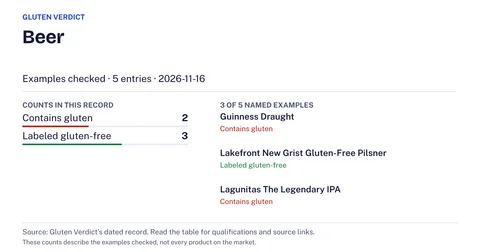 BeerDepends on the product2 of 5 products we checked contain gluten: Guinness Draught and Lagunitas The Legendary IPAchecked Nov 16, 2026
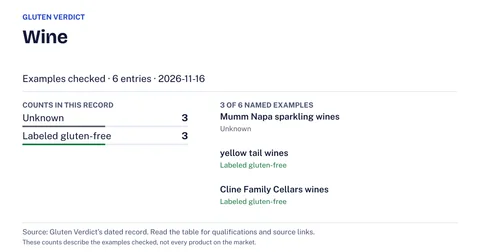 WineNaturally gluten-freechecked Nov 16, 2026
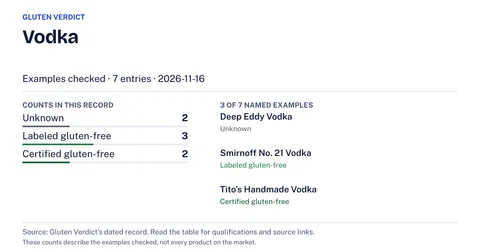 VodkaDepends on the productchecked Nov 16, 2026
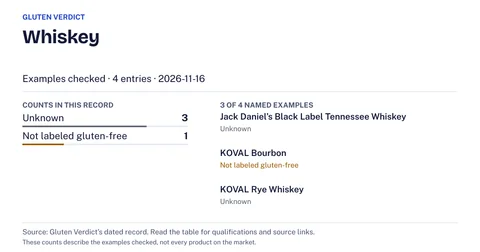 WhiskeyDepends on the productchecked Nov 16, 2026
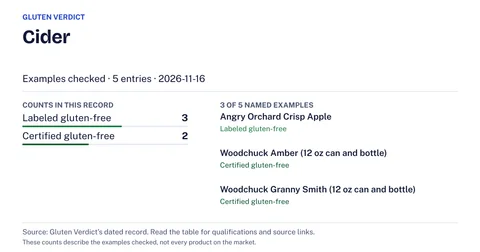 CiderNaturally gluten-freechecked Nov 16, 2026
Questions people ask
Does a gluten-free label on a drink mean alcohol is fine with celiac disease?
No. On alcohol the claim is tied to FDA's definition of gluten-free18, so it speaks to gluten. Whether alcohol suits a person with celiac disease is not something the label addresses; NIDDK and the National Celiac Association pages we read give no guidance on it4, 14.
Is gluten-removed beer gluten-free?
The National Celiac Association says gluten-reduced beers made with barley malt may not be labeled gluten-free33 and should be avoided by those following a gluten-free diet12. TTB requires a fermented drink made from gluten-containing grain that says gluten was removed to add that its gluten content cannot be verified19.
More in Drinks and alcohol
 Gluten-free alcohol: what US beer, spirits, wine and cider labels may sayWhich US alcohol labels may say gluten-free, who sets the wording, and how beer, spirits, wine, cider and hard seltzer differ, each rule sourced.
 How to look up an alcohol label in TTB’s COLA registryAlcohol labels need not list every ingredient. How to find a bottle in TTB’s COLA registry, what it shows, and what the allergen rules do and do not cover.
 Cider, wine, hard seltzer and malt beverages: where barley can still show upHow to read a can for a malt base, and when cider, wine, hard seltzer and coolers need the maker’s own page to settle the barley question.
 Sake, soju, mead and shochu: what each is made from and what to askWhat sake, soju, mead, shochu and makgeolli are made from, which come in grain-based versions, and what to ask a server or maker.
 Liqueurs and cream liqueurs: what a maker’s page can and cannot tell youSplit a liqueur into base spirit, flavors, sugar and cream, read what each maker’s own page says about gluten, and know what to ask when it says nothing.
 Whiskey, vodka and gin: what makers say about grain, distillation and added flavorsHow to read a maker’s gluten statement on vodka, whiskey and gin, tell plain bottles from flavored ones by label wording, and know what to ask.
Related guides
 Gluten-removed beer: what the treatment does, why the tests are disputed and what the TTB statement saysWhat “crafted to remove gluten” means on a barley beer, why lab results on it are disputed, and what TTB, NCA and GIG say, for your clinician talk.
 If you think you were glutened: what the celiac organizations say to doWhat the celiac charities, FDA and NIDDK say to do after accidental gluten exposure, when to contact a clinician, and how to trace the cause.
 Follow-up testing after a celiac diagnosis: what the guidelines listWhat celiac guidelines and charities list for follow-up: antibody checks, repeat biopsy, nutrient tests, and what is checked if symptoms continue.
 Reading US gluten-free labels as a visitor from the UK, EU, Canada or AustraliaWhat a US gluten-free claim, the Contains line, malt and alcohol labels mean if you are used to UK, EU, Canadian or Australian labels.
Sources
- [1, 2, 3, 4] National Institute of Diabetes and Digestive and Kidney Diseases (NIDDK), Eating, Diet, & Nutrition for Celiac Disease, checked Nov 17, 2026.
Read on 2026-11-17: the page's only mentions of alcohol are that beer, lagers, ale, flavored liquors and malt beverages may contain gluten and that FDA's gluten-free rule does not apply to most alcoholic beverages; it gives no amount and no guidance on whether a person with celiac disease may drink alcohol.
- [5, 6, 7, 8] National Institute of Diabetes and Digestive and Kidney Diseases (NIDDK), Treatment for Celiac Disease, checked Nov 17, 2026.
- [9] National Institute of Diabetes and Digestive and Kidney Diseases (NIDDK), Symptoms & Causes of Celiac Disease, checked Nov 17, 2026.
- [10, 11, 12, 13, 14, 33] National Celiac Association, Alcohol on the Gluten-Free Diet, checked Nov 17, 2026.
Read on 2026-11-17: the list headed “Fermented Alcohols That Are Considered Gluten Free” names wine, true hard cider and labeled gluten-free beer (made without malted barley); the list headed “Fermented Alcohols That Are Not Considered Gluten Free” names beer and other malted beverages (ale, porter, stout), sake/rice wine made with barley malt, flavored hard cider containing malt, flavored hard lemonade containing malt, and flavored wine coolers containing malt or hydrolyzed wheat protein.
Read on 2026-11-17: the page sorts drinks by whether the National Celiac Association considers them free of gluten protein and answers questions about labeling; it has no passage on how alcohol affects the intestine and none on how much alcohol a person with celiac disease may drink.
- [15, 16, 17] Gluten Intolerance Group, Does Fermentation or Distillation Make a Product Gluten-Free?, checked Nov 17, 2026.
- [18, 19] Alcohol and Tobacco Tax and Trade Bureau (TTB), TTB Ruling 2020-2: Gluten Content Statements in the Labeling and Advertising of Wine, Distilled Spirits, and Malt Beverages, checked Nov 17, 2026.
- [20, 21, 22, 34] National Institute on Alcohol Abuse and Alcoholism (NIAAA), Alcohol's Effects on the Body, checked Nov 17, 2026.
Read on 2026-11-17: the page's text does not mention celiac disease or gluten.
- [23, 24] Revista Espanola de Enfermedades Digestivas (via PubMed), Celiac disease and alcohol use disorders: increased length of hospital stay, overexpenditures and attributable mortality, checked Nov 17, 2026.
- [25, 26, 27, 35] The Lancet Regional Health – Europe (via PubMed Central), Long-term risk of chronic liver disease in patients with celiac disease: a nationwide population-based, sibling-controlled cohort study, checked Nov 17, 2026.
- [28, 29, 30, 31, 36] Journal of AOAC International (via PubMed), The Celiac Patient Antibody Response to Conventional and Gluten-Removed Beer, checked Nov 17, 2026.
- [32] Gluten Intolerance Group, Gluten-Free vs. Gluten-Removed Beer: A Study, checked Nov 17, 2026.