Cider, wine, hard seltzer and malt beverages: where barley can still show up
Short answer
TTB defines a malt beverage as a drink fermented from malted barley with hops2, and the National Celiac Association does not consider beer and other malted beverages gluten-free4. It does list wine and true hard cider among the fermented alcohols it considers gluten-free1. Check a can or bottle in this order:
- Read the class and type line. Every malt beverage label has to carry one or, for a specialty product, a fanciful name with a statement of composition3.
- Treat a flavored cider, hard lemonade or cooler as unknown until you know its base: the National Celiac Association does not consider those gluten-free when they contain malt4.
- For a seltzer, read the maker’s own page for the base. Truly says its alcohol is made from cane sugar5; White Claw says all of its CLAWTAILS flavors are malt beverages6.
- Read any gluten-free claim against TTB Ruling 2020-2, which allows the claim where FDA’s definition is met and treats it as misleading where it is not7, 8.
Part of Drinks and alcohol, 18 guides
Key points
- A malt beverage is, in TTB’s regulation, a drink fermented from malted barley with hops, so the phrase on a can points to barley2, 13.
- The National Celiac Association lists wine and true hard cider among the fermented alcohols it considers gluten-free, and flavored hard cider, flavored hard lemonade and flavored wine coolers containing malt among those it does not1, 4.
- “Hard seltzer” covers more than one base: Gluten Intolerance Group says they are typically made with cane sugar and that some use fermented malt instead9, 10.
- A brand name does not settle it: White Claw’s hard seltzer and its CLAWTAILS have separate pages that say different things11, 6.
- Gluten Intolerance Group calls the answer for wine “probably” or “usually”, not a clear yes12.
What “malt beverage” means on a can
“Malt beverage” is a class of drink under US rules, not a flavor13. The federal regulation defines it as a beverage made by the alcoholic fermentation of an infusion or decoction of malted barley with hops, with or without other malted cereals and added ingredients2. GIG describes barley as one of the three gluten-containing grains and says malt is derived from it30.
Federal rules require every malt beverage label to carry a class and type designation, or, for a specialty product, a fanciful name with a statement of composition3. Any malt beverage may use the class “malt beverage”, and beer, lager, ale, porter and stout are among the class designations for malt beverages of 0.5% or more alcohol by volume, when the product is known to the trade under that name13. A fanciful name has to come with a statement of composition that includes the base class14.
Flavored versions are still malt beverages. TTB’s rule on ingredients says that nonbeverage flavors and other nonbeverage ingredients containing alcohol may be used in producing a malt beverage, which it says is sometimes referred to as a “flavored malt beverage”15. TTB’s own example is a malt beverage of 5.0 percent alcohol by volume that must get at least 2.55 percent of that volume from the fermentation of barley malt and other materials16.
Which fermented drinks need the check
The National Celiac Association (NCA) sorts fermented alcohols into two lists. Its list of those it considers gluten-free names wine, true hard cider and labeled gluten-free beer made without malted barley1. Its list of those it does not consider gluten-free names beer and other malted beverages, sake or rice wine made with barley malt, flavored hard cider containing malt, flavored hard lemonade containing malt, and flavored wine coolers containing malt or hydrolyzed wheat protein4.
| Drink | What the sources say | Where to check |
|---|---|---|
| Wine | NCA: fermented from grapes and does not contain gluten17. Gluten Intolerance Group (GIG): “probably” or “usually”, not a clear yes12. | A gluten-free claim on the label, or the winery |
| True hard cider | On NCA’s list of fermented alcohols it considers gluten-free1. Woodchuck says its cider comes from apples, which contain no gluten18. | The ingredient list |
| Flavored cider, hard lemonade or cooler containing malt | NCA does not consider these gluten-free4. | The class line, the ingredient list and the maker |
| Hard seltzer on a cane sugar base | GIG: in general, a cane sugar-based hard seltzer is gluten-free9. Truly: its alcohol is made from cane sugar5. | The maker’s page for that product |
| Hard seltzer or cooler sold as a malt beverage | White Claw says all CLAWTAILS flavors are malt beverages and may contain trace amounts of gluten6. GIG: some hard seltzers use fermented malt instead of cane sugar10. | The maker’s page for that product |
| Smirnoff Ice | Smirnoff’s page for it is titled “Flavored Malt Beverages”19. The page makes no gluten statement20. | Smirnoff itself: we have no statement |
Our verdicts for hard seltzer and beer list the maker pages and charity pages we have read for those drinks.
Wine and sparkling wine: grapes, fining and barrels
The NCA’s answer for wine is that it is fermented from grapes and does not contain gluten17. GIG is more careful: it calls the answer “probably” or “usually”, and says there is no industry-wide testing that definitively proves wine is always gluten-free12.
GIG’s article goes through the steps of winemaking. Fining agents it lists, among them egg whites, casein, isinglass, bentonite, carbon, skim milk, gelatin and PVPP, are all gluten-free in its words21, and it says adding gluten in fining is not a common practice today22. On barrels, it says some cooperages once used small amounts of flour-based paste containing gluten to seal the barrel23, and that paraffin or barrel wax is now more commonly used24.
The same applies to champagne and other sparkling wine: GIG says wines with added flavoring, such as fruit flavors, could contain gluten and should be avoided25. Our champagne verdict lists the maker and charity pages we have read.
Hard cider and the flavored exceptions
NCA puts true hard cider on its list of fermented alcohols it considers gluten-free, and flavored hard cider containing malt on its list of those it does not1, 4.
Woodchuck draws the same line. Its FAQ says its hard cider is naturally gluten free because it comes from apples18. Asked whether its cider is an apple beer, Woodchuck says that apple beers have malt and that its cider is made from pure apples26.
NCA also notes that FDA regulates wine and hard cider that contain less than 7% alcohol by volume27. Our cider verdict lists the maker pages we have read.
Hard seltzer: sugar base or malt base
Hard seltzer is not one recipe. GIG says it is typically made with cane sugar mixed with water and yeast, and that in general a cane sugar-based hard seltzer is gluten-free9. It adds that some hard seltzers use fermented malt instead of cane sugar, and that fermented malt drinks are not gluten-free since malt is derived from barley10.
The maker’s own page is where the base is named:
- Truly: its FAQ says Truly Hard Seltzer is crafted with simple, naturally gluten-free ingredients and contains alcohol made from cane sugar5.
- White Claw Hard Seltzer: its ingredients page describes “our gluten free alcohol base”11, and the Black Cherry list reads “alcohol, natural flavors, cane sugar” among its ingredients28. Our verdict on natural flavors covers that ingredient name.
- White Claw CLAWTAILS: the maker’s page says all flavors are malt beverages that may contain trace amounts of gluten, and that they should not be consumed by persons with gluten sensitivity6.
The brand name does not carry across a product line. White Claw’s hard seltzer and its CLAWTAILS have separate pages with different statements11, 6, so read the page for the exact product in your hand.
Smirnoff Ice, coolers and other flavored malt beverages
Smirnoff’s own page for Smirnoff Ice is titled “Smirnoff Ice | Flavored Malt Beverages | Smirnoff”19. The page does not mention gluten20, so the answer for that drink has to come from a statement by Smirnoff itself. The page we read gives none.
Wine coolers are the older version of the same question. NCA says to be careful with wine coolers because they often contain barley malt17. GIG says many wine coolers are not gluten-free if they are made with a malt base29, and that makers have more recently shifted back to wine instead of malt-based additives after years in which coolers were categorized as flavored malt beverages30. The base can therefore differ from one cooler to the next29, 30, and the class line on each can is the first place to look.
What a gluten-free claim means on these drinks
TTB Ruling 2020-2 lets a wine, distilled spirit or malt beverage use “gluten-free” where the product would be entitled to the claim under FDA’s regulation7. It treats the claim as misleading where the drink would not be entitled to it8.
A malt beverage fermented from gluten-containing grains is one of TTB’s examples of a product that does not meet that definition31. TTB lets such products say they were processed, treated or crafted to remove gluten instead31, with this qualifying statement next to it: “Product fermented from grains containing gluten and [processed or treated or crafted] to remove gluten. The gluten content of this product cannot be verified, and this product may contain gluten.”32 That wording is not a gluten-free claim. Our guide to gluten-removed beer covers it.
Reading the can, step by step
- Find the class and type line. “Malt beverage” is a class any malt beverage may use13, and TTB’s definition of a malt beverage rests on malted barley2.
- Check for “flavored malt beverage” or “malt beverage” on the can or on the maker’s product page, as on Smirnoff’s page for Smirnoff Ice19.
- Read the ingredient list. GIG’s advice is to check the ingredients labels carefully on any alcoholic beverage10, and to check what is in any wine-related product33.
- Open the maker’s FAQ or ingredients page and look for a statement about the base of that exact product, the way Truly and White Claw give one5, 11, 6.
Verdicts in this guide
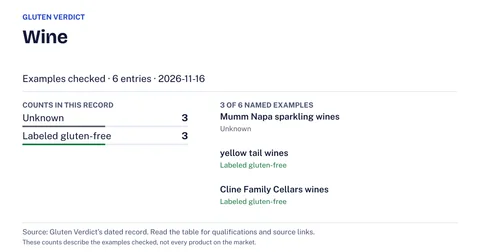 WineNaturally gluten-freechecked Nov 16, 2026
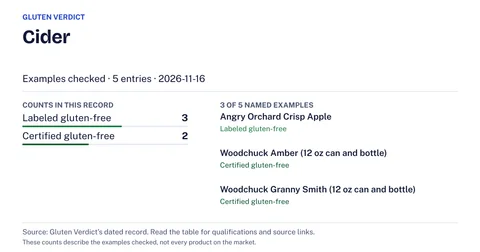 CiderNaturally gluten-freechecked Nov 16, 2026
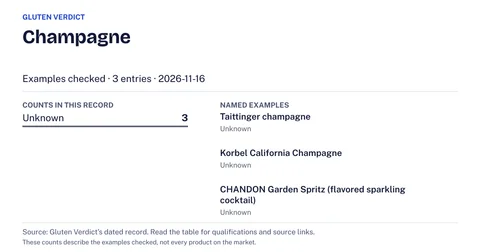 ChampagneNaturally gluten-freechecked Nov 16, 2026
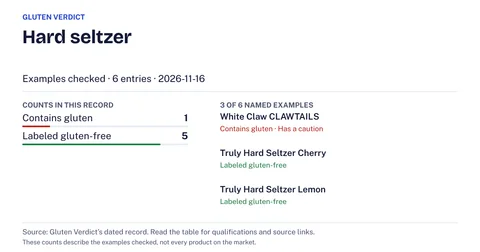 Hard seltzerDepends on the product1 of 6 products we checked contains gluten: White Claw CLAWTAILSchecked Nov 16, 2026
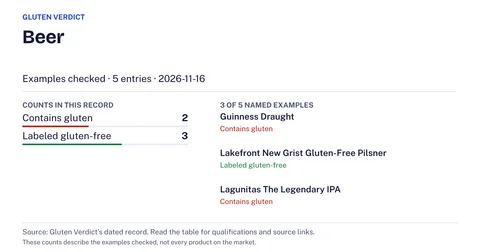 BeerDepends on the product2 of 5 products we checked contain gluten: Guinness Draught and Lagunitas The Legendary IPAchecked Nov 16, 2026
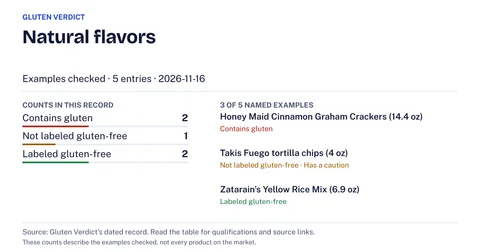 Natural flavorsDepends on the product2 of 5 products we checked contain gluten: Honey Maid Cinnamon Graham Crackers (14.4 oz) and Chex Mix Sour Cream & Onionchecked Nov 16, 2026
Questions people ask
What is a malt beverage?
TTB’s regulation defines it as a beverage made by the alcoholic fermentation of an infusion or decoction of malted barley with hops, with or without other ingredients2. Beer, lager, ale, porter and stout are among the class designations that may be applied to malt beverages13.
Is hard seltzer gluten-free?
It depends on the base. GIG says that in general a cane sugar-based hard seltzer is gluten-free, and that some hard seltzers use fermented malt instead9, 10. Check the maker’s page for that product.
Is Smirnoff Ice gluten-free?
Smirnoff’s page for Smirnoff Ice is titled “Flavored Malt Beverages”19 and does not mention gluten20. We have no statement from Smirnoff, so we cannot confirm it either way.
Do wine coolers have gluten?
NCA says wine coolers often contain barley malt17. GIG says many wine coolers are not gluten-free if made with a malt base, and that some makers have shifted back to using wine29, 30.
More in Drinks and alcohol
 Gluten-free alcohol: what US beer, spirits, wine and cider labels may sayWhich US alcohol labels may say gluten-free, who sets the wording, and how beer, spirits, wine, cider and hard seltzer differ, each rule sourced.
 Alcohol and celiac disease: what a gluten-free label does and does not settleWhether a drink has gluten and whether alcohol suits a person with celiac disease are two questions. What the sources say, and what to ask a clinician.
 How to look up an alcohol label in TTB’s COLA registryAlcohol labels need not list every ingredient. How to find a bottle in TTB’s COLA registry, what it shows, and what the allergen rules do and do not cover.
 Tequila, rum and brandy: what to check on the bottle for glutenHow to read mixto, spiced, flavored and aged tequila, rum and brandy labels for gluten, and what to ask the maker before you buy.
 Sake, soju, mead and shochu: what each is made from and what to askWhat sake, soju, mead, shochu and makgeolli are made from, which come in grain-based versions, and what to ask a server or maker.
 Flavored coffee, pods and creamers: where gluten can enter a cup you make at homeCheck a flavored bean, pod, instant mix or creamer against the maker's own statement; eight makers' pages read on 2026-11-17.
Related guides
 Gluten-removed beer: what the treatment does, why the tests are disputed and what the TTB statement saysWhat “crafted to remove gluten” means on a barley beer, why lab results on it are disputed, and what TTB, NCA and GIG say, for your clinician talk.
 Liqueurs and cream liqueurs: what a maker’s page can and cannot tell youSplit a liqueur into base spirit, flavors, sugar and cream, read what each maker’s own page says about gluten, and know what to ask when it says nothing.
 Gluten-free at a holiday dinner, potluck or cookout as a guestHow a guest with celiac disease can message the host, bring a dish, serve first at a buffet and decide when to eat only their own food.
 Gluten-free Fourth of July cookout: what to check on the table and at the grillCheck franks, buns, sauces, sides and drinks for gluten, and set up the grill and a mixed table for a Fourth of July, Memorial Day or Labor Day cookout.
Sources
- [1, 4, 27] National Celiac Association, Alcohol on the Gluten-Free Diet, checked Nov 17, 2026.
Read on 2026-11-17: the list headed “Fermented Alcohols That Are Considered Gluten Free” names wine, true hard cider, and labeled gluten-free beer (made without malted barley).
Read on 2026-11-17: the list headed “Fermented Alcohols That Are Not Considered Gluten Free” names beer and other malted beverages (ale, porter, stout), sake/rice wine made with barley malt, flavored hard cider containing malt, flavored hard lemonade containing malt, and flavored wine coolers containing malt or hydrolyzed wheat protein.
- [2] Electronic Code of Federal Regulations (eCFR), 27 CFR 7.1 Definitions (malt beverage), checked Nov 17, 2026.
- [3, 13, 14] Alcohol and Tobacco Tax and Trade Bureau (TTB), Malt Beverage Labeling: Class and Type Designation, checked Nov 17, 2026.
- [5] Truly Hard Seltzer (Boston Beer Company), Truly FAQ, checked Nov 17, 2026.
- [6] White Claw (Mark Anthony Brands), Are CLAWTAILS by White Claw Gluten Free?, checked Nov 17, 2026.
- [7, 8, 31, 32] Alcohol and Tobacco Tax and Trade Bureau (TTB), TTB Ruling 2020-2: Gluten Content Statements in the Labeling and Advertising of Wine, Distilled Spirits, and Malt Beverages, checked Nov 17, 2026.
- [9, 10] Gluten Intolerance Group, Does Fermentation or Distillation Make a Product Gluten-Free?, checked Nov 17, 2026.
- [11, 28] White Claw (Mark Anthony Brands), White Claw Hard Seltzer Ingredients, checked Nov 17, 2026.
- [12, 21, 22, 23, 24, 25, 29, 30, 33] Gluten Intolerance Group, Is Wine Gluten-Free…Or Not?, checked Nov 17, 2026.
- [15, 16] Electronic Code of Federal Regulations (eCFR), 27 CFR 7.5 Ingredients and processes (malt beverages), checked Nov 17, 2026.
- [17] National Celiac Association, Is wine OK on the gluten-free diet?, checked Nov 17, 2026.
- [18, 26] Woodchuck Hard Cider, Woodchuck FAQs, checked Nov 17, 2026.
- [19, 20] Smirnoff (Diageo), Smirnoff Ice, checked Nov 17, 2026.
Read on 2026-11-17: the Smirnoff Ice page and its page title, description and product list do not mention gluten.