Sake, soju, mead and shochu: what each is made from and what to ask
Short answer
Whether one of these drinks involves a gluten grain depends on its base and on whether it is brewed or distilled, so read the base first:
- Sake: brewed from rice, koji and water1, 2; sake or rice wine made with barley malt is on the National Celiac Association’s list of fermented alcohols not considered gluten free11.
- Mead: made primarily from honey, water and yeast35; a braggot adds malt37.
- Shochu is distilled22 and soju is sold both distilled and diluted27. Shochu bases include rice, barley and sweet potatoes23; soju bases reported include rice, barley, wheat and sweet potatoes28. The National Celiac Association considers distilled spirits free of gluten protein even when made from wheat, barley or rye10.
- Makgeolli: a rice wine brewed with a starter such as nuruk, which is made by grinding wheat, barley and rice39, 40, 41.
Part of Drinks and alcohol, 18 guides
Key points
- Sake is brewed from rice, koji and water1, 2; shochu is distilled and its base changes by bottle22, 23.
- Soju is sold both distilled and diluted27; traditional soju is primarily rice, with barley, wheat and sweet potatoes reported28.
- The National Celiac Association separates fermented drinks, where the starting material matters, from distilled ones, which it considers free of gluten protein9, 10.
- A US alcohol label does not have to carry an allergen line19, so the base ingredient is a question for the maker.
What is each of these drinks made from?
Each name covers a different kind of drink. The table gives what the sources we read say about each; the sections after it take them one at a time. For the wider picture of alcohol on a gluten-free diet, see our alcohol guide.
| Drink | Made from | What to check |
|---|---|---|
| Sake | Rice, koji and water; brewed, not distilled1, 2 | Whether it is junmai (only rice and koji4) or has spirit added7. The National Celiac Association lists sake or rice wine made with barley malt among fermented alcohols not considered gluten free11. |
| Shochu | A distilled spirit22. The main ingredients of honkaku shochu are starchy foods such as rice, barley and sweet potatoes26 | The base on the bottle: the Japanese government recognizes about 50 ingredients for honkaku shochu, from rice and barley to buckwheat, brown sugar and even tomatoes23. |
| Soju | A Korean spirit sold both distilled and diluted27. Traditional soju is primarily produced from rice28 | Barley, wheat and sweet potatoes have been reported as bases28. The starter nuruk is prepared from grains such as wheat, barley, rice and sweet potatoes30. |
| Mead | Primarily honey, water and yeast35 | A braggot adds malt37. For categories other than traditional mead, the BJCP asks entrants to declare things like specific fruit, spices or special characteristics36. |
| Makgeolli | A traditional Korean turbid rice wine39, brewed in one of the study’s methods from glutinous rice with nuruk40 | Nuruk is made by grinding wheat, barley and rice41. Makgeolli has also been brewed with koji instead of nuruk42. |
The National Celiac Association sorts alcohol by method before base: for a fermented alcohol, whether it is considered free of gluten protein depends upon the starting material9; for a distilled one, proteins from the starting materials are removed10. That is why this guide asks two questions of every drink: brewed or distilled, and made from what.
Sake: rice, koji and, in some bottles, added spirit
The Japan Sake and Shochu Makers Association describes sake as made from rice, koji and water1. It is brewed, like wine and beer, rather than distilled2. Koji, in this account, is steamed rice treated with koji-fungus3.
Junmai sake has only rice and koji as ingredients, with no other additives allowed4. Sake that is not junmai can have neutral spirit added at the end of fermentation; the association’s glossary describes this added jozo alcohol as distilled alcohol made from molasses or grains7. In US wine rules, sake is wine produced from rice in accordance with the commonly accepted method of manufacture8.
The one sake-specific grain flag in our sources is the National Celiac Association’s: sake or rice wine made with barley malt is on its list of fermented alcohols not considered gluten free11. A bottle whose label or maker mentions malt or barley is the case to ask about. Our rice and barley verdicts show how those two grains read on their own.
Shochu: rice, barley, sweet potato and many other bases
Shochu is a distilled beverage, like whisky or brandy22. JETRO, Japan’s trade promotion organization, says the Japanese government recognizes about 50 ingredients for honkaku shochu, including rice, barley, sweet potatoes, buckwheat and brown sugar, and also milk, matcha, oolong tea and tomatoes23.
Koji is always used in making honkaku shochu, and the main ingredients are starchy foods such as rice, barley and sweet potatoes26. For one type, the process mixes rice or barley with koji mold24. So the type name (rice, barley, sweet potato) is the first thing to read, and a menu that says only “shochu” leaves the question to the bar or the maker.
Some bottles blend two kinds of shochu. JETRO says manufacturers have established labeling standards so that consumers can see the mixing rates and the raw materials used25.
Shochu is distilled, and the National Celiac Association says distilled spirits are considered free of gluten protein even when the starting material is wheat, barley or rye10. That is one charity’s position; the next sections show what US label rules add.
Soju: distilled or diluted, and a starter that can contain wheat
In Korea, soju refers to both distilled and diluted liquors27. A peer-reviewed review says traditional soju is primarily produced from rice, though the use of barley, wheat and sweet potatoes has been reported28. The review’s passages on soju do not name the raw materials of diluted soju29, so for that kind the label or the maker is the only way to know.
The Gluten Intolerance Group’s page on Korean cuisine describes soju as the traditional distilled, slightly sweet spirit of Korea, which can be made from rice, barley or wheat and which, being distilled, it calls gluten-free even when made from gluten-containing grains31.
Two makers show how differently a bottle can read. Hwayo’s manufacturing page says its liquor is distilled with rice and natural rock water33. Tokki Soju says it formulated its soju with glutinous rice and nuruk34. The review says nuruk is prepared using grains such as wheat, barley, rice and sweet potatoes, alone or in combination30, so a maker’s own page is where to find what went into its starter.
Mead: honey, and what brewers add
The Beer Judge Certification Program’s mead guidelines say mead is made primarily from honey, water and yeast35. Our honey verdict covers the honey itself.
A braggot is a mead made with both honey and malt, and the malt can come from grain or from malt extracts37, 38. “Malt” is the word to stop at: FDA says malt extract and malt syrup are ingredients derived from barley that has not been processed to remove gluten21. Our guide to malt on food labels goes further.
Other meads carry fruit, spices or other additions. For categories other than traditional mead, the BJCP’s rules ask entrants to declare specific fruit, spices or special characteristics36. At a meadery, ask what was added and whether the same tanks or kitchen make grain-based drinks.
Makgeolli and other rice ferments
Makgeolli is a traditional Korean turbid rice wine39. One study brewed it from glutinous rice with nuruk, a Korean starter culture40. Nuruk is made by grinding wheat, barley and rice41, and another study compared makgeolli brewed with koji against makgeolli brewed with nuruk42. Studies have brewed makgeolli with nuruk and with koji40, 42, so the starter is worth asking the maker about.
“Koji” on a label is a prompt to ask which grain. The sake association describes koji as steamed rice treated with koji-fungus3, while the Gluten Intolerance Group describes the koji used in miso as cultured grains such as barley or rice32. Our miso verdict shows how that plays out in one product.
For a fermented drink, the National Celiac Association’s point applies: whether it is considered free of gluten protein depends upon the starting material9. For makgeolli that means the maker’s statement of grain and starter, not the menu name.
What a US label can and cannot tell you
The National Celiac Association says most alcohol is regulated by the TTB43. TTB authorizes “gluten-free” on a label if the product would qualify under FDA’s definition14. Under its 2020 ruling it also permits the claim on distilled spirits made from gluten-containing grains, as long as good manufacturing practices keep any gluten-containing material out of the final product15.
When protein-containing ingredients are added after distillation, the label may carry the claim only if the maker can substantiate on request that the distillate has no protein, that the added ingredients have no gluten, and what precautions were taken against cross-contact16. That is why a flavored spirit needs its own question: the National Celiac Association considers flavored spirits gluten-free unless a gluten-containing ingredient was added after distillation12.
A fermented drink made from gluten-containing grains is handled differently. TTB lets a product fermented from gluten-containing grains claim that it was processed, treated or crafted to remove gluten, with a qualifying statement and documentation17.
US alcohol labels do not have to carry an allergen line: TTB’s FAQ says current regulations under the Federal Alcohol Administration Act do not require disclosure of major food allergens19. In April 2025 TTB extended the comment period on a proposal to require it20. A missing Contains line on a bottle of sake or soju therefore does not show that wheat is absent19.
Imports add one more layer. Sake labels in Japan must list ingredients5, and the association adds that every country that sells sake sets its own labeling requirements6. If a bottle has a translated back label, read its ingredient line; if it does not, ask the importer or the maker.
The National Celiac Association’s FAQ on this page says that distilled alcohol with wheat, barley or rye as a starting material can not be labeled gluten-free13. TTB’s 2020 ruling permits the claim on such spirits under the conditions above15 and states that TTB Ruling 2014-2 is superseded18. For the label rule, this guide follows TTB.
What to ask at a restaurant or tasting room
Each question turns a menu name into a base ingredient and a method, the two facts the sources above use to sort drinks.
- What is it made from? Ask for the base by name: rice, barley, wheat, sweet potato, honey or something else.
- Is it brewed or distilled? Sake is brewed rather than distilled2, shochu is distilled22, and soju is sold both distilled and diluted27.
- Was anything added afterward? Candidates are added spirit in sake that is not junmai7, malt in a braggot37, and flavors in a spirit12.
- What started the fermentation? Koji (rice, in sake3) or nuruk (made from wheat, barley and rice in the makgeolli study41).
- Can I see the bottle, or does the maker publish the ingredients? A server may not know the base; the label and the maker’s own page will.
- Do you brew or distill grain-based drinks on the same equipment? This matters most at a meadery or craft distillery that also makes beer-style products.
Our verdicts for the plain ingredients are a place to start: rice, barley, honey, wine, vodka and beer. We do not rate individual bottles; the bottle in your hand and its maker have the final word.
Verdicts in this guide
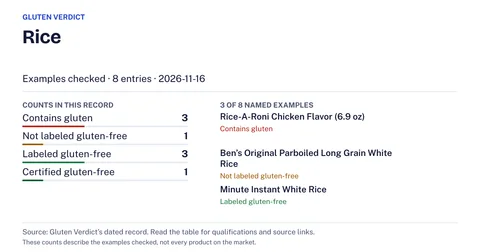 RiceNaturally gluten-free3 of 8 products we checked contain gluten: Rice-A-Roni Chicken Flavor (6.9 oz), Near East Original Rice Pilaf, and Ben’s Original Ready Rice Rice PilafBuy it labeled gluten-freechecked Nov 16, 2026
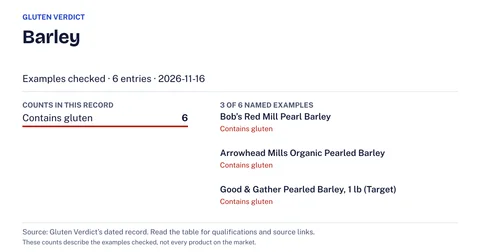 BarleyContains glutenchecked Nov 16, 2026
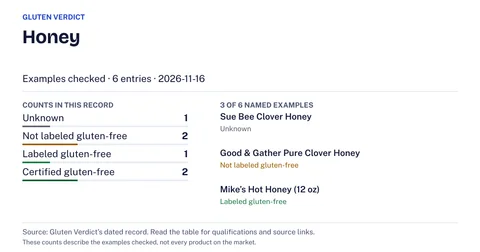 HoneyDepends on the productchecked Nov 16, 2026
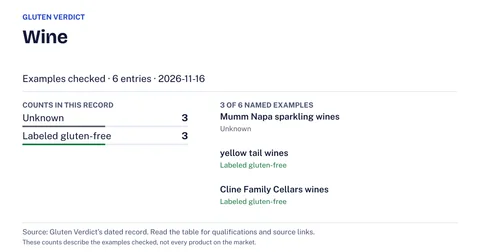 WineNaturally gluten-freechecked Nov 16, 2026
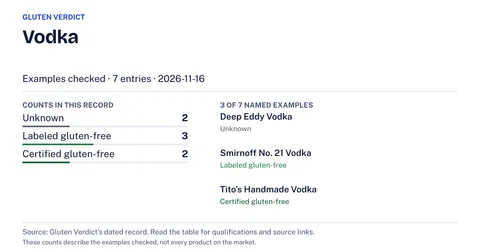 VodkaDepends on the productchecked Nov 16, 2026
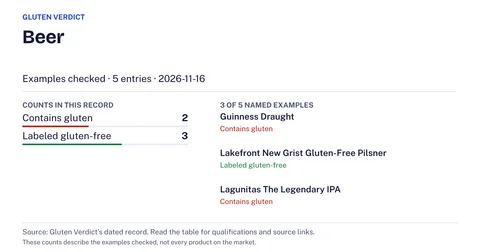 BeerDepends on the product2 of 5 products we checked contain gluten: Guinness Draught and Lagunitas The Legendary IPAchecked Nov 16, 2026
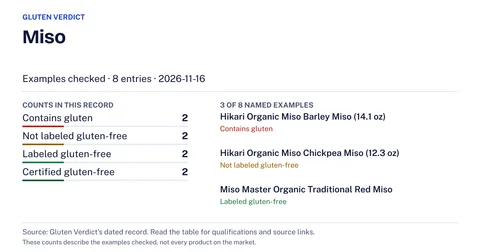 MisoDepends on the product2 of 8 products we checked contain gluten: Hikari Organic Miso Barley Miso (14.1 oz) and Hikari Miso Soup Akadashi (12 servings, 7.0 oz)checked Nov 16, 2026
Questions people ask
Is sake gluten free?
The Japan Sake and Shochu Makers Association describes sake as made from rice, koji and water1. The National Celiac Association lists sake or rice wine made with barley malt among fermented alcohols not considered gluten free11, so the ingredient line on the bottle matters.
Is soju gluten free?
The Gluten Intolerance Group says soju can be made from rice, barley or wheat and, being distilled, is gluten-free even when made from gluten-containing grains31. TTB permits a gluten-free claim on distilled spirits made from gluten-containing grains when good manufacturing practices keep gluten-containing material out of the final product15. The base is still worth asking about: soju is sold distilled and diluted27.
Is mead gluten free?
Mead is made primarily from honey, water and yeast35. A braggot is a mead made with both honey and malt37, so ask what a given mead contains.
More in Drinks and alcohol
 Gluten-free alcohol: what US beer, spirits, wine and cider labels may sayWhich US alcohol labels may say gluten-free, who sets the wording, and how beer, spirits, wine, cider and hard seltzer differ, each rule sourced.
 How to look up an alcohol label in TTB’s COLA registryAlcohol labels need not list every ingredient. How to find a bottle in TTB’s COLA registry, what it shows, and what the allergen rules do and do not cover.
 Alcohol and celiac disease: what a gluten-free label does and does not settleWhether a drink has gluten and whether alcohol suits a person with celiac disease are two questions. What the sources say, and what to ask a clinician.
 Gluten-removed beer: what the treatment does, why the tests are disputed and what the TTB statement saysWhat “crafted to remove gluten” means on a barley beer, why lab results on it are disputed, and what TTB, NCA and GIG say, for your clinician talk.
 Whiskey, vodka and gin: what makers say about grain, distillation and added flavorsHow to read a maker’s gluten statement on vodka, whiskey and gin, tell plain bottles from flavored ones by label wording, and know what to ask.
 Non-alcoholic beer, kvass and malta: what the grain means for glutenHow non-alcoholic beer, kvass and malta are made, what US labels let them say about alcohol and gluten, and what to check on each can or bottle.
Related guides
 Gluten-free in Japan: soy sauce, miso, barley tea and the allergen boxWhat to check in Japan: wheat in soy sauce, barley in miso and barley tea, and what the Japanese allergen box covers and leaves out.
 Fermented, hydrolyzed and distilled foods: how a gluten-free claim is checkedHow FDA’s 2020 rule checks a gluten-free claim on fermented, hydrolyzed and distilled foods, why a test cannot settle it, and where TTB takes over.
 “Low gluten”, “gluten removed” and “gluten friendly” on a labelWhat “low gluten”, “gluten removed” and “gluten friendly” mean on a US label, which phrases FDA or TTB define, and what to ask the maker.
 Gluten-free at a holiday dinner, potluck or cookout as a guestHow a guest with celiac disease can message the host, bring a dish, serve first at a buffet and decide when to eat only their own food.
Sources
- [1, 2, 3] Japan Sake and Shochu Makers Association, How is Sake Made?, checked Nov 17, 2026.
- [4, 5, 6] Japan Sake and Shochu Makers Association, How to Read Sake Bottle Labels, checked Nov 17, 2026.
Read on 2026-11-17: the list headed “Legally Required Information on Sake Bottle Labels in Japan” names product name, producer’s name, producer’s address, net content, alcohol content, ingredients, date of production and a legal statement on drinking.
- [7] Japan Sake and Shochu Makers Association, Glossary of Sake Terms, checked Nov 17, 2026.
- [8] US Code of Federal Regulations, Title 27, 27 CFR 4.21: The standards of identity (wine), checked Nov 17, 2026.
- [9, 10, 11, 12, 13, 43] National Celiac Association, Alcohol on the Gluten-Free Diet, checked Nov 17, 2026.
Read on 2026-11-17: the list headed “Fermented Alcohols That Are Not Considered Gluten Free” names beer and other malted beverages (ale, porter, stout); sake/rice wine made with barley malt; flavored hard cider containing malt; flavored hard lemonade containing malt; and flavored wine coolers containing malt or hydrolyzed wheat protein.
- [14, 15, 16, 17, 18] Alcohol and Tobacco Tax and Trade Bureau (TTB), TTB Ruling 2020-2: Gluten Content Statements in the Labeling and Advertising of Wine, Distilled Spirits, and Malt Beverages, checked Nov 17, 2026.
- [19] Alcohol and Tobacco Tax and Trade Bureau (TTB), Major Food Allergen Labeling for Wines, Distilled Spirits, and Malt Beverages (FAQs), checked Nov 17, 2026.
- [20] Alcohol and Tobacco Tax and Trade Bureau (TTB), TTB Extends Comment Period for 'Alcohol Facts' and Major Allergen Labeling Proposals for Alcohol Beverages, checked Nov 17, 2026.
- [21] US Food and Drug Administration, Questions and Answers on the Gluten-Free Food Labeling Final Rule, checked Nov 17, 2026.
- [22, 23, 24, 25] Japan External Trade Organization (JETRO), Honkaku shochu, checked Nov 17, 2026.
- [26] Japan Sake and Shochu Makers Association with the National Research Institute of Brewing, Honkaku Shochu and Awamori (brochure, 2014), checked Nov 17, 2026.
- [27, 28, 29, 30] Foods (MDPI), peer-reviewed review, A Comparative Analysis of Aroma Profiles of Soju and Other Distilled Spirits from Northeastern Asia, checked Nov 17, 2026.
Read on 2026-11-17: the passages on soju name rice, barley, wheat and sweet potatoes as bases of traditional distilled soju; none names the raw materials of diluted soju.
- [31] Gluten Intolerance Group, Gluten-Free Korean Cuisine, checked Nov 17, 2026.
- [32] Gluten Intolerance Group, Japanese Cuisine When You’re Eating Gluten-Free, checked Nov 17, 2026.
- [33] Hwayo, Manufacturing Process, checked Nov 17, 2026.
- [34] Tokki Soju, Premium Korean Rice Soju and Sonbi Gin (home page), checked Nov 17, 2026.
- [35, 36] Beer Judge Certification Program (BJCP), Introduction to Mead Guidelines, checked Nov 17, 2026.
- [37, 38] Beer Judge Certification Program (BJCP), M4A. Braggot (2015 style guidelines), checked Nov 17, 2026.
- [39, 40, 41] Current Research in Food Science, peer-reviewed study, Characterisation of Korean rice wine (makgeolli) prepared by different processing methods, checked Nov 17, 2026.
- [42] Food Research International, peer-reviewed study (PubMed abstract), Effects of saccharification agents on the microbial and metabolic profiles of Korean rice wine (makgeolli), checked Nov 17, 2026.