Gluten-removed beer: what the treatment does, why the tests are disputed and what the TTB statement says
Short answer
Gluten-removed beer is regular beer brewed from a gluten grain and then treated, for example with an enzyme, to remove gluten1, 14. TTB allows the label to say so only with a qualifying statement beside the claim that includes “The gluten content of this product cannot be verified, and this product may contain gluten.”2 The National Celiac Association says gluten reduced beers should be avoided by those following a gluten-free diet3.
Part of Drinks and alcohol, 18 guides
Key points
- GIG describes gluten-free stouts as brewed from gluten-free grains such as sorghum, rice or millet4, and FDA says beer made from gluten-containing grains processed to remove gluten before fermentation may also bear the term if it meets the requirements35; GIG describes a gluten-removed beer as a regular beer that has undergone a process to reduce gluten content5.
- FDA does not consider fermentation or hydrolysis a process that removes gluten, and says conventional methods may not accurately detect and quantify gluten in fermented foods6, 7.
- TTB agrees with FDA that there is currently no scientifically valid method to quantify gluten in fermented or hydrolyzed foods as intact gluten protein8, and TTB will consider a label statement of a specific level such as “contains x ppm” misleading without an appropriate basis or necessary qualification9.
- In one published study, mass spectrometry found gluten peptides in many gluten-reduced beers10; in another, gluten composition varied between three replicate pilot-scale productions11.
- NCA and GIG both treat gluten-removed beer differently from labeled gluten-free beer3, 12, 16.
Gluten-free beer and gluten-removed beer are two different products
The Gluten Intolerance Group (GIG) says gluten-free stouts are brewed using gluten-free grains and names sorghum, rice and millet as examples4. FDA also says a beer made from gluten-containing grains that were processed to remove gluten before fermentation may bear the term gluten-free if it meets the requirements35. GIG describes gluten-removed beer, using stout as its example, as regular beer that has undergone a process to reduce gluten content5.
FDA says beer is a fermented beverage derived from malted cereal grains, most commonly barley or wheat, which are gluten-containing grains13. Which agency writes the label rules depends on the beer: FDA says beers that meet the Federal Alcohol Administration Act definition of malt beverages are subject to TTB’s labeling requirements, while certain other beers, such as sorghum beer, fall under FDA’s13.
| Gluten-free beer | Gluten-removed beer | |
|---|---|---|
| Brewed from | Gluten-free grains such as sorghum, rice or millet, in GIG’s description4; FDA also allows the claim on a beer from gluten-containing grains processed to remove gluten before fermentation, if the requirements are met35 | A gluten-containing grain, then treated; TTB’s wording covers products fermented from one or more ingredients that are, or are derived from, a gluten-containing grain14 |
| Wording TTB allows | “gluten-free”, where the product would be entitled to the claim under FDA’s standards15 | A statement that it was processed, treated or crafted to remove gluten14, with a qualifying statement beside it2 |
| NCA’s position | Lists labeled gluten-free beer made without malted barley as considered gluten-free16 | Says gluten reduced beers should be avoided by those following a gluten-free diet3 |
Our beer verdict records what the sources we read say about beer in general; this guide is about the narrower question of the gluten-removed label.
What an enzyme treatment does to a barley beer
Colgrave and colleagues write that gluten fragments persist in conventional beers, and that barley-based beers crafted to remove gluten use proprietary precipitation and/or application of enzymes, for example prolyl endopeptidases (PEP) that degrade the proline-rich gluten molecules1.
FDA defines a hydrolyzed food as one whose proteins and other components are broken into smaller compounds by reaction with water, and notes that enzymes often accelerate these reactions17. Breaking gluten into fragments is therefore not the same as taking it out: FDA does not consider hydrolysis7, or fermentation6, a process to remove gluten.
One pilot-scale example
In a 2019 pilot-scale experiment (Fiedler and colleagues), a gluten-reduced beer was brewed with barley malt in the presence of PEP and then filtered with diatomaceous earth and perlite18. The combination reduced detectable gluten more than either step alone, yet gluten proteins or polypeptides were still observed in the filtered, PEP-treated beers using sandwich ELISA, western blot and mass spectrometry19.
TTB will not approve a label with the “processed to remove gluten” statement unless the label application describes the method used20.
Why a lab result on the finished beer is disputed
FDA says that during fermentation proteins are broken apart into peptides, and that conventional analytical methods may not accurately detect and quantify gluten in fermented foods; beer is one of its examples6. TTB agrees that, as of its 2020 ruling, there was no scientifically valid method to quantify the amount of gluten in fermented or hydrolyzed foods in terms of equivalent amounts of intact gluten protein8.
The test at the center of the dispute
Fiedler and colleagues write that the competitive ELISA is generally considered appropriate for analyzing hydrolysed gluten, but not considered a scientifically valid method for quantifying gluten in fermented or hydrolysed foods, because there is no appropriate reference standard21. Colgrave and colleagues call a competitive ELISA the industry standard and write that it may indicate gluten values under 20 mg/kg, while describing gluten measurement in fermented products as controversial22.
What individual studies reported
- Colgrave and colleagues, 2017: liquid chromatography-mass spectrometry detected barley hordeins in all beers analyzed, with peptides from all hordein classes found in conventional beers also appearing in many gluten-reduced beers; the authors write that PEP digestion was incomplete in several commercial beers10.
- Fiedler and colleagues, 2019: gluten composition varied between three replicate pilot-scale productions, which the authors say suggests the gluten profile in beer could differ from batch to batch11.
- Panda and colleagues, 2015, in a model sorghum beer made with wheat gluten: detectable gluten fell during fermentation and fell further with PEP, only one sandwich ELISA could detect the apparent low levels, and a competitive ELISA with a pepsin-trypsin hydrolysate calibrant was unreliable23.
- Gluten Free Watchdog, quoted by NCA, says a sandwich ELISA will not adequately detect gluten protein fragments that may be found in fermented products such as beer, and names the competitive R5 ELISA for testing yeast24.
Put side by side, these sources show why one number on a finished beer is contested: Fiedler and colleagues write that the competitive ELISA is not considered a scientifically valid method for fermented foods21, one study found gluten peptides by mass spectrometry although a competitive ELISA may indicate under 20 mg/kg10, 22, and the sources do not agree on sandwich ELISA: one sandwich ELISA detected the low levels in a model beer23, while Gluten Free Watchdog says a sandwich ELISA will not adequately detect gluten protein fragments in fermented products24.
An antibody study on patients’ blood samples
A 2017 study in the Journal of AOAC International, which GIG discusses on its site25, tested serum samples from 31 people with active celiac disease and 29 people without it against barley, rice, traditional beer, gluten-free beer and a gluten-removed beer. It measured antibody binding in the laboratory, and none of the sera bound to proteins in the gluten-free beer26.
Of the seven patients with an IgA response to barley, four also responded to traditional beer and two of those responded to the gluten-removed beer27. The authors write that binding by patients’ serum but not controls’ may indicate residual peptides that are celiac-specific28, and note that no validated testing methods exist to quantify all the hydrolyzed or fermented gluten peptides that might be harmful29.
What the TTB statement on the label says
TTB, the Alcohol and Tobacco Tax and Trade Bureau, sets the labeling rules for malt beverages13. Under TTB Ruling 2020-2, a label or advertisement may state that a beer fermented from a gluten-containing grain was processed, treated or crafted to remove some or all of the gluten, under conditions14. The 2020 ruling did not change TTB’s policy on malt beverages fermented from gluten-containing grains30.
- The qualifying statement must appear legibly and conspicuously, immediately adjacent to or as a continuation of the claim. Its wording is “Product fermented from grains containing gluten and [processed or treated or crafted] to remove gluten. The gluten content of this product cannot be verified, and this product may contain gluten.”2
- The brewer’s label application must describe in detail the method used to remove gluten; without it TTB will not approve the label20.
What each part tells you
- “cannot be verified”: TTB agrees with FDA that there is currently no scientifically valid method to quantify the amount of gluten in fermented or hydrolyzed foods as intact gluten protein8.
- “may contain gluten”: the label states it itself, and TTB treats a gluten-free claim on an alcohol beverage that would not qualify under FDA’s standards as misleading31.
- No number: labels or advertisements that state a specific level of gluten in a fermented finished product, such as “contains x ppm”, without an appropriate basis or necessary qualification will be considered misleading9.
- No disease claim: claims that characterize a product’s relationship to a health-related condition such as celiac disease are prohibited unless they comply with TTB’s specific health claim requirements32.
TTB no longer requires the brewer’s gluten test results with the application, except upon request33.
What FDA’s 20 ppm rule does and does not reach in beer
FDA’s definition of gluten-free sets a limit of less than 20 parts per million for the gluten in a food that it covers, and bars gluten-containing grains and ingredients derived from them that were not processed to remove gluten34.
For beer, FDA says that beers not made from gluten-containing grains, or made from them but processed to remove gluten in line with the definition before fermentation, may bear the term gluten-free if they meet the applicable requirements35. Because current tests do not adequately detect and quantify gluten in fermented foods, a maker making that claim must keep records showing the food met the definition, including less than 20 ppm gluten before fermentation or hydrolysis, and must evaluate cross-contact36.
A beer that TTB regulates and that would not qualify under FDA’s standards cannot carry a gluten-free claim: TTB would consider it misleading31. The gluten-removed statement is the wording TTB allows instead2.
You may still see a barley-based gluten-removed beer labeled gluten-free. NCA explains that the Federal Alcohol Administration Act generally requires prior label approval for beverages sold across state lines, but that this may not apply to a product brewed and sold in the same state37.
What the celiac organizations say
Positions as each organization’s own page states them. They are advice for people following a gluten-free diet, not a ruling on any one person’s case.
- National Celiac Association (NCA): gluten-reduced beers made with barley malt may not be labeled gluten-free, and gluten reduced beers should be avoided by those following a gluten-free diet3. Its page adds that until more is known they should be avoided38, and ties this to testing issues39.
- Gluten Free Watchdog, as quoted by NCA: drink only hard ciders and beers labeled gluten-free and, at this time, avoid products labeled gluten removed40.
- Gluten Intolerance Group (GIG): its page separates gluten-free stouts, brewed from grains like sorghum, rice or millet4, from gluten-removed stouts, regular beers that have undergone a process to reduce gluten content5, and says its research shows gluten-removed beers are not a choice it recommends for someone with celiac disease12.
What the label tells you before you buy
- Look for a gluten-free claim. TTB allows it on a malt beverage only where the product would be entitled to the claim under FDA’s standards15.
- If the label says processed, treated or crafted to remove gluten, look beside it for the statement that the gluten content cannot be verified and the product may contain gluten2.
- If the label has an ingredient list, read it for barley, malt and yeast, and compare it with our verdicts for barley, malt extract and brewer’s yeast.
- Treat a specific gluten number printed on a fermented product with care: TTB says such a statement without an appropriate basis is misleading9.
- Our gluten scanner looks for gluten ingredients in a photo of a label or in pasted text.
Questions people take to their own clinician
This guide reports what regulators, charities and researchers say. It does not tell any one person what to drink. Questions some readers bring to a clinician or registered dietitian:
- NCA and GIG treat gluten-removed beer differently from beer brewed without gluten grains3, 12. How does that apply to my situation?
- Studies have reached different results depending on the test method10, 22. What does that mean for someone with my diagnosis?
- If I choose a beer brewed without gluten grains, what should I check on the label or ask the maker?
Verdicts in this guide
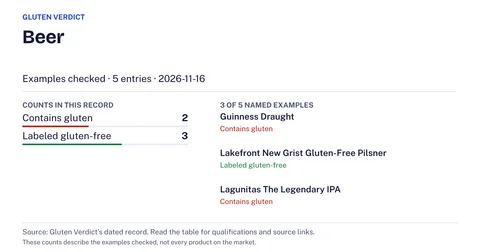 BeerDepends on the product2 of 5 products we checked contain gluten: Guinness Draught and Lagunitas The Legendary IPAchecked Nov 16, 2026
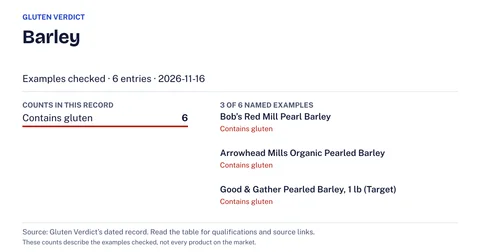 BarleyContains glutenchecked Nov 16, 2026
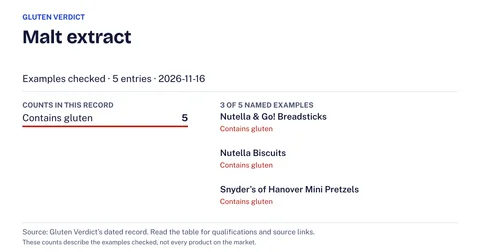 Malt extractContains glutenchecked Nov 16, 2026
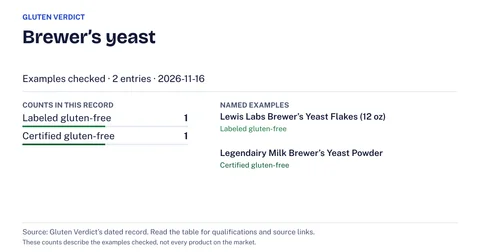 Brewer’s yeastDepends on the productchecked Nov 16, 2026
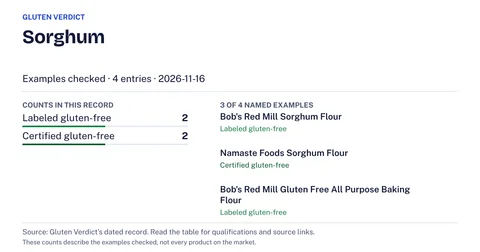 SorghumNaturally gluten-freeBuy it labeled gluten-freechecked Nov 16, 2026
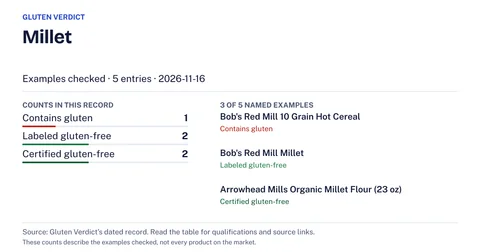 MilletNaturally gluten-free1 of 5 products we checked contains gluten: Bob's Red Mill 10 Grain Hot CerealBuy it labeled gluten-freechecked Nov 16, 2026
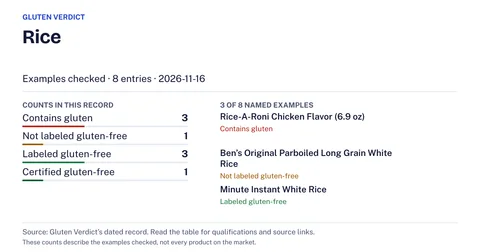 RiceNaturally gluten-free3 of 8 products we checked contain gluten: Rice-A-Roni Chicken Flavor (6.9 oz), Near East Original Rice Pilaf, and Ben’s Original Ready Rice Rice PilafBuy it labeled gluten-freechecked Nov 16, 2026
Questions people ask
Is gluten-removed beer gluten-free?
The labeling rules do not treat it as such. TTB considers a gluten-free claim misleading on an alcohol beverage that would not be entitled to it under FDA’s standards31, FDA does not consider fermentation or hydrolysis a process to remove gluten6, 7, and a gluten-removed beer carries the statement “The gluten content of this product cannot be verified, and this product may contain gluten.”2
Can people with celiac disease drink gluten-removed beer?
NCA says gluten reduced beers should be avoided by those following a gluten-free diet3, and GIG says its research shows they are not a choice it recommends for someone with celiac disease12. Your own clinician can speak to your situation.
What does “crafted to remove gluten” mean?
TTB lets a beer fermented from a gluten-containing grain say it was processed, treated or crafted to remove some or all of the gluten, with a qualifying statement beside it14. The brewer must describe the method in its label application20; one reported method uses an enzyme, prolyl endopeptidase1.
Why can’t a lab test settle whether a gluten-removed beer contains gluten?
FDA says conventional analytical methods may not accurately detect and quantify gluten in fermented foods6, and TTB agrees that no scientifically valid method exists to quantify it as intact gluten protein8.
Why did I see a barley-based gluten-removed beer labeled gluten-free?
NCA says federal label approval may not apply to a beer brewed and sold in the same state37.
Can a gluten-removed beer print its ppm on the label?
Not without an appropriate basis. TTB says a statement of a specific level, such as “contains x ppm”, on a fermented finished product without an appropriate basis or necessary qualification will be considered misleading9.
More in Drinks and alcohol
 Non-alcoholic beer, kvass and malta: what the grain means for glutenHow non-alcoholic beer, kvass and malta are made, what US labels let them say about alcohol and gluten, and what to check on each can or bottle.
 Gluten-free alcohol: what US beer, spirits, wine and cider labels may sayWhich US alcohol labels may say gluten-free, who sets the wording, and how beer, spirits, wine, cider and hard seltzer differ, each rule sourced.
 Sake, soju, mead and shochu: what each is made from and what to askWhat sake, soju, mead, shochu and makgeolli are made from, which come in grain-based versions, and what to ask a server or maker.
 Instant coffee, tea, cocoa and malted drink mixes: what to read for glutenWhere gluten turns up in instant coffee, tea blends, chai, cocoa and malted drink mixes, and what to read on each label before you buy.
 Cocktail mixers, bitters and rims: what can carry gluten besides the spiritTake a cocktail apart: spirit, mixer, bitters, beer, rim and garnish. See what makers and charities say about each, and what to ask the bar.
 How to look up an alcohol label in TTB’s COLA registryAlcohol labels need not list every ingredient. How to find a bottle in TTB’s COLA registry, what it shows, and what the allergen rules do and do not cover.
Related guides
 “Low gluten”, “gluten removed” and “gluten friendly” on a labelWhat “low gluten”, “gluten removed” and “gluten friendly” mean on a US label, which phrases FDA or TTB define, and what to ask the maker.
 Fermented, hydrolyzed and distilled foods: how a gluten-free claim is checkedHow FDA’s 2020 rule checks a gluten-free claim on fermented, hydrolyzed and distilled foods, why a test cannot settle it, and where TTB takes over.
 How to check a gluten-free seal in the certifier's own directorySearch GFCO's Product Finder by brand, product or UPC, read what an entry shows, and learn what a missing listing means for the seal on your pack.
 Gluten-free substitutes: the swap for each wheat ingredient and the label check it needsA lookup table of gluten-free swaps for wheat flour, pasta, bread, soy sauce, beer and more, with the one label check each swap needs.
Sources
- [1, 10, 22] PubMed (US National Library of Medicine), Colgrave et al. 2017, Liquid Chromatography-Mass Spectrometry Analysis Reveals Hydrolyzed Gluten in Beers Crafted To Remove Gluten (J Agric Food Chem), PubMed record, checked Nov 17, 2026.
- [2, 8, 9, 14, 15, 20, 30, 31, 32, 33] Alcohol and Tobacco Tax and Trade Bureau (TTB), TTB Ruling 2020-2: Gluten Content Statements in the Labeling and Advertising of Wine, Distilled Spirits, and Malt Beverages, checked Nov 17, 2026.
- [3, 16, 24, 37, 38, 39, 40] National Celiac Association, Alcohol on the Gluten-Free Diet, checked Nov 17, 2026.
Read on 2026-11-17: in its answer about beer treated to remove gluten and gluten-reduced beers, the page opens its reasoning with “testing issues” and says it is not known whether gluten-removed beers are suitable to drink, adding that they should be avoided until more is known.
- [4, 5, 12] Gluten Intolerance Group, Stout Beer: Gluten-Free Options for National Stout Day, checked Nov 17, 2026.
Read on 2026-11-17: the paragraph on gluten-removed stouts ends by saying that GIG’s research shows gluten-removed beers are not a choice it recommends for someone with celiac disease.
- [6, 7, 13, 17, 34, 35, 36] US Food and Drug Administration, Questions and Answers on the Gluten-Free Food Labeling Final Rule, checked Nov 17, 2026.
- [11, 18, 19, 21] PubMed (US National Library of Medicine), Fiedler et al. 2019, Detection of gluten in a pilot-scale barley-based beer produced with and without a prolyl endopeptidase enzyme (Food Addit Contam), PubMed record, checked Nov 17, 2026.
- [23] PubMed (US National Library of Medicine), Panda et al. 2015, Effects of a Proline Endopeptidase on the Detection and Quantitation of Gluten by Antibody-Based Methods during the Fermentation of a Model Sorghum Beer (J Agric Food Chem), PubMed record, checked Nov 17, 2026.
- [25] Gluten Intolerance Group, Gluten-Free vs. Gluten-Removed Beer: A Study, checked Nov 17, 2026.
- [26, 27, 28, 29] PubMed (US National Library of Medicine), Allred et al. 2017, The Celiac Patient Antibody Response to Conventional and Gluten-Removed Beer (J AOAC Int), PubMed record, checked Nov 17, 2026.