Gluten-free alcohol: what US beer, spirits, wine and cider labels may say
Short answer
Most US alcohol labels follow TTB’s rules, not FDA’s1, 2, and the gluten wording on the bottle puts a drink in one of four groups:
- “Gluten-free”: TTB allows the claim where the drink would qualify under FDA’s definition, and TTB’s ruling lists wine from grapes, spirits from potatoes and, under good manufacturing practices, spirits distilled from gluten grains among the products that may carry it3, 4.
- “Processed”, “treated” or “crafted” to remove gluten: the drink was fermented from a gluten grain, and the label must add that its gluten content cannot be verified and it may contain gluten5.
- No gluten wording on a wine, cider, spirit or seltzer: what it is made from decides; the National Celiac Association and the Gluten Intolerance Group list the usual cases6, 7, 23, 52, 53.
- No gluten wording on a beer or other malt beverage: the National Celiac Association lists beer and other malted beverages as not considered gluten-free7.
Part of Drinks and alcohol, 18 guides
Key points
- TTB regulates the labeling of most alcoholic beverages, including all distilled spirits, wines that contain 7 percent or more alcohol by volume, and malted beverages made with both malted barley and hops1.
- FDA says fermentation is not considered a process to remove gluten, while distillation done properly is capable of removing all proteins, including gluten8, 9.
- Since TTB’s 2020 ruling, a spirit distilled from gluten grains may say gluten-free if good manufacturing practices keep gluten-containing material out of the final product10.
- “Processed to remove gluten” is not a gluten-free claim: TTB treats “gluten-free” as misleading on a drink that would not qualify11, and the National Celiac Association says gluten-reduced beers should be avoided on a gluten-free diet12.
- TTB’s allergen FAQ says current regulations do not require an allergen line on alcohol labels13, so a missing one is no statement about wheat, barley or rye.
Who writes the label rules for alcohol?
Two federal agencies share the job1, 14. TTB regulates the labeling of most alcoholic beverages, including all distilled spirits, wines that contain 7 percent or more alcohol by volume, and malted beverages made with both malted barley and hops1. FDA’s gluten-free labeling rule does not apply to those labels2.
Some drinks fall to FDA instead: certain beers that do not meet the definition of a malt beverage, such as sorghum beer, are subject to FDA’s labeling requirements14. The National Celiac Association describes the same split, naming labeled gluten-free beer as an example of beer FDA regulates15. TTB’s own ruling adds wines under 7 percent alcohol by volume to that group16. The National Celiac Association adds hard cider under 7 percent17, and says alcohol regulated by FDA must comply with the Food Allergen Labeling and Consumer Protection Act18.
For TTB-regulated drinks, an allergen line is not required. TTB’s FAQ says current regulations under the Federal Alcohol Administration Act do not require the disclosure of major food allergens on alcohol beverage labels13. A maker that chooses to add one has to list every major food allergen used in production, including fining or processing agents19.
TTB’s list of major food allergens names wheat and does not name barley or rye20, so a “Contains” line, where there is one, does not settle whether barley malt is in the drink. For food labels, see how to read a US food label for gluten.
Four wordings on a label, and what each means
Find the line on the bottle or can that talks about gluten, then use the row that matches. The claim is voluntary: TTB’s ruling speaks of industry members who wish to make voluntary “gluten-free” claims21.
| Wording on the label | What the rules say | What the organizations say |
|---|---|---|
| “Gluten-free” on wine, a spirit or a malt beverage | TTB allows it where the product would qualify under FDA’s gluten-free definition3. That covers drinks made without gluten-containing ingredients, such as wine from grapes or spirits from potatoes, and spirits distilled from gluten grains under good manufacturing practices4. | The National Celiac Association lists labeled gluten-free beer, made without malted barley, among fermented alcohols it considers gluten-free6. The Gluten Intolerance Group says GFCO can certify distilled products22. |
| “Processed”, “treated” or “crafted” to remove gluten | Allowed on a drink fermented from a gluten grain, with a qualifying statement beside it5. TTB treats “gluten-free” as misleading on a drink that would not qualify11. | The National Celiac Association says gluten-reduced beers made with barley malt may not be labeled gluten-free and should be avoided by those following a gluten-free diet12. |
| No gluten wording; wine, cider, spirit or seltzer | No claim to check. Read what it is made from and what was added after distillation. | The National Celiac Association considers wine and true hard cider gluten-free6, distilled spirits free of gluten protein23, and flavored hard cider containing malt not gluten-free7. It considers flavored spirits gluten-free unless a gluten-containing ingredient is added after distillation24. |
| No gluten wording; beer, ale, porter, stout or another malted beverage | TTB’s policy on malt beverages fermented from gluten-containing grains is unchanged by its 2020 ruling25. | The National Celiac Association lists beer and other malted beverages (ale, porter, stout) as not considered gluten-free7. |
TTB’s ruling says a label statement of a specific gluten level in a fermented finished product, such as “contains x ppm”, made without an appropriate basis or necessary qualification, will be considered misleading pending a scientifically valid method of measuring gluten in such products26.
Why beer and vodka are treated differently
The difference is the process. FDA says fermentation is not considered a process to remove gluten, and that conventional methods may not accurately detect and quantify gluten in fermented foods8. The Gluten Intolerance Group says that if you start with a gluten-containing substance, fermentation might break down some gluten proteins but does not remove all the gluten27.
Distillation works differently. FDA says that if distilled properly, distillation is capable of removing all proteins, including gluten9, though that depends on the adequacy of the process, and transfer of gluten into the distillate may occur under poor manufacturing practices28. The Gluten Intolerance Group explains the mechanism: gluten proteins are not volatile, so they should sink to the bottom rather than be siphoned off into the distilled liquid29.
That split shows up in how claims are checked. For fermented foods, because current tests do not adequately detect and quantify gluten, FDA’s rule requires makers who want to claim gluten-free to keep records showing the food met the gluten-free definition before fermentation30. For distilled foods, FDA says it verifies by testing for the absence of protein31. Both statements are about foods FDA regulates2. TTB revised its alcohol policy in light of FDA’s 2020 rule32.
The long version of the beer question has its own page: gluten-removed beer, explained.
Beer: brewed without gluten grain, or treated to remove gluten
Beer is a fermented beverage derived from malted cereal grains, most commonly malted barley or wheat, which are gluten-containing grains33. A beer that says gluten-free has to be one that would qualify under FDA’s definition; TTB considers the claim misleading on one that would not11. The National Celiac Association describes gluten-free beers as made with a substitute for malted barley, such as sorghum malt34.
A barley beer that was treated to remove gluten is a different product. Its label may say so only with the qualifying statement beside it5, and TTB requires the maker to submit a detailed description of the method with its label application35. What the organizations say about these beers:
- The National Celiac Association: gluten-reduced beers made with barley malt may not be labeled gluten-free and should be avoided by those following a gluten-free diet12.
- The Gluten Intolerance Group: if gluten-removed liquid is put through more powerful testing such as liquid chromatography-mass spectrometry, barley gluten fragments may still be detected36.
- GFCO, as the Gluten Intolerance Group states it: any alcoholic beverage derived from gluten-containing grains, but not distilled, cannot be certified gluten-free37.
- Gluten Free Watchdog, as the National Celiac Association quotes it: drink only the hard ciders and beers labeled gluten-free, and at this time avoid products labeled “gluten removed”38.
If yeast is a concern, Gluten Free Watchdog, again as quoted by the National Celiac Association, suggests contacting the brewer to ask whether the medium used to grow the yeast is free of wheat, barley, malt and rye39.
Wording can differ by state. The National Celiac Association says there are sometimes differences in labeling of malt beverages from state to state40, and quotes TTB that states may choose not to require federal approval of the labeling of malt beverages sold within the state41.
A label with no gluten wording is a plain beer label. Guinness’s US page for Draught, for example, lists malted barley, barley and roasted barley among its ingredients and does not mention gluten42. Our beer verdict shows the beers whose makers’ pages call them gluten-free next to the ones whose pages list barley.
Spirits: the base, the still and what is added after
The National Celiac Association considers distilled spirits free of gluten protein even if the starting material is wheat, barley or rye23. Its list of distilled alcohols names vodka, gin, whisky, brandy, rum and tequila, flavored vodka and flavored gin, and liqueurs and cordials43. It adds that pure distilled alcohol is considered free of gluten protein by consensus of celiac disease experts44.
On the label side, TTB’s 2020 ruling lets a spirit distilled from gluten-containing grains say gluten-free, because distillation removes protein if good manufacturing practices are followed and the absence of protein can be verified10. So a vodka distilled from wheat may carry the claim: Grey Goose’s FAQ answers yes to whether its vodka is gluten-free and says it is made from Picardie wheat45. Tito’s FAQ says its vodka is distilled from corn and is certified gluten-free46. See our vodka, whiskey, gin, rum and tequila verdicts for what each maker’s own page says.
What happens after the still is the open question. The National Celiac Association considers flavored spirits gluten-free unless a gluten-containing ingredient is added after distillation24. TTB lets a spirit made from a distillate of gluten-containing grains plus protein-containing ingredients added later carry the claim if the maker is prepared to substantiate the absence of protein in the distillate, the absence of gluten in the added ingredients and the precautions against cross-contact, including from storage materials47. The Gluten Intolerance Group names one case: whiskey aged in a beer barrel48.
On one point a charity page and TTB’s ruling disagree. The National Celiac Association’s alcohol page says TTB will not allow gluten-free claims where the alcohol is made with wheat, barley or rye49, while TTB’s 2020 ruling permits them on spirits under the conditions above10. For what a label may say, the ruling is TTB’s own text.
Wine, champagne and cider
The National Celiac Association’s answer on wine is that it is fermented from grapes and does not contain gluten, with a warning that wine coolers often contain barley malt50. TTB names wines fermented from grapes among the products that may carry a gluten-free claim4. Our wine and champagne verdicts cover them.
If a wine label does carry an allergen line, one rule helps: a maker who lists major food allergens on a wine label must include all those used in production, including fining or processing agents, unless TTB has approved an exemption51. A wine without the line has made no allergen statement either way13.
For cider, the National Celiac Association separates true hard cider, which it considers gluten-free, from flavored hard cider containing malt, which it does not6, 7. Read the ingredient list of a flavored cider for malt; our cider verdict shows what the makers we checked say.
Hard seltzer, coolers and other malt beverages
The Gluten Intolerance Group says hard seltzer is typically made with cane sugar mixed with water and yeast, and that in general a cane sugar-based hard seltzer is gluten-free and can be certified by GFCO52. It also says fermented malt drinks, such as hard lemonade, are not gluten-free since malt is derived from barley, that some hard seltzers use fermented malt instead of cane sugar, and to check the ingredient label of any alcoholic beverage53.
One brand can land in two groups. White Claw’s support page says its Hard Seltzer is made with gluten-free ingredients54, while its page on CLAWTAILS says all flavors are malt beverages and may contain trace amounts of gluten55. Our hard seltzer verdict lays both side by side.
On an ingredient list, malt is the word to check. FDA says malt extract and malt syrup are derived from barley that has not been processed to remove gluten56; see malt extract. The National Celiac Association also lists flavored wine coolers containing malt or hydrolyzed wheat protein among fermented alcohols it does not consider gluten-free7.
Cocktails and ordering at a bar
A cocktail is several products in one glass: the spirit, the mixer, any liqueur and the rim. The spirit’s status does not carry over to the rest.
Mixes are where it breaks. Zing Zang’s FAQ says the spice blend in its Bloody Mary mixes and premixed Bloody Mary cocktails in 32 oz and 1.75 L bottles contains a wheat ingredient, and that none of its other cocktail mixes or premixed canned cocktails contain any gluten ingredients57. Our Bloody Mary and margarita verdicts go through the parts of each drink.
- Ask which spirit goes in, then ask to see the bottle and read its label with the four groups above.
- Ask the same of any bottled mix, liqueur or ready-to-drink component.
- For beer, ask whether it is labeled gluten-free or treated to remove gluten, and read the can or tap handle’s wording.
What each organization says
| Organization | On distilled spirits | On beer and other fermented drinks |
|---|---|---|
| TTB (federal regulator) | May say gluten-free when distilled from gluten grains under good manufacturing practices10. | Processed-to-remove wording only with the qualifying statement5. |
| FDA (federal regulator) | Distillation, if done properly, is capable of removing all proteins, including gluten9. | Fermentation is not considered a process to remove gluten8. |
| National Celiac Association | Considers distilled spirits free of gluten protein even if the starting material is wheat, barley or rye23. | Beer and other malted beverages are not considered gluten-free; gluten-reduced beers should be avoided7, 12. |
| Gluten Intolerance Group and GFCO | GFCO can certify distilled alcoholic products22. | GFCO’s position: anything derived from gluten-containing grains and not distilled cannot be certified gluten-free37. |
This guide does not summarize the Celiac Disease Foundation’s or Beyond Celiac’s alcohol pages, because they could not be opened for checking on 2026-11-17. What any of these organizations say is general information.
Where each drink has its own verdict
| Drink | What decides it | Our verdict |
|---|---|---|
| Beer | The grain it was brewed from: malted barley, or a substitute such as sorghum34 | Beer |
| Vodka, whiskey, gin, rum, tequila | Distilled; flavors and anything added after distillation24 | Vodka, whiskey, gin, rum, tequila |
| Wine and champagne | Fermented from grapes50 | Wine, champagne |
| Cider | True hard cider, or flavored cider containing malt6, 7 | Cider |
| Hard seltzer | A cane sugar base, or fermented malt53 | Hard seltzer |
| Margarita, Bloody Mary | Every ingredient, including a bottled mix57 | Margarita, Bloody Mary |
Recipes and labels change, so the bottle in your hand has the final word. Our scanner reads a label photo or pasted ingredients for the names that matter.
Verdicts in this guide
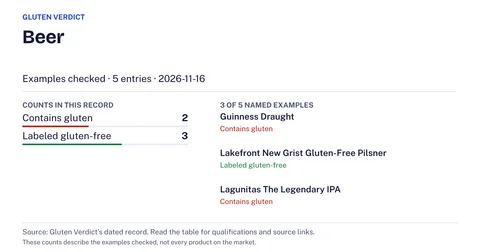 BeerDepends on the product2 of 5 products we checked contain gluten: Guinness Draught and Lagunitas The Legendary IPAchecked Nov 16, 2026
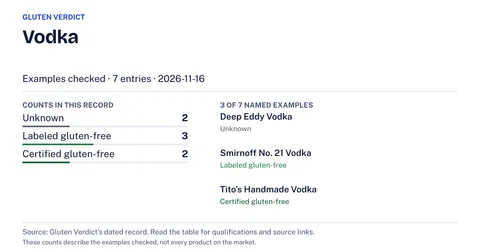 VodkaDepends on the productchecked Nov 16, 2026
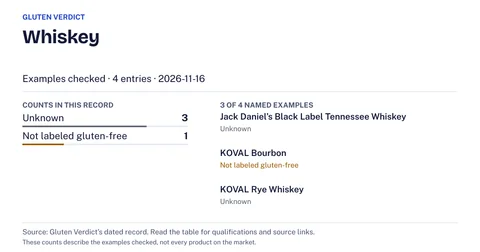 WhiskeyDepends on the productchecked Nov 16, 2026
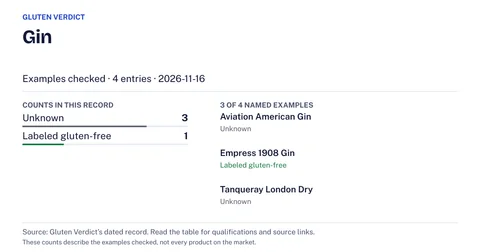 GinDepends on the productchecked Nov 16, 2026
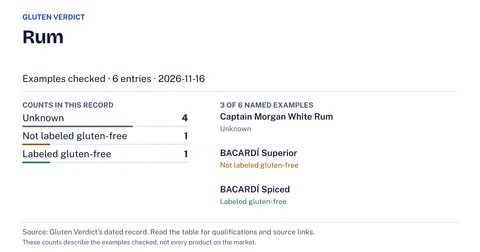 RumDepends on the productchecked Nov 16, 2026
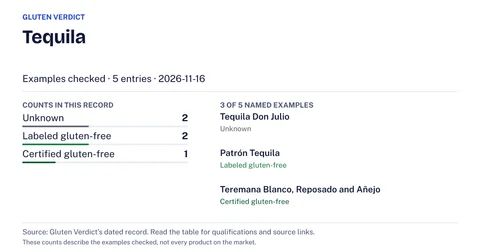 TequilaDepends on the productchecked Nov 16, 2026
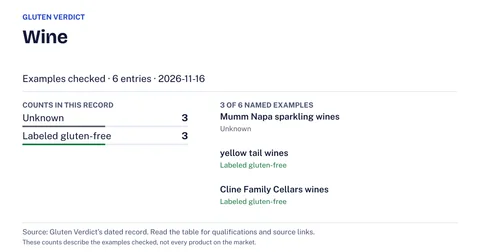 WineNaturally gluten-freechecked Nov 16, 2026
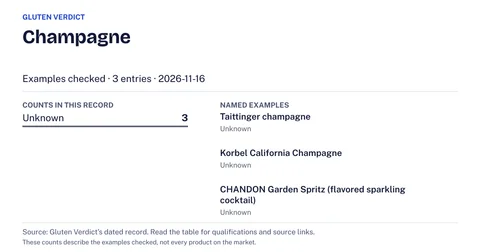 ChampagneNaturally gluten-freechecked Nov 16, 2026
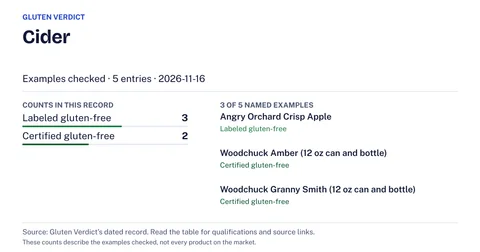 CiderNaturally gluten-freechecked Nov 16, 2026
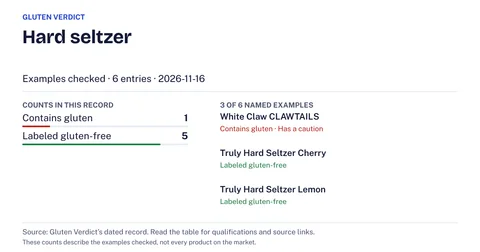 Hard seltzerDepends on the product1 of 6 products we checked contains gluten: White Claw CLAWTAILSchecked Nov 16, 2026
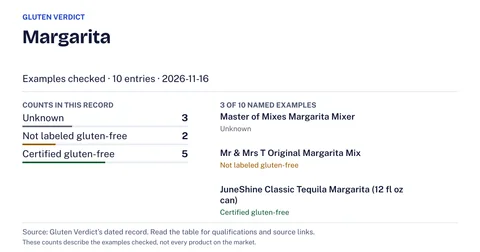 MargaritaDepends on the productchecked Nov 16, 2026
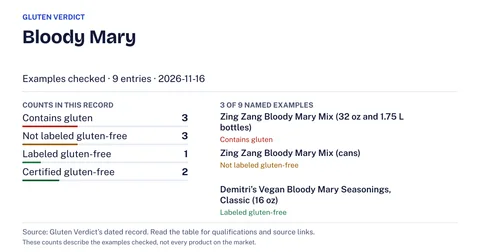 Bloody MaryDepends on the product3 of 9 products we checked contain gluten: Zing Zang Bloody Mary Mix (32 oz and 1.75 L bottles), Zing Zang Blazing Bloody Mary Mix (32 oz and 1.75 L bottles), and Mr & Mrs T Horseradish Bloody Mary Mixchecked Nov 16, 2026
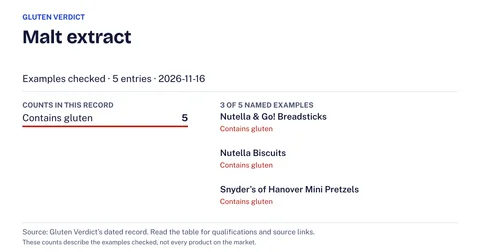 Malt extractContains glutenchecked Nov 16, 2026
Questions people ask
Is vodka made from wheat gluten-free?
The National Celiac Association considers distilled spirits free of gluten protein even if the starting material is wheat, barley or rye23. Since TTB’s 2020 ruling, the maker may also say gluten-free on such a spirit if good manufacturing practices keep gluten-containing material out of the final product10.
Can a beer brewed from barley be labeled gluten-free?
Only if it would qualify under FDA’s definition: TTB treats “gluten-free” as misleading on a drink that would not11. Such a beer may instead say it was processed, treated or crafted to remove gluten, with the required statement5. The National Celiac Association notes that state labeling can differ40.
Does “gluten-free” on alcohol mean zero gluten?
Not necessarily. TTB ties the claim to FDA’s definition3, in which any unavoidable presence of gluten must be below 20 parts per million (ppm)58. For fermented drinks, TTB agrees with FDA that there is currently no scientifically valid method to quantify the amount of gluten in fermented foods in terms of equivalent amounts of intact gluten protein59.
More in Drinks and alcohol
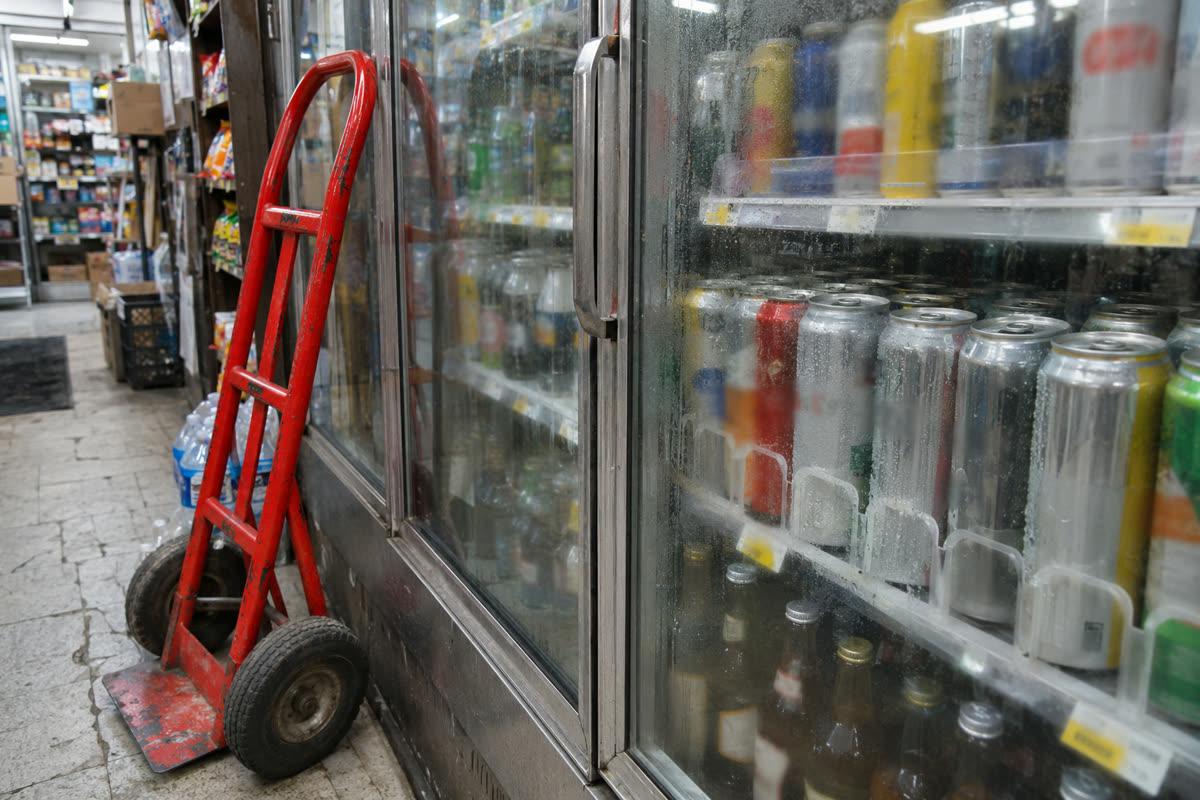 Cider, wine, hard seltzer and malt beverages: where barley can still show upHow to read a can for a malt base, and when cider, wine, hard seltzer and coolers need the maker’s own page to settle the barley question.
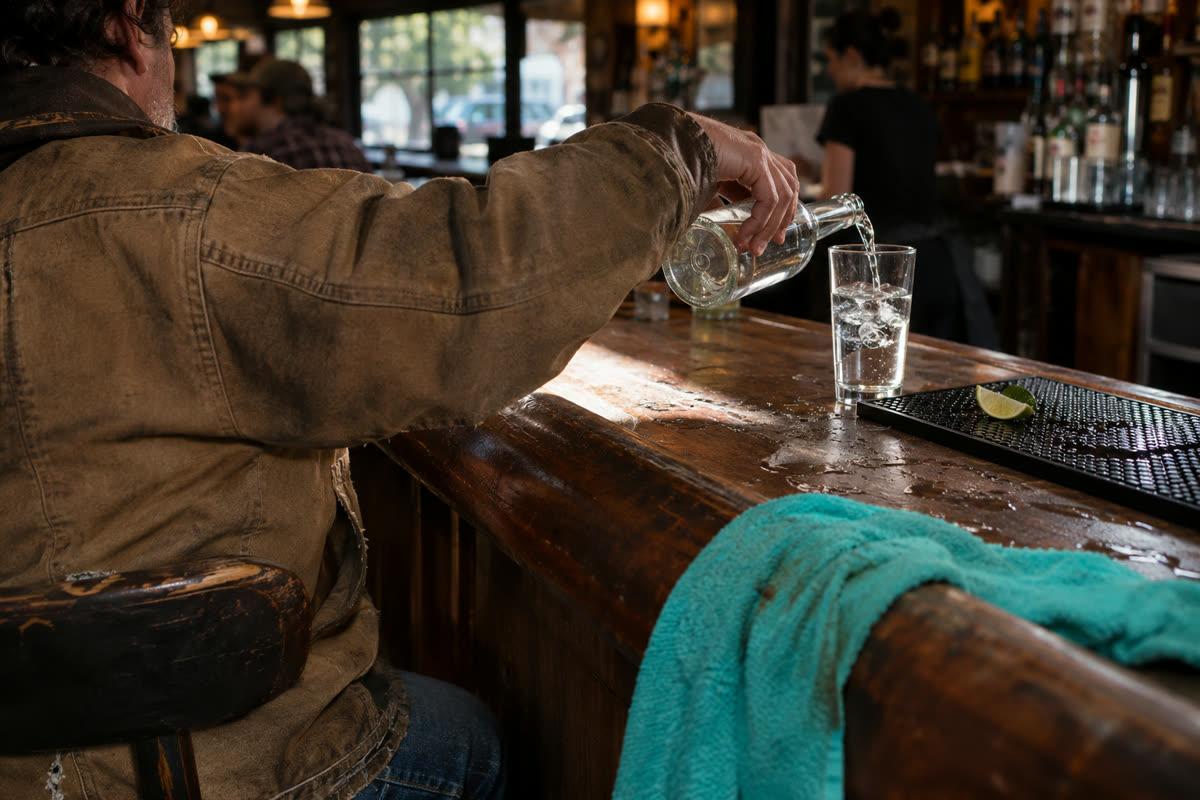 Alcohol and celiac disease: what a gluten-free label does and does not settleWhether a drink has gluten and whether alcohol suits a person with celiac disease are two questions. What the sources say, and what to ask a clinician.
 How to look up an alcohol label in TTB’s COLA registryAlcohol labels need not list every ingredient. How to find a bottle in TTB’s COLA registry, what it shows, and what the allergen rules do and do not cover.
 Whiskey, vodka and gin: what makers say about grain, distillation and added flavorsHow to read a maker’s gluten statement on vodka, whiskey and gin, tell plain bottles from flavored ones by label wording, and know what to ask.
 Cocktail mixers, bitters and rims: what can carry gluten besides the spiritTake a cocktail apart: spirit, mixer, bitters, beer, rim and garnish. See what makers and charities say about each, and what to ask the bar.
 Tequila, rum and brandy: what to check on the bottle for glutenHow to read mixto, spiced, flavored and aged tequila, rum and brandy labels for gluten, and what to ask the maker before you buy.
Related guides
 Gluten-removed beer: what the treatment does, why the tests are disputed and what the TTB statement saysWhat “crafted to remove gluten” means on a barley beer, why lab results on it are disputed, and what TTB, NCA and GIG say, for your clinician talk.
 “Low gluten”, “gluten removed” and “gluten friendly” on a labelWhat “low gluten”, “gluten removed” and “gluten friendly” mean on a US label, which phrases FDA or TTB define, and what to ask the maker.
 Who regulates a gluten-free claim: FDA, USDA or TTBWhich agency sets the rules for a gluten-free claim on packaged food, meat, eggs, beer, wine and spirits, and what to check when a label is unclear.
 Reading US gluten-free labels as a visitor from the UK, EU, Canada or AustraliaWhat a US gluten-free claim, the Contains line, malt and alcohol labels mean if you are used to UK, EU, Canadian or Australian labels.
Sources
- [1, 2, 8, 9, 14, 28, 30, 31, 33, 56] US Food and Drug Administration, Questions and Answers on the Gluten-Free Food Labeling Final Rule, checked Nov 17, 2026.
- [3, 4, 5, 10, 11, 16, 21, 25, 26, 32, 35, 47, 58, 59] Alcohol and Tobacco Tax and Trade Bureau (TTB), TTB Ruling 2020-2: Gluten Content Statements in the Labeling and Advertising of Wine, Distilled Spirits, and Malt Beverages, checked Nov 17, 2026.
- [6, 7, 12, 15, 17, 18, 23, 24, 34, 38, 39, 40, 41, 43, 44, 49] National Celiac Association, Alcohol on the Gluten-Free Diet, checked Nov 17, 2026.
Read on 2026-11-17: the list headed “Fermented Alcohols That Are Considered Gluten Free” names wine; true hard cider; and labeled gluten-free beer (made without malted barley).
Read on 2026-11-17: the list headed “Fermented Alcohols That Are Not Considered Gluten Free” names beer and other malted beverages (ale, porter, stout); sake/rice wine made with barley malt; flavored hard cider containing malt; flavored hard lemonade containing malt; and flavored wine coolers containing malt or hydrolyzed wheat protein.
Read on 2026-11-17: the list headed “Distilled alcohols include:” names pure distilled spirits such as vodka, gin, whisky, brandy, rum, and tequila; flavored spirits, such as flavored vodka and flavored gin; and liqueurs and cordials.
- [13, 19, 20, 51] Alcohol and Tobacco Tax and Trade Bureau (TTB), Major Food Allergen Labeling for Wines, Distilled Spirits, and Malt Beverages (FAQs), checked Nov 17, 2026.
- [22, 27, 29, 36, 37, 48, 52, 53] Gluten Intolerance Group, Does Fermentation or Distillation Make a Product Gluten-Free?, checked Nov 17, 2026.
- [42] Guinness (Diageo), US site, Guinness Draught, checked Nov 17, 2026.
Read on 2026-11-17: the list headed “Ingredients” names Water, Malted Barley, Barley, Roasted Barley, Hops, Nitrogen and Yeast; the page has no gluten statement.
- [45] Grey Goose (Bacardi), Frequently Asked Questions about Cocktails and Vodka, checked Nov 17, 2026.
- [46] Tito’s Handmade Vodka, Contact & FAQs, checked Nov 17, 2026.
- [50] National Celiac Association, Is wine OK on the gluten-free diet?, checked Nov 17, 2026.
- [54] White Claw, Is White Claw® Hard Seltzer gluten free?, checked Nov 17, 2026.
- [55] White Claw, Are CLAWTAILS™ by White Claw® gluten free?, checked Nov 17, 2026.
- [57] Zing Zang, Zing Zang FAQ, checked Nov 17, 2026.