How to look up an alcohol label in TTB’s COLA registry
Short answer
TTB’s Public COLA Registry lets anyone view a drink’s approved label images without an account2, 3, but the label need not list every ingredient, because TTB has stated that the Federal Alcohol Administration Act does not require a full list31. Allergen statements are voluntary under the rules TTB describes19, 20, and wheat is on TTB’s allergen list while barley and rye are not22.
Part of Drinks and alcohol, 18 guides

Key points
- Distilled spirits, wines of 7% to 24% alcohol by volume and malt beverages (for example, beers with both malted barley and hops) need a COLA when sold in interstate commerce5, 6; wines under 7% and beers without both malted barley and hops do not8.
- Registry images exist for COLAs issued from 1999 and are generally available 48 hours after approval3.
- Allergen disclosure is voluntary today19, 20; TTB has proposed making it mandatory24.
- A voluntary “Contains” line must list every major allergen used, including fining agents21.
Why an alcohol label may have no ingredient list
TTB, the Alcohol and Tobacco Tax and Trade Bureau, says its labeling regulations are written to give consumers “adequate information” about the product’s identity and quality, to prohibit false or misleading statements and to provide information on alcohol content12. The requirements of the Federal Alcohol Administration Act (FAA Act) and its implementing regulations vary for distilled spirits, wines and malt beverages9. In a January 2024 notice, TTB stated that the FAA Act does not require alcohol beverage labels to disclose a full list of ingredients31.
The same notice says TTB regulations do require disclosure of certain specified ingredients: FD&C Yellow No. 5, cochineal extract or carmine, sulfites at ten or more parts per million, and a warning statement when aspartame is present36. None of those is gluten, and none of the TTB pages we read describes a full ingredient list as a label requirement.
A drink that needs no COLA, such as a wine under 7% alcohol by volume or a beer without both malted barley and hops, may still be subject to other federal labeling requirements, including the Federal Food, Drug, and Cosmetic Act administered by FDA8.
That is a reading of the pages listed under Sources, not a legal opinion. A label can carry more than the rules require: makers may add voluntary statements.
What a COLA is and which drinks need one
A COLA is a Certification/Exemption of Label/Bottle Approval. Alcohol producers must apply for one and follow TTB’s labeling and advertising regulations1. Approval is required for products that fall under the Federal Alcohol Administration Act5, which TTB lists as distilled spirits, wines with 7% to 24% alcohol by volume, and malt beverages (for example, beers with both malted barley and hops) when sold in interstate commerce6.
Two exceptions explain why a bottle might have no COLA. Distilled spirits and wines of 7% to 24% sold only within the state where they are bottled may qualify for a certificate of exemption instead, and malt beverages sold only within one state need neither7. Wines under 7% and beers without both malted barley and hops need no COLA at all8.
Every approved label has to be truthful, not misleading and carry all mandatory information9.
How to find a label in the public registry
The Public COLA Registry is a TTB database of COLA information, including approved, expired, surrendered or revoked approvals, and no registration or password is needed to use it2.
- Open TTB’s COLA Public Registry page and use its “Search the Public COLA Registry” button, which opens the registry itself4.
- Enter what you know about the bottle. The search form has fields for a date range, a product name (brand name, fanciful name or either), a product class or type and an origin code33. If you know a COLA’s TTB ID number, nothing else is needed; for any other search you must enter dates, the range may not exceed 15 years, and the percent sign (%) works as a wildcard in any field except the dates32. Try the brand name from the front label.
- Open a result and view the label images. Images are available for COLAs issued from 1999 to the present and are generally available 48 hours after approval; for COLAs before 1999 you may view data only3.
- Note the status of the approval (approved, expired, surrendered or revoked)2, and compare the image with the label on the bottle in your hand.
We read the registry’s search form on 2026-11-17 through a text-fetching tool and did not run a search, so we have not described the results screens. The steps above stick to what TTB’s pages and the form itself say.
What to read on an approved label
Look first for the class and type designation. A malt beverage label must carry one or, for specialty products, a fanciful name with a statement of composition14. On a distilled spirits label, the brand name, class or type designation and alcohol content must appear in the same field of vision15.
| Item | What TTB’s guidance says |
|---|---|
| Class and type | Malt beverages must state one or, for specialty products, a fanciful name plus a statement of composition14 |
| Brand, class or type, alcohol content (spirits) | Must appear in the same field of vision15 |
| Color additives | FD&C Yellow No. 5, cochineal extract and carmine must be named if present16 |
| Sulfites (malt beverages) | Declaration mandatory at 10 or more ppm sulfur dioxide17 |
| Aspartame (malt beverages) | Declaration must appear if the beverage contains aspartame18 |
Class and type is also where a product’s formulation can show. For distilled spirits that need a TTB-approved formula, TTB says certain parts of a label, including class and type, are determined by the product’s formulation11. Some drinks need an approved formula first, including products with added flavors, colors or artificial sweeteners10.
For the labels themselves, TTB links guides to reading a wine, malt beverage and distilled spirits label13.
Gluten statements on a label
TTB allows “gluten-free” on an alcohol label when the product would qualify under FDA’s definition26, and on a spirit distilled from gluten-containing grains when good manufacturing practices keep gluten-containing material out of the final product27. A fermented product that was processed to remove gluten may say so only with this qualifying statement beside it: “Product fermented from grains containing gluten and [processed or treated or crafted] to remove gluten. The gluten content of this product cannot be verified, and this product may contain gluten.”28 TTB also requires the maker to submit a detailed description of the removal method with the label application for that claim29. Our guide to what US alcohol labels may say about gluten goes through each drink type.
What alcohol labels must say about allergens today
TTB’s allergen FAQ says current regulations do not require major food allergens to be disclosed on alcohol labels19. Makers may declare them but need not20.
If a maker does choose to list allergens, the rule is all or nothing. The declaration is the word “Contains” and a colon followed by the source of each major food allergen, and if any one is declared, all major food allergens used in production, including fining or processing agents, must be listed21. Adding such a statement to an approved label requires a new COLA application23, so an older approval in the registry may predate a statement on today’s bottle.
Wheat is on TTB’s list of major food allergens. Barley and rye are not on that list, which names milk, egg, fish, crustacean shellfish, tree nuts, wheat, peanuts and soybeans22. So a voluntary “Contains” line, where one is present, must name wheat if wheat was used in production21, 22, but it would not name barley or rye, because neither is on the list22.
A change is proposed but not in force on the pages we read. In January 2025 TTB published Notice No. 238, which would require labels to declare major food allergens, adding sesame to the list24. TTB later extended the comment period to August 15, 202525. The allergen FAQ page we read on 2026-11-17, last updated October 23, 2026, still describes disclosure as not required19.
What the registry cannot tell you
- A recipe or formula. The registry is described as a database of COLA information2. A product that needs an approved formula must get it before applying for label approval, so it is a different step10, 34. The registry page does not say it contains formulas.
- A verified gluten level in a fermented drink. A fermented product processed to remove gluten must carry a statement that its gluten content “cannot be verified”28, and TTB considers a label statement about the specific level of gluten in a fermented finished product, such as “contains x ppm”, misleading when it has no appropriate basis or necessary qualification30.
- Whether your bottle matches the image. The registry holds images of approved labels, generally available 48 hours after approval3, and TTB’s approval guidance says a maker may not need to send in the revised label for some changes to an approved label35. Compare the wording on the image with the bottle you hold.
For what we found about particular drinks, see our verdicts for beer, wine, whiskey, vodka, hard seltzer and kombucha. A label that says only “natural flavors” is covered in natural flavors.
When to ask the maker, and what to ask
When the registry shows a label and no allergen or gluten statement, the maker is the one to ask what went into the drink. Ask in writing so you have the answer on record. Useful questions, all for the maker to answer rather than TTB:
- Which grains, malts or other ingredients go into this product, and are any added after distillation or fermentation?
- If it is distilled, what protects the finished product from gluten-containing material after distillation?
- Is the product or its filtering or fining agents made with wheat, barley or rye?
- If the label says “gluten-free” or “processed to remove gluten”, what is the basis for the claim?
Our guide to what to ask a manufacturer about gluten has a fuller list and how to read the reply.
Verdicts in this guide
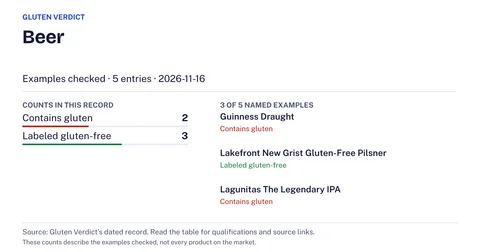 BeerDepends on the product2 of 5 products we checked contain gluten: Guinness Draught and Lagunitas The Legendary IPAchecked Nov 16, 2026
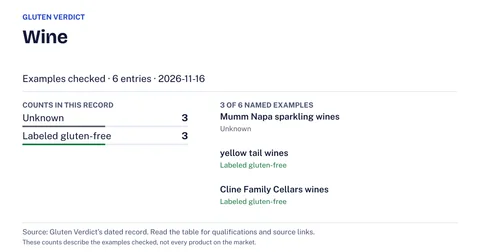 WineNaturally gluten-freechecked Nov 16, 2026
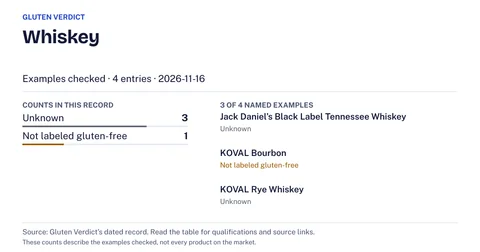 WhiskeyDepends on the productchecked Nov 16, 2026
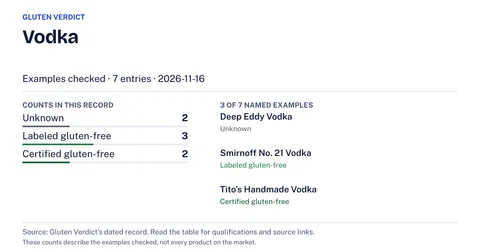 VodkaDepends on the productchecked Nov 16, 2026
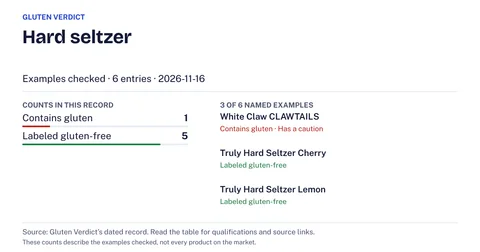 Hard seltzerDepends on the product1 of 6 products we checked contains gluten: White Claw CLAWTAILSchecked Nov 16, 2026
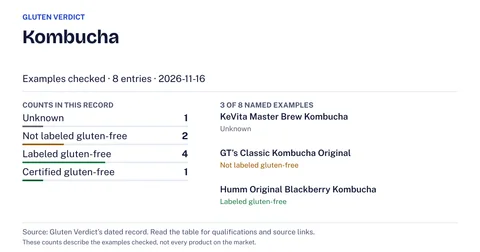 KombuchaDepends on the productchecked Nov 16, 2026
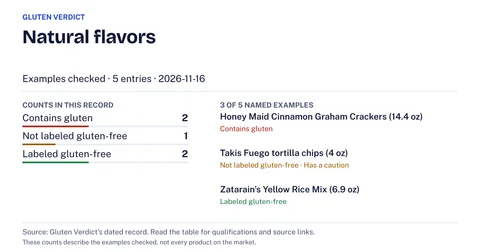 Natural flavorsDepends on the product2 of 5 products we checked contain gluten: Honey Maid Cinnamon Graham Crackers (14.4 oz) and Chex Mix Sour Cream & Onionchecked Nov 16, 2026
Questions people ask
Do I need an account to search the TTB COLA registry?
No. TTB says no registration or password is required to use the Public COLA Registry2.
Do alcohol labels have to list wheat as an allergen?
Not under the regulations TTB’s allergen FAQ describes19. Makers may add a voluntary “Contains” statement20.
How far back do registry label images go?
Images can be viewed for COLAs issued from 1999 to the present; for earlier COLAs you may view data only3.
Can a whiskey be labeled gluten-free if it is distilled from grain?
TTB permits it when good manufacturing practices prevent gluten-containing material from entering the final product27.
More in Drinks and alcohol
 Alcohol and celiac disease: what a gluten-free label does and does not settleWhether a drink has gluten and whether alcohol suits a person with celiac disease are two questions. What the sources say, and what to ask a clinician.
 Gluten-free alcohol: what US beer, spirits, wine and cider labels may sayWhich US alcohol labels may say gluten-free, who sets the wording, and how beer, spirits, wine, cider and hard seltzer differ, each rule sourced.
 Liqueurs and cream liqueurs: what a maker’s page can and cannot tell youSplit a liqueur into base spirit, flavors, sugar and cream, read what each maker’s own page says about gluten, and know what to ask when it says nothing.
 Cider, wine, hard seltzer and malt beverages: where barley can still show upHow to read a can for a malt base, and when cider, wine, hard seltzer and coolers need the maker’s own page to settle the barley question.
 Whiskey, vodka and gin: what makers say about grain, distillation and added flavorsHow to read a maker’s gluten statement on vodka, whiskey and gin, tell plain bottles from flavored ones by label wording, and know what to ask.
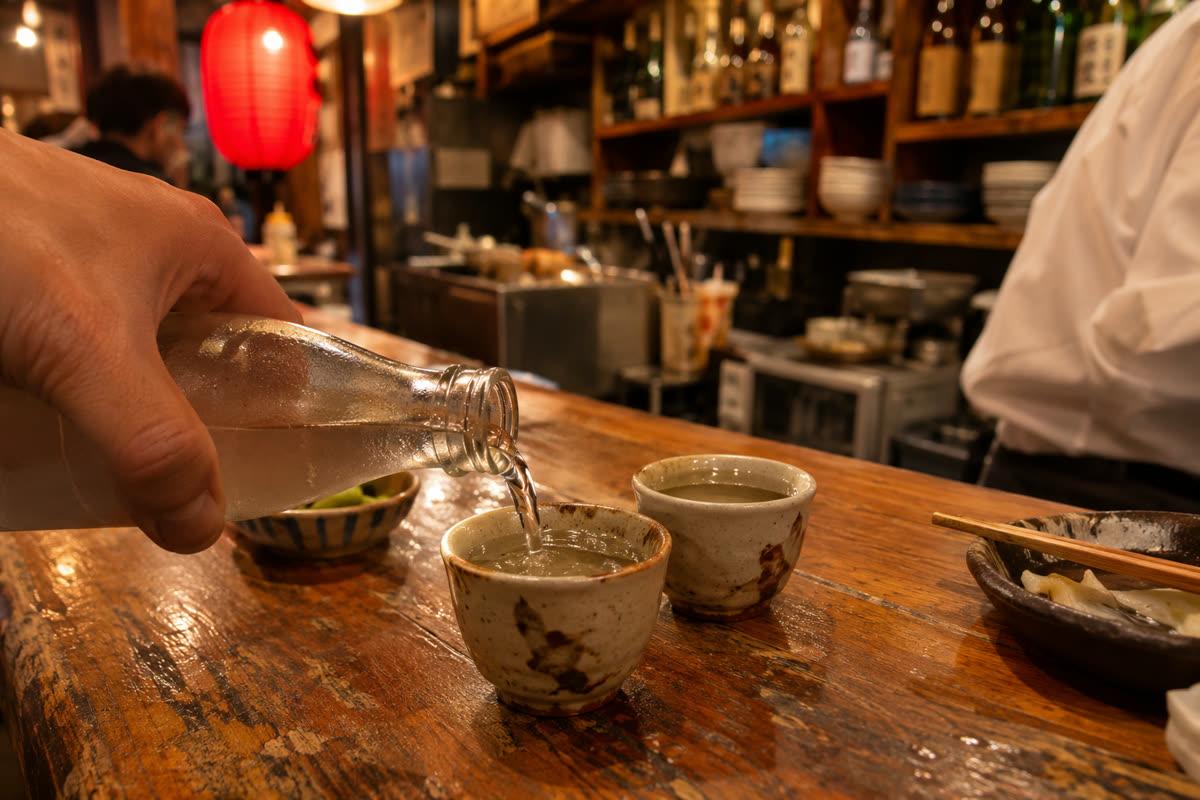 Sake, soju, mead and shochu: what each is made from and what to askWhat sake, soju, mead, shochu and makgeolli are made from, which come in grain-based versions, and what to ask a server or maker.
Related guides
 Who regulates a gluten-free claim: FDA, USDA or TTBWhich agency sets the rules for a gluten-free claim on packaged food, meat, eggs, beer, wine and spirits, and what to check when a label is unclear.
 What to ask a food maker about gluten, and how to read the replyHow to write to a food maker about gluten: what to include, questions that get a usable answer, and how to sort the reply.
 The Contains line names wheat, not barley or rye: what US allergen labels coverWhat the US allergen Contains line covers, why it names wheat but not barley or rye, and which ingredient-list names stand in for them.
 Reading US gluten-free labels as a visitor from the UK, EU, Canada or AustraliaWhat a US gluten-free claim, the Contains line, malt and alcohol labels mean if you are used to UK, EU, Canadian or Australian labels.
Sources
- [1] Alcohol and Tobacco Tax and Trade Bureau (TTB), Certificate of Label Approval (COLA), checked Nov 17, 2026.
- [2, 3, 4] Alcohol and Tobacco Tax and Trade Bureau (TTB), COLA Public Registry, checked Nov 17, 2026.
Read on 2026-11-17: the page has a button labeled “Search the Public COLA Registry” that opens the registry on ttbonline.gov, and a separate section, “What is COLAs Online?”, about the system producers use to apply.
- [5, 6, 7, 8, 9, 10, 34, 35] Alcohol and Tobacco Tax and Trade Bureau (TTB), TTB Label Approval Basics, checked Nov 17, 2026.
Read on 2026-11-17: the list under “The FAA Act applies to the following products when they are sold, shipped, or otherwise introduced in interstate commerce” names distilled spirits; wines that contain 7% to 24% alcohol by volume; and malt beverages (for example, beers that contain both malted barley, and hops).
- [11] Alcohol and Tobacco Tax and Trade Bureau (TTB), Distilled Spirits Formulas and Labels: What is the Connection?, checked Nov 17, 2026.
- [12, 13] Alcohol and Tobacco Tax and Trade Bureau (TTB), Alcohol Beverage Labeling and Advertising, checked Nov 17, 2026.
Read on 2026-11-17: under “Reading a Label” the page links to three guides headed “How to Read a Wine Label”, “How to Read a Malt Beverage Label” and “How to Read a Distilled Spirits Label”.
- [14] Alcohol and Tobacco Tax and Trade Bureau (TTB), Malt Beverage Labeling: Class and Type Designation, checked Nov 17, 2026.
- [15] Alcohol and Tobacco Tax and Trade Bureau (TTB), Distilled Spirits Labeling: Mandatory Label Information, checked Nov 17, 2026.
- [16] Alcohol and Tobacco Tax and Trade Bureau (TTB), Wine Labeling: Color Ingredient Disclosures, checked Nov 17, 2026.
- [17, 18] Alcohol and Tobacco Tax and Trade Bureau (TTB), Malt Beverage Labeling: Declarations (Sulfites and Aspartame), checked Nov 17, 2026.
- [19, 20, 21, 22, 23] Alcohol and Tobacco Tax and Trade Bureau (TTB), Major Food Allergen Labeling FAQs, checked Nov 17, 2026.
- [24] Alcohol and Tobacco Tax and Trade Bureau (TTB), TTB Proposes Mandatory Disclosures of Major Food Allergens and Alcohol Facts in the Labeling of Wines, Distilled Spirits, and Malt Beverages, checked Nov 17, 2026.
- [25] Alcohol and Tobacco Tax and Trade Bureau (TTB), TTB Extends Comment Period for 'Alcohol Facts' and Major Allergen Labeling Proposals for Alcohol Beverages, checked Nov 17, 2026.
- [26, 27, 28, 29, 30] Alcohol and Tobacco Tax and Trade Bureau (TTB), TTB Ruling 2020-2: Gluten Content Statements in the Labeling and Advertising of Wine, Distilled Spirits, and Malt Beverages, checked Nov 17, 2026.
- [31, 36] Alcohol and Tobacco Tax and Trade Bureau (TTB), via the Federal Register, Notice No. 232: Labeling and Advertising of Wine, Distilled Spirits, and Malt Beverages With Alcohol Content, Nutritional Information, Major Food Allergens, and Ingredients, checked Nov 17, 2026.
- [32, 33] Alcohol and Tobacco Tax and Trade Bureau (TTB), Public COLA Registry: Search for COLAs, checked Nov 17, 2026.
Read on 2026-11-17: under “Basic Search Criteria” the form lists Date Completed (From and To), Product Name (with the choices Brand Name, Fanciful Name or Either), Product Class/Type and Origin Code.