Reading US gluten-free labels as a visitor from the UK, EU, Canada or Australia
Short answer
Four things to know when you read a US label, in the order you meet them on a US shelf:
- The “gluten-free” claim is voluntary; on a food FDA regulates it comes with a limit of less than 20 parts per million of gluten1, 2.
- The allergen line names wheat, not barley or rye, so a pack with no wheat in its Contains line can still hold them3, 4.
- Barley can arrive in the ingredient list as malt, malt extract or malt flavoring5, 6.
- Most alcohol follows TTB8, which does not require an allergen line7, and meat and poultry follow USDA rather than FDA’s gluten-free rule8.
Part of Gluten-free labeling law by country, 12 guides
Key points
- A US “gluten-free” claim is voluntary: a maker may choose to use it2.
- “No gluten”, “free of gluten” and “without gluten” are held to the same rule as “gluten-free”9.
- The US allergen law names wheat among its major food allergens; the Celiac Disease Foundation notes barley and rye are not on the list3, 4.
- Beer, wine and spirits are mostly TTB products, and TTB’s allergen declaration is voluntary8, 7, 10.
- For a restaurant meal, FDA recommends rather than requires that a menu’s gluten-free claim match its definition11.
What a US gluten-free claim promises
“Gluten-free” is voluntary in the US: a maker may choose to use it, and when it does, FDA’s rule decides what the claim means2. FDA’s definition: the food is inherently gluten-free, or it contains no gluten-containing grain, no ingredient derived from one that has not been processed to remove gluten, and no processed-to-remove-gluten ingredient that brings the food to 20 parts per million (ppm) of gluten or more12. Any unavoidable presence of gluten has to be below 20 ppm, which the rule also writes as below 20 mg of gluten per kg of food13.
The rule treats wheat, rye and barley, and crossbred hybrids such as triticale, as the gluten-containing grains14. “No gluten”, “free of gluten” and “without gluten” are held to the same requirements, and a food using one of them without meeting the rule is deemed misbranded9. FDA says 20 ppm is the lowest level that can be reliably detected in foods using scientifically validated analytical methods15. For each country’s own limit and wording, see our labeling law by country tables.
Three details matter to a visitor. The rule reaches imported food: an imported food subject to FDA regulations that makes the claim must comply16. A state cannot set a different definition of the claim17. And oats can carry the claim when they contain less than 20 ppm, without any certification18.
A US pack can say both “Contains: wheat” and “gluten-free”. The rule allows it only when the word wheat carries a symbol that leads to this statement near the ingredients: “The wheat has been processed to allow this food to meet the Food and Drug Administration (FDA) requirements for gluten-free foods.”19 The rule’s own example of such an ingredient is wheat starch12.
A familiar brand does not settle it either. Our Cheerios and Oreo verdicts each separate the versions the maker calls gluten-free from the ones it does not.
What the Contains line covers, and what it leaves out
US allergen law gives a maker two ways to name a major allergen: a line starting “Contains”, printed right after or next to the ingredient list20, or the food source in parentheses after the ingredient’s name21.
Wheat is on the Act’s list of major food allergens3. The Celiac Disease Foundation notes that barley and rye are not on the list, that a lack of allergen labeling does not mean a product is gluten-free, and that the ingredients list should be checked for other hidden sources of gluten4.
| Where | What the rule names |
|---|---|
| United States | Wheat is a major food allergen; barley and rye are not on the list3, 4. |
| European Union | “Cereals containing gluten”: wheat, rye, barley, oats, spelt, kamut or their hybridised strains22. The name is emphasised in the ingredient list by a typeset such as font, style or background colour23. |
| United Kingdom | “Cereals containing gluten”: wheat (such as spelt and khorasan wheat), rye, barley, oats or their hybridised strains24. |
| Australia | Barley, oats and rye must be declared if they contain gluten, in the ingredients and with ‘gluten’ in the summary statement25. |
| Canada | Health Canada’s enhanced labelling rules cover priority allergens, gluten sources and added sulphites in prepackaged foods26. |
On a US pack, read the ingredient list itself rather than looking for a bold cereal name or a “gluten” summary line. It names each ingredient by its common or usual name, in descending order by weight27, but some ingredients can be declared as a class, spices and flavorings among them28.
Where barley and wheat can sit behind a plain word
These are label words that can carry barley, or wheat, without the plain grain name:
| Word on the label | What the sources say |
|---|---|
| Malt extract, malt syrup | FDA says both are derived from barley that has not been processed to remove gluten5. |
| Malt flavoring, malted barley flour, malt vinegar | The Celiac Disease Foundation lists them among the forms of malt6. FDA says malt vinegar cannot be used in a food that bears a gluten-free claim29. |
| Corn flakes, rice puffs | The Celiac Disease Foundation says they often contain malt extract or flavoring30. |
| Brown rice syrup | The Celiac Disease Foundation says it may be made with barley enzymes31. |
| Flavorings | A flavoring can be declared as a class28. A flavoring that contains a major food allergen, which includes wheat, is subject to the allergen labeling rule32, 3. |
| Soy sauce | FDA says that in general a soy sauce made from soybeans and wheat may not carry a gluten-free claim33. |
| Worcestershire sauce | Brand by brand: our verdict shows what each maker’s own page says. |
A voluntary line such as “made in a facility that also processes wheat” can appear on the same pack as a gluten-free claim, as long as it is truthful and not misleading34. Neither the line nor its absence replaces reading the ingredient list.
Which agency’s label you are reading
FDA’s gluten-free rule does not cover every product on a US shelf8.
| Product | Agency |
|---|---|
| Packaged foods, dietary supplements, fruits and vegetables, shell eggs and fish | FDA, and the gluten-free rule applies35. |
| Meat, poultry and certain egg products | USDA; FDA’s gluten-free rule does not apply8. |
| Most alcoholic drinks: all distilled spirits, wines of 7 percent alcohol by volume or more, and malted beverages made with both malted barley and hops | TTB; FDA’s gluten-free rule does not apply8. |
| Beers that are not malt beverages (FDA’s example is sorghum beer) and wines under 7 percent alcohol by volume | FDA36, 37. |
Beer, wine and spirits: mostly TTB’s rules, not FDA’s
Allergen lines work differently on alcohol that TTB regulates. TTB’s FAQ says current rules under the Federal Alcohol Administration Act do not require major food allergens to be disclosed on alcohol labels7. Makers may declare them but are not required to10, and TTB’s list of major food allergens names wheat, not barley or rye38.
TTB announced a proposal in January 2025 to require the disclosure; its list for the proposal is milk, eggs, fish, Crustacean shellfish, tree nuts, wheat, peanuts, soybeans and sesame39. That was a proposal when announced, so read the bottle in your hand rather than assuming either way.
TTB allows a “gluten-free” claim on alcohol when the product would qualify under FDA’s definition40. TTB’s ruling includes spirits distilled from gluten-containing grains, provided good manufacturing practices keep gluten-containing material out of the final product41. See our verdicts on whiskey and vodka.
A product fermented from gluten grains may instead say it was “processed”, “treated” or “crafted” to remove gluten, with a statement that its gluten content cannot be verified and that it may contain gluten42. Beer is most commonly made from malted barley or wheat43. That wording is not a gluten-free claim. Our beer verdict and gluten-removed beer guide go further.
Restaurants and take-away
FDA’s gluten-free regulation applies to packaged foods, and FDA says it shares complaints about unpackaged food, such as restaurant meals, with state and local government partners44. For restaurants that make a gluten-free claim on a menu, FDA recommends that the claim be consistent with its definition11.
So treat a menu line as the restaurant’s statement, and ask how the dish is made. Our guide to eating out lists the questions, and the french fries verdict shows how one plain-looking item varies.
A routine for the shop and the shelf
- Look for the claim. On a food FDA regulates it comes with the 20 ppm limit1.
- Read the whole ingredient list for malt, barley and rye, even when the Contains line shows no wheat4, 6.
- For alcohol, meat and poultry, remember FDA’s rule does not apply8: use the maker’s own statement and our verdicts.
- Check a label photo or pasted ingredients with our gluten scanner, or look up one food in every verdict, A to Z.
Verdicts in this guide
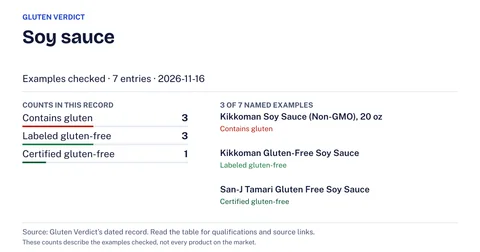 Soy sauceDepends on the product3 of 7 products we checked contain gluten: Kikkoman Soy Sauce (Non-GMO), 20 oz; San-J Organic Shoyu Soy Sauce; and Lee Kum Kee Premium Soy Sauce (No Preservatives Added)checked Nov 16, 2026
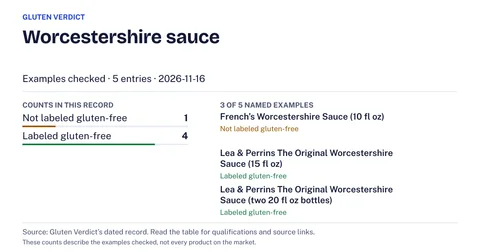 Worcestershire sauceDepends on the productchecked Nov 16, 2026
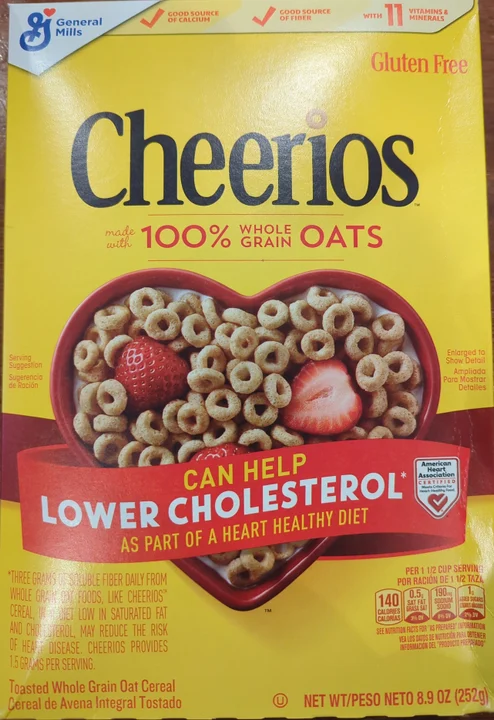 CheeriosLabeled gluten-freeWheat warning on 1 of 8 varieties we checkedGeneral Mills · checked Nov 16, 2026
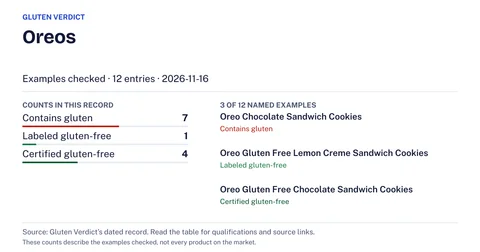 OreosContains glutenMondelēz International (Oreo) · checked Nov 16, 2026
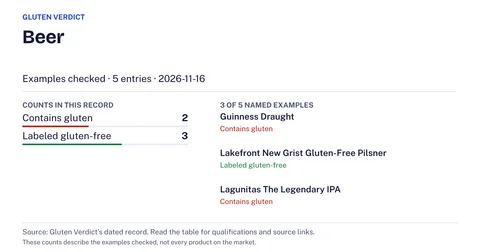 BeerDepends on the product2 of 5 products we checked contain gluten: Guinness Draught and Lagunitas The Legendary IPAchecked Nov 16, 2026
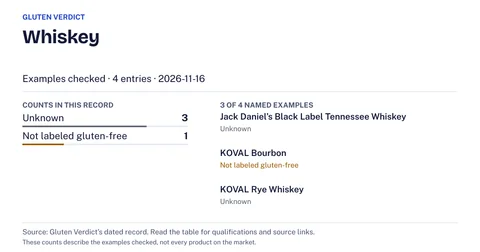 WhiskeyDepends on the productchecked Nov 16, 2026
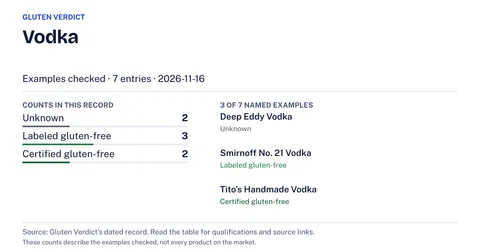 VodkaDepends on the productchecked Nov 16, 2026
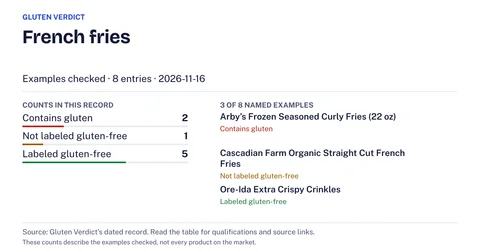 French friesDepends on the product2 of 8 products we checked contain gluten: Arby’s Frozen Seasoned Curly Fries (22 oz) and Checkers Frozen Crispy Seasoned Fries (28 oz)checked Nov 16, 2026
Questions people ask
Do US labels list barley and rye as allergens?
No. Wheat is on the Act’s list of major food allergens3, and the Celiac Disease Foundation notes that barley and rye are not4.
Does a US gluten-free pack ever say it contains wheat?
Yes, when the wheat was processed to meet the gluten-free rule; the rule requires a statement saying so19.
Is a “may contain wheat” line required in the US?
FDA describes such statements as voluntary advisory statements, and allows one on a pack that also says gluten-free if it is truthful and not misleading34.
More in Gluten-free labeling law by country
 Gluten-free labelling in Australia and New Zealand: what the claim meansWhat “gluten free” and “low gluten” mean on Australian and New Zealand packs: no detectable gluten, no oats, no malt, and how US packs compare.
 Gluten-free labeling in Canada: the claim, the gluten-source declaration and oatsHow Health Canada's gluten-free claim works, how gluten sources and oats must be declared on a Canadian pack, and how it differs from the FDA rule.
 May-contain labels abroad: what each country’s regulator says about themWhether a “may contain” or shared-facility line is required, voluntary or guided by a scheme in the US, UK, EU, Canada, Australia, New Zealand and Codex.
 Gluten-free oats by country: where the claim is allowed and where it is barredWhether oats can carry a gluten-free claim in the US, Canada, EU, UK, Australia and New Zealand, in each regulator’s own words.
 Gluten-free logos outside the US: who issues each one and what it requiresTell a certifier’s gluten-free logo from a maker’s own: who issues Crossed Grain, Coeliac Australia’s and Celiac Canada’s marks, and the limit each sets.
 Which gluten grains a pack’s allergen line must name, by countryWhether the allergen line must name barley, rye and oats, country by country: US, Canada, EU, UK, Australia and New Zealand, Brazil, Japan.
Related guides
 How to read a US food label for glutenWhere gluten shows up on a US food label: the gluten-free claim, the Contains line, the ingredient list and may-contain lines, and what each means.
 What “may contain wheat” and “made in a facility with wheat” mean on a US labelHow to read “may contain wheat”, shared-facility and shared-equipment lines on US labels, with and without a gluten-free claim, and what to check next.
 Gluten-free labeling rules by country: ceilings, claim wording and where no rule was foundLook up the gluten-free limit and claim wording for the US, Canada, EU, UK, Australia, New Zealand and more, each figure tied to the page we read.
 Where wheat, barley and rye hide in processed food: 15 places to checkFifteen processed foods where wheat, barley or rye turn up, the label step that catches each, and what US allergen law does and does not flag.
Sources
- [1, 2, 15, 35] US Food and Drug Administration, Gluten and Food Labeling, checked Nov 17, 2026.
- [3, 20, 21, 28, 32] US Food and Drug Administration, Food Allergen Labeling and Consumer Protection Act of 2004 (FALCPA), checked Nov 17, 2026.
- [4] Celiac Disease Foundation, Label Reading & the FDA, checked Nov 17, 2026.
- [5, 8, 11, 12, 16, 18, 29, 33, 34, 36, 43, 44] US Food and Drug Administration, Questions and Answers on the Gluten-Free Food Labeling Final Rule, checked Nov 17, 2026.
- [6, 30, 31] Celiac Disease Foundation, Sources of Gluten, checked Nov 17, 2026.
- [7, 10, 38] Alcohol and Tobacco Tax and Trade Bureau (TTB), Allergen Labeling FAQs, checked Nov 17, 2026.
- [9, 13, 14, 17, 19] eCFR (US Government Publishing Office), 21 CFR 101.91, Gluten-free labeling of food, checked Nov 17, 2026.
- [22, 23] European Union (EUR-Lex), Regulation (EU) No 1169/2011 on the provision of food information to consumers, checked Nov 17, 2026.
- [24] legislation.gov.uk, Regulation (EU) No 1169/2011, Annex II (UK version), checked Nov 17, 2026.
- [25] Food Standards Australia New Zealand, Allergen labelling (business guidance), checked Nov 17, 2026.
- [26] Health Canada, Food Allergen Labelling, checked Nov 17, 2026.
- [27] eCFR (US Government Publishing Office), 21 CFR 101.4, Food; designation of ingredients, checked Nov 17, 2026.
- [37, 40, 41, 42] Alcohol and Tobacco Tax and Trade Bureau (TTB), TTB Ruling 2020-2: Gluten Content Statements in the Labeling and Advertising of Wine, Distilled Spirits, and Malt Beverages, checked Nov 17, 2026.
- [39] Alcohol and Tobacco Tax and Trade Bureau (TTB), TTB Proposes Mandatory Disclosures of Major Food Allergens and Alcohol Facts (January 17, 2025), checked Nov 17, 2026.