Children’s medicines, gummies and liquids: reading the ingredients for gluten
Short answer
Which gluten rule covers a children’s product depends on whether it is sold as a drug or as a dietary supplement1, 2. Check that first, then read the matching list:
- A product with a Drug Facts label is a drug. FDA’s gluten-free food rule does not cover it, and its ingredients are listed under “inactive ingredients”1, 3.
- A product with a Supplement Facts panel is a dietary supplement. The gluten-free food rule covers it, and ingredients not named inside the panel are listed under “Other Ingredients”2, 4.
- Match the product to its label on DailyMed by name, maker and NDC number5, 6.
- If a name on the list is unclear, ask the pharmacist and the maker, as the Gluten Intolerance Group advises7.
Part of Medications, supplements and non-food products, 13 guides
Key points
- FDA’s gluten-free food rule covers dietary supplements but does not include medications2, 1, 51.
- On a drug, read “inactive ingredients” in the Drug Facts label; on a supplement, read “Other Ingredients”3, 4.
- FDA says it is aware of no oral drug product marketed in the United States with wheat gluten or wheat flour intentionally added as an inactive ingredient8; its draft guidance lists ingredients made from starch as potentially derived from wheat starch9.
- FDA’s draft guidance and a Gluten Intolerance Group bulletin list sweeteners such as dextrose, maltose and sorbitol differently, so those names are a question for the maker9, 10.
- FDA says the product name and maker on a DailyMed label should match the product you hold5.
Drug or supplement? The panel on the package tells you which rules apply
Which rules apply depends on whether the product is a drug or a dietary supplement, and the package shows which. A nonprescription drug carries a “Drug Facts” label3; a supplement carries a “Supplement Facts” panel11.
| Drug (Drug Facts label) | Dietary supplement (Supplement Facts panel) | |
|---|---|---|
| Where the ingredients are listed | “Inactive ingredients” on a nonprescription drug’s label; generally the “Description” section for a prescription drug3. | A list headed “Other Ingredients” when some ingredients are named inside the panel4; no ingredient statement is needed when every source ingredient is inside the panel and there are no other ingredients, such as excipients or fillers11. |
| FDA’s gluten-free food rule | Medications are not included1, 51. | Applies: the rule covers FDA-regulated packaged foods, including dietary supplements2. |
| FDA’s draft guidance on gluten in drugs | Recommends a label statement when it is truthful and properly supported12. | Does not apply to food, including dietary supplements13. |
A drug therefore has no gluten-free food claim to lean on, and the Gluten Intolerance Group (GIG) notes that most drug manufacturers do not clearly label gluten content on the product or its packaging1, 14.
FDA’s draft guidance is a recommendation, not a requirement: FDA says its guidance documents “do not establish legally enforceable responsibilities”15.
How to read the ingredient list on each kind of product
On a drug
FDA’s rule for nonprescription drug labels (21 CFR 201.66) says the Drug Facts label lists the established name of each inactive ingredient, in alphabetical order on an OTC drug that is not also a cosmetic16. An inactive ingredient is any component other than an active ingredient17. For a prescription drug, FDA says ingredients will generally be listed in the “Description” section of the labeling3.
On a supplement
FDA’s supplement labeling guide also uses the word “ingredient” for substances such as binders, colors, excipients, fillers, flavors and sweeteners18. Ingredients not named inside the Supplement Facts panel go under “Other Ingredients”, in descending order of predominance by weight4, 19.
A flavor can be declared as just “natural flavor” or “artificial flavor”20, so that line does not name a grain. Our verdict on natural flavors shows what charities say and what FDA-regulated food labels must declare.
A supplement with every ingredient inside the panel and no other ingredients, such as fillers, need not carry an ingredient statement at all11. The FDA labeling guide page we read is marked “Content current as of: 04/01/2005”21.
Ingredient names that deserve a second look
FDA says it is aware of no oral drug product marketed in the United States with wheat gluten or wheat flour intentionally added as an inactive ingredient8. Its draft guidance discusses starch and ingredients made from starch as ingredients that may be derived from wheat, and FDA notes that the starch used as a starting material is often corn or potato starch, not wheat starch9, 22.
FDA and GIG do not name the same ingredients. This table sets out each source’s own list:
| Name on the label | FDA draft guidance (oral drugs) | GIG bulletin |
|---|---|---|
| Modified starch, pregelatinized starch, sodium starch glycolate | Listed as potentially derived from wheat starch9. | Pre-gelatinized starch and sodium starch glycolate are on its list of excipients that could be derived from wheat or barley; modified starch is not named23. |
| Maltodextrin, dextrates | Listed among the starch hydrolysates potentially derived from wheat starch9. | Dextrates are on its could-be-derived list23; maltodextrin is on neither of its lists23, 10. |
| Dextrin, cyclodextrins, dextrimaltose | Not named24. | On its could-be-derived list23. |
| Dextrose, maltose | Listed among the starch hydrolysates potentially derived from wheat starch9. | On its list of common gluten-free pharmaceutical excipients10. |
| Sorbitol, mannitol, maltitol, xylitol | All four listed as sugar alcohols among the starch hydrolysates9. | The first three are on its common gluten-free list; xylitol is not named10. |
Where the two differ, a name on this list is a prompt to ask the maker which grain the ingredient comes from, not a verdict either way. FDA’s own statement is that if the list of ingredients does not mention wheat gluten or wheat flour, the product should not contain gluten in an amount that would harm a typical (non-refractory) individual with celiac disease25.
FDA’s page covers oral drug products in general; it does not mention children’s products, chewables, liquids or gummies26. It is marked “Content current as of: 12/12/2017”50.
Gummies and chewables
Neither FDA’s “Medications and Gluten” page nor GIG’s page on medications and supplements mentions gummies or chewables26, 27. The rules above apply according to how the product is sold.
If it is sold as a supplement, the gluten-free food rule covers it, so a “gluten-free” claim has to meet the same definition as on any other food, including a limit of less than 20 parts per million2, 28. GIG says gluten is more prevalent in supplements than in medications29, and that for supplements not labeled or certified gluten-free, you should read the label for the ingredients used30.
If it is sold as a drug, there is no gluten-free food claim to look for, and the list to read is “inactive ingredients”1, 3.
Our verdicts for names you may want to look up from a gummy’s list: glucose syrup, modified food starch and natural flavors. They are written for foods. For how one gummy product varies by brand, see gummy bears (candy, not vitamins).
Liquids, syrups and flavors
GIG says elixirs generally do not contain gluten31. That line sits in its supplements section, so treat it as a general statement and ask the maker about a particular product.
FDA’s draft guidance discusses two ingredients by name that can be made by fermentation, citric acid and ethanol: the fermentation may use plant carbohydrates that potentially include wheat32, and whether small amounts of gluten remain depends on how the ingredient is purified33. It adds that gluten is unlikely in ethanol purified by distillation using good manufacturing practices34.
One study looked at the excipient lists of 308 medicines authorized in Portugal, a mix of pediatric and adult products rather than children’s medicines alone35, 36. It reported that, among analgesics and antipyretics, 40% of the liquid oral formulations contained gluten, and that among NSAIDs gluten was mainly present in liquid oral dosage forms, at 26.7%37.
Read those figures with the study’s method in mind. A product was classed as not gluten-free when its excipients included any on the study’s list of excipients that may contain gluten or soy derivatives38, 39, and the study relied only on the composition information in each product’s summary of characteristics40. It counts ingredient names, not gluten, and it is a Portuguese sample, not a US one.
A step-by-step read, from the package to DailyMed
- Write down the product name, the maker and the NDC number. DailyMed says the NDC can be found on the outside packaging of the drug6.
- Find the panel: Drug Facts on a nonprescription drug3, Supplement Facts on a supplement11.
- Read “inactive ingredients” (drug) or “Other Ingredients” (supplement) against the names in the table above16, 4.
- Look the product up on DailyMed, which holds the most recent labeling that companies have submitted to FDA41 and includes dietary supplements as well as drugs42. Check that the name and manufacturer on the DailyMed label match your package5; the same drug may be made by many manufacturers6.
- If you find no label, treat the question as unanswered: DailyMed does not hold a complete listing of labeling43.
DailyMed’s help page lists inactive ingredient among the types of information that can be searched, next to active ingredient44.
Who to ask, and what to ask
GIG advises consulting the pharmacist and/or checking with the manufacturer when you have doubts about a medication’s gluten-free status7. FDA encourages drug makers to keep accurate information on the sources of their ingredients so they can answer questions from the public and health care providers45.
Questions that follow from the table above, in our own wording:
- Does this product contain any starch, or an ingredient made from starch? Which grain is it made from?
- For a sweetener or a flavor, which ingredient is it, and from which source?
- Does the labeling carry the statement FDA recommends, “Contains no ingredient made from a gluten-containing grain (wheat, barley, or rye).”12 (It is a recommendation, not a requirement.)
- Has the formula changed since the label I am reading?
Coeliac UK, a UK charity, says prescribed medications should only be taken or stopped under medical advice46. It also says that in the UK a medicine containing wheat starch will say so on its label and patient information leaflet47. GIG describes its pages as educational and asks readers to consult their healthcare team48.
For a school or camp form, copy the product name, the maker and the NDC number from the package so staff can look up the same label. Our guides to a 504 plan for celiac disease and a school plan for teachers cover the paperwork.
Verdicts in this guide
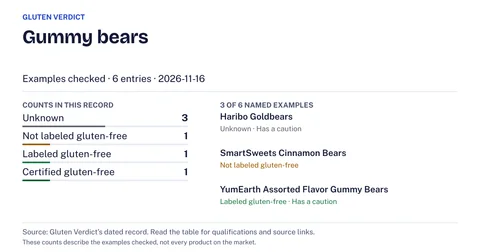 Gummy bearsDepends on the productchecked Nov 16, 2026
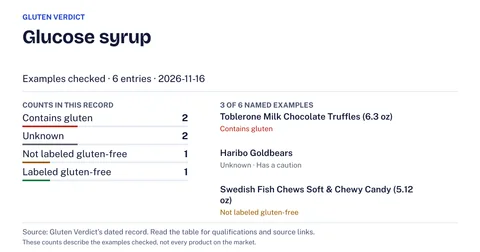 Glucose syrupNaturally gluten-free2 of 6 products we checked contain gluten: Toblerone Milk Chocolate Truffles (6.3 oz) and Darrell Lea Original Black Licorice (7 oz)checked Nov 16, 2026
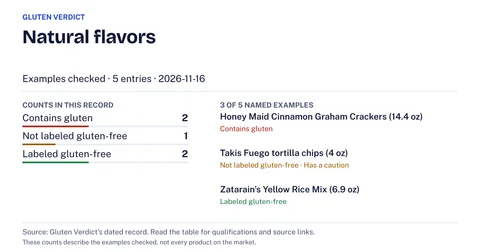 Natural flavorsDepends on the product2 of 5 products we checked contain gluten: Honey Maid Cinnamon Graham Crackers (14.4 oz) and Chex Mix Sour Cream & Onionchecked Nov 16, 2026
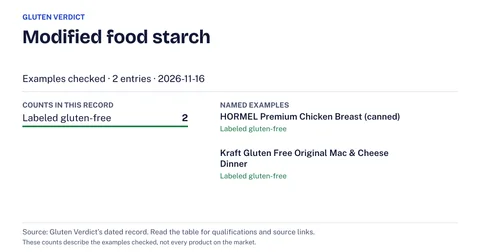 Modified food starchDepends on the productchecked Nov 16, 2026
Questions people ask
Do children’s medicines carry a gluten-free label?
FDA’s gluten-free labeling regulation covers food, and medications are not included in it1, 51. FDA’s draft guidance recommends that makers add “Contains no ingredient made from a gluten-containing grain (wheat, barley, or rye).” when it is truthful and properly supported12, and that guidance is a recommendation15.
Does the gluten-free rule cover gummy vitamins?
It covers dietary supplements, because the rule applies to FDA-regulated packaged foods including them2. A product sold as a drug is outside it1, 51. The panel on the package, Supplement Facts or Drug Facts, shows which you are holding11, 3.
More in Medications, supplements and non-food products
 How to read a supplement label for glutenWhere gluten can hide on a US supplement label: the Supplement Facts panel, the Other Ingredients list and the allergen line, and what each leaves out.
 How to check a medicine for gluten, from the bottle to the makerFind your exact medicine by NDC in DailyMed, read its inactive ingredients, compare refills, and ask the maker about starch names the label leaves open.
 What gluten wording on an over-the-counter medicine box meansFind the inactive-ingredient line in Drug Facts and see what each kind of gluten wording on an OTC medicine box has behind it, from silence to a mark.
 Gluten in medications: what the label, DailyMed and a pharmacist can showFDA’s gluten-free food rule does not cover drugs. Use the ingredient list, DailyMed, the maker and a pharmacist, and know what each can show.
 Are vitamins gluten-free? What a bottle’s claim, mark and ingredient list showWhat “gluten-free” on a vitamin bottle rests on (FDA rule, certifier listing or nothing) and how to read Other Ingredients for binders and fillers.
 Gluten and vaccines: how to read the ingredient information yourselfFind a vaccine’s FDA package insert and ingredient list, see what two inserts name, and learn what the lists cannot show.
All 13 guides in Medications, supplements and non-food products
Related guides
 Celiac disease symptoms in children, and who pediatric guidelines say to testTypical and less typical celiac signs in children, who pediatric guidelines say to test, and why the child keeps eating gluten until testing ends.
 Wheat, barley and rye on an ingredient list: the names to look forLook up wheat, barley and rye names on a US ingredient list, from durum to malt, and sort each as contains gluten, depends on the maker, or lookalike.
 Reading the label of a flavored syrup, sauce or cookie topping for glutenHow to read coffee and bar syrup, sauce and cookie-topping labels for gluten, and what Torani, Monin and DaVinci Gourmet say on their own pages.
 Still having symptoms on a gluten-free diet? Where gluten can still get inA checklist of label, kitchen, restaurant, product and medicine sources of gluten, and what the sources say about when to see a doctor.
Sources
- [1, 7, 14, 27, 29, 30, 31, 48] Gluten Intolerance Group, Are Your Medications and Supplements Gluten-Free?, checked Nov 17, 2026.
Read on 2026-11-17: the text on medications and supplements does not mention children, chewables, gummies, syrups or liquid medicines; it says once that elixirs generally do not contain gluten.
- [2, 28, 51] US Food and Drug Administration, Questions and Answers on the Gluten-Free Food Labeling Final Rule, checked Nov 17, 2026.
- [3, 5, 8, 12, 22, 25, 26, 45, 49, 50] US Food and Drug Administration, Medications and Gluten, checked Nov 17, 2026.
Read on 2026-11-17: the page, which covers oral drug products in general, does not mention children, chewables, liquids, syrups, gummies, vitamins or supplements.
Read on 2026-11-17: the page is marked “Content current as of: 12/12/2017”.
- [4, 11, 18, 19, 20, 21] US Food and Drug Administration, Dietary Supplement Labeling Guide: Chapter V, Ingredient Labeling, checked Nov 17, 2026.
- [6, 44] US National Library of Medicine, DailyMed help: search and NDC codes, checked Nov 17, 2026.
Read on 2026-11-17: the table headed “Current types of information that can be searched include:” lists INGREDIENT (“Active Ingredients contained in the drug”) and INACTIVE INGREDIENT (“Inactive Ingredients contained in the drug”).
- [9, 13, 15, 24, 32, 33, 34] US Food and Drug Administration, Gluten in Drug Products and Associated Labeling Recommendations (draft guidance, December 2017), checked Nov 17, 2026.
Read on 2026-11-17: the draft guidance does not name dextrin, cyclodextrins or dextrimaltose.
- [10, 23] Gluten Intolerance Group, Medications and the Gluten-Free Diet (educational bulletin), checked Nov 17, 2026.
Read on 2026-11-17: the list headed “Common Gluten-Free Pharmaceutical Excepients” [sic] names, among others, dextrose, glucose, fructose, maltose, mannitol, sorbitol, “Matitol” [sic, for maltitol], sucrose, lactose, xanthan gum, vanillin and microcrystalline cellulose; it does not name maltodextrin or xylitol.
Read on 2026-11-17: the list headed “Excipients which could be derived from wheat or barley” names starch, pre-gelatinized starch, dextrimaltose, dextrin, dextrates, cyclodextrins and sodium starch glycolate.
- [16, 17] eCFR, 21 CFR 201.66 Format and content requirements for over-the-counter (OTC) drug product labeling, checked Nov 17, 2026.
- [35, 36, 37, 38, 39, 40] Scientific Reports (Figueiredo et al., 2025), Presence of gluten and soy derived excipients in medicinal products, checked Nov 17, 2026.
- [41, 42, 43] US National Library of Medicine, DailyMed home page: About DailyMed, checked Nov 17, 2026.
- [46, 47] Coeliac UK, Medication and coeliac disease, checked Nov 17, 2026.