Ordering a gluten-free birthday cake: what to ask the bakery
Short answer
Ask the bakery to describe how it makes a gluten-free order, because FDA says its gluten-free rule applies to packaged foods1 and gluten can reach food at any stage of preparing or serving it2. Four things to ask about:
- What goes in: the cake, the filling and the frosting, and a look at the package of any ingredient you are unsure about3.
- Flour and equipment: where the wheat flour is handled while the cake is made, and whether bowls, pans, sifters and knives are cleaned or kept for gluten-free work4, 5, 6.
- Cutting and boxing: who decorates, cuts and boxes the cake, and with which utensils7.
- The answer itself: the Gluten Intolerance Group (GIG) describes staff who answer what they know, admit when they do not, and get accurate answers from the kitchen8.
Part of Holidays, weddings and celebrations, 16 guides
Key points
- A packaged cake labeled gluten-free has to comply with FDA’s rule, which requires any unavoidable gluten to be below 20 parts per million9, 10. FDA says that rule applies to packaged foods1; for a cake made to order, the bakery’s description of its process is what you can check.
- One study that collected 130 samples from 25 bakeries in Brasília, Brazil reported contamination in 21.5% of the gluten-free bakery products it sampled11, 12. It is a single study outside the US, and a reason to ask, not a verdict on any bakery.
- In a pilot study by Coeliac UK researchers, a test dish needed to be 2 metres from wheat flour in use to stay at or below 20 ppm after four hours of flour use4.
- For an event where you do not know the host very well, GIG suggests bringing your own gluten-free food13. For events with baked goods, it describes a batch of cupcakes frozen one by one, with a few defrosted and frosted just before the event14.
Bakery, labeled packaged cake or your own: how to choose
Cakes are among the foods that typically contain gluten15. A gluten-free cake therefore depends on how it is made. There are three routes, and each rests on a different kind of evidence.
| Route | What you rely on | What to do |
|---|---|---|
| A bakery that also bakes wheat cakes | The bakery’s description of its process. FDA’s Q&A says its regulation applies to packaged foods and does not mention bakeries or cakes made to order1, 37. | Call ahead and ask the questions below16. |
| A packaged cake labeled gluten-free | FDA’s rule: a food whose label bears the claim must comply with it9. A voluntary advisory statement such as “made in a facility that also processes wheat” can sit beside the claim if it is truthful and not misleading17. | Read the whole label. Our guide to how to read a US food label for gluten walks through where to look. |
| A cake or cupcakes you bring from home | Your own kitchen and ingredients. GIG suggests bringing your own gluten-free food to an event when you do not know the host well13. | Make a batch ahead. GIG describes freezing cupcakes one by one and frosting a few just before the event14. |
Bakeries differ, and so does the evidence about them. One study that collected 130 samples from 25 bakeries in Brasília, Brazil reported contamination in 21.5% of the gluten-free bakery products sampled, and 64% of the bakeries sold at least one contaminated product in its sample11, 12. It is a single study outside the US, so read it as a reason to ask the questions below, not as a ruling on any bakery.
The questions to ask the bakery
Call ahead and ask to speak to a manager or the person who bakes. Coeliac UK’s eating-out tips say to call ahead and ask to speak to a manager or a chef16. These questions come from the charities’ eating-out guidance and from the one flour study we found; ask the ones that fit the bakery.
- How do you handle gluten-free orders? GIG’s guide to restaurants suggests asking: “How does your kitchen normally handle gluten-free or allergen orders to prevent cross-contact?”18
- What is in the cake, the filling and the frosting, and can I see the packages? GIG lists asking to see the package of any questionable ingredient, and says most eating establishments can do this3.
- Where is the wheat flour handled while the cake is made, and how far from it is the gluten-free cake mixed and finished? In a pilot study by Coeliac UK researchers, petri dishes of gluten-free rice pudding were placed at distances from a site where wheat flour was in use19. After 4 hours of flour use, 2 metres was the distance needed to control gluten at 20 ppm or less4. The authors report that the 2 metre distance, with good hygiene practices, was effective for preparing gluten-free meals at all five study sites they tested, and note that kitchens vary20. It was a pilot study, not a bakery standard; it is why separation is worth asking about.
- Which bowls, mixers, pans, sifters and knives touch the batter, and are they cleaned or kept for gluten-free work? GIG says items such as sifters are harder to clean thoroughly and should not be shared between gluten-free and other use if possible5. Its restaurant questions include whether the kitchen can use clean utensils and a freshly sanitized surface6.
- Who decorates, cuts and boxes the cake, and with what? GIG calls using the same serving utensil on gluten-free and other food one of the most common ways gluten crumbs get into gluten-free food7.
- When I pick it up, will the person who made it confirm it was made the way you described? GIG’s restaurant tips include double-checking that what you were served is the special order you made21.
What a real answer sounds like
Here is how to read what you hear, using the staff answers GIG describes in its guide to eating out. The same patterns can show up at a bakery counter.
| What you hear | What it tells you |
|---|---|
| “Of course that’s gluten-free!”, then “I think so” when you ask how it is made | GIG describes this pattern: a confident first answer, then hesitation once you ask about preparation22. Ask them to check with the baker and wait for the answer. |
| Staff who answer what they know, say when they do not know, and check with the kitchen | GIG’s description of the server who gets it: they “answer what they know, admit freely when they don’t, and take the extra steps to get accurate answers from the kitchen”8. |
| A described process: separate bowls and utensils, flour kept apart, a clear cutting and boxing step | The kind of answer the questions above are asking for. It is a description to weigh, not a certification. |
GIG lists reasons to eat elsewhere or choose pre-packaged, pre-verified items23: staff saying “A little bit of gluten won’t hurt, right?”24 and kitchen staff refusing or hesitating to check the ingredient labels on packaged sauces or mixes25. At a bakery, that is the moment to choose a labeled packaged cake or to bring your own.
Fillings, frosting, ice cream and the rest of the plate
A cake is several ingredients, and each can raise its own question. GIG’s list of foods where gluten may be hidden notes that some additives in certain chocolates or fillings could contain gluten26. Ask for the label of every layer, as in question 2.
Our verdict pages show what the sources we read say about each food, with the date we read them:
- The cake and what goes in or under it: cake, cheesecake, pie crust, brownies and cookies.
- Frosting and filling ingredients: chocolate chips, whipped cream, cornstarch and vanilla extract.
- Ice cream: ice cream. At an ice cream shop, GIG says to know exactly what goes into a shake and to make sure clean scoops are used27. It also notes that ice cream bars and frozen yogurt bars could contain added ingredients, wheat starch that is not certified gluten-free, or flavorings such as malt28.
At the party: cutting, serving and a child at someone else’s party
If you are hosting
GIG’s advice for a party that serves both kinds of food is to lay them out far apart, on separate tables or in different rooms29, with their own serving utensils, plates and napkins at each30. For the cake:
- Keep the gluten-free cake in its box until it is time to serve.
- Cut it with a clean knife and server that have touched no other food. GIG calls a shared serving utensil one of the most common ways crumbs reach gluten-free food7.
- Serve the gluten-free slices on their own plates, with their own utensils30.
- Wash hands before handling the cake or the child’s plate. GIG says wet wipes and soap and water remove food proteins, while hand sanitizer and dry towels often leave residue31.
More on setting up the whole party is in hosting a gluten-free party, and the child’s side of it is in a gluten-free kid at a birthday party.
If your child is the guest
GIG suggests asking what food will be served before you go32, offering to bring a gluten-free dish to share33, and bringing gluten-free snacks or treats and enough to share34. For events with baked goods, it describes making a batch of cupcakes at home, freezing them individually, and defrosting and frosting just a few before the event14. GIG also warns that shared bowls, dips, serving utensils and buffet tables can introduce gluten into otherwise gluten-free foods35, so keep the cupcake apart until it is eaten.
What FDA’s rule covers, and what it does not
FDA’s gluten-free rule says any unavoidable presence of gluten in a food bearing the claim must be below 20 parts per million10. A food whose label carries the claim has to comply, whether or not the label also has a voluntary advisory statement9.
The rule applies to packaged foods1. For unpackaged foods, such as those served in restaurants, FDA says it shares complaints with state and local government partners1, and it recommends that restaurants making a gluten-free claim on their menus be consistent with its definition36. FDA’s Q&A page, in its answers on those two points, does not mention a bakery or a cake made to order37.
FDA’s Q&A page does not say whether it covers a made-to-order bakery cake, so treat the gluten-free claim on one as the bakery’s own statement and use the questions above to test it.
Verdicts in this guide
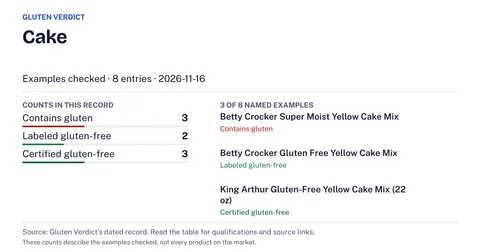 CakeContains glutenchecked Nov 16, 2026
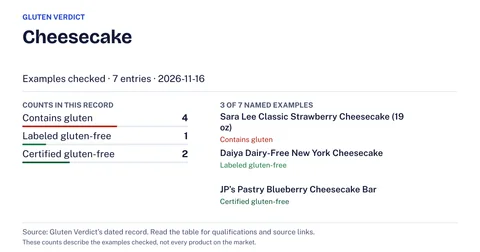 CheesecakeDepends on the product4 of 7 products we checked contain glutenchecked Nov 16, 2026
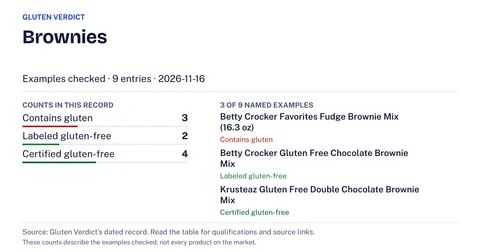 BrowniesContains glutenchecked Nov 16, 2026
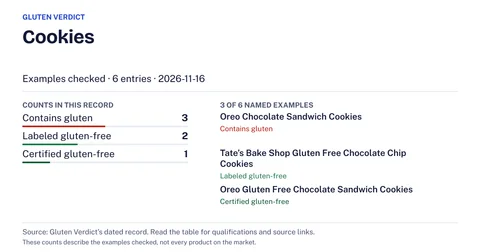 CookiesContains glutenchecked Nov 16, 2026
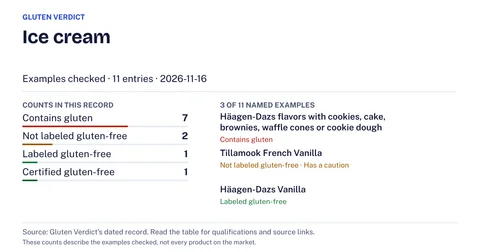 Ice creamDepends on the product7 of 11 products we checked contain glutenchecked Nov 16, 2026
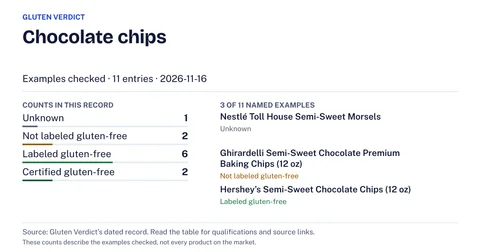 Chocolate chipsDepends on the productchecked Nov 16, 2026
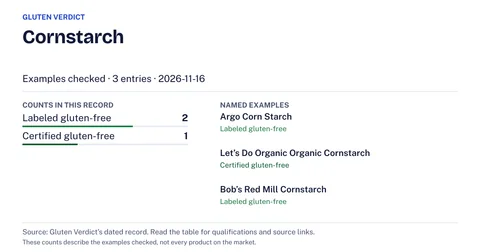 CornstarchNaturally gluten-freeBuy it labeled gluten-freechecked Nov 16, 2026
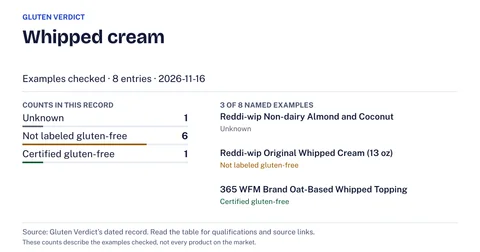 Whipped creamDepends on the productchecked Nov 16, 2026
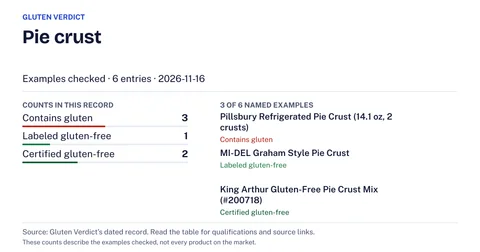 Pie crustContains glutenchecked Nov 16, 2026
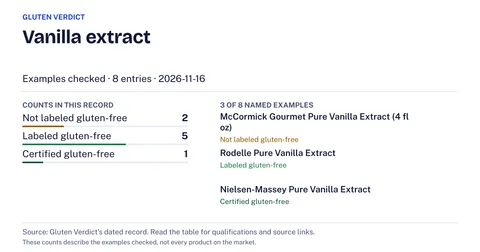 Vanilla extractDepends on the productchecked Nov 16, 2026
Questions people ask
Can a bakery that also bakes wheat cakes make a gluten-free cake?
The sources we read do not say whether one can. Cross-contact can happen when food is prepared or served2, so the bakery’s own description of how it makes the cake, and the questions above, are what you have to go on.
What does a shared-facility line on a packaged cake mean?
FDA says its regulation does not prohibit a voluntary advisory statement on a food that also carries a gluten-free claim, if the statement is truthful and not misleading17. The food still has to comply with the gluten-free rule9.
Does hand sanitizer remove gluten from hands before serving the cake?
GIG says hand sanitizer is often found to leave residue behind, and names wet wipes and soap and water as the methods that remove food proteins31.
More in Holidays, weddings and celebrations
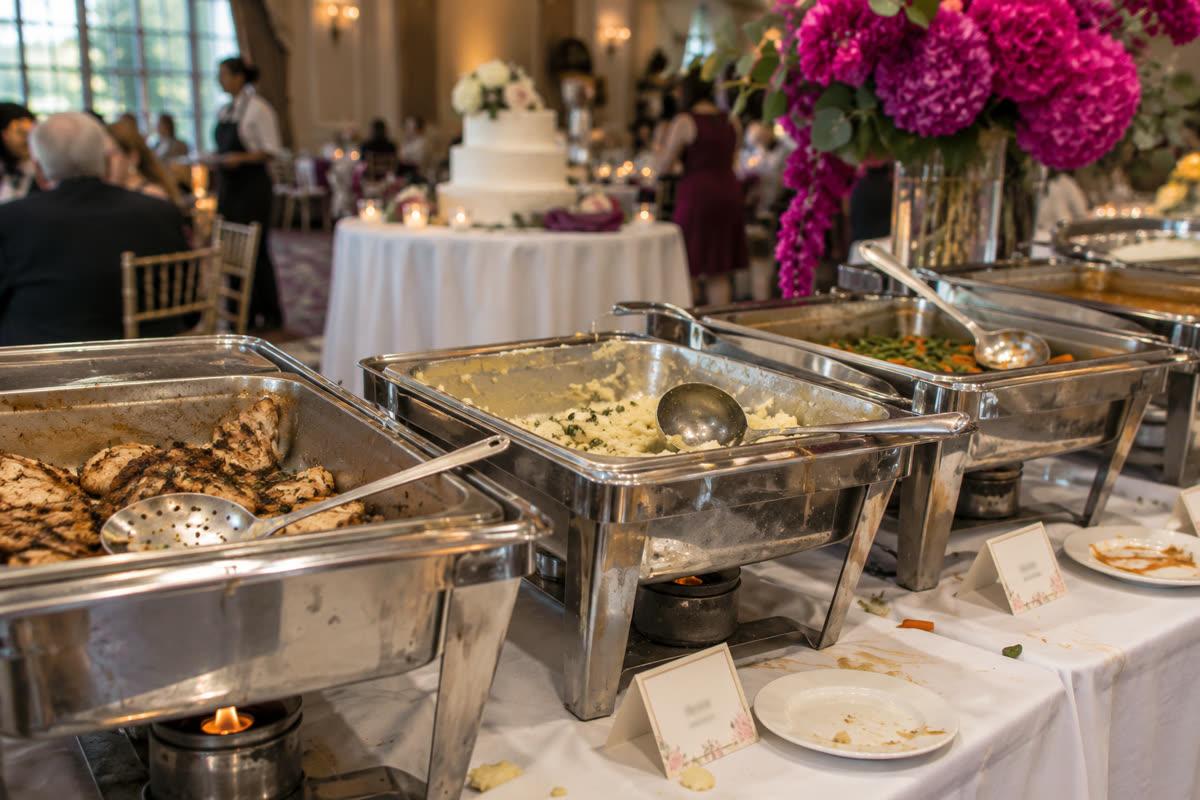 Gluten-free wedding catering: what to ask the caterer and the cake bakerQuestions for a wedding caterer and cake baker, what a real answer sounds like, a tasting checklist and what to put in the contract for a celiac guest.
 Gluten-free Thanksgiving: a dish-by-dish check of the menuTurkey, stuffing, gravy, cranberry sauce, casserole and pie: which dishes need a label or maker check, and how to order the work in a shared kitchen.
 Eating at a wedding with celiac disease: what to write, who to call and what to askA wedding guest with celiac disease: the RSVP line, the caterer call, the questions to ask and when to rely on your own food.
 Gluten-free Christmas table: ham glaze, gravy, eggnog, snack mix and cookie trayCheck the ham glaze packet, gravy, eggnog, Chex Mix and cookie tray against the makers' own pages, and learn which agency covers a ham label.
 Hosting a gluten-free party: a menu and cross-contact planPlan a mixed party table for a guest with celiac disease: what to ask, which store-bought items to check, and how to keep dishes apart.
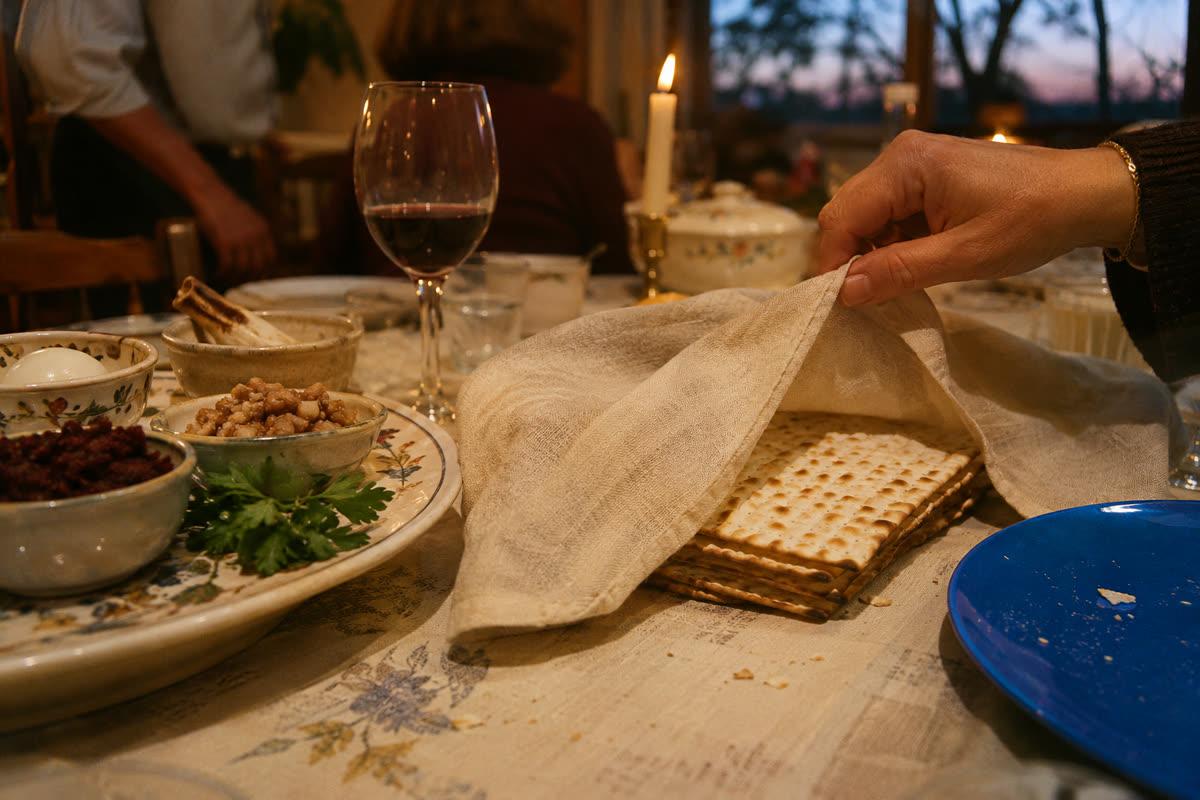 Passover and gluten: matzo, matzo meal and what a kosher mark leaves outWheat matzo contains gluten and a kosher-for-Passover mark is not a gluten-free claim. How to check matzo, matzo meal, cake meal and seder dishes.
Related guides
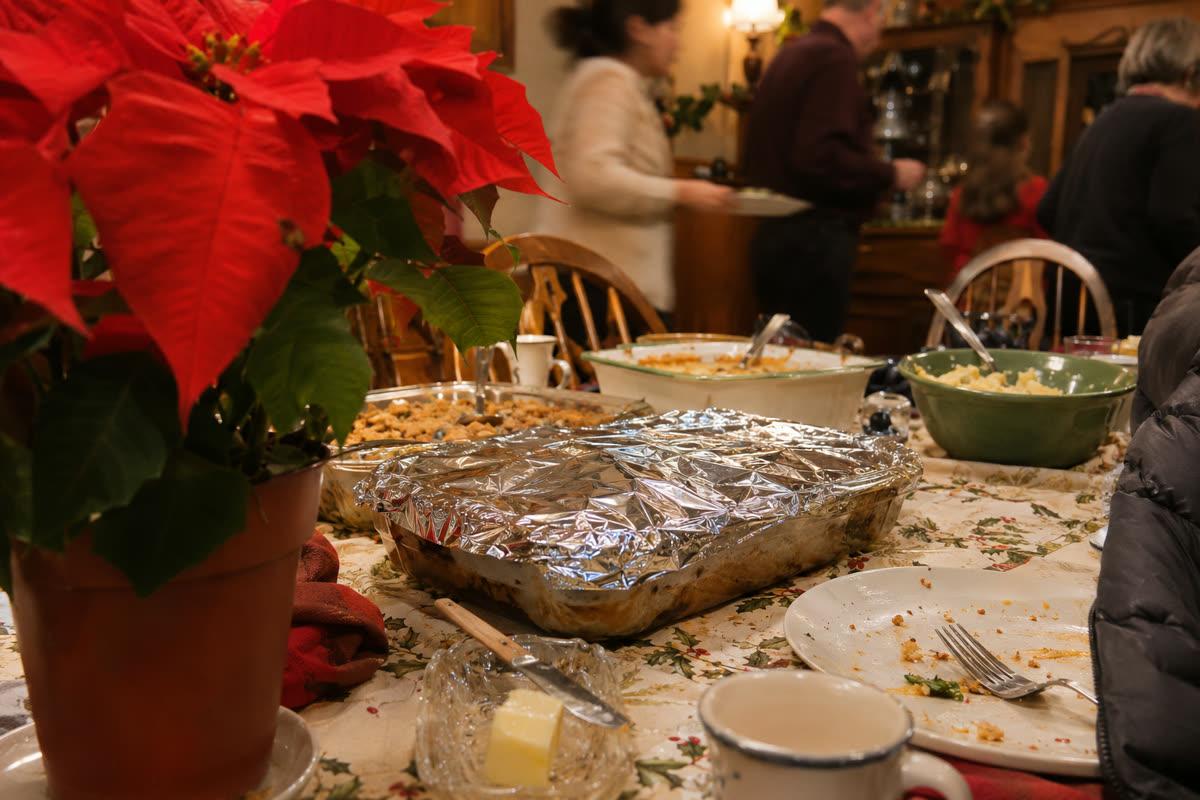 Gluten-free at a holiday dinner, potluck or cookout as a guestHow a guest with celiac disease can message the host, bring a dish, serve first at a buffet and decide when to eat only their own food.
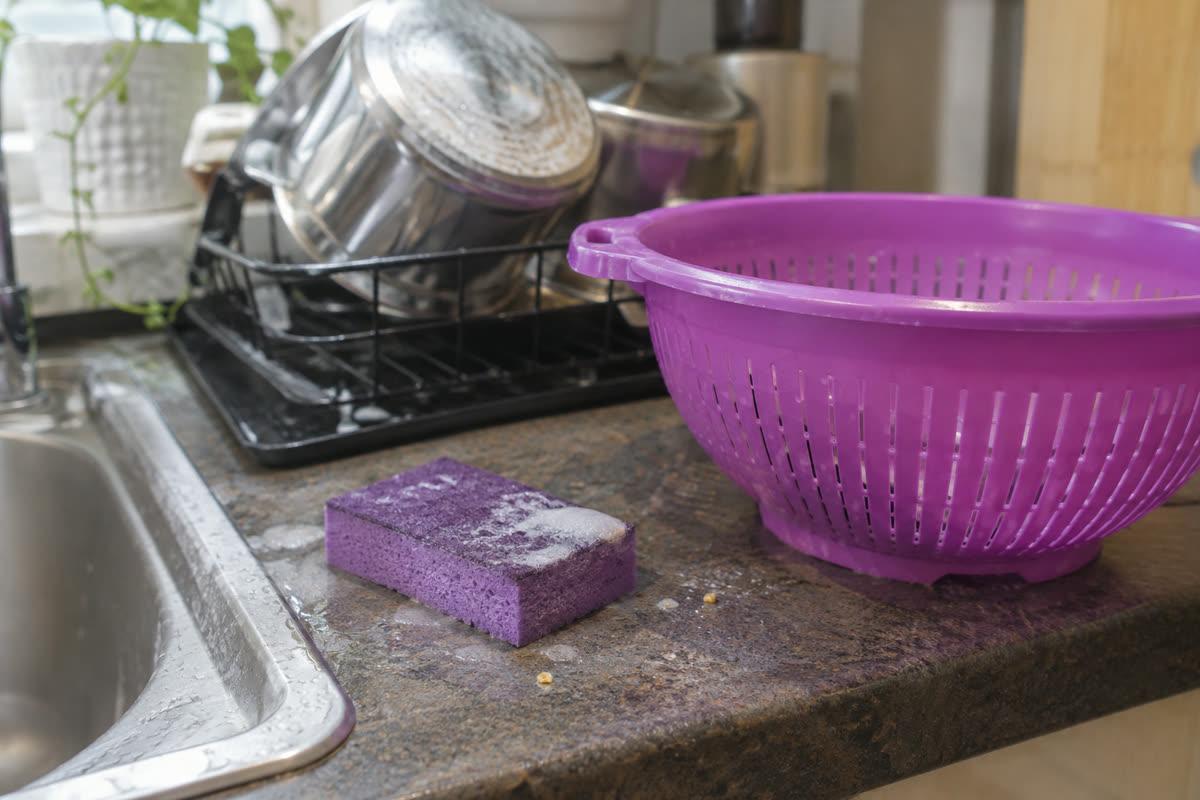 Setting up a gluten-free kitchen: what to replace, wash or shareWalk each kitchen zone and decide, item by item, what to replace, what to wash and what a mixed household can keep sharing, with charity sources.
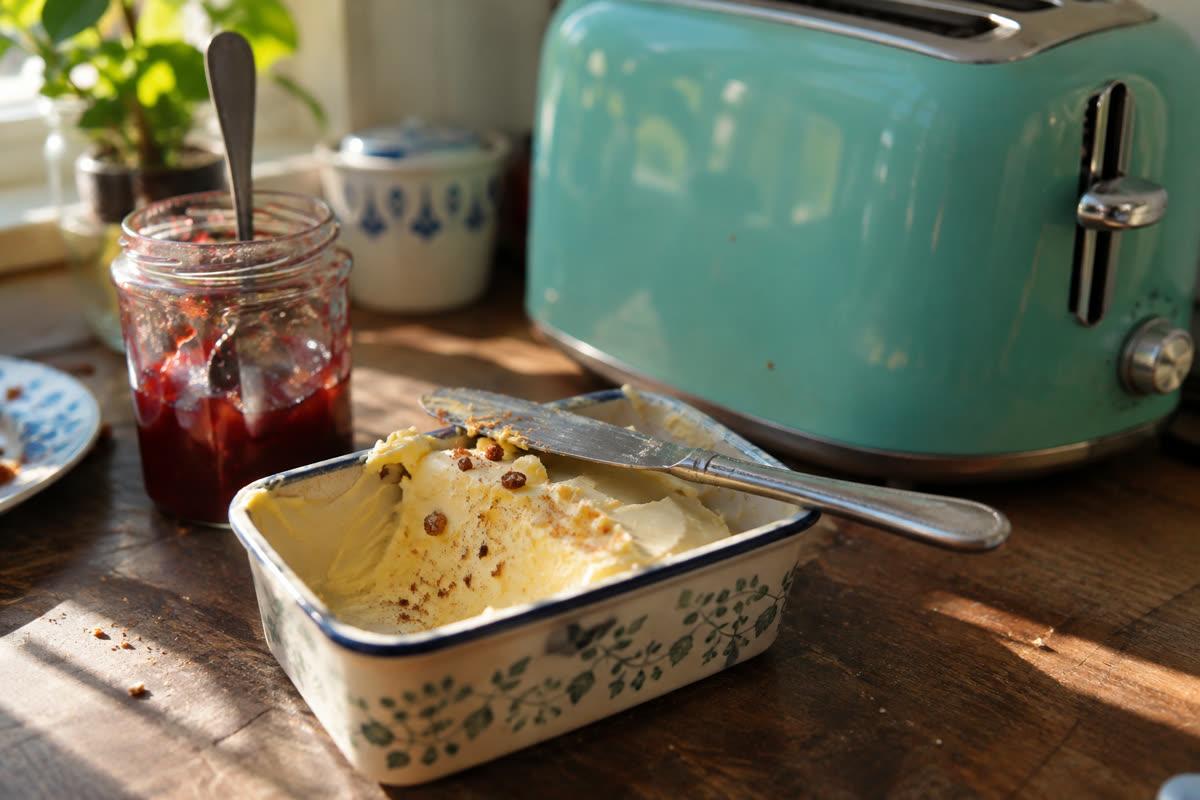 Gluten cross-contact at home: where it happens and what to do about itHow gluten reaches gluten-free food at home, whether to separate, wash or ask for each route, and which rules have lab data behind them.
 A gluten-free kid at a birthday party: the host text, the cake knife and the snack tableA parent’s plan for a celiac child at a party or sleepover: the host text, own food, cake and snack-table cross-contact, and hand washing.
Sources
- [1, 9, 17, 36, 37] US Food and Drug Administration, Questions and Answers on the Gluten-Free Food Labeling Final Rule, checked Nov 17, 2026.
Read on 2026-11-17: the page’s answers on unpackaged foods and on gluten-free claims for foods served in restaurants, cafeterias and buffets do not mention bakeries or cakes made to order; the word “bakery” does not appear on the page.
- [2] National Institute of Diabetes and Digestive and Kidney Diseases (NIDDK), Eating, Diet, & Nutrition for Celiac Disease, checked Nov 17, 2026.
- [3, 5, 7, 13] Gluten Intolerance Group, 25 Ways Cross-Contact Could Happen (And How to Avoid It), checked Nov 17, 2026.
- [4, 19, 20] Journal of Food Protection (PubMed record), Catering Gluten-Free When Simultaneously Using Wheat Flour (Miller, McGough and Urwin, Coeliac UK, 2016), checked Nov 17, 2026.
- [6, 8, 18, 22, 23, 24, 25] Gluten Intolerance Group, Questions to Ask When Eating Out, checked Nov 17, 2026.
- [10] Electronic Code of Federal Regulations, 21 CFR 101.91 Gluten-free labeling of food, checked Nov 17, 2026.
- [11, 12] Public Health Nutrition (PubMed record), Gluten contamination in gluten-free bakery products: a risk for coeliac disease patients (Farage and colleagues, 2017), checked Nov 17, 2026.
- [14, 31] Gluten Intolerance Group, Navigating School Parties and Community Events this Fall, checked Nov 17, 2026.
- [15] US Food and Drug Administration, Gluten and Food Labeling, checked Nov 17, 2026.
- [16] Coeliac UK, Essential Gluten Free Eating Out Tips, checked Nov 17, 2026.
- [21] Gluten Intolerance Group, Eating Out: 7 Tips For Staying Gluten-Free, checked Nov 17, 2026.
- [26, 27, 28] Gluten Intolerance Group, 38 Foods Where Gluten May Be “Hidden”, checked Nov 17, 2026.
- [29, 30] Gluten Intolerance Group, Gluten-Free Safe Entertaining, checked Nov 17, 2026.
- [32, 35] Gluten Intolerance Group, Going out Gluten free: Dates, Parties and Everything in Between, checked Nov 17, 2026.
- [33, 34] Gluten Intolerance Group, Supporting Gluten-Free Kids at Parties – What Teens and Parents Need to Know, checked Nov 17, 2026.