Gluten cross-contact at home: where it happens and what to do about it
Short answer
At home, gluten reaches gluten-free food through surfaces and utensils that were not cleaned after gluten-containing foods, or by direct contact with them1, 2. Match each route to one fix. The charities’ rules are precaution; a few small studies have tested some of them, and the table below says which.
- Shared surfaces and storage: wipe and wash them with hot soapy water, and keep gluten-free food above and away from crumbs and dust3, 4.
- Shared tools and appliances: wash most items with soap and water; for what holds crumbs, such as toasters, colanders and sifters, the charities advise a second one or a barrier5, 6, 7, 46.
- Shared food: separate condiments or clean cutlery for shared spreads, and when eating out, ask how food is prepared8, 9.
Part of Cross-contact and the home kitchen, 19 guides
Key points
- Cross-contact is the word the NIDDK and the Gluten Intolerance Group use for gluten-containing food touching gluten-free food; GIG keeps “cross-contamination” for bacteria2, 10.
- Shared pasta water was the riskiest of the three scenarios in one small study: every sample cooked in it tested above 20 parts per million (ppm), and a rinse brought them below11, 12, 17.
- In one study, spreads were applied with a knife used on gluten-containing bread, and the mayonnaise and peanut butter samples were above FDA’s gluten-free limit42, 13.
- Small studies found little or no transfer from rinsed or washed pots and knives, from a shared colander and ladle, or from shared toasters, while the charities still advise a second toaster or colander; one study’s authors list its small sample size as a limit14, 15, 16, 17, 7, 46.
- For flour dust and fryer oil, the studies below measured commercial kitchens and food service fryers, not homes18, 19, 20.
Cross-contact or cross-contamination?
Two words turn up for this problem. GIG says the proper term for gluten is cross-contact, because gluten is a protein, not bacteria21; it uses cross-contamination for microorganisms, such as salmonella or E. coli, that are transferred by accident10.
The NIDDK defines cross-contact as foods or products that contain gluten coming into contact with gluten-free foods2, and says it can occur when foods are grown, processed, stored, prepared or served22. GIG adds that the amounts matter: crumbs or particles in amounts that could cause an adverse reaction23. This page covers the part you control, which is your own kitchen.
The three routes at home
GIG describes cross-contact at home as food prepared on common surfaces, or with utensils and cookware that were not thoroughly cleaned after gluten-containing foods1. Sorting what you own into three routes makes the fix easier to pick.
| Route | Examples the charities name | Fix they point to |
|---|---|---|
| Surfaces and storage | Prep and cooking surfaces after gluten-containing dishes24; a fridge or cupboard shared with gluten-containing food25 | Wipe down often; store gluten-free food above, securely packaged24, 25 |
| Tools and appliances | Toasters26; colanders, sifters and waffle irons7; worn wooden, plastic and non-stick utensils27 | Wash most items5; a second item or a barrier such as toaster bags for the hard-to-clean ones6, 7 |
| Shared food | A jar reached into with a utensil that touched gluten-containing food28; frying oil that cooked gluten-containing food29 | Separate condiments, or clean cutlery for shared spreads8; clean oil or a separate fryer30 |
Separate, wash or ask: one rule per route
Separate
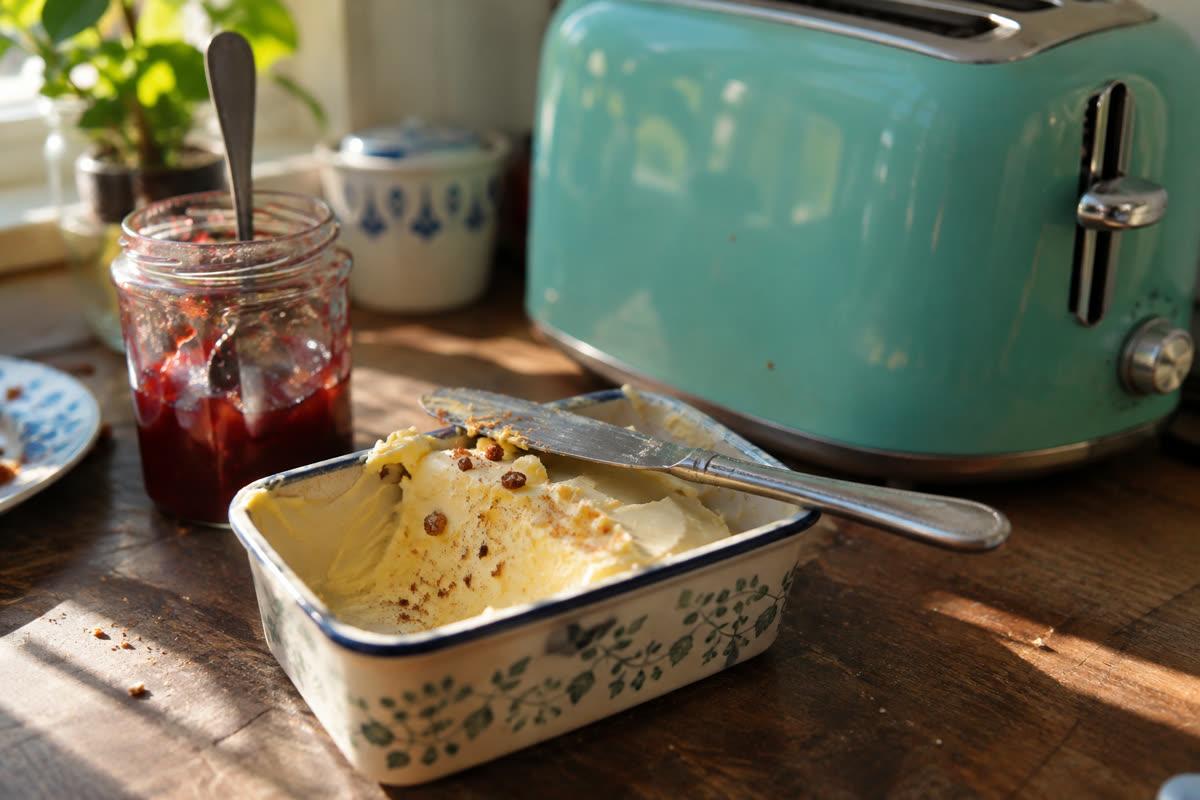
Where a food gets reached into again and again, or an item holds crumbs, the charities’ answer is a second one. GIG advises a gluten-free area in the fridge or pantry, preferably on a top shelf so crumbs and dust do not fall onto it4, and, in a shared kitchen, double of foods such as peanut butter, jam, mustard and mayo31. Coeliac UK, a UK charity, advises separate condiments to avoid breadcrumbs, or at least clean cutlery for shared butters, jams and spreads8. The NIDDK advises storing and preparing gluten-free foods separately from other family members’ gluten-containing foods32.
GIG says double-dipping is one of the most common ways crumbs get into gluten-free food28. What is in the jar is a separate question from what the knife did: see our verdicts for peanut butter and butter.
Wash
For most items, the charities’ answer is washing. Coeliac UK says standard washing-up liquid or a dishwasher will remove gluten33, and to wipe down surfaces and clean pots, pans and utensils with hot soapy water3. GIG says thorough cleaning of cooking equipment and utensils with soap and water is sufficient for most items5.
The charities differ on sponges and cloths. Coeliac UK says you do not need separate cloths or sponges34; GIG lists sink sponges among the items to give extra cleaning attention or keep separate35. GIG also says worn plastic, wooden and non-stick utensils may develop grooves that can collect gluten27, and that a shared colander, sifter or waffle iron, if it cannot be avoided, needs thorough cleaning between every use7. For an item-by-item walk through a kitchen, use our kitchen setup guide.
Ask
When someone else cooks, you cannot wash anything yourself, so the rule is to ask. The NIDDK advises asking about ingredients and how food is prepared when eating out9, and GIG advises telling a host about your needs in advance36. Stores count too: GIG notes that prepared foods from a store’s deli, hot bar or salad bar are at risk of cross-contact37, which is worth knowing before you buy deli meat, and that bulk bins can leave gluten-containing ingredients on scoops38. Restaurants have their own guide: eating out with celiac disease.
Which rules have lab data, and which are precaution
The rules above are advice from the charities and the NIDDK, not test results. A 2020 paper noted that diet guides suggest dedicated toasters and conflict on dedicated utensils, and called these recommendations “based upon expert consensus with scant data to support them”39. A few small studies have measured gluten in food prepared with shared items. FDA’s limit for a gluten-free claim is less than 20 ppm40, and the results below are read against that figure.
| Practice | What the studies measured | Limits and context |
|---|---|---|
| Cooking gluten-free pasta in water used for gluten-containing pasta | In one small study, gluten levels were above 20 ppm in all samples tested11; rinsing the pasta brought it below 20 ppm12. A 2024 mini-review reports the same direction, with a few seconds’ rinse enough41. | The riskiest of the three scenarios that study tested11. |
| A knife used on gluten-containing bread, then used to apply a spread | One study tested sandwich spreads applied with such a knife (mayonnaise, jam, peanut butter)42; mayonnaise and peanut butter samples were above FDA’s gluten-free limit13. | The same study reports that most results across its fryer, toaster and spread tests (93.6%) showed no significant cross-contact43. |
| Washing pots and knives | Rinsing pots with water alone after cooking gluten-containing pasta was as effective as scrubbing with soap and water at preventing detectable gluten transfer14, and all three knife washing methods were effective44. In a 2018 study of shared kitchenware, the cleaning method did not influence gluten concentrations15. | The 2020 paper’s authors list small sample size and the use of a sandwich rather than a competitive ELISA, which is able to detect hydrolyzed gluten17. The charities above still advise soap and hot water3, 5. |
| Toasting gluten-free bread in a shared toaster | In one small study no sample was above 20 ppm; four had 5.1 to 8.3 ppm16, although gluten-containing crumbs were visible in all the toasters45. | Charities still advise toaster bags or a separate toaster46, 26. |
| A shared colander, ladle, wooden spoon or knife | The 2018 study used these four items after gluten-containing food47 and found gluten below 20 mg/kg15; it raised, as a hypothesis, that shared ladles pose a higher risk than the other three48. | GIG advises not sharing colanders, sifters and waffle irons if possible7. That study’s four items did not include sifters or waffle irons47, and its authors limit their conclusion to a domestic environment49. |
The 2024 mini-review sums up a similar pattern for utensils and equipment: in general, in controlled experiments, shared spoons, ladles, colanders, knives, fryers and toasters did not lead to significant contamination50; the restaurant fry samples further down are a different kind of study. The authors of the 2020 paper add that cross-contact will inevitably vary between kitchens51.
Read this table as small studies, not as permission or a ban. Whether a second toaster is worth buying is a household call; how much gluten matters for one person is a question for their own doctor or dietitian.
Flour dust and fryer oil: the studies we found were not in homes
Flour dust
GIG notes that flour or baking mixes could make dust52, and that, in commercial kitchen spaces, gluten-containing flours may be airborne and settle on surfaces, utensils and gluten-free products53. The measurement we found was a pilot study by Coeliac UK researchers, in commercial kitchens18: a distance of 2 metres from the use of wheat flour was needed to hold gluten at or below 20 ppm after 4.0 hours of flour use54, and a minimum of 2 metres plus good hygiene worked at all five study sites, though kitchens vary55. We did not find a study of flour dust in a home kitchen. Whether the flour itself contains gluten is the job of our flour verdict.
Fryer oil
Coeliac UK advises clean oil or a separate fryer for frying gluten-free foods30, and GIG says oil that fried gluten-containing food becomes a source of cross-contact29. Both studies below sampled food service establishments rather than homes19, 20.
- A 2021 pilot study bought 20 orders of fries from 10 restaurants19. One ELISA test found gluten in 9 of 20 (7 to more than 80 ppm) and a second in 3 of 20 (14 to more than 270 ppm)56; the authors note that ELISAs may underperform on heated gluten57.
- A 2026 study of 98 fry and tortilla chip samples from fryers shared with gluten-containing foods, at food service establishments across several US states, found six (6.1%) exceeded 20 ppm and 84 of 98 below 5 ppm58. All samples from establishments reporting daily oil changes were below 20 ppm; weekly oil changes showed higher and more variable results59.
For what a fry order can contain beyond the oil, see our french fries verdict.
What a gluten-free claim and a may-contain line tell you
In FDA’s Q&A on its gluten-free rule, cross-contact, which the regulation does not define, generally means the unavoidable presence of gluten in a food due to contact with a gluten-containing food60, and any unavoidable gluten in a food labeled gluten-free must be below 20 ppm61. FDA also says that manufacturing facilities with shared production equipment for foods with and without gluten could result in gluten cross-contact62.
FDA calls an advisory statement such as “made in a facility that also processes wheat” voluntary72. It also says a food with a gluten-free claim must meet the rule whether or not it also carries an advisory statement63. Makers do not have to test, but they are responsible for compliance64; GIG points out that there is no guarantee foods labeled gluten-free are being properly tested65. Our food label guide covers each part of a US label.
Treat a label as describing the packaged food, not your kitchen. FDA’s regulation applies to packaged foods66; for unpackaged food, such as restaurant meals, FDA says it shares complaints with state and local government partners67, and it recommends that restaurants making a gluten-free claim be consistent with its definition68.
Some cross-contact happens before a food reaches you. The NIDDK says cross-contact between oats and grains that contain gluten is common69; see our oatmeal verdict for what makers say about their oats.
Where to go next
- Setting up a gluten-free kitchen: the item-by-item walk-through for the tools and appliances route.
- Going gluten-free: what to remove and what to keep: sorting the shelves you already have.
- Sharing butter, jam and spreads with gluten eaters: the shared food route for jars and spreads.
- Frying at home with celiac disease: the shared food route for frying oil.
- What to clean after wheat flour lands in a gluten-free kitchen: the flour dust route.
- What studies measured in shared kitchens: the studies in the table above, in more detail.
- Eating out with celiac disease: the ask route at restaurants.
- How to read a food label for gluten: claims, Contains lines and may-contain lines.
- What “may contain wheat” and “made in a facility with wheat” mean: advisory statements on US labels.
- Every verdict, A to Z: what makers say about the foods themselves.
Verdicts in this guide
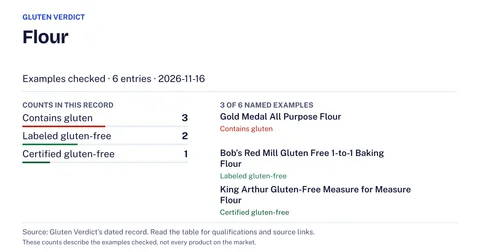 FlourContains glutenchecked Nov 16, 2026
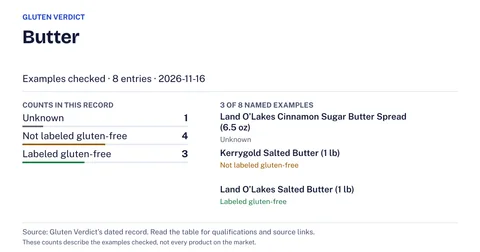 ButterNaturally gluten-freechecked Nov 16, 2026
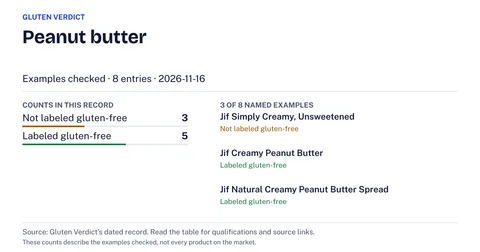 Peanut butterDepends on the productchecked Nov 16, 2026
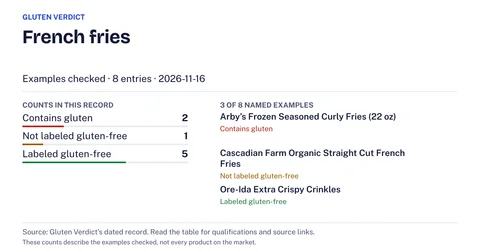 French friesDepends on the product2 of 8 products we checked contain gluten: Arby’s Frozen Seasoned Curly Fries (22 oz) and Checkers Frozen Crispy Seasoned Fries (28 oz)checked Nov 16, 2026
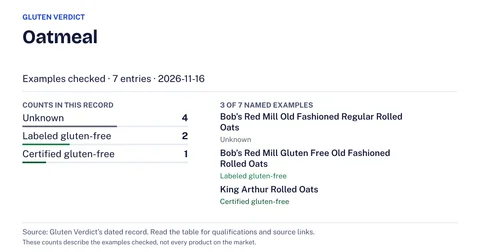 OatmealDepends on the productchecked Nov 16, 2026
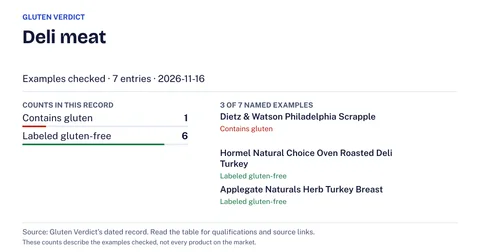 Deli meatDepends on the product1 of 7 products we checked contains gluten: Dietz & Watson Philadelphia Scrapplechecked Nov 16, 2026
Questions people ask
Does everyone in the house have to go gluten-free?
Not necessarily. GIG lists going entirely gluten-free as optional and says it is not for every household, though some families choose it70.
More in Cross-contact and the home kitchen
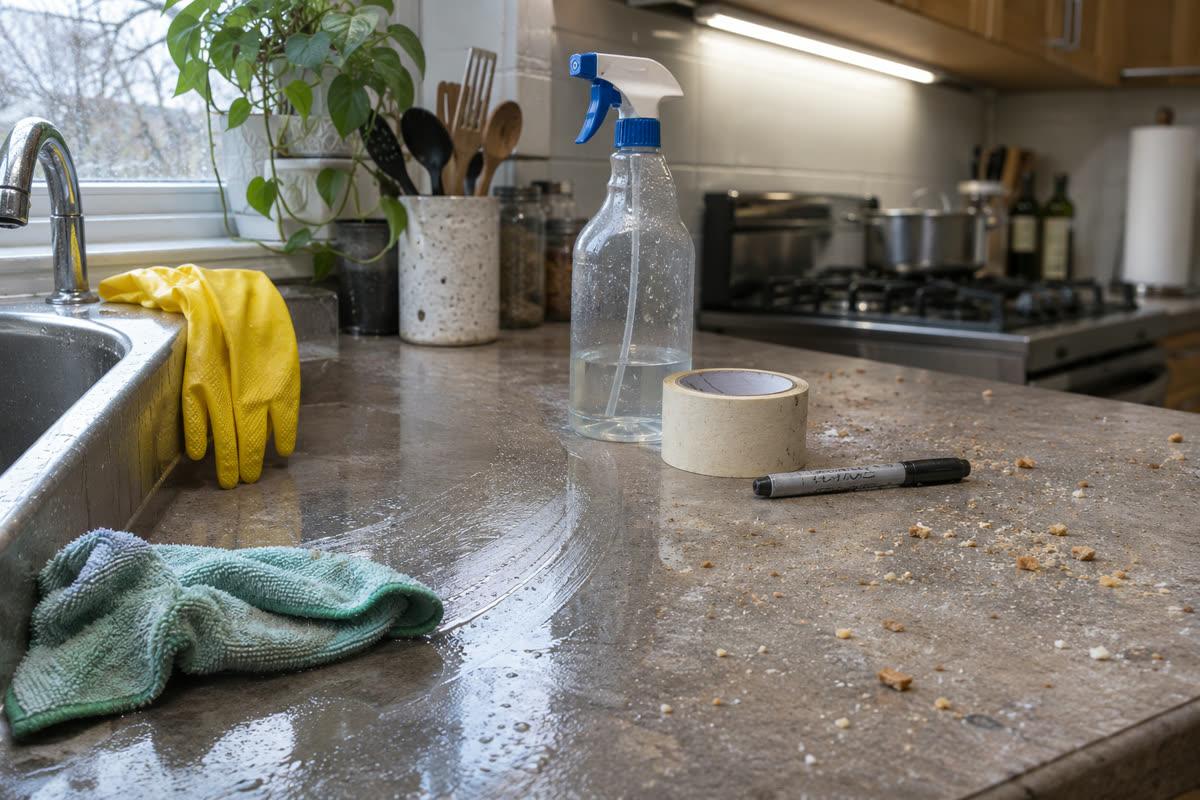 A weekly gluten-free kitchen routine: wipe, label, restock, re-checkA one-page weekly pass for a gluten-free kitchen: what to wipe, label, restock and do with leftovers, and where the charities and small studies differ.
 Storing gluten-free food in a shared fridge, pantry and freezerWhere gluten-free food goes in a shared fridge, pantry and freezer, how to label it so everyone follows, and what the sources say and leave out.
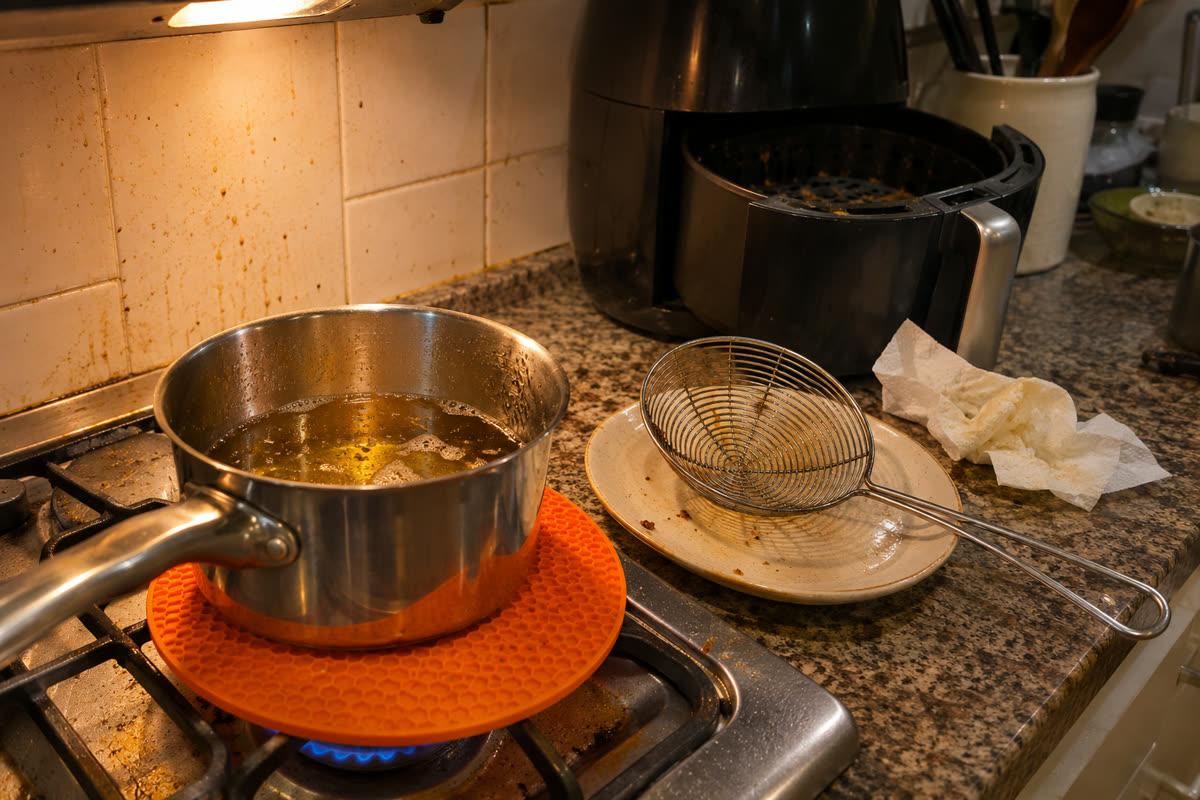 Frying at home with celiac disease: fresh oil, a separate fryer or an air fryerFry at home without cross-contact: when to use fresh oil, a separate fryer or an air fryer, and what the 2026 shared-fryer study does and does not show.
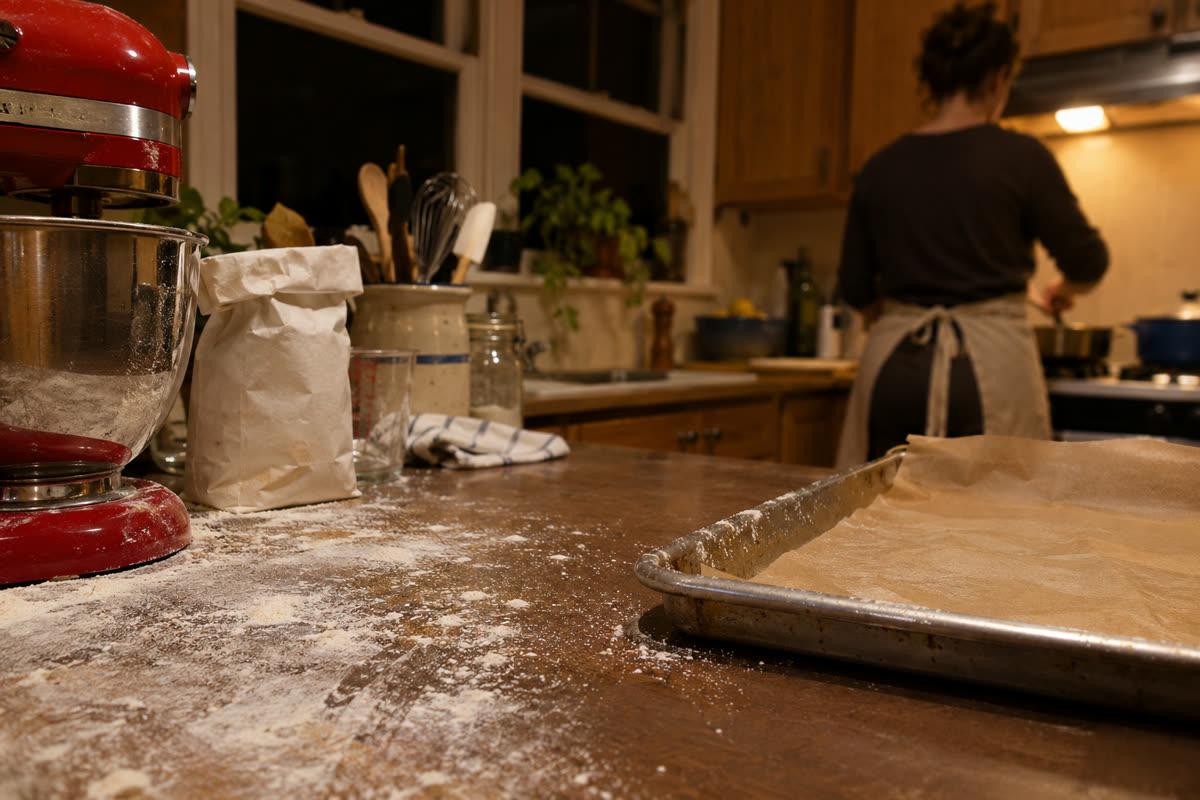 Baking gluten-free in a home where someone else bakes with wheat flourA baking-day plan for a shared kitchen: order, counters, flour storage, tools and oven, and which timing rules have no published source.
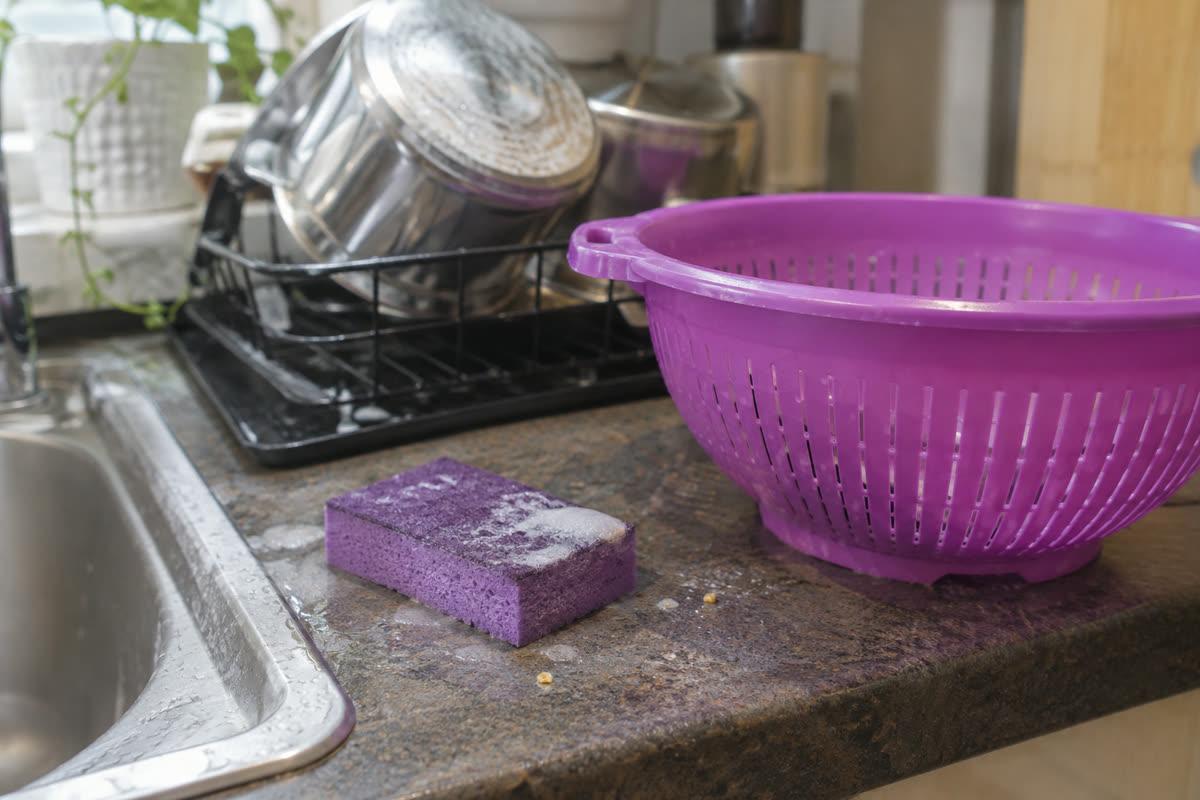 Setting up a gluten-free kitchen: what to replace, wash or shareWalk each kitchen zone and decide, item by item, what to replace, what to wash and what a mixed household can keep sharing, with charity sources.
 Gluten-free with roommates, partners and family: a shared-kitchen agreementHow to split a shared kitchen when one person is gluten-free: what to keep separate, what to wash and share, and how to put the rules to housemates.
Related guides
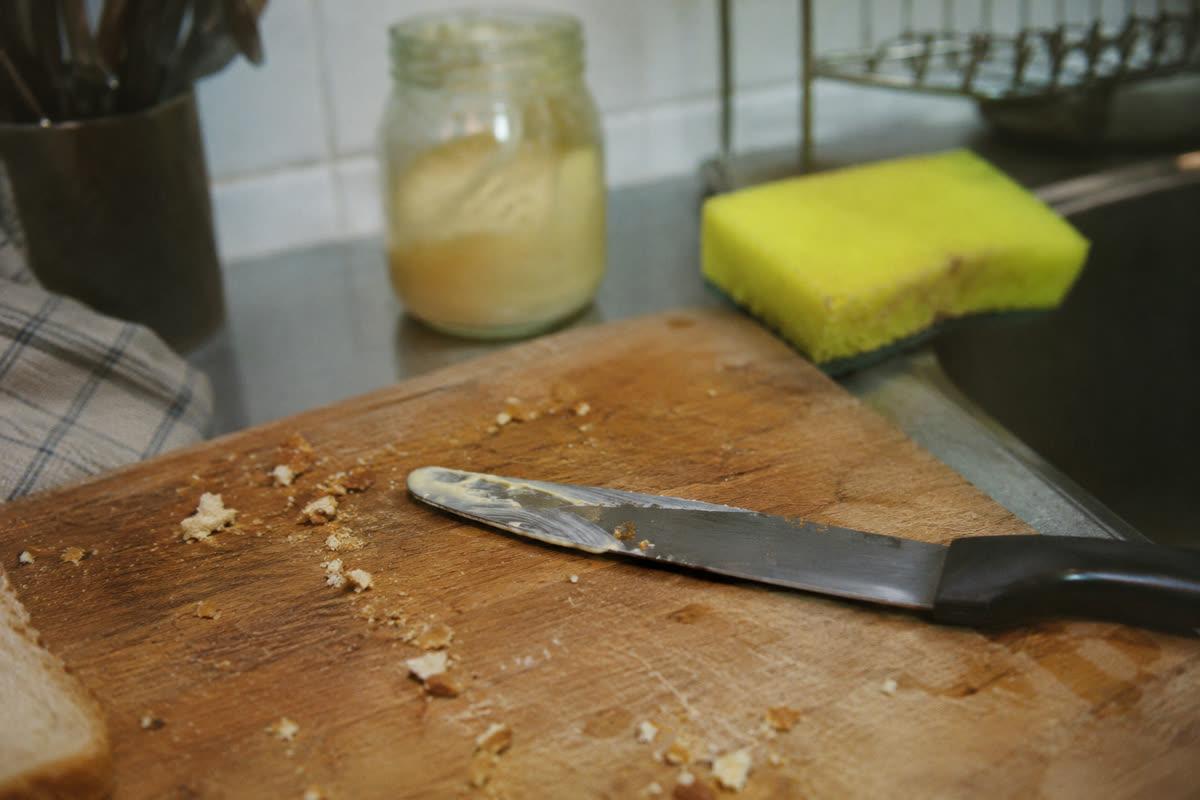 What studies measured in shared kitchens: pasta water, toasters, knives and spreadsWhat four experimental studies measured when gluten-free food met shared pots, toasters, knives and spreads: samples, results, and what went untested.
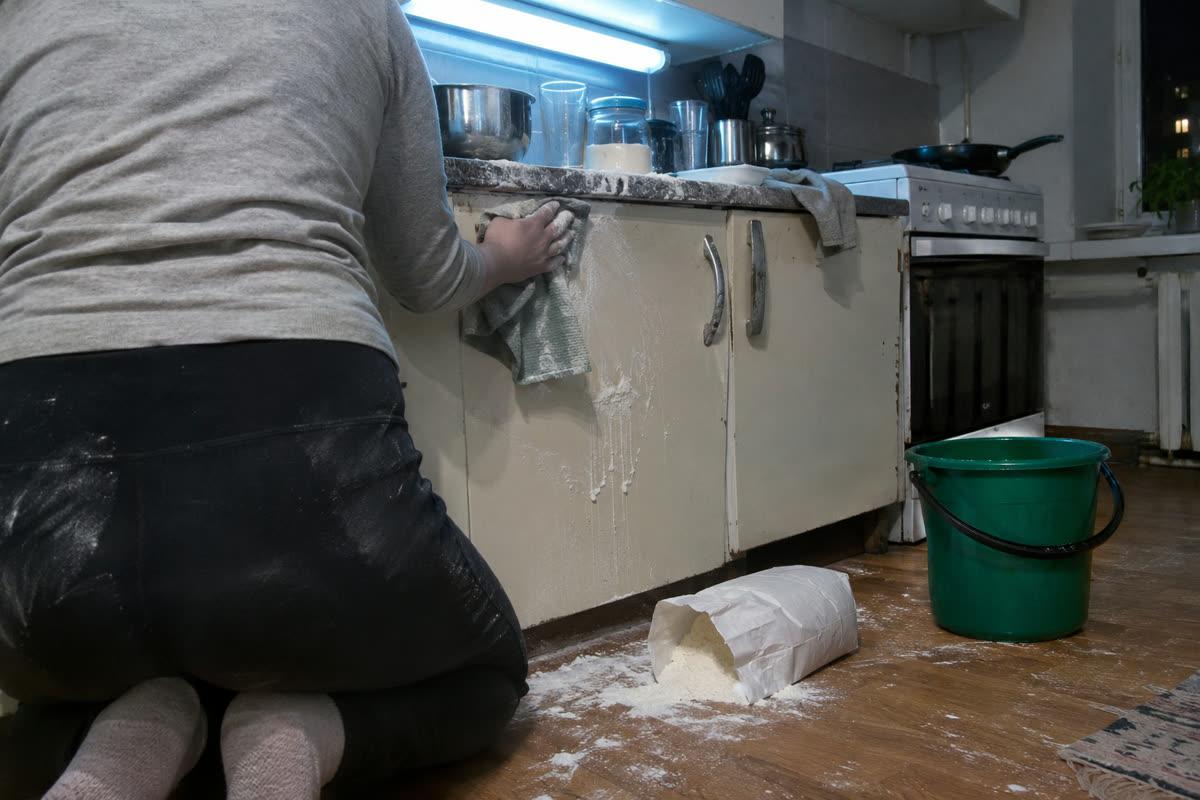 What to clean after wheat flour lands in a gluten-free kitchenThe order of jobs after wheat flour reaches a gluten-free kitchen, what charities and studies say about each item, and what no source covers.
 Sharing butter, jam and spreads with gluten eatersHow crumbs reach shared butter, jam and peanut butter, and what a second jar, squeeze bottle, knife rule or shelf each does and does not do.
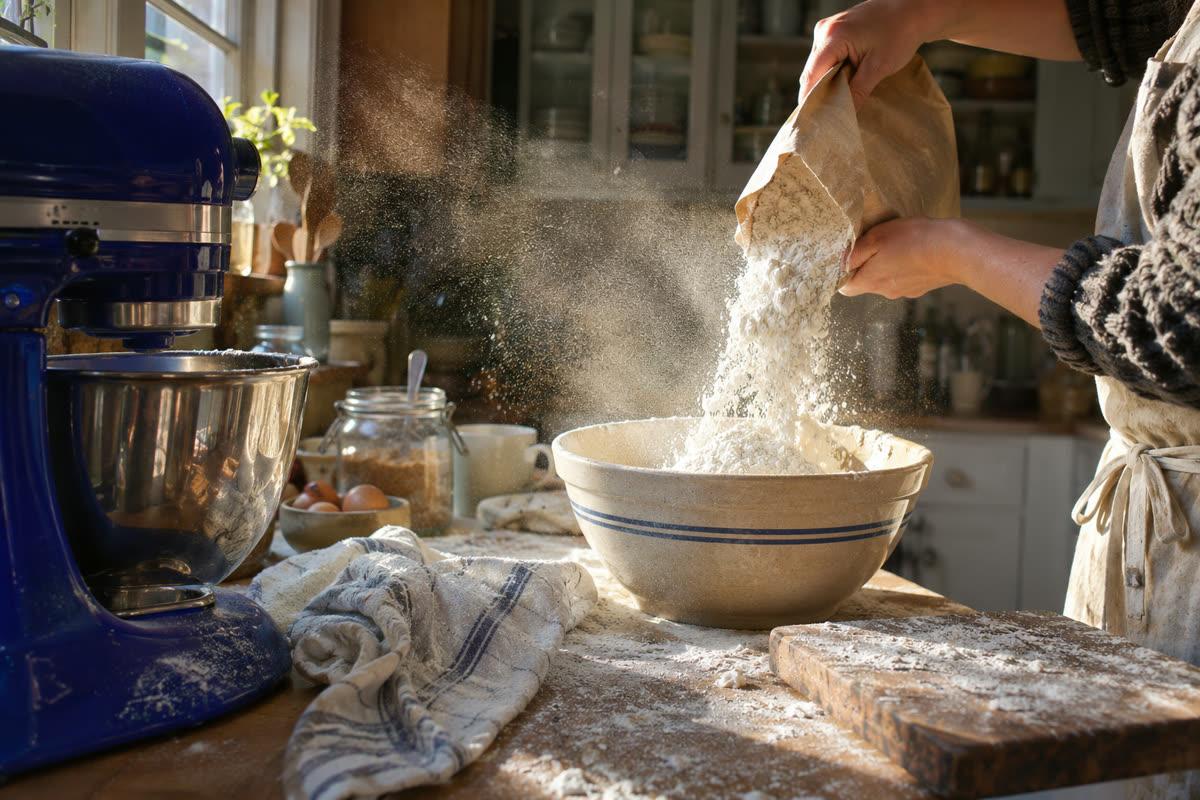 Airborne flour and celiac disease: what the sources sayWhat charities and studies say about wheat flour dust in the air, what is only a hypothesis, and the wipe-down and cover steps the charities suggest.
Sources
- [1, 4, 6, 26, 27, 29, 31, 35, 37, 38, 53] Gluten Intolerance Group, 7 Tips for Avoiding Gluten Cross-Contact at Home, checked Nov 17, 2026.
Read on 2026-11-17: the list under “Step 3. Clean carefully or keep separate.” names wooden utensils, cutting boards, nonstick pans, cast iron skillet, wooden rolling pins, food storage containers, waffle irons, cake pans and muffin tins, and sink sponges.
- [2, 9, 22, 32, 69] National Institute of Diabetes and Digestive and Kidney Diseases (NIDDK), Eating, Diet, & Nutrition for Celiac Disease, checked Nov 17, 2026.
- [3, 8, 30, 33, 34, 46] Coeliac UK, Cross-contamination (cooking at home), checked Nov 17, 2026.
- [5, 7, 23, 24, 25, 28, 36, 52, 65, 70] Gluten Intolerance Group, 25 Ways Cross-Contact Could Happen (And How to Avoid It), checked Nov 17, 2026.
- [10] Gluten Intolerance Group, What is cross-contact versus cross-contamination? (FAQ), checked Nov 17, 2026.
- [11, 12, 14, 16, 17, 39, 44, 45, 51, 71] Weisbrod and colleagues, Gastroenterology, Preparation of Gluten-Free Foods Alongside Gluten-Containing Food May Not Always Be as Risky for Celiac Patients as Diet Guides Suggest (Gastroenterology, 2020), checked Nov 17, 2026.
- [13, 42, 43] Parsons and colleagues, Clinical Nutrition, Gluten cross-contact from common food practices and preparations (2021), checked Nov 17, 2026.
- [15, 47, 48, 49] Studerus and colleagues, Journal of Food Protection, Cross-Contamination with Gluten by Using Kitchen Utensils: Fact or Fiction? (2018), checked Nov 17, 2026.
- [18, 54, 55] Miller, McGough and Urwin (Coeliac UK), Journal of Food Protection, Catering Gluten-Free When Simultaneously Using Wheat Flour (2016), checked Nov 17, 2026.
- [19, 56, 57] Thompson and colleagues, Frontiers in Nutrition, Gluten-Free Foods Cooked in Shared Fryers With Wheat: A Pilot Study Assessing Gluten Cross Contact (2021), checked Nov 17, 2026.
- [20, 58, 59] Weisbrod and colleagues, Nutrients, Shared Fryers May Not Always Be as Risky for Gluten Cross-Contact in Celiac Disease as Dietary Guidance Suggests (2026), checked Nov 17, 2026.
- [21] Gluten Intolerance Group, Gluten in Your Food: Cross-Contact or Cross-Contamination?, checked Nov 17, 2026.
- [40] US Food and Drug Administration, Gluten and Food Labeling, checked Nov 17, 2026.
- [41, 50] Damasceno and colleagues, Nutrients, Risk of Gluten Cross-Contamination Due to Food Handling Practices: A Mini-Review (2024), checked Nov 17, 2026.
- [60, 61, 62, 63, 64, 66, 67, 68, 72] US Food and Drug Administration, Questions and Answers on the Gluten-Free Food Labeling Final Rule, checked Nov 17, 2026.