Gluten-free wedding catering: what to ask the caterer and the cake baker
Short answer
A real answer from a caterer or baker names steps; a reassurance names none. Do three things with it:
- On the call, ask how gluten-free food is kept apart from wheat flour, shared fryer oil, pasta water and serving tools. Beyond Celiac says you may want to look for a different place when answers are overly confident but without details1.
- At the tasting, watch the process and ask to see the packages of questionable ingredients2.
- In the contract, write the steps down: FDA’s gluten-free rule applies to packaged foods, and FDA recommends that restaurants making a gluten-free claim on their menus be consistent with its definition3, 4.
Part of Holidays, weddings and celebrations, 16 guides
Key points
- Ask for steps, not promises: Beyond Celiac says you may want to look for a different place when answers are overly confident but without details1.
- Press on four places: fryer oil, pasta and vegetable water, thickeners, and flour storage and dust5, 6, 7, 8.
- FDA’s gluten-free rule applies to packaged foods, and FDA recommends that restaurants making a gluten-free claim on their menus be consistent with its definition, so for a reception meal the contract has to carry the handling3, 4.
- GIG and Coeliac UK advise keeping gluten-free dishes apart and clearly distinguishable, with their own serving utensils, and GIG suggests letting gluten-free guests serve first9, 10, 11.
- Treat a tasting as a look at the process, not a gluten test; Coeliac UK’s caterer guidance says lab testing can verify a kitchen’s processes, so ask about the caterer’s testing history12, 13.
Before the first call: who is eating and what the kitchen must do
Settle three things before you contact anyone: who needs gluten-free food (name each guest, or your partner), what that person will accept from a kitchen, and what else the same menu has to carry, such as nut or dairy needs.
Ask the person with celiac disease directly. GIG’s advice to hosts is to make sure a guest is comfortable eating from a kitchen shared with gluten-containing dishes, and it notes a higher risk of cross-contact when gluten-containing flour is being baked with in the same space, adding that a guest may choose to bring their own food14. Whether a given kitchen is acceptable is that person’s decision, with their own doctor or dietitian.
Tell every vendor that this is a health need. Coeliac UK, the UK charity, advises diners to explain their restrictions so that staff understand them as a health necessity and not a dietary choice15. The same wording works in an inquiry email to a caterer or baker.
If you are the guest rather than the couple, read Eating at a wedding with celiac disease instead. For a single cake order, see ordering a gluten-free birthday cake.
Caterer questions: fryers, pasta water, thickeners and flour
Ask these on the phone, then ask the caterer to confirm the answers by email. They come from the restaurant checklists of celiac charities, adapted for an event kitchen. The Celiac Disease Foundation’s own advice for a catered event is to call ahead and ask whether a gluten-free meal or options can be requested16.
| Ask about | The question | A specific answer names |
|---|---|---|
| Fryer | “Is there a dedicated fryer, or do you change the oil for gluten-free food?”17 | A fryer or fresh oil used only for the gluten-free item. Beyond Celiac’s restaurant sheet says oil used for breaded foods cannot then be used for gluten-free foods5. |
| Pasta and vegetable water | “Is the gluten-free pasta boiled in fresh water, or in the same water used for regular pasta?”18 | A separate, fresh pot. Beyond Celiac says a separate, fresh pot and water must be used before boiling any gluten-free foods6, and the National Celiac Association says not to steam, bathe or warm vegetables in pasta water or over pasta pots19. |
| Sauces, gravy and soups | “Does this contain flour or roux? Are the sauces and marinades made in-house, and what goes in them?”7 | The thickener by name. GIG notes that roux is flour and fat cooked together and that the flour is often wheat flour7, and that soy sauce and Worcestershire-type sauces could contain gluten20. The Celiac Disease Foundation also asks whether a marinade contains flour, soy sauce or teriyaki sauce21. |
| Flour on the food | “Is anything dusted or coated with flour before it is cooked?”22 | A named list of coated items. The Celiac Disease Foundation warns not to assume: omelets may contain pancake batter and baked potatoes may be coated with flour23. |
| Flour storage and dust | “Where is wheat flour stored and used, compared with the gluten-free station?” | A different area for flour; Beyond Celiac’s restaurant sheet says boxes of mixes and sacks of flour can create flour dust that can fall on the gluten-free products8. Its dining tips also list airborne flour in the kitchen among the cross-contact questions to ask24. |
| Cookware, utensils, surfaces | “Do you use clean or separate cookware and utensils for gluten-free food?”25 | Clean or dedicated tools. Beyond Celiac says kitchens do not need cookware or utensils exclusively for gluten-free food, but porous utensils such as wooden spoons must be dedicated26. |
| Ingredient checks | “How do you verify that your ingredients are gluten-free?” | Labels read, not recalled. Beyond Celiac’s dining tips list spice blends, thickeners, coatings and toppings or garnishes as things to ask about27. GIG says that in doubt, you can ask to see the package of any questionable ingredient2. |
| Training | “Has your staff completed a gluten-free training program?”28 | A named program or a described briefing. Beyond Celiac’s dining tips give GREAT Kitchens as an example of such a program29. |
Our verdicts say what we found for foods that often come up on a wedding menu: see gravy and cornstarch, the two to have in mind when you ask about thickeners, and cheese for a cheese course or board.
What a real answer sounds like, and what a red flag sounds like
A real answer is specific enough to write down. Beyond Celiac’s advice when you call a restaurant is that if answers are overly confident but without details, or if there are no procedures in place, you may want to look for a different place1. The same test works for a caterer.
| A reassurance | A process you can write down |
|---|---|
| “We do gluten-free all the time.” | “The gluten-free plates are made first, at a cleaned station, with tongs that only touch those plates.” |
| “Our fryer is fine.” | “The sweet potato fries go in a fryer that never sees breaded food, or in fresh oil in a clean pan.” |
| “Nothing in the sauce has gluten.” | “The sauce is thickened with cornstarch from a labeled bag; here is the ingredient list for the stock.” |
| “Don’t worry, the staff know.” | “The banquet captain briefs every server on the gluten-free plates before service.” |
GIG’s restaurant red flags, written for parents of gluten-free children, carry over: kitchen staff refusing or hesitating to check the labels of packaged sauces or mixes30, and confirmation that gluten-free food shares cooking oil or grill space with heavily breaded items31. GIG’s sample question for a fryer is whether fries are cooked in a dedicated fryer or share oil with breaded items32.
“I will find out” can be a good answer. Coeliac UK’s guidance for caterers says staff should be trained to always check and not to guess when unsure of ingredients or processes33. A caterer who checks and writes back is giving a better answer than one who guesses on the spot.
Cake baker questions: flour dust, shared tools, ovens and fillings
Ask the baker the same way, and ask for answers in writing. One exploratory study looked at gluten contamination in gluten-free bakery products: 130 samples were collected from twenty-five bakeries in Brasília, Brazil34. The study reported contamination in 21·5 % of the bakery products sampled, and 64 per cent of the bakeries sold at least one contaminated product35. That is one study in one city and says nothing about your baker; it is a reason to ask.
| Ask about | The question | A specific answer names |
|---|---|---|
| Flour in the room | “Is wheat flour used or stored in the room where the gluten-free cake is made, and when?” | A separate room, a separate time, or a distance. Beyond Celiac’s restaurant sheet says flour dust can fall on gluten-free products8. In one pilot study, which put petri dishes of rice pudding at set distances from wheat flour use, a distance of 2 m was needed to keep contamination at or under 20 ppm after 4 hours of flour use36; the same 2 m minimum with good hygiene was found effective for a test meal at all five study sites that followed37. Coeliac UK’s caterer guidance says gluten-free meals can be prepared in kitchens where wheat flour is used, with care38. |
| Mixers, bowls, sifters, pans | “Are the bowls, mixer attachments, sifters and pans for this cake used for anything with wheat?” | Dedicated or thoroughly cleaned equipment. GIG says items like colanders, sifters and waffle irons are harder to clean and should not be shared between gluten-free and other use if possible39. |
| Oven | “Is the cake baked alongside flour-based items?” | A plan for the oven. Coeliac UK’s guidance says that where fan ovens circulate flour or flaky pastry, gluten-free foods should be cooked separately40. |
| Fillings, chocolate, frosting | “Can I see the labels for every filling, chocolate, frosting and decoration?” | Labels shown, not described. GIG says additives, including emulsifiers and flavoring agents in certain chocolates or fillings, could contain gluten41, and that you can ask to see the package of questionable ingredients2. |
| Cake base | “Is the cake flourless, or made with a gluten-free flour, and which one?” | A named base. GIG gives flourless chocolate cake, French macarons and meringues as examples of recipes that call for no flour42. |
| Finishing and decorating | “Who finishes and decorates it, and do they change gloves and tools after handling wheat?” | A named person and a described change of gloves. GIG tells restaurants that changing gloves when switching between gluten-containing and gluten-free food keeps crumbs away43. |
FDA lists cakes among the foods that typically contain gluten44, so a gluten-free cake needs the flour replaced and then kept away from the flour. See what we found for cake, cheesecake, brownies, cookies and chocolate before you decide what goes on the dessert table. We have no source that says whether fondant, sprinkles or toppers contain gluten, so the answer for each is its label.
The gluten-free dessert: separate, labeled, cut and served first
Even a well-made gluten-free cake can pick up gluten at the table. GIG says one of the most common ways gluten crumbs get into gluten-free food is a serving utensil used on both kinds of food45. Ask the caterer and the baker to agree on these points:
- Keep it apart. GIG’s entertaining advice is to lay gluten dishes far from gluten-free ones on separate tables, or even different rooms46. Coeliac UK’s guidance says gluten-free dishes should be kept physically separate and clearly distinguishable9.
- Give it its own tools. GIG says to equip both tables with their own serving utensils, plates, eating utensils and napkins10. That includes the cake knife and server.
- Make it recognizable. Coeliac UK suggests an easily identifiable serving plate, such as a square plate or a board47, and the National Celiac Association suggests a differently colored or shaped plate where possible48.
- Label it. GIG suggests a card next to self-serve dishes with a list of ingredients49, and labeling the gluten-free dishes or that end of the table50.
- Serve it first. GIG suggests letting gluten-free guests serve first, so utensils from gluten-containing dishes have not been moved around and shared11.
Our advice: cut the gluten-free cake or tier before anyone touches the main cake, with a clean knife that is used for nothing else, and have it handed to the guest instead of left on a shared table.
The tasting and the kitchen visit
A tasting is a chance to see whether the answers from the call hold up. Use it to check the process as well as the flavor:
- Ask for the gluten-free portion to be made the way it will be on the day: same fryer or oil plan, same water, same tools.
- Look for the steps you were told about. Coeliac UK’s guidance says gluten-free ingredients should be stored in clearly marked containers or on dedicated shelves above gluten-containing ingredients51.
- Ask to see the packages for sauces, mixes, fillings and decorations2.
- When the plate arrives, look at it. Beyond Celiac advises looking closely at your plate for signs of gluten52, and notes that cross-contact may occur if the cook or waiter adds garnishes or condiments that contain or have touched gluten before serving53.
- Ask who plates the food and who carries it, and how the server knows which plate it is. Coeliac UK’s guidance says there must be a way to pass a gluten-free order from the front of house to the kitchen, so that a gluten-free order is what gets served54.
Do not treat a taste as a gluten test. Coeliac UK’s guidance for caterers says it is not necessary or practical to test every meal12, and that laboratory testing of meals served as gluten-free can be a good way to verify whether a kitchen’s processes are sufficient13. So ask the caterer whether they have ever had their gluten-free meals tested, and what they changed afterward. That is a question to ask, not a requirement; it is UK guidance.
Whether the person with celiac disease eats at the tasting is their decision. The couple can still watch the process.
What to put in the contract
We found no authority page on wedding contract wording, so this section is our checklist, not sourced advice and not legal advice. Have the contract wording reviewed by your planner or a lawyer. The point of each line is to turn a spoken answer into a duty.
- Who and how many: name the number of gluten-free meals and the gluten-free cake, and describe the need as a health necessity, as Coeliac UK advises when explaining restrictions to staff15.
- The handling steps agreed on the call, in the vendor’s own words: the fryer or fresh-oil plan, fresh water for pasta and vegetables, clean or dedicated tools, and where wheat flour is stored and used.
- The ingredient list and the labels for every sauce, filling and decoration in the gluten-free items, delivered before the event, with a line saying any substitution is reported to you and checked first. GIG tells restaurants to verify that substituted ingredients are gluten-free55; Coeliac UK’s guidance says a system for communicating changes in the gluten status of ingredients must be in place56.
- Who serves and how: separate utensils, a distinct plate and gluten-free plates served first, matching the dessert table section above.
- Who is briefed: the banquet manager and every server who handles the plates, on the day. The National Celiac Association’s kitchen guidelines say to alert the manager and all staff when a gluten-free order is placed57 and to re-train whenever the staff, chef or manager changes58, so ask whether the team that cooks at your event is the team you tasted with.
- A named fallback: a replacement meal, agreed in advance, if any gluten-free item cannot be made as written on the day.
- No gluten number: for a plated meal, write the process and any testing history rather than a laboratory result. FDA’s definition of unavoidable gluten for a food that carries a gluten-free claim is below 20 ppm59, in a rule FDA says applies to packaged foods3 (see the next section).
If the caterer’s standard contract disclaims all gluten-free handling, ask which of the steps above they will still commit to in writing. If the answer is none, treat that as an answer.
What the FDA gluten-free rule covers, and what it does not
Under FDA’s rule (21 CFR 101.91), a food that carries a “gluten-free” claim must have any unavoidable presence of gluten below 20 ppm, which is 20 mg per kg of food59. A food that bears the claim and fails the rule’s requirements will be deemed misbranded60.
The rule reaches packaged food. FDA says its regulation applies to packaged foods, and that it will share complaints about unpackaged food, such as food served in restaurants, with state and local government partners3. It recommends that restaurants making a gluten-free claim on their menus be consistent with its definition4, and says state and local governments play an important role in oversight of restaurants61. FDA’s text speaks of restaurants, not wedding caterers, so read it as the closest guidance there is.
In practice: a gluten-free claim on a package you buy for the event, such as boxed favors or rolls, is a claim on a packaged food3. For a plated or buffet meal FDA recommends consistency for restaurants that make a gluten-free claim on their menus, so the contract has to carry what the vendor does. The picture differs in the UK, where Coeliac UK’s caterer guidance says the 20 ppm limit for a gluten-free label applies to all foods sold in catering establishments as well as to pre-packaged products62. This guide covers US rules.
The day: who tells the servers
- Send the handling sheet to the banquet manager or head server, and ask for it to be passed to the whole floor team. Do not rely on your sales contact alone57.
- Put the guest’s name and table on the sheet, so the plate can be matched to the person; the National Celiac Association suggests a differently colored or shaped plate where possible48.
- Ask for gluten-free plates to come out first and to be plated by someone who has changed gloves43.
- Have your planner or day-of coordinator look at the plate before it goes out, and the guest look at it when it arrives52.
- Keep a packaged backup in the guest’s bag. This is our suggestion, for a mix-up that cannot be fixed at the table.
For how to eat, what to say to a server and what to do if a plate looks wrong, point the guest to eating out with celiac disease; for the home side of cross-contact, see gluten cross-contact at home and setting up a gluten-free kitchen.
Verdicts in this guide
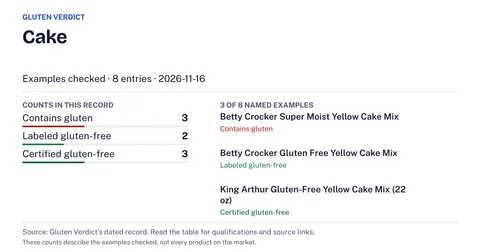 CakeContains glutenchecked Nov 16, 2026
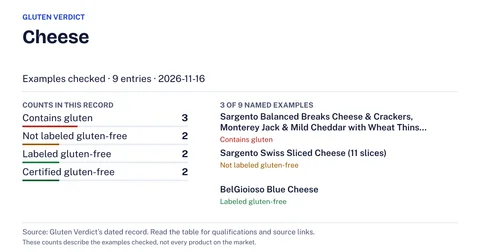 CheeseNaturally gluten-free3 of 9 products we checked contain gluten: Sargento Balanced Breaks Cheese & Crackers, Monterey Jack & Mild Cheddar with Wheat Thins Mini (6-pack); Farm Rich Mozzarella Sticks; and Farm Rich Cheddar Cheese Curdschecked Nov 16, 2026
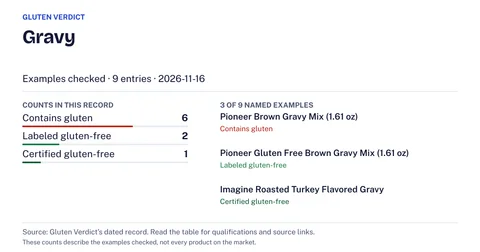 GravyDepends on the product6 of 9 products we checked contain glutenchecked Nov 16, 2026
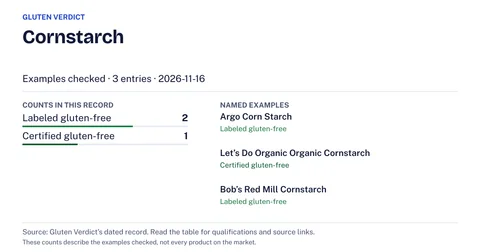 CornstarchNaturally gluten-freeBuy it labeled gluten-freechecked Nov 16, 2026
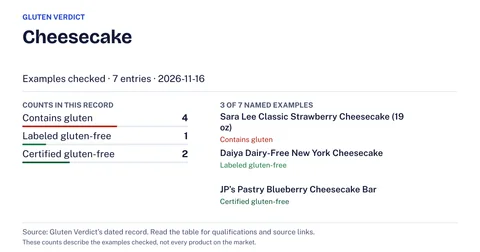 CheesecakeDepends on the product4 of 7 products we checked contain glutenchecked Nov 16, 2026
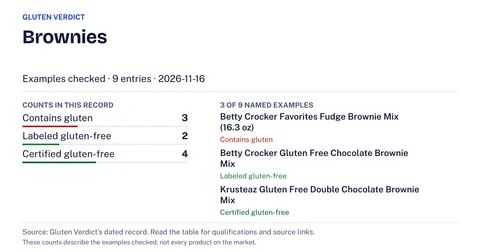 BrowniesContains glutenchecked Nov 16, 2026
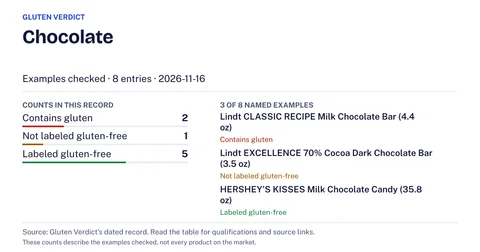 ChocolateDepends on the product2 of 8 products we checked contain gluten: Lindt CLASSIC RECIPE Milk Chocolate Bar (4.4 oz) and HERSHEY’S Cookies ‘N’ Creme Candy Bar (1.55 oz)checked Nov 16, 2026
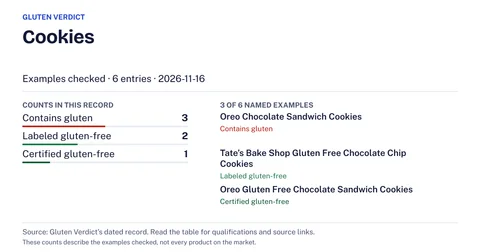 CookiesContains glutenchecked Nov 16, 2026
Questions people ask
Can a caterer whose kitchen also uses wheat flour still make gluten-free food?
Coeliac UK’s guidance for caterers says gluten-free meals can be prepared in kitchens where wheat flour is used, but care must be taken to manage cross-contamination38. In one pilot study with petri dishes of rice pudding, a 2 m distance from wheat flour use was needed to keep contamination at or under 20 ppm after 4 hours of use36. Whether that kitchen is acceptable is the decision of the person with celiac disease.
Does the FDA gluten-free rule apply to a caterer’s gluten-free menu?
FDA says its regulation applies to packaged foods3. For restaurants it recommends consistency with its definition when a menu makes a gluten-free claim4. Put the handling in the contract.
More in Holidays, weddings and celebrations
 Eating at a wedding with celiac disease: what to write, who to call and what to askA wedding guest with celiac disease: the RSVP line, the caterer call, the questions to ask and when to rely on your own food.
 Ordering a gluten-free birthday cake: what to ask the bakeryBakery, labeled packaged cake or your own? The questions to ask a bakery that also bakes wheat, and how to cut and serve the cake at the party.
 Hosting a gluten-free party: a menu and cross-contact planPlan a mixed party table for a guest with celiac disease: what to ask, which store-bought items to check, and how to keep dishes apart.
 Gluten-free Thanksgiving: a dish-by-dish check of the menuTurkey, stuffing, gravy, cranberry sauce, casserole and pie: which dishes need a label or maker check, and how to order the work in a shared kitchen.
 Gluten-free Christmas table: ham glaze, gravy, eggnog, snack mix and cookie trayCheck the ham glaze packet, gravy, eggnog, Chex Mix and cookie tray against the makers' own pages, and learn which agency covers a ham label.
 Passover and gluten: matzo, matzo meal and what a kosher mark leaves outWheat matzo contains gluten and a kosher-for-Passover mark is not a gluten-free claim. How to check matzo, matzo meal, cake meal and seder dishes.
Related guides
 Setting up a gluten-free kitchen: what to replace, wash or shareWalk each kitchen zone and decide, item by item, what to replace, what to wash and what a mixed household can keep sharing, with charity sources.
 Gluten cross-contact at home: where it happens and what to do about itHow gluten reaches gluten-free food at home, whether to separate, wash or ask for each route, and which rules have lab data behind them.
 Eating out with celiac disease: what to check, ask and watch forPlan a restaurant meal with celiac disease: what to check before you go, the questions to ask in order, how to read the answers, and what studies measured.
 Gluten-free in Brazil: the “contém glúten” line, pão de queijo, farofa and tapiocaHow to read Brazil’s mandatory “contém glúten” line, and how to judge pão de queijo, farofa, tapioca and fried snacks by recipe and kitchen.
Sources
- [1, 24, 27, 29, 52] Beyond Celiac, Dining Tips from Beyond Celiac (PDF), checked Nov 17, 2026.
Read on 2026-11-17: under the question “How is this dish prepared? How do you avoid cross-contact with gluten-containing ingredients?” the sheet says to ask about separate prep space, separate cookware and utensils, airborne flour in the kitchen, possible cross-contact on the grill, and a dedicated gluten-free fryer.
Read on 2026-11-17: under the question “How do you verify that your ingredients are gluten-free?” the sheet says to ask about spice blends, thickeners, coatings, and toppings/garnishes.
- [2, 39, 45] Gluten Intolerance Group, 25 Ways Cross-Contact Could Happen (And How to Avoid It), checked Nov 17, 2026.
- [3, 4] US Food and Drug Administration, Questions and Answers on the Gluten-Free Food Labeling Final Rule, checked Nov 17, 2026.
- [5, 6, 8, 26, 53] Beyond Celiac, Hot Spots in the Restaurant (PDF), checked Nov 17, 2026.
- [7, 20] Gluten Intolerance Group, What are some of the most important questions to ask the wait staff or management?, checked Nov 17, 2026.
- [9, 12, 13, 33, 38, 40, 47, 51, 54, 56, 62, 63] Coeliac UK, Catering gluten free: how to get it right (UK guidance for caterers, December 2019), checked Nov 17, 2026.
- [10, 46, 49] Gluten Intolerance Group, GIG article on gluten-free entertaining, checked Nov 17, 2026.
- [11, 14, 42, 50] Gluten Intolerance Group, Tips for Entertaining Your Gluten-free Family and Friends This Holiday Season, checked Nov 17, 2026.
- [15] Coeliac UK, Essential Gluten Free Eating Out Tips, checked Nov 17, 2026.
- [16, 17, 21, 22, 23, 25, 28] Celiac Disease Foundation, Dining and Social Eating, checked Nov 17, 2026.
- [18, 30, 31, 32] Gluten Intolerance Group, Questions to Ask When Eating Out, checked Nov 17, 2026.
- [19, 48, 57, 58] National Celiac Association, Gluten-Free (GF) Meal Preparation Restaurant Guidelines (PDF), checked Nov 17, 2026.
- [34, 35] Public Health Nutrition (PubMed record), Gluten contamination in gluten-free bakery products: a risk for coeliac disease patients (Farage and colleagues, 2017), checked Nov 17, 2026.
- [36, 37] Journal of Food Protection (PubMed record), Catering Gluten-Free When Simultaneously Using Wheat Flour (Miller, McGough and Urwin, Coeliac UK, 2016), checked Nov 17, 2026.
- [41] Gluten Intolerance Group, 38 Foods Where Gluten May Be “Hidden”, checked Nov 17, 2026.
- [43, 55] Gluten Intolerance Group, 8 Tips to Help You Best Serve Your Gluten-Free Guests, checked Nov 17, 2026.
- [44, 61] US Food and Drug Administration, Gluten and Food Labeling, checked Nov 17, 2026.
- [59, 60] Electronic Code of Federal Regulations, 21 CFR 101.91 Gluten-free labeling of food, checked Nov 17, 2026.