College meal plans and gluten-free food: accommodations, waivers and the cost
Short answer
Start with the college’s disability office, ask early, and get the result in writing before you sign for housing and a meal plan; what a college grants differs, and the Justice Department agreements with Lesley and Rider each bind the university that signed them, not every college1, 2, 3, 4, 16.
- Register with the disability office and ask what documents it wants; schools set their own standards, and Beyond Celiac says you will most likely need a physician’s note5, 6.
- Meet dining services and ask how gluten-free food is prepared, offered, labeled and ordered7.
- Ask for the outcome as a written plan, whether it is an adjusted plan or a waiver8, 9.
- If the answer is no, use the college’s grievance procedure; OCR says a complaint to OCR or a court is also open, and ADA.gov sends other disability complaints to the Justice Department10, 11, 12.
Part of Cost, taxes and food assistance, 14 guides

Key points
- The Education Department’s Office for Civil Rights says practically every US postsecondary school is covered by Section 504, Title II of the ADA, or both13.
- The Justice Department’s agreements with Lesley University (2012) and Rider University (2019) treat a meal-plan exemption as one possible modification among others14, 15; Beyond Celiac notes the Lesley case did not create a law all colleges must follow16.
- Colleges write their own exemption rules: one page says exemptions are rarely granted17, another says exemptions occur only when modifications cannot be made18, and a third looks at accommodations inside the plan first19.
- A doctor’s letter does not settle it: two colleges say a provider’s statement does not promise an exemption20, 21.
- OCR says a postsecondary school may not charge a student for an academic adjustment, or charge disabled students more for its programs22; what a waiver does to your bill depends on each college’s refund and financial-aid rules, which differ23, 24, 25.
Do disability laws reach a college meal plan?
The Education Department’s Office for Civil Rights (OCR) enforces Section 504 of the Rehabilitation Act and Title II of the Americans with Disabilities Act (ADA). It says practically every postsecondary school in the United States is subject to one or both laws13. The Justice Department’s agreement with Lesley University, a private nonprofit, treats the university as a public accommodation under ADA Title III26.
A mandatory plan is what turned dining into a legal question. The Justice Department’s Q&A says Lesley had required every student living on campus to take, and pay for, its meal service plan, even though some students with severe allergies could not eat the food it offered without risk of illness27. Because the plan was mandatory, the Department says, the ADA required reasonable modifications to it for students with celiac disease and other food allergies28.
On whether celiac disease counts, the Department says some people with food allergies have a disability under the ADA, particularly those with more significant or severe responses to certain foods, and that this would include individuals with celiac disease and others who have autoimmune responses to certain foods29. The Celiac Disease Foundation’s expert panel writes that celiac disease qualifies30.
Two limits. The Department adds that the ADA does not require every place that serves food to offer gluten-free food; the Lesley agreement concerned a mandatory program for a defined group of students28. And the Foundation’s paper says that although legal protections exist, enforcement remains uneven across institutions31.
What the Lesley and Rider agreements say
The Justice Department says many aspects of the Lesley agreement will serve as a model for other schools, but that food service plans are “not one-size-fits-all”2. Each agreement binds the university that signed it3, 4, each runs three years32, 33, and neither university admitted a violation34, 35. Beyond Celiac puts the practical point this way: the Lesley case “did not establish a law that all colleges and universities must adhere to”, but gives guidelines other schools can follow16.
| What | Lesley University, Massachusetts | Rider University, New Jersey |
|---|---|---|
| Signed | December 20, 201236. DOJ had received a complaint in or around October 200937. | February 21, 201938. DOJ had received a complaint in July 201639. |
| Meal-plan exemption | The university “may allow” a student to be exempt from the mandatory plan as a possible modification14. DOJ’s Q&A says the agreement requires Lesley to consider exempting students who cannot, because of disability, take full advantage of the plan40. | The university “must allow” students with food-allergy disabilities to be exempt as a possible modification15. |
| How a request is handled | Disability Services meets the student and works out an individualized plan in an interactive process41, then issues a written letter8. | Requests are to be answered within seven business days42. |
| Dining changes | Pre-ordered meals with at least 24 hours’ notice43; a dedicated area with card access for students in the process44, including separate appliances such as a microwave and toaster45. | A separate kitchen and preparation area with its own pots, pans and utensils46. |
| If the student disagrees | Review by the university’s ADA/Section 504 Coordinator47. | Appeal decided within seven days of submission48. |
In Rider’s agreement the Justice Department determined, among other things, that the university had not given students enough information on its website about getting a modification, had in some instances handed responsibility for accommodating students to its food service provider, and did not readily offer exemptions in some instances; Rider disputes the allegations49, 35. Two practical points follow for a student today: look for the procedure on the college’s website, and ask who, the disability office or the dining contractor, makes the decision.
What to take from the two agreements: Lesley’s started with the disability office41; both ended in a written plan8, 97 and treated a meal-plan exemption as one possible modification, not the only one14, 15.
What the disability office asks for
OCR says a student who wants an academic adjustment must tell the school about the disability and the need50, and that the school may require reasonable procedures the student is responsible for following51. It also says the school will probably require documentation showing a current disability and the need for the adjustment52. Schools may set reasonable standards, and may ask for a report from a medical doctor or another qualified professional5.
Beyond Celiac’s toolkit says many schools require registration with the Office of Disability Services before dietary accommodations, and that a student will most likely need a physician’s note stating the diagnosis and the need for a gluten-free diet6.
| College | What its page says |
|---|---|
| Florida Atlantic University | A verification form or a letter on letterhead from a medical doctor with the diagnosis and why it prevents the student from meeting dietary needs through a campus meal plan53. |
| Whittier College | An application with the student’s own account of the need and a medical provider’s certificate, with the lab or imaging results used for diagnosis54. |
| Lake Forest College | Medical documentation of the disability-related need and how it connects to the request, from a provider in a field consistent with the diagnosis55. |
| Earlham College | The student’s medical provider submits documentation of the condition directly to the college’s health services56. |
- A high school IEP or 504 plan may show what has worked, but OCR says it is generally not enough on its own for college57.
- If your papers fall short, a school official should tell you in a timely manner what else to provide58. Neither a high school nor a college is required to conduct or pay for a new evaluation59.
- Parents: OCR says not to expect the school to invite them to take part in the process60.
- If you want a single room, an appliance in the room or a kitchen, Beyond Celiac says to have the doctor name each one in the letter61.
The request, step by step
- Find the procedure. Postsecondary schools usually publish it in recruitment materials, catalogs, student handbooks and on their websites62. Beyond Celiac’s first step is to contact the Office of Disability Services63.
- Ask early. OCR says a student may ask at any time but should ask as early as possible1. Colleges that publish dates tie them to the semester: for example Earlham’s page says full-year requests received by June 15 will be processed by July 164, and Whittier’s asks for the end of July for fall65.
- Send the documents, then expect an interactive process: OCR tells students to expect the school to work with them to identify an adjustment60. At Vermont the accessibility office has the student meet the dining dietitian to finalize the accommodation66.
- Get the outcome in writing. Lesley’s agreement calls for a written modification letter8, and Vermont gives a meal plan accommodation letter9.
- Check whether you must keep paying while you wait. Whittier charges for meals until a medical exemption is granted in writing67, and Florida Atlantic expects payment by the deadline even while a request is pending23.
- Plan to renew and update. Lesley’s agreement says the modification process may be ongoing68; Louisiana at Lafayette says to reapply each year69; Earlham says prior approvals do not promise future ones70; Vermont puts the duty to report changes on the student71.
If the plan is not working, tell the school as soon as you notice; OCR warns it may be too late to correct a problem if you wait until the course or activity is completed72.
Questions for dining services before you pick a plan
Ask who decides what. At Louisiana at Lafayette, for example, meal plan modifications are determined by Sodexo staff, not the disability office18. Beyond Celiac’s toolkit says to start talking to dining services long before choosing a college73, and its college page names the food service director as the best link to the options available74. The Gluten Intolerance Group (GIG) adds that most colleges lack a dedicated gluten-free dining hall75, so the useful question is what the college does offer.
| Ask | What the sources show |
|---|---|
| How is gluten-free food prepared, offered, labeled and kept from cross-contact? | GIG’s list for a meeting with a dining manager or dietitian7. |
| Can I pre-order meals, and with how much notice? | Lesley’s agreement uses at least 24 hours’ notice43. |
| Is there a separate preparation or storage area I can use? | Lesley: a card-access dedicated area with separate appliances44, 45. Rider: a separate kitchen46. |
| Who is my contact, and can I reach the dietitian or head chef? | The Foundation’s panel lists direct communication channels with dining leadership among its dining accommodations76. |
| Can I see ingredient lists or original packaging? | GIG says to ask to see packaging for dishes made from packaged foods77; Beyond Celiac lists asking to share dishes’ ingredients78. |
| Are gluten-free meals available at every dining hour, weekends and holidays? | A line in the Foundation’s Table 179. |
| Does dining tell disability services when someone asks about a plan change? | Lesley’s staff training includes that the food service manager should promptly notify Disability Services80. |
| Can the meal card be used off campus? | Beyond Celiac’s toolkit suggests finding out whether flex spending works off campus81. |
Write down the answers, and ask for the dining arrangements to appear in the written plan, as Lesley’s modification letters detail the specific plan for the student8.
Accommodated plan or waiver?
Both routes are on the table in the sources. The Foundation’s panel lists pre-ordered or custom meals, exemptions from mandatory plans when medically necessary, and dedicated preparation areas among its dining recommendations76; that is a recommendation from a 40-person panel convened by the Foundation82. The colleges’ own policies, in the table below, differ from one another, and a waiver can be partial: Earlham’s page speaks of a “partial or full exemption”83, and Vermont’s of a meal plan “reduction or waiver”84.
| College | Order of events | Money and timing |
|---|---|---|
| University of Vermont | Accessibility office reviews requests with the dining dietitian and has the student meet them66; a waiver means cooking in the residence hall kitchen or alternate arrangements84. | Student must report changes71. |
| Florida Atlantic University | Dining first explores accommodations inside the required plan19. | Pay by the deadline; if approved, refund from the approval date23. |
| University of Louisiana at Lafayette | First response is to accommodate; exemptions only when modifications cannot be made18. Its list of reasons not considered includes “gluten free diet”85. | Credit is pro-rata from the approval date86; reapply yearly69; a provider’s statement does not promise an exemption20. |
| Whittier College | Says it usually denies exemption requests based solely on diets such as vegetarian, vegan or food made without gluten-containing ingredients87. | Charged until a medical exemption is granted in writing67; a doctor’s statement does not promise one21. |
| Lake Forest College | Exemptions are rarely granted17. | Not retroactive; no refunds for current or past semesters24. |
| Earlham College | A documented medical condition requiring a diet that Food Services cannot accommodate may qualify for an exemption88. | Reduces cost of attendance and may affect financial aid25. |
Louisiana at Lafayette’s list is worth reading closely: it names “gluten free diet” among the reasons for which exemptions will not be considered, while the process it describes starts at the Office of Disability Services85, 89. Our reading: these pages frame an exemption around a documented medical need that dining cannot meet88, 85, so describe the need and why the dining options do not meet it, not only a diet.
What it costs
OCR says a postsecondary school may not charge a student for an academic adjustment, nor charge students with disabilities more for its programs than other students22. That is a statement about academic adjustments; what a waiver refunds and when varies by college, as the table shows23, 24, 86, and at Earlham a waiver may affect financial aid25. Ask the bursar and financial aid office for the plan price, the refund rule and the aid effect in writing before you choose. If you will cook for yourself, see gluten-free on a budget.
A rule of thumb from our reading, not a source’s advice: choose the adjusted plan when dining can show you a pre-order route, a named contact and a preparation area in writing; look at a waiver when it cannot and you have a kitchen you can use.
Dorm kitchens and appliances
A waiver only works if you can cook. Vermont expects a waiver student to cook in the residence hall kitchen or make alternate arrangements84. The Foundation’s Table 1 lists kitchen appliances among its housing accommodations90, and Beyond Celiac’s toolkit lists a single room, a community kitchen and bringing a microwave, fridge, toaster or hot plate among the accommodations some students request91. Lesley’s dedicated area included a separate microwave and toaster45.
Put any housing request in the same letter as the dining one61. For the kitchen itself, from the fridge shelf to the shared toaster, see gluten-free in a college dorm.
If the college says no
- Ask for the decision in writing and for the appeal route. Practically every postsecondary school must have a Section 504, ADA or disability services coordinator92 and grievance procedures10. Lesley’s agreement names review by its ADA/Section 504 Coordinator47; Rider’s requires an appeal to be decided within seven days48.
- Use the grievance procedure, with all the reasons that support the request in hand93.
- Add documentation if the school wants more clinical detail. The Foundation’s paper recommends, in order: revise the plan with disability services; add documentation from a treating physician or registered dietitian; then patient advocacy organizations; and as a last resort a disability rights attorney who knows postsecondary access94.
- Beyond the campus, OCR says a student may file a complaint with OCR or go to court11. ADA.gov sends other disability complaints to the Justice Department’s Civil Rights Division12, says its review can take up to three months95, and runs a mediation program that does not involve the courts96.
A federal complaint is slow, judging by these two cases. The Lesley agreement says the Justice Department received its complaint in or around October 2009 and is dated December 201237, 36; Rider’s says July 2016 and was signed in February 201939, 38. Settle the campus process first.
Questions people ask
Is celiac disease a disability under the ADA?
The Justice Department says some people with food allergies have a disability under the ADA, particularly those with more significant or severe responses, and that this would include individuals with celiac disease29. The Foundation’s expert panel states that it qualifies30. The college still asks for documentation of your own case52.
Can a college charge extra for an accommodation?
OCR says no: a postsecondary school may not charge for an academic adjustment, nor charge students with disabilities more for its programs22.
Does a doctor’s letter get me a meal-plan waiver?
Not on its own. Louisiana at Lafayette and Whittier each say a provider’s statement does not promise an exemption20, 21.
Does my high school 504 plan carry over?
OCR says an IEP or 504 plan may help identify services that worked but is generally not sufficient documentation for college57.
Do my parents take part in the college process?
OCR says not to expect a postsecondary school to invite parents to take part in the process60.
More in Cost, taxes and food assistance
 Does insurance cover celiac testing and dietitian visits in the US?What a US plan pays for celiac blood tests, biopsy and dietitian visits depends on the plan. Reference points, questions to ask and appeal steps.
 Gluten-free flour and baking mix cost per cup, with each maker’s statementWhat a cup of gluten-free flour or baking mix costs from each maker’s own price and label, shown beside what the maker says about gluten.
 Claiming the extra cost of gluten-free food in Canada: what the CRA allows and what to keepWhat the CRA lets a person with celiac disease claim for gluten-free food, how to work out the extra cost, what to keep, and the $1,000 proposal.
 Financial help for a gluten-free diet in the US: each program and where to startThe US programs that touch the cost of a gluten-free diet, who runs each one, and which page to open to read its own rule.
 Paying for gluten-free food and dietitian visits with an HSA or FSAWhat IRS rules say about paying for special food, dietitian visits and test kits from an HSA or FSA, what a physician's letter covers and what to keep.
 Is gluten-free food tax deductible? What the IRS says and what to keepWhat IRS Publication 502 says about special food as a medical expense, how the excess-cost sum works, and what records to bring to a tax professional.
Related guides
 A 504 plan and school meal rules for celiac disease: what to ask for and where to complainMeal substitution or a 504 plan for a child with celiac disease: what each rule says, what the medical statement must hold, and where to complain.
 Asking an employer for celiac-related accommodations: what the ADA, EEOC and JAN sayHow to ask an employer for a celiac-related accommodation: what the ADA, EEOC and JAN say, what a request contains, and the EEOC charge deadline.
 Gluten-free on a budget: what costs extra and what does notSort a gluten-free shopping list into plain foods, foods that need a statement and packaged substitutes, then compare costs and check each claim.
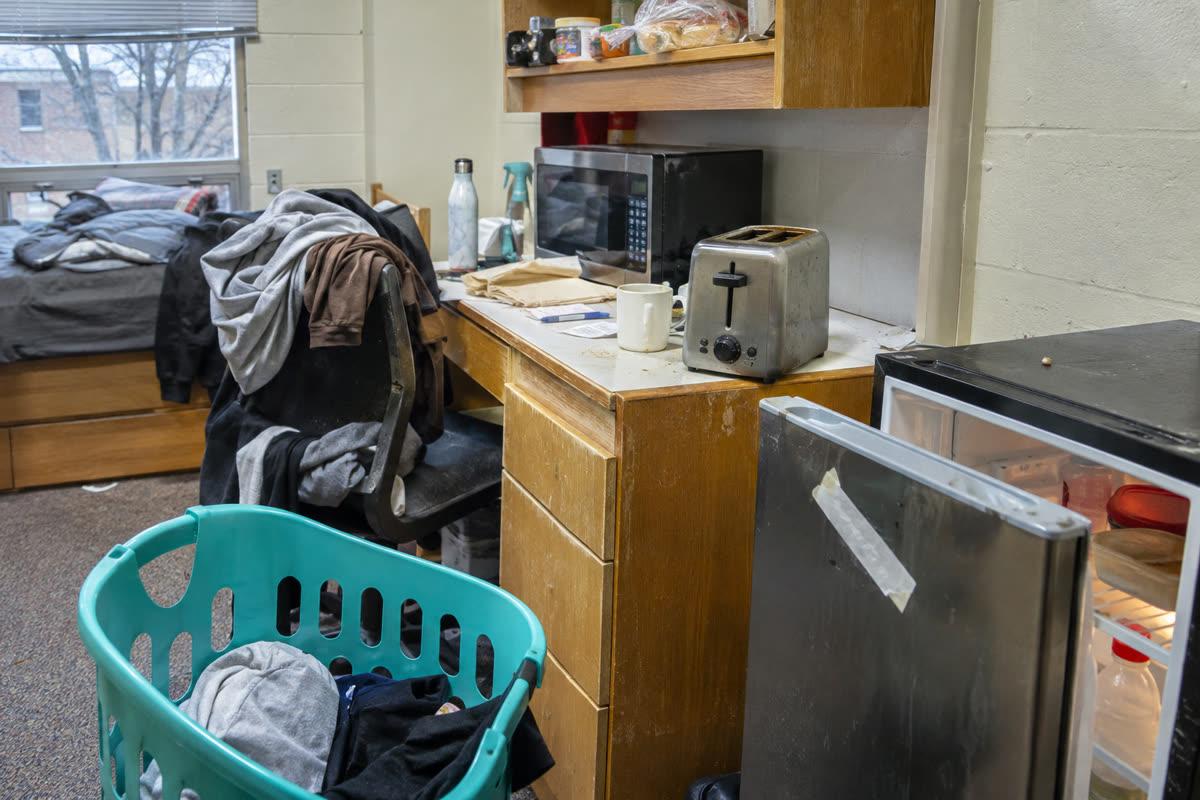 Gluten-free in a college dorm: the fridge, microwave, toaster and roommate rulesHow to set up a shared dorm room or kitchen for gluten-free living: fridge, microwave, toaster, sponges, a roommate script and how to ask for housing help.
Sources
- [1, 5, 10, 11, 13, 22, 50, 51, 52, 57, 58, 59, 60, 62, 72, 92, 93] US Department of Education, Office for Civil Rights, Students with Disabilities Preparing for Postsecondary Education, checked Nov 17, 2026.
- [2, 27, 28, 29, 36, 40] US Department of Justice, Questions and Answers about the Lesley University Agreement and Potential Implications for Individuals with Food Allergies, checked Nov 17, 2026.
- [3, 8, 14, 26, 32, 34, 37, 41, 43, 44, 45, 47, 68, 80] US Department of Justice, Settlement Agreement between the United States and Lesley University (DJ 202-36-231), checked Nov 17, 2026.
Read on 2026-11-17: paragraph 4(f) lists what the dedicated area is to contain: a sink and counter area, dish rack and other kitchen supplies; a refrigerator and freezer for perishable items; cabinet space for non-perishable items; separate appliances, including a microwave and toaster; and a food warmer to keep pre-ordered meals warm.
- [4, 15, 33, 35, 38, 39, 42, 46, 48, 49, 97] US Department of Justice, Settlement Agreement between the United States and Rider University (DJ 202-48-32), checked Nov 17, 2026.
Read on 2026-11-17: the signature block of the agreement reads “Executed this 21st day of February , 2019”.
- [6, 61, 63, 73, 81, 91] Beyond Celiac, Beyond Celiac College Toolkit, checked Nov 17, 2026.
Read on 2026-11-17: under “Additional Accommodations”, which says some students request accommodations beyond special dietary ones, the toolkit lists a single room; having a car on campus; access to a community kitchen; the ability to bring a microwave, fridge, toaster or hot plate to the dorm to prepare gluten-free meals; academic accommodations in case of glutening; and a dorm with a community kitchen or close to a gluten-free dining hall.
- [7, 75, 77] Gluten Intolerance Group, College Dining Halls, checked Nov 17, 2026.
- [9, 66, 71, 84] University of Vermont, Dining Service Accommodations, checked Nov 17, 2026.
- [12, 95, 96] ADA.gov (US Department of Justice), File a Complaint, checked Nov 17, 2026.
Read on 2026-11-17: under “Where and How to File Your Complaint”, the page sends employment issues to the EEOC, air travel issues to the Department of Transportation, housing issues to HUD, and “Other Issues” to the Department of Justice, Civil Rights Division, which can be filed online or by mail.
- [16, 74, 78] Beyond Celiac, Information for College Students, checked Nov 17, 2026.
Read on 2026-11-17: the list under “Some questions to consider asking your foodservice director include:” names the best place to go for gluten-free food; whether any dining halls have a gluten-free section; whether other students eat gluten-free on campus; whether the dishes' ingredients can be shared; whether the kitchens have a dedicated section for gluten-free food preparation; how cross-contact is prevented in the kitchen; and whether symbols mark dishes that are gluten-free or can be made so.
- [17, 24, 55] Lake Forest College, Meal Plan Accommodations, checked Nov 17, 2026.
- [18, 20, 69, 85, 86, 89] University of Louisiana at Lafayette, Request a Refund, Change, or Exemption, checked Nov 17, 2026.
- [19, 23, 53] Florida Atlantic University, Meal Plan Accommodations, checked Nov 17, 2026.
- [21, 54, 65, 67, 87] Whittier College, Meal Plan Exemption, checked Nov 17, 2026.
- [25, 56, 64, 70, 83, 88] Earlham College, Meal Plan Exemptions, checked Nov 17, 2026.
- [30, 31, 76, 79, 82, 90, 94] Nutrients (Celiac Disease Foundation panel), Accommodating Celiac Disease in Higher Education: Evidence-Informed National Recommendations, checked Nov 17, 2026.
Read on 2026-11-17: Table 1 of the paper lists six housing accommodations, among them “Roommate Considerations” and “Kitchen Appliances”, and seven dining accommodations, among them “Direct Communication”, “Custom Meals”, “Meal Plan Exemption” and “Dedicated GF Zones”.