Is gluten-free food tax deductible? What the IRS says and what to keep
Short answer
Only the extra cost over a normal diet can count, and Publication 502 does not mention gluten, so it does not say whether a gluten-free diet qualifies2, 4. The publication lets a taxpayer include special food only if it does not satisfy normal nutritional needs, it treats an illness and a physician substantiates the need1. Even then, the amount helps only if you itemize and your total medical expenses pass 7.5% of adjusted gross income6, 18.
Part of Cost, taxes and food assistance, 14 guides

Key points
- Publication 502 has three tests for special food: it does not satisfy normal nutritional needs, it alleviates or treats an illness, and a physician substantiates the need1.
- The word “gluten” does not appear in Publication 502, so whether a gluten-free diet meets the tests is a question for a tax professional4.
- Only the excess over the cost of a normal diet is includible, never the whole grocery bill2.
- The deduction is on Schedule A, so it applies only if you itemize, and only the part of medical expenses above 7.5% of adjusted gross income counts15, 18.
- Keep receipts and the documents behind each figure for as long as the IRS says they may be material to the return21.
What the IRS says about special food
The rule sits in Publication 502, the IRS guide to the medical and dental expense deduction. It says a taxpayer can include the cost of special food in medical expenses only if three things are true1:
- The food does not satisfy normal nutritional needs.
- The food alleviates or treats an illness.
- The need for the food is substantiated by a physician.
Even then, the amount that counts is limited to the amount by which the special food costs more than a normal diet2. The IRS draws a line with diet food: the cost of diet food or beverages cannot be included, because they substitute for what is normally consumed to satisfy nutritional needs3. The Schedule A instructions repeat that diet food is not includible17.
Publication 502 also says medical care expenses must be primarily to alleviate or prevent a physical or mental disability or illness, and that expenses merely beneficial to general health do not qualify5.
Publication 502 does not name gluten-free food. We read the 2025 edition of Publication 502 on 2026-11-17 and the word “gluten” is not in it4. Whether a physician-directed gluten-free diet meets the three tests is for a tax professional to judge on your facts. This guide does not decide it.
The Gluten Intolerance Group, a charity, reaches a view on this: it answers “yes” and says the passage above on special food is the relevant rule, noting that the term “gluten-free” is not mentioned in Publication 50225, 27. It also says it does not offer tax advice28. Treat that as a charity’s reading, not as IRS guidance.
Only the extra cost counts: the arithmetic
The IRS wording is “the amount by which the cost of the special food exceeds the cost of a normal diet”2. Read plainly, that is the difference between two costs: the special items you bought and what you would otherwise have bought.
The numbers below are made up to show the sum. They are not prices, and not a claim about what any household spends.
| Step | Made-up figure | Where it comes from |
|---|---|---|
| Gluten-free items you bought that year | $2,400 | Your receipts |
| What the ordinary versions of the same items would have cost | $1,500 | Your comparison prices |
| Excess cost (the only part that can be a medical expense) | $900 | $2,400 minus $1,500 |
| Other medical expenses you paid and were not reimbursed for | $4,200 | Your records |
| Total medical expenses | $5,100 | $900 plus $4,200 |
| Adjusted gross income | $60,000 | Your return |
| 7.5% of adjusted gross income | $4,500 | $60,000 times 0.075 |
| Amount above the 7.5% floor | $600 | $5,100 minus $4,500 |
In this made-up case $600 would go on Schedule A, and in most cases it lowers your tax only if your itemized deductions beat your standard deduction14 (next section). With only $3,000 of other expenses the total would be $3,900, under the $4,500 floor, and nothing would be deductible. The 7.5% rule is the IRS’s: only the part of medical and dental expenses above 7.5% of adjusted gross income is deductible6.
Pick comparison prices you can show. The special-food passage gives no method for pricing “a normal diet”4, so how you build the comparison is a question for your preparer. Our verdict pages for staples such as bread, pasta, flour, cereal and crackers are about gluten status, not prices, so they will not supply either side of the comparison.
Two gates before any of this matters
You have to itemize
Medical expenses go on Schedule A, which is where itemized deductions are figured18. A taxpayer who itemizes cannot also take the standard deduction19. The Schedule A instructions say that in most cases federal income tax is lower with the larger of the itemized deductions or the standard deduction14. So a medical total can be above the floor and still not change your tax if your itemized deductions as a whole fall short of the standard deduction.
The 7.5% floor
Only the part of medical and dental expenses that exceeds 7.5% of adjusted gross income is deductible15. The floor is measured on your medical and dental expenses together, so the gluten-free excess cost is added to your other unreimbursed medical costs, which is why the arithmetic above includes both.
The edition of Publication 502 we read is for 2025 returns; it is marked “For use in preparing 2025 Returns”7. Percentages, limits and wording can change, so check the edition for the year you are filing.
Whose expenses count, and what you subtract
You can generally include medical expenses you pay for yourself and for someone who was your spouse or your dependent either when the services were provided or when you paid for them9. That is the rule that matters if the person with the diagnosis is a spouse or a dependent.
Expenses must be ones you paid in the year you are claiming8. Anything paid by insurance or another source is out10, and Schedule A line 1 is the total after reducing expenses by payments from insurance or other sources16. Spending paid for with a tax-free distribution from a health savings account cannot be included either11.
The IRS’s separate FAQ for health savings accounts, health FSAs and similar plans applies the same three tests and the same excess-cost limit to food and beverages bought for health reasons20. Whether a plan will reimburse gluten-free food is a different question from the tax deduction, and it is not covered here.
What to keep
The IRS says to keep records such as receipts, canceled checks and other documents that support a deduction on a return, generally until the period of limitations expires for that return21. For how long that is in practice, the IRS publishes a record-keeping page22.
The Gluten Intolerance Group tells readers to keep detailed records all year, covering purchases for a doctor-prescribed gluten-free diet26. Publication 502 names the physician’s substantiation as a condition but gives no form or wording for it4, so ask your preparer what they want to see.
A file that matches the way the sum is built:
- The physician’s substantiation of the need for the food, which Publication 502 makes a condition1. Ask your preparer what form it should take.
- Receipts for every special-food purchase, showing the item, the date and the price paid, kept by calendar year.
- The ordinary-version price for each special item and where you got it (a store page, a shelf photo, a dated screenshot).
- Insurance, health savings account or other reimbursements you received, so they can be subtracted10.
- Your other unreimbursed medical expenses for the same year, because the 7.5% floor is measured on the total15.
The Gluten Intolerance Group says other costs may also be deductible, such as items specific to the diet like non-gluten-containing flours and xanthan gum, travel for shopping for the products, and shipping29. That is the charity’s guidance and it cites no IRS passage for it, so raise it with a tax professional before relying on it.
If you overlooked a past year
The IRS says that if you did not claim a medical or dental expense that would have been deductible in an earlier year, you can file Form 1040-X to claim a refund for that year instead of putting it on this year’s return12. Generally, the claim must be filed within 3 years from the date the original return was filed or within 2 years from the time the tax was paid, whichever is later13.
Questions to bring to a tax professional
The IRS’s wording leaves judgment calls. Taking the list below and your file to a tax professional is the way to answer them for your own return.
- Does a physician-directed gluten-free diet meet all three tests in Publication 502, given that the publication does not mention gluten4?
- What should the physician’s substantiation say, and does it need to be renewed each year?
- Which price comparison would you accept for “the cost of a normal diet”?
- Will my itemized deductions, with the medical total, beat my standard deduction14?
- Are travel or shipping costs for gluten-free shopping something you would include?
- Should I amend an earlier return12?
The IRS’s online tool for this topic asks for your filing status, the type and amount of expenses, the year paid, your adjusted gross income and any reimbursements, so have those at hand23. The tool is the IRS’s own interview for this question24.
Verdicts in this guide
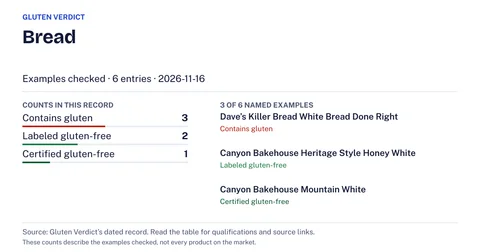 BreadContains glutenchecked Nov 16, 2026
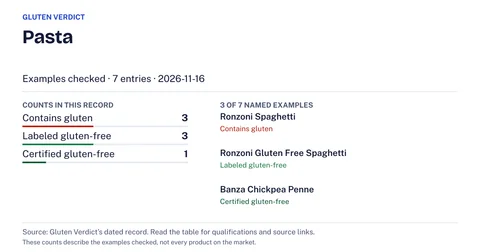 PastaContains glutenchecked Nov 16, 2026
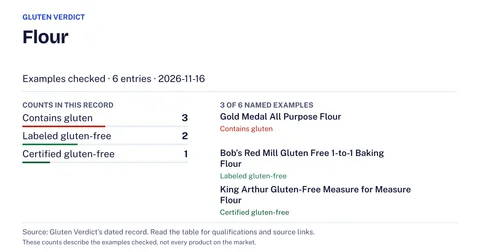 FlourContains glutenchecked Nov 16, 2026
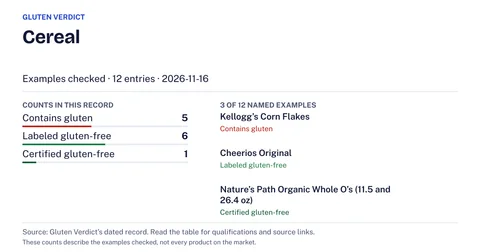 CerealDepends on the product5 of 12 products we checked contain glutenchecked Nov 16, 2026
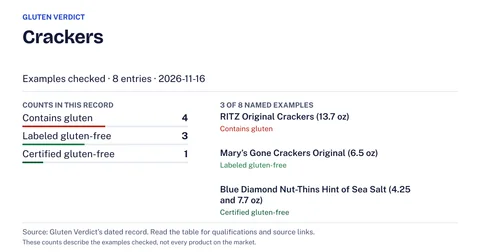 CrackersDepends on the product4 of 8 products we checked contain glutenchecked Nov 16, 2026
Questions people ask
Is gluten-free food tax deductible in the US?
Possibly in part. The IRS lets taxpayers include special food only if it does not satisfy normal nutritional needs, treats an illness and is substantiated by a physician, and only the excess over a normal diet1, 2. Publication 502 does not mention gluten4, so ask a tax professional whether your situation qualifies.
Can I deduct my whole gluten-free grocery bill?
No. The amount you can include is limited to the amount by which the special food costs more than a normal diet2.
Do I need to itemize?
Yes. Medical expenses are deducted on Schedule A, the itemized-deductions form, and you cannot also take the standard deduction18, 19.
How much medical spending do I need before it counts?
Only the part of medical and dental expenses above 7.5% of adjusted gross income is deductible, in the editions we read for 2025 returns15, 7.
Can I claim it for a child or spouse with celiac disease?
You can generally include medical expenses you pay for your spouse or dependent9. Whether the food qualifies still depends on the three tests1.
What if I paid with a health savings account?
Expenses paid with a tax-free health savings account distribution cannot also be included as medical expenses11.
More in Cost, taxes and food assistance
 Paying for gluten-free food and dietitian visits with an HSA or FSAWhat IRS rules say about paying for special food, dietitian visits and test kits from an HSA or FSA, what a physician's letter covers and what to keep.
 Gluten-free on a budget: what costs extra and what does notSort a gluten-free shopping list into plain foods, foods that need a statement and packaged substitutes, then compare costs and check each claim.
 Why gluten-free packaged food costs more, and what the price surveys showWhat price surveys found, what researchers say drives the gap, what FDA’s rule and one certifier require, and what a shopper can avoid.
 A price-per-ounce worksheet for comparing gluten-free staples at any store, club or onlineA worksheet for comparing gluten-free staples by price per ounce across stores, clubs and online, with a column for the gluten-free statement.
 Gluten-free food on prescription in the UK: how to check your areaWhat gluten-free staples the NHS prescribes in England, Scotland, Wales and Northern Ireland, how amounts are set, what you pay, and where to check.
 Claiming the extra cost of gluten-free food in Canada: what the CRA allows and what to keepWhat the CRA lets a person with celiac disease claim for gluten-free food, how to work out the extra cost, what to keep, and the $1,000 proposal.
Related guides
 Does insurance cover celiac testing and dietitian visits in the US?What a US plan pays for celiac blood tests, biopsy and dietitian visits depends on the plan. Reference points, questions to ask and appeal steps.
 Going gluten-free: what to remove and what to keep in your pantry and kitchenSort a full pantry into foods to remove, labels to read and plain foods to keep, then decide on shared jars, toasters and pans.
 A 504 plan and school meal rules for celiac disease: what to ask for and where to complainMeal substitution or a 504 plan for a child with celiac disease: what each rule says, what the medical statement must hold, and where to complain.
 A gluten-free child who refuses food: what to track and when to ask the doctorHow to tell ordinary picky eating from a pattern to raise with your child’s doctor or dietitian, what ARFID is, and a one-week log to bring.
Sources
- [1, 2, 3, 4, 5, 6, 7, 8, 9, 10, 11, 12, 13] Internal Revenue Service, Publication 502 (2025), Medical and Dental Expenses, checked Nov 17, 2026.
Read on 2026-11-17: the word “gluten” does not appear anywhere in the text of Publication 502 (2025). The passage on special food gives no form, wording or template for the physician’s substantiation and no method for pricing a normal diet.
- [14, 15, 16, 17] Internal Revenue Service, Instructions for Schedule A (Form 1040), 2025, checked Nov 17, 2026.
Read on 2026-11-17: the list headed “Examples of Medical and Dental Payments You Can't Include” names “The cost of diet food.”
- [18] Internal Revenue Service, Topic no. 502, Medical and dental expenses, checked Nov 17, 2026.
- [19] Internal Revenue Service, Topic no. 551, Standard deduction, checked Nov 17, 2026.
- [20] Internal Revenue Service, FAQs about medical expenses related to nutrition, wellness and general health, checked Nov 17, 2026.
- [21] Internal Revenue Service, Topic no. 305, Recordkeeping, checked Nov 17, 2026.
- [22] Internal Revenue Service, How long should I keep records?, checked Nov 17, 2026.
- [23, 24] Internal Revenue Service, Can I deduct my medical and dental expenses?, checked Nov 17, 2026.
Read on 2026-11-17: the list headed “Information you'll need” names filing status; type and amount of expenses paid; the year in which the expenses were paid; your adjusted gross income; and whether you were reimbursed or whether expenses were paid out of a Health Savings Account or an Archer Medical Savings Account.
- [25, 26, 27, 28, 29] Gluten Intolerance Group, Is Your Gluten-Free Food Tax Deductible?, checked Nov 17, 2026.
Read on 2026-11-17: the post, published February 8, 2021, answers “Yes” to whether gluten-free food can be deducted as a medical expense, and sets out criteria: food prescribed by a doctor as part of medical treatment for celiac disease or non-celiac gluten sensitivity, itemizing on Schedule A, careful records, and only the amount above what the reader would normally spend on comparable products.
Read on 2026-11-17: the post lists, as further items it says may be deductible, “items specific to the gluten-free diet” such as non-gluten-containing flours and xanthan gum for baking, travel expenses related to shopping for the products, and shipping or delivery expenses for products ordered. It states these as GIG’s guidance and does not cite an IRS passage for them.