Paying for gluten-free food and dietitian visits with an HSA or FSA
Short answer
No IRS page we read says whether gluten-free food qualifies, because none names gluten or celiac disease1, 2, 3. A health FSA pays what its plan specifies9; the IRS's general rules for HSAs and FSAs8 say:
- Food counts only if it does not satisfy normal nutritional needs, alleviates or treats an illness, and a physician substantiates the need, and only for the amount above a normal product's cost4.
- Nutritional counseling counts when it treats a specific disease diagnosed by a physician5.
- Supplements count when a medical practitioner recommends them as treatment for a diagnosed condition6.
- Anything an HSA or FSA pays cannot also be deducted on your tax return7.
Part of Cost, taxes and food assistance, 14 guides

Key points
- HSAs and FSAs pay for expenses that count as medical care under section 213 of the tax code, the section that also governs the itemized medical deduction8.
- A health FSA covers what its plan specifies9; with an HSA you keep the records that justify each withdrawal10.
- The IRS FAQ page gives no form for the physician's statement11, so ask a plan administrator what it wants before asking your doctor to write.
- Self-employed people cannot have an FSA12 but can contribute to an HSA13.
- An HSA withdrawal not used for qualified medical expenses is taxed and may carry an additional 20% tax14.
Who decides what counts: the IRS and your plan
Two layers apply. The IRS sets the outer limit: expenses for medical care under section 213 of the Internal Revenue Code can be paid or reimbursed under an HSA or a health FSA8. Publication 502 defines medical expenses as the costs of diagnosis, cure, mitigation, treatment or prevention of disease, and says they include payments for legal medical services rendered by physicians and other medical practitioners15. The expense must be primarily to alleviate or prevent a physical or mental disability or illness, not merely beneficial to general health16.
Inside that limit, a health FSA pays what its own plan specifies, from the expenses that would generally qualify for the medical expense deduction9. Employers are not required to offer an FSA, and an IRS news release (November 2019, marked as historical content) tells employees to check with their employer about eligible expenses and claim procedures17, 18.
An HSA works differently. Qualified medical expenses are amounts paid for medical care for you, your spouse and your dependents, to the extent insurance or others have not paid them19. The withdrawal is yours to justify: you keep the records10, and a distribution not used for qualified medical expenses is taxed and may carry an additional 20% tax14.
None of the IRS pages we read for this guide names gluten or celiac disease2, 1, 3. That is why the answer for a gluten-free grocery item comes from applying the general food rule below, and why a plan may decide it differently from another plan.
HSA, FSA and the itemized deduction: how they differ
| HSA | Health FSA | Itemized deduction | |
|---|---|---|---|
| Who can use it | People covered by a high deductible health plan (HDHP) on the first day of the month, among other requirements20. A self-employed person can contribute13. | Employees whose employer offers one17. Self-employed persons are not eligible12. | Claimed on Schedule A (Form 1040)21. |
| What it pays for | Medical care for you, your spouse and your dependents, to the extent not paid by insurance or otherwise19. | What the plan specifies, among expenses that would generally qualify for the medical expense deduction9. | Only the part of medical and dental expenses above 7.5% of adjusted gross income (AGI)22. |
| Unused money | You do not have to withdraw each year23. | Generally use-it-or-lose-it; the plan can allow a grace period or a carryover24. | Not an account. |
| Papers | You keep records and do not send them with your return25. | A written statement from an independent third party goes to the FSA26; for an employer-issued card, certain substantiation methods may mean no additional information is needed45. | Records that support the item on your return27. |
One rule covers all three. An expense cannot be used twice: if an amount is paid or reimbursed under an HSA or FSA, you cannot also deduct it as a medical expense on your return7.
If you have an FSA and an HSA
An employee covered by an HDHP and a health FSA that pays or reimburses qualified medical expenses generally cannot contribute to an HSA28. The exceptions include a limited-purpose or a post-deductible health FSA29. If your employer offers both, ask which type the FSA is.
Gluten-free food: the three tests and the extra-cost rule
The IRS has answered a general question: can the cost of food bought for a health reason be paid from an HSA or FSA? Yes, but only if all three of these hold4:
- The food does not satisfy normal nutritional needs4.
- The food alleviates or treats an illness4.
- A physician substantiates the need for the food4.
Even then, the expense is limited to the amount by which the food costs more than a product that satisfies normal nutritional needs, and if any of the three is missing, the cost is not a medical expense4. Publication 502 states the same limit for the itemized deduction, measured against the cost of a normal diet30.
Worked example with made-up prices: a gluten-free loaf costs $7 and the ordinary loaf you would otherwise buy costs $4. If all three tests are met, the expense is limited to the $3 difference, not the $74. Your own receipts decide the real numbers.
Where gluten-free food sits against the three tests
NIDDK says doctors treat celiac disease by helping people follow a gluten-free diet31. That bears on the second test. It does not settle the first: no IRS page we read says whether a particular gluten-free food meets it2, 1, 3. Because nothing on those pages addresses the first test for gluten-free food, ask the plan how it applies it; the letter section below lists points to cover.
The Gluten Intolerance Group (GIG), a celiac charity, points to Publication 502's rules on restricted diets in a 2021 post. It notes that gluten-free is not mentioned in Publication 50232, and says that, to file for this type of deduction, the gluten-free foods must be prescribed by a doctor as part of a medical treatment for celiac disease or a non-celiac gluten sensitivity33. That is a charity's reading, not IRS guidance, and GIG says it does not offer tax advice34.
GIG's post also lists, among items you may be able to deduct, the full cost of items specific to the gluten-free diet35. The IRS answer on food limits the expense to the amount above a normal product's cost4. Ask the plan which rule it applies to baking items such as gluten-free flour.
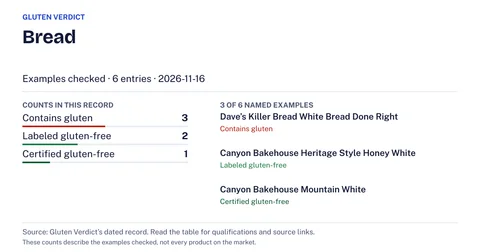
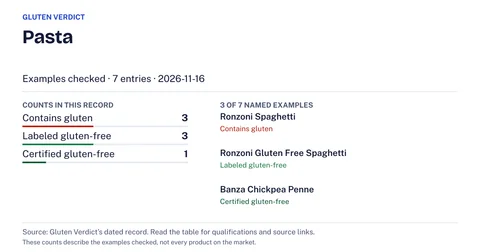
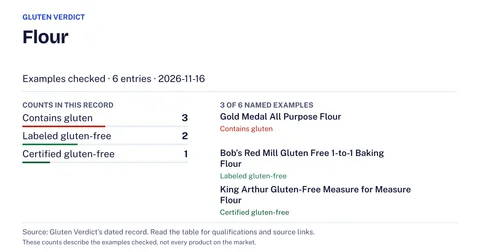
Our verdicts for bread, pasta and flour show which of the products we checked contain gluten and which carry a gluten-free label, with the date we read the makers' pages.
Dietitian visits, supplements and doctor visits
Nutritional counseling can be paid from an HSA or FSA only if it treats a specific disease diagnosed by a physician; the IRS gives obesity and diabetes as examples, and otherwise it is not a medical expense5. Celiac disease is not named in that answer3. What the answer turns on is the diagnosis.
NIDDK describes the dietitian's role: a registered dietitian will teach you how to avoid gluten while following a healthy diet36. That is a description of treatment from a government health institute, not a statement that a plan will pay.
Supplements follow their own rule. The cost counts only if a medical practitioner recommends the supplements as treatment for a specific medical condition diagnosed by a physician6. NIDDK says that when someone is diagnosed with celiac disease, the doctor may test for low levels of certain vitamins and minerals and may recommend or prescribe supplements if they are needed37.
Payments for legal medical services rendered by physicians and other medical practitioners are among the medical expenses Publication 502 describes15. Insurance or others who pay part of the cost reduce what an HSA can pay19.
Test kits and over-the-counter products
Publication 502 says you can include the cost of devices used in diagnosing and treating illness and disease38. Its example is a blood sugar test kit for someone who has diabetes39.
No IRS page we read mentions a gluten test or a celiac test kit2, 1, 3, so whether a given kit qualifies is a question for the plan administrator. Our guide on what home gluten tests can and cannot show covers what those products measure.
Over-the-counter drugs and medicines may be paid or reimbursed by an HSA or FSA40. Food and supplements follow the separate rules above.
What a physician's letter needs to cover
The IRS food rule requires that a physician substantiate the need4. The FAQ page gives no form, wording or list of fields for that11. The IRS news release tells employees to check with their employer for details on eligible expenses and claim procedures18, so ask your FSA plan what it wants before you ask your doctor to write anything. With an HSA you keep your own records10.
A letter that speaks to the IRS tests leaves the administrator less to guess at. These are points to take to the physician, drawn from the tests above. They are not a plan's required fields:
- The diagnosis, named, and that a physician made it. The IRS ties counseling to a specific disease diagnosed by a physician5.
- That a gluten-free diet is the treatment for that diagnosis, which is the second test4.
- The need for the purchases you will claim, such as gluten-free bread, pasta or flour in place of ordinary ones, which is the third test4.
- Anything the physician can say on whether the food satisfies normal nutritional needs, which is the first test4.
- For a dietitian: that the counseling treats the diagnosed disease5. For supplements: that a practitioner recommends them as treatment for the diagnosed condition6.
- Whose condition it is, because the expense has to be for the account holder, a spouse or a dependent19.
- A date, the physician's signature and the period it covers. Ask the plan whether it needs more.
Whose expenses an account can pay
For an HSA, qualified medical expenses are those for the account holder, the holder's spouse and any dependent of the holder19. For a health FSA, Publication 969 lists you and your spouse, dependents you claim on your return, certain other people you could have claimed as dependents, and your child under age 27 at the end of your tax year41.
For HSA purposes, a child of parents who are divorced, separated or living apart for the last 6 months of the calendar year is treated as the dependent of both parents42. A dependent's medical care is within what an HSA can pay19. The IRS FAQ page does not mention dependents3, so ask the plan how it treats a child's purchases.
Claiming and keeping records
FSA
You provide the FSA with a written statement from an independent third party that the expense was incurred and its amount, plus a written statement that it has not been paid or reimbursed under other health coverage. The FSA cannot reimburse future or projected expenses in advance26. Publication 969 adds that payments on a card from your employer that meet certain substantiation methods may not need additional information45. Unspent money is generally lost at the end of the plan year unless the plan offers a grace period or a carryover24.
HSA
Only expenses incurred after the HSA was established are qualified medical expenses43. The records must be sufficient to show that withdrawals were only for qualified medical expenses, that the expenses were not paid or reimbursed from another source, and that they were not taken as an itemized deduction in any year10. The IRS says not to send these records with your return but to keep them with your tax records25.
How long to keep them
The IRS general rule is to keep records that support an item on your return until the period of limitations for that return runs out27. Its page gives 3 years for the basic case, and longer periods in the situations it lists44.
For a gluten-free diet, useful papers to keep are the physician's letter, the receipts, a note of what the ordinary version of each product cost, and the plan's approval or denial. That list is our suggestion, not an IRS requirement.
When the deduction route is the one to look at
The itemized deduction counts only the part of medical and dental expenses above 7.5% of AGI22, and it is claimed on Schedule A21. Each expense goes one way: if an HSA or FSA paid or reimbursed it, it cannot also be deducted7.
Our guide Is gluten-free food tax deductible? walks through the deduction route and the extra-cost arithmetic. For SNAP households, see SNAP and gluten-free food; for ways to lower the cost itself, gluten-free on a budget.
Questions for your plan administrator
- Does the plan pay for special food for a diagnosed condition, and does it want a physician's letter first?
- Does it have its own letter form or a list of what the letter must say?
- Will it pay for gluten-free grocery items, only for the amount above the ordinary product, or not at all? What should the receipts show?
- Does it cover dietitian visits for celiac disease, and what documentation does it need?
- Does it cover test kits or supplements, and what proof does it need?
- For an FSA: is there a grace period or a carryover, and what is the deadline to submit claims24?
- If you have an HSA and an FSA: which type of FSA is it29?
Verdicts in this guide
Questions people ask
Is gluten-free food HSA eligible?
No IRS page we read says so either way1, 3. The IRS food rule asks for three things and limits the amount to the extra cost4. For an FSA the plan specifies what it pays9; for an HSA you justify the withdrawal with records10.
Do I need a letter of medical necessity?
The IRS food rule requires that a physician substantiate the need4, and the FAQ page prescribes no form for it11. Employees are told to check with their employer about claim procedures18, so ask what your plan wants.
Can I use my HSA or FSA for a dietitian visit?
Nutritional counseling counts when it treats a specific disease diagnosed by a physician5. Celiac disease is not named among the IRS's examples, so ask the plan how it treats it3.
Can I have an HSA and an FSA at the same time?
Generally not with a health FSA that pays qualified medical expenses28; limited-purpose and post-deductible health FSAs are among the exceptions29.
More in Cost, taxes and food assistance
 Is gluten-free food tax deductible? What the IRS says and what to keepWhat IRS Publication 502 says about special food as a medical expense, how the excess-cost sum works, and what records to bring to a tax professional.
 Gluten-free food on prescription in the UK: how to check your areaWhat gluten-free staples the NHS prescribes in England, Scotland, Wales and Northern Ireland, how amounts are set, what you pay, and where to check.
 Why gluten-free packaged food costs more, and what the price surveys showWhat price surveys found, what researchers say drives the gap, what FDA’s rule and one certifier require, and what a shopper can avoid.
 Gluten-free on a budget: what costs extra and what does notSort a gluten-free shopping list into plain foods, foods that need a statement and packaged substitutes, then compare costs and check each claim.
 A price-per-ounce worksheet for comparing gluten-free staples at any store, club or onlineA worksheet for comparing gluten-free staples by price per ounce across stores, clubs and online, with a column for the gluten-free statement.
 SNAP and gluten-free food: what the benefit covers and how to shop itWhich gluten-free foods SNAP covers, what it excludes, and how to build a list from naturally gluten-free staples plus a few labeled items.
Related guides
 Does insurance cover celiac testing and dietitian visits in the US?What a US plan pays for celiac blood tests, biopsy and dietitian visits depends on the plan. Reference points, questions to ask and appeal steps.
 Finding a dietitian who knows celiac disease: credentials, directories and questionsWhat RD and RDN mean, which celiac-related credentials and directories exist, and what to ask a dietitian at your first visit after a celiac diagnosis.
 Gluten-free at Schnucks: the app filter, the counters and the pharmacyWhat the Schnucks Rewards app’s Gluten Free filter is built on, how to check a pack, and why the counters and pharmacy need their own checks.
 Gluten-free substitutes: the swap for each wheat ingredient and the label check it needsA lookup table of gluten-free swaps for wheat flour, pasta, bread, soy sauce, beer and more, with the one label check each swap needs.
Sources
- [1, 9, 10, 12, 13, 14, 19, 20, 23, 24, 25, 26, 28, 29, 41, 42, 43, 45] Internal Revenue Service, Publication 969 (2025), Health Savings Accounts and Other Tax-Favored Health Plans, checked Nov 17, 2026.
Read on 2026-11-17: Publication 969 (2025, page updated 30-Apr-2026): the words gluten and celiac do not appear in the text, and neither does the phrase letter of medical necessity.
Read on 2026-11-17: under Recordkeeping for an HSA, the page lists three things the records must be sufficient to show: that the distributions were exclusively to pay or reimburse qualified medical expenses; that those expenses hadn’t previously been paid or reimbursed from another source; and that they hadn’t been taken as an itemized deduction in any year.
Read on 2026-11-17: the list that follows “However, an employee can make contributions to an HSA while covered under an HDHP and one or more of the following arrangements.” names a limited-purpose health FSA or HRA, a suspended HRA, a post-deductible health FSA or HRA, and a retiree-only HRA.
Read on 2026-11-17: in the section on health FSAs, the list that follows “Qualified medical expenses include those incurred by the following persons.” names you and your spouse; all dependents you claim on your tax return; any person you could have claimed as a dependent on your return, with three exceptions; and your child under age 27 at the end of your tax year.
- [2, 15, 21, 22, 30, 38, 39] Internal Revenue Service, Publication 502 (2025), Medical and Dental Expenses, checked Nov 17, 2026.
Read on 2026-11-17: Publication 502 (2025, page updated 30-Apr-2026): the words gluten and celiac do not appear in the text, and neither does the phrase letter of medical necessity.
- [3, 4, 5, 6, 7, 8, 11, 16, 40] Internal Revenue Service, FAQs about medical expenses related to nutrition, wellness and general health, checked Nov 17, 2026.
Read on 2026-11-17: the page (last reviewed 23-Sep-2026) answers fifteen questions on food, counseling, supplements, devices and similar costs; the words gluten and celiac do not appear on it, and neither do dependent, child or spouse.
Read on 2026-11-17: the answer on food (Q12) requires that the need be substantiated by a physician; it gives no form, wording or list of fields for that substantiation, and the phrase letter of medical necessity does not appear on the page.
- [17, 18] Internal Revenue Service, IR-2019-184: Eligible employees can use tax-free dollars for medical expenses (archived news release), checked Nov 17, 2026.
- [27, 44] Internal Revenue Service, How long should I keep records?, checked Nov 17, 2026.
- [31, 36, 37] National Institute of Diabetes and Digestive and Kidney Diseases (NIDDK), Treatment for Celiac Disease, checked Nov 17, 2026.
- [32, 33, 34, 35] Gluten Intolerance Group, Is Your Gluten-Free Food Tax Deductible?, checked Nov 17, 2026.