What “gluten-free” on a restaurant menu means
Short answer
FDA’s gluten-free rule applies to packaged foods, and for menu claims FDA only recommends that restaurants follow its definition1. In our sorting, a menu label can describe the recipe, the kitchen’s handling or an outside program, and only the chain’s own pages or the kitchen show which. Work through four checks:
- Open the chain’s own allergen page or guide: does it make a gluten-free claim, or only list allergens, wheat and gluten among them27, 25?
- Look for a handling statement, such as a glove change on request or a note that fryers are shared23, 29.
- Look for a named outside program, such as GFFS validation, which includes an onsite audit18.
- If none of that is stated, call and ask how gluten-free items are prepared11.
Part of Eating out and chain restaurant policies, 25 guides
Key points
- FDA says its gluten-free regulation applies to packaged foods and that it recommends restaurants making a menu claim be consistent with its definition1.
- Chains publish very different things: Chipotle offers a glove change on request23, Buffalo Wild Wings says no items are certified gluten-free28, and Chili’s page makes no gluten-free claim27.
- The Gluten-Free Food Service (GFFS) program of the Gluten Intolerance Group says it reviews procedures and sends an auditor onsite13, 20, 18.
- One study that tested restaurant food labeled gluten-free found gluten in 32% of the foods labeled gluten-free, using crowd-sourced results from a portable detection device35, 36.
Does FDA’s gluten-free rule apply to a restaurant menu?
Not directly. FDA’s regulation applies to packaged foods, which may be sold in some retail and food-service establishments such as some carry-out restaurants1. For a restaurant that makes a “gluten-free” claim on its menu, FDA says it recommends the claim be consistent with FDA’s definition1. The wording for restaurants is “we recommend”, not a requirement1.
That definition is the one written for food labels: foods that carry “gluten-free”, “no gluten”, “free of gluten” or “without gluten” must contain less than 20 parts per million (ppm) of gluten4. A food that bears “gluten-free” and fails the requirements is deemed misbranded5, and the same holds for the other three phrases6.
FDA also says it will monitor reported information on unpackaged food and share complaints about unpackaged foods, such as those served in restaurants, with state and local government partners2. The FDA Q&A page we read ends with “Content current as of: 06/30/2022”3, so check it for later changes.
Three things a menu label can describe
Because the rule does not fix what a menu claim means, the same words can stand for different things. This three-way sort is ours, not an FDA category, and each kind points to a different thing to check.
| Kind | What the label describes | What a chain or program publishes | What it leaves open |
|---|---|---|---|
| Ingredient-only | The recipe: no gluten-containing ingredient is used. | An allergen chart. Chipotle’s combines wheat and gluten because all its gluten-containing items contain wheat22. | Contact during preparation: Chipotle says individual foods may touch one another, which its chart does not show24. |
| Handling procedure | What the kitchen does: gloves, fryers, utensils, surfaces. | A stated step, such as Chipotle’s glove change at the start of an order23, or a note that fryers are shared29. | Whether the procedures are in place: the Gluten Intolerance Group says some restaurants offering gluten-free options may not have the procedures set up to reliably produce gluten-free items10. |
| Outside program | An outside body has reviewed the kitchen. | For GFFS: a review of policies, procedures, recipes, ingredients and training20, then an onsite audit18. | Whether a given place is in it: GFFS says it validates establishments in the US, Canada and Japan16, so check its list. A chain may say none of its items are certified28. |
Ingredient-only labels and their fine print
Some chains publish a chart of what each item contains instead of a gluten-free claim. Chili’s nutrition page links an interactive guide and a printable allergen guide, and on the page text we read it makes no gluten-free claim27. Chili’s says its guide gives allergen information from its food suppliers for common allergens, wheat and gluten among them25. Our Chili’s verdict shows how the chart reads item by item.
A chart tells you what the recipe contains. The fine print on the same pages is about everything else: Chili’s says common oil frying and shared equipment and surfaces may allow contact among food items, so it cannot guarantee any item to be completely allergen-free26.
On packaged food, FDA draws a similar line. A statement such as “made with no gluten-containing ingredients” is not prohibited if truthful and not misleading, but without a “gluten-free” claim consumers should not assume the food meets all FDA requirements for that claim8. That is FDA on packaged labels; a menu has no such rule behind it.
Handling statements: gloves, fryers and shared surfaces
A handling statement says what the kitchen will do. Chipotle’s page tells diners who are highly sensitive to gluten that it will change gloves if they say so at the start of the order23. See our Chipotle verdict for the rest of what the page says.
Other chains publish the opposite kind of statement. Buffalo Wild Wings says it does not use separate fryers, so there is the potential for allergen and gluten cross-contact between fried foods29. Our Buffalo Wild Wings verdict links the guide.
The Gluten Intolerance Group suggests asking about these steps directly, for example whether fries are cooked in a dedicated fryer, whether gluten-free pasta is boiled in fresh water, and whether an item is cooked on a clean section of the grill15.
Outside programs: what GFFS validation involves
The Gluten Intolerance Group (GIG) advises choosing a restaurant that has gone through its Gluten-Free Food Services (GFFS) Validation Program13. These are GFFS’s own descriptions of how it works.
- GFFS collaborates on a plan for the facility and reviews the documentation to check it meets its gluten-free best practices17.
- An auditor visits and evaluates the processes onsite, to check that what the documents say is being implemented18.
- GFFS says it returns for regular audits19.
GFFS says it validates food service establishments in the US, Canada and Japan16. Its home page has a “Find a Validated Company” link21.
“Certified” is a separate word. Buffalo Wild Wings’ guide says no items are certified gluten-free28. On packaged food labels, FDA says it does not endorse, accredit or recommend any particular third-party gluten-free certification program9.
“Gluten-friendly”, “(GF)” and other wording
FDA’s regulation covers four claims: “gluten-free”, “no gluten”, “free of gluten” and “without gluten”5, 6. The regulation’s text contains neither the word “friendly” nor “GF”7, so a menu that says “gluten-friendly”, or marks dishes “GF”, is using the restaurant’s own wording. What it means is for the restaurant to say, so check its page or ask.
Where five chains sit, in their own words
Each row is what the chain’s own page said when we read it on 2026-11-17. Our verdict for each chain, linked in the first column, covers the rest.
| Chain | Its published words |
|---|---|
| Chipotle | A chart that combines wheat and gluten22, and a glove change on request23. |
| Chili’s | No gluten-free claim on its nutrition page27; an allergen guide covering wheat and gluten25; no guarantee any item is completely allergen-free26. |
| Buffalo Wild Wings | No items are certified gluten-free28; no separate fryers29. |
| The Cheesecake Factory | “Gluten Free” headings and “(GF)” item names in its allergen guide31, beside a notice that its restaurants are not allergen free environments and may use shared equipment, including common fryers32. |
| TGI Fridays | A “Gluten-Free Vegan Bun” row in its chart33, and a notice that it cannot guarantee any menu item will be completely free of allergens34. |
Chains update these guides. Buffalo Wild Wings says its guide is updated periodically and suggests checking back each time you dine30; the Cheesecake Factory’s guide shows a “Last Updated” date31.
What to ask, and how far a label carries you
When the label does not say, the Gluten Intolerance Group’s advice is to ask how gluten-free items are prepared and what procedures are in place to avoid cross-contact11. It advises calling the day before or earlier the same day and speaking to the chef14, and then making an informed decision about your comfort level once you have the answers12.
One study looked at how often labeled restaurant food contained gluten. Researchers analyzed crowd-sourced results from users of a portable gluten detection device, testing restaurant food described as gluten-free35. Gluten was detected in 32% of the labeled foods36. The authors note the device may detect gluten below 20 ppm, at levels of unknown clinical significance, and describe their findings as raising a potential concern37.
For more on talking to a kitchen, see our eating-out guide; for packaged food, see how to read a food label.
Verdicts in this guide
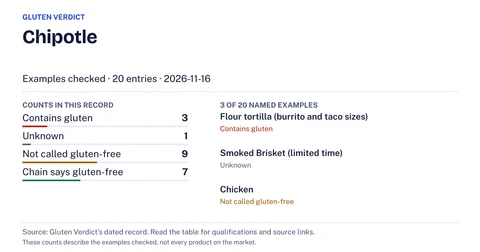 ChipotleDepends on the order3 of 20 menu items we checked contain gluten: Flour tortilla (burrito and taco sizes), Burrito, and QuesadillaChipotle Mexican Grill · checked Nov 16, 2026
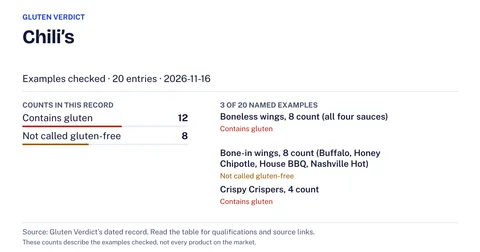 Chili’sDepends on the order12 of 20 menu items we checked contain glutenChili’s Grill & Bar · checked Nov 16, 2026
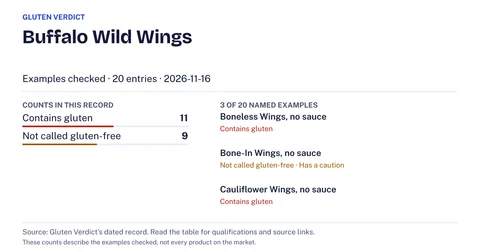 Buffalo Wild WingsDepends on the order11 of 20 menu items we checked contain glutenBuffalo Wild Wings · checked Nov 16, 2026
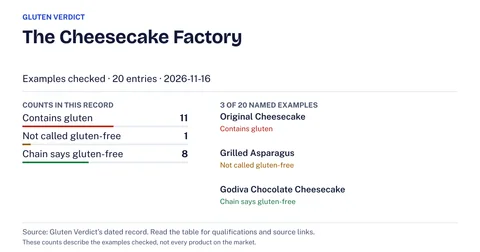 The Cheesecake FactoryDepends on the order11 of 20 menu items we checked contain glutenThe Cheesecake Factory · checked Nov 16, 2026
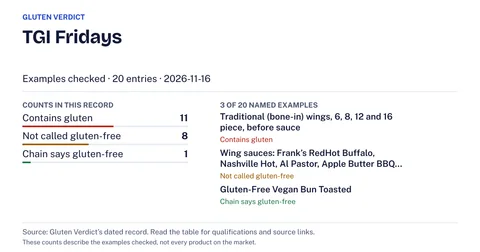 TGI FridaysDepends on the order11 of 20 menu items we checked contain glutenTGI Fridays · checked Nov 16, 2026
Questions people ask
Does FDA’s gluten-free rule apply to restaurants?
FDA says its regulation applies to packaged foods, and that it recommends restaurants making a “gluten-free” claim on their menus be consistent with its definition1.
What does “gluten-friendly” mean on a menu?
The regulation’s text does not use that word7, so the restaurant decides what it means. Check its allergen page for a stated procedure, or ask the kitchen how the dish is prepared11.
Is a gluten-free menu the same as a certified kitchen?
Not by itself. A menu label may describe only the recipe or the handling. An outside program such as GFFS includes an onsite audit18, while Buffalo Wild Wings says no items are certified gluten-free28.
What does FDA do with a complaint about a restaurant’s gluten-free claim?
FDA says it will monitor any reported information on unpackaged food and share any complaints it receives about unpackaged foods, such as those served in restaurants, with state and local government partners2.
More in Eating out and chain restaurant policies
 Eating out with celiac disease: what to check, ask and watch forPlan a restaurant meal with celiac disease: what to check before you go, the questions to ask in order, how to read the answers, and what studies measured.
 How to read a restaurant allergen chart for glutenWhat a mark, a blank cell, an X and a footnote mean on real US chain allergen charts, and which gluten questions the chart cannot answer.
 Casual-dining chains and gluten: what nine chains’ own allergen documents sayWhat Olive Garden, Outback, Applebee’s, Texas Roadhouse, Red Lobster, Chili’s and others say in writing about fryers, gluten menus and cross-contact.
 What fast-food chains say about shared fryers, and what a shared-fryer study measuredEach chain's own sentence on fryer oil, with its document and date, plus what a 2026 study measured in fries and chips from shared fryers.
 Ordering gluten-free through delivery apps and online menusWhat a dietary filter, tag or special-instructions note does in DoorDash and Uber Eats, and how to check a chain’s page and call before you order.
 How to order at a Mexican restaurant when you avoid glutenCorn is not the whole story at a Mexican restaurant. What to ask about tortillas, chip fryers, sauces, seasoning and shared grills.
Related guides
 How to read a US food label for glutenWhere gluten shows up on a US food label: the gluten-free claim, the Contains line, the ingredient list and may-contain lines, and what each means.
 How to trace a reaction after a restaurant meal marked gluten-freeHow to work out how gluten reached a restaurant dish, what to ask the kitchen, what to write down, and which agency takes a complaint.
 Your first restaurant meal after a celiac diagnosisHow to pick a place, call ahead, ask the kitchen the right questions and decide what to do when answers are vague, for a first meal out.
 How to judge a city for celiac disease: three signals you can checkSize up any US city for celiac disease with three checks: a hospital celiac program, the state’s restaurant allergy law and validated restaurants.
Sources
- [1, 2, 3, 8, 9] US Food and Drug Administration, Questions and Answers on the Gluten-Free Food Labeling Final Rule, checked Nov 17, 2026.
Read on 2026-11-17: the page ends with “Content current as of: 06/30/2022”.
- [4] US Food and Drug Administration, Gluten and Food Labeling, checked Nov 17, 2026.
- [5, 6, 7] eCFR, 21 CFR 101.91, Gluten-free labeling of food, checked Nov 17, 2026.
Read § 101.91 on 2026-11-17: the section sets requirements for the claims “gluten-free”, “no gluten”, “free of gluten” and “without gluten”; neither the word “friendly” nor the abbreviation “GF” appears anywhere in it.
- [10, 11, 12] Gluten Intolerance Group, FAQ: food marked gluten-free on the menu, but glutened after the meal, checked Nov 17, 2026.
- [13, 14] Gluten Intolerance Group, Eating Out: 7 Tips For Staying Gluten-Free, checked Nov 17, 2026.
- [15] Gluten Intolerance Group, Questions to Ask When Eating Out, checked Nov 17, 2026.
- [16, 17, 18, 19] Gluten-Free Food Service (GFFS), Validation, checked Nov 17, 2026.
- [20, 21] Gluten-Free Food Service (GFFS), Home page, checked Nov 17, 2026.
Read the home page on 2026-11-17: it offers a “Find a Validated Company” link and says GFFS validates food service locations throughout the US and internationally.
- [22, 23, 24] Chipotle Mexican Grill, Allergens & Special Diet, checked Nov 17, 2026.
- [25, 26] Chili’s Grill & Bar, Printable Allergen Guide, Allergen Information, checked Nov 17, 2026.
- [27] Chili’s Grill & Bar, Nutrition Facts & Guide, checked Nov 17, 2026.
Read the page on 2026-11-17: it links an Interactive Nutrition & Allergen Guide and a Printable Allergen Guide; the word “gluten” does not appear in the page text, and there is no gluten-free claim or gluten-free menu on it.
- [28, 29, 30] Buffalo Wild Wings, Allergen & Preparation Guide, checked Nov 17, 2026.
- [31] The Cheesecake Factory, Online Allergen Guide, gluten view, checked Nov 17, 2026.
Read the gluten view of the Online Allergen Guide on 2026-11-17 (it says “Last Updated: 07/28/2026”): it has headings such as “Gluten Free Pastas” and “Gluten Free Steaks & Chops”, and item names ending “(GF)”, for example “Pasta Carbonara (GF)”.
- [32] The Cheesecake Factory, Online Allergen Guide, notice, checked Nov 17, 2026.
- [33, 34] TGI Fridays, Nutrition and Allergen Information, checked Nov 17, 2026.
Read the PDF on 2026-11-17: its chart has bun rows named “Gluten-Free Vegan Bun Toasted (1)” and “Potato Bun Toasted (1)”; the notice at the top names wheat among the products its restaurants prepare and serve.
- [35, 36, 37] PubMed (NCBI), Lerner et al. 2019, Detection of Gluten in Gluten-Free Labeled Restaurant Food (Am J Gastroenterol), checked Nov 17, 2026.