Ordering gluten-free through delivery apps and online menus
Short answer
On DoorDash a gluten-free label is applied only after the restaurant approves it, and a restaurant can decline a special-instructions note1, 2. Four checks before you order:
- Treat a gluten-free tag as something the restaurant has to confirm: on DoorDash a suggested gluten-free label is not applied until the restaurant approves it1.
- Look for a field built for allergies: on Uber Eats it is there where the restaurant has turned allergy requests on3, 4, and Uber advises against putting allergy instructions in the general special-instructions field5.
- Open the restaurant’s or chain’s own allergen page and check each item you plan to order, including sauces and sides6, 7.
- Call the restaurant before you order and ask how its kitchen handles a gluten-free order8, 9.
Part of Eating out and chain restaurant policies, 25 guides
Key points
- DoorDash’s store-level dietary labels come in two kinds: “friendly” for stores that cannot ensure no cross-contamination, and “dedicated” for stores that ensure every item follows the practice10, 11.
- A special instruction is a request the restaurant can decline2; Grubhub’s policy for restaurants says approved instructions should be followed12.
- An item can be available only through digital ordering: Chipotle’s quesadilla is ordered through its digital-ordering system and uses a flour tortilla that Chipotle says is not gluten free13, 14.
- Domino’s says pizza made with its gluten-free crust is prepared in a common kitchen, and it does not recommend that pizza for customers with celiac disease15.
- NIDDK, the National Celiac Association and Coeliac UK each advise speaking to the restaurant16, 8, 9.
What a gluten-free filter or tag in an app is based on
On DoorDash, food labels apply to individual menu items and include dietary labels, such as Gluten-free, and allergen labels17. DoorDash suggests labels using machine learning and human review of item names, descriptions and menu photos18. It calls some labels, gluten-free among them, highly sensitive19, and a suggested label is not applied until the restaurant approves it1.
At the store level, DoorDash defines two kinds of dietary label for restaurants. A “friendly” label is for a store that carries a meaningful selection of such items, may not follow the practice for every item, and cannot ensure no cross-contamination10. A “dedicated” label is for a store that, in DoorDash’s definition, ensures all available items follow the practice and there is no risk of cross-contamination, as in “Gluten-free Kitchen”11. DoorDash’s page tells restaurants to add or remove their store’s dietary labels in Store Settings50, so a label tells you what the restaurant says, and the call script below is how you test it.
Uber Eats’ filter works on restaurants: its help page lists the dietary types “VEGETARIAN, VEGAN, GLUTEN-FREE, ALLERGY-FRIENDLY”20 and says that applying one shows the merchants that have available options according to your restriction21. Uber’s 2024 announcement of its allergy features also described a note on each store’s details page telling a customer whether the restaurant can accommodate food allergies22. Both point you to a restaurant. The pages we read do not describe how a particular dish is made.
A “gluten-free” tag on a restaurant dish is a different case from a claim on a package. FDA says its federal definition was established for food manufacturers that voluntarily label FDA-regulated foods23. For restaurants, FDA says their use of gluten-free labeling “should be consistent with the federal definition”24, and that state and local governments play an important role in oversight of restaurants25.
Special instructions: where your note goes and who reads it
On DoorDash you add a note by selecting a menu item and using the Special Instructions box in the Preferences section26. DoorDash’s help page says a restaurant may not be able to accommodate certain special instructions, and in that case may not fulfill the request2. Some requests also add charges27. Grubhub’s policy page for restaurants says that if special instructions are approved by the restaurant, items should be prepared accordingly12. In both, a note is a request that depends on the restaurant, not a setting.
Uber Eats treats allergies separately. Where it is offered, you pick allergens for an item and can add a note28. A restaurant has to enable it: Uber’s page for restaurants describes allergy requests as something a restaurant turns on3, by toggling “Allow allergy requests” to “On”4. Once an allergen is selected, Uber says it is highlighted on the order card in the restaurant’s Uber Eats Orders app and on the receipt29. Uber’s 2024 announcement said the allergy features were rolling out across the US and Canada that May51; the restaurant-side pages we read for the settings are Uber’s Australian-locale help pages, so what a US restaurant sees may differ.
Uber’s consumer help page also says to avoid putting allergy instructions in the general Special Instructions field, and that merchants may follow requests added there but neither they nor the Uber Eats app are responsible for doing so5. So on Uber Eats, an allergy note belongs in the allergy field when the restaurant offers one, and a phone call fills the gap when it does not.
Uber lists “Cereals with gluten” among the allergies it supports, which it describes as those recognized by local regulatory agencies; customers can also make requests for allergens not on the list30. What you see in the app may therefore differ by country31.
DoorDash’s allergen labels support a different list: the top 9 U.S. allergens, which names wheat but not barley or rye32. A “Contains” line such as “Contains soybeans, wheat”33 may therefore say nothing about barley or rye. For a gluten question, barley, rye and malt still need to be asked about.
If the restaurant cannot do what an Uber Eats allergy request asks, Uber says the merchant must notify you, and you then have 10 minutes to respond before the order is automatically canceled34. Uber’s page for restaurants adds that the option to flag the request may not be available if a delivery person has already been dispatched35. Keep notifications on after you order.
Reading allergen information on a chain’s own ordering page
Open the restaurant’s or chain’s own allergen page as well as the app. DoorDash lets a restaurant add a link to its allergen menu, nutrition guide or ingredient page in its store labels so customers can review it before ordering6, so look for that link in the store details.
Read what the chart does not cover. Chipotle’s page says individual foods may come into contact with one another during preparation, which its chart does not reflect7, and that limited-time offerings or menu items in test may include allergens not identified on the page36. Domino’s says availability of toppings may vary by store and that not all menu items are supported in its allergen chart37.
Read the chain’s own gluten statement too. Chipotle’s page tells someone highly sensitive to gluten who would like gloves changed to say so at the start of the order38. The page does not say whether that applies to an app order, and whether a note or field in an app order reaches the person making your bowl is a question for the restaurant. Domino’s says pizza made with its Gluten Free Crust is prepared in a common kitchen with the risk of gluten exposure and that it does not recommend it for customers with celiac disease15; it says the disclaimer appears in store, online and in all advertising39. An order screen that offers a gluten-free crust is therefore not the whole answer.
For how to read the chart itself, see how to read a restaurant allergen chart. Our verdicts for some chains: Chipotle, Panera, P.F. Chang’s and Chili’s.
Substitutions, modifiers and add-ons that change the answer
Each choice in an order builder can change the answer, and the names matter. Domino’s says that to be certain the store uses its Garlic Parmesan White Sauce, you should ask for it by name when ordering40. Its list of items that contain gluten includes several crusts, Alfredo Sauce, Bread Twists, Parmesan Bread Bites and sandwich bread41, so a side added to the same order is a separate check.
An item can be available only through digital ordering, so check your usual order again. Chipotle says its quesadilla is made through its digital-ordering system, so you need to order it online or in the app13, and that the flour tortillas used for quesadillas are not gluten free14.
Orders picked by a shopper have their own trap. DoorDash’s help page says that when a shopper substitutes a product, the shopper cannot ensure the substitute caters to your specific dietary requirements, including allergies, and asks you to read the labels of all products42. Our guide to reading a food label covers what to look for.
Whose menu is it? Why the app copy can lag
Both platforms put upkeep on the restaurant. Grubhub tells restaurants to audit their menus on Grubhub regularly so the information is accurate and up to date43, and DoorDash tells them to review labels again if ingredients or preparation methods change44. That leaves the app menu in the restaurant’s hands. When a dish matters, compare the app listing with the restaurant’s own page and ask on the phone.
Calling the restaurant before you order
Three celiac sources advise speaking to the restaurant. NIDDK’s eating-out advice is to tell the server you have celiac disease, ask about ingredients, how food is prepared and whether a gluten-free menu is available, and ask to talk with the chef for more detail16. The National Celiac Association advises calling the restaurant about gluten-free options and preparation methods, and notes that off hours are best because staff may not have time to talk on a busy night8. Coeliac UK, a UK charity, advises calling ahead to speak to a manager or chef about your requirements and the risks of cross-contamination9.
The National Celiac Association also cites one study of 105 patients with celiac disease in which 29% of gluten exposure was attributed to problems ordering at restaurants45. The study is about restaurants in general, not delivery apps.
Uber Eats lets a restaurant choose to share its phone number in allergy information, shown on the store details page and on item pages46. If you cannot find a number there, the restaurant’s own page or listing is the next place to look.
What to ask
- Who makes delivery and pickup orders, and will they see a note or an allergy field on the ticket?
- What does the kitchen do for a gluten-free order: clean gloves, clean utensils, a clean surface?
- Are the fries cooked in a dedicated fryer, or do they share oil with breaded items?47
- Is the sauce or seasoning on this dish gluten-free? Can you read me its ingredients?
- If something changes after I order, will you call me or cancel the item?
Packaging, sealed bags and delivery mix-ups
Grubhub’s policy for restaurants says order containers should be sealed and packed per best practices before pickup48. When your order arrives, check it against the receipt before you open it: an item you did not order, a missing seal or a gluten-containing side in the same container is a reason to call the restaurant, not to guess.
Pickup and delivery differ in who you can ask. The National Celiac Association advises confirming with the server or manager when you receive your order that the meal is GF49; for pickup, that means asking at the counter. For delivery, the person at your door is a courier, so settle your questions before you order, and keep the restaurant’s number to hand.
A short note to type and a call script
Keep a typed note short and specific, because a restaurant can decline one2. Something like this, in the allergy field where there is one:
Gluten-free order for celiac disease. No wheat, barley, rye, malt or soy sauce. Please use clean gloves, utensils and surface. Call me if anything cannot be done.
Then call. A script that fits in thirty seconds:
- “Hi, I’d like to place a delivery order and I need it gluten-free for celiac disease. Can I ask two quick questions?”
- “I’m ordering the [dish], with [sauce or side]. Is it made with wheat, barley, rye or malt, and what is it cooked in or on?”
- “Will whoever makes it see a note on the ticket? I’ve written one in the app.”
- “If you can’t do it, please call me on the number on the order before you make it.”
If the restaurant says it cannot do it, that is a useful answer: choose another restaurant rather than submitting the order and hoping.
Verdicts in this guide
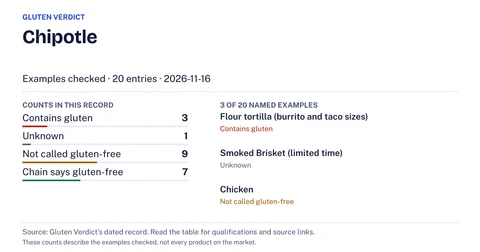 ChipotleDepends on the order3 of 20 menu items we checked contain gluten: Flour tortilla (burrito and taco sizes), Burrito, and QuesadillaChipotle Mexican Grill · checked Nov 16, 2026
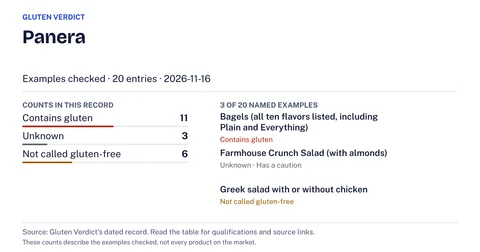 PaneraDepends on the order11 of 20 menu items we checked contain glutenPanera Bread · checked Nov 16, 2026
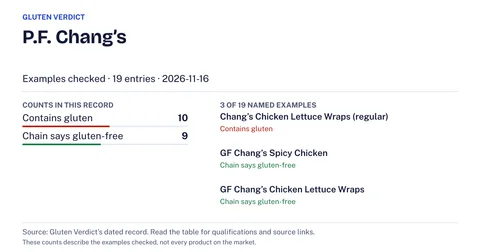 P.F. Chang’sDepends on the order10 of 19 menu items we checked contain glutenP.F. Chang’s · checked Nov 16, 2026
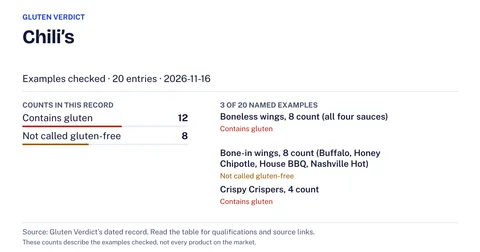 Chili’sDepends on the order12 of 20 menu items we checked contain glutenChili’s Grill & Bar · checked Nov 16, 2026
Questions people ask
Can I rely on the gluten-free filter in DoorDash or Uber Eats?
Treat it as a way to find restaurants. On DoorDash a suggested gluten-free label is applied only after the restaurant approves it1, and a “friendly” store label is for stores that cannot ensure no cross-contamination10. Uber Eats’ filter shows merchants with available options according to your restriction21.
Should I put my allergy in the special instructions box?
On DoorDash that is where notes go26, and the restaurant may not fulfill a request2. Uber Eats advises against putting allergy instructions in its general Special Instructions field5; use its allergy field where the restaurant offers one28.
Does a restaurant’s “gluten-free” menu item have to meet FDA’s package definition?
FDA says its federal definition was established for food manufacturers that voluntarily label FDA-regulated foods23, and that restaurants’ use of gluten-free labeling should be consistent with it24. FDA also notes that state and local governments play an important role in restaurant oversight25.
What happens if the restaurant cannot follow an Uber Eats allergy request?
Uber says the merchant must notify you, and you have 10 minutes to respond before the order is automatically canceled34.
More in Eating out and chain restaurant policies
 Eating out with celiac disease: what to check, ask and watch forPlan a restaurant meal with celiac disease: what to check before you go, the questions to ask in order, how to read the answers, and what studies measured.
 How to read a restaurant allergen chart for glutenWhat a mark, a blank cell, an X and a footnote mean on real US chain allergen charts, and which gluten questions the chart cannot answer.
 What “gluten-free” on a restaurant menu meansFDA’s gluten-free rule is written for packaged food. See what a menu label can mean, and how to tell a recipe from a procedure or an audited program.
 Casual-dining chains and gluten: what nine chains’ own allergen documents sayWhat Olive Garden, Outback, Applebee’s, Texas Roadhouse, Red Lobster, Chili’s and others say in writing about fryers, gluten menus and cross-contact.
 What fast-food chains say about shared fryers, and what a shared-fryer study measuredEach chain's own sentence on fryer oil, with its document and date, plus what a 2026 study measured in fries and chips from shared fryers.
 What Chipotle, Moe’s and Taco Bell say about gluten, fryers and tortillasWhat Chipotle, Moe’s and Taco Bell say on their own pages about flour tortillas, fryers, gloves and shared kitchens, with the date we read each.
Related guides
 When a restaurant gets your gluten-free order wrong or says no: what to do at the table and afterwardWhat to check on the plate, how to ask for a remake, when to leave, and who to report a restaurant gluten mistake to: manager, chain, health department.
 Your first restaurant meal after a celiac diagnosisHow to pick a place, call ahead, ask the kitchen the right questions and decide what to do when answers are vague, for a first meal out.
 How to trace a reaction after a restaurant meal marked gluten-freeHow to work out how gluten reached a restaurant dish, what to ask the kitchen, what to write down, and which agency takes a complaint.
 How to judge a city for celiac disease: three signals you can checkSize up any US city for celiac disease with three checks: a hospital celiac program, the state’s restaurant allergy law and validated restaurants.
Sources
- [1, 6, 10, 11, 17, 18, 19, 32, 33, 44, 50] DoorDash, Merchant help: How to Manage Food and Store Labels in Merchant Portal, checked Nov 17, 2026.
Read on 2026-11-17: under “How does DoorDash determine menu item labels?” the page says DoorDash uses a combination of machine learning and human review to suggest labels, and the list under it names item names, item descriptions and menu photos.
- [2, 26, 27] DoorDash, Help: How do I specify special instructions when placing my order?, checked Nov 17, 2026.
- [3, 4, 29, 35, 46] Uber Eats, Help for restaurants: Allergy Requests FAQ, checked Nov 17, 2026.
- [5, 20, 21, 28, 34] Uber Eats, Help: How can I add or remove allergy instructions?, checked Nov 17, 2026.
- [7, 36, 38] Chipotle Mexican Grill, Allergens & Special Diet, checked Nov 17, 2026.
- [8, 45, 49] National Celiac Association, Eating out, checked Nov 17, 2026.
- [9] Coeliac UK, Essential Gluten Free Eating Out Tips, checked Nov 17, 2026.
- [12, 43, 48] Grubhub for Restaurants, Grubhub Restaurant Policies, checked Nov 17, 2026.
- [13, 14] Chipotle Mexican Grill, National Quesadilla Day at Chipotle (FAQ), checked Nov 17, 2026.
- [15, 39, 40, 41] Domino's, Gluten Free Warning, checked Nov 17, 2026.
Read on 2026-11-17: the list headed “Items That Contain Gluten” names Hand Tossed, Thin Crust, Handmade Pan, and New York crusts; Spinach & Feta Pizza (on any crust); Alfredo Sauce; Sandwich bread; Bread Twists; Parmesan Bread Bites; Boneless Chicken; Loaded Chicken; Pasta; Lava Cakes; Marbled Cookie Brownie; Chicken Caesar Salad (croutons in separate packet); Classic Garden Salad (croutons in separate packet); Hoagie Bread (select locations); Dipped Chocolate Chunk Cookie (select locations); Melty 3-Cheese Loaded Tots; Philly Cheese Steak Loaded Tots; Stuffed Cheesy Bread; Pepperoni Stuffed Cheesy Bread; Spinach & Feta Stuffed Cheesy Bread; and Bacon & Jalapeno Stuffed Cheesy Bread.
- [16] National Institute of Diabetes and Digestive and Kidney Diseases (NIDDK), Eating, Diet, & Nutrition for Celiac Disease, checked Nov 17, 2026.
- [22, 51] Uber, Newsroom: Introducing New Features for Consumers With Food Allergies (May 28, 2024), checked Nov 17, 2026.
- [23, 24, 25] US Food and Drug Administration, Gluten and Food Labeling, checked Nov 17, 2026.
- [30, 31] Uber Eats, Help: Allergen list, checked Nov 17, 2026.
Read on 2026-11-17: the list under “We support food allergies recognized by local regulatory agencies, which includes:” names bee pollen, celery, cereals with gluten, crustaceans, eggs, fish, lupin, milk, molluscs, mustard, peanuts, royal jelly, sesame, soybeans, sulphur dioxide/sulphites, tree nuts and “Other”; the page adds that customers may make requests regarding allergens not on the list.
- [37] Domino's, Allergen Information Chart Guide, checked Nov 17, 2026.
- [42] DoorDash, Help: What are customer substitution preferences?, checked Nov 17, 2026.
- [47] Gluten Intolerance Group, Questions to Ask When Eating Out, checked Nov 17, 2026.