Your first restaurant meal after a celiac diagnosis
Short answer
FDA’s gluten-free regulation applies to packaged foods and only recommends that restaurants making a menu claim follow its definition1, so check the kitchen yourself, in this order:
- Choose a place that offers a gluten-free menu, and search for it online before you go6.
- Call ahead, the day before or earlier the same day, and speak to the chef12.
- At the table, tell the server you have celiac disease and ask how food is prepared18.
- Ask about the fryer, the grill and the sauces, not only whether a dish has gluten15, 17, 24.
- If the answers are vague, weigh them against GIG’s red flags: it suggests considering eating elsewhere if you hear any of them45.
Part of Newly diagnosed: the first weeks, 8 guides
Key points
- FDA’s regulation applies to packaged foods; for restaurant menus it only recommends that a gluten-free claim match its definition1.
- NIDDK’s advice: look up gluten-free menus online before you go, tell the server you have celiac disease and ask to talk with the chef6, 18.
- GIG suggests calling the day before or earlier the same day12, and asking about dedicated fryers, shared grills and sauces15, 17, 24.
- One 2019 crowd-sourced study detected gluten in 32% of gluten-free labeled restaurant foods with a device that may detect gluten below 20 ppm40, 42.
- In a 2026 study of 98 shared-fryer samples, six exceeded 20 ppm, and places reporting daily oil changes all measured below 20 ppm38, 39.
What does “gluten-free” on a restaurant menu promise?
FDA’s gluten-free regulation applies to packaged foods, which may be sold in some food-service establishments such as some carry-out restaurants. For gluten-free claims on restaurant menus, FDA recommends that restaurants making the claim be consistent with its definition1. The definition it points to includes less than 20 parts per million (ppm) for any unavoidable gluten2.
FDA also says it will share complaints it receives about unpackaged foods, such as those served in restaurants, with state and local government partners3.
The Gluten Intolerance Group (GIG) puts the practical side plainly: some restaurants that offer gluten-free menu options may not have the procedures needed to reliably produce them4. That is why the steps below ask about the kitchen as well as the menu.
NIDDK defines the thing you are asking about: cross-contact is when foods that contain gluten come into contact with gluten-free foods5. Every question in this guide is a way of asking whether that happens in the kitchen. For more on the idea, see cross-contamination.
How do you choose a place for a first meal?
Start online. NIDDK suggests searching, before you go out, for restaurants that offer a gluten-free menu6. For a first meal, that gives you a shortlist before you are standing at the door.
The kind of place matters too, according to GIG. It says fast food establishments are less likely to be able to make appropriate adjustments, and cross-contact could be an issue7, while finer dining places offer a less-hurried atmosphere and usually have more time to meet your needs8.
For feeling more confident about where you dine, GIG’s “best approach” is a restaurant that has been through its Gluten-Free Food Services (GFFS) validation program9. GFFS describes that program as including an onsite visit from an auditor, who checks that what the written documentation says is being implemented10. GIG does not say every restaurant must be validated: the next sections are for the many that are not.
If someone else picked the restaurant, such as a dinner invitation or a work lunch, look up its menu and allergen page first and call as described below. If the meal is at someone’s home instead, NIDDK’s advice for social gatherings is to tell the host you have celiac disease and ask whether gluten-free food will be available11.
If the place is a chain, our verdict pages record what its own allergen information said on the day we read it. Chains we have read so far include: Chipotle, Five Guys, Panera, Wendy’s, Chili’s, The Cheesecake Factory, P.F. Chang’s, TGI Fridays, Sweetgreen and Buffalo Wild Wings. Most of them open with “it depends on the order”, so read the one for the chain you are going to rather than assuming the whole menu is one answer.
To read a chain’s own chart once you find it, see how to read a restaurant allergen guide and what a gluten-free menu label means.
What do you say when you call ahead?
GIG’s advice is to call the restaurant the day before or earlier the same day, and to speak to the chef about your meal options12. A GIG FAQ page likewise suggests calling or visiting when the establishment may be less busy13.
Here is a short script, built from the wording GIG suggests for explaining the diet14. Say it, then ask the questions in order:
- “Hi, I have celiac disease and need to eat strictly gluten-free: no wheat, rye, barley or foods made with them. Could I ask a few questions about how your kitchen handles that?”
- “Do you have a gluten-free menu or an allergen list I can see before I come?”15
- “How does your kitchen normally handle a gluten-free order, to prevent cross-contact?”16
- “Is there a dedicated fryer for gluten-free foods, and is the grill used for gluten-free food separate or shared?”15, 17
- “Could I speak to the chef or kitchen manager?”18
Listen for specifics. GIG describes a common pattern: a confident “of course that’s gluten-free”, and then, once you ask how the food is prepared, the hesitation starts19. A person who names the fryer, the grill and the sauces, or says they will check with the kitchen, has answered a different question from one who only says yes.
If you reach a busy server rather than the chef, GIG notes that busy servers respond best to short, direct explanations20, and suggests telling them it is entirely okay if they do not know every answer offhand, then politely asking them to double-check with the kitchen21.
Which questions do you ask at the table?
NIDDK’s advice for the restaurant itself is to let the server know you have celiac disease, ask about ingredients, how food is prepared and whether a gluten-free menu exists, and ask to talk to the chef if you want more detail about the menu18. Pick the questions below that fit what you are ordering:
- Fryer and shared oil: “Are the french fries cooked in a dedicated fryer, or do they share oil with breaded items?”22
- Grill and pan: whether the grill used for gluten-free food is separate or shared, and if shared, how it is cleaned and how often; and whether your meal can be cooked in a separate pan17. GIG also suggests asking whether breaded foods were cooked on the same surface beforehand, and proposes foil over the cooking surface23.
- Sauces and marinades: whether they are certified gluten-free or, if made in-house, whether the kitchen knows what is in them; GIG notes Worcestershire-type sauces and soy sauce could contain gluten24.
- Flour and roux: whether the dish contains flour or roux25.
- Clean utensils and surface: “Can the kitchen prepare this meal using clean utensils and a freshly sanitized surface?”26
When the plate arrives, GIG advises double-checking with your server that it is the special meal you ordered and confirming your instructions were followed27.
A printed card can say all this for you. GIG publishes a Restaurant Card as a printable PDF that tells restaurant staff the diner must avoid wheat, rye, barley and their derivatives, lists some possible sources of gluten, and asks that foods fried in oil used for gluten-containing foods, and surfaces and utensils shared with them, be avoided28. It does not replace the questions above.
Which dishes trip up first-timers?
| Dish | Why it can carry gluten, according to GIG | Our page |
|---|---|---|
| French fries and other fried food | Oil used for deep-frying may be shared between breaded and non-breaded items29. GIG says no to “crunchy”, “seasoned” or “battered” fries, or fries with gravy or sauces, if you cannot verify the ingredients30. | French fries, fish and chips, Burger King fries |
| Soy sauce and teriyaki | Soy sauce is traditionally made with fermented crushed wheat and soy31. | Soy sauce, fried rice |
| Salads: croutons and dressings | GIG says to ask that croutons and other bread products be left off, and to send the salad back if croutons are on top32. It also suggests asking how dressings are made, or having dressing on the side or oil and vinegar or lemon instead33. | Croutons, Caesar dressing |
| Soups and broths | Soup bases could be made with roux, a combination of butter and flour34. | Where gluten hides in restaurant kitchens |
| Seasoned rice | Some rice pilafs and seasoned rice may have added gluten-containing ingredients; GIG calls plain or steamed rice cooked in water a good choice35, 36. | Fried rice, Popeyes red beans and rice |
On shared fryers, one 2026 study is worth knowing. Its authors measured gluten in 98 samples taken from shared fryers: 55 of French fries and 43 of tortilla chips37. Six of the 98 samples (6.1%) exceeded 20 ppm38. All samples from places reporting daily oil changes measured below 20 ppm, while samples from places reporting weekly changes were higher and more variable, with some above 20 ppm39.
That is one observational study, not a rule, and it does not remove GIG’s advice to ask. It does suggest a useful extra question: how often the fryer oil is changed.
What has testing of restaurant food found?
In a 2019 analysis of crowd-sourced results from a portable gluten-detection device, published in the American Journal of Gastroenterology, there were 5,624 tests by 804 users, and gluten was detected in 32% of foods labeled gluten-free40. Gluten-free pizza and pasta were most likely to test positive: 53.2% of pizza and 50.8% of pasta samples41.
The authors themselves note limits: the device may detect gluten below 20 ppm, leading to gluten exposure of unknown clinical significance, but they say their findings raise a potential concern42. GIG’s review of a study with the same figures (804 people, 5,624 tests)51 adds that the Nima sensor’s performance characteristics make it impossible to tell what fraction of the samples actually contained 20 ppm of gluten43, and that each result reflects only the one sample tested, not the whole serving or meal44.
Read together, the study is a reason to ask about the kitchen, not a rate you can apply to the restaurant you are going to.
What if the answers are vague?
GIG’s guidance, written for people ordering for a child or dependent, is to consider eating elsewhere, or sticking to pre-packaged, pre-verified items, if you hear or see any of the following45:
- Staff members saying “A little bit of gluten won’t hurt, right?”46
- Kitchen staff refusing or acting hesitant to check ingredient labels on packaged sauces or mixes47.
- Confirmation that gluten-free foods share cooking oil or grill spaces with heavily breaded items48.
Short of those, a vague answer is information. GIG says to make an informed decision about your comfort level with dining in an establishment once you have the answers to your questions49. For a first meal, that can mean choosing another place for this meal, or ordering something simple and asking for dressing on the side33.
Leaving is a legitimate outcome of a first attempt. The point of the call and the questions is that you find out before the food is on the table.
After the meal
GIG suggests thanking a server who was attentive to your need and leaving a generous tip50. For your own next time, write down what you ordered, who you spoke to and what they said about the fryer, grill and sauces, so a good experience is repeatable.
For the bigger picture, see hidden sources of gluten and support groups and organizations.
Verdicts in this guide
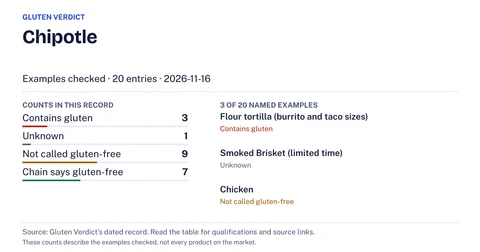 ChipotleDepends on the order3 of 20 menu items we checked contain gluten: Flour tortilla (burrito and taco sizes), Burrito, and QuesadillaChipotle Mexican Grill · checked Nov 16, 2026
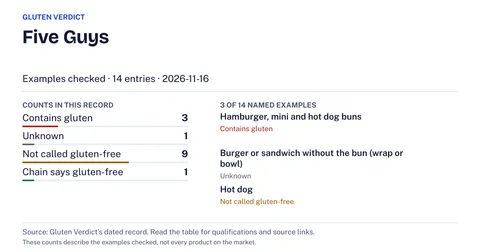 Five GuysDepends on the order3 of 14 menu items we checked contain gluten: Hamburger, mini and hot dog buns; Malt vinegar (fry condiment); and Oreo® Cookie Pieces shake mix-inFive Guys · checked Nov 16, 2026
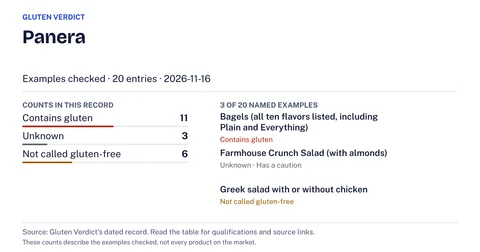 PaneraDepends on the order11 of 20 menu items we checked contain glutenPanera Bread · checked Nov 16, 2026
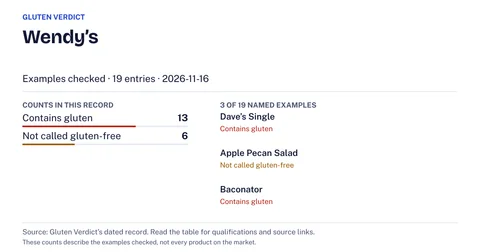 Wendy’sDepends on the order13 of 19 menu items we checked contain glutenWendy’s · checked Nov 16, 2026
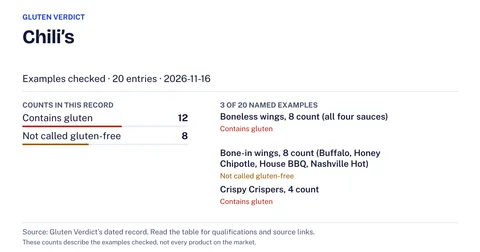 Chili’sDepends on the order12 of 20 menu items we checked contain glutenChili’s Grill & Bar · checked Nov 16, 2026
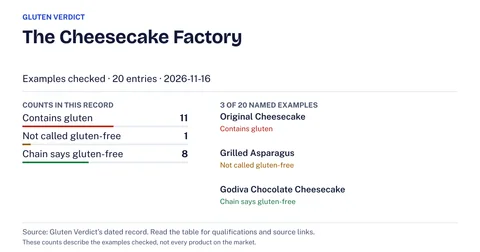 The Cheesecake FactoryDepends on the order11 of 20 menu items we checked contain glutenThe Cheesecake Factory · checked Nov 16, 2026
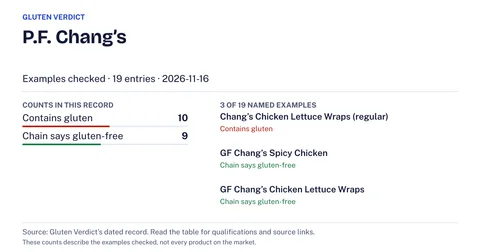 P.F. Chang’sDepends on the order10 of 19 menu items we checked contain glutenP.F. Chang’s · checked Nov 16, 2026
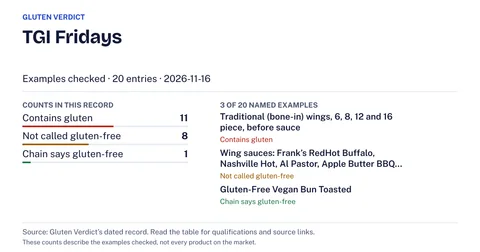 TGI FridaysDepends on the order11 of 20 menu items we checked contain glutenTGI Fridays · checked Nov 16, 2026
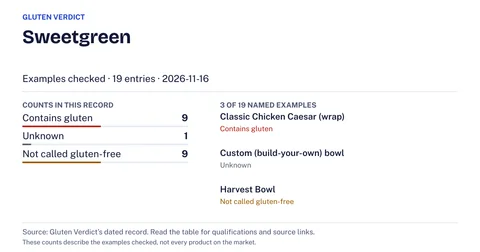 SweetgreenDepends on the order9 of 19 menu items we checked contain glutenSweetgreen · checked Nov 16, 2026
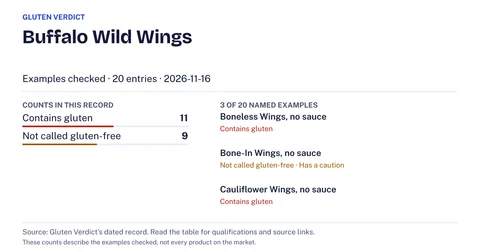 Buffalo Wild WingsDepends on the order11 of 20 menu items we checked contain glutenBuffalo Wild Wings · checked Nov 16, 2026
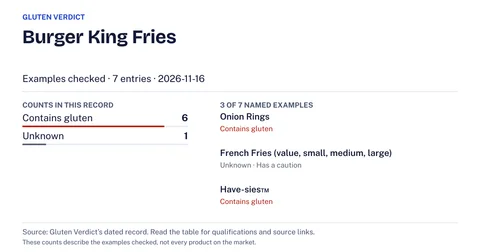 Burger King FriesUnknown6 of 7 menu items we checked contain glutenBurger King · checked Nov 16, 2026
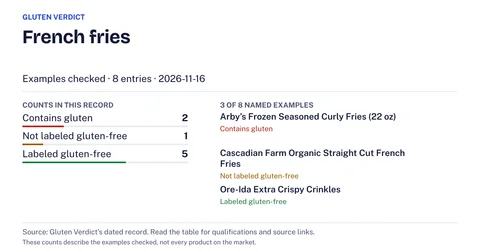 French friesDepends on the product2 of 8 products we checked contain gluten: Arby’s Frozen Seasoned Curly Fries (22 oz) and Checkers Frozen Crispy Seasoned Fries (28 oz)checked Nov 16, 2026
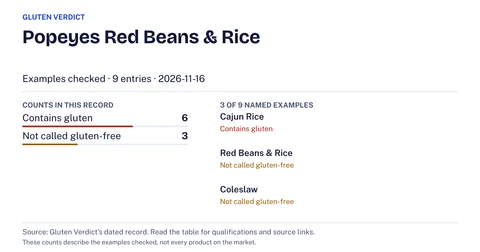 Popeyes Red Beans & RiceNot called gluten-free6 of 9 menu items we checked contain glutenPopeyes · checked Nov 16, 2026
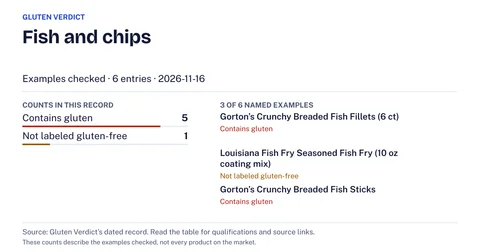 Fish and chipsDepends on the product5 of 6 products we checked contain glutenchecked Nov 16, 2026
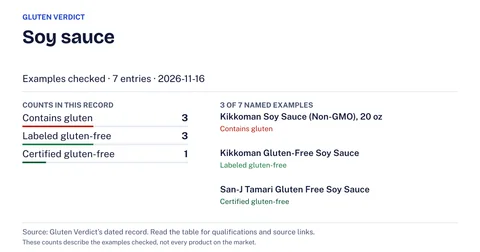 Soy sauceDepends on the product3 of 7 products we checked contain gluten: Kikkoman Soy Sauce (Non-GMO), 20 oz; San-J Organic Shoyu Soy Sauce; and Lee Kum Kee Premium Soy Sauce (No Preservatives Added)checked Nov 16, 2026
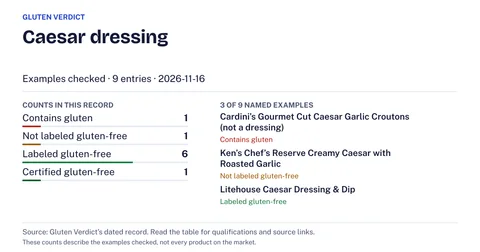 Caesar dressingDepends on the product1 of 9 products we checked contains gluten: Cardini’s Gourmet Cut Caesar Garlic Croutons (not a dressing)checked Nov 16, 2026
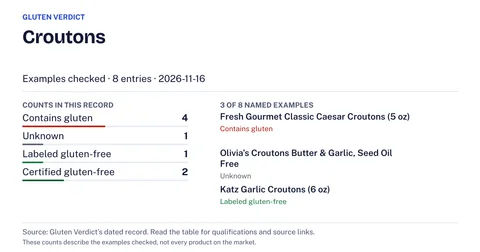 CroutonsContains glutenchecked Nov 16, 2026
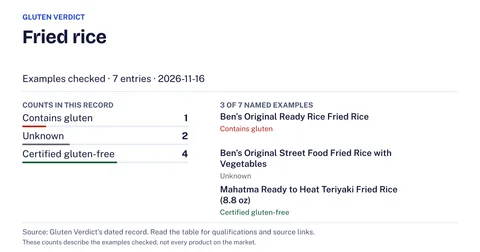 Fried riceDepends on the product1 of 7 products we checked contains gluten: Ben’s Original Ready Rice Fried Ricechecked Nov 16, 2026
Questions people ask
Does a restaurant have to meet FDA’s 20 ppm limit if its menu says gluten-free?
FDA’s regulation applies to packaged foods, and for restaurant menus FDA recommends that restaurants making a gluten-free claim be consistent with its definition1. FDA describes this as a recommendation.
When should I call the restaurant?
GIG advises calling the day before or earlier the same day and speaking to the chef12, and calling when the restaurant is less busy13.
More in Newly diagnosed: the first weeks
 Your first 30 days after a celiac diagnosis: a week-by-week planA week-by-week plan for the first month after a celiac diagnosis: label rules, kitchen changes, a dietitian, follow-up tests and questions for your doctor.
 Feeling worse after going gluten-free: what the sources say to check firstWhat NIDDK, Coeliac UK and clinical reviews say about symptoms that do not improve or get worse on a gluten-free diet, and which causes you can check.
 Starting a gluten-free diet: testing first, then labels, oats and the kitchenWhat NIH and the celiac charities say about starting a gluten-free diet: testing first, which foods to start with, a US label check, oats and the kitchen.
 How long until you feel better on a gluten-free diet?What NIH, celiac charities and studies report on when symptoms, antibody levels and the gut lining recover after a celiac diagnosis, and why they differ.
 Grieving foods after a celiac diagnosis: what people describe and where to get helpSadness or anger about food after a celiac diagnosis: what charities and research report, small steps the sources name, and when to call a provider or 988.
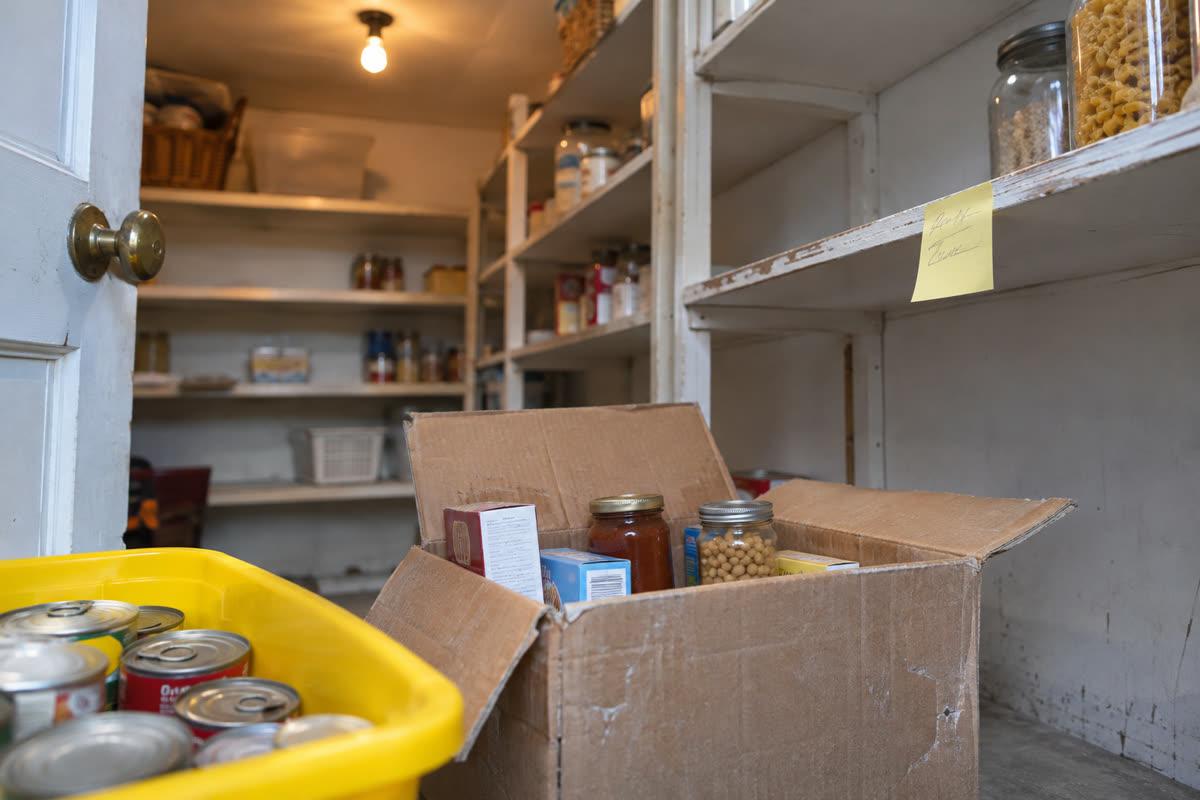 Going gluten-free: what to remove and what to keep in your pantry and kitchenSort a full pantry into foods to remove, labels to read and plain foods to keep, then decide on shared jars, toasters and pans.
Related guides
 Gluten cross-contact at home: where it happens and what to do about itHow gluten reaches gluten-free food at home, whether to separate, wash or ask for each route, and which rules have lab data behind them.
 Celiac support groups: what the national groups say they offerWhat the National Celiac Association and Gluten Intolerance Group say their support groups offer, and how to judge any group before you join.
 Where wheat, barley and rye hide in processed food: 15 places to checkFifteen processed foods where wheat, barley or rye turn up, the label step that catches each, and what US allergen law does and does not flag.
 How to read a US food label for glutenWhere gluten shows up on a US food label: the gluten-free claim, the Contains line, the ingredient list and may-contain lines, and what each means.
Sources
- [1, 2, 3] US Food and Drug Administration, Questions and Answers on the Gluten-Free Food Labeling Final Rule, checked Nov 17, 2026.
- [4, 13, 49] Gluten Intolerance Group, I went to a restaurant that had food marked “gluten-free” on the menu, but I felt “glutened” after my meal. How could this have happened?, checked Nov 17, 2026.
- [5, 6, 11, 18] NIDDK (National Institutes of Health), Eating, Diet, & Nutrition for Celiac Disease, checked Nov 17, 2026.
- [7, 8, 9, 12, 14, 23, 27, 29, 32, 33, 34, 35, 36, 50] Gluten Intolerance Group, Eating Out: 7 Tips For Staying Gluten-Free, checked Nov 17, 2026.
- [10] Gluten-Free Food Service (GFFS), Validation, checked Nov 17, 2026.
- [15, 17, 24, 25] Gluten Intolerance Group, What are some of the most important questions to ask the wait staff or management of a food service or restaurant?, checked Nov 17, 2026.
- [16, 19, 20, 21, 22, 26, 45, 46, 47, 48] Gluten Intolerance Group, Questions to Ask When Eating Out (September 8, 2026), checked Nov 17, 2026.
- [28] Gluten Intolerance Group, Restaurant Card (printable PDF), checked Nov 17, 2026.
Read on 2026-11-17: the printable PDF of GIG’s Restaurant Card has a first page headed “Restaurant Card” and a second page, addressed to restaurant staff, that says the person has a medical condition requiring caution when eating out and must avoid wheat, rye, barley and all derivatives of these grains; it lists possible sources of gluten (among them baking mixes, bread and rolls, broth and soup bases, coating and breading, crackers and croutons, pasta, bottled salad dressings, thickeners and roux, sauces and marinades, and soy sauce); and it ends “Avoid Foods fried in oil used for frying gluten-containing foods. Avoid surfaces and utensils shared with gluten-containing foods.” The text is set in images, so this is a reading of the PDF, not copied page text.
- [30, 31] Gluten Intolerance Group, 38 Foods Where Gluten May Be “Hidden”, checked Nov 17, 2026.
- [37, 38, 39] PubMed (NCBI), Shared Fryers May Not Always Be as Risky for Gluten Cross-Contact in Celiac Disease as Dietary Guidance Suggests (Weisbrod and colleagues, Nutrients 2026; PMID 42943004), checked Nov 17, 2026.
- [40, 41, 42] PubMed (NCBI), Detection of Gluten in Gluten-Free Labeled Restaurant Food: Analysis of Crowd-Sourced Data (Lerner and colleagues, Am J Gastroenterol 2019; PMID 30920417), checked Nov 17, 2026.
- [43, 44, 51] Gluten Intolerance Group, Hot Topic: gluten-free restaurant food and personal testing devices (GIG review of the Nima study, October 7, 2020), checked Nov 17, 2026.