Reading a US label for gluten and another food allergy
Short answer
A US label needs two reads, because allergen law and the gluten-free rule are separate: the ingredient list or Contains line has to name each major allergen used to make the food2, 3, while “gluten-free” is a voluntary claim that has to meet FDA’s rule, which sets a limit below 20 parts per million of gluten29, 27.
- Read the ingredient list and Contains line for your second allergen: each of the nine major allergens used to make the food has to be named in one of them1, 2, 3.
- Read the gluten-free claim for gluten, or the whole ingredient list when there is none, because barley and rye are not among the allergens a Contains line has to list1, 35.
- Do not take a gluten-free claim as proof a food has no wheat: a food may contain an ingredient made from wheat and processed to remove gluten, and a label that names wheat then needs an asterisk statement27, 28.
- Treat may-contain and shared-facility lines as the maker’s voluntary statements about cross-contact; allergen law does not address them8, 38.
Part of Nutrition and combining diets, 24 guides

Key points
- Allergen labeling names nine major allergens; the gluten-free claim is voluntary and means under 20 ppm of gluten1, 29, 27.
- Barley and rye are not among the allergens a Contains line has to list, so a Contains line without wheat does not clear a food for gluten1, 35.
- A gluten-free food can contain an ingredient made from wheat and processed to remove gluten; if the label names wheat, it needs an asterisk statement27, 28.
- Coconut is no longer a major allergen in FDA’s view, and highly refined oils are exempt from allergen labeling18, 14.
- No regulation defines “egg-free” or “peanut-free” the way FDA’s rule defines “gluten-free”9, 27.
Two label systems, side by side
A US package can carry two separate kinds of statement. Allergen labeling is required of FDA-regulated foods that contain a major allergen2, 7. A gluten-free claim is something a maker may add, and FDA’s rule sets what it has to mean29. Each answers a different question.
| Question | Allergen labeling | Gluten-free claim |
|---|---|---|
| Is it required? | Yes: the label has to name the food source of each major food allergen used to make the food2 | No: the rule covers the voluntary use of the claim29 |
| How much is too much? | FDA has not established a threshold level for any allergens6 | Below 20 parts per million of gluten, including any unavoidable gluten27 |
| Which grains? | Wheat is a major allergen1; barley and rye are not among the allergens required to be listed35 | Wheat, rye, barley and their crossbred hybrids count as gluten-containing grains26 |
| Where is it on the package? | In the ingredient list or in a Contains statement3 | No set place: the rule does not require a specific location on the label34 |
| What does “free” mean? | For a claim such as “egg-free”, no regulation defines the conditions9 | “Gluten-free”, “free of gluten”, “without gluten” and “no gluten” all have to meet the rule30 |
| May-contain lines | FDA’s allergen labeling provision does not address them8 | Not prohibited on a food that also says gluten-free, if truthful and not misleading31 |
The nine major allergens and what the label must name
FDA’s list of major food allergens is milk, eggs, fish, Crustacean shellfish, tree nuts, peanuts, wheat, soybeans and sesame1. Each has to be named in one of two ways: in parentheses after the ingredient it comes from, or in a Contains statement next to the ingredient list3. Fish, shellfish and tree nuts are named by type or species5.
| Allergen | What the label names | Edge for a gluten-free reader |
|---|---|---|
| Wheat | “Wheat”; FDA defines it as any species in the genus Triticum and lists grains such as spelt and triticale11 | Barley and rye are gluten grains26 but not on the Contains line’s list35 |
| Milk | “Milk”; FDA reads milk as milk from domesticated cows, goats, sheep or other ruminants19 | Milk from animals other than cows should carry the animal’s name, such as “goat milk”20 |
| Egg | “Egg”; FDA reads eggs as eggs from domesticated chickens, ducks, geese, quail and other fowl19 | Plain eggs and egg noodles differ for gluten: see our verdicts on eggs and egg noodles |
| Soy | “Soy” or “soybeans”; inside another ingredient it shows as, for example, “lecithin (soy)”4 | Soy sauce made from soybeans and wheat names two allergens32: see the soy section below |
| Peanut | “Peanuts”, in the ingredient list or the Contains line3 | A highly refined oil made from a major allergen is exempt, while one that is not highly refined has to be declared14, 15; see peanut oil |
| Tree nuts | The specific nut, such as almond, pecan or walnut5 | Only the nuts on FDA’s Table 1 must meet the allergen rule12; coconut is no longer on it18 |
| Sesame | “Sesame”, on packaged foods and dietary supplements since January 1, 202322 | Products already on shelves before 2023 did not have to be removed23 |
Wheat allergy and celiac disease read different labels
The Gluten Intolerance Group says celiac disease is an autoimmune condition, while wheat allergy involves an immune response that is not autoimmune36. Its bulletin adds that a person with a wheat allergy must avoid any form of wheat but does not have trouble tolerating gluten from non-wheat sources, and that a person can have a wheat allergy and also celiac disease or non-celiac gluten sensitivity37. On a label, that splits the two questions:
- For wheat: the allergen label names wheat, a term FDA applies to grains such as spelt and triticale11. A gluten-free claim does not rule wheat out. The rule allows an ingredient made from a gluten grain and processed to remove gluten, with wheat starch as its own example, if the food stays under 20 ppm27. When such a food names wheat in its ingredient list or Contains line, the label has to put an asterisk after “wheat” and carry the statement “The wheat has been processed to allow this food to meet the Food and Drug Administration (FDA) requirements for gluten-free foods.”28
- For gluten: the Contains line is not required to list barley or rye35, so a gluten-free claim, or a read of the full ingredient list when there is none, has to carry that question. Our guides on reading a food label and on the Contains line, wheat, barley and rye go through it.
Soy: soy sauce, tamari and lecithin
Soy sauce is where the two questions meet most often. FDA says soy sauce is ordinarily made by fermenting soybeans and wheat, that some are made without wheat, and that in general one made from soybeans and wheat may not bear a “gluten-free” claim32. Kikkoman’s page for its regular soy sauce lists water, soybeans, wheat and salt41, so that bottle names two major allergens.
Kikkoman’s gluten-free tamari lists water, soybeans, salt and sugar and says it is certified gluten-free by the Gluten Intolerance Group42. The wheat is gone from that list; the soybeans are not.
Soy inside another ingredient can be shown in parentheses after it, as in “lecithin (soy)”4. Whether soy lecithin carries gluten is a separate question that our soy lecithin entry takes up. For other soy-based foods, each verdict shows what our sources say about gluten: teriyaki sauce, hoisin sauce, oyster sauce, miso, tofu, edamame, soy milk, soy flour and soy sauce itself.
Peanut and tree nuts: flours, milks, coconut and oils
Peanuts and tree nuts are two separate allergens on the list1. For tree nuts, FDA’s guidance names the nuts that count in its Table 1: almond, black walnut, Brazil nut, California walnut, cashew, filbert/hazelnut, heartnut/Japanese walnut, macadamia nut/bush nut, pecan, pine nut/pinon nut, pistachio and walnut13. Only those must meet the allergen labeling requirements12.
Coconut is not on that list: FDA says it no longer considers coconut a major food allergen18. A product that uses a Contains statement would not name coconut there, but coconut still has to appear in the ingredient list unless an exemption applies17. Our verdicts cover coconut flour and coconut milk for gluten.
Nut flours and nut milks are two places where a gluten-free kitchen can add a tree nut. Blue Diamond’s almond flour page says the flour is made with California grown almonds and calls it gluten-free49; almond is on Table 113. Almond Breeze’s page describes its original almondmilk as an alternative to dairy and soymilks and says it is made with real California almonds50. A swap away from milk or soy can therefore be a swap onto a tree nut13, 50. See our verdicts on almond flour, almond milk, cashew milk and macadamia milk.
Oils follow a special rule. A highly refined oil made from a major allergen is exempt from the allergen labeling rule, but, under FDA’s general ingredient rules, the oil’s source goes in its name in the ingredient list, as in “soybean oil”14. An oil that is not highly refined has to be declared15. Our entries for peanut oil, walnut oil, peanut butter and Nutella cover their gluten side.
Egg and milk: what gluten-free mixes ask you to add
A gluten-free mix can list no egg or milk and still call for them. Bob’s Red Mill’s Gluten Free Pancake Mix page says to “just add milk or water, butter or oil, and an egg”44, though the ingredient list on the page names neither egg nor milk45. Its Gluten Free Brownie Mix page says “All you need from your kitchen is 3 eggs, 1/2 cup butter, 1/4 cup water and our gluten free brownie mix”46, again with no egg or milk in the mix’s own ingredient list47. The ingredient list describes the mix; the directions add the allergens.
For milk and egg as ingredients, FDA reads “milk” as milk from domesticated cows, goats, sheep or other ruminants and “eggs” as eggs from domesticated chickens, ducks, geese, quail and other fowl19. For foods with egg as an ingredient, our verdicts on mayonnaise and egg noodles show where the gluten question sits.
Sesame: what changed on labels
As of January 1, 2023, sesame must be labeled as an allergen on packaged foods and dietary supplements22. Products already on their way to or on shelves before 2023 did not have to come off the market23. FDA says that during the transition you may still find products for sale that do not list sesame as an allergen on the label53. FDA also says some manufacturers changed their recipes after the FASTER Act, and there are now products with small amounts of sesame that did not have it before24. For a product with an unclear label, FDA’s advice to people allergic to sesame is to contact the manufacturer or supplier25.
May-contain and free-from lines when you have two questions
Both questions send you to the same part of the package. FARE says advisory labeling is voluntary and that no law governs when to use it or how to word it38.
| Statement on the label | What FDA says |
|---|---|
| “May contain [allergen]” or “made in a facility that also uses [allergen]” | The allergen labeling provision does not address advisory statements; they must be truthful and not misleading8 |
| “Made in a facility that also processes wheat” on a gluten-free food | The gluten-free rule does not prohibit it, if truthful and not misleading31 |
| “Contains milk” plus “may contain milk” | Not appropriate: an advisory statement for a major allergen already declared as an ingredient10 |
| “Wheat-free” plus “may contain wheat” | Not appropriate for the same allergen21 |
| “Egg-free”, “peanut-free”, “milk-free” | No regulation defines the conditions for a “free” claim from a major allergen9 |
Where it is unclear whether a product could have come in contact with an allergen, FARE’s advice is to call the manufacturer39.
Our guide on may-contain wheat labels takes up the gluten side of these lines.
Where the Contains line does not apply
FDA enforces the allergen provisions on most packaged foods, but not on meat, poultry and egg products (USDA), alcoholic beverages under TTB labeling rules, raw agricultural commodities, highly refined oils, or most foods sold at retail or food service that are not pre-packaged with a label7. The labeling requirements do not apply to foods put in a wrapper or box in response to a customer’s order, such as a sandwich prepared to order16. The gluten-free rule has a similar split: it does not apply to foods whose labeling USDA or TTB regulates33.
What makers say on both questions
These are statements from the maker’s own page, read on 2026-11-17. A maker’s page can change, and the package in your hand has the final word; FARE notes that ingredients and manufacturing processes can change without warning40.
| Product | What it says on gluten | What it says on another allergen |
|---|---|---|
| Kikkoman Gluten-Free Tamari Soy Sauce | Certified gluten-free by the Gluten Intolerance Group42 | Brewed from water, soybeans, salt and sugar, so soy is still named42 |
| Kikkoman Soy Sauce (all-purpose) | Brewed from water, soybeans, wheat and salt41 | Kikkoman says the all-purpose and less sodium soy sauces are brewed at its Walworth, WI plant, where no peanut or tree nut ingredients enter, and to check the back of the label for where a specific product was made43 |
| Enjoy Life Semi-Sweet Mini Chips | Says all its chocolate is free from gluten and 14 common allergens52 | Lists “Our chocolate is free from: Wheat, Lupin, Casein, Crustaceans, Mustard, Dairy, Shellfish, Sesame, Tree nuts, Fish, Egg, Peanut, Added sulfites, and Soy.”51 |
| Bob’s Red Mill Organic Coconut Flour | Says it is tested and confirmed gluten free and packaged in a separate gluten free facility48 | Coconut is no longer a major allergen in FDA’s view18 |
| Blue Diamond Almond Flour | Calls the flour gluten-free49 | Made with California grown almonds49, a nut on FDA’s Table 113 |
Verdicts in this guide
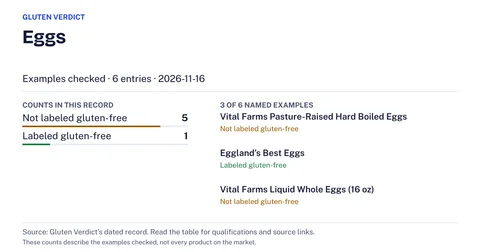 EggsNaturally gluten-freechecked Nov 16, 2026
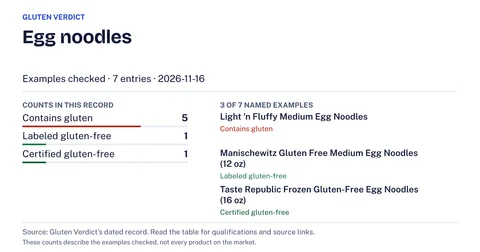 Egg noodlesContains glutenchecked Nov 16, 2026
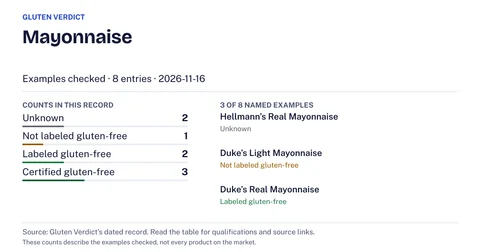 MayonnaiseNaturally gluten-freechecked Nov 16, 2026
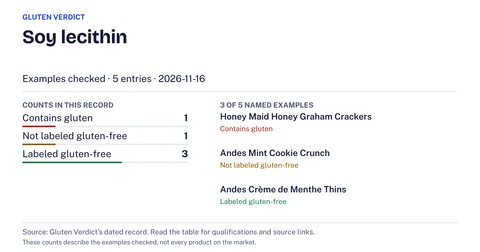 Soy lecithinUnknown1 of 5 products we checked contains gluten: Honey Maid Honey Graham Crackerschecked Nov 16, 2026
 Soy sauceDepends on the product3 of 7 products we checked contain gluten: Kikkoman Soy Sauce (Non-GMO), 20 oz; San-J Organic Shoyu Soy Sauce; and Lee Kum Kee Premium Soy Sauce (No Preservatives Added)checked Nov 16, 2026
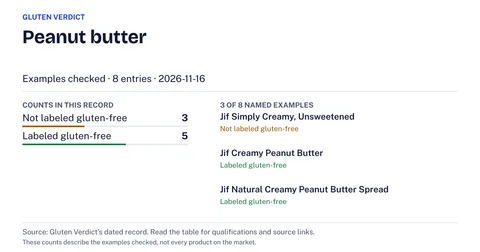 Peanut butterDepends on the productchecked Nov 16, 2026
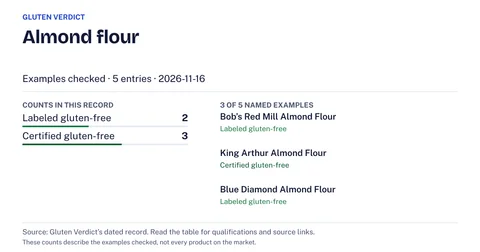 Almond flourNaturally gluten-freeBuy it labeled gluten-freechecked Nov 16, 2026
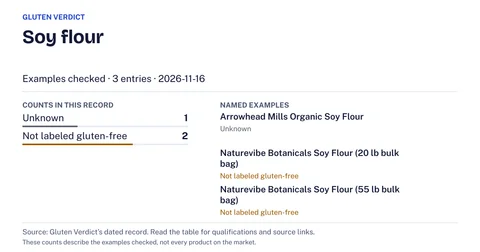 Soy flourNaturally gluten-freeBuy it labeled gluten-freechecked Nov 16, 2026
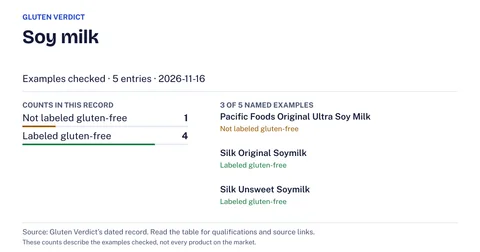 Soy milkNaturally gluten-freechecked Nov 16, 2026
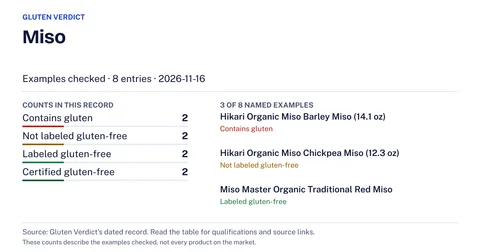 MisoDepends on the product2 of 8 products we checked contain gluten: Hikari Organic Miso Barley Miso (14.1 oz) and Hikari Miso Soup Akadashi (12 servings, 7.0 oz)checked Nov 16, 2026
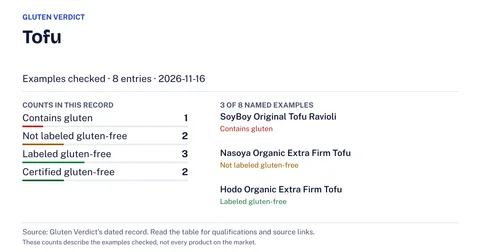 TofuDepends on the product1 of 8 products we checked contains gluten: SoyBoy Original Tofu Raviolichecked Nov 16, 2026
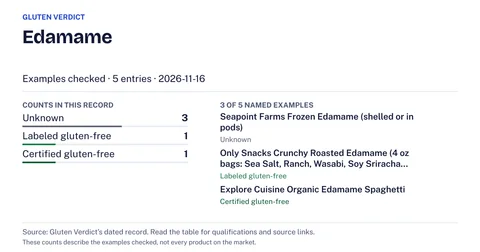 EdamameNaturally gluten-freechecked Nov 16, 2026
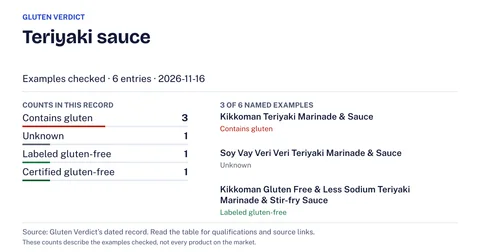 Teriyaki sauceDepends on the product3 of 6 products we checked contain gluten: Kikkoman Teriyaki Marinade & Sauce, Kikkoman Teriyaki Marinade & Stir-fry Sauce – Roasted Garlic, and Kikkoman Teriyaki BBQ Sauce – Originalchecked Nov 16, 2026
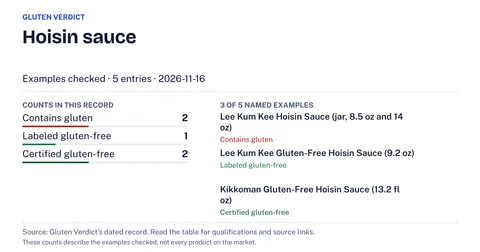 Hoisin sauceDepends on the product2 of 5 products we checked contain gluten: Lee Kum Kee Hoisin Sauce (jar, 8.5 oz and 14 oz) and Kikkoman Hoisin Sauce (9.3 oz)checked Nov 16, 2026
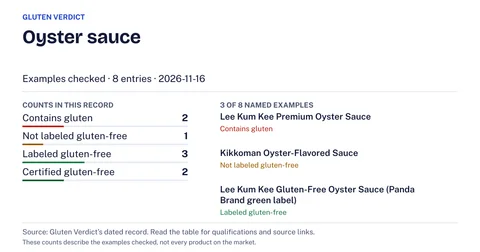 Oyster sauceDepends on the product2 of 8 products we checked contain gluten: Lee Kum Kee Premium Oyster Sauce and Lee Kum Kee Panda Brand Oyster Flavored Saucechecked Nov 16, 2026
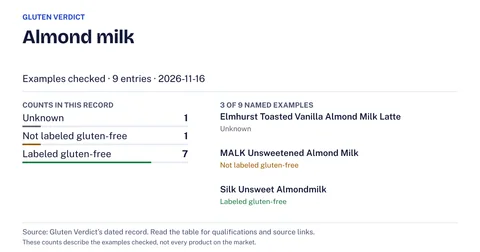 Almond milkNaturally gluten-freechecked Nov 16, 2026
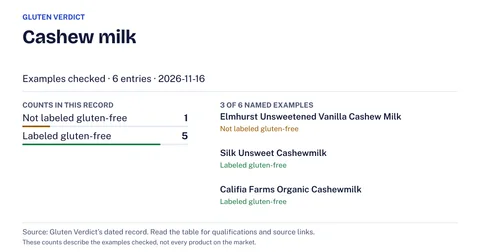 Cashew milkNaturally gluten-freechecked Nov 16, 2026
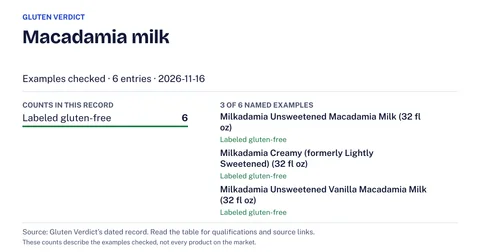 Macadamia milkNaturally gluten-freechecked Nov 16, 2026
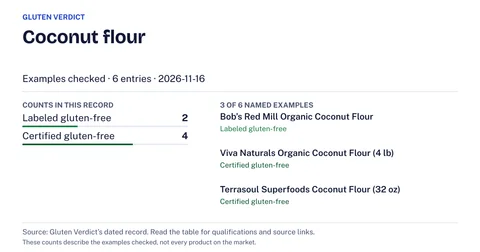 Coconut flourNaturally gluten-freeBuy it labeled gluten-freechecked Nov 16, 2026
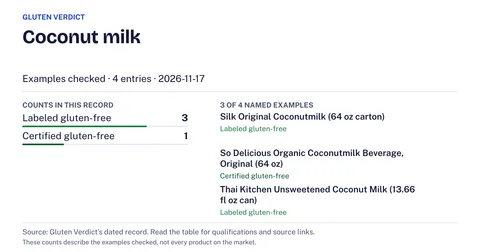 Coconut milkNaturally gluten-freechecked Nov 17, 2026
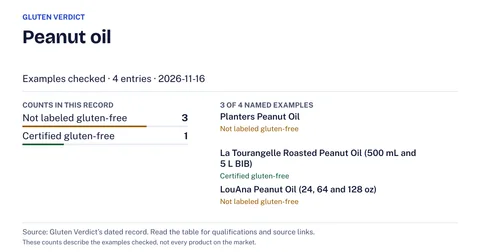 Peanut oilUnknownchecked Nov 16, 2026
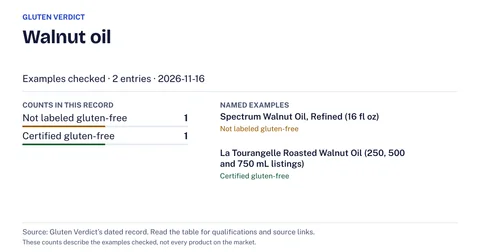 Walnut oilUnknownchecked Nov 16, 2026
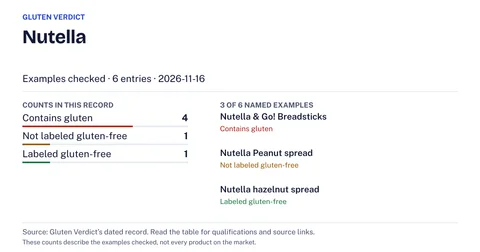 NutellaLabeled gluten-free4 of 6 varieties we checked contain glutenFerrero USA · checked Nov 16, 2026
Questions people ask
Does a gluten-free label mean the food has no wheat?
Not necessarily. FDA’s rule allows an ingredient derived from a gluten grain and processed to remove gluten, such as wheat starch, if the food stays under 20 ppm27. If the label then names wheat, it has to carry the asterisk statement that the wheat has been processed28.
Will barley or rye appear on a Contains line?
FDA’s list of major allergens does not include barley or rye1. The Celiac Disease Foundation says barley and rye are not among the allergens required to be listed35.
Is coconut a tree nut on US labels?
FDA says it no longer considers coconut a major food allergen18. Coconut still has to be in the ingredient list when it is an ingredient, unless an exemption applies17.
Are “egg-free” and “milk-free” defined like “gluten-free”?
FDA says there are no regulations defining specific conditions for a “free” claim from a major food allergen source9. “Gluten-free” has its own rule, with a 20 ppm limit27.
Does highly refined peanut or soybean oil have to be declared as an allergen?
A highly refined oil made from a major allergen is exempt from the allergen labeling rule, but in general the source stays in the oil’s name in the ingredient list14.
More in Nutrition and combining diets
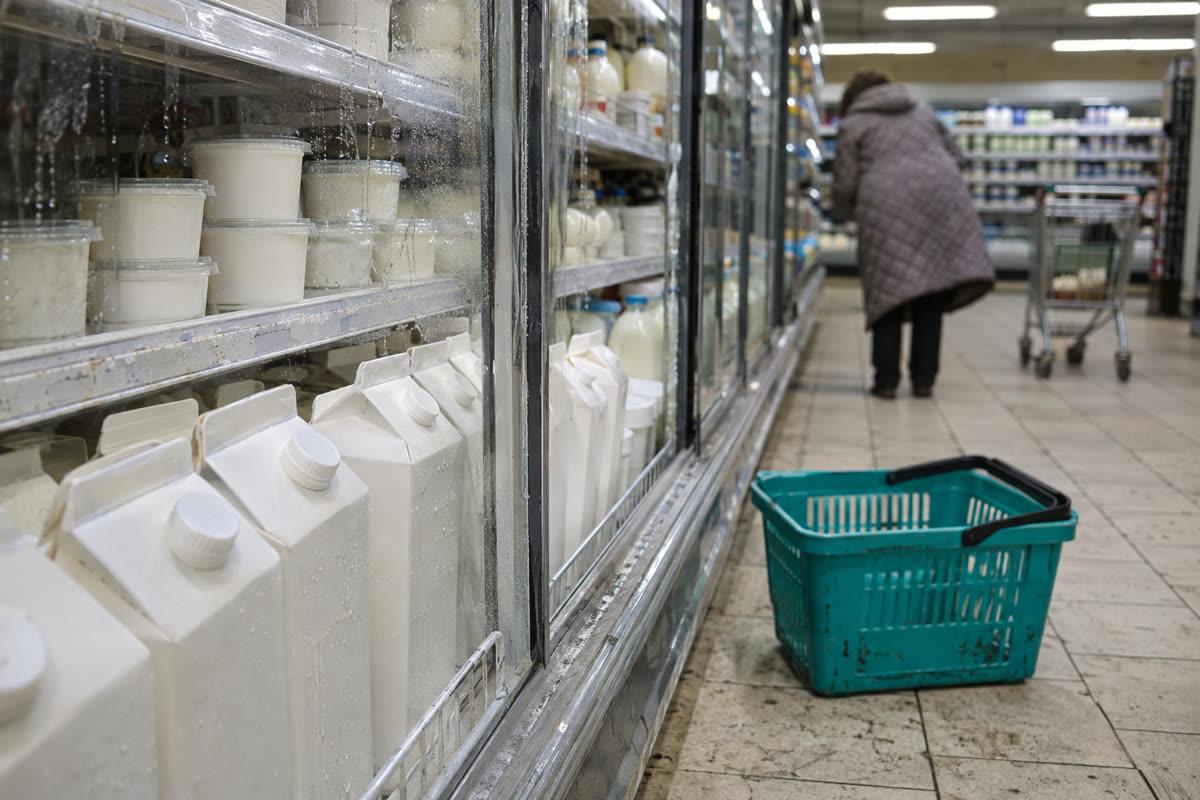 Gluten-free and dairy-free: how to check a US label for bothUS labels treat milk and gluten under different rules. How to read for both, which makers state both claims, and what to ask when eating out.
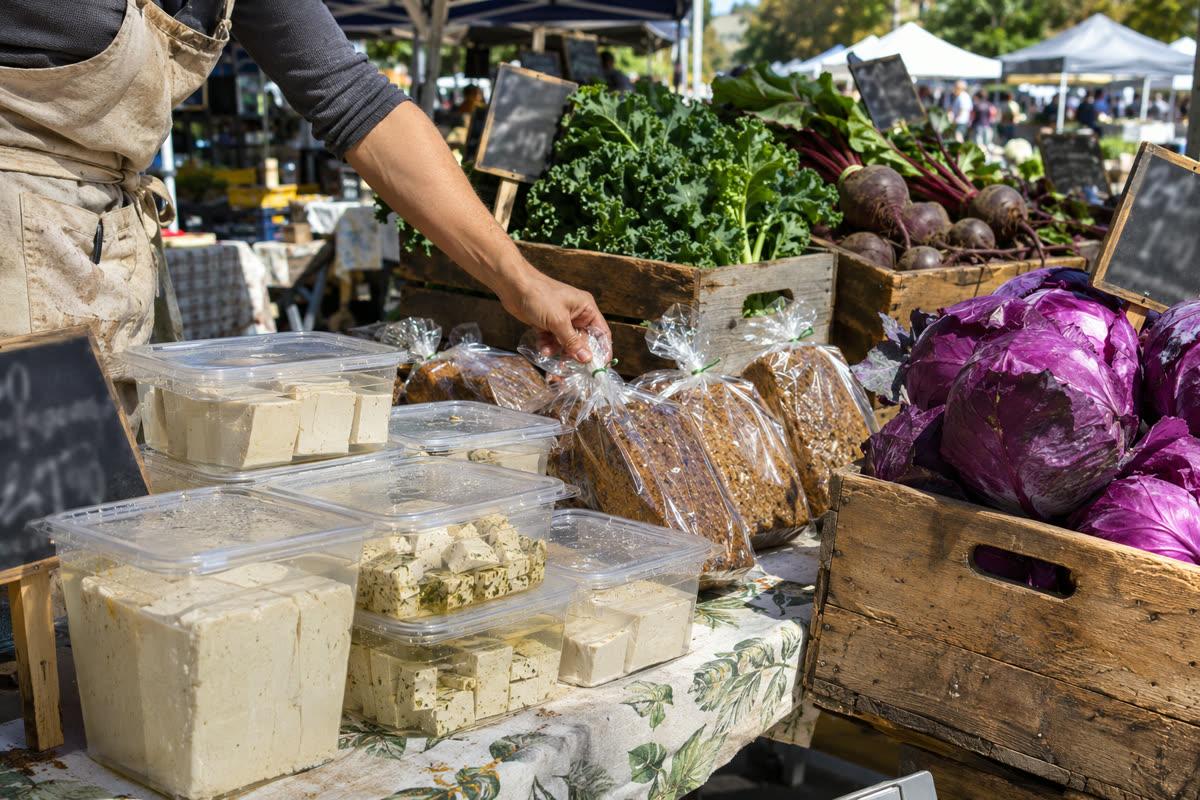 Gluten-free and vegan: where wheat hides in plant-based foodSpot wheat gluten in vegan meat substitutes and sauces, ask the right questions at a restaurant, and see where the charities send you for nutrition.
 Calcium and magnesium on a gluten-free, dairy-free dietWhere calcium and magnesium come from without dairy or gluten, and how to read a plant milk’s panel and ingredient list for added calcium.
 Gluten-free vegetarian protein: what to check on beans, lentils, tofu and tempehWhat to read on beans, lentils, tofu, tempeh and meat substitutes when you are vegetarian and gluten-free: stray grain, added grains, sauces and batters.
 Fiber on a gluten-free diet: where it drops and what fills the gapCheck the fiber on gluten-free breads and pastas against the US Daily Value, and see which gluten-free whole foods charities list to add more.
 Vitamin D with celiac disease: reading a result and checking a supplement for glutenWhat a vitamin D blood result measures, the published reference levels and upper intake level, and how to check a supplement label for gluten.
Related guides
 What to use instead of soy sauce when you eat gluten-freeTamari, gluten-free soy sauce, coconut aminos and liquid aminos: what each maker says, how to confirm it on the bottle, and what changes when you cook.
 How to read a US food label for glutenWhere gluten shows up on a US food label: the gluten-free claim, the Contains line, the ingredient list and may-contain lines, and what each means.
 What “may contain wheat” and “made in a facility with wheat” mean on a US labelHow to read “may contain wheat”, shared-facility and shared-equipment lines on US labels, with and without a gluten-free claim, and what to check next.
 The Contains line names wheat, not barley or rye: what US allergen labels coverWhat the US allergen Contains line covers, why it names wheat but not barley or rye, and which ingredient-list names stand in for them.
Sources
- [1, 2, 3, 4, 5, 6, 7] US Food and Drug Administration, Food Allergies, checked Nov 17, 2026.
- [8, 9, 10, 11, 12, 13, 14, 15, 16] US Food and Drug Administration, Questions and Answers Regarding Food Allergens, Including the Food Allergen Labeling Requirements (Edition 5), checked Nov 17, 2026.
Read on 2026-11-17: the table headed “Table 1. Tree Nuts FDA Considers as Major Food Allergens with Their Common or Usual Names and Scientific Names” names almond, black walnut, Brazil nut, California walnut, cashew, filbert/hazelnut, heartnut/Japanese walnut, macadamia nut/bush nut, pecan, pine nut/pinon nut, pistachio and walnut (English, Persian).
- [17, 18, 19, 20, 21] US Food and Drug Administration, Frequently Asked Questions: Food Allergen Labeling Guidance for Industry, checked Nov 17, 2026.
- [22, 23, 24, 25, 53] US Food and Drug Administration, The FASTER Act: Sesame Is the Ninth Major Food Allergen, checked Nov 17, 2026.
- [26, 27, 28] US Food and Drug Administration (eCFR), 21 CFR 101.91 Gluten-free labeling of food, checked Nov 17, 2026.
- [29, 30, 31, 32, 33] US Food and Drug Administration, Questions and Answers on the Gluten-Free Food Labeling Final Rule, checked Nov 17, 2026.
- [34] US Food and Drug Administration, Gluten and Food Labeling, checked Nov 17, 2026.
- [35] Celiac Disease Foundation, Label Reading & the FDA, checked Nov 17, 2026.
- [36, 37] Gluten Intolerance Group, Celiac Disease, Non-Celiac Gluten Sensitivity or Wheat Allergy: What is the Difference?, checked Nov 17, 2026.
- [38, 39, 40] Food Allergy Research & Education (FARE), How to Read a Food Label, checked Nov 17, 2026.
- [41] Kikkoman USA, Soy Sauce (Non-GMO), checked Nov 17, 2026.
- [42, 43] Kikkoman USA, Gluten-Free Tamari Soy Sauce (Non-GMO), checked Nov 17, 2026.
- [44, 45] Bob's Red Mill, Gluten Free Pancake Mix, checked Nov 17, 2026.
Read on 2026-11-17: the ingredient list on the page names a gluten free flour blend (brown rice flour, potato starch, pearled white sorghum flour, tapioca flour, sweet white rice flour), sugar, baking powder (cornstarch, sodium bicarbonate, monocalcium phosphate), sea salt and xanthan gum; it names no egg or milk.
- [46, 47] Bob's Red Mill, Gluten Free Brownie Mix, checked Nov 17, 2026.
Read on 2026-11-17: the ingredient list on the page names sugar, a gluten free flour blend (sweet white rice flour, whole grain brown rice flour, pearled white sorghum flour, potato starch, tapioca flour, xanthan gum), cocoa powder, baking powder, sea salt and natural flavor; it names no egg or milk.
- [48] Bob's Red Mill, Organic Coconut Flour, checked Nov 17, 2026.
- [49] Blue Diamond Growers, Almond Flour, checked Nov 17, 2026.
- [50] Blue Diamond Growers, Original Almondmilk (Almond Breeze), checked Nov 17, 2026.
- [51, 52] Enjoy Life Foods, Semi-Sweet Mini Chocolate Chips, checked Nov 17, 2026.