Gluten-free and vegan: where wheat hides in plant-based food
Short answer
“Vegan” and “gluten-free” are separate checks, because vital wheat gluten is the main ingredient of seitan and a staple of other meat substitutes1, 2. Check four places, in this order:
- The ingredient list of any meat substitute, for wheat gluten, wheat protein isolate, barley malt extract and soy sauce made with wheat3, 4, 5.
- The maker’s own gluten statement for that exact product, because one maker’s sausage and its chicken can differ6, 7, 8, 9.
- Sauces, marinades, flavored tofu and tempeh, where soy sauce, barley miso and added ingredients bring gluten10, 11, 12, 13.
- At a restaurant, the batter, the frying oil and the marinade14, 15, 16.
Part of Nutrition and combining diets, 24 guides
Key points
- Vital wheat gluten is the main ingredient in seitan, and Bob’s Red Mill calls it a staple ingredient for meat and meat substitutes1, 2.
- Check the product, not the brand: Impossible’s own page lists some products with no gluten-containing ingredients and others that contain gluten6, 7.
- Plain tofu is gluten-free, but flavored tofu depends on its added ingredients, and the Gluten Intolerance Group says some types of tempeh may contain gluten or other grains12, 13.
- FDA’s gluten-free rule applies to packaged foods, including some sold in carry-out restaurants; for a restaurant menu FDA recommends that a “gluten-free” claim be consistent with its definition17.
- NIDDK points to a registered dietitian and the National Celiac Association to a dietitian for planning, and the Gluten Intolerance Group names vitamin B12, vitamin D, calcium, iron and zinc as nutrients where some people who are both gluten-free and vegetarian may need fortified foods or supplements18, 19, 20.
Why “vegan” and “gluten-free” are separate checks
In the US, a “gluten-free” claim has a legal meaning: the food has no gluten-containing grain as an ingredient, no ingredient made from one that has not been processed to remove gluten, and, if an ingredient was processed to remove gluten, its use must not bring the food to 20 parts per million (ppm) or more gluten; any unavoidable gluten must also be under 20 ppm21. That definition concerns gluten only, so it does not tell you whether a food is vegan.
Coeliac UK, the UK charity, says there are lots of vegetarian alternatives to meat products but that it is important to always check that they are gluten free22. It adds that many specialist vegan foods are supplemented with vitamin B12 but may not be gluten free23.
Brands do not settle it either. FDA says a manufacturer may make a wide variety of foods, including some that are “gluten-free” and some that contain gluten24. And a label that says only “no gluten-containing ingredients” is not a gluten-free claim: FDA says consumers should not assume the food meets the rule unless the label also bears the claim25.
The vegan question has its own place to look. The US list of major food allergens includes milk, egg, fish, crustacean shellfish and wheat26, and a “Contains” line printed next to the ingredient list names the source of each one in the food27. That helps with those animal ingredients and with wheat; it does not cover every animal ingredient, and barley and rye are not on that list26.
Which plant-based meats are built on wheat?
Bob’s Red Mill, which sells vital wheat gluten, calls it a staple ingredient for meat and meat substitutes that acts as a binder in veggie burgers and tofu1, and the main ingredient in seitan2. The Celiac Disease Foundation lists meat substitutes made with seitan, such as vegetarian burgers, vegetarian sausage, imitation bacon and imitation seafood, among foods that may contain gluten16. The Gluten Intolerance Group says different brands of plant-based “meat” contain different ingredients, and some contain wheat28.
| Product | What the maker’s page says |
|---|---|
| Upton’s Naturals Traditional Seitan | Lists vital wheat gluten, soy sauce (water, soybeans, wheat, salt) and whole wheat flour, with “Contains: Wheat, Soy”3 |
| Tofurky Plant-Based Italian Sausage | Lists vital wheat gluten and soy sauce (water, soybeans, wheat, salt), with “CONTAINS: SOY, WHEAT”4 |
| Field Roast Italian Garlic & Fennel sausages | Lists wheat gluten, wheat protein isolate and barley malt extract5; the Contains line reads “CONTAINS: WHEAT”29 |
| Impossible Beef, Sausage, Meatballs and Pork | Impossible says these have no gluten-containing ingredients6 |
| Impossible Chicken, Beef Hot Dogs and Corn Dogs | Impossible says these do contain gluten7 |
| Beyond Sausage and Beyond Chicken pieces | Beyond’s sausage page says the sausage has no soy, gluten and GMOs8; its chicken page says the chicken pieces contain wheat9 |
The lesson of the table is to read the line for the product in your hand. One maker can sell a sausage with no gluten-containing ingredients next to a “chicken” that contains wheat6, 7, 8, 9, and recipes move: Impossible tells readers to review its ingredient labels regularly because of periodic recipe updates30, and Field Roast says its ingredients and allergen statements can change and points to the package29. Our seitan verdict has the products we read, with their lists.
Words to look for in the ingredient list
- “Wheat gluten” or “vital wheat gluten”, the seitan base2, 4.
- “Wheat protein isolate”, as in Field Roast’s sausages5.
- “Barley malt extract”, as in the same list5. Barley is not on the US list of major allergens, so a Contains line naming wheat does not flag it26.
- “Soy sauce” followed by “wheat” in the brackets, as in the Tofurky and Upton’s lists4, 3, and “whole wheat flour”3.
The full set of names, and what the Contains line does and does not cover, is in how to read a food label for gluten. If a list leaves you unsure, NIDDK says not to eat the food, and to contact the company or visit its website if possible31.
What a Canadian survey found
The Canadian Food Inspection Agency tested 249 samples of plant-based food products, collected between April 2021 and January 202232, 33. One meat alternative was found to contain undeclared gluten34, and CFIA assessed that product as being of no risk to consumers, so no recall was needed44. This is one Canadian survey, and it looked for gluten that the label did not declare, so it says nothing about products that name wheat gluten openly: for those, the ingredient list is the whole answer.
Sauces, marinades and seasonings
Soy sauce is the first sauce to check. FDA says soy sauce is ordinarily made by fermenting soybeans and wheat, and that when it is, it may not bear a “gluten-free” claim10. The Celiac Disease Foundation lists soy sauce among foods to verify, noting that tamari made without wheat is gluten-free, so the label has to be checked for wheat35, and the Gluten Intolerance Group suggests asking for tamari instead of soy sauce36. Our soy sauce verdict and the soy sauce substitutes guide go further.
Miso is the second one to check. The Gluten Intolerance Group says miso is made by fermenting soybeans with salt and koji, cultured grains such as barley or rice, and that versions made with barley must be avoided11. FDA adds that fermentation is not a process to remove gluten and that conventional tests may not accurately detect gluten in fermented foods37, so read the grain on the label rather than assuming. Our miso verdict lists the pastes we read.
Our hoisin sauce verdict found jars that list wheat flour or wheat in their soy sauce, and our teriyaki sauce verdict found bottles that list wheat, so the same question applies to each jar. More sauces are in gluten-free Asian sauces.
Tofu, tempeh, beans and falafel
- Tofu: plain tofu is gluten-free, but added ingredients in flavored tofu may not be12. The Celiac Disease Foundation names soy sauce marinades and cross-contact, especially when the tofu is fried, as the cautions16.
- Tempeh: the Gluten Intolerance Group says some types may contain gluten or other grains13. We have no tempeh verdict page yet, so the label is your check.
- Falafel: our verdict is that it depends on the product, and we found no source we could read on restaurant falafel.
- Lentils, chickpeas, hummus and tahini: our verdicts say what we found on each product we read.
For protein ideas that are not meat substitutes, see gluten-free vegetarian protein and gluten-free high-protein foods. Processed soy products and other “meat alternatives” may or may not be gluten-free, says the Gluten Intolerance Group38.
Frying oil, breading and marinades when you eat out
FDA’s gluten-free rule applies to packaged foods, which may be sold in some food-service establishments such as some carry-out restaurants. For a restaurant menu, FDA recommends that restaurants making a “gluten-free” claim be consistent with its definition17, which is a recommendation, so ask what the kitchen does.
The charities name the same few places for plant-based food. The Gluten Intolerance Group says the batter on fried tofu might be wheat flour based, and that cross-contact is more likely when gluten-containing and gluten-free items are fried in the same oil14. For Japanese fried foods it says panko breadcrumbs, made from wheat, are typically used in the batter and the frying oil could contain gluten39. The Celiac Disease Foundation lists fried foods cooked in oil shared with breaded products as a place cross-contact happens15. Impossible’s own page asks diners to check with the restaurant about cross-contamination risks40.
Questions to ask
- Is the plant-based “meat” in this dish seitan or made with wheat gluten? (Seitan is wheat gluten16.)
- Is the tofu or vegetable battered or breaded, and is it fried in oil shared with breaded items?14, 15
- What is in the marinade or sauce: soy sauce, or tamari made without wheat?10, 35
- Can I speak to the chef? NIDDK’s advice is to tell the server about your condition, ask about ingredients and how food is prepared, and ask to talk with the chef for more detail41.
- If the menu says “gluten-free”, what does the kitchen do to back it up?17
Cuisine-specific versions of these questions are in our guides to Thai and sushi and Japanese restaurants, and where gluten hides in restaurant kitchens.
Nutrients across both diets: what the sources say
This section reports what the sources say. It is not advice for any one person, and it waits for a named medical reviewer before it is released.
- The Gluten Intolerance Group says some people who are both gluten-free and vegetarian may need fortified foods or supplements, naming vitamin B12, vitamin D, calcium, iron and zinc, and that diet and nutritional status should be assessed with a healthcare team18.
- The National Celiac Association, in an answer bylined by a registered dietitian, lists vitamin B12, vitamin D, omega-3 fatty acids, calcium, iron and zinc as nutrients of concern with vegetarian diets, and fiber, fat, sugar and several vitamins and minerals as concerns with gluten-free diets42. It says to see a dietitian who can plan a gluten-free vegetarian diet around your needs19.
- Coeliac UK says that following both a vegetarian and a gluten free diet means a more limited diet and steps are needed to reduce the risk of nutritional deficiencies43.
- NIDDK says a doctor and a registered dietitian can help plan a healthy, balanced diet that provides the nutrients you need20.
Verdicts in this guide
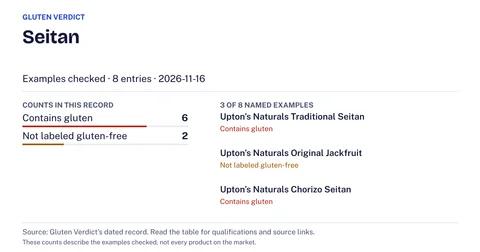 SeitanContains glutenchecked Nov 16, 2026
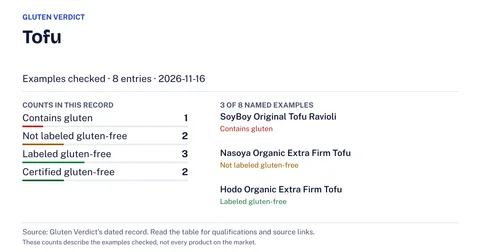 TofuDepends on the product1 of 8 products we checked contains gluten: SoyBoy Original Tofu Raviolichecked Nov 16, 2026
 Soy sauceDepends on the product3 of 7 products we checked contain gluten: Kikkoman Soy Sauce (Non-GMO), 20 oz; San-J Organic Shoyu Soy Sauce; and Lee Kum Kee Premium Soy Sauce (No Preservatives Added)checked Nov 16, 2026
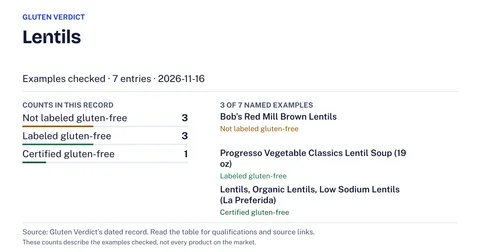 LentilsDepends on the productchecked Nov 16, 2026
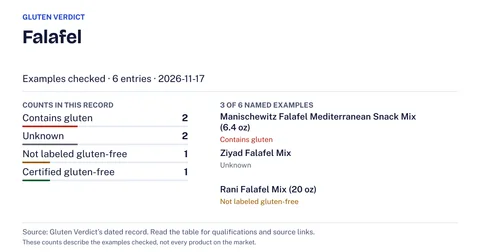 FalafelDepends on the product2 of 6 products we checked contain gluten: Manischewitz Falafel Mediterranean Snack Mix (6.4 oz) and Al’Fez Lebanese Falafel Kit (5.3 oz)checked Nov 17, 2026
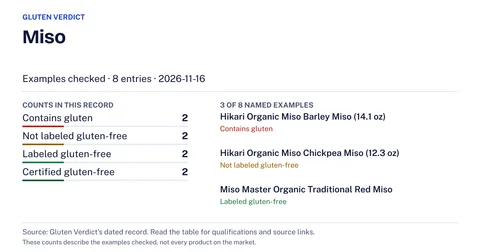 MisoDepends on the product2 of 8 products we checked contain gluten: Hikari Organic Miso Barley Miso (14.1 oz) and Hikari Miso Soup Akadashi (12 servings, 7.0 oz)checked Nov 16, 2026
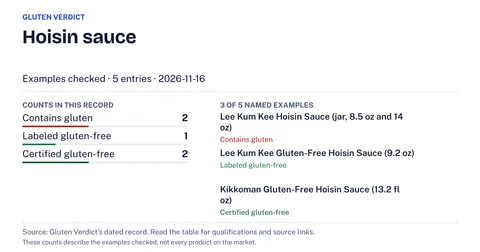 Hoisin sauceDepends on the product2 of 5 products we checked contain gluten: Lee Kum Kee Hoisin Sauce (jar, 8.5 oz and 14 oz) and Kikkoman Hoisin Sauce (9.3 oz)checked Nov 16, 2026
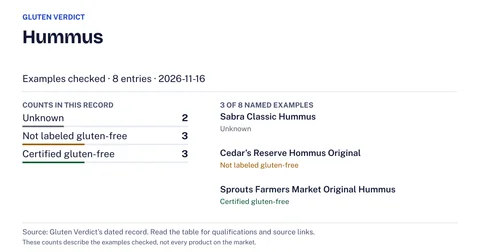 HummusDepends on the productchecked Nov 16, 2026
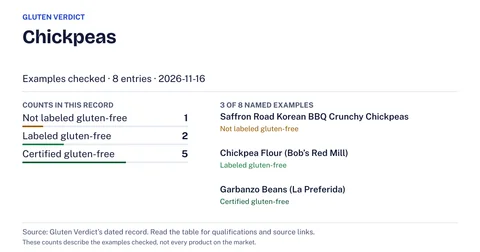 ChickpeasNaturally gluten-freechecked Nov 16, 2026
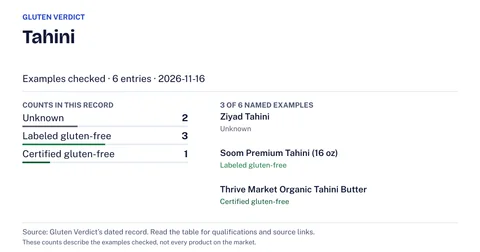 TahiniDepends on the productchecked Nov 16, 2026
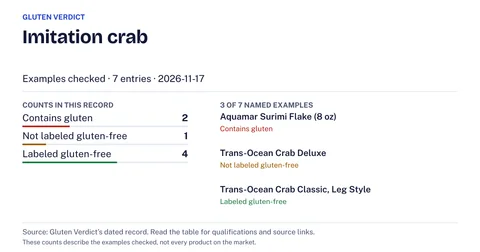 Imitation crabDepends on the product2 of 7 products we checked contain gluten: Aquamar Surimi Flake (8 oz) and Aquamar Surimi Stick (8 oz)checked Nov 17, 2026
Questions people ask
Is seitan gluten-free?
No. Vital wheat gluten is the main ingredient in seitan2, and the Celiac Disease Foundation writes it as “seitan (wheat gluten)”16. See our seitan verdict.
Is the Impossible burger gluten-free?
Impossible says its Beef, Sausage, Meatballs and Pork have no gluten-containing ingredients, and that its Chicken, Beef Hot Dogs and Corn Dogs contain gluten6, 7. “No gluten-containing ingredients” is a statement about ingredients, not a gluten-free claim25, and recipes get updated30, so read the package.
Is tempeh gluten-free?
It depends on the product. The Gluten Intolerance Group says some types may contain gluten or other grains13.
Is tamari gluten-free?
Tamari made without wheat is, according to the Celiac Disease Foundation35. Check the label for wheat.
More in Nutrition and combining diets
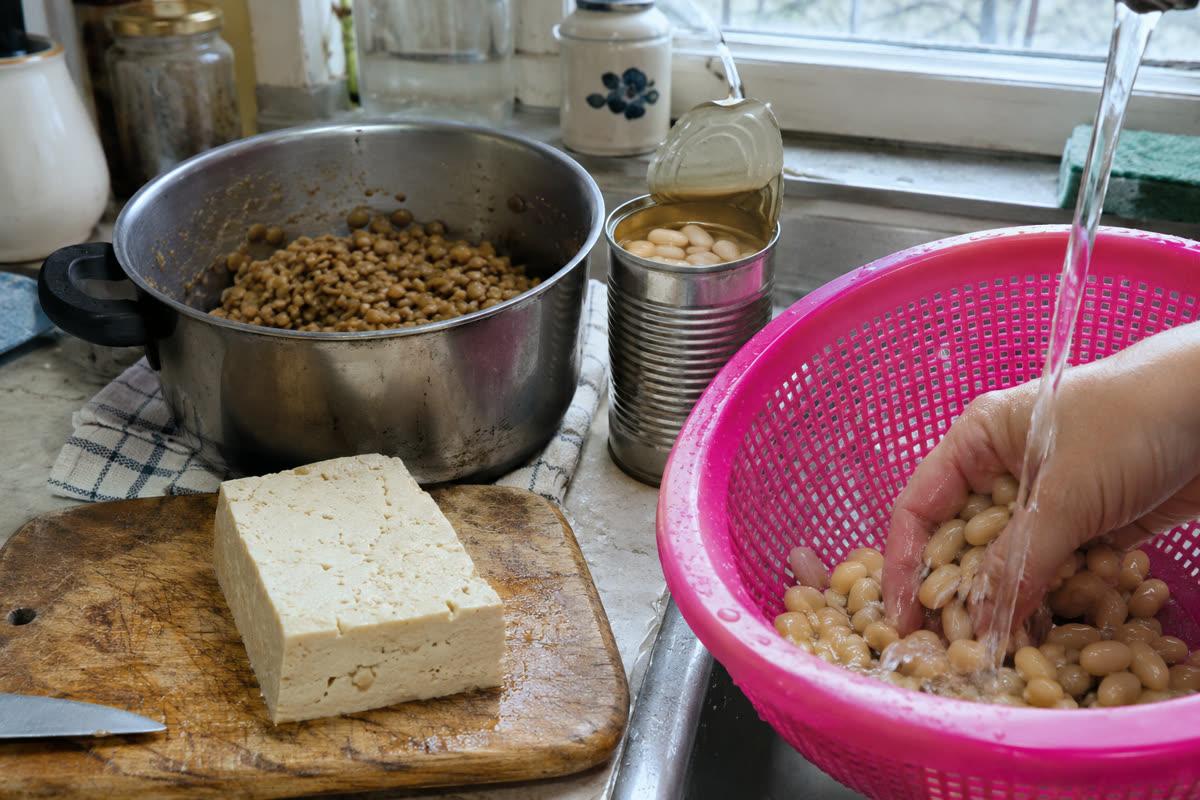 Gluten-free vegetarian protein: what to check on beans, lentils, tofu and tempehWhat to read on beans, lentils, tofu, tempeh and meat substitutes when you are vegetarian and gluten-free: stray grain, added grains, sauces and batters.
 Gluten-free high-protein foods: where gluten hides in bars, powders, jerky and marinadesCheck each protein product type for its gluten trap: seitan, jerky, bars, powders, sausage and broth, with what makers say on their own pages.
 Reading a US label for gluten and another food allergyHow to read a US food label for gluten and a second allergen: what the Contains line, gluten-free claim and may-contain lines each cover.
 Gluten-free with type 2 diabetes or high cholesterol: where the plans overlapWhere a gluten-free plan and a diabetes or cholesterol plan agree, where packaged gluten-free foods cut across them, and what to ask a dietitian.
 What to eat after a celiac diagnosis: what the sources document and what they do notBone broth, collagen, glutamine or plain staples? What NIDDK, ACG and celiac charities document after a diagnosis, and what no page we read names.
 Fiber on a gluten-free diet: where it drops and what fills the gapCheck the fiber on gluten-free breads and pastas against the US Daily Value, and see which gluten-free whole foods charities list to add more.
Related guides
 Gluten-free and dairy-free: how to check a US label for bothUS labels treat milk and gluten under different rules. How to read for both, which makers state both claims, and what to ask when eating out.
 Calcium and magnesium on a gluten-free, dairy-free dietWhere calcium and magnesium come from without dairy or gluten, and how to read a plant milk’s panel and ingredient list for added calcium.
 Iron, B12 and B6 on a gluten-free diet: where they come from and how to check a labelWhich foods supply iron, B12 and B6, what US enrichment standards name, and how to check whether a gluten-free flour, bread or cereal is fortified.
 Where wheat, barley and rye hide in processed food: 15 places to checkFifteen processed foods where wheat, barley or rye turn up, the label step that catches each, and what US allergen law does and does not flag.
Sources
- [1, 2] Bob’s Red Mill, Vital Wheat Gluten, checked Nov 17, 2026.
- [3] Upton’s Naturals, Traditional Seitan, checked Nov 17, 2026.
- [4] Tofurky, Plant-Based Italian Sausage, checked Nov 17, 2026.
- [5, 29] Field Roast, Italian Garlic & Fennel Plant-Based Sausages, checked Nov 17, 2026.
- [6, 7, 30, 40] Impossible Foods, Do your products contain gluten?, checked Nov 17, 2026.
- [8] Beyond Meat, Beyond Sausage, checked Nov 17, 2026.
- [9] Beyond Meat, Beyond Chicken Pieces, checked Nov 17, 2026.
- [10, 17, 21, 24, 25, 37] US Food and Drug Administration, Questions and Answers on the Gluten-Free Food Labeling Final Rule, checked Nov 17, 2026.
- [11, 39] Gluten Intolerance Group, Japanese Cuisine When You’re Eating Gluten-Free, checked Nov 17, 2026.
- [12, 13, 28] Gluten Intolerance Group, Navigating a Plant-Based and Gluten-Free Diet, checked Nov 17, 2026.
- [14, 36] Gluten Intolerance Group, Exploring Thai Cuisine on a Gluten-Free Diet, checked Nov 17, 2026.
- [15, 16, 35] Celiac Disease Foundation, Sources of Gluten, checked Nov 17, 2026.
- [18, 38] Gluten Intolerance Group, Plant-Based Gluten-Free (Vegetarian), checked Nov 17, 2026.
- [19, 42] National Celiac Association, Dietary advice for a vegetarian with celiac disease, checked Nov 17, 2026.
Read on 2026-11-17: the answer is bylined Katarina Mollo MEd, RDN, LDN. The list headed “The main nutrients of concern with vegetarian diets:” names vitamin B12, vitamin D, omega-3 fatty acids, calcium, iron and zinc. The list headed “Main nutrients of concern with GF diets:” names low fiber, high fat, more sugar and high fructose corn syrup, low in certain vitamins and minerals (B vitamins, calcium, magnesium, iron, zinc), and many GF foods not fortified or enriched with iron, folate, or other vitamins like their gluten-containing counterparts.
- [20, 31, 41] National Institute of Diabetes and Digestive and Kidney Diseases (NIDDK), Eating, Diet, & Nutrition for Celiac Disease, checked Nov 17, 2026.
- [22, 23, 43] Coeliac UK, Following a gluten free vegetarian or vegan diet, checked Nov 17, 2026.
- [26, 27] US Food and Drug Administration, Food Allergen Labeling and Consumer Protection Act of 2004 (FALCPA), checked Nov 17, 2026.
- [32, 33, 34, 44] Canadian Food Inspection Agency (CFIA), Undeclared allergens and gluten in plant-based food products, April 1, 2021, to January 31, 2022, checked Nov 17, 2026.