Gluten-free flours and starches: what each one is and how to read the bag
Short answer
A flour made from rice, corn, potatoes, soy, nuts, cassava, buckwheat or beans is made from a gluten-free food, but that describes the plant, not the bag1, 2. Check the bag in this order:
- The ingredient list: a single flour or a blend, and whether it names wheat, spelt or another wheat-based flour3.
- A “gluten-free” claim, which on a US bag requires any unavoidable gluten to be below 20 parts per million4.
- A certification mark such as GFCO’s, whose standard is 10 ppm or less and which you can look up in its product finder5, 6.
- If there is no claim and no mark, the maker’s own page: in a 2009 US sample, 7 of 22 inherently gluten-free grains, seeds and flours not labeled gluten-free had mean gluten levels at or above 20 ppm7.
Part of Grains, flours and substitutes, 13 guides

Key points
- NIDDK lists flour made from potatoes, rice, corn, soy, nuts, cassava, amaranth, quinoa, buckwheat and beans as flour made from gluten-free foods, but it notes cross-contact can occur when foods are grown, processed or stored1, 2.
- On a US bag, a “gluten-free” claim requires any unavoidable gluten to be below 20 ppm; GFCO’s certification standard is 10 ppm or less4, 5.
- Bob’s Red Mill’s own pages word the gluten statement differently flour by flour, and its buckwheat page has none8, 9.
- In one 2009 US sample of 22 inherently gluten-free grains, seeds and flours not labeled gluten-free, 7 had mean gluten levels at or above 20 ppm7.
- Spelt is wheat: the regulation names spelt wheat as a gluten-containing grain3, and Bob’s Red Mill’s spelt page says it is not gluten free10.
Gluten-free by nature, or gluten-free on the bag?
NIDDK lists flour made from potatoes, rice, corn, soy, nuts, cassava, amaranth, quinoa, buckwheat and beans as flour made from gluten-free foods1. That is a statement about the plant.
The bag is a separate question. NIDDK says cross-contact can occur at any time, including when foods are grown, processed, stored, prepared or served2. FDA points to crop rotation and shared harvest and transport equipment and storage silos, which often bring gluten-containing grains into contact with other grains, legumes and seeds that are naturally free of gluten11.
Bob’s Red Mill’s cornstarch page draws the same line. It says cornstarch is naturally gluten free, then adds that its own was produced and packaged in a gluten free facility and batch tested12. Read the bag, not only the plant.
A flour with no claim is not a warning in itself: FDA says makers of foods that are by nature free of gluten may choose not to label them “gluten-free”13. It does mean the label gives you nothing to check, so the ingredient list and the maker’s own page are what you have.
What a gluten-free claim and a certification mark each promise
On a US bag, “gluten-free” is a regulated claim, and it is voluntary14. Under 21 CFR 101.91 the food may not contain an ingredient derived from a gluten-containing grain that has not been processed to remove gluten, such as wheat flour15, and any unavoidable gluten must be below 20 parts per million (20 mg of gluten per kg of food)4.
A certification mark is a second, separate promise, made by a certifier. GFCO, the Gluten Intolerance Group’s program, says it certifies physical products displaying its mark, not brands or manufacturing facilities16. The Gluten Intolerance Group puts the difference in numbers: a labeled product should comply with FDA’s under 20 ppm but that is not third-party verified, and GFCO’s standard is 10 ppm of gluten or less5. GFCO says all grains are high-risk ingredients that must be tested per lot before use in finished products17.
| On the bag | Who stands behind it | The number |
|---|---|---|
| “Gluten-free” claim | The maker, which FDA says is responsible for compliance78 | Unavoidable gluten below 20 ppm4 |
| GFCO certification mark | GFCO, which certifies the product16 | 10 ppm of gluten or less5 |
To check a mark, use GFCO’s product finder: a product is certified if it appears on the list and carries a certification mark6. A product on the list whose packaging lacks the mark is not certified18.
Flours and starches, one maker’s pages side by side
Bob’s Red Mill has a product page for each flour and starch below, so one maker’s wording can be read side by side. The table records what each page said on 2026-11-17; it is one maker’s wording, not a rating, and other makers’ pages differ. Where we have a verdict page for the food itself, the name links to it.
| Flour or starch | What its page says it is for | What the page says about gluten |
|---|---|---|
| White rice flour | Noodles, delicate cookies, cakes, pancakes, and a thickener19 | Tested and confirmed gluten free; processed and packaged in a separate gluten free facility; batch tested by an ELISA gluten assay8 |
| Brown rice flour | Breading, thickening sauces and gravies, pancakes, muffins and bread20 | Calls it a “gluten free flour”20 |
| Sorghum flour | Pancakes, porridges, flatbread, and a replacement for wheat flour in sweet breads and cookies, with a binder such as xanthan gum added21, 22 | Calls it a “gluten free flour”21 |
| Millet flour | A delicate cake-like crumb, alone or in blends; the page suggests replacing up to 25% of the flour in a recipe23 | Says the flour is “gluten free”24 |
| Buckwheat flour | Russian blini and buckwheat crepes25 | No gluten statement on the page9 |
| Corn flour | Breading and gluten free baking, combined with other flours; a binder may be needed26, 27 | Stone ground in a dedicated gluten free facility28 |
| Cornstarch | Thickening puddings, pie fillings, sauces, soups and stews29 | Naturally gluten free; its own produced and packaged in a gluten free facility and batch tested12 |
| Tapioca flour | Comes from cassava; a staple in gluten free baking and a thickener for soups, sauces and pie fillings30, 31 | Calls it one of its “gluten free flours”31 |
| Potato starch | A thickener that tolerates higher temperatures than cornstarch32 | Calls it “Gluten Free Potato Starch”33 |
| Chickpea flour | Falafel, hummus, socca and farinata34 | Tested and confirmed gluten free; processed and packaged in a separate gluten free facility; batch tested by an ELISA gluten assay35 |
| Almond flour | Adds a buttery flavor and moist texture to almond flour recipes36 | Tested and confirmed gluten free37 |
| Coconut flour | Absorbent: recipes often need extra eggs and liquid, so use recipes designed for coconut flour38 | Tested and confirmed gluten free; processed and packaged in a separate gluten free facility; batch tested by an ELISA gluten assay39 |
Read the right-hand column as the point of the table. The same maker words the gluten statement differently from one page to the next, and the buckwheat page has none. Only some pages say how that flour was tested or packed.
Grain and starch flours: what the table cannot show
- Potato flour is not potato starch. The Gluten Intolerance Group says recipes may call for either, but they cannot be substituted for each other40.
- Tapioca flour is made from cassava using only the starch from the root, while cassava flour is made from the entire root41, 42.
- Rice comes three ways. White rice flour is milder and smoother than brown, which provides more fiber and other nutrients, and sweet rice flour is not sweet43. They do not substitute equally for one another44.
- Corn flour is a more finely ground version of cornmeal, and the texture changes the result in baking45. Masa harina is a distinct type of corn flour made from corn treated with lime46.
- Despite the name, buckwheat is not wheat: the Gluten Intolerance Group calls it a gluten-free member of the rhubarb family47.
- Whole grain flours keep less well. Brown rice flour has a shorter shelf life than white rice flour because the germ and bran contain oil that can go rancid48.
For sauces, the Gluten Intolerance Group names white or sweet rice flour as a substitute for the wheat flour in a roux49. Our verdict pages cover rice flour, tapioca and cornstarch one by one.
Nut, seed and legume flours
The Gluten Intolerance Group lists nuts and beans as sources of gluten-free flour, naming soy, garbanzo, almond and coconut50. See our verdicts for almond flour, coconut flour, soy flour and chickpeas.
- Soy flour: the Gluten Intolerance Group suggests combining it with starchier flours when baking51.
- Nut flours: the Gluten Intolerance Group notes that nuts have a high fat content and says to store nut flours in the refrigerator or freezer so they do not go rancid too quickly52.
- Lentil flour: the Gluten Intolerance Group says that, because of the risk of cross-contact with gluten-containing grains, it should be labeled or certified gluten-free53.
- Chia flour: the Gluten Intolerance Group says chia can be used as a binder in place of xanthan gum54.
Reading a blend: what is already in the bag
The Gluten Intolerance Group says that for most recipes one gluten-free flour is not ideal and a blend of several gives the best results55. A blend is a different product from the flours in it, so read its own list. Three common 1-to-1 blends, as each maker prints them:
| Blend | Ingredient list as printed | How the maker says to use it | Claim or mark the maker shows |
|---|---|---|---|
| Bob’s Red Mill Gluten Free 1-to-1 Baking Flour | Sweet white rice flour, whole grain brown rice flour, pearled white sorghum flour, potato starch, tapioca flour, xanthan gum56 | Replaces wheat flour cup for cup in non-yeast recipes57 | Product page: “tested and confirmed” in a dedicated gluten free facility79; the maker says some of its products carry the GFCO logo and others the red GF logo58, 59 |
| King Arthur Gluten-Free Measure for Measure Flour | Rice flour, whole grain brown rice flour, sorghum flour, tapioca starch, potato starch, cellulose, vitamin and mineral blend [calcium carbonate, niacinamide (vitamin B3), reduced iron, thiamin hydrochloride (vitamin B1), riboflavin (vitamin B2)], xanthan gum, cellulose gum60 | Substitute 1:1 for all-purpose or whole wheat flour in non-yeasted recipes; not recommended 1:1 for yeasted recipes61, 62 | The packaging PDF prints “Certified Gluten-Free by GFCO”63 |
| Krusteaz Gluten Free All Purpose Flour | Whole grain sorghum flour, brown rice flour (rice flour, stabilized rice bran with germ), whole grain millet flour, rice flour, food starch-modified, whole grain quinoa flour, xanthan gum64 | A 1:1 conversion from regular flour65 | Krusteaz’s page says it is certified gluten free by GFCO66 |
Every list above includes xanthan gum56, 60, 64. That is the binder question: the Gluten Intolerance Group says “flours” often have no binder and “baking mixes” do, and to read the ingredients67. If a blend has none, it says you will need to add one when baking68. Which binder to use is a baking question this page leaves aside.
The right-hand column of the table shows a testing statement for the first blend, a printed GFCO certification line for the second and a GFCO certification statement on the maker’s page for the third: the two different promises described above. Our verdict pages record what each maker said and when: Bob’s Red Mill, King Arthur, Krusteaz and Pillsbury. Maker pages are at Bob’s Red Mill and King Arthur.
Wheat flours that sound like alternatives
Some flours on a shelf of “alternative” flours are wheat. The Gluten Intolerance Group says to avoid gluten-containing grains, including wheat, barley and rye plus all their varieties and derivatives, such as spelt and malt69.
- Spelt: the regulation names spelt wheat as an example of a gluten-containing grain3, and Bob’s Red Mill’s spelt page says spelt is not gluten free10.
- Graham, kamut, durum, semolina, bulgur, wheat bran and wheat flour: Whole Foods Market lists them together as wheat-based ingredients70.
- Wheat flour itself is the regulation’s own example of an ingredient derived from a gluten-containing grain15; see flour.
- Wheat starch: for a food to carry the gluten-free claim, the regulation rules out an ingredient derived from a gluten-containing grain and processed to remove gluten, such as wheat starch, if its use results in 20 ppm or more gluten in the food71.
The rule’s list of gluten-containing grains is wheat, rye and barley, and crossbred hybrids such as triticale72.
Flours with no gluten-free claim: what one study found
One published US study looked at exactly this. Its authors bought 22 inherently gluten-free grains, seeds and flours not labeled gluten-free in June 2009 and sent them unopened to a company that specializes in gluten analysis73. Their abstract reports the results: 13 of 22 samples had less than the 5 ppm limit of quantification; 9 had more, with mean gluten levels from 8.5 to 2,925.0 ppm; and 7 had mean levels at or above 20 ppm7. The authors called gluten contamination of such products a legitimate concern74.
Two limits on that result. It is a pilot study of 22 samples73, and its abstract still describes FDA’s labeling rule as proposed75, so the 20 ppm line it uses7 is the one the rule above sets4. It does not tell you the rate for any flour on your shelf today.
That is why this page puts the checks on a bag in this order: a gluten-free claim or a certification mark first, then a one-ingredient list, then the maker’s own page for the flour. For whole dry beans, the Gluten Intolerance Group describes washing and visual sorting76; its page covers whole beans and grains and names no flour77.
Where to go next
This page is the reference for what each flour and starch is and what to read on the bag. For a food you are about to buy, start at every verdict, A to Z; for a bake, the leavening is its own item: baking powder. All guides are at the guides hub.
Verdicts in this guide
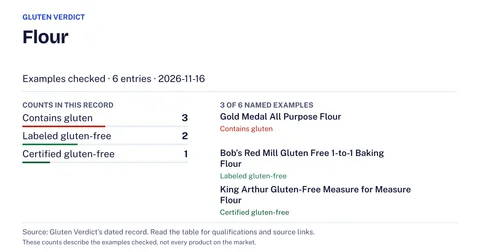 FlourContains glutenchecked Nov 16, 2026
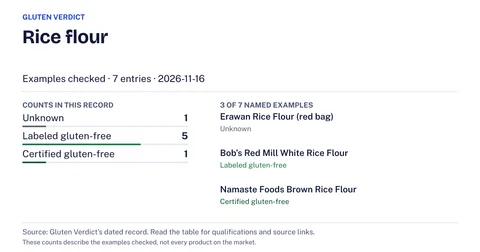 Rice flourNaturally gluten-freeBuy it labeled gluten-freechecked Nov 16, 2026
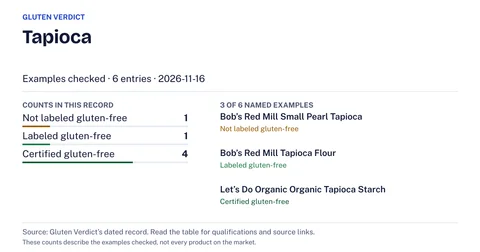 TapiocaNaturally gluten-freeBuy it labeled gluten-freechecked Nov 16, 2026
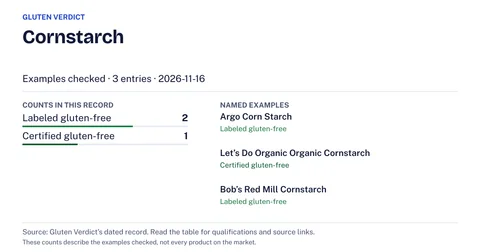 CornstarchNaturally gluten-freeBuy it labeled gluten-freechecked Nov 16, 2026
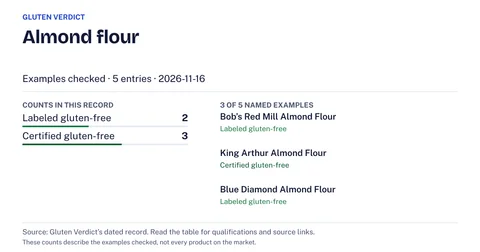 Almond flourNaturally gluten-freeBuy it labeled gluten-freechecked Nov 16, 2026
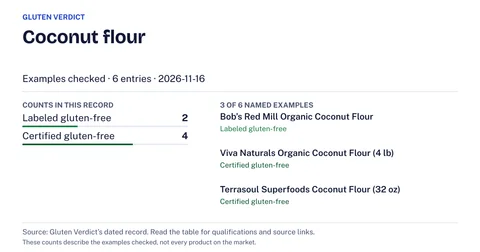 Coconut flourNaturally gluten-freeBuy it labeled gluten-freechecked Nov 16, 2026
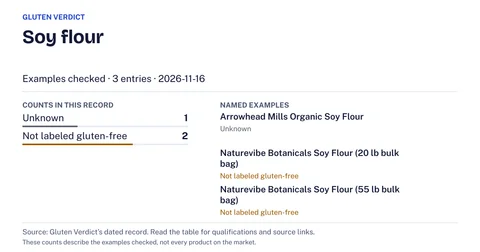 Soy flourNaturally gluten-freeBuy it labeled gluten-freechecked Nov 16, 2026
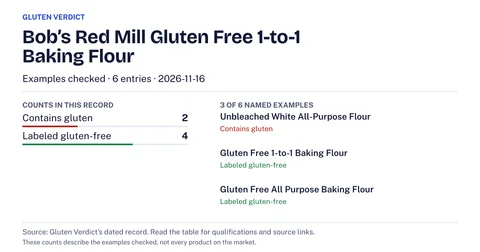 Bob’s Red Mill Gluten Free 1-to-1 Baking FlourLabeled gluten-free2 of 6 varieties we checked contain gluten: Unbleached White All-Purpose Flour and Whole Wheat FlourBob’s Red Mill Natural Foods · checked Nov 16, 2026
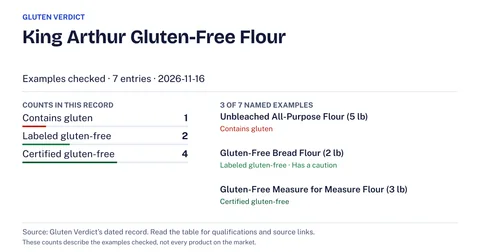 King Arthur Gluten-Free FlourCertified gluten-free1 of 7 varieties we checked contains gluten: Unbleached All-Purpose Flour (5 lb)Wheat warning on 2 of 7 varieties we checkedKing Arthur Baking Company · checked Nov 16, 2026
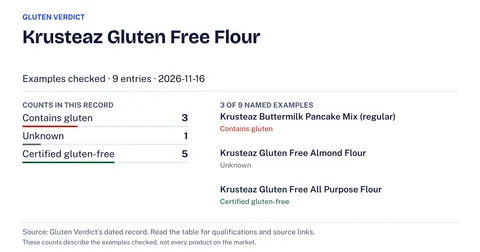 Krusteaz Gluten Free FlourCertified gluten-free3 of 9 varieties we checked contain gluten: Krusteaz Buttermilk Pancake Mix (regular), Krusteaz Honey Cornbread Muffin Mix (regular), and Krusteaz Pie Crust Mix (regular)Krusteaz · checked Nov 16, 2026
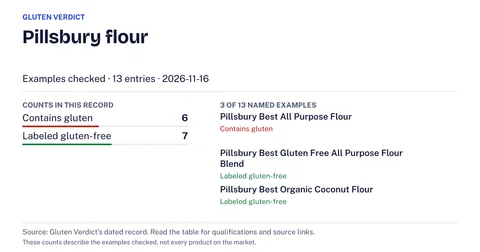 Pillsbury flourLabeled gluten-free6 of 13 varieties we checked contain glutenPillsbury · checked Nov 16, 2026
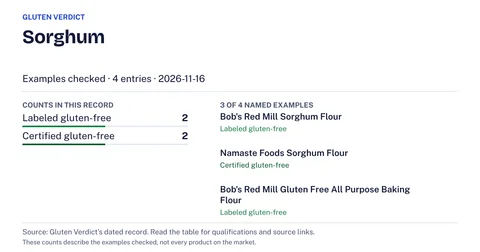 SorghumNaturally gluten-freeBuy it labeled gluten-freechecked Nov 16, 2026
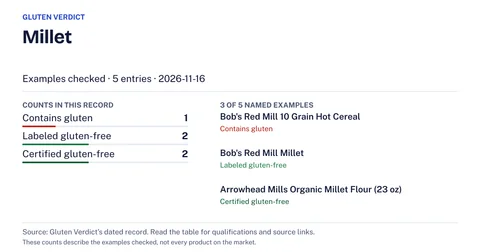 MilletNaturally gluten-free1 of 5 products we checked contains gluten: Bob's Red Mill 10 Grain Hot CerealBuy it labeled gluten-freechecked Nov 16, 2026
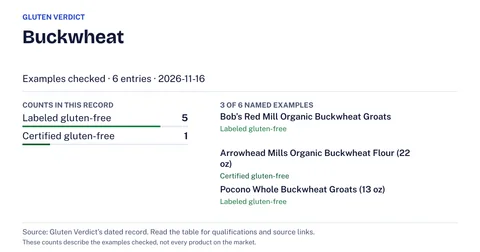 BuckwheatNaturally gluten-freeBuy it labeled gluten-freechecked Nov 16, 2026
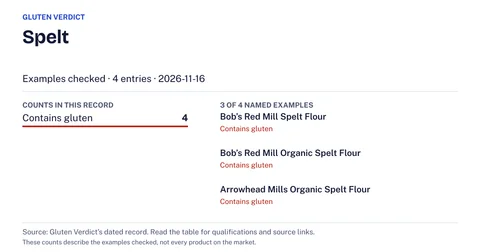 SpeltContains glutenchecked Nov 16, 2026
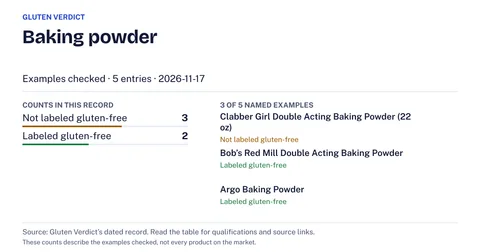 Baking powderDepends on the productchecked Nov 17, 2026
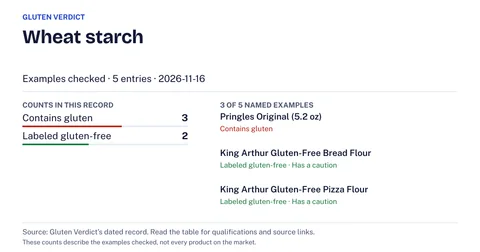 Wheat starchDepends on the product3 of 5 products we checked contain gluten: Pringles Original (5.2 oz), Jiffy Corn Muffin Mix, and Chex Mix Bold Garlic and Herbchecked Nov 16, 2026
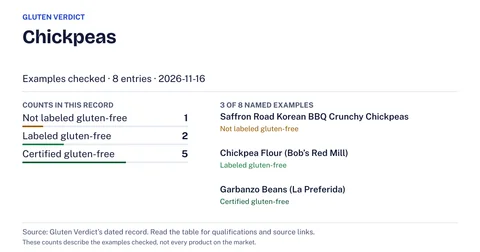 ChickpeasNaturally gluten-freechecked Nov 16, 2026
Questions people ask
Are all flours gluten-free?
No. Wheat flour is the regulation’s own example of an ingredient derived from a gluten-containing grain15, and the regulation names spelt wheat as a gluten-containing grain3; Bob’s Red Mill’s spelt flour page says spelt is not gluten free10.
Is a certified gluten-free flour the same as one labeled gluten-free?
They are two promises. A labeled product should comply with FDA’s under 20 ppm but that is not third-party verified, and GFCO’s standard is 10 ppm of gluten or less5.
Does a gluten-free flour blend need xanthan gum added?
It depends on the blend. The Gluten Intolerance Group says “flours” often do not contain a binder while “baking mixes” do, so read the ingredients67. If a blend has none, it says you will need to add one when baking68.
Is rice flour gluten-free?
NIDDK includes rice among the gluten-free foods that flour can be made from1. Whether a given bag meets the claim or mark is a separate check, described above.
More in Grains, flours and substitutes
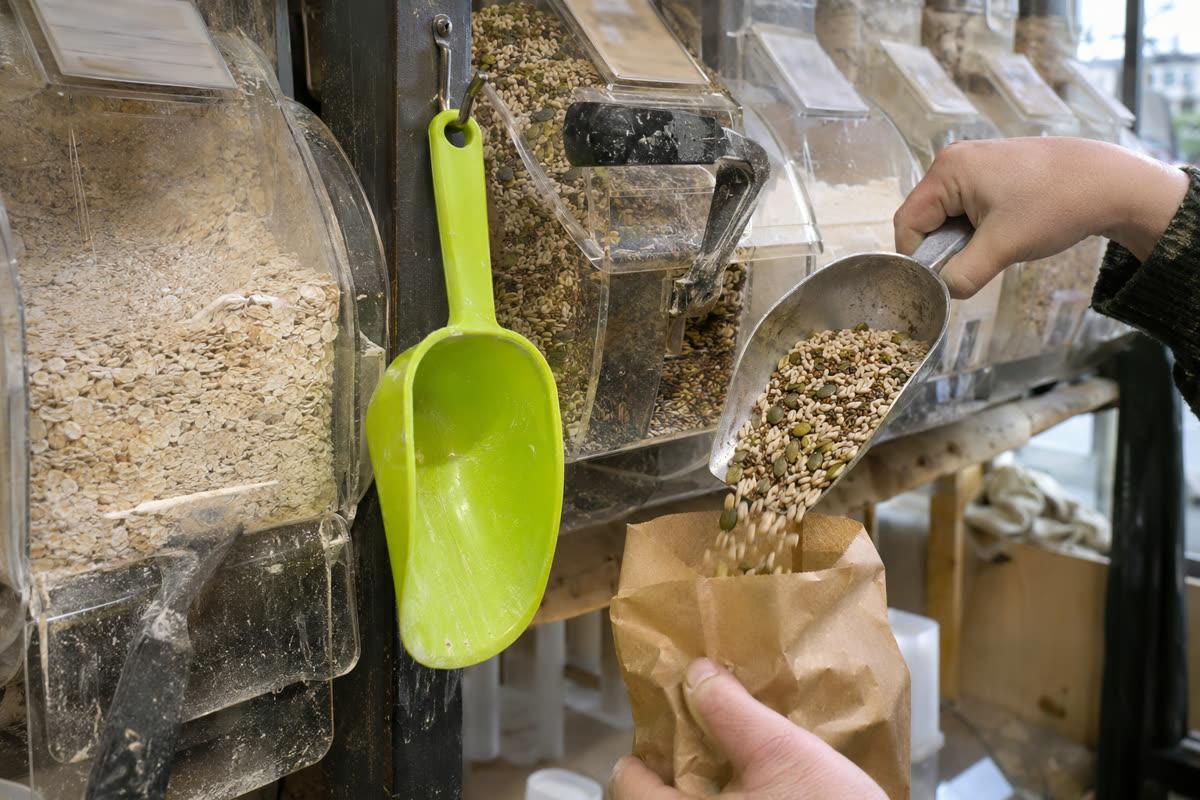 Millet, sorghum, quinoa, buckwheat, teff, amaranth and wild rice: what the bag has to sayWhich grains and seeds are gluten-free plants, what makers and certifiers say about seven of them, and the cross-contact checks for bags, bins and blends.
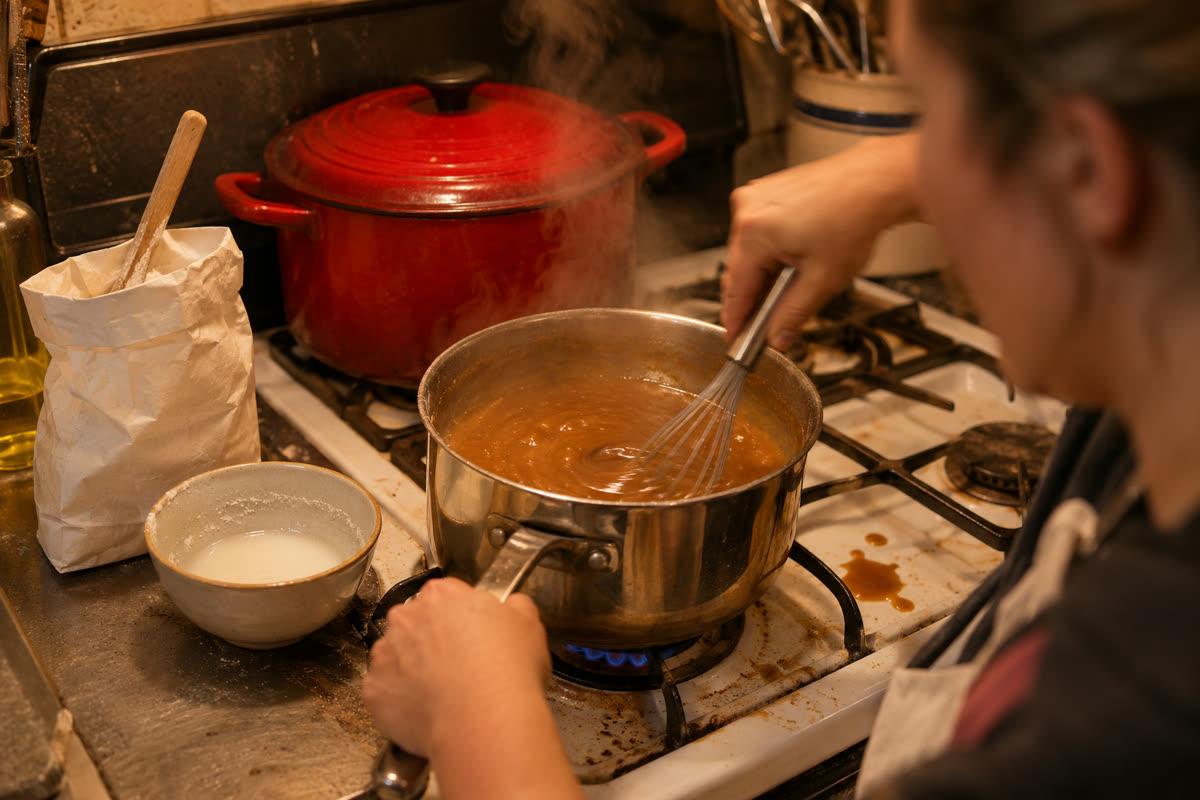 Gluten-free thickeners: cornstarch, tapioca, arrowroot, potato starch and rice flourPick a gluten-free thickener for gravy, soup or pie filling, follow the maker's directions, choose slurry or roux, and spot wheat thickeners.
 Gluten-free substitutes: the swap for each wheat ingredient and the label check it needsA lookup table of gluten-free swaps for wheat flour, pasta, bread, soy sauce, beer and more, with the one label check each swap needs.
 Gluten-free breadcrumbs, panko and coatings: what to read on the packHow to read a crumb, panko or batter mix for wheat, which gluten-free crumbs makers state, and what their pages say about baking and frying.
 Spelt, farro, Kamut, bulgur, couscous and freekeh: wheat under other namesWhich shop and menu names are wheat: spelt, farro, Kamut, einkorn, bulgur, couscous, freekeh and more, and what FDA’s rules say about them.
 Gluten-free pasta and noodles: what to read on the boxHow to read a pasta or noodle box: the gluten-free claim, the ingredient list, same-brand wheat twins, and why soba and udon need a close read.
Related guides
 Gluten-free flours for baking: what rice, sorghum, tapioca, almond and coconut flour each doWhat makers say rice, sorghum, millet, tapioca, potato starch, almond and coconut flour do in a bake, and which bags say gluten-free on the label.
 1-to-1, all-purpose and bread flour blends: what each maker’s page says the bag is forWhat King Arthur and Bob’s Red Mill say their 1-to-1, all-purpose, bread and pizza gluten-free flours are for, and which bakes each sends elsewhere.
 Gluten-free binders: what makers say about xanthan, guar, psyllium and flaxWhich gluten-free flours already list xanthan gum, what makers say about adding more, and how xanthan, guar, psyllium and flax are each described.
 Deli, bakery and bulk-bin counters on a gluten-free dietFor each store counter (deli, bakery, bulk bins, bars): skip it, ask first, or buy the packaged item, and what a store’s own statement tells you.
Sources
- [1, 2] National Institute of Diabetes and Digestive and Kidney Diseases (NIDDK), Eating, Diet, & Nutrition for Celiac Disease, checked Nov 17, 2026.
- [3, 4, 15, 71, 72] Electronic Code of Federal Regulations, 21 CFR 101.91 Gluten-free labeling of food, checked Nov 17, 2026.
- [5, 40, 41, 42, 43, 44, 45, 46, 47, 51, 52, 53, 54, 69] Gluten Intolerance Group, 35+ Alternative Gluten-Free Grains and Flour Substitutes, checked Nov 17, 2026.
- [6, 18] Gluten Intolerance Group (GFCO), GFCO Product Finder, checked Nov 17, 2026.
- [7, 73, 74, 75] PubMed (Thompson T, Lee AR, Grace T), Gluten contamination of grains, seeds, and flours in the United States: a pilot study (J Am Diet Assoc 2010), checked Nov 17, 2026.
- [8, 19] Bob's Red Mill, White Rice Flour, checked Nov 17, 2026.
- [9, 25] Bob's Red Mill, Organic Buckwheat Flour, checked Nov 17, 2026.
Read on 2026-11-17: the product description, the use line and the ingredient list (“Organic Whole Grain Buckwheat.”) on this page do not contain the word gluten; the page has no gluten-free statement, testing line or facility line.
- [10] Bob's Red Mill, Organic Spelt Flour, checked Nov 17, 2026.
- [11, 13, 14, 78] US Food and Drug Administration, Questions and Answers on the Gluten-Free Food Labeling Final Rule, checked Nov 17, 2026.
- [12, 29] Bob's Red Mill, Cornstarch, checked Nov 17, 2026.
- [16, 17] Gluten Intolerance Group (GFCO), How GFCO certifies gluten-free food, checked Nov 17, 2026.
- [20] Bob's Red Mill, Brown Rice Flour, checked Nov 17, 2026.
- [21, 22] Bob's Red Mill, Sorghum Flour, checked Nov 17, 2026.
- [23, 24] Bob's Red Mill, Millet Flour, checked Nov 17, 2026.
- [26, 27, 28] Bob's Red Mill, Gluten Free Corn Flour, checked Nov 17, 2026.
- [30, 31] Bob's Red Mill, Tapioca Flour, checked Nov 17, 2026.
- [32, 33] Bob's Red Mill, Potato Starch, checked Nov 17, 2026.
- [34, 35] Bob's Red Mill, Chickpea Flour, checked Nov 17, 2026.
- [36, 37] Bob's Red Mill, Almond Flour, checked Nov 17, 2026.
- [38, 39] Bob's Red Mill, Organic Coconut Flour, checked Nov 17, 2026.
- [48, 49, 50, 55, 67, 68] Gluten Intolerance Group, Gluten-Free Flours & Thickening Agents, checked Nov 17, 2026.
- [56, 57, 79] Bob's Red Mill, Gluten Free 1-to-1 Baking Flour, checked Nov 17, 2026.
- [58, 59] Bob's Red Mill, Gluten Free (product line and facility statement), checked Nov 17, 2026.
- [60, 61, 62, 63] King Arthur Baking Company, Gluten-Free Measure for Measure Flour, packaging PDF, checked Nov 17, 2026.
- [64, 65] Krusteaz, Gluten Free All Purpose Flour, checked Nov 17, 2026.
- [66] Krusteaz, Gluten Free Flour for Everyday Baking, checked Nov 17, 2026.
- [70] Whole Foods Market, Our Beginner’s Guide to Gluten-Free Eating, checked Nov 17, 2026.
Read on 2026-11-17: under the heading “What to Avoid”, the list item “Wheat-based ingredients” names wheat bran, wheat flour, bulgur, durum, graham, kamut, spelt and semolina.
- [76, 77] Gluten Intolerance Group, How to wash beans and grains, checked Nov 17, 2026.
Read on 2026-11-17: the sections of this page are headed “Dry Beans.”, “Rice and Sorghum.” and “Millet, Teff and Amaranth.”; it describes washing and visually sorting whole beans and grains and names no flour.