Why gluten-free packaged food costs more, and what the price surveys show
Short answer
Price surveys in several countries found gluten-free versions of staples such as bread and pasta dearer than the wheat versions, but they measure prices, not causes1, 2, 3, 17, 24. The reasons below come from the surveys’ authors, FDA’s rule and one certifier’s published requirements:
- Dough and raw materials: Swiss authors say gluten-free dough is harder to work with and needs special certified raw materials, but no source we read puts a figure on that share4, 5, 6.
- Keeping gluten out: FDA’s rule sets a limit of less than 20 parts per million and does not require testing or certification; it lists them among tools a maker may choose7, 8, 9.
- Volume and competition: the authors of the latest US survey suggest mass-market production may have helped reduce the gap, and UK authors suggest demand, manufacturing efficiency and competition10, 11.
- What shoppers will pay: Swiss authors reason that buyers with a diagnosed disorder have no alternative, and an Italian survey found premiums for small packs and gluten-free specialist brands12, 13.
- The part a shopper can avoid: GIG calls specialty processed foods like breads, crackers and cereals the most expensive part of the diet and says naturally gluten-free whole foods are less expensive14, 15.
Part of Cost, taxes and food assistance, 14 guides
Key points
- In the latest US survey we found, gluten-free bread cost 229% more and pasta 227% more than wheat versions, per ounce1, 16; an earlier survey found bread and pasta about twice as expensive2.
- A percentage is a gap between unit prices and an average hides a wide range: in Canada’s survey it ran from 5% to 1,000% across products17, and Coeliac UK found a whole gluten-free weekly shop up to 20% dearer18.
- FDA does not require testing or certification, and its own 2013 estimate of the rule’s compliance cost was about $7 million a year8, 9, 19.
- The US gap fell from 240% to 183% between 2006 and 2016 after adjusting for inflation20.
- The surveys compare a gluten-free version with a wheat version; GIG says whole foods that are naturally gluten-free are less expensive15.
What the price surveys measured
Each survey below compared the prices of gluten-free foods with gluten-containing equivalents and reported the gap. They differ in country, year, stores and unit, so their percentages are not directly comparable.
| Survey | What it compared | What it found |
|---|---|---|
| United States, Lee and colleagues (2007 paper) | A market basket of named products, wheat-based and gluten-free21 | Every gluten-free product was dearer; bread and pasta were twice as expensive2 |
| United States, Lee and colleagues (2019 paper) | Price per ounce of a market basket of regular and gluten-free products across four venues and five regions16 | 183% more overall; crackers 270%, bread 229%, pasta 227%1 |
| Canada, Stevens and Rashid (2008) | Products labelled gluten-free against comparable gluten-containing items in two large-chain grocery stores22 | All 56 gluten-free products were dearer; 242% more on average, range 5% to 1,000%17 |
| Austria, Missbach and colleagues (2015) | 63 gluten-free foods and 126 gluten-containing counterparts from 12 supermarkets23 | +205% (cereals) to +267% (bread and bakery products)24 |
| Greece, Bathrellou and colleagues (2025) | A gluten-free shopping basket against gluten-containing counterparts, one store from each of the five most popular chains25 | Overall median price per 100 g not significantly different; staples dearer, non-staples slightly lower3 |
| Switzerland, Soler and Borzykowski (2025) | Gluten-free and gluten-containing products on the Swiss retail market, priced with a hedonic method26 | 79% more expensive on average27 |
| United Kingdom (London), McInnes and colleagues (2026) | 20 foods, ten wheat-based and ten everyday, in 30 stores, repeating a 2010 survey28 | Gluten-free dearer; the ratio declined over the 11 years29 |
How to read the numbers
Units differ. The 2019 US survey analysed price per ounce16; the Canadian survey used price in dollars per 100 grams22. When you compare at the shelf, compare unit prices the same way, not the price on the tag.
Averages hide spread. In the Canadian survey the gap ran from 5% to 1,000% across products17, and the Greek survey found no significant overall difference in median price per 100 g even though staple gluten-free products were dearer3.
A product is not a basket. Coeliac UK’s own study found the cheapest gluten-free loaf cost 7.2 times the cheapest gluten-containing loaf weight for weight, and a gluten-free weekly shop up to 20% more than a standard shop18. Those figures describe different things, one loaf against a whole shop.
Dates matter. The latest US survey we found reports prices from 2016, when the authors say the gap had fallen from 240% in 2006 to 183%, adjusted for inflation20.
What a gluten-free claim requires, and what it does not
Under FDA’s rule a food labeled gluten-free must contain less than 20 parts per million (ppm) of gluten7. The regulation says any unavoidable gluten in such a food is below 20 ppm30. The claim itself is voluntary31.
The rule does not make a maker test. FDA says the regulation does not require testing of starting ingredients or finished foods8. It lists four quality-control tools a maker may choose: in-house testing, a third-party laboratory, certificates of gluten analysis from ingredient suppliers, and a third-party certification program9. The rule leaves testing and certification to the maker’s choice.
When FDA wrote the rule in 2013 it estimated that full compliance would cost about $7 million per year19, made up of $1,000,000 for relabeling and $5,800,000 for testing of foods32, and, in its small-entity analysis, called the additional cost per entity small but not negligible33. That is FDA’s 2013 estimate of the rule’s compliance cost. It does not say what a loaf costs to make, and it says nothing about ingredient prices, volume or retail margin.
Ingredients and dough: what the researchers say
FDA describes gluten as the substance that gives breads and other grain products their shape, strength, and texture34. GIG’s article on processed gluten-free foods says they often use additives such as preservatives and emulsifiers, and that without them gluten-free bread would often fall apart, taste bland and spoil quickly35.
The authors of the price studies tie the premium to production, as a reasoned expectation rather than a measurement. Soler and Borzykowski write that the higher price might be due to several factors, among them dough that is harder to work with and costly measures to prevent cross-contact4. They write that a mark-up will probably remain because gluten-free food requires special certified raw materials and the doughs are more difficult to work with5.
The Greek study’s authors attribute the higher cost mainly to food production procedures, from infrastructure and raw materials to distribution and demand, citing an earlier review36. Missbach and colleagues write that marketers tap into perceived healthfulness, which shows in the higher price besides the increased production cost37.
The Swiss paper that discusses these reasons most fully gives no split of its premium among them6. We did not find a source that splits a US loaf’s price into ingredients, handling, testing and margin.
Testing, separate handling and certification
Cross-contact is the reason makers take extra steps. FDA notes that facilities using shared equipment to make foods with and without gluten could cause gluten cross-contact38. Soler and Borzykowski add that avoiding it is costly, particularly if an accident forces a recall5.
Certification is one optional route. GFCO is the Gluten Intolerance Group’s product certification program39; it is one program, and FDA does not endorse, accredit, or recommend any particular third-party program40. GFCO’s own page lists what a certified maker takes on: all grains rated high-risk and high-risk ingredients tested per lot before use41; ongoing regular testing of ingredients, shared equipment and finished products for established brands42; and annual in-person audits at every manufacturing facility43.
GFCO publishes its fees. They are set by company size and by product and ingredient risk44. For a micro enterprise with one to five plants the annual fee runs from $1,820 at low risk to $3,630 at high risk, and the schedule lists a Standard Audit Fee of $1,50045. The micro-enterprise tier is priced per company with unlimited products, so the share that lands on one package depends on how much the maker sells. No source we read gives that share.
Volume, competition and shelf space
The authors of the 2019 US survey write that mass-market production may have influenced the increase in availability and the overall reduction of cost10. In its comparison of mass-market products, the gluten-free versions were still 139% more expensive than their wheat-based counterparts, though the authors report that this difference did not meet statistical significance46.
In London the cost difference for wheat-based gluten-free products went from 76%–518% to 19%–182% over 11 years47. The authors say the narrowing for bread and pasta may be attributed to greater consumer demand, improved manufacturing efficiency, expanded retail availability and increased market competition11, and that these products may benefit from economies of scale48.
Price also varies inside the gluten-free aisle. An Italian survey found gluten-free pasta priced at more than twice conventional pasta, with a premium for small packages and for brands specialized in gluten-free products13. Soler and Borzykowski reason that buyers with a diagnosed disorder have high willingness to pay because they have no alternative12; that is the authors’ reasoning, not a measured margin.
Where a product is sold matters as well. In the US survey the market basket was most available in health food and upscale stores, at 66% each49, and UK authors say the very limited availability in local shops may have decreased further because of cost constraints, reduced consumer demand and limited shelf space50.
Why naturally gluten-free foods are different
The surveys above compare a gluten-free version with a wheat version. A food that is gluten-free by nature has no wheat version to be compared with, and FDA lists fruits, vegetables and eggs among them51. GIG says whole foods that are naturally gluten-free, including beans, rice and eggs, are less expensive15.
Cheaper does not mean the label can be skipped. FDA says crop rotation and shared harvesting, transport and storage equipment often bring gluten-containing grains into contact with other grains, legumes and seeds that are naturally free of gluten52, and a grain such as rice can be labeled gluten-free if any unavoidable gluten is less than 20 ppm53. Our rice page shows which rice products we checked carry a claim.
Which part of the gap a shopper can avoid
- Part of the substitute premium. GIG calls specialty processed foods like breads, crackers and cereals the most expensive part of a gluten-free diet14 and recommends whole foods that are naturally gluten-free, which it says are less expensive15.
- Some of the venue difference. In the US survey the gluten-free basket averaged $0.45 per ounce at the traditional grocery store, $0.56 at upscale and health food stores and $0.59 online54; the earlier survey found cost was affected more by shopping venue than geographic location55, and in that 2006 survey the upscale market, not the traditional grocery store, was the cheapest venue59. Those are one survey’s averages, so check your own stores’ unit prices.
- Some grains and flours. GIG says gluten-free oats, buckwheat, millet, teff, sorghum and almond or chickpea flours are often cheaper in the bulk section56. It also cautions that products in international markets are less likely to be labeled or certified gluten-free57.
What a shopper cannot avoid is the rule itself. Any food that bears the claim has to meet the same requirement, whatever it costs7.
For a step-by-step way to sort a shopping list, see Gluten-free on a budget. For what the IRS says about deducting the extra cost, see our IRS guide.
What our own pages show
Our verdict pages do not carry prices. What they add is which products carry a gluten-free claim at all, as the maker’s page said when we read it. This table counts the products on eight food pages as of 2026-11-17, with “labeled or certified” meaning the maker’s page or a certifier says gluten-free.
| Food page | Products checked | Labeled or certified gluten-free |
|---|---|---|
| Bread | 6 | 3 |
| Pasta | 7 | 4 |
| Flour | 6 | 3 |
| Crackers | 8 | 4 |
| Cereal | 12 | 7 |
| Granola bars | 6 | 3 |
| Cookies | 6 | 3 |
| Rice | 8 | 4 |
| All eight pages | 59 | 31 |
A wheat version and a gluten-free version of the same food are separate products on these pages. For the packaged foods we have checked, start at every verdict, A to Z. Recipes change, so the package in your hand has the final word.
Verdicts in this guide
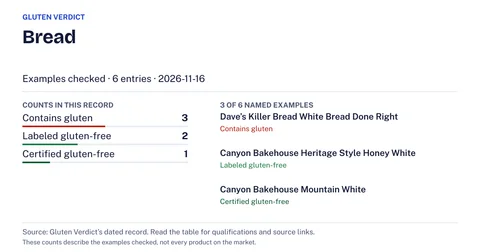 BreadContains glutenchecked Nov 16, 2026
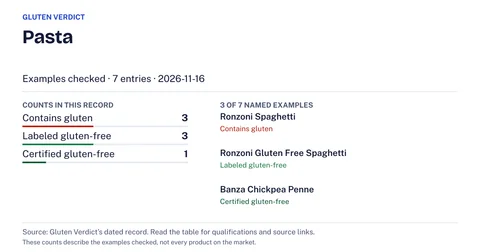 PastaContains glutenchecked Nov 16, 2026
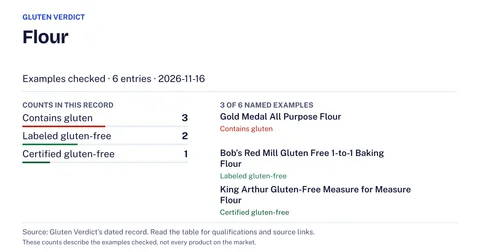 FlourContains glutenchecked Nov 16, 2026
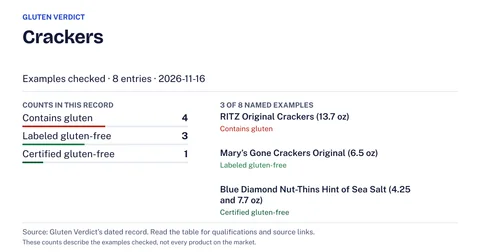 CrackersDepends on the product4 of 8 products we checked contain glutenchecked Nov 16, 2026
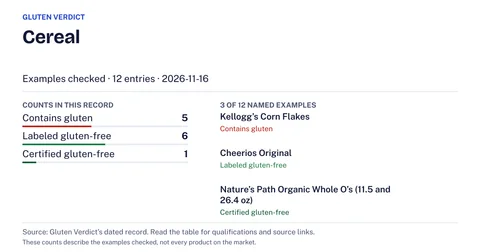 CerealDepends on the product5 of 12 products we checked contain glutenchecked Nov 16, 2026
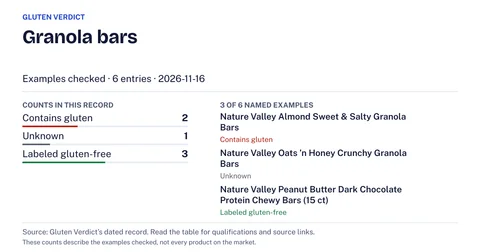 Granola barsDepends on the product2 of 6 products we checked contain gluten: Nature Valley Almond Sweet & Salty Granola Bars and Nature Valley Cinnamon Brown Sugar Soft-baked Oatmeal Squareschecked Nov 16, 2026
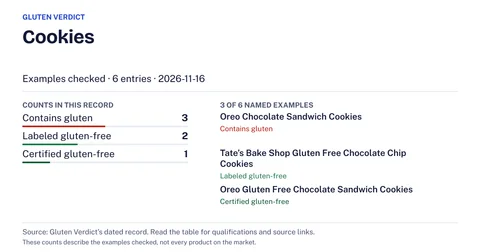 CookiesContains glutenchecked Nov 16, 2026
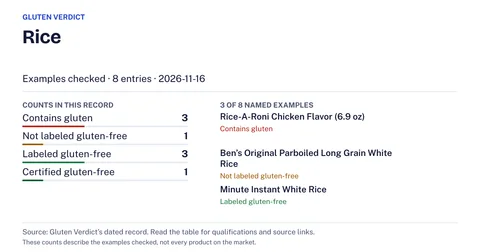 RiceNaturally gluten-free3 of 8 products we checked contain gluten: Rice-A-Roni Chicken Flavor (6.9 oz), Near East Original Rice Pilaf, and Ben’s Original Ready Rice Rice PilafBuy it labeled gluten-freechecked Nov 16, 2026
Questions people ask
Why is gluten-free bread so expensive?
In the latest US survey we found, gluten-free bread cost 229% more than wheat bread per ounce1. Coeliac UK found the cheapest gluten-free loaf cost 7.2 times the cheapest gluten-containing loaf, weight for weight18. Researchers point to dough that is harder to work with and costly cross-contact measures4, but we found no source that splits the price.
Is gluten-free always more expensive than the wheat version?
Not in every category. The US survey found all ten categories dearer58, but the Greek survey found staple gluten-free products dearer and non-staple ones slightly cheaper3.
More in Cost, taxes and food assistance
 Gluten-free on a budget: what costs extra and what does notSort a gluten-free shopping list into plain foods, foods that need a statement and packaged substitutes, then compare costs and check each claim.
 A price-per-ounce worksheet for comparing gluten-free staples at any store, club or onlineA worksheet for comparing gluten-free staples by price per ounce across stores, clubs and online, with a column for the gluten-free statement.
 SNAP and gluten-free food: what the benefit covers and how to shop itWhich gluten-free foods SNAP covers, what it excludes, and how to build a list from naturally gluten-free staples plus a few labeled items.
 Paying for gluten-free food and dietitian visits with an HSA or FSAWhat IRS rules say about paying for special food, dietitian visits and test kits from an HSA or FSA, what a physician's letter covers and what to keep.
 Is gluten-free food tax deductible? What the IRS says and what to keepWhat IRS Publication 502 says about special food as a medical expense, how the excess-cost sum works, and what records to bring to a tax professional.
 Gluten-free food on prescription in the UK: how to check your areaWhat gluten-free staples the NHS prescribes in England, Scotland, Wales and Northern Ireland, how amounts are set, what you pay, and where to check.
Related guides
 The FDA gluten-free rule: what 21 CFR 101.91 requires and what 20 ppm measuresWhat FDA’s gluten-free rule requires, which claim words it covers, what 20 ppm means for a portion of food, and how FDA checks that a claim holds.
 Gluten-free certification programs compared: limit, testing and auditsHow GFCO, GFFP, NSF and the BRCGS-based marks differ on gluten limit, testing and audits, set against FDA’s 20 ppm rule for every claim.
 Is a gluten-free diet healthy if you do not have celiac disease?What a gluten-free label promises, what studies of gluten-free products and eaters report, and why testing comes before cutting gluten.
 Gluten-free at Price Chopper and Market 32: the blue shelf tag, the ppm figure and the bakery and deliHow to use Price Chopper and Market 32’s gluten-free tag and pages, hold a pack to FDA’s 20 ppm rule, and what the bakery and deli pages leave unsaid.
Sources
- [1, 10, 16, 20, 46, 49, 54, 58, 59] Nutrients (MDPI), Persistent Economic Burden of the Gluten Free Diet (Lee et al., 2019), checked Nov 17, 2026.
- [2, 21, 55] Journal of Human Nutrition and Dietetics (via PubMed), Economic burden of a gluten-free diet (Lee et al., 2007), checked Nov 17, 2026.
- [3, 25, 36] Nutrition Bulletin, Higher cost of gluten-free products compared to gluten-containing equivalents is mainly attributed to staple foods (Bathrellou et al., 2025), checked Nov 17, 2026.
- [4, 5, 6, 12, 26, 27] Health Economics Review, The cost of being gluten-free: a hedonic pricing analysis of food products for celiac patients (Soler and Borzykowski, 2025), checked Nov 17, 2026.
Read on 2026-11-17: the Introduction and Discussion name production (dough, cross-contact measures), demand, and economies of scale and scope as reasons for the gluten-free premium, and the Results give the premium by product category; no sentence or table gives a figure for how much of the premium any one of those reasons accounts for.
- [7, 31, 34, 40, 51] US Food and Drug Administration, Gluten and Food Labeling, checked Nov 17, 2026.
- [8, 9, 38, 52, 53] US Food and Drug Administration, Questions and Answers on the Gluten-Free Food Labeling Final Rule, checked Nov 17, 2026.
Read on 2026-11-17: after the sentence “Manufacturers may choose to use effective quality control tools to ensure that any foods they label “gluten-free” do not contain 20 ppm or more gluten, such as:” the page lists four tools: conducting in-house gluten testing of starting ingredients or finished foods; employing a third-party laboratory to conduct in-house gluten testing; requesting certificates of gluten analysis from ingredient suppliers; and participating in a third-party “gluten-free” certification program.
- [11, 28, 29, 47, 48, 50] Journal of Human Nutrition and Dietetics, Limited availability and higher cost of gluten-free foods continue in the United Kingdom (McInnes et al., 2026), checked Nov 17, 2026.
- [13] Nutrients (MDPI), Gluten-Free Products: From Dietary Necessity to Premium Price Extraction Tool (Gorgitano and Sodano, 2019), checked Nov 17, 2026.
- [14, 15, 57] Gluten Intolerance Group, 5 Ways to Cut Costs on a Gluten-Free Diet, checked Nov 17, 2026.
- [17, 22] Canadian Journal of Dietetic Practice and Research (via PubMed), Gluten-free and regular foods: a cost comparison (Stevens and Rashid, 2008), checked Nov 17, 2026.
- [18] Coeliac UK, Campaigning for more affordable and more accessible gluten free food, checked Nov 17, 2026.
- [19, 32, 33] US Food and Drug Administration, Food Labeling; Gluten-Free Labeling of Foods, final rule (78 FR 47154, August 5, 2013), checked Nov 17, 2026.
Read on 2026-11-17: the table headed “Annual Benefit and Cost Overview” in the rule’s summary lists two costs: Relabeling of Foods, $1,000,000, and Testing of Foods, $5,800,000.
- [23, 24, 37] PeerJ, Gluten-free food database: the nutritional quality and cost of packaged gluten-free foods (Missbach et al., 2015), checked Nov 17, 2026.
- [30] US Food and Drug Administration, 21 CFR 101.91, Gluten-free labeling of food (eCFR text as of 2026-11-10), checked Nov 17, 2026.
- [35, 56] Gluten Intolerance Group, Gluten-Free, But at What Cost? The Hidden Risks for Those with Gluten Intolerance or Celiac Disease, checked Nov 17, 2026.
- [39, 41, 42, 43] Gluten Intolerance Group (GFCO), How Does GFCO Certify Gluten-Free Food?, checked Nov 17, 2026.
- [44, 45] Gluten Intolerance Group (GFCO), GFCO Fee Schedule (document 3006-P), checked Nov 17, 2026.
Read on 2026-11-17: the schedule (last amended 241111) lists annual fees in US dollars by company size, risk level and number of plants; for a micro enterprise (9 or fewer employees, unlimited products) with 1-5 plants the annual fees are $1,820 at low risk, $2,420 at medium risk and $3,630 at high risk. Its auditing-costs table lists a Standard Audit Fee of $1,500.