How to trace a reaction after a restaurant meal marked gluten-free
Short answer
Ask the restaurant how the dish was made, write down what you learn, and report it to the state or local agency that regulates restaurants. FDA says its gluten-free rule applies to packaged foods and that it shares complaints it receives about unpackaged foods, such as those served in restaurants, with state and local government partners1, 2.
Part of Symptoms, reactions and persistent complaints, 22 guides

Key points
- FDA’s gluten-free rule applies to packaged foods; for restaurant menus FDA recommends, rather than requires, that a gluten-free claim match its definition3.
- Gluten Intolerance Group’s restaurant tips point to shared frying oil, a surface that cooked breaded food earlier, soup bases that may be made with roux, and croutons or dressings containing gluten as places to check4, 5, 6, 7.
- One analysis of crowd-sourced device results found gluten detected in 32% of foods labeled gluten-free; its authors add a caveat about what the device detects8, 9.
- FDA tells people who think a food made them ill to contact a healthcare provider and to keep any food packages10.
- FDA’s page sends a complaint about a restaurant to the state and local regulatory agencies, and meat and poultry problems to USDA2, 11.
What a gluten-free menu label does and does not promise
On a packaged food, “gluten-free” is a voluntary claim that manufacturers can use provided the food meets all of FDA’s requirements for a gluten-free food12. A restaurant menu is a different case. FDA says its regulation applies to packaged foods, which may be sold in some food-service establishments such as some carry-out restaurants, and that for menus it recommends that a restaurant making a gluten-free claim be consistent with FDA’s definition3.
That puts the weight on what the kitchen actually does. Gluten Intolerance Group (GIG) notes that some restaurants offering gluten-free menu options may not have the necessary procedures set up to reliably produce gluten-free items13. A review in the journal Nutrients states that meals from food services such as restaurants, workplaces and schools remain a significant risk for inadvertent gluten exposure14.
One analysis in the American Journal of Gastroenterology used results shared by people who own a portable gluten detection device: 5,624 tests across the United States over 18 months15, 16. Gluten was detected in 32% of the foods labeled gluten-free, and in 53.2% of the gluten-free-labeled pizza and 50.8% of the gluten-free-labeled pasta samples8, 17. Its authors caution that the device may detect gluten below 20 parts per million, an exposure of unknown clinical significance9.
The usual paths: where gluten can join a dish
Start from what you ordered and look for the step where gluten could have joined it. The table pairs each path with what GIG or a chain says about it and a question the kitchen can answer.
| Path | What the source says | A question for the kitchen |
|---|---|---|
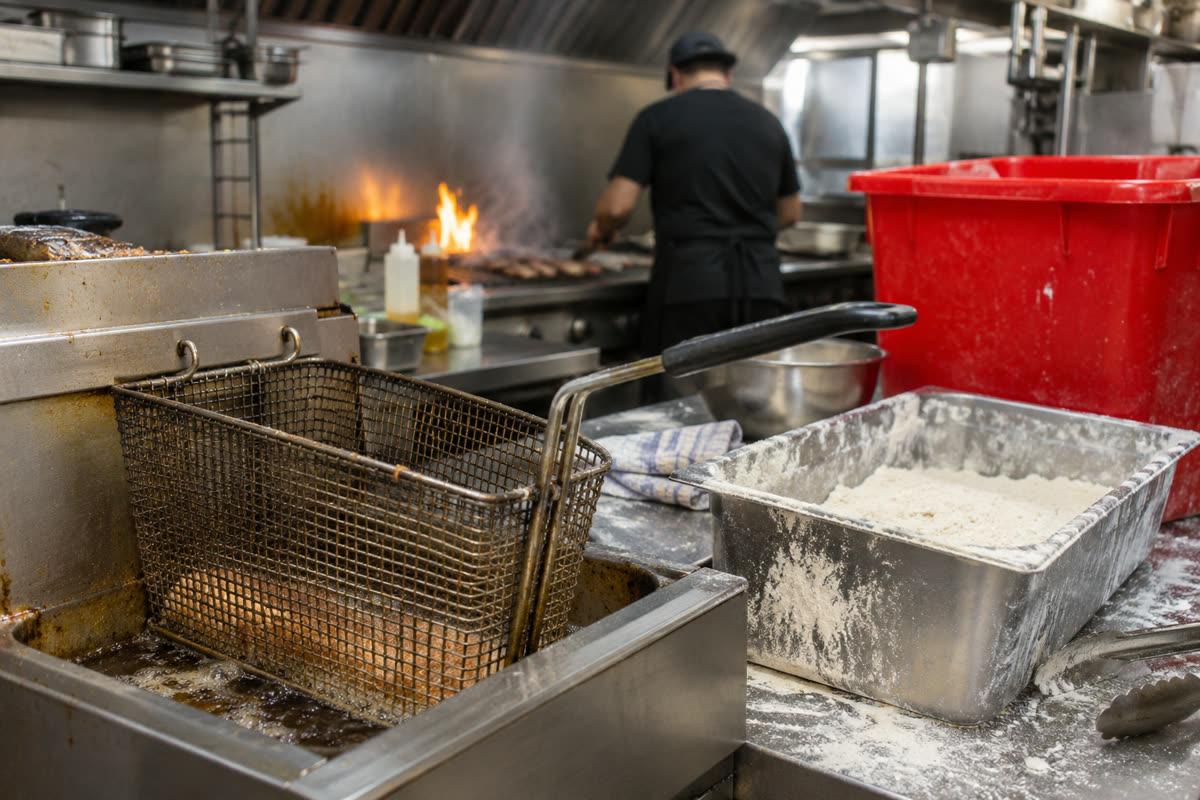
| Shared fryer | GIG: the oil used to deep-fry foods may be used for both breaded and non-breaded items4 | “Is there a dedicated fryer for gluten-free foods?”18 |
| Shared grill, pan or surface | GIG advises finding out whether breaded or gluten-containing foods have been cooked on the same surface beforehand5 | “Is the grill used to cook gluten-free foods separate or shared with gluten foods? If shared, how is it cleaned and how often?”19 “Can my meal be cooked in a separate pan from gluten foods?”20 |
| Soup bases and thickened sauces | GIG: soup bases may be used as a foundation for soups and could be made with roux, a combination of butter and flour6 | “Does this contain flour or roux?”21 |
| Sauces and marinades | GIG: Worcestershire-type sauces and soy sauce could contain gluten22 | “If made in-house, do they know if they contain gluten?”22 |
| Salad | GIG: cross-contact can happen on cutting boards used to chop ingredients, and through croutons or salad dressings containing gluten7 | Which dressing went on it, and what was it built on? |
| Order mix-up | GIG advises double-checking with the server that what you were served is the meal you ordered and that your instructions were followed23 | What did the order ticket say, and who plated the dish? |
| An ingredient before it reached the kitchen | Chipotle’s allergens page says items containing corn may have trace amounts of gluten from potentially co-mingling with gluten-containing grains in the field24 | What is in each part of the dish, according to the allergen guide? |
Which path applies is something only the restaurant can tell you, so the next step is to ask. Where gluten hides in restaurant kitchens goes deeper on the kitchen side.
What to ask the restaurant, and when
GIG advises calling or visiting when the restaurant may be less busy25, and asking how gluten-free items are prepared and what procedures are in place to avoid cross-contact between foods that contain gluten and those intended to be gluten-free26. After a reaction, aim the same questions at the dish you ate: go down the last column of the table above and ask each one that applies to what was on your plate. GIG also lists asking to see a gluten-free menu or allergen list27.
Write the answers down as they are given, with the name of the person and the time. A manager may not know every detail, and an answer such as “I’ll find out” is also worth recording.
What a chain’s own allergen guide says
If the restaurant is a chain, its published allergen guide shows what the company itself says about its kitchens. Three examples, each from an allergen guide or page the company publishes:
- Buffalo Wild Wings: its guide says “We do not use separate fryers”, with the potential for allergen and gluten cross-contact between fried foods28. It also says it cannot eliminate the risk of cross-contact and that no items are certified gluten-free29.
- The Cheesecake Factory: its guide says that while it uses reasonable efforts in sourcing, preparation and handling, it is unable to guarantee that any menu item will be free of any allergen30.
- Chipotle: its allergens page tells guests who are highly sensitive to gluten that they can ask the staff to change gloves, at the start of the order31.
Our verdicts for Five Guys, Wendy’s, Panera, Chili’s and TGI Fridays link to the pages we read for each, with the date. Compare what you were told at the counter with what the company’s guide says: a difference is worth including in a report. How to read a restaurant allergen guide explains the charts, and fast-food fryer and prep policies covers fryers.
What to write down and keep
FDA lists what a report should include: who is reporting and who was affected; the name and address of the place where the product was purchased; the date, all symptoms, how long after eating or drinking they began, medications used to treat them and whether further medical care was needed; and a description of the product32. The same list also asks for codes and label photos, which suit a packaged product, but its first items fit a restaurant meal32. FDA also says to keep any food packages, because they may contain important information10.
- The restaurant’s name, address, the date and time of the meal, and what you ordered, including any change you asked for.
- A photo of the menu line and the plate, and of the allergen guide page if one was shown.
- The answers from the kitchen, with names and times.
- Your symptoms and when they started, in your own words.
Who to tell: the restaurant, your local agency, FDA or USDA
| What it was | Who takes the report |
|---|---|
| A meal prepared and served at a restaurant | FDA’s page says to contact the state and local regulatory agencies that regulate restaurants2. FDA also says it will share complaints it receives about unpackaged food, such as restaurant food, with state and local government partners1. |
| A packaged food, including one sold at some carry-out restaurants | FDA’s gluten-free regulation applies to packaged foods3. For an FDA-regulated food product, FDA’s page lists the ways to report to FDA33. |
| A meat or poultry product | FDA’s page says all questions or problems related to meat and poultry go to USDA11. |
Telling the manager what happened, in the words you recorded, gives the restaurant the chance to check its own kitchen. For the agency, look for the state or local body that regulates restaurants where you ate, and send the same facts.
Whether to eat there again
That is your decision. GIG’s advice is to make an informed decision about your comfort level of dining in an establishment once you have the answers to your questions34. Specific answers, such as which fryer, which pan and what was in the sauce, give you something to check against on a later visit.
When to talk to a clinician
For an illness a person believes is associated with a particular food, FDA’s instruction, which it extends to people with food allergies and celiac disease, is to contact a healthcare provider immediately10. Our guide on eating out with celiac disease covers the dining side.
Verdicts in this guide
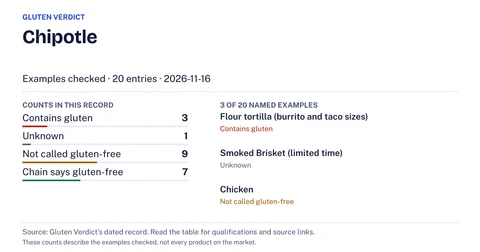 ChipotleDepends on the order3 of 20 menu items we checked contain gluten: Flour tortilla (burrito and taco sizes), Burrito, and QuesadillaChipotle Mexican Grill · checked Nov 16, 2026
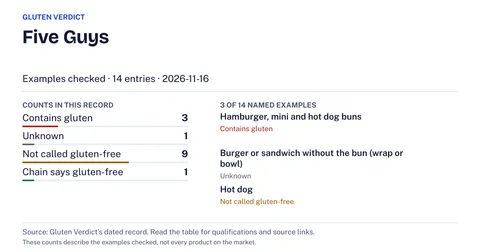 Five GuysDepends on the order3 of 14 menu items we checked contain gluten: Hamburger, mini and hot dog buns; Malt vinegar (fry condiment); and Oreo® Cookie Pieces shake mix-inFive Guys · checked Nov 16, 2026
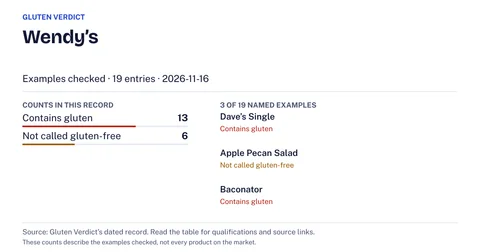 Wendy’sDepends on the order13 of 19 menu items we checked contain glutenWendy’s · checked Nov 16, 2026
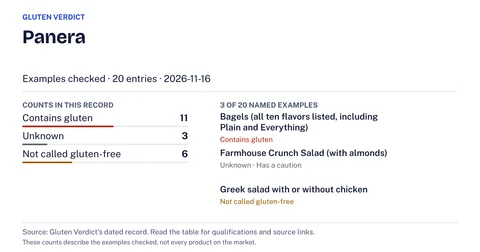 PaneraDepends on the order11 of 20 menu items we checked contain glutenPanera Bread · checked Nov 16, 2026
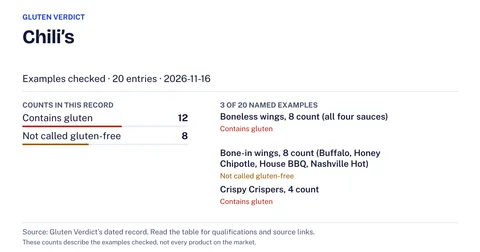 Chili’sDepends on the order12 of 20 menu items we checked contain glutenChili’s Grill & Bar · checked Nov 16, 2026
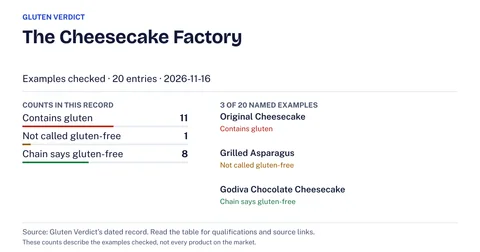 The Cheesecake FactoryDepends on the order11 of 20 menu items we checked contain glutenThe Cheesecake Factory · checked Nov 16, 2026
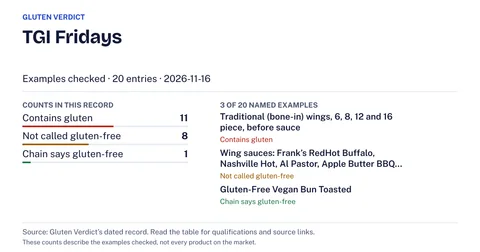 TGI FridaysDepends on the order11 of 20 menu items we checked contain glutenTGI Fridays · checked Nov 16, 2026
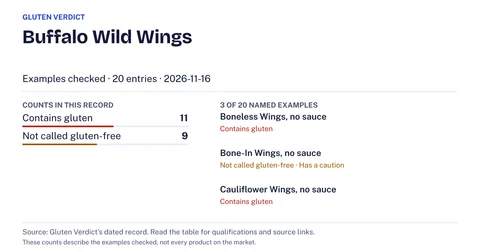 Buffalo Wild WingsDepends on the order11 of 20 menu items we checked contain glutenBuffalo Wild Wings · checked Nov 16, 2026
Questions people ask
Does FDA’s gluten-free rule apply to restaurants?
FDA says the regulation applies to packaged foods, and that for restaurant menus it recommends that a gluten-free claim be consistent with its definition3.
Can I report a restaurant meal to FDA?
Asked whether unpackaged foods labeled “gluten-free” can be reported, FDA says it will monitor reported information about unpackaged food and share complaints with state and local government partners1. For a complaint about a restaurant, its page points to the state and local regulatory agencies2.
Does a positive result from a home gluten test prove the restaurant made a mistake?
The authors of the crowd-sourced study note that the device may detect gluten at levels below 20 parts per million, with exposure of unknown clinical significance9. A positive result is one more thing to record, not a conclusion.
More in Symptoms, reactions and persistent complaints
 If you think you were glutened: what the celiac organizations say to doWhat the celiac charities, FDA and NIDDK say to do after accidental gluten exposure, when to contact a clinician, and how to trace the cause.
 Gluten reaction or food poisoning? What the sources say about telling them apartHow onset, duration, symptoms and warning signs compare for a gluten reaction and food poisoning, and the signs NIDDK and CDC list for seeing a doctor.
 Still having symptoms on a gluten-free diet? Where gluten can still get inA checklist of label, kitchen, restaurant, product and medicine sources of gluten, and what the sources say about when to see a doctor.
 Stomach pain after gluten-free bread: what the label can and cannot tell youWhy gluten-free bread can hurt: ingredients that cause gas, how gluten gets in, a one-change log to tell them apart, and when sources say see a doctor.
 How long after eating gluten do symptoms start, and how long do they last?Onset and duration after gluten as celiac charities and studies report them, and how sources time celiac disease, gluten sensitivity and wheat allergy.
 Constipation and celiac disease: when it is the main symptomWhat studies and guidelines report about constipation in celiac disease, why it is easy to miss, and how diet-related constipation differs.
All 22 guides in Symptoms, reactions and persistent complaints
Related guides
 Gluten cross-contact at home: where it happens and what to do about itHow gluten reaches gluten-free food at home, whether to separate, wash or ask for each route, and which rules have lab data behind them.
 Eating out with celiac disease: what to check, ask and watch forPlan a restaurant meal with celiac disease: what to check before you go, the questions to ask in order, how to read the answers, and what studies measured.
 A food and symptom diary for tracking possible gluten exposureWhat to write in a food and symptom diary on a gluten-free diet, how to read it, a template to copy, and what to bring to a dietitian or doctor.
 Where gluten hides in a restaurant kitchen, and the question to ask about each sourceFryers, sauces, roux, marinades, grills, pasta water and eggs: how gluten reaches restaurant food and the question GIG lists for each source.
Sources
- [1, 3, 10, 12, 32] US Food and Drug Administration, Questions and Answers on the Gluten-Free Food Labeling Final Rule, checked Nov 17, 2026.
Read on 2026-11-17: the list under “Reports submitted to FDA should include as much information as possible, such as:” names who is reporting and who was affected; the name and address of the place where the product was purchased; a description of the reaction (date, all symptoms, how long after eating or drinking it occurred, medications used to treat symptoms, and whether further medical care was needed); and a complete description of the product (date of purchase, codes or identifying marks on the label or container, and photos).
- [2, 11, 33] US Food and Drug Administration, Get Assistance from the FDA Human Foods Program (HFP), checked Nov 17, 2026.
- [4, 5, 6, 7, 23] Gluten Intolerance Group, Eating Out: 7 Tips For Staying Gluten-Free, checked Nov 17, 2026.
- [8, 9, 15, 16, 17] American Journal of Gastroenterology (via PubMed), Detection of Gluten in Gluten-Free Labeled Restaurant Food: Analysis of Crowd-Sourced Data, checked Nov 17, 2026.
- [13, 25, 26, 34] Gluten Intolerance Group, I went to a restaurant that had food marked “gluten-free” on the menu, but I felt “glutened” after my meal. How could this have happened?, checked Nov 17, 2026.
- [14] Nutrients (via PubMed), Food Safety and Cross-Contamination of Gluten-Free Products: A Narrative Review, checked Nov 17, 2026.
- [18, 19, 20, 21, 22, 27] Gluten Intolerance Group, What are some of the most important questions to ask the wait staff or management of a food service or restaurant?, checked Nov 17, 2026.
- [24, 31] Chipotle, Allergens, checked Nov 17, 2026.
- [28, 29] Buffalo Wild Wings, Allergen & Preparation Guide (PDF), checked Nov 17, 2026.
- [30] The Cheesecake Factory, Online Allergen Guide, checked Nov 17, 2026.