How to judge a city for celiac disease: three signals you can check
Short answer
Check three signals for the city, and treat each as a reason to make a call, not as a verdict on any kitchen:
- A hospital celiac program: the Celiac Disease Foundation’s map lists centers that attested in writing that they meet the criteria of the CRUE recognition program1.
- The state’s restaurant allergy law: the rules we read are written around major food allergens2, 23, and Massachusetts’s list of them names wheat but not barley or rye2.
- Restaurants validated by the Gluten Intolerance Group’s Gluten-Free Food Service (GFFS) program, which says it reviews policies, recipes, ingredients and training at each site3.
Part of Travel planning and logistics, 22 guides

Key points
- This guide does not score cities. A US restaurant sensor study we read sorted its tests into four Census regions, not cities4, and its authors say it was not systematic testing5.
- The federal gluten-free rule applies to packaged foods; for restaurants, FDA recommends that those making a gluten-free claim on a menu follow its definition6, 7.
- A restaurant allergy law can set training, poster or menu-notice duties18, 19, 20, and FARE’s page names a handful of states and two cities8. That is a reason to ask questions, not an answer.
- A restaurant missing from the GFFS database has not been shown to be worse: GIG describes the database as including several large chains and some smaller places9.
- Chains are the part of a city you can read before you arrive: each of the nine chain verdicts linked below is marked as varying by item.
Why this guide does not score cities
A city score would need the same measurement taken the same way in each city. The restaurant data we found do not give that.
A US study of gluten in restaurant food that we read analysed 5,624 sensor tests from 804 users and detected gluten in 32% of the foods labeled gluten-free10. It sorted the tests into the Census Bureau’s four regions, not cities4. Its authors write that it did not involve systematic testing and that the foods tested could have been chosen because of doubts about their gluten-free status5.
The one city-level study we found measures something else. In Winnipeg, Canada, researchers asked restaurant staff by telephone whether they served gluten-free items, charged extra and used methods to limit cross-contact11. Of the 548 restaurants surveyed, 69% reported offering gluten-free items12. That is what staff reported, in one Canadian city.
So the useful question is not which city ranks first. It is what you can open, for the city you are looking at, that tells you where to ask questions. Three things qualify.
Signal one: a hospital with a celiac program
Two lists name celiac centers. The Celiac Disease Foundation (CDF) maps centers recognized under CRUE, which the Society for the Study of Celiac Disease (SSCD) developed1. Recognition rests on unit policies, credentialing, staff training and competency assessment, and quality improvement activities, and the centers on the CDF map attested in writing that they meet the criteria1.
The SSCD’s own CRUE page lists the recognized units. On 2026-11-17 it named units in nine states: Colorado, Illinois, Massachusetts, Minnesota, New Jersey, New York, Ohio, Pennsylvania and Tennessee13.
Beyond Celiac keeps a longer list, which it calls non-exhaustive, of healthcare facilities in the United States that offer care specifically for people with celiac disease14. Its entries are grouped by state15.
What this signal shows, and what it does not
A listing shows that a team focused on celiac disease exists in the area. It does not rate restaurants: the CRUE criteria concern society membership, staff, yearly education and research or quality-improvement activity16. A city without a listing is not ruled out either, since Beyond Celiac’s list is non-exhaustive14.
Open the hospital’s own page rather than a summary of it, and read who the program treats. Some entries are children’s programs, such as a Phoenix clinic for children and teens17.
Signal two: the state’s restaurant allergy law
FDA says its gluten-free regulation applies to packaged foods, and that it will share complaints about unpackaged food such as restaurant food with state and local government partners6. For restaurants, FDA says it recommends that those making a gluten-free claim on their menus be consistent with its definition7.
State and city law adds a layer in some places. FARE, a food allergy charity, describes restaurant requirements under headings for California, Illinois, Massachusetts, Maryland, Michigan, Rhode Island, Virginia, and New York City and St. Paul8. What the sources we read say each requires:
| Place | What the source says |
|---|---|
| Massachusetts | A clear notice on printed menus and menu boards asking customers to tell the server about a food allergy18; a permit holder or person in charge trained in allergen awareness, on site during all operating hours19. |
| Rhode Island | A food allergy awareness poster in the staff area and a notice on all menus20; a “Food Allergy Friendly” designation with a public database of restaurants earning it21. |
| Maryland | A food allergy awareness poster displayed in the staff area22. |
| California | Written notification of major allergens in menu ingredient descriptions at restaurants of 20 or more locations23. |
| New York City | Posters with information on food allergy in food service establishments24. |
| Illinois, Michigan, Virginia | Illinois: a manager on duty with food allergen training. Michigan: certified managers in most restaurants take a training course with an allergen awareness component. Virginia: the state Board of Health must include food allergy training standards in its restaurant regulations25. |
FARE’s page is a charity’s summary. For the rule in force where you are going, read the state health department’s own page; Massachusetts’s is the source of the first row above18.
What these laws cover, and what they leave out
The rules we read, Massachusetts’s and California’s, are written around major food allergens2, 23. Massachusetts lists nine: milk, egg, fish, crustacean shellfish, tree nuts, wheat, peanuts, soybeans and sesame2. Wheat is on the list; barley and rye are not named. The training content Massachusetts approves must include methods to prevent cross-contact, such as cleaning and separating tools and preparation areas26. Whether the person taking your order connects that training to a gluten-free diet is something to ask on the phone.
FARE also points to the FDA Food Code. It says the 2022 Food Code requires a person in charge to demonstrate knowledge of the major food allergens and the symptoms of a food allergy reaction27, and that adoption varies by state and locality, so some places may be on earlier versions28.
Signal three: restaurants validated by the Gluten Intolerance Group
Gluten-Free Food Service (GFFS) is a program of the Gluten Intolerance Group (GIG)29, and GFFS says it validates food service locations30. GFFS says it reviews policies and procedures, recipes, ingredients and training for each facility3. GIG describes the program as educating, training and auditing staff31. Validation is offered to hospitals, universities, senior living facilities, restaurants, bakeries and food trucks32, and GFFS says it validates locations throughout the US and internationally30.
GIG’s travel FAQ tells readers to search the GFFS database at gffs.org for validated establishments9. It also suggests finding out whether a GIG support group exists in or near the destination33.
The limit of this signal
That FAQ is dated October 14th, 201934, and it describes the database as including several large chains and some smaller places9. A thin result is not a verdict on the city. When you find a validated site, ask what its validation covers today and when it was last reviewed.
What the sensor study found, and how far it reaches
The 2019 study we read used results that people with a portable Nima gluten sensor chose to share, collected across the United States over 18 months35. Among its findings:
- Rates of gluten detection differed by meal, with 27.2% at breakfast and 34.0% at dinner36.
- Foods labeled gluten-free were most likely to test positive when they were pizza or pasta: gluten was detected in 53.2% of pizza and 50.8% of pasta samples37.
On geography the paper is mixed. In the simple comparison, rates of detection did not differ significantly by region38. After adjusting, gluten-free labeled food was less likely to test positive in the West than in the Northeast (odds ratio 0.80; 95% confidence interval 0.67–0.95)39. About 46% of the tests came from the West40, and most were done at restaurants in the wealthiest quartile of zip codes41.
The authors also note that the sensor may detect gluten at levels under 20 parts per million42. A positive reading may therefore not mean a food above 20 parts per million.
Pizza, pasta and dinner are where this study found more positives36, 37, so those are worth extra questions in any city. It is one study of shared results, in the authors’ own words crowd-sourced5.
Chains: the part of a city you can read before you arrive
Our verdicts for the nine chains below read each chain’s own allergen or menu pages item by item and record the date we read them. Each is marked as varying by item, so the item you order decides the answer: Chipotle, Panera, P.F. Chang’s, The Cheesecake Factory, Buffalo Wild Wings, TGI Fridays, Chili’s, Five Guys and Wendy’s. The full list is at restaurant verdicts.
A chain’s page describes its menu, not a given kitchen on a given night. In the Winnipeg phone survey, a higher proportion of chain restaurants than local ones reported using methods to limit cross-contact (89% against 78%), again as reported by staff43. Read the chain’s guide to pick items, then ask the location; what to check, ask and watch for when eating out and what chains say about shared fryers cover the questions.
How to read a city in an hour
- Open the CDF map and Beyond Celiac’s list and note any program in the city or within reach1, 14. Then open that hospital’s own page.
- Find the state’s restaurant allergy rule on the state health department’s site. FARE’s page shows whether the state is among those it describes8.
- Search the GFFS database at gffs.org for validated sites in the city9.
- Look for a GIG support group in or near the destination33.
- Read the verdicts for the chains you expect to use, starting from restaurant verdicts.
- Choose two or three places and call each one. The steps for that call are in the last section.
Write down what each step found, including a blank.
When the signals disagree
| What you find | What it tells you | Next step |
|---|---|---|
| A hospital program, but no validated restaurants | The two lists count different things: one lists medical units1, the other food service sites32. | Call restaurants directly. |
| A state allergy law, but nothing on GFFS | The law concerns major allergen training and notices18, 19; GFFS validation is a separate review of each site3. | Ask how gluten-free orders are handled. |
| A validated site, but no program on the lists | The center lists are non-exhaustive14, and GFFS also validates food service sites that are not restaurants32. | Use the validated site as a starting point and keep your own backups. |
| Nothing on any list | Missing data, not a finding: Beyond Celiac calls its list non-exhaustive14, and GIG describes the GFFS database as including several large chains and some smaller places9. | Rely on calls, a printed card and food you carry. |
When no signal helps: call, say it plainly, check the order
GIG’s advice for a new place is to call in advance and ask questions44. GIG’s dining tips for restaurants that are not validated are specific:
- Call the day before or earlier the same day and speak to the chef about your meal options45.
- Time the meal before or after the busiest mealtime46.
- Say it plainly. GIG’s sample wording: “Hi, I need your help with my menu selection. I am on a medically restricted diet and am unable to eat wheat, rye, barley, and foods made with these grains.”47
- Double-check with your server that what you were served is the “special” meal you ordered48.
GIG also publishes a restaurant card with a print friendly version49. For the rest of the trip, GIG suggests keeping non-perishable gluten-free snacks on hand50 and visiting a local grocery store on arrival rather than traveling with a large supply51. Planning a gluten-free trip covers the order to arrange it in.
Verdicts in this guide
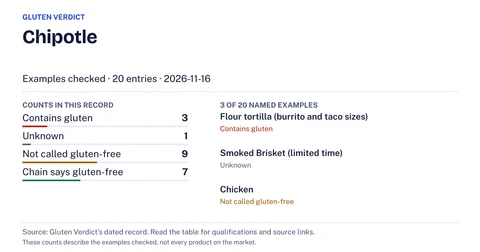 ChipotleDepends on the order3 of 20 menu items we checked contain gluten: Flour tortilla (burrito and taco sizes), Burrito, and QuesadillaChipotle Mexican Grill · checked Nov 16, 2026
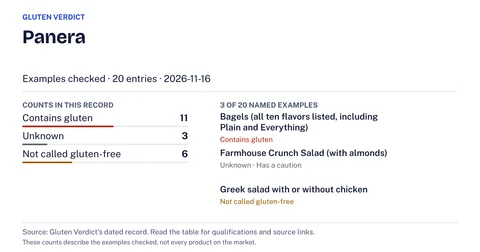 PaneraDepends on the order11 of 20 menu items we checked contain glutenPanera Bread · checked Nov 16, 2026
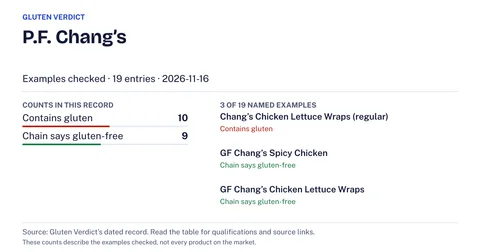 P.F. Chang’sDepends on the order10 of 19 menu items we checked contain glutenP.F. Chang’s · checked Nov 16, 2026
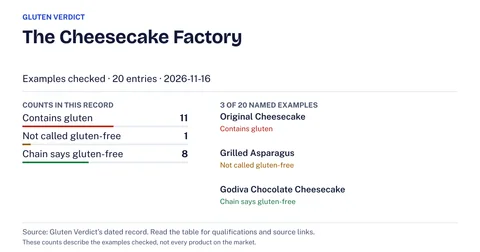 The Cheesecake FactoryDepends on the order11 of 20 menu items we checked contain glutenThe Cheesecake Factory · checked Nov 16, 2026
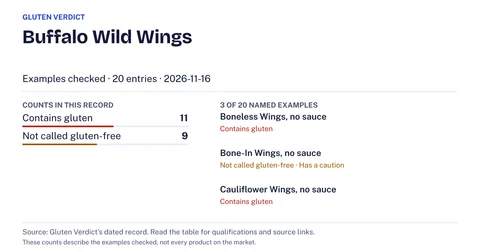 Buffalo Wild WingsDepends on the order11 of 20 menu items we checked contain glutenBuffalo Wild Wings · checked Nov 16, 2026
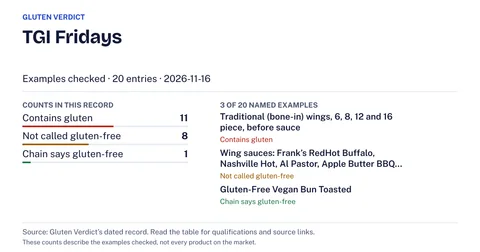 TGI FridaysDepends on the order11 of 20 menu items we checked contain glutenTGI Fridays · checked Nov 16, 2026
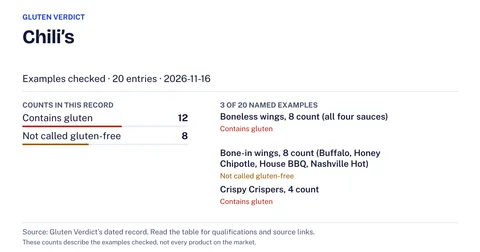 Chili’sDepends on the order12 of 20 menu items we checked contain glutenChili’s Grill & Bar · checked Nov 16, 2026
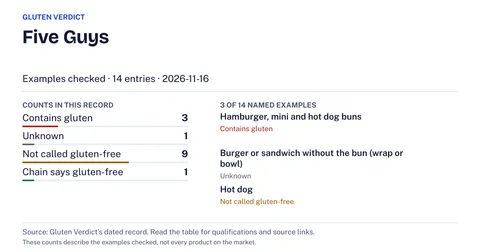 Five GuysDepends on the order3 of 14 menu items we checked contain gluten: Hamburger, mini and hot dog buns; Malt vinegar (fry condiment); and Oreo® Cookie Pieces shake mix-inFive Guys · checked Nov 16, 2026
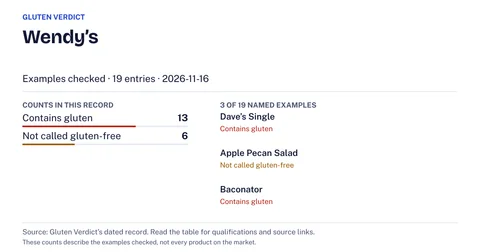 Wendy’sDepends on the order13 of 19 menu items we checked contain glutenWendy’s · checked Nov 16, 2026
Questions people ask
Is there a ranking of the most celiac-friendly cities?
We do not publish one. A US restaurant sensor study we read reports by four Census regions4, and the one city-level study we found is a Winnipeg phone survey of what restaurant staff reported11.
Does a restaurant’s gluten-free label have to meet the 20 ppm rule?
FDA’s regulation applies to packaged foods6, and FDA recommends that restaurants making a gluten-free claim on their menus be consistent with its definition7.
Does a restaurant missing from the GFFS database count against it?
GIG describes the database as including several large chains and some smaller places9. A restaurant missing from it has not been shown to be worse.
More in Travel planning and logistics
 Gluten-free on a road trip: stops, snacks, cooler and hotel nightsPlan each driving day: chain stops with dated verdicts, snacks read at the gas station, a cooler packed to USDA time limits and hotel fridge questions.
 Gluten-free food at the airport: what to check first and what to ask at the counterHow to judge an airport food counter for gluten: what airport and chain pages can tell you, the questions to ask, and when to eat what you packed.
 Planning a gluten-free trip: what to arrange, in orderA gluten-free trip in order: how you will eat, what to tell hotels and airlines, which cards and notes to carry, and what food to pack.
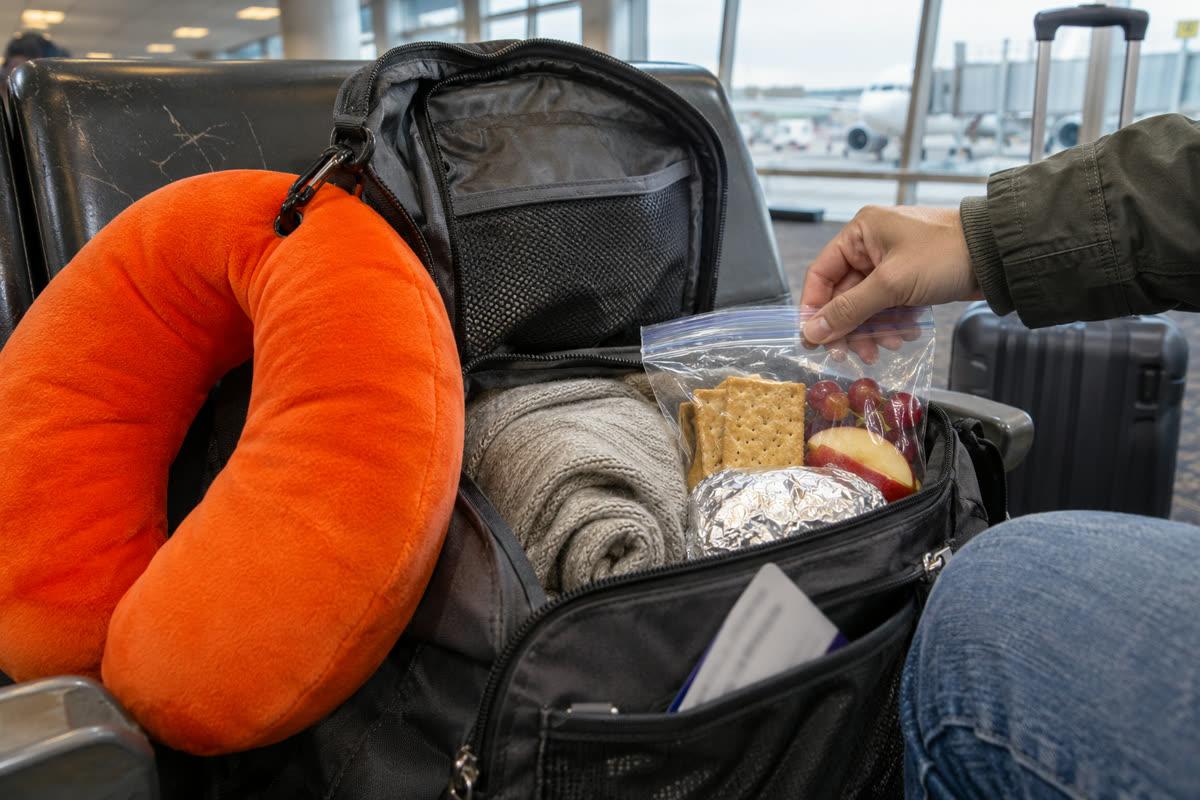 Flying gluten-free: what to arrange, pack and ask, from booking to landingA gluten-free flight in order: the airline's special-meal request, what TSA allows through the checkpoint, and the food to carry as a backup.
 State restaurant allergy laws: what eight states’ laws say, and what they leave out for barley and ryeWhat CA, VA, NY, MA, RI, MD, IL and MI law says about restaurant allergens, whether wheat is covered, and what is left out for barley and rye.
 Gluten-free dining cards in other languages: where the wording comes fromWhich gluten-free card wording comes from EU law or a celiac society, which cards are members-only, and how to hand one to a server.
Related guides
 Eating out with celiac disease: what to check, ask and watch forPlan a restaurant meal with celiac disease: what to check before you go, the questions to ask in order, how to read the answers, and what studies measured.
 Travel insurance and finding a doctor abroad with celiac diseaseWhat a travel policy says about pre-existing conditions, the questions to put to an insurer in writing, and where to look for a doctor abroad.
 What fast-food chains say about shared fryers, and what a shared-fryer study measuredEach chain's own sentence on fryer oil, with its document and date, plus what a 2026 study measured in fries and chips from shared fryers.
 What “gluten-free” on a restaurant menu meansFDA’s gluten-free rule is written for packaged food. See what a menu label can mean, and how to tell a recipe from a procedure or an audited program.
Sources
- [1] Celiac Disease Foundation, Celiac Disease Centers, checked Nov 17, 2026.
- [2, 18, 19, 26] Massachusetts Department of Public Health, Food Allergen Awareness FAQs, checked Nov 17, 2026.
- [3, 29, 30, 32] Gluten-Free Food Service (GFFS), Home page, checked Nov 17, 2026.
- [4, 5, 38, 40, 41] American Journal of Gastroenterology (PubMed Central), Detection of Gluten in Gluten-Free Labeled Restaurant Food (full text), checked Nov 17, 2026.
- [6, 7] US Food and Drug Administration, Questions and Answers on the Gluten-Free Food Labeling Final Rule, checked Nov 17, 2026.
- [8, 20, 21, 22, 23, 24, 25, 27, 28] Food Allergy Research & Education (FARE), Food Allergies and Food Service Establishments, checked Nov 17, 2026.
Read on 2026-11-17: the page describes restaurant requirements under headings for California, Illinois, Massachusetts, Maryland, Michigan, Rhode Island, Virginia, and New York City and St. Paul, MN.
Read on 2026-11-17: the Illinois section requires at least one manager on duty with training in nationally recognized standards for food allergens; the Michigan section says Public Act 516 (2014) requires certified managers in most restaurants to take a training course with an allergen awareness component; the Virginia section says HB 2090 requires the state Board of Health to include training standards for food allergy awareness in its restaurant regulations.
- [9, 33, 34, 44, 50, 51] Gluten Intolerance Group, FAQ: eating in a new place, checked Nov 17, 2026.
Read on 2026-11-17: the FAQ answer shows the date October 14th, 2019 under the question.
- [10, 35, 36, 37, 39, 42] American Journal of Gastroenterology (PubMed), Detection of Gluten in Gluten-Free Labeled Restaurant Food: Analysis of Crowd-Sourced Data (Lerner and colleagues, 2019), checked Nov 17, 2026.
- [11, 12, 43] Journal of Human Nutrition and Dietetics (PubMed), Reported Availability, Additional Cost and Use of Methods to Limit Cross-Contact of Gluten-Free Foods in Restaurants in a Canadian Large Urban Centre, checked Nov 17, 2026.
- [13, 16] Society for the Study of Celiac Disease, Celiac Recognized Unit of Excellence (CRUE), checked Nov 17, 2026.
Read on 2026-11-17: the list headed “United States” names units in Colorado, Illinois, Massachusetts, Minnesota, New Jersey, New York, Ohio, Pennsylvania and Tennessee.
Read on 2026-11-17: the list headed “CRUE Criteria” names SSCD membership for the unit medical director, one dietitian and at least 50% of unit staff; the medical director’s attendance at an SSCD-associated event each year; and evidence of IRB-approved or similar research or quality improvement activity within five years; units at separate addresses count as separate units. No criterion concerns restaurants.
- [14, 15, 17] Beyond Celiac, Celiac Centers, Labs & Alternative Resources, checked Nov 17, 2026.
Read on 2026-11-17: under “Healthcare Centers” the entries are grouped by state, from Alabama to Wisconsin, with Washington D.C. listed too.
Read on 2026-11-17: the entry for Phoenix Children’s Celiac Disease Clinic (Phoenix) describes a clinic for children and teens.
- [31, 45, 46, 47, 48] Gluten Intolerance Group, Eating Out: 7 Tips For Staying Gluten-Free, checked Nov 17, 2026.
- [49] Gluten Intolerance Group, Restaurant Card, checked Nov 17, 2026.
Read on 2026-11-17: the page titled “Restaurant Card” offers a print friendly version of the card.