Gluten-free oats vs regular oats: what the label changes
Short answer
Oats are not a gluten grain in FDA’s rule1, but they are often grown, processed and transported alongside wheat, barley and rye2. That is why the Celiac Disease Foundation says to look for oats labeled gluten-free3, which under FDA’s rule means less than 20 parts per million (ppm) of gluten1. The claim does not settle how one person reacts to oats themselves4.
Part of Head-to-head comparisons, 3 guides

Key points
- On oats, FDA’s rule asks for the same thing as for any gluten-free claim: less than 20 ppm of gluten, and no certification required1.
- The Celiac Disease Foundation advises looking for oats labeled gluten-free3; the National Celiac Association says a lot of oat sources have had cross-contact with gluten-containing grains, even some labeled gluten-free5.
- Makers reach the claim by purity protocol, mechanical sorting or both6, and purity protocol has no standard definition7.
- A gluten-free claim is not third-party verified8; a certification such as GFCO’s adds audits and a limit of 10 ppm or less9, 10.
- Some people react to oats labeled gluten-free; the National Celiac Association names avenin and fiber, and a Beth Israel Deaconess Celiac Center statement it hosts names fiber, FODMAPs and gluten contamination as possible reasons11, 12.
Why oats are not wheat, barley or rye, and why they still get contaminated
FDA’s gluten-free rule treats wheat, rye, barley and their crossbred hybrids such as triticale as the gluten-containing grains13. Oats are outside that list: FDA calls them a non-gluten-containing grain, like any other grain that is not on it1.
The trouble is the route to the shelf. FDA describes crop rotation and the shared use of harvesting and transport equipment and storage silos as practices that often bring gluten-containing grains into contact with naturally gluten-free grains in general14. The Gluten Intolerance Group (GIG) says that for oats the concern is contact with gluten grains from the field to processing15, and that gluten grains can still get in through wind, animals and human error before processing16.
One older study shows how far this can go. Health Canada researchers who tested 133 samples from the Canadian commercial oat supply, in a study published in 2011, reported that approximately 88% were contaminated above 20 mg of gluten per kilogram17. The one gluten-free variety they analysed gave negative results throughout18. It is one Canadian study from 2011 and says nothing about any current US brand.
What a gluten-free claim on oats promises in the US
In the US the claim is voluntary19. When oats carry it they must contain less than 20 ppm of gluten, and FDA says they do not have to be certified to carry it1. Any unavoidable gluten from cross-contact has to stay under that same 20 ppm13.
| Labeled gluten-free | No gluten claim | |
|---|---|---|
| What FDA’s rule asks | Less than 20 ppm of gluten1 | No claim, and the claim is voluntary19 |
| What the charities say | The Celiac Disease Foundation: look for oats specifically labeled gluten-free3 | The National Celiac Association: a lot of oat sources have had cross-contact with gluten-containing grains, even some labeled gluten-free5 |
| One maker, both canisters (Bob’s Red Mill) | Says all the oat groats it receives undergo an R5 ELISA test to no more than 19 parts per million of gluten20, and that the grains are packaged in a dedicated facility21 | The regular rolled oats page makes no statement about gluten22 |
Bob’s Red Mill’s own page draws the line: its gluten free grains are packaged in a dedicated facility “unlike our regular rolled oats”21. We link what we found for each brand rather than repeat it here: see our oatmeal verdict and the Bob’s Red Mill page.
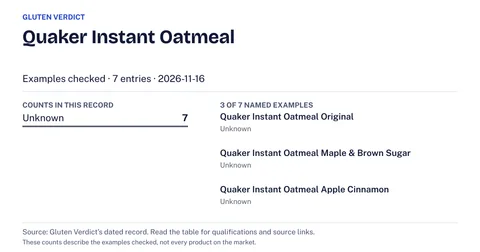
We could not read Quaker’s own oat pages because the site blocked our request23. Our Quaker Instant Oatmeal verdict shows what we could read.
What GIG says about the cost of gluten-free oats
In a 2022 article, GIG said gluten-free oats are culled from the highest quality kernels in the field, which makes them the most labor-intensive and expensive oat crop to harvest and process24. That is GIG’s explanation, not a price comparison.
How oats reach a gluten-free claim: purity protocol and sorting
Makers use two main methods. Some use purity protocol alone, some follow it with mechanical sorting, and others rely on sorting6.
- Purity protocol. GIG describes steps taken from growing through manufacturing, a non-regulated set25. The Celiac Disease Foundation notes there is no standard definition and the standards vary by company7. GIG says GFCO worked with oat processors on an industry standard in 201726.
- Mechanical or optical sorting. GIG says machines sort oats to eliminate unwanted particles, including errant grains27. The Foundation describes a combination of machines and humans removing errant gluten-containing grains28.
GIG says potential cross-contact can happen at any stage of either method29. The canister’s claim does not tell you which method was used, so look on the maker’s page or ask the maker.
What a gluten-free claim does not cover
A claim is the maker’s statement that the food meets FDA’s rule, and GIG notes it is not third-party verified8. FDA lets makers show a certification program’s logo when its use is truthful and not misleading, and says it does not endorse, accredit or recommend any particular program30.
Certification adds a layer. GIG says that under GFCO certification all oat-processing procedures are audited and oats are tested multiple times9, and that GFCO holds products to 10 ppm or less, against FDA’s less than 20 ppm10. GIG advises caution with oat products that are neither labeled nor certified gluten-free31.
Other clinicians are more guarded. In a statement hosted on the National Celiac Association’s site, the Celiac Center at Beth Israel Deaconess Medical Center wrote in May 2023 that its clinicians could not offer a standard recommendation for any particular brand of gluten-free oats, regardless of purity protocol, sorting or certification status32. The same statement says some manufacturers do not adequately test oats for gluten or use inadequate sorting and testing methods33, and that it is important to understand the source of gluten-free labeled oats34.
One 2022 study in Chile compared 25 oat flours, rolled oats and instant cereals labeled gluten-free with 27 regular equivalents35. It found gluten above the local 5 ppm cutoff in 40% of the gluten-free labeled products and above the Codex Alimentarius cutoff of 20 ppm in 36%36. That is one study of one country’s shelves; it does not describe US products.
When a person reacts to gluten-free oats anyway
Some patients with celiac disease report symptoms similar to a gluten exposure even when eating gluten-free oats, according to the Celiac Disease Foundation4. The National Celiac Association names the protein avenin, which a small number of celiac patients react to, and the high soluble fiber in oats11. The Beth Israel Deaconess Celiac Center statement adds fermentable carbohydrates (FODMAPs) in products such as energy bars or baked goods12.
GIG says research on avenin sensitivity generally indicates that avenin does not cause a reaction in the majority of celiac disease patients37. A systematic review and meta-analysis found no evidence that adding oats to a gluten-free diet affects symptoms, histology, immunity or serology in patients with celiac disease, with low-quality evidence38. Its randomized trials all used pure or uncontaminated oats39. The Foundation adds that ongoing research suggests most people with celiac disease can tolerate moderate amounts of gluten-free oats40.
Even a maker of gluten-free oats says it: Bob’s Red Mill’s page notes that a small percentage of people cannot tolerate even the purest of oat groats41.
Both charities point to a medical team. The National Celiac Association says to always discuss gluten-free oats with a doctor or dietitian before introducing them42, and the Foundation says the decision should be made with input from the doctor and dietitian43. We do not give individual medical advice.
Instant packets, oat flour and oat milk
The canister question is the question for every oat product: is there a gluten-free claim, and who stands behind it? The Celiac Disease Foundation lists energy bars and granola bars among foods that may contain gluten, noting some may contain wheat as an ingredient and most use oats that are not gluten-free44.
For a flavored instant oatmeal packet, read its own ingredient list and look for its own claim. Our Quaker Instant Oatmeal verdict shows how we read one.
Oat flour: GIG says it is much easier to test for gluten in oat flour than in whole, unprocessed oat groats, because any gluten grains present are more evenly spread through the flour45. More on flours is in our gluten-free flour guide.
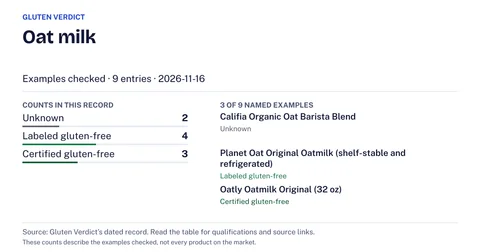
Oat milk is judged by its own carton: our oat milk verdict lists what the brand pages we could read say.
How to check a canister
- Find the claim on the package. Where it appears, FDA’s rule says the oats must contain less than 20 ppm1, though a claim is not third-party verified8. Where it does not, the Celiac Disease Foundation’s advice is to look for oats specifically labeled gluten-free3.
- Look for a certification mark, then check it against the certifier’s list. GFCO says a product is certified if it appears on its list and carries one of its marks46; a product on the list whose packaging lacks the mark is not certified47. A search of GFCO’s list for “oats” includes King Arthur’s Rolled Oats 2.5 lb48.
- Read the maker’s page for how the oats were produced, which can be purity protocol, sorting or both6, and what testing it names. Bob’s Red Mill, for example, names a test method and a limit for its groats20.
- Read the whole ingredient list too, because oats can be one ingredient among several; our guide to reading a food label covers the rest.
Verdicts in this guide

Questions people ask
Are regular oats gluten-free?
Oats are not a gluten grain under FDA’s rule1, but the Celiac Disease Foundation advises looking for oats labeled gluten-free3, and the National Celiac Association says a lot of oat sources have had cross-contact with gluten-containing grains, even some labeled gluten-free5.
Do gluten-free oats have to be certified?
No. FDA says oats do not have to be certified to be labeled gluten-free1. Certification is a separate program, such as GFCO’s, which holds products to 10 ppm or less10.
More in Head-to-head comparisons
 Corn vs flour tortillas: the label line and the griddle questionFlour tortillas contain wheat; corn ones may too. What to read on the package, and two questions to ask a restaurant about the tortillas and the griddle.
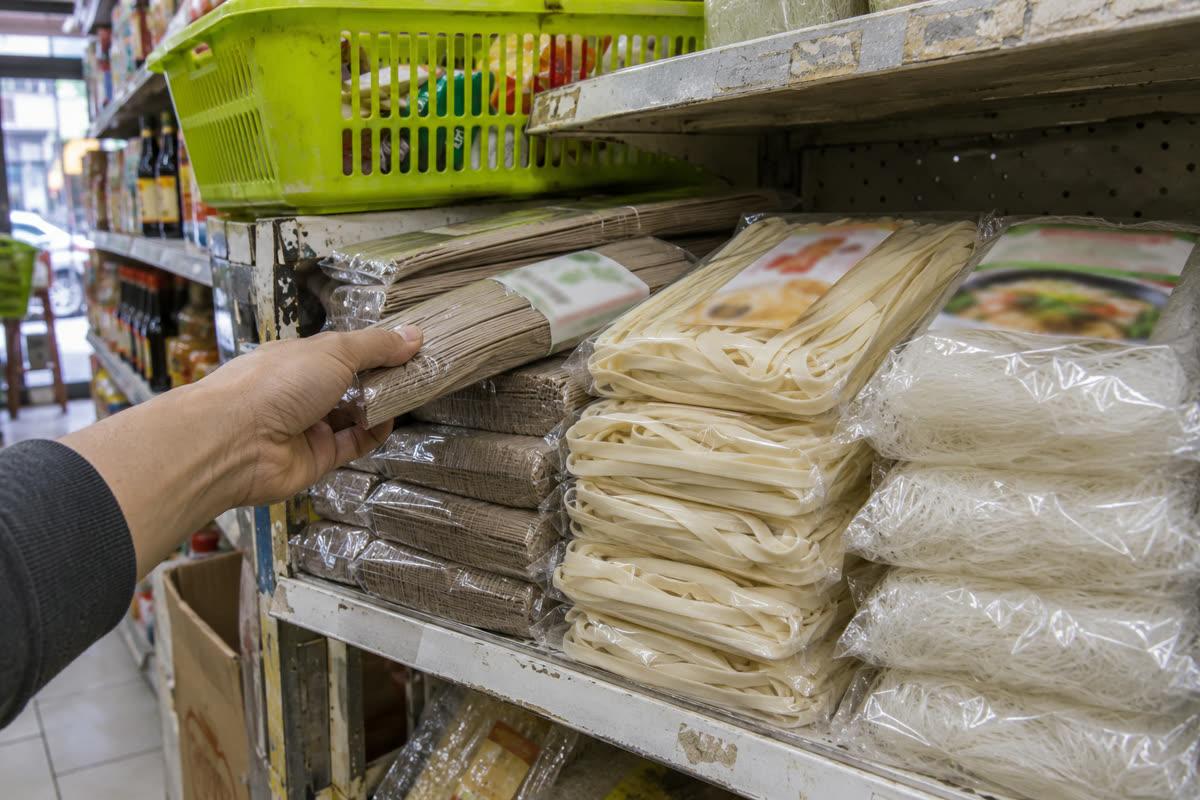 Soba vs udon vs rice noodles: which noodle holds wheatUdon is wheat, soba can be a buckwheat and wheat mix, and rice noodles are rice. How to read a package and ask about the broth and dipping sauce.
Related guides
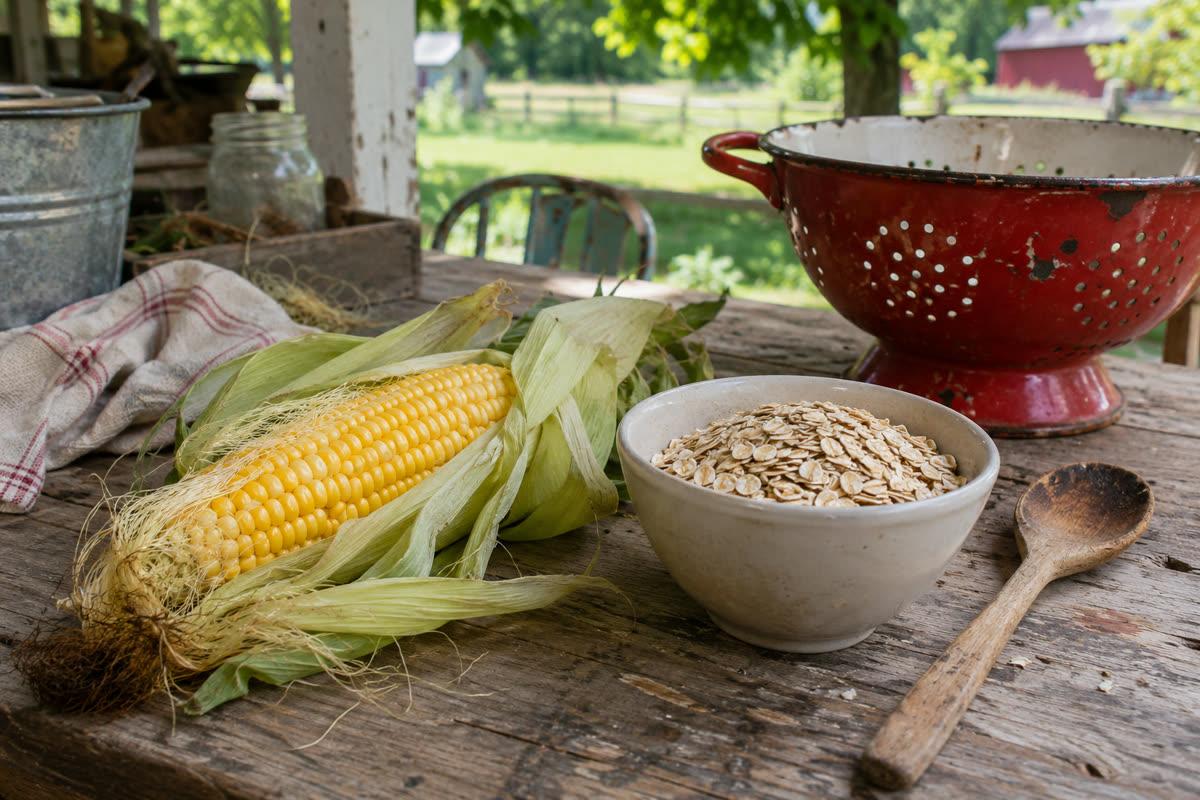 Zein, avenin and gluten: how corn and oats differ from wheatIs zein gluten? How FDA’s rule defines gluten, what “corn gluten” and avenin are, and why a gluten-free label matters for oats.
 Gluten-free oats by country: where the claim is allowed and where it is barredWhether oats can carry a gluten-free claim in the US, Canada, EU, UK, Australia and New Zealand, in each regulator’s own words.
 Gluten-free snack bars: reading oats and barley malt on the wrapperRead a snack-bar wrapper in four steps (gluten-free claim, malt, oats, Contains line), with a Clif and a KIND bar worked through.
 Certified or naturally gluten-free: when a seal mattersWhich naturally gluten-free foods are worth buying with a claim or seal: produce, grains, flours, oats and processed foods, with FDA rules and test data.
Sources
- [1, 13, 14, 19, 30] US Food and Drug Administration, Questions and Answers on the Gluten-Free Food Labeling Final Rule, checked Nov 17, 2026.
- [2, 4, 7, 28, 40, 43] Celiac Disease Foundation, Gluten-Free Oats: What’s the Deal? (April 2024 webinar page), checked Nov 17, 2026.
- [3, 44] Celiac Disease Foundation, Sources of Gluten, checked Nov 17, 2026.
- [5, 11, 42] National Celiac Association, Why can I NOT tolerate GF oats? (reviewed April 8, 2024), checked Nov 17, 2026.
- [6, 8, 9, 10, 15, 16, 25, 26, 27, 29, 31, 37, 45] Gluten Intolerance Group, Are Oats and Oat Flour Gluten-Free? (updated October 2023), checked Nov 17, 2026.
- [12, 32, 33, 34] National Celiac Association, Oats on the Gluten-Free Diet (Celiac Center, Beth Israel Deaconess Medical Center, May 2023), checked Nov 17, 2026.
- [17, 18] PubMed (US National Library of Medicine), Gluten contamination in the Canadian commercial oat supply (Food Additives & Contaminants, 2011), checked Nov 17, 2026.
- [20, 21, 41] Bob’s Red Mill, Gluten Free Old Fashioned Rolled Oats, checked Nov 17, 2026.
- [22] Bob’s Red Mill, Old Fashioned Regular Rolled Oats, checked Nov 17, 2026.
Read on 2026-11-17: the description and the ingredients (“Whole Grain Oats.”) on this product page say nothing about gluten, wheat or allergens; the word “gluten” appears only in site menus and links to other Bob’s Red Mill products.
- [23] The Quaker Oats Company, Quaker Old Fashioned Oats, checked Nov 17, 2026.
Tried on 2026-11-17: quakeroats.com returned HTTP 403 (a bot-check page) to a command-line fetch and to WebFetch, so we read no Quaker maker page and did not try to get past the check.
- [24] Gluten Intolerance Group, The Shortage of Gluten-Free Oats (2022), checked Nov 17, 2026.
- [35, 36] PubMed (US National Library of Medicine), Commercial oats in gluten-free diet: a persistent risk for celiac patients (Frontiers in Nutrition, 2022), checked Nov 17, 2026.
- [38, 39] PubMed (US National Library of Medicine), Adding oats to a gluten-free diet for patients with celiac disease: systematic review and meta-analysis (Gastroenterology, 2017), checked Nov 17, 2026.
- [46, 47, 48] Gluten-Free Certification Organization, GFCO Product Finder search: oats, checked Nov 17, 2026.
Read on 2026-11-17: the first page of results for the search “oats” (page 1 of 13) lists products from Modern Oats, Highland Milling LLC, Elmhurst, Northern Gold Foods, Avena Regen Ag., Montana Gluten Free, Tiny Hero and King Arthur Baking Company, among them “Rolled Oats 2.5 lb” from King Arthur Baking Company.