Zein, avenin and gluten: how corn and oats differ from wheat
Short answer
FDA’s gluten-free rule counts only the proteins in wheat, rye, barley and their crossbred hybrids as gluten, so zein (corn) and avenin (oats) fall outside its wording1, 2. The National Celiac Association calls corn naturally gluten free, and the Celiac Disease Foundation says oats are often grown and processed alongside wheat, barley and rye6, 30; some studies do report immune recognition of zein and avenin in some celiac patients11, 28.
Part of Gluten basics and myths, 13 guides
Key points
- FDA’s rule defines gluten as the proteins in wheat, rye, barley or their crossbred hybrids; corn and oats are not on that list1, 2.
- The National Celiac Association says corn is naturally gluten free and that the protein sometimes called “corn gluten” is not harmful to those with celiac disease6.
- “Corn gluten meal” is a livestock-feed ingredient name, and AAFCO has changed its US name to corn protein meal16, 17.
- Avenin is oats’ storage protein18; Coeliac UK says most people with coeliac disease can tolerate gluten free oats21, and the Celiac Disease Foundation says oats are often grown, processed and transported alongside wheat, barley and rye30.
- Studies report immune recognition of zein and avenin by some celiac patients; the studies and what they measured are described on this page11, 28.
What does FDA’s rule count as gluten?
FDA’s gluten-free rule defines gluten by where it comes from, not by the name of a protein. It lists the gluten-containing grains as wheat, rye and barley and their crossbred hybrids, such as triticale1, and it defines gluten as the proteins that naturally occur in one of those grains and may cause adverse health effects in people with celiac disease, with prolamins and glutelins as examples2.
Corn is not on that list, and neither are oats1. FDA’s Q&A says any grain other than wheat, rye, barley or their crossbred hybrids can be labeled “gluten-free” if any unavoidable gluten from cross-contact is under 20 ppm3, and it applies the same limit to oats as to any other non-gluten-containing grain4.
This is the US labeling rule. Other countries word their rules differently; see gluten-free labeling laws by country.
What is zein, and is it gluten?
Zeins are maize (corn) prolamins10. “Prolamin” is also one of the words FDA’s rule uses when it gives examples of gluten2. The rule ties gluten to the proteins of the three grains it lists, so a corn protein falls outside its wording1, 2.
The National Celiac Association says corn is naturally gluten free and that the protein in corn, sometimes called “corn gluten”, is “not harmful to those with celiac disease”6. The Celiac Disease Foundation lists corn among naturally gluten-free foods8.
What laboratory studies have found
Research complicates a simple answer, so it helps to read what it measured. A 2012 laboratory study reported that some zeins contain amino acid sequences that resemble the wheat gluten immunodominant peptides10, and that IgA from some celiac patients with HLA-DQ2 or DQ8 recognized two alpha-zeins even after digestion in the lab11. Its authors wrote that the relative abundance of these zeins, along with factors affecting their resistance to proteolysis, “may be of paramount clinical relevance” and that the use of maize in gluten-free foods “must be reevaluated in some cases of celiac disease”12.
A 2021 study measured antibodies to zeins in the blood of 37 newly diagnosed celiac patients, 375 people with irritable bowel syndrome and 302 healthy controls13. IgA antibodies to zein were most common in the celiac group, at 35.1%, against 4.3% in the irritable bowel group and 2.3% in the controls14.
What do “corn gluten” and “corn gluten meal” mean?
The words show up in more than one place and do not mean the same thing in each. The National Celiac Association notes that the protein in corn is sometimes referred to as “corn gluten”6.
“Corn gluten meal” is an animal-feed term. The Canadian Food Inspection Agency (CFIA) sought comments on feed ingredient descriptions for corn gluten meal and corn gluten with bran17. Its proposed amended description of corn gluten meal (or corn protein meal) is the meal of the dried residue from corn after the bran is separated and the majority of the starch and germ is removed15.
The same CFIA page reports that the Association of American Feed Control Officials (AAFCO) has revised the US ingredient name: corn gluten meal has been changed to corn protein meal16.
On a food label, the ingredients that matter for the rule are the grains it lists: wheat, rye, barley and their hybrids1. A product has to be judged by its own label, not by the word “gluten” in a corn ingredient’s name.
What is avenin, and why are oats treated differently?
Oats contain avenin, a storage protein that the Gluten Intolerance Group (GIG) says bears some similarities to the gluten found in wheat, rye and barley18. Coeliac UK, a UK charity, calls it a protein similar to gluten21. A 2019 review noted that oats contain less prolamin than wheat, barley and rye24.
On whether avenin matters for people with celiac disease, the charities say: GIG says research on sensitivity to avenin generally indicates that it does not cause a reaction in the majority of celiac disease patients19. Coeliac UK says research has shown that most people with coeliac disease can tolerate gluten free oats with no problems21, and that a very small number may still be sensitive to gluten free oat products22. The Celiac Disease Foundation adds that some patients report symptoms similar to a gluten exposure even when eating gluten-free oats33.
What the immune studies found
A 2015 study fed oats to 73 celiac patients who carry the HLA-DQ2.5 gene variant and looked for T cell responses to avenin peptides27. It found avenin-specific responses in 6 of the 73 patients (8%)28. The authors wrote that the low rate of T cell activation after this 100 g/day oat challenge suggests that doses of oats commonly consumed are insufficient to cause clinical relapse40. In the same study, a barley challenge produced cross-reactive avenin/hordein-specific T cells in most patients, while a wheat or rye challenge did not29.
The Celiac Disease Foundation describes a 2022 symposium presentation in which avenin in purified oats induced an acute IL-2 response in patients with celiac disease; with continued consumption this response did not lead to harmful effects, and no patients showed damage in their intestinal tissue32. The same page says several studies have indicated that pure, uncontaminated oats do not cause an immune response leading to intestinal damage31.
The 2019 review’s summary is that data support pure oats being well tolerated by most celiac patients25, and it also notes that the potential for sensitivity exists26. Whether to eat oats at all is a decision NIDDK and the Celiac Disease Foundation both leave to the person’s own doctor or dietitian36, 37.
Where does gluten in oats come from?
Two charities describe cross-contact as a source of gluten in oats. The Celiac Disease Foundation says oats themselves do not contain gluten but are often grown, processed and transported alongside wheat, barley and rye, which do30. GIG says gluten grains can get into oats through wind, animals and human error before processing20. FDA describes the same pattern for naturally gluten-free grains in general: crop rotation and shared harvesting, transport and storage equipment often bring gluten-containing grains into contact with other grains5.
That is why the label matters for oats. An oat product labeled gluten-free has to contain less than 20 ppm gluten, and FDA says oats do not have to be certified to carry the claim4. The Celiac Disease Foundation advises picking oat products that bear a gluten-free label34, and notes there is no standard definition for “purity protocol” and that standards vary by company35. Coeliac UK, writing about UK labels, says terms such as “pure oats” or “organic” oats do not tell you whether a product is gluten free23.
For how makers describe their sorting, see mechanically sorted or purity-protocol oats and gluten-free oats vs regular oats.
The names side by side
| Name | What the sources say it is | Where it stands |
|---|---|---|
| Gluten (FDA’s rule) | The proteins that naturally occur in wheat, rye, barley or their crossbred hybrids1, 2. | The legal term on US gluten-free labels1. |
| Zein | The maize (corn) prolamins10. | Outside the rule’s wording1, 2. The National Celiac Association calls the protein in corn not harmful to those with celiac disease6; two laboratory studies report immune recognition by some celiac patients11, 14. |
| “Corn gluten” | A name sometimes used for the protein in corn6. | Not a gluten grain in the rule1. |
| Corn gluten meal | A livestock-feed ingredient: corn residue after the bran, most of the starch and the germ are removed; AAFCO changed the US name to corn protein meal15, 16. | A feed-ingredient name; a food label is judged by the grains the rule lists1. |
| Avenin | The storage protein of oats, with some similarities to the gluten in wheat, rye and barley18. | Oats are not a gluten-containing grain in the rule, but a gluten-free oat claim needs less than 20 ppm3, 4. Coeliac UK says most people with coeliac disease can tolerate gluten free oats21. |
What else on a corn or oat label matters
A corn or oat food can contain gluten for reasons that have nothing to do with zein or avenin. The Celiac Disease Foundation says corn flakes and rice puffs often contain malt extract or flavoring38, and that multi-grain or “artisan” tortilla chips or tortillas that are not entirely corn-based may contain a wheat-based ingredient39. In an Ask the Expert answer, the National Celiac Association recommends making sure corn flour, cornmeal, masa and cornstarch are labeled gluten free, because they could have had cross-contact with gluten-containing grains during processing7.
Our verdicts read each maker’s own pages and ingredient lists, with the date we read them, instead of judging a food by its main grain: corn, cornstarch, popcorn, grits, polenta, corn tortillas, tortilla chips, corn flakes, oatmeal, oat milk and Quaker Instant Oatmeal. For a label you hold in your hand, how to read a US food label for gluten walks through the places to look, and the gluten scanner checks a photo or pasted ingredient text.
Questions to check before buying
- Is the product only corn? A multi-grain or “artisan” corn product can include a wheat-based ingredient39.
- Is it a corn flour, cornmeal, masa or cornstarch? The National Celiac Association recommends buying these labeled gluten free because of possible cross-contact in processing7.
- Is it a cereal? Corn flakes often contain malt extract or flavoring38, and malt is on the Celiac Disease Foundation’s list of gluten sources9.
- Is it an oat product? A gluten-free claim means less than 20 ppm gluten under FDA’s rule4, and the Celiac Disease Foundation advises picking oat products that bear the label34.
- Does the front of the package say “pure” or “organic” instead of gluten-free? Coeliac UK says those words do not tell you whether an oat product is gluten free23.
Verdicts in this guide
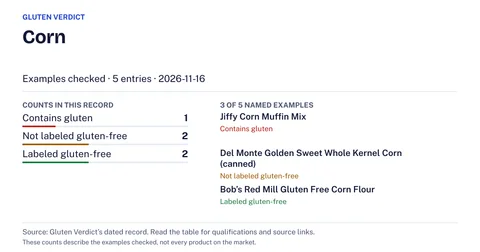 CornNaturally gluten-free1 of 5 products we checked contains gluten: Jiffy Corn Muffin Mixchecked Nov 16, 2026
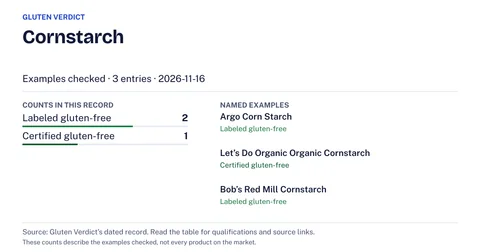 CornstarchNaturally gluten-freeBuy it labeled gluten-freechecked Nov 16, 2026
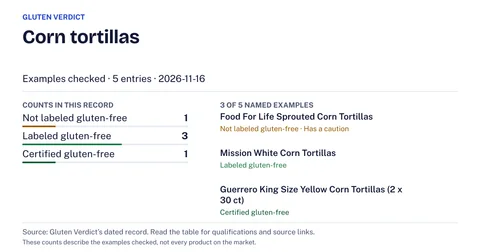 Corn tortillasDepends on the productchecked Nov 16, 2026
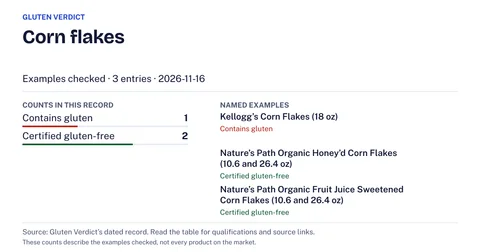 Corn flakesDepends on the product1 of 3 products we checked contains gluten: Kellogg’s Corn Flakes (18 oz)checked Nov 16, 2026
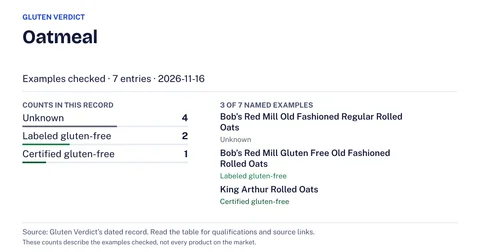 OatmealDepends on the productchecked Nov 16, 2026
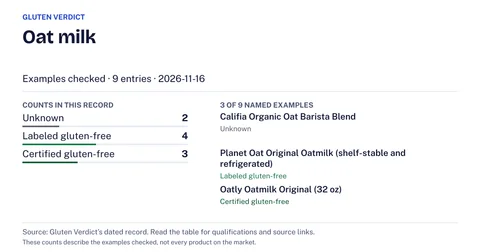 Oat milkDepends on the productchecked Nov 16, 2026
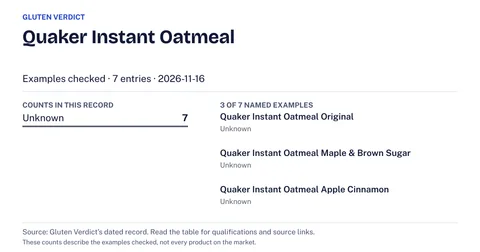 Quaker Instant OatmealUnknownThe Quaker Oats Company · checked Nov 16, 2026
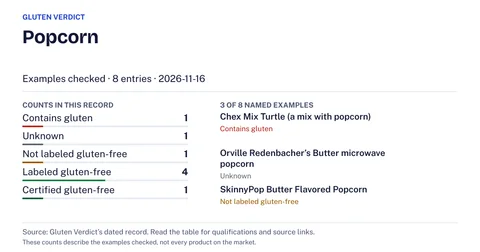 PopcornNaturally gluten-free1 of 8 products we checked contains gluten: Chex Mix Turtle (a mix with popcorn)checked Nov 16, 2026
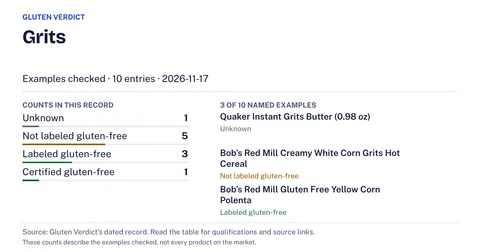 GritsNaturally gluten-freeBuy it labeled gluten-freechecked Nov 17, 2026
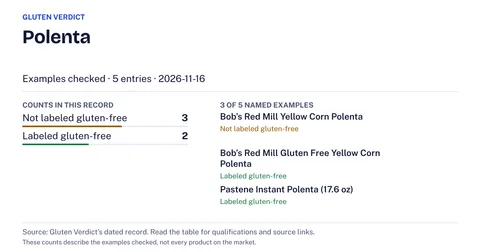 PolentaNaturally gluten-freeBuy it labeled gluten-freechecked Nov 16, 2026
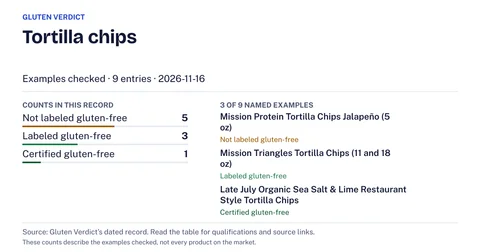 Tortilla chipsDepends on the productchecked Nov 16, 2026
Questions people ask
Is zein gluten?
Not under FDA’s rule, which defines gluten as the proteins in wheat, rye, barley and their crossbred hybrids1, 2. Zein is a group of maize prolamins10. The National Celiac Association says the protein in corn, sometimes called “corn gluten”, is not harmful to those with celiac disease6, while a 2012 laboratory study found IgA from some celiac patients recognized two alpha-zeins11.
Does corn have gluten?
The National Celiac Association says corn is naturally gluten free6, and the Celiac Disease Foundation lists corn among naturally gluten-free foods8. Corn flour, cornmeal, masa and cornstarch could have had cross-contact with gluten-containing grains in processing, so the Association recommends buying them labeled gluten free7.
Is avenin gluten?
Avenin is the storage protein of oats and bears some similarities to the gluten in wheat, rye and barley, according to GIG18. Oats are not one of the gluten-containing grains in FDA’s rule1, and an oat product labeled gluten-free must contain less than 20 ppm gluten4.
What is corn gluten meal?
CFIA’s proposed amended feed description of it is the meal of the dried residue from corn after the bran is separated and most of the starch and germ is removed15. It is listed as a livestock feed ingredient, and AAFCO has changed its US name to corn protein meal16, 17.
Can people with celiac disease eat corn?
The National Celiac Association and the Celiac Disease Foundation both describe corn as naturally gluten free6, 8. Laboratory studies have also found antibody recognition of zein in some celiac patients11, 14. A question about one person’s own diet is for that person’s doctor or dietitian.
Can people with celiac disease eat oats?
Coeliac UK says research has shown most people with coeliac disease can tolerate gluten free oats, and a very small number may still be sensitive21, 22. The Celiac Disease Foundation says to pick oat products that bear a gluten-free label34, and NIDDK says to talk with a doctor or registered dietitian about whether to include oats and how much37.
More in Gluten basics and myths
 Gluten-free myths about labels and food, checked against the rulesNatural, organic, zero gluten, fermenting and oats: each gluten-free myth checked against the page that states the rule, with the wording and read date.
 How the 20 ppm gluten-free limit was chosen, and by whomWho set the 20 ppm gluten-free limit and when: the 2004 law, FDA's 2013 rule and its stated reasons, the 2020 follow-up rule, and Codex and EU wording.
 What gluten is, which grains carry it and what “gluten-free” meansA plain definition of gluten, the grains that carry it, look-alike words such as malt and wheat starch, and what a US gluten-free label means.
 Why gluten problems seem more common: what the evidence separatesGluten problems seem everywhere. Studies separate three things: cases found, cases that exist, and people avoiding gluten.
 Is gluten in everything? Where it starts and where it gets addedSort your pantry into foods that start without gluten, foods where it is added as an ingredient, and foods that pick it up by contact.
 What in wheat bothers people if it is not gluten?The non-gluten candidates for wheat symptoms (fructans, ATIs, wheat allergy), the trial or review behind each, and what limits it.
Related guides
 Oats and celiac disease: what a gluten-free oat label does and does not tell youWhat FDA’s rule covers for oats, how makers get oats to the gluten-free limit, what avenin studies found, and what to ask your doctor.
 How to read a US food label for glutenWhere gluten shows up on a US food label: the gluten-free claim, the Contains line, the ingredient list and may-contain lines, and what each means.
 Gluten cross-contact at home: where it happens and what to do about itHow gluten reaches gluten-free food at home, whether to separate, wash or ask for each route, and which rules have lab data behind them.
 Gluten-free oats vs regular oats: what the label changesTwo canisters of rolled oats, one labeled gluten-free: what the US claim means, how oats reach it, what it does not cover, and how to check.
Sources
- [1, 2] Electronic Code of Federal Regulations, 21 CFR 101.91 Gluten-free labeling of food, checked Nov 17, 2026.
- [3, 4, 5] US Food and Drug Administration, Questions and Answers on the Gluten-Free Food Labeling Final Rule, checked Nov 17, 2026.
- [6, 7] National Celiac Association, Is there gluten in corn?, checked Nov 17, 2026.
- [8] Celiac Disease Foundation, Gluten-Free Foods, checked Nov 17, 2026.
Read on 2026-11-17: the list under “Naturally Gluten-Free Foods” on the page, introduced as “The following grains, legumes, seeds, and other starchy foods are naturally gluten-free”, names amaranth, arrowroot, beans, buckwheat groats, cassava, chia, corn, flax, gluten-free oats, millet, nut flours, potato, quinoa, rice, sorghum, soy, tapioca, teff and yucca.
- [9, 38, 39] Celiac Disease Foundation, Sources of Gluten, checked Nov 17, 2026.
Read on 2026-11-17: the list headed “Gluten-Containing Grains and Their Derivatives” names wheat (with varieties and derivatives such as wheatberries, durum, emmer, semolina, spelt, farina, farro, graham, KAMUT® khorasan wheat and einkorn wheat), rye, barley, triticale, malt in various forms, brewer’s yeast and wheat starch that has not been processed to remove gluten to below 20 ppm; it does not name corn, oats, zein or avenin.
- [10, 11, 12] Plant Foods for Human Nutrition (PubMed), Maize prolamins resistant to peptic-tryptic digestion maintain immune-recognition by IgA from some celiac disease patients (2012), checked Nov 17, 2026.
- [13, 14] Nutrients (PubMed), The Prevalence of Anti-Zein Antibodies: A Comparative Study between Celiac Disease and Irritable Bowel Syndrome (2021), checked Nov 17, 2026.
- [15, 16, 17] Canadian Food Inspection Agency, Proposed amended livestock feed ingredients - Corn gluten meal and corn gluten with bran: Closed Consultation, checked Nov 17, 2026.
- [18, 19, 20] Gluten Intolerance Group, Are Oats and Oat Flour Gluten-Free?, checked Nov 17, 2026.
- [21, 22, 23] Coeliac UK, Oats and the gluten free diet, checked Nov 17, 2026.
- [24, 25, 26] Frontiers in Pediatrics (PubMed), To Be Oats or Not to Be? An Update on the Ongoing Debate on Oats for Patients With Celiac Disease (2019), checked Nov 17, 2026.
- [27, 28, 29, 40] Journal of Autoimmunity (PubMed), Ingestion of oats and barley in patients with celiac disease mobilizes cross-reactive T cells activated by avenin peptides and immuno-dominant hordein peptides (2015), checked Nov 17, 2026.
- [30, 31, 32, 33, 34, 35, 36] Celiac Disease Foundation, Gluten-Free Oats: What’s the Deal?, checked Nov 17, 2026.
- [37] NIDDK (National Institutes of Health), Eating, Diet & Nutrition for Celiac Disease, checked Nov 17, 2026.