Gluten-free snack bars: reading oats and barley malt on the wrapper
Short answer
Read a snack-bar wrapper in four steps, because a bar can pass or fail on any one of them:
- The maker’s own gluten-free claim, which on foods FDA regulates means less than 20 parts per million of gluten1.
- Malt, including barley malt extract hidden inside crisps or syrups: FDA says malt extract and similar malt-derived ingredients cannot be used in a food that carries the claim6.
- Oats: not a gluten grain in FDA’s rule, but often grown, processed and transported alongside gluten grains, so look for the claim on an oat bar10, 12.
- The Contains line: US allergen law names wheat but not barley, so the line need not show malt20.
Part of Hidden gluten in ingredients, sauces and processed foods, 21 guides

Key points
- “Gluten-free” is a voluntary claim, and one product’s claim does not extend to the maker’s other bars2, 4.
- FDA names barley malt extract as a form of malt extract5 and says malt extract cannot be used in a food that bears the claim, so a bar listing it and carrying the claim is a mismatch to question6.
- Oats can carry the claim if unavoidable gluten is under 20 ppm, and they need no certification to do so10, 11.
- A Contains line without wheat does not rule out barley: the ingredient list can still name barley malt20, 18.
- Ingredient lists change, so the package in your hand outranks any web page, including ours34.
Step 1: does the maker claim gluten-free?
On a packaged food FDA regulates, “gluten-free” means no gluten-containing grain as an ingredient, no ingredient made from one unless it was processed to remove gluten and the food stays under 20 parts per million (ppm), and less than 20 ppm of any gluten the maker could not avoid1.
The claim is voluntary2, so a bar without it leaves the question to the ingredient list and the steps below.
A claim belongs to a product, not a brand. FDA says a maker using the claim on some of its foods does not mean every food it makes is free of gluten4. Check each flavor and each line.
“Made with no gluten-containing ingredients” is a different statement. FDA says that unless the label also bears a “gluten-free” claim, consumers should not assume the food meets all FDA requirements for the claim3. A certification logo is optional too, and FDA does not endorse any one program17.
Step 2: is there malt in any form?
FDA treats malt syrup and malt extract as interchangeable terms for a concentrate made from germinated barley, and notes that “barley malt” and “barley malt extract” are used too5. NIDDK lists barley as the grain that may be found in malt, malt extract, malt vinegar and brewer’s yeast7.
FDA’s position is that malt extract and similar malt-derived ingredients come from a gluten-containing grain that has not been processed to remove gluten, so they cannot be used in foods that bear a “gluten-free” claim6.
In a bar, malt can sit inside a sub-ingredient: Clif’s Chocolate Chip bar lists “SOY RICE CRISPS (SOY PROTEIN ISOLATE, RICE FLOUR, BARLEY MALT EXTRACT)”22. Read inside the parentheses, not only the first line of the list. Our malt extract page covers the ingredient, and our guide to malt on food labels separates malt from look-alike words such as maltodextrin.
Step 3: are there oats, and does the bar say gluten-free?
FDA’s rule names wheat, rye, barley and their hybrids as the gluten-containing grains. Any other grain, oats included, can carry the claim if unavoidable gluten from cross-contact is under 20 ppm10. Oats do not have to be certified to carry it11.
That is why the claim is worth looking for on an oat bar. The Celiac Disease Foundation says oats do not contain gluten themselves but are often grown, processed and transported alongside wheat, barley and rye12. The Gluten Intolerance Group says gluten grains can still get into oats through wind, animals and human error before processing14. The National Celiac Association says a lot of sources of oats have had cross-contact with gluten-containing grains, even some labeled gluten-free13.
For people with celiac disease, the Celiac Disease Foundation’s oats webinar page lists key points from expert dietitians, including “Only eat oat products that have a gluten-free label”15 and that the decision to include gluten-free oats should be made with input from a doctor and dietitian35. The Gluten Intolerance Group adds that products labeled gluten-free should comply with FDA’s definition, but that this is not third-party verified16.
What a claim on oats does and does not cover, and how oats are sorted, is in our guide to gluten-free oats vs regular oats. Oat-based foods we have checked are in our oatmeal, granola and granola bars verdicts.
Step 4: what the Contains line shows, and what it misses
US allergen law gives a maker two ways to name a major allergen: a line starting “Contains” printed right after or next to the ingredient list18, or the food source in parentheses after the ingredient’s name in the list19.
Wheat is on the law’s list of major food allergens; barley and rye are not named there20. A Contains line built on that list therefore need not mention barley malt extract18, 20. Our guide to the Contains line goes further.
Lines such as “made in a facility that also processes wheat” are voluntary, and FDA allows one on a food that also carries the claim, provided it is truthful and not misleading21.
Worked example: CLIF BAR Chocolate Chip
The four steps, in order, on Clif’s own page for this bar:
- Claim: the page text carries no gluten-free claim for this bar24.
- Malt: the ingredient list names BARLEY MALT EXTRACT inside the soy rice crisps22. FDA says malt extract cannot be used in a food that bears the claim6.
- Oats: organic rolled oats are the first ingredient22, with no gluten-free claim to speak to them24.
- Contains line: the allergen statement reads “CONTAINS SOY. MAY CONTAIN PEANUTS, TREE NUTS, MILK, SESAME, AND WHEAT.”23 Barley is not named, so the line does not point to the malt.
Step 2 settles it for a shopper avoiding barley. Our verdict, with the maker’s other pages: Clif Bar Chocolate Chip.
Worked example: KIND Dark Chocolate Nuts & Sea Salt
- Claim: KIND’s page for this bar says “This KIND nut bar is also gluten free”26. KIND’s FAQ says that for all products that make a “Gluten Free” claim it completes testing to ensure they meet FDA’s requirements29.
- Malt: the ingredient list is almonds, peanuts, chicory root fiber, honey and so on, ending in cocoa butter, with no malt in it27.
- Oats: none are listed27.
- Contains line: the page’s allergen information reads “contains almonds, peanuts and soy. May contain tree nuts. May contain nut shell fragments”28. Wheat and barley are not named, and the list names no gluten grain, so the claim and the list agree.
This is one bar’s page. Because a claim belongs to a product4, a different KIND flavor or a package without the claim needs its own read. Our verdict: KIND Dark Chocolate Nuts & Sea Salt.
Two oat bars side by side
Both bars below are built on oats. What separates their pages is step 1.
| Bar | Oats in the list | Gluten-free claim on the maker’s page | Malt or wheat in the list |
|---|---|---|---|
| LUNA Bar LemonZest | Rolled oats, inside a protein grain blend31 | Yes: the product name and description read “Gluten Free Snack Bars”30 | None named31 |
| Nature Valley Oats ’n Honey Crunchy Granola Bars | Whole grain oats, first32 | None on the page33 | None named32 |
By step 3, the LUNA page gives the maker’s statement that the Nature Valley page does not. That does not rank either bar; it tells you which question each page leaves open. See our verdicts on LUNA bars and Nature Valley crunchy granola bars. For a bar where wheat sits in the list, see Nutri-Grain bars.
The wrapper in your hand has the last word
Clif’s page for the Chocolate Chip bar says “Packaging May Vary”25, and Nature Valley’s page says ingredients, nutrition facts and allergen statements can change and to refer to the actual package34. NIDDK’s advice for people with celiac disease includes carefully reading food labels for gluten grains and ingredients made from them8.
For a food whose gluten status is unclear, NIDDK says that, if possible, you should contact the company that makes it or visit its website9.Our guide to asking a manufacturer lists what to ask, and our gluten scanner looks for these names in a photo of a label or in pasted text.
Verdicts in this guide
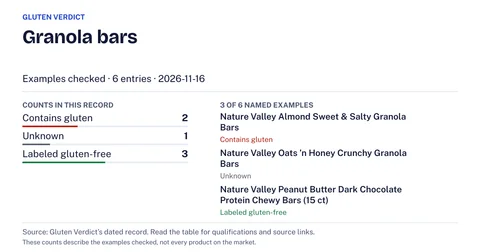 Granola barsDepends on the product2 of 6 products we checked contain gluten: Nature Valley Almond Sweet & Salty Granola Bars and Nature Valley Cinnamon Brown Sugar Soft-baked Oatmeal Squareschecked Nov 16, 2026
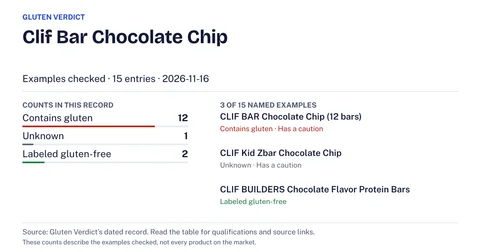 Clif Bar Chocolate ChipContains glutenClif Bar & Company · checked Nov 16, 2026
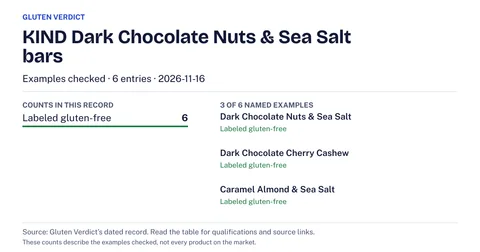 KIND Dark Chocolate Nuts & Sea Salt barsLabeled gluten-freeKIND (Mars) · checked Nov 16, 2026
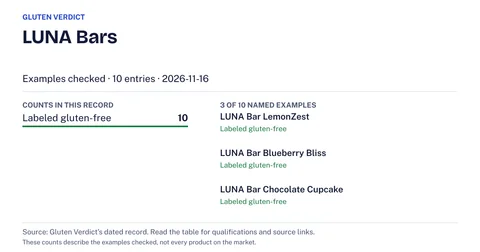 LUNA BarsLabeled gluten-freeClif Bar & Company · checked Nov 16, 2026
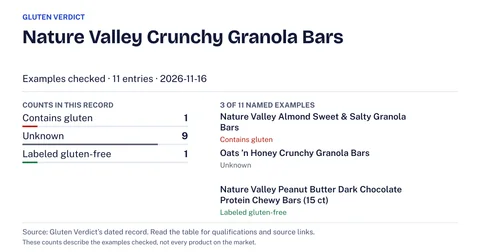 Nature Valley Crunchy Granola BarsUnknown1 of 11 varieties we checked contains gluten: Nature Valley Almond Sweet & Salty Granola BarsGeneral Mills · checked Nov 16, 2026
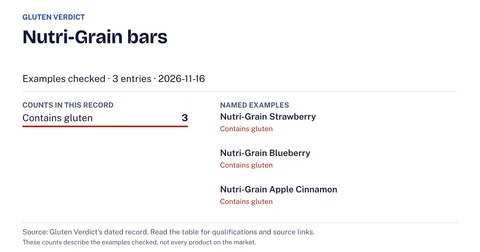 Nutri-Grain barsContains glutenKellogg’s · checked Nov 16, 2026
 OatmealDepends on the productchecked Nov 16, 2026
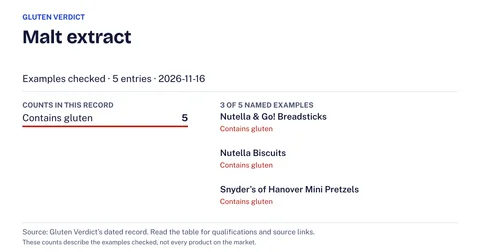 Malt extractContains glutenchecked Nov 16, 2026
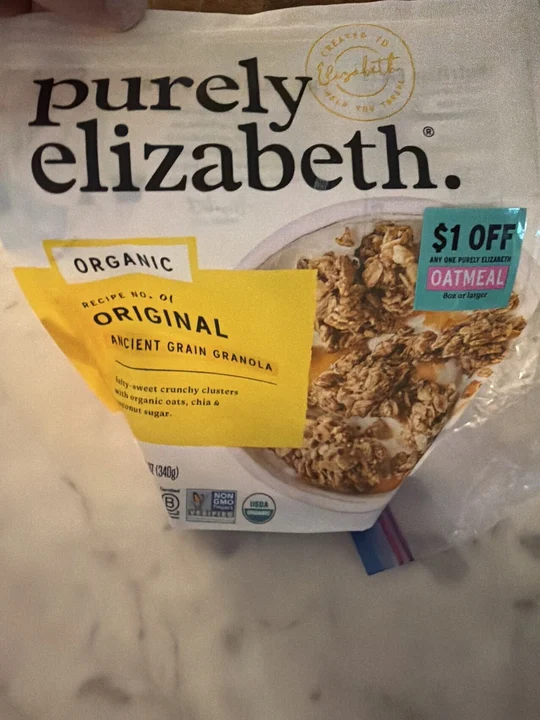 GranolaDepends on the product1 of 6 products we checked contains gluten: Honey Bunches of Oats Honey Roasted Granolachecked Nov 16, 2026
Questions people ask
Are Clif Bars gluten-free?
It depends on the bar. Clif’s page for the Chocolate Chip CLIF BAR lists barley malt extract and carries no gluten-free claim22, 24, and FDA says malt extract cannot be used in a food with the claim6. Clif’s page for the LUNA LemonZest bar says gluten free30.
Are KIND bars gluten-free?
KIND’s page for its Dark Chocolate Nuts & Sea Salt bar says it is gluten free26. A claim belongs to one product4, so check the flavor in your hand.
More in Hidden gluten in ingredients, sauces and processed foods
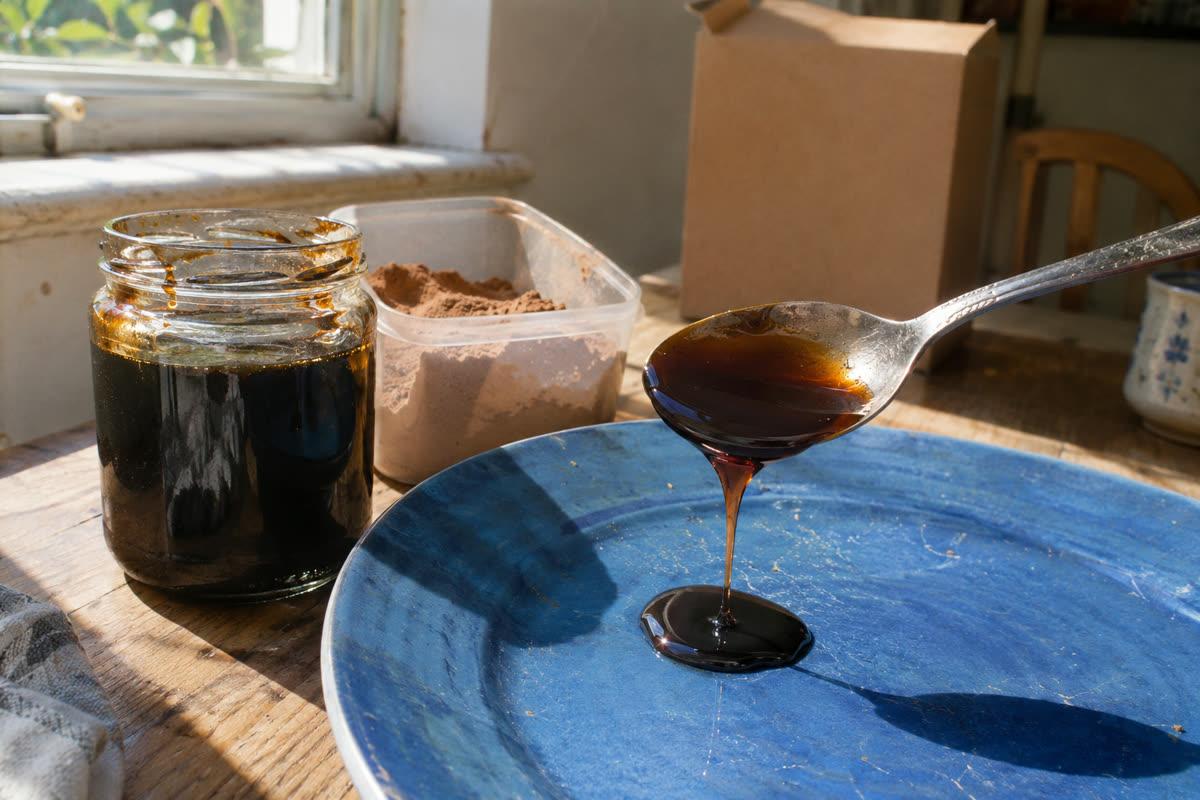 Malt on a food label: which forms are barley and what to checkWhat malt extract, syrup, flavoring and vinegar on a US label mean for gluten, why the Contains line misses barley, and what to check first.
 Wheat, barley and rye on an ingredient list: the names to look forLook up wheat, barley and rye names on a US ingredient list, from durum to malt, and sort each as contains gluten, depends on the maker, or lookalike.
 Where wheat, barley and rye hide in processed food: 15 places to checkFifteen processed foods where wheat, barley or rye turn up, the label step that catches each, and what US allergen law does and does not flag.
 Foods that contain gluten, aisle by aisle, and the label words that give them awayA store-order map of foods that contain gluten, which depend on the brand, and which need a cross-contact check, with the label words to look for.
 Keto and low-carb breads, wraps and bars: where wheat gluten hidesSome keto and low-carb breads, wraps and bars list wheat gluten. How to read the label, with named products and the makers’ own statements.
 Maltodextrin, dextrin and glucose syrup made from wheat: what the label rules sayWhat US label law, FDA and the two US celiac charities say about wheat-made maltodextrin, dextrin and glucose syrup, and how to confirm one.
All 21 guides in Hidden gluten in ingredients, sauces and processed foods
Related guides
 Oats and celiac disease: what a gluten-free oat label does and does not tell youWhat FDA’s rule covers for oats, how makers get oats to the gluten-free limit, what avenin studies found, and what to ask your doctor.
 Gluten-free high-protein foods: where gluten hides in bars, powders, jerky and marinadesCheck each protein product type for its gluten trap: seitan, jerky, bars, powders, sausage and broth, with what makers say on their own pages.
 Mechanically sorted or purity-protocol oats: what the makers' own pages sayTwo routes lead to a gluten-free oat label. See how to sort a pack by the maker's own words, which pages say what, and what they leave out.
 Gluten-free school lunches and classroom snacks: a checklist for parentsHow to prove each lunchbox item, read a snack label for oats, malt and wheat, brief the teacher, and when the school cafeteria is the better route.
Sources
- [1, 2, 3, 4, 5, 6, 10, 11, 17, 21] US Food and Drug Administration, Questions and Answers on the Gluten-Free Food Labeling Final Rule, checked Nov 17, 2026.
- [7, 8, 9] NIDDK (NIH), Eating, Diet, & Nutrition for Celiac Disease, checked Nov 17, 2026.
- [12, 15, 35] Celiac Disease Foundation, Gluten-Free Oats: What’s the Deal?, checked Nov 17, 2026.
- [13] National Celiac Association, Why can I NOT tolerate GF oats?, checked Nov 17, 2026.
- [14, 16] Gluten Intolerance Group, Are Oats and Oat Flour Gluten-Free?, checked Nov 17, 2026.
- [18, 19, 20] US Food and Drug Administration, Food Allergen Labeling and Consumer Protection Act of 2004 (FALCPA), checked Nov 17, 2026.
- [22, 23, 24, 25] Clif Bar & Company, CLIF BAR Chocolate Chip, checked Nov 17, 2026.
Read the product page text on 2026-11-17 (product details, ingredients, allergen statement, the Find the Right Energy table): no gluten-free claim for the CLIF BAR Chocolate Chip; “Gluten Free” appears as a row label in the Find the Right Energy comparison table, where the CLIF BAR column shows a minus-sign icon and the other two columns show check icons, and in the names of LUNA bars listed further down the page.
- [26, 27, 28] KIND Snacks (Mars), Dark Chocolate Nuts & Sea Salt, checked Nov 17, 2026.
- [29] KIND Snacks (Mars), KIND FAQ & Contact, checked Nov 17, 2026.
- [30, 31] Clif Bar & Company, LUNA Bar LemonZest, checked Nov 17, 2026.
- [32, 33, 34] General Mills (Nature Valley), Oats ’n Honey Crunchy Granola Bars, checked Nov 17, 2026.
Read the product page text on 2026-11-17 (description, allergens, consumer statements, ingredients, nutrition facts): no gluten-free claim for this bar (the only “gluten free” on the page text is a category link in the site menu) and no mention of wheat, barley or malt.