Gluten-free oats by country: where the claim is allowed and where it is barred
Short answer
Whether oats can carry a gluten-free claim depends on the country. The US, Canada, the EU and the UK allow it when the oats meet a 20 ppm (20 mg/kg) limit, with Canada, the EU and the UK adding conditions on how the oats were produced, while Australia and New Zealand bar oats from a gluten-free claim1, 22, 11, 12, 29, 34.
- United States: oats are treated like any grain other than wheat, rye and barley, so oats labeled gluten-free must contain less than 20 ppm gluten1, 2.
- Canada: since a 2015 Marketing Authorization, specially produced “gluten-free oats” with no more than 20 ppm of gluten from wheat, rye, barley or hybridized strains may carry the claim, and they must be named as such in the ingredient list20, 21, 22.
- EU and UK: oats in a food presented as gluten-free must have been specially produced, prepared or processed to avoid contamination by wheat, rye or barley, and their gluten content cannot exceed 20 mg/kg11, 12.
- Australia and New Zealand: the Food Standards Code’s “Free” gluten claim requires that the food contain no oats or oat products29, 34.
Part of Gluten-free labeling law by country, 12 guides
Key points
- Codex Alimentarius’s gluten standard says the allowance of uncontaminated oats may be determined at the national level, so national rules can differ6.
- The US, Canada, the EU and the UK each give a numeric limit of 20 ppm or 20 mg/kg for oats in a gluten-free claim, and Canada, the EU and the UK add conditions on how the oats were produced1, 22, 11, 12.
- In Australia and New Zealand the Code bars oats from the gluten-free claim29, 30, and Coeliac New Zealand says terms such as “pure” or “uncontaminated” are not regulated there35.
- Coeliac UK says “pure oats” and “organic” oats do not tell you whether the product is gluten free18.
- In the US, Australia and New Zealand an imported pack is judged by the rules of the country where it is sold: FDA applies its rule to imported foods that make the claim, and Australian and New Zealand rules bar the claim on imported oats4, 42, 29, 34.
Why do countries treat oats differently?
The Codex Alimentarius standard for gluten-free foods counts oats in its definition of gluten7. Its footnote then leaves the choice to each country: oats can be tolerated by most but not all people who are intolerant to gluten, and the allowance of oats not contaminated with wheat, rye or barley in foods covered by the standard may be determined at the national level6.
The EU’s regulation gives a similar reasoning in its own recitals: it says most people with intolerance to gluten can include oats in their diet, and that the major concern is contamination of oats with wheat, rye or barley during harvesting, transport, storage and processing9.
Australia and New Zealand bar oats from the claim. In its 2004 final assessment report on proposal P264, the food standards agency FSANZ said the then-current ban on gluten claims for foods containing oats or malt was introduced because the available analysis methods were unreliable for the gluten fractions in oats and malt31. The same report said ELISA tests had limited reactivity to barley hordeins and failed to detect oat avenins32, and that New Zealand and Australian health professionals held opposing views on small amounts of oats and malt33.
That report is from 2004. For what the Code says now, see the Australia and New Zealand section below.
Oats and a gluten-free claim, country by country
| Country | Oats allowed in a gluten-free claim? | What the rule asks |
|---|---|---|
| United States | Yes2 | Under 20 ppm gluten; no certification required1 |
| Canada | Yes, under Health Canada’s 2015 Marketing Authorization, listed as active20, 43 | Only specially produced “gluten-free oats”, finished food at or under 20 ppm, oats named as gluten-free oats in the ingredient list22 |
| European Union | Yes11 | Oats specially produced, prepared or processed to avoid contamination, at no more than 20 mg/kg11 |
| United Kingdom | Yes12 | Same wording as the EU annex, in the UK version12 |
| Australia | No29 | The “Free” gluten claim requires no oats or oat products29 |
| New Zealand | No34 | The same Code applies in New Zealand30 |
The table compares claim rules, not diets. The charities’ positions on eating gluten-free oats differ, as the sections below show.
United States: oats under the 20 ppm rule
FDA’s rule names wheat, rye, barley and their crossbred hybrids like triticale as the gluten-containing grains a gluten-free food cannot be intentionally made with3. Oats are not on that list, so FDA says any grain other than those can be labeled gluten-free if unavoidable gluten from cross-contact is less than 20 ppm2.
The claim is voluntary5, and oats do not have to be certified to carry it: as with any other non-gluten-containing grain, oats labeled gluten-free must contain less than 20 ppm gluten1.
How makers get oats to that level (dedicated fields, sorting, testing) is covered in our guide to purity protocols and oat sorting; the charities’ views on eating them are in our guide to oats and celiac disease.
Canada: Health Canada’s oats authorization
Canada’s starting point was stricter. The Food and Drug Regulations’ definition of gluten lists oats alongside barley, rye, triticale and wheat26, so before 2015 even pure, uncontaminated oats were prohibited from making a gluten-free claim, as Celiac Canada’s professional advisory council describes it27.
On May 19, 2015, Health Canada registered a Marketing Authorization that permits gluten-free claims for gluten-free oats and for foods that contain them as ingredients20. Health Canada considers “gluten-free oats” to be oats with no more than 20 ppm of gluten from wheat, rye, barley or their hybridized strains21.
The authorization carries four conditions:
- the food contains no oats other than specially produced “gluten-free oats”22;
- the finished product has no more than 20 ppm of gluten from wheat, rye, barley or their hybridized strains22;
- the food has no intentionally added gluten from those grains22; and
- the “gluten-free oats” are named as such wherever oats are referenced, including the ingredient list22.
Health Canada gives the reason for the naming condition: labelling the oats as “gluten-free” tells consumers these oats are different from regular oats24, which it says can often contain some wheat, rye or barley from the way they are grown, harvested and transported alongside those grains23.
The authorization does not prescribe a method: Celiac Canada’s council notes that Health Canada does not specify the methods or controls producers should use to meet it28. The authorization page also says further regulations were being developed to align the Food and Drug Regulations with it25. Health Canada’s list of food Marketing Authorizations, read on 2026-11-17, shows the gluten-free oats authorization as active, transitioned into a ministerial class exemption order on March 26, 202543.
EU and UK: the oat condition in the claim regulation
The EU rule is Commission Implementing Regulation (EU) No 828/2014. It defines gluten as a protein fraction from wheat, rye, barley, oats or their crossbred varieties8, and allows “gluten-free” only where the food as sold contains no more than 20 mg/kg of gluten10.
Part B of the Annex adds the oat condition: oats in a food presented as gluten-free or very low gluten must have been specially produced, prepared and/or processed in a way to avoid contamination by wheat, rye, barley or their crossbred varieties, and the gluten content of such oats cannot exceed 20 mg/kg11.
The UK version of the regulation on legislation.gov.uk carries the same 20 mg/kg limit13 and the same oat condition12. The page says that version was derived from EUR-Lex on 31 December 2020 and had not been amended by the UK since14.
Coeliac UK describes the effect: only foods with 20 ppm or less can be labelled gluten free15, and the label may also be used for uncontaminated oat products16. Its oats page puts the test the same way: uncontaminated oats that test at 20 ppm gluten or less may be labelled gluten free17. It explains the “uncontaminated” part this way: sometimes oats are produced in the same place as wheat, barley and rye and then become contaminated19.
On UK packs, Coeliac UK warns that “pure oats” and “organic oats” do not tell you whether the product is gluten free18.
See also gluten-free labeling in the EU and the wider comparison of labeling laws by country.
Australia and New Zealand: the oats exclusion
In the Food Standards Code’s table of conditions for nutrition content claims, the “Free” descriptor for gluten requires that the food contain no detectable gluten, no oats or oat products, and no malted gluten-containing cereals or their products29. The “Low” descriptor, at no more than 20 mg gluten/100 g, lists no oats condition29.
The Code applies in New Zealand through that country’s Food Act 201430, and Coeliac New Zealand reads it the same way: New Zealand and Australian food legislation does not allow oats to be labelled “gluten free” because of contamination, and that includes imported oats34.
Coeliac New Zealand adds that, because oats cannot carry the claim there, wording such as “wheat free”, “low gluten”, “uncontaminated” or “pure” is often used, and that these health claims are not regulated35. It says there is currently no global consensus on regulating and labelling pure, uncontaminated oats36.
The charity’s own position is that it recognises the health benefits of oats but advises against including oats in a gluten-free diet because of the risk of contamination with standard oat products, and notes that a small number of individuals will not tolerate “pure” oats37. It also recommends working with a medical specialist and dietitian before introducing “pure” or gluten-free oats39. That is Coeliac New Zealand’s advice, not a legal rule. Coeliac UK says research has shown most people with coeliac disease can tolerate gluten free oats with no problems40, and Celiac Canada supports Health Canada’s decision to allow the claim on specially produced oats41.
For the rest of the Australian and New Zealand rules, see gluten-free labeling in Australia and New Zealand.
A pack from another country: whose rule decides?
Where we checked, the rule of the market where the food is sold decides the claim. In the US, a food imported from another country that makes a gluten-free claim has to comply with FDA’s gluten-free requirements4. In Australia, foods imported for sale must comply with the Food Standards Code42, and in New Zealand the oat bar covers imported oats too34.
Two things follow from the rules above. A pack that meets Canada’s or the EU’s oat conditions still cannot carry the claim in Australia or New Zealand, where the Code bars oats from the “Free” gluten claim29, 34. And a logo that rests on the Codex standard alone does not give a pack the wording in New Zealand: Coeliac New Zealand says products that only qualify under the Codex standard cannot carry the wording “gluten free” there38.
Our verdicts for oat products
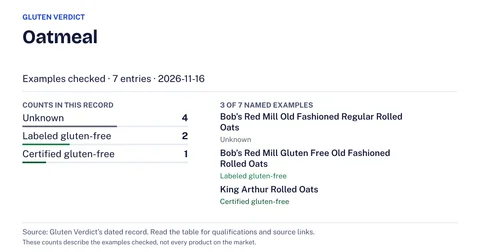
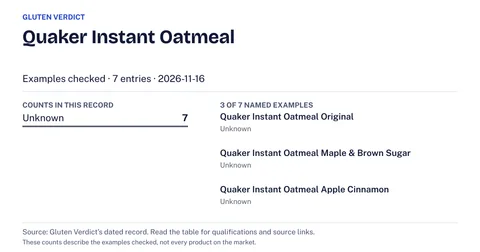
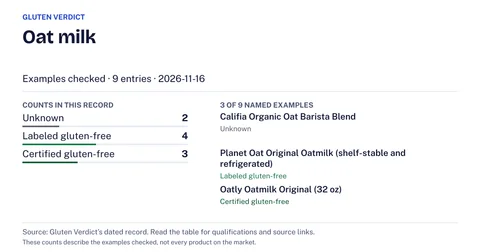
Our verdicts apply US rules and read each maker’s own pages, with the date. For oat products they show the split this guide describes: some carry a gluten-free claim and others of the same kind carry none. Start with oatmeal, Quaker Instant Oatmeal, oat milk and Cheerios.
Where to read a pack’s oat statement
- Find the claim wording first. In the US it is voluntary5, so a pack with no claim is not a pack that failed one.
- On a Canadian pack, read the ingredient list: the oats have to be named as “gluten-free oats” wherever oats are referenced22.
- On a UK pack, Coeliac UK says “pure” and “organic” oats do not tell you whether the product is gluten free18; look for the words “gluten free”.
- On an Australian or New Zealand pack, expect no gluten-free claim on oats at all29, 34; in New Zealand, Coeliac NZ says words like “pure” or “uncontaminated” are not regulated35.
- In the US, oats do not have to be certified to carry the claim1, so the claim wording and the ingredient list are the first things to read.
Verdicts in this guide
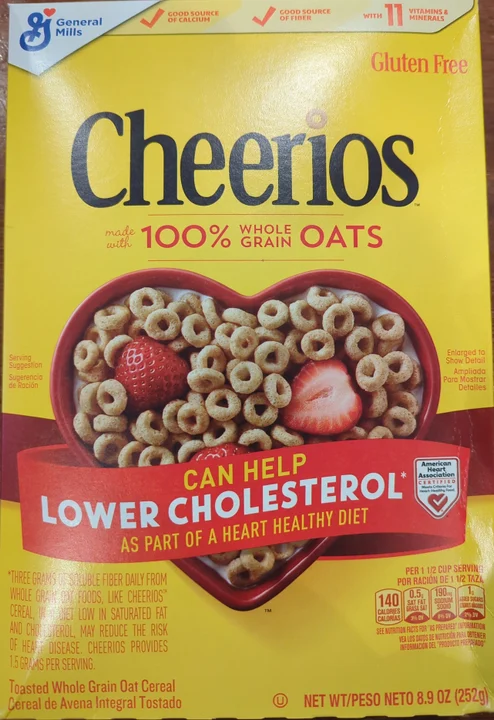
Questions people ask
Can oats be labeled gluten-free in Australia?
No. The Food Standards Code’s “Free” gluten claim requires that the food contain no oats or oat products29.
Do oats need a certification logo to be labeled gluten-free in the US?
No. FDA says oats do not have to be certified, but oats labeled gluten-free must contain less than 20 ppm gluten1.
More in Gluten-free labeling law by country
 Gluten-free labeling in Canada: the claim, the gluten-source declaration and oatsHow Health Canada's gluten-free claim works, how gluten sources and oats must be declared on a Canadian pack, and how it differs from the FDA rule.
 Gluten-free labelling in Australia and New Zealand: what the claim meansWhat “gluten free” and “low gluten” mean on Australian and New Zealand packs: no detectable gluten, no oats, no malt, and how US packs compare.
 Gluten-free labeling rules by country: ceilings, claim wording and where no rule was foundLook up the gluten-free limit and claim wording for the US, Canada, EU, UK, Australia, New Zealand and more, each figure tied to the page we read.
 Gluten-free logos outside the US: who issues each one and what it requiresTell a certifier’s gluten-free logo from a maker’s own: who issues Crossed Grain, Coeliac Australia’s and Celiac Canada’s marks, and the limit each sets.
 May-contain labels abroad: what each country’s regulator says about themWhether a “may contain” or shared-facility line is required, voluntary or guided by a scheme in the US, UK, EU, Canada, Australia, New Zealand and Codex.
 Which gluten grains a pack’s allergen line must name, by countryWhether the allergen line must name barley, rye and oats, country by country: US, Canada, EU, UK, Australia and New Zealand, Brazil, Japan.
Related guides
 Oats and celiac disease: what a gluten-free oat label does and does not tell youWhat FDA’s rule covers for oats, how makers get oats to the gluten-free limit, what avenin studies found, and what to ask your doctor.
 Gluten-free oats vs regular oats: what the label changesTwo canisters of rolled oats, one labeled gluten-free: what the US claim means, how oats reach it, what it does not cover, and how to check.
 Mechanically sorted or purity-protocol oats: what the makers' own pages sayTwo routes lead to a gluten-free oat label. See how to sort a pack by the maker's own words, which pages say what, and what they leave out.
 Gluten-free and very low gluten on EU labels, and how allergens are highlightedWhat EU “gluten-free” and “very low gluten” claims permit, how cereals containing gluten are highlighted in ingredient lists, and the rules for loose food.
Sources
- [1, 2, 3, 4, 5] US Food and Drug Administration, Questions and Answers on the Gluten-Free Food Labeling Final Rule, checked Nov 17, 2026.
- [6, 7] Codex Alimentarius Commission (FAO/WHO), Standard for foods for special dietary use for persons intolerant to gluten (CXS 118-1979), checked Nov 17, 2026.
- [8, 9, 10, 11] European Commission (EUR-Lex), Commission Implementing Regulation (EU) No 828/2014 on gluten-free and very low gluten statements, checked Nov 17, 2026.
- [12, 13, 14] legislation.gov.uk, Regulation (EU) No 828/2014, Annex, UK version, checked Nov 17, 2026.
- [15, 16] Coeliac UK, Gluten and the law, checked Nov 17, 2026.
- [17, 18, 19, 40] Coeliac UK, Oats and the gluten free diet, checked Nov 17, 2026.
- [20, 21, 22, 23, 24, 25] Health Canada, Gluten-free labelling claims for products containing specially produced "gluten-free oats", checked Nov 17, 2026.
- [26] Health Canada, Health Canada's Position on Gluten-Free Claims (June 2012), checked Nov 17, 2026.
- [27, 28, 41] Celiac Canada, Oats Statement: Professional Advisory Council position statement, checked Nov 17, 2026.
- [29, 30] Food Standards Australia New Zealand, Australia New Zealand Food Standards Code, Schedule 4: Nutrition, health and related claims, checked Nov 17, 2026.
Read on 2026-11-17: in the table of conditions for nutrition content claims, the row for gluten has two descriptors. “Free”: the food must not contain (a) detectable gluten; or (b) oats or oat products; or (c) cereals containing gluten that have been malted, or products of such cereals. “Low”: the food contains no more than 20 mg gluten/100 g of the food. The Low row lists no oats condition. This is the authorised version F2026C00415, registered 15/05/2026.
- [31, 32, 33] Food Standards Australia New Zealand, P264 Final Assessment Report (17 March 2004): gluten claims, oats and malt, checked Nov 17, 2026.
- [34, 35, 36, 37, 39] Coeliac New Zealand, Coeliac NZ position statement: Oats and coeliac disease, checked Nov 17, 2026.
- [38] Coeliac New Zealand, The Crossed Grain logo, checked Nov 17, 2026.
- [42] Food Standards Australia New Zealand, Imported foods, checked Nov 17, 2026.
- [43] Health Canada, Archived Marketing Authorizations (table of food Marketing Authorizations), checked Nov 17, 2026.
Read on 2026-11-17: the table headed “Table of Food Marketing Authorizations” lists “Marketing Authorization for Gluten-Free Oats and Foods Containing Gluten-free Oats” with the status “Active – transitioned into a ministerial class exemption order on March 26, 2025”.