Soba vs udon vs rice noodles: which noodle holds wheat
Short answer
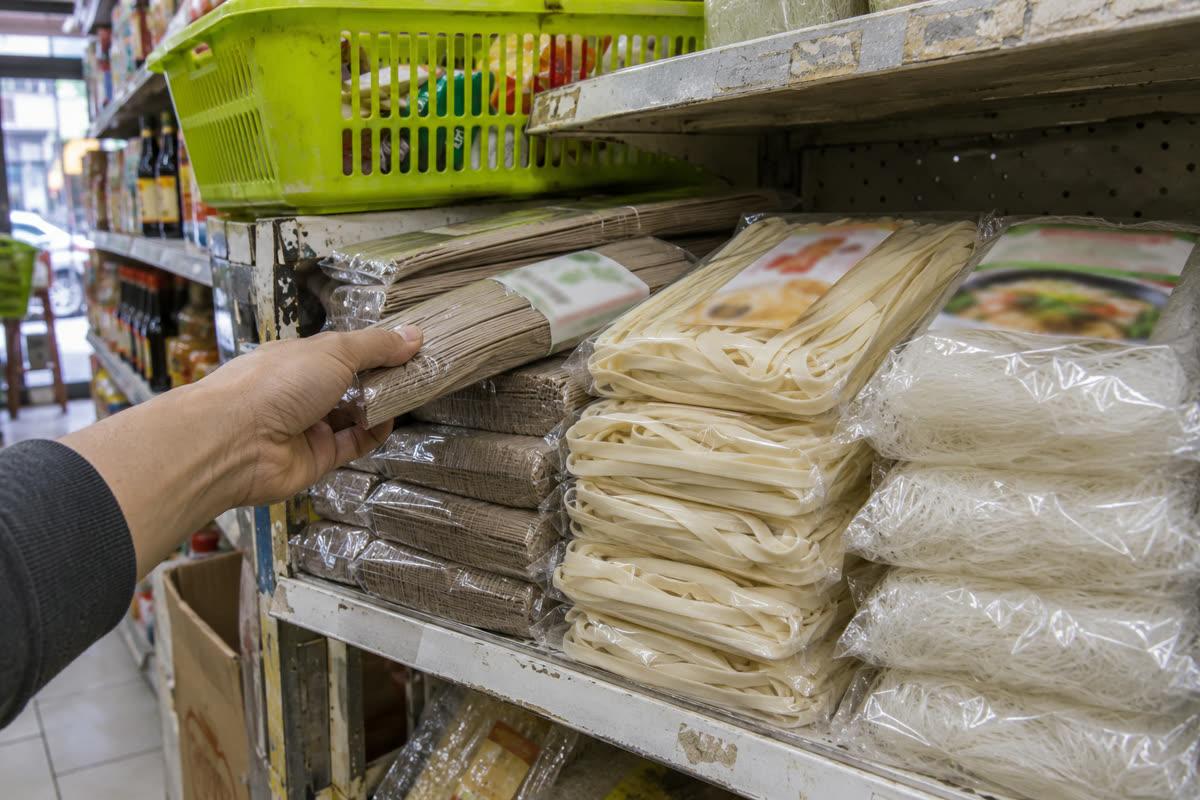
Udon is a wheat noodle1; soba and rice noodles can fit a gluten-free order, but each needs one check:
- Udon: made with wheat flour1. Rice udon is a separate product with its own gluten-free claim13.
- Soba: buckwheat, but some soba is mixed with wheat flour, so read the ingredient list2, 5.
- Rice noodles: almost always gluten-free; confirm they are rice noodles25. Then ask what they are served in.
- Broth and dipping sauce: soy sauce is ordinarily made with wheat, so ask18.
Part of Head-to-head comparisons, 3 guides
Key points
- A soba package that lists only buckwheat flour and water shows no wheat; one that lists wheat flour and says “Contains wheat” is a blend10, 7.
- On a food FDA regulates, a gluten-free claim on a buckwheat noodle covers cross-contact as well as ingredients: any unavoidable gluten must be under 20 ppm19, 20.
- Wheat udon and ramen are wheat noodles; rice udon is a different product1, 13.
- The broth or dipping sauce is a second question for every noodle: soy sauce is ordinarily made with wheat18.
The three noodles side by side
The word on the menu is not the whole answer. Each of these three names covers more than one product, and the sauce or broth is a second question.
| Noodle | What the sources say | What to check |
|---|---|---|
| Udon | Nongshim calls udon “thick, wheat-based noodles”15; the Gluten Intolerance Group says udon is made with wheat flour1. | Whether it is rice udon, a separate product with its own gluten-free claim13. |
| Soba | Made with buckwheat flour alone, or with buckwheat and wheat flour mixed5. | The ingredient list for wheat flour7. |
| Rice noodles | The Gluten Intolerance Group says rice noodles are almost always gluten-free25. | That the noodle really is rice25, and what it is served in. |
For all three, the broth or dipping sauce can add wheat on its own. That is covered below.
Udon: wheat, and rice udon as a separate product
Udon is a wheat noodle1, 15. Nongshim describes it as thick and wheat-based, and its Udon Bowl lists enriched wheat flour15, 16. Myojo’s Original Flavor Udon page lists wheat in its allergy warnings17. The Gluten Intolerance Group says ramen noodles are made with wheat flour too1. Our udon verdict lists the udon products we read, and our ramen verdict covers that noodle.
A gluten-free udon exists, but it is a different noodle. The Gluten Intolerance Group says gluten-free versions of ramen and udon are now widely available from many brands, made with rice, edamame and other ingredients4. Lotus Foods’ Brown & White Udon Rice Noodles page says they are made gluten-free by replacing wheat with brown and white rice13, and the GFCO product finder lists the same maker’s Brown Udon Rice Noodles14.
Because both wheat udon and rice udon exist, “udon” alone on a menu is a question to ask, not an answer.
Soba: buckwheat, wheat blends and how to read the package
Soba made only from buckwheat is the kind the Gluten Intolerance Group calls gluten-free2. The trouble is that soba is not always only buckwheat: the group says to read the ingredients on soba labels because some are made from a mixture of buckwheat and wheat2.
Kikkoman’s glossary says soba is made either with buckwheat flour alone or with a mix of buckwheat and wheat flour, in ratios such as 9:1, 8:2 and 5:55. It does not say which ratio any given package uses, so the ingredient list is where to look.
What the package can say
| What the page shows | What it tells you |
|---|---|
| Ingredients: buckwheat flour and water (King Soba’s organic buckwheat noodles)10 | No wheat in the list. The maker adds that the noodles are produced in a dedicated gluten-free facility9. |
| Ingredients: “Wheat flour, buckwheat flour, salt. Contains wheat.” (Woodland Foods)7 | A wheat and buckwheat blend. Not for a gluten-free order. |
| Allergen: WHEAT, no ingredient list (JFC International’s Akagi Joshu Akagi Soba, a dry soba)8 | Wheat is declared. The page gives no ratio. |
| Buckwheat and brown rice, called gluten-free by the maker (Lotus Foods)11 | A gluten-free claim on a soba made with buckwheat and brown rice. The GFCO product finder lists this product too12. |
A package with no ingredient list in front of you, such as a noodle on a menu or a loose bundle, tells you nothing yet. Ask what it is made of, or leave it. Our soba verdict and buckwheat verdict show what we read, with the date.
What “gluten-free” adds on a buckwheat package
FDA says any grain other than wheat, rye, barley or their hybrids, buckwheat included, can be labeled gluten-free if any unavoidable gluten from cross-contact is less than 20 ppm19. The claim therefore speaks to cross-contact as well as to ingredients19, 20.
That matters because buckwheat can pick up gluten. One study of naturally gluten-free flours and starches bought in Canada in 2010 to 2012 (its first author is at Health Canada) put buckwheat’s mean contamination at 153 mg per kg, among the largest the study reported23. For the ingredients labeled gluten-free, the abstract reports a contamination range of 5 to 141 mg per kg, lower than the full set, and 3 of 268 samples24. That study tested flours and starches, not noodles.
A voluntary line such as “made in a facility that also processes wheat” can appear on a food that also says gluten-free, as long as it is truthful and not misleading21. Read both.
Rice noodles: plain ones are rice, but check the bowl
NIDDK lists rice among foods that are naturally gluten-free without additives or some seasonings27. The Gluten Intolerance Group says rice noodles are almost always gluten-free, and to check the package labeling or talk with the restaurant to confirm they are rice noodles and completely gluten-free25. For a noodle dish at a Thai restaurant, it advises choosing rice noodles and avoiding egg noodles26.
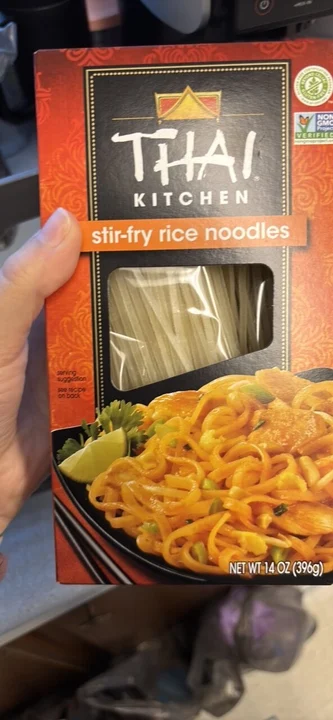
A plain rice noodle package is short. Thai Kitchen’s Stir Fry Rice Noodles lists rice and water29 and says “Gluten free and vegan”28.
A dish called pho or pad thai is not the same as a rice noodle package. Annie Chun’s Pho Soup Bowl, for example, lists hokkien noodles made with wheat flour and wheat gluten30. Our rice noodle, pho and pad thai verdicts keep the product and the dish apart.
The broth and the dipping sauce
A gluten-free noodle can still arrive in a sauce or broth that holds wheat. FDA says soy sauce is ordinarily made by fermenting soybeans and wheat, though some soy sauces are made without wheat18. The Gluten Intolerance Group says shoyu contains wheat unless otherwise noted3.
The usual ways of serving the noodles use a sauce or broth. Kikkoman describes two of the main soba dishes: the noodles dipped in a sauce (mori soba) or mixed with warm broth (kake soba)6. Nongshim describes udon as commonly served in a dashi broth seasoned with soy sauce15, and its Udon Bowl lists soy sauce made with soy and wheat16. Either way, the noodles come with a sauce or broth to ask about.
Sauces are a general place for added gluten, too. The Gluten Intolerance Group notes that many traditional Asian dishes use wheat-based ingredients such as soy sauce, noodles and dumplings35, and says sauces may contain added gluten as a thickener or binding agent34. Packaged bowls show it too: Annie Chun’s pho bowl lists a soy sauce made with wheat in its soup base31.
What to ask
- What is the broth made from, and does it contain soy sauce?
- What is in the dipping sauce? Can it be served as plain broth, or with a gluten-free tamari?
- Is this soba all buckwheat, or buckwheat and wheat flour?
The Gluten Intolerance Group suggests a gluten-free version of soy sauce or tamari as the swap3. Our soy sauce verdict has the bottles we read. More on ordering in our guide to eating out.
Shared boiling water and strainers
If a kitchen cooks wheat noodles and gluten-free ones, ask about the water. The Gluten Intolerance Group’s list of restaurant questions includes one about pasta: “Is the GF pasta boiled in fresh water, or in the same water used for regular pasta?”32. The same question fits a bundle of soba dropped into water that just cooked udon.
The Gluten Intolerance Group also says colanders are hard to clean thoroughly and should not be shared between gluten-free and non-gluten-free use if possible33. So ask about the strainer as well as the pot.
A package check for dry noodles and instant bowls
- Read the ingredient list for wheat flour. “Wheat flour, buckwheat flour, salt” is a blend7.
- Look for a Contains line or an allergen line naming wheat. Wheat is on the list of major food allergens in US law22.
- Look for a gluten-free claim. On a food FDA regulates, any unavoidable presence of gluten must be less than 20 ppm, and the rule also limits gluten-grain ingredients20.
- If the noodles come in a bowl or kit, read the seasoning and soup base too, not only the noodle line31.
- Read any may-contain or shared-facility line along with the claim21.
Our guide to reading food labels covers each of those places in more detail.
Our verdicts for these noodles
Each verdict shows what the maker’s own pages said and the date we read them:
- Soba noodles: depends on the flour; the packages we read ranged from buckwheat and water to a declared wheat allergen10, 8.
- Udon: made with wheat flour; rice udon is its own product1, 13.
- Rice noodles: plain rice noodles, and the bowls and sauces that differ.
- Buckwheat, ramen and soy sauce.
Recipes change, so the package in your hand has the final word.
Verdicts in this guide
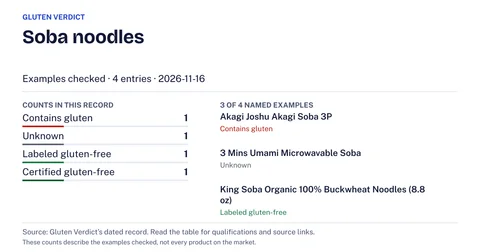 Soba noodlesDepends on the product1 of 4 products we checked contains gluten: Akagi Joshu Akagi Soba 3Pchecked Nov 16, 2026
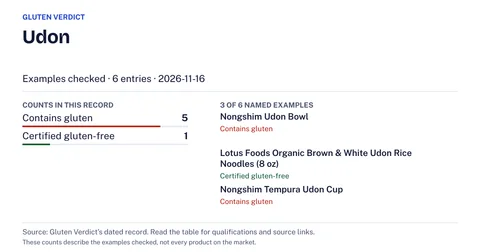 UdonContains glutenchecked Nov 16, 2026
 Rice noodlesNaturally gluten-free2 of 9 products we checked contain gluten: Annie Chun’s Pad Thai Noodle Bowl with Vegetables and Annie Chun’s Pho Soup Bowl with VegetablesBuy it labeled gluten-freechecked Nov 16, 2026
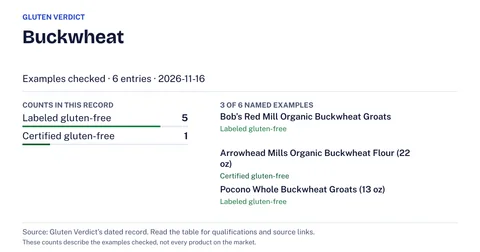 BuckwheatNaturally gluten-freeBuy it labeled gluten-freechecked Nov 16, 2026
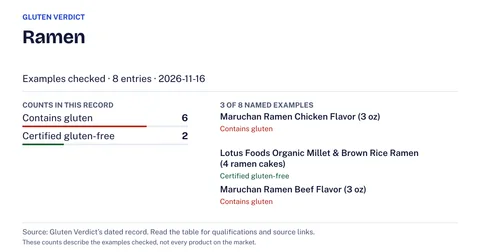 RamenContains glutenchecked Nov 16, 2026
 Soy sauceDepends on the product3 of 7 products we checked contain gluten: Kikkoman Soy Sauce (Non-GMO), 20 oz; San-J Organic Shoyu Soy Sauce; and Lee Kum Kee Premium Soy Sauce (No Preservatives Added)checked Nov 16, 2026
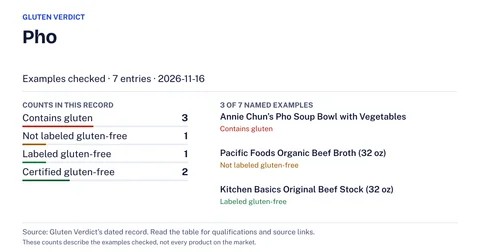 PhoDepends on the product3 of 7 products we checked contain gluten: Annie Chun’s Pho Soup Bowl with Vegetables, Lee Kum Kee Hoisin Sauce (jar), and Kikkoman Hoisin Sauce (9.3 oz)checked Nov 16, 2026
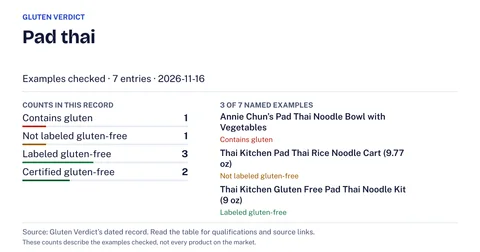 Pad thaiDepends on the product1 of 7 products we checked contains gluten: Annie Chun’s Pad Thai Noodle Bowl with Vegetableschecked Nov 16, 2026
Questions people ask
Is soba gluten-free?
Not always. Some soba is only buckwheat, and some is a mixture of buckwheat and wheat flour2, 5. The ingredient list tells you which.
Can a food made only from buckwheat be labeled gluten-free?
Yes. FDA says a grain other than wheat, rye, barley or their hybrids can be labeled gluten-free if any unavoidable gluten from cross-contact is less than 20 ppm19.
Is udon ever gluten-free?
Wheat udon is not gluten-free; the Gluten Intolerance Group says udon noodles are made with wheat flour1. Udon made from rice is a separate product, and its maker says so on its product page13.
More in Head-to-head comparisons
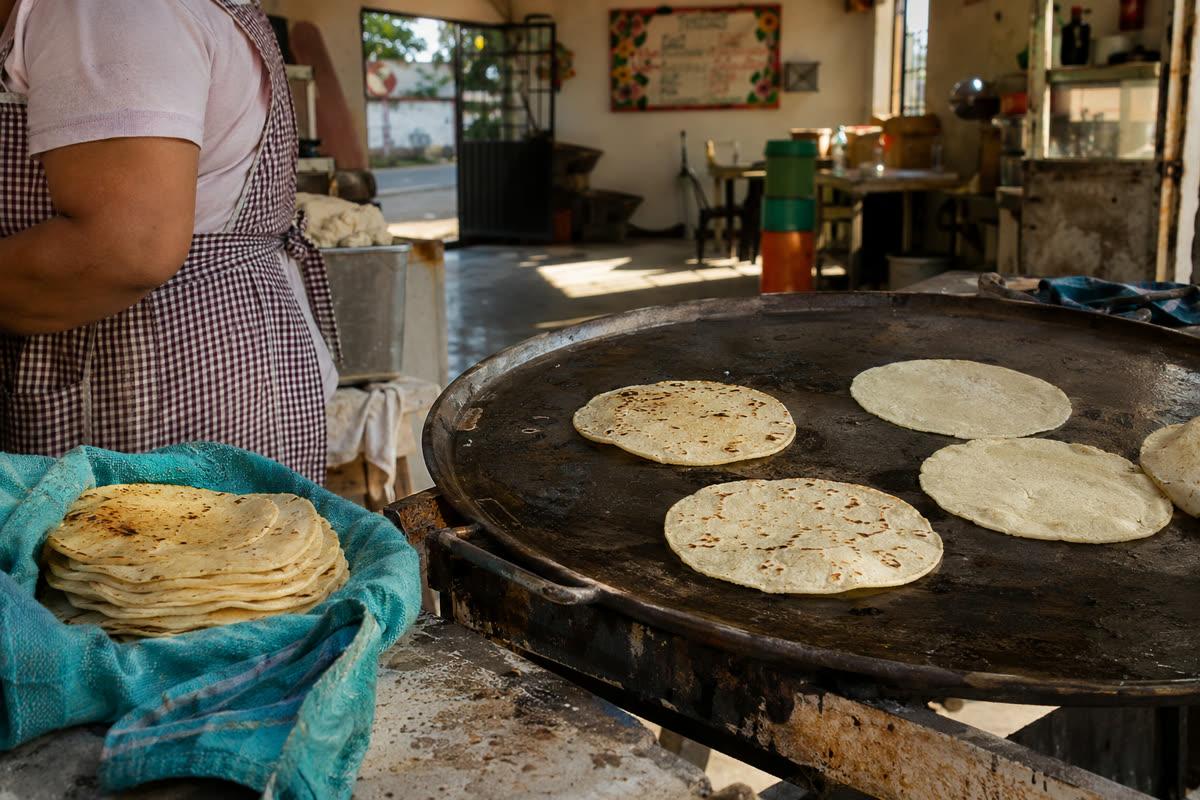 Corn vs flour tortillas: the label line and the griddle questionFlour tortillas contain wheat; corn ones may too. What to read on the package, and two questions to ask a restaurant about the tortillas and the griddle.
 Gluten-free oats vs regular oats: what the label changesTwo canisters of rolled oats, one labeled gluten-free: what the US claim means, how oats reach it, what it does not cover, and how to check.
Related guides
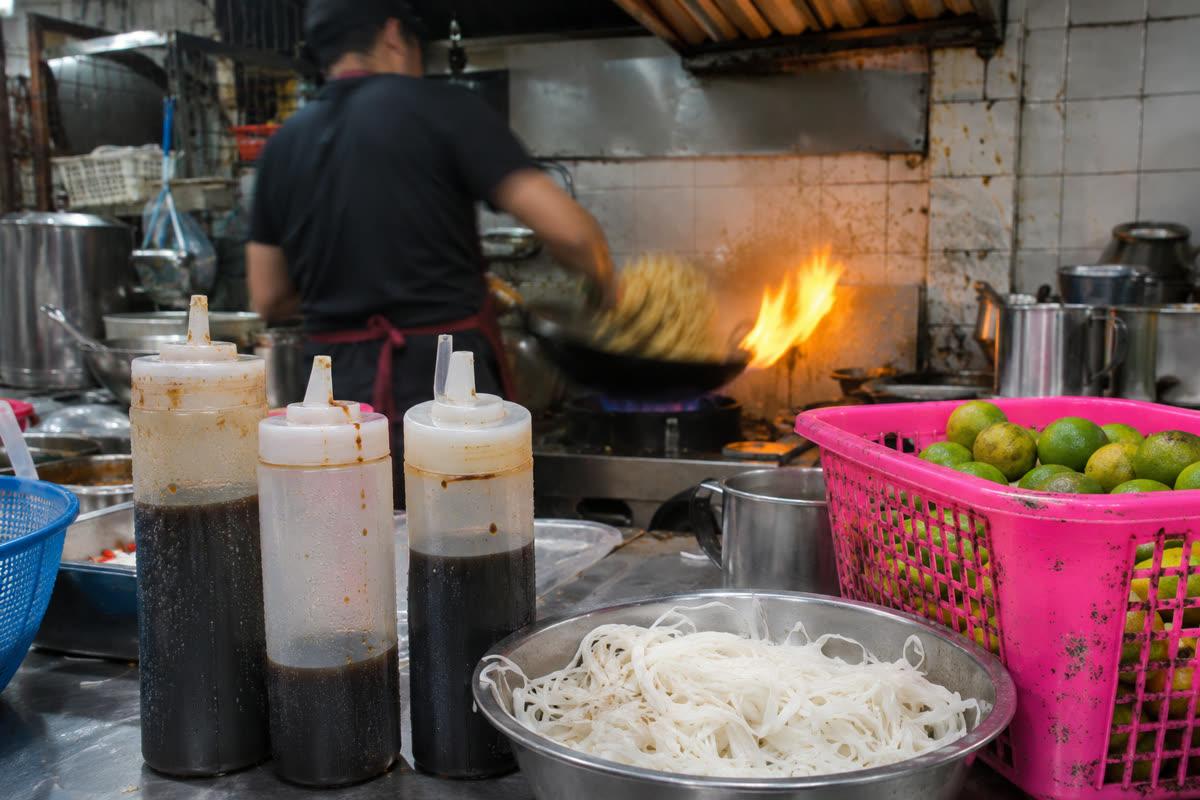 Ordering at a Thai restaurant when you avoid gluten: sauces, noodles and woksWhich Thai sauces, noodles, coatings and kitchen habits can bring in wheat, and the questions to ask before you order at a Thai restaurant.
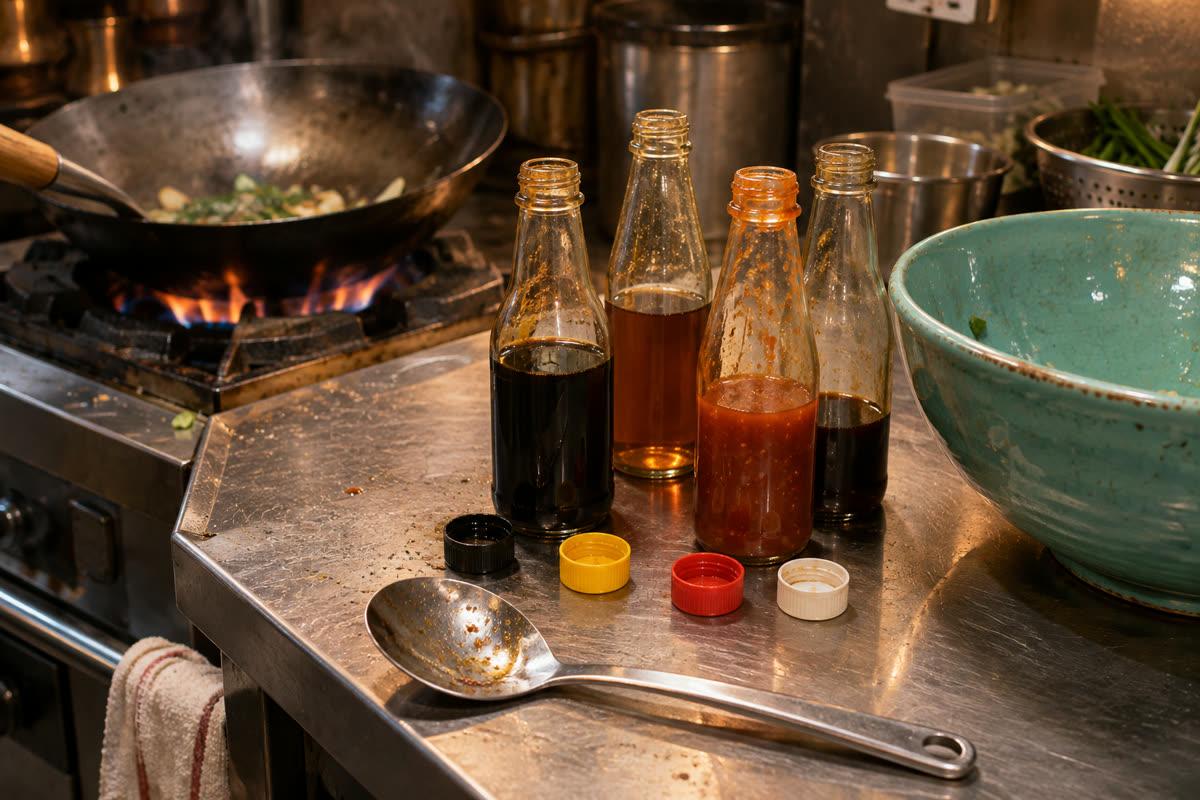 Soy, hoisin, oyster, teriyaki and fish sauce: which bottles carry wheatSoy, hoisin, oyster, teriyaki and fish sauce compared by the ingredient lists of Kikkoman, Lee Kum Kee, San-J and Red Boat, plus what to ask at a counter.
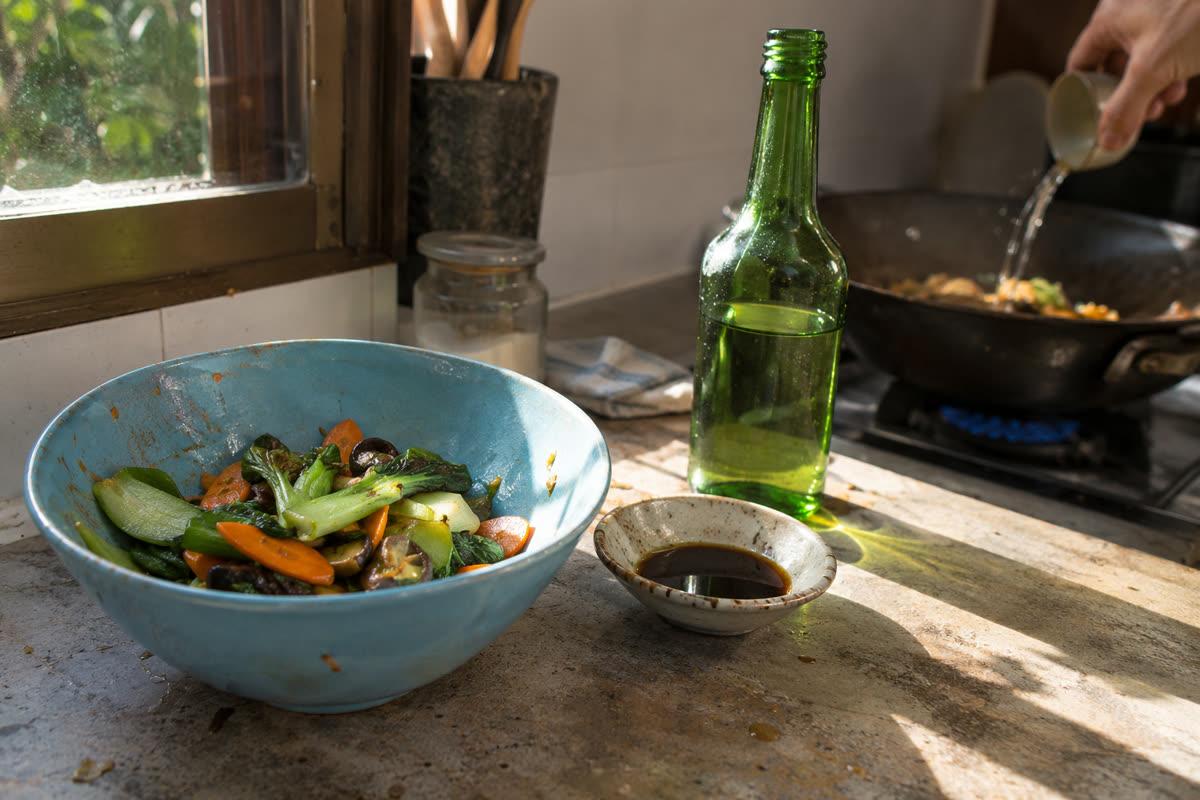 What to use instead of soy sauce when you eat gluten-freeTamari, gluten-free soy sauce, coconut aminos and liquid aminos: what each maker says, how to confirm it on the bottle, and what changes when you cook.
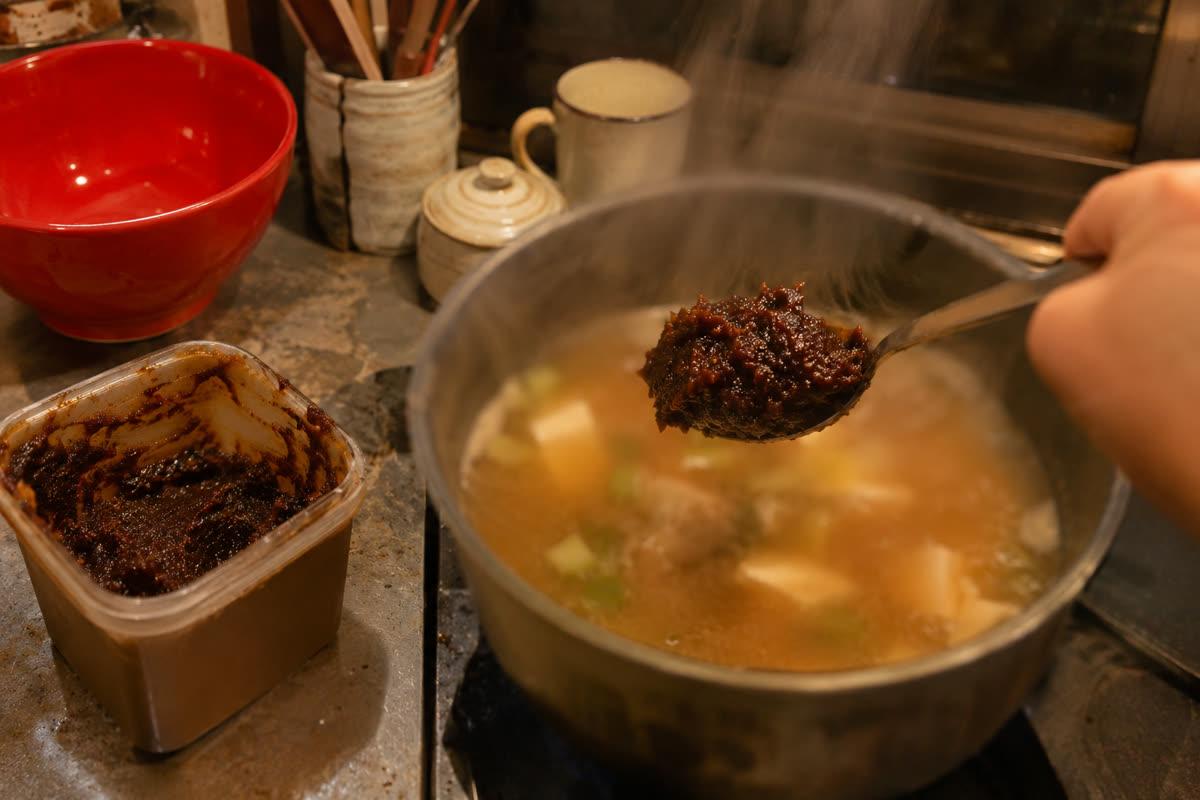 Miso, gochujang and other fermented pastes: where barley and wheat are usedHow to pick a miso or gochujang jar: read the koji grain, the full ingredient list and the maker’s gluten-free statement.
Sources
- [1, 2, 3] Gluten Intolerance Group, Japanese Cuisine When You’re Eating Gluten-Free, checked Nov 17, 2026.
- [4, 35] Gluten Intolerance Group, Explore Asian Cuisine, Gluten-Free, checked Nov 17, 2026.
- [5, 6] Kikkoman Corporation, Soba / Buckwheat Noodles (glossary), checked Nov 17, 2026.
- [7] Woodland Foods, Soba Noodles, checked Nov 17, 2026.
- [8] JFC International, Akagi Joshu Akagi Soba 3P (item 19556), checked Nov 17, 2026.
Read on 2026-11-17: the catalog page for item 19556 (Sub-Category “Soba Dry”) lists the allergen as WHEAT; it shows no ingredient list.
- [9, 10] King Soba USA, Organic Buckwheat Noodles (product page), checked Nov 17, 2026.
Read on 2026-11-17: the ingredients line reads buckwheat flour and water, and nothing else; the page does not list wheat.
- [11] Lotus Foods, Organic Buckwheat & Brown Soba Rice Noodles, checked Nov 17, 2026.
- [12] Gluten-Free Certification Organization, GFCO Product Finder search for soba, checked Nov 17, 2026.
Read the GFCO Product Finder results for “soba” on 2026-11-17: the list includes Buckwheat & Brown Soba Rice Noodles, Lotus Foods, UPC 708953641058, sales region US, Canada.
- [13] Lotus Foods, Organic Brown & White Udon Rice Noodles, checked Nov 17, 2026.
- [14] Gluten-Free Certification Organization, GFCO Product Finder search: udon, checked Nov 17, 2026.
Read the GFCO Product Finder results for “udon” on 2026-11-17: the list includes Brown Udon Rice Noodles, Lotus Foods, UPC 708953641065, sales region US, Canada.
- [15, 16] Nongshim USA, Udon Bowl, checked Nov 17, 2026.
Read on 2026-11-17: the ingredients list names enriched wheat flour and soy sauce (soy, wheat, salt).
- [17] Myojo USA, Original Flavor Udon, checked Nov 17, 2026.
- [18, 19, 20, 21] US Food and Drug Administration, Questions and Answers on the Gluten-Free Food Labeling Final Rule, checked Nov 17, 2026.
- [22] US Food and Drug Administration, Food Allergen Labeling and Consumer Protection Act of 2004 (FALCPA), checked Nov 17, 2026.
- [23, 24] Food Additives & Contaminants, Part A (PubMed record; first author at Health Canada), Gluten contamination of naturally gluten-free flours and starches used by Canadians with celiac disease, checked Nov 17, 2026.
- [25, 26] Gluten Intolerance Group, Exploring Thai Cuisine on a Gluten-Free Diet, checked Nov 17, 2026.
- [27] National Institute of Diabetes and Digestive and Kidney Diseases (NIDDK), Eating, Diet, & Nutrition for Celiac Disease, checked Nov 17, 2026.
- [28, 29] McCormick (Thai Kitchen), Thai Kitchen Gluten Free Stir Fry Rice Noodles, 14 oz, checked Nov 17, 2026.
- [30, 31] Annie Chun’s, Pho Soup Bowl with Vegetables, checked Nov 17, 2026.
- [32] Gluten Intolerance Group, Questions to Ask When Eating Out, checked Nov 17, 2026.
- [33] Gluten Intolerance Group, 25 Ways Cross-Contact Could Happen and How to Avoid It, checked Nov 17, 2026.
- [34] Gluten Intolerance Group, Restaurant Dining: Seven Tips for Staying Gluten-Free, checked Nov 17, 2026.