Gluten-free in Brazil: the “contém glúten” line, pão de queijo, farofa and tapioca
Short answer
Brazilian law requires every industrialized food to say “contém glúten” or “não contém glúten”1, 3. Check four things, in this order:
- Find that line on the pack, and read the allergen warning under the ingredient list too: in Anvisa’s guidance a “pode conter” warning for wheat, rye, barley or oats still goes with “contém glúten”2.
- Do not assume a number stands behind “não contém glúten”: the law gives no numeric limit for it, and Anvisa’s food division said in an April 2025 document that there is no legal basis to apply 20 mg of gluten per kg3, 4.
- For cheese bread, snacks and anything not in a package, judge the recipe and the kitchen: FENACELBRA lists cheese bread made in a bakery that uses wheat flour among foods that can be contaminated5.
- In restaurants, ask about thickeners, the grill and the fryer: FENACELBRA says sauces, soups and beans can have wheat flour added as a thickener6.
- Gluten-free limit
- No numeric limit: Law 10.674 gives none, and Anvisa’s food division said in an April 2025 document that there is no legal basis for applying 20 mg of gluten per kg3, 4. Industrialized foods must say “contém glúten” or “não contém glúten”1
Part of Travel: the Americas and Oceania, 10 guides

Key points
- The statement is mandatory on industrialized foods1, but it is not backed by a number: Brazilian law sets no limit for “não contém glúten”3, 4.
- In Anvisa’s guidance, “contém glúten” goes on a pack both when wheat, rye, barley or oats are ingredients7 and when the maker only warns of cross-contact2, so the line alone does not say which.
- Yoki’s page for its polvilho azedo (cassava starch) reads “Não contém Glúten”8, but FENACELBRA lists bakery cheese bread among foods that may be contaminated5.
- FENACELBRA’s food table lists salgadinhos, empadão, kibe, bife à milanesa and industrial farofa as containing gluten9.
- Brazil’s beer standard allows “cerveja sem glúten” for beer from gluten-free cereals10, and Anvisa’s 2025 document says several beers registered as “sem glúten” are made from gluten-containing raw materials and treated with proteases11.
The line on every packaged food
Law 10.674 of 16 May 2003 says all industrialized foods must carry, on the label and package leaflet (bula), the statement “contém glúten” or “não contém glúten”, as the case may be1. The warning has to be printed on labels and packaging, and on posters and promotional material, in characters that stand out and are clear and easy to read12.
The allergen warning is a separate line. Under Anvisa’s resolution RDC 727/2022 the warnings sit directly after or below the ingredient list, in capitals and bold, in a color that contrasts with the background13. The list of allergenic foods begins with wheat, rye, barley, oats and their hybridized strains14.
The table below gives Anvisa’s answers in its question-and-answer guide on allergen labelling (6th edition, May 2024). It is guidance on how the two statements fit together, not the text of the law.
| What the allergen warning says | What the gluten line must say |
|---|---|
| “ALÉRGICOS: CONTÉM …” or “CONTÉM DERIVADOS DE …”, naming wheat, rye, barley or oats | “CONTÉM GLÚTEN”7 |
| “ALÉRGICOS: PODE CONTER …”, naming wheat, rye, barley or oats. RDC 727/2022 requires this warning where cross-contact cannot be ruled out15 | “CONTÉM GLÚTEN” as well, because the law has no way to declare cross-contact for gluten2 |
| No warning about those four cereals | “NÃO CONTÉM GLÚTEN”16 |
A maker’s page shows the pattern. Yoki’s page for its Farofa Suave prints “Alérgicos: Contém Derivados De Soja. Pode Conter Trigo. Contém Glúten.”17. So “contém glúten” can mean a gluten ingredient or only a wheat warning7, 2; read the ingredient list to tell which.
Anvisa’s own 2025 document says products are still found on the market with both a cross-contact warning and a “não contém glúten” statement18. Where the two disagree, the cross-contact warning is the part to take seriously.
What “não contém glúten” does not promise
Anvisa’s April 2025 discussion document says Law 10.674 did not define parameters for classifying a food as free of gluten3. It adds that Anvisa’s food division keeps saying there is no legal basis for a limit of 20 mg of gluten per kilogram, and that a food should be considered free of gluten only when its presence cannot be detected by analysis4.
| Brazil | United States (FDA) | |
|---|---|---|
| Is a gluten statement required? | Yes: “contém glúten” or “não contém glúten” on industrialized foods1 | No: “gluten-free” is a voluntary claim19 |
| What number stands behind it? | None in the law; Anvisa says there is no legal basis for 20 mg/kg4 | Less than 20 parts per million20 |
The same document says the gluten declaration was left out of the allergen-labelling rule and put off to a later time21. It also says Anvisa told the agriculture ministry it intends to take the subject up, suggesting that the Codex Alimentarius reference values be adopted22. We have not read any rule published after that document, so check Anvisa’s site if the exact limit matters to your trip.
FENACELBRA’s own advice is to read the label of every packaged food, even foods that are naturally free of gluten, and to leave it if in doubt23.
Pão de queijo and cassava starch
A guide on FENACELBRA’s site calls pão de queijo “naturalmente sem glúten”24, and a frozen cheese bread maker, Brazi Bites, says its product is made with tapioca flour, which makes it naturally gluten-free25, and that all its products are Certified Gluten-Free26. The Brazilian maker Yoki sells polvilho azedo, sour cassava starch, with the ingredient list “Fécula de mandioca. Não contém Glúten.”8. FENACELBRA’s food table lists polvilho (sweet and sour) and goma de tapioca among foods without gluten27.
The risk the sources name is the place, not the starch. The same guide’s example of cross-contamination in a professional kitchen is a traditional bakery that makes pão de queijo in a room full of airborne wheat flour, on the same bench and in the same oven24. Its table lists polvilho biscuits and pão de queijo made in a bakery, or anywhere wheat flour is worked, among foods that are naturally free of gluten but may be contaminated5.
Questions for a bakery counter:
- Is the cheese bread baked in an oven that also bakes wheat bread?
- Is it shaped on a bench that also handles wheat flour?
- Is it made only with polvilho or tapioca starch, or is any wheat flour added?
A packaged cheese bread carries the gluten line like any other industrialized food1. Our verdicts for bread, cheese and flour cover the ingredients.
FENACELBRA’s table places pão de queijo in a “permitted in moderation” column: free of gluten, but with cheese and fatty sauces28. That is a nutrition note, not a gluten warning.
Tapioca, farofa, feijoada and churrasco
Tapioca
FENACELBRA lists goma de tapioca and tapioca among foods without gluten27, and Yoki’s granulated tapioca page reads “Não contém glúten”29. The Italian celiac society AIC, writing for home cooks, still tells readers to check that the tapioca they use carries a gluten-free claim on its label30. See our verdict for tapioca. Beyond the starch, ask what a stand fills it with and what it cooks on. GIG’s list asks whether a pan is separate from gluten foods31.
Farofa
AIC describes farofa as cassava flour toasted with butter, margarine or oil, to which a cook may add bacon, sausage, onion, egg, banana or cabbage32. Packaged farofa follows the pack: Yoki’s Farofa Suave says “Pode Conter Trigo. Contém Glúten.”17, while the page for its Farofa Tradicional shows an ingredient list of cassava flour, palm oil, garlic, salt and seasonings and no gluten line33. FENACELBRA’s table lists industrialized farofa among foods that contain gluten9. Read each pack.
Feijoada
AIC describes feijoada as beans, meat and rice, with recipes that vary by ingredients and preparation34. The beans are one question and the meats another; see our verdicts for sausage and rice. FENACELBRA lists sauces, soups and beans in restaurants as foods that may have wheat flour added as a thickener6, and food on a self-service counter as possibly contaminated when serving utensils are swapped35. GIG’s list asks the matching question: does this contain flour or roux36?
Churrasco
AIC describes churrasco as grilled meats that are marinated first and then cooked on the grill37. So the questions are the marinade and the grill: GIG suggests asking what is in the marinades and seasonings38, and whether the grill is separate or shared with gluten foods and, if shared, how it is cleaned39.
Coxinha, pastel and other fried snacks
FENACELBRA’s table lists empadão, salgadinhos, kibe, bife à milanesa and empanados among foods that contain gluten9. Yoki’s recipe for pastel mineiro lists wheat flour and cornmeal among its ingredients40, and its coxinha recipe lists wheat flour and breadcrumbs41. Those are one maker’s recipes, so they do not describe every stand, but they show where to ask: about the dough and the coating. See our verdict for breadcrumbs.
Frying is the second question. FENACELBRA’s table lists French fries in restaurants and at parties as a risk because the oil is reused from other fried foods such as pastel, salgadinhos and breaded foods42, and a nutritionist’s ten steps on its site say to avoid fried food on the street because of cross-contamination with gluten43. GIG’s list asks whether there is a dedicated fryer44.
Polvilho biscuits made in a bakery that works with wheat flour fall under the same warning as bakery cheese bread5; see our verdict for cookies.
Sweets and drinks: brigadeiro, caipirinha and beer
For gluten-free versions of Brazilian sweets, AIC says coconut flour, grated coconut, condensed milk, cocoa powder and chocolate sprinkles might contain gluten as an ingredient or through contamination45. FENACELBRA’s table lists chocolate containing malt, and party sweets, cakes and pies, among foods that contain gluten9; a nutritionist’s page on its site adds that malt comes from barley and is used in beer, chocolates and biscuits46. See our verdict for chocolate.
AIC says the caipirinha’s ingredients are permitted because distillates are, when no flavors or other substances are added47. FENACELBRA’s table lists cachaça and natural guaraná or guaraná syrup among drinks that are free of gluten but to be taken in moderation28. If a version has other ingredients added, ask what they are.
Beer is a different case. The agriculture ministry’s standard defines beer as a drink fermented from malted barley wort or malt extract48, and it allows “cerveja sem glúten” only for beer made from cereals that give no gluten, or with gluten below a limit set in a specific technical regulation10. Anvisa’s 2025 document says the agriculture ministry told brewers to use 20 mg of gluten per kg as a reference49, and that several beers registered as “sem glúten” are made from raw materials that naturally contain gluten and are treated with proteases11. So the words “sem glúten” can sit on beer brewed from gluten-free cereals and on beer made from gluten-containing grain10, 11. Our gluten-removed beer guide explains the second kind, and our verdict covers beer.
Supermarkets and bulk bins
For packaged food, FENACELBRA’s advice is to look for “Não contém glúten” on the pack, even on foods that are naturally free of gluten23. Its table names foods sold in bulk, sliced cheese and cold cuts in bakeries, and ground coffee in bakeries, bars and snack bars as possibly contaminated50. A cross-contamination guide on FENACELBRA’s site says bulk-sale areas often use the same containers, grinders and measuring cups for products with and without gluten51.
What to ask, and what to say
No source we could open for this guide gives a restaurant sentence in Portuguese specific to Brazil, so we do not write one here. Our guide to asking for gluten-free in Spanish and Portuguese has the wording its sources print. What a source prints, and you can point at, are the label statements: “contém glúten” and “não contém glúten”1, and the allergen warnings that begin “ALÉRGICOS: CONTÉM” and “ALÉRGICOS: PODE CONTER”15. Show the line on a pack to a shop assistant and ask whether the product is the one you mean.
Questions to carry, from GIG’s restaurant list, to put through a translation you trust:
- Is there a dedicated fryer for gluten-free foods?44
- Does this contain flour or roux?36
- What is in the marinades and seasonings?38
- Is the grill separate or shared with gluten foods, and how is it cleaned?39
- Can my meal be cooked in a separate pan?31
Add the Brazilian items from this guide: which flour is on the bench for the cheese bread, and whether the beans or sauce are thickened with wheat flour6.
Verdicts in this guide
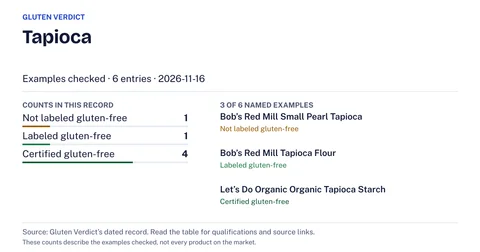 TapiocaNaturally gluten-freeBuy it labeled gluten-freechecked Nov 16, 2026
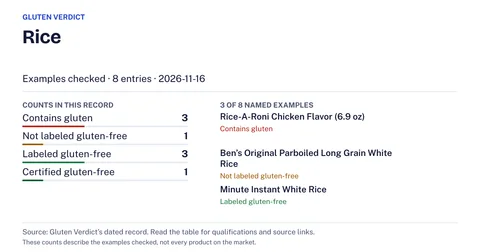 RiceNaturally gluten-free3 of 8 products we checked contain gluten: Rice-A-Roni Chicken Flavor (6.9 oz), Near East Original Rice Pilaf, and Ben’s Original Ready Rice Rice PilafBuy it labeled gluten-freechecked Nov 16, 2026
 BreadContains glutenchecked Nov 16, 2026
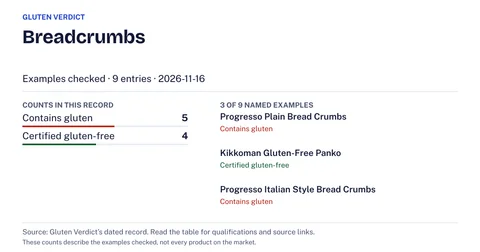 BreadcrumbsContains glutenchecked Nov 16, 2026
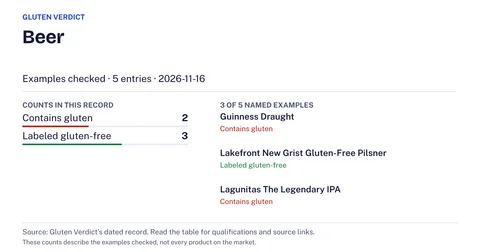 BeerDepends on the product2 of 5 products we checked contain gluten: Guinness Draught and Lagunitas The Legendary IPAchecked Nov 16, 2026
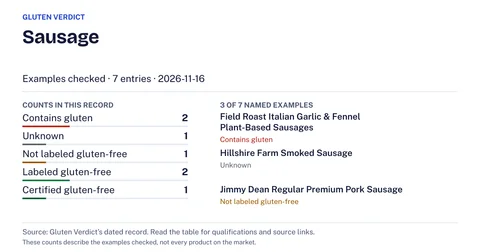 SausageDepends on the product2 of 7 products we checked contain gluten: Field Roast Italian Garlic & Fennel Plant-Based Sausages and Tofurky Plant-Based Italian Sausagechecked Nov 16, 2026
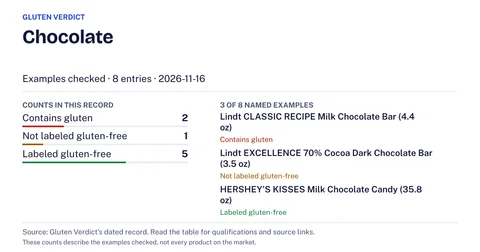 ChocolateDepends on the product2 of 8 products we checked contain gluten: Lindt CLASSIC RECIPE Milk Chocolate Bar (4.4 oz) and HERSHEY’S Cookies ‘N’ Creme Candy Bar (1.55 oz)checked Nov 16, 2026
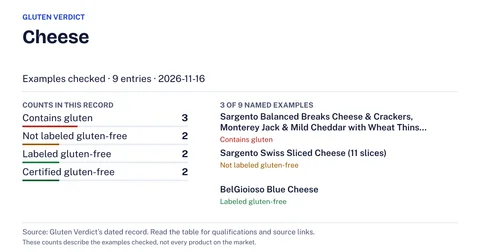 CheeseNaturally gluten-free3 of 9 products we checked contain gluten: Sargento Balanced Breaks Cheese & Crackers, Monterey Jack & Mild Cheddar with Wheat Thins Mini (6-pack); Farm Rich Mozzarella Sticks; and Farm Rich Cheddar Cheese Curdschecked Nov 16, 2026
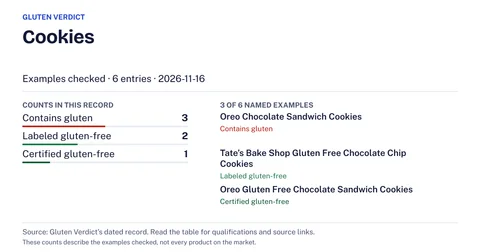 CookiesContains glutenchecked Nov 16, 2026
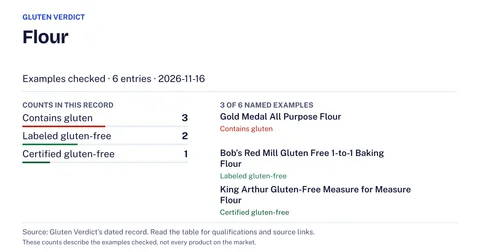 FlourContains glutenchecked Nov 16, 2026
Questions people ask
Is pão de queijo gluten-free in Brazil?
A guide on FENACELBRA’s site calls it naturally gluten-free24, and Yoki’s page for its polvilho (cassava starch) reads “Não contém Glúten”8. FENACELBRA lists pão de queijo made in a bakery that works with wheat flour among foods that may be contaminated5, so ask about the oven and the bench. A packaged one must carry the gluten line1.
Does “contém glúten” always mean a gluten grain is an ingredient?
No. Anvisa’s guidance puts “contém glúten” on a pack that only warns of possible cross-contact with wheat, rye, barley or oats2, and also on one that names them as ingredients7.
Is “não contém glúten” the same as the US “gluten-free”?
Not in what the rules say. The Brazilian law sets no numeric limit3, while the FDA’s rule requires less than 20 parts per million20.
Are oats treated as a gluten grain in Brazil?
Anvisa’s allergen list names oats with wheat, rye and barley14, and its guidance counts them with those cereals for the “contém glúten” line7. FENACELBRA’s FAQ says oats are also on its list of prohibited cereals because, worldwide, they suffer gluten contamination along their whole production chain52.
Does the law cover restaurant menus?
The text we read speaks of labels, packaging, posters and promotional material12. We did not find a statement about restaurant menus in the sources we read.
More in Travel: the Americas and Oceania
 Gluten-free in the Caribbean: island dishes, jerk labels and cruise port daysWhich Caribbean doughs, soup mixes and jerk sauces list wheat, what a cruise line’s dietary request covers on a port day, and what to ask.
 Gluten-free in Argentina: sin TACC, the ANMAT list, parrilla and milanesaWhat “sin TACC” means, how to check a product in ANMAT’s official list, and how to judge parrilla, milanesa, empanadas and alfajores in Argentina.
 Gluten-free in Peru: chifa soy sauce, bread in the sauce and Ley 31881Where wheat enters Peruvian cooking (sillao in chifa dishes, bread in sauces), what Peru’s gluten-free label law settles, and how to plan trek meals.
 Gluten-free in Hawaii, Puerto Rico and the US Virgin IslandsDoes the US gluten-free label rule hold in Hawaii, Puerto Rico and the USVI? Plus poke sauce, SPAM, musubi, seasoning packets and rum.
 Gluten-free in New Zealand: the shared food code, oats, Marmite and the borderWhat a US visitor needs for gluten-free food in New Zealand: the shared Australian claim, oats, Marmite, Coeliac NZ marks and border declaration.
 Bringing gluten-free food into Canada, Mexico, Australia and New ZealandWhat a US traveler can carry into Canada, Mexico, Australia and New Zealand: declare food, pack to each country’s list, and know what to buy there.
Related guides
 Gluten-free labeling rules by country: ceilings, claim wording and where no rule was foundLook up the gluten-free limit and claim wording for the US, Canada, EU, UK, Australia, New Zealand and more, each figure tied to the page we read.
 May-contain labels abroad: what each country’s regulator says about themWhether a “may contain” or shared-facility line is required, voluntary or guided by a scheme in the US, UK, EU, Canada, Australia, New Zealand and Codex.
 Gluten-removed beer: what the treatment does, why the tests are disputed and what the TTB statement saysWhat “crafted to remove gluten” means on a barley beer, why lab results on it are disputed, and what TTB, NCA and GIG say, for your clinician talk.
 Gluten-free in Portugal: the couvert, pastelarias and what to askWhat «isento de glúten» means in Portugal, what you owe for the couvert, what restaurants must say about allergens, and what the celiac society advises.
Sources
- [1, 12, 13, 14, 15] FENACELBRA (Federação Nacional das Associações de Celíacos do Brasil), Rotulagem de alimentos: Lei nº 10.674/2003 (text reproduced), checked Nov 17, 2026.
- [2, 7, 16] Anvisa (Brazilian health regulator), Rotulagem de alimentos alergênicos: perguntas e respostas (6ª edição, 13 de maio de 2024), checked Nov 17, 2026.
- [3, 4, 11, 18, 21, 22, 49] Anvisa (Brazilian health regulator), Revisão da regulamentação sobre rotulagem de alimentos alergênicos: documento para discussão regulatória (abril de 2025), checked Nov 17, 2026.
- [5, 6, 9, 27, 28, 35, 42, 50] FENACELBRA (Federação Nacional das Associações de Celíacos do Brasil), Alimentos proibidos e permitidos (table, PDF; material by nutritionist Dra. Juliana Crucinsky), checked Nov 17, 2026.
Read on 2026-11-17: under the heading “Alimentos naturalmente isentos de glúten, mas que podem estar contaminados”, the table lists “Biscoitos de polvilho e pão de queijo preparados em padaria ou ambientes onde se trabalha com farinha de trigo”.
Read on 2026-11-17: in the table, the column “Proibido – contém glúten” names, among other items, farofa industrializada (tubers and their flours); empadão, salgadinhos and kibe (breads, biscuits and pasta); bife à milanesa and empanados (proteins); bolos, tortas, docinhos de festa and chocolate contendo malte (sweets); and cerveja and whisky (drinks).
Read on 2026-11-17: in the table, the column “Permitidos – não contém glúten” names polvilho (doce e azedo) and goma de tapioca (tubers and their flours), and biscoito de polvilho and tapioca (breads, biscuits and pasta).
Read on 2026-11-17: in the table, the column “Permitidos com moderação”, headed “Isentos de glúten, porém contém muito açúcar, sódio, álcool, gorduras e/ou aditivos químicos”, names “Pão de queijo, lasanha, pizza e massas em geral isentas de glúten, porém contendo queijo e molhos gordurosos”, and among drinks vinho, saquê, cachaça, vodka, cerveja sem glúten, Prosecco, Champagne, refrescos industrializados, refrigerante and guaraná natural/xarope de guaraná.
Read on 2026-11-17: under the heading “Alimentos naturalmente isentos de glúten, mas que podem estar contaminados”, the table lists “Alimentos no balcão dos restaurantes self service (podem ser contaminados pela troca de talheres, na hora de servir)”.
Read on 2026-11-17: under the same heading, the table lists “Alimentos vendidos a granel – grãos, sementes/oleaginosas, ervas/condimentos, chás, etc.”, “Queijos e frios fatiados em padarias” and “Café previamente moído, em padarias, bares e lanchonetes (pode estar contaminado com cevada)”.
- [8] Yoki Alimentos, Polvilho Azedo 500 g e 1 kg (product page), checked Nov 17, 2026.
- [10, 48] FENACELBRA (Federação Nacional das Associações de Celíacos do Brasil), Rotulagem de bebidas: Instrução Normativa MAPA nº 65/2019 (text reproduced), checked Nov 17, 2026.
- [17] Yoki Alimentos, Farofa Suave 200 g (product page), checked Nov 17, 2026.
- [19, 20] US Food and Drug Administration, Gluten and Food Labeling, checked Nov 17, 2026.
- [23] FENACELBRA (Federação Nacional das Associações de Celíacos do Brasil), Tabela de alimentos (page), checked Nov 17, 2026.
- [24, 51] FENACELBRA (Federação Nacional das Associações de Celíacos do Brasil), Contaminação cruzada por glúten na cozinha (guide by Dra. Ana Paula Braganholo, on FENACELBRA’s site), checked Nov 17, 2026.
- [25, 26] Brazi Bites, FAQ, checked Nov 17, 2026.
- [29] Yoki Alimentos, Tapioca Granulada 500 g (product page), checked Nov 17, 2026.
- [30, 32, 34, 37, 45, 47] Associazione Italiana Celiachia (AIC), Un weekend con la cucina brasiliana (Celiachia Notizie, 1/2021), checked Nov 17, 2026.
- [31, 36, 38, 39, 44] Gluten Intolerance Group, What are some of the most important questions to ask the wait staff or management of a food service or restaurant?, checked Nov 17, 2026.
- [33] Yoki Alimentos, Farofa Tradicional 250 g, 400 g e 1 kg (product page), checked Nov 17, 2026.
Read on 2026-11-17: the page lists the ingredients (farinha de mandioca, oleína vegetal de palma, alho, sal, colorífico made with farinha de milho, and seasonings) and nutrition data; no allergen or gluten line appears anywhere on the page.
- [40] Yoki Alimentos, Receita de Pastel Mineiro, checked Nov 17, 2026.
- [41] Yoki Alimentos, Receita de Coxinhas com Purê de Batata, checked Nov 17, 2026.
Read on 2026-11-17: the recipe’s ingredient list names “2 xícaras (chá) de farinha de trigo”, “1 colher (sopa) de farinha de trigo” and “Farinha de Rosca YOKI”.
- [43, 46] FENACELBRA (Federação Nacional das Associações de Celíacos do Brasil), 10 passos para alimentação dos celíacos (nutricionista Juliana Crucinsky), checked Nov 17, 2026.
- [52] FENACELBRA (Federação Nacional das Associações de Celíacos do Brasil), Dúvidas frequentes sobre doença celíaca, checked Nov 17, 2026.