Non-alcoholic beer, kvass and malta: what the grain means for gluten
Short answer
Taking the alcohol out of a drink does not take out the grain it was made from: Athletic Brewing says its non-alcoholic beer uses malted barley, and Heineken says its 0.0 uses barley malt14, 18. Check three things, in this order:
- The ingredient list: NIDDK names barley (which may be found in malt), rye and wheat among the sources of gluten12. The bottled kvass and malta lists we read include barley malt, rye malt, or pale and caramel malt27, 29, 33.
- The gluten wording: TTB authorizes “gluten-free” on an alcohol label when the product would be entitled to the claim under FDA’s definition5, while “crafted to remove gluten” comes with a statement that the gluten content cannot be verified7.
- The maker’s own page, which says what grains the drink was brewed from: Go Brewing, for example, lists millet, buckwheat and certified gluten-free oats21.
Part of Drinks and alcohol, 18 guides
Key points
- “Non-alcoholic” and “alcohol free” describe alcohol only: the first needs “contains less than 0.5 percent alcohol by volume” beside it, the second means no alcohol1, 2.
- Athletic Brewing and Heineken list malted barley or barley malt for their non-alcoholic beers14, 18.
- Heineken 0.0 and Athletic’s Upside Dawn carry the “crafted to remove gluten” wording, which comes with a statement that the gluten content cannot be verified19, 15.
- The bottled kvass lists we read include rye malt and barley malt27, 29, and the Malta Goya list names pale and caramel malt33.
Three drinks, one question
Non-alcoholic beer, kvass and malta are all grain-based drinks sold with little or no alcohol: Athletic Brewing and Heineken start their non-alcoholic beers from barley14, 18, kvass from rye24, and Malta Goya from barley32. NIDDK lists beer, lagers, ale, flavored liquors and malt beverages among the drinks that may contain gluten11, so the question for each is which grain it starts from, not how much alcohol is left.
For beer treated with an enzyme to remove gluten, see gluten-removed beer explained; for alcohol in general, the gluten-free alcohol guide. Our verdicts cover beer and, separately, root beer, ginger beer, soda and kombucha.
How non-alcoholic beer is made, and what stays in it
A 2026 review in Frontiers in Microbiology sorts non-alcoholic beer production into two approaches: physical dealcoholization, which removes ethanol after fermentation, and biological strategies that limit how much ethanol forms during fermentation13.
Heineken describes the first kind in its own words: its 0.0 is double brewed with the same ingredients as Heineken Original (water, barley malt, hop extracts and its A-yeast), and it removes the alcohol through vacuum distillation18. Athletic Brewing says its non-alcoholic beer is made just like full-strength beer, with the same ingredients: hops, malted barley, water and yeast, finishing under 0.5% ABV14; its FAQ calls its method proprietary35.
Go Brewing takes a different base. It lists millet, buckwheat, certified gluten-free oats, hops, corn and gluten-free yeast for its Freedom Hazy IPA21, says the beer is crafted without barley or wheat23, and says its process keeps alcohol below 0.5% ABV with no dealcoholization22.
None of the pages we read reports a gluten measurement for these drinks beyond the makers’ own statements quoted below, so this guide gives no gluten numbers of its own.
What the words on the can allow
US alcohol labels follow TTB’s rules. The words about alcohol and the words about gluten are separate claims:
| Word on the label | What the rule says | About gluten? |
|---|---|---|
| “Non-alcoholic” | May be used only with “contains less than 0.5 percent (or .5%) alcohol by volume” immediately beside it1. | No gluten claim. |
| “Alcohol free” | May be used only on a malt beverage containing no alcohol2. Heineken says its 0.0 is classified as alcohol free by TTB20. | No gluten claim. |
| “Malt beverage”, “cereal beverage” or “near beer” | The class names a product under 0.5 percent alcohol by volume must carry3; it may not be called beer, lager, ale, porter or stout4. | No gluten claim. |
| “Gluten-free” | TTB authorizes it if the product would be entitled to the claim under FDA’s definition5. | A gluten claim. |
| “Crafted (or processed, or treated) to remove gluten” | Allowed on products fermented from gluten grains, with a qualifying statement6. The statement reads that the gluten content cannot be verified and the product may contain gluten7. | Not a gluten-free claim: the statement says the product may contain gluten7. |
Two agencies are involved. FDA’s labeling Q&A says beers that meet the Federal Alcohol Administration Act definition of “malt beverages” are subject to TTB’s labeling requirements, and certain other beers that do not meet it are subject to FDA’s8. That is one more reason to read the maker’s own gluten statement rather than infer from the alcohol wording.
Brewed from gluten-free grains or crafted to remove gluten: what makers say
| Drink | Grain base the maker lists | Gluten statement the maker makes |
|---|---|---|
| Athletic Brewing, non-alcoholic beer | Hops, malted barley, water and yeast14. | No gluten statement for these beers on the FAQ page17. |
| Athletic Brewing, Upside Dawn Golden | Water, malted barley, oats, hops, wheat, yeast16. | “Crafted to remove gluten”; its gluten content cannot be verified; Athletic says it tests every batch to make sure it is under 20 ppm15. |
| Heineken 0.0 | Water, barley malt, hop extracts and Heineken A-yeast18. | Crafted to remove gluten; the exact content cannot be verified, and it may contain gluten19. |
| Go Brewing, Freedom Hazy IPA | Millet, buckwheat, certified gluten-free oats, hops, corn, gluten-free yeast21. | Crafted without barley or wheat; Go Brewing says final testing shows gluten under 20 ppm23. |
Read the right-hand column with care. The Athletic and Heineken wording follows the TTB qualifying statement for beer made from gluten grains6, 7, 15, 19, and the test results quoted for Athletic and Go Brewing are the makers’ own claims, not ours. Our gluten-removed beer guide covers why testing fermented beer is disputed. Recipes change, so the package in your hand has the final word.
Kvass: a rye drink that is not a grain-free soft drink
A 2024 study in Foods describes kvass as made through lactic acid fermentation and alcoholic fermentation of rye raw materials (rye flour, dry rye bread, rye malt), sugar and yeast24, and says that, unlike other grain-based alcoholic beverages, it is considered a non-alcoholic beverage25, while giving its alcohol as no greater than 1.5% by volume, and 2.5% or more with longer stands36.
That describes the traditional drink. The same paper says the most common product sold under the name kvass today is made by diluting malt concentrate with many additives, often pasteurized26. So read the list on the bottle in your hand.
- Lidski’s bread kvass lists kvass wort concentrate (rye flour, fermented rye malt, brewing barley malt) and a dark rye malt concentrate (fermented rye malt, dark brewing barley malt, rye bread)27.
- A US store lists Kvas Taras bread kvass as water, rye malt, sugar, barley malt and yeast29.
- Neither page makes a statement about gluten30, 31.
Kvass may carry more than 0.5% alcohol: Lidski’s page gives its alcohol content as not more than 1,2 %28. If alcohol matters to you, read that number too.
Malta and other malt beverages
Goya describes Malta Goya as a non-alcoholic beverage brewed from barley and hops32. Its ingredient list reads water, high fructose corn syrup, corn syrup, pale malt, caramel malt, caramel color, calcium sulfate, phosphoric acid, salt and hops33.
The list does not name the grain behind “pale malt” and “caramel malt”; Goya’s own description names barley32, and NIDDK lists barley, which it says may be found in malt, among the sources of gluten12. The product page makes no statement about gluten34.
If another malt drink lists “malt extract” or “malt syrup”, FDA’s compliance policy guide says those unqualified terms should be applied only to products prepared from barley10, and FDA’s gluten-free Q&A calls malt extract and malt syrup ingredients derived from barley that has not been processed to remove gluten9. See malt extract, barley and malt on food labels.
Verdicts in this guide
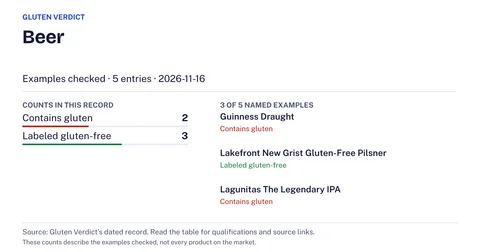 BeerDepends on the product2 of 5 products we checked contain gluten: Guinness Draught and Lagunitas The Legendary IPAchecked Nov 16, 2026
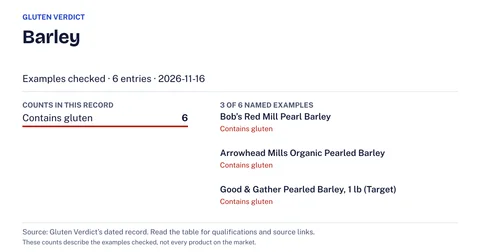 BarleyContains glutenchecked Nov 16, 2026
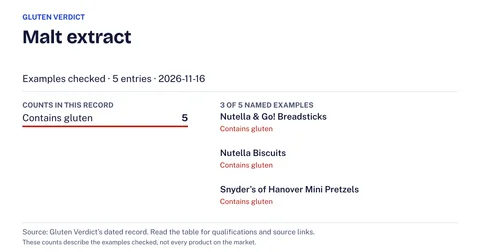 Malt extractContains glutenchecked Nov 16, 2026
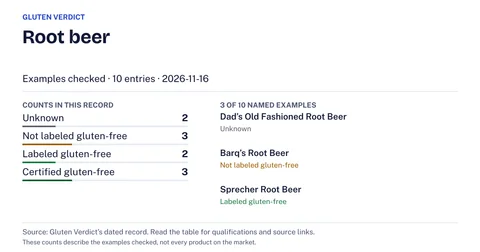 Root beerDepends on the productchecked Nov 16, 2026
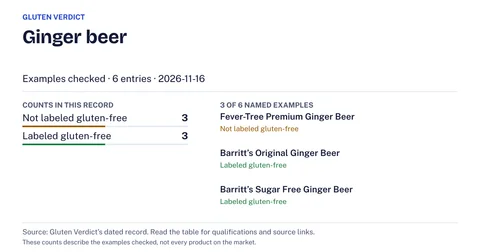 Ginger beerDepends on the productchecked Nov 16, 2026
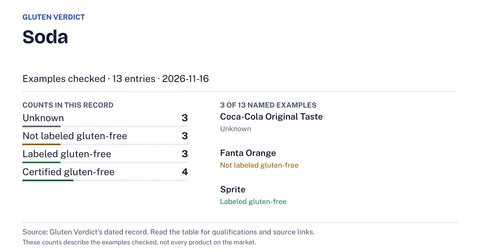 SodaDepends on the productchecked Nov 16, 2026
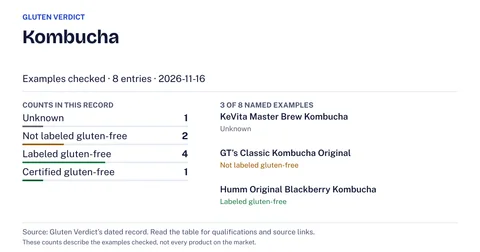 KombuchaDepends on the productchecked Nov 16, 2026
Questions people ask
Does taking the alcohol out remove the gluten?
Not by itself. Heineken says its 0.0 starts from the same ingredients as its regular beer, including barley malt, with the alcohol removed by vacuum distillation18, and its US page says the beer has been crafted to remove gluten but the exact content cannot be verified19.
Is a beer labeled 0.0% or alcohol free also gluten-free?
Not necessarily. “Alcohol free” is a claim about alcohol only2. A gluten-free claim is a separate one: TTB authorizes it when the product would be entitled to it under FDA’s definition5.
More in Drinks and alcohol
 Gluten-removed beer: what the treatment does, why the tests are disputed and what the TTB statement saysWhat “crafted to remove gluten” means on a barley beer, why lab results on it are disputed, and what TTB, NCA and GIG say, for your clinician talk.
 Gluten-free alcohol: what US beer, spirits, wine and cider labels may sayWhich US alcohol labels may say gluten-free, who sets the wording, and how beer, spirits, wine, cider and hard seltzer differ, each rule sourced.
 Instant coffee, tea, cocoa and malted drink mixes: what to read for glutenWhere gluten turns up in instant coffee, tea blends, chai, cocoa and malted drink mixes, and what to read on each label before you buy.
 Cocktail mixers, bitters and rims: what can carry gluten besides the spiritTake a cocktail apart: spirit, mixer, bitters, beer, rim and garnish. See what makers and charities say about each, and what to ask the bar.
 How to look up an alcohol label in TTB’s COLA registryAlcohol labels need not list every ingredient. How to find a bottle in TTB’s COLA registry, what it shows, and what the allergen rules do and do not cover.
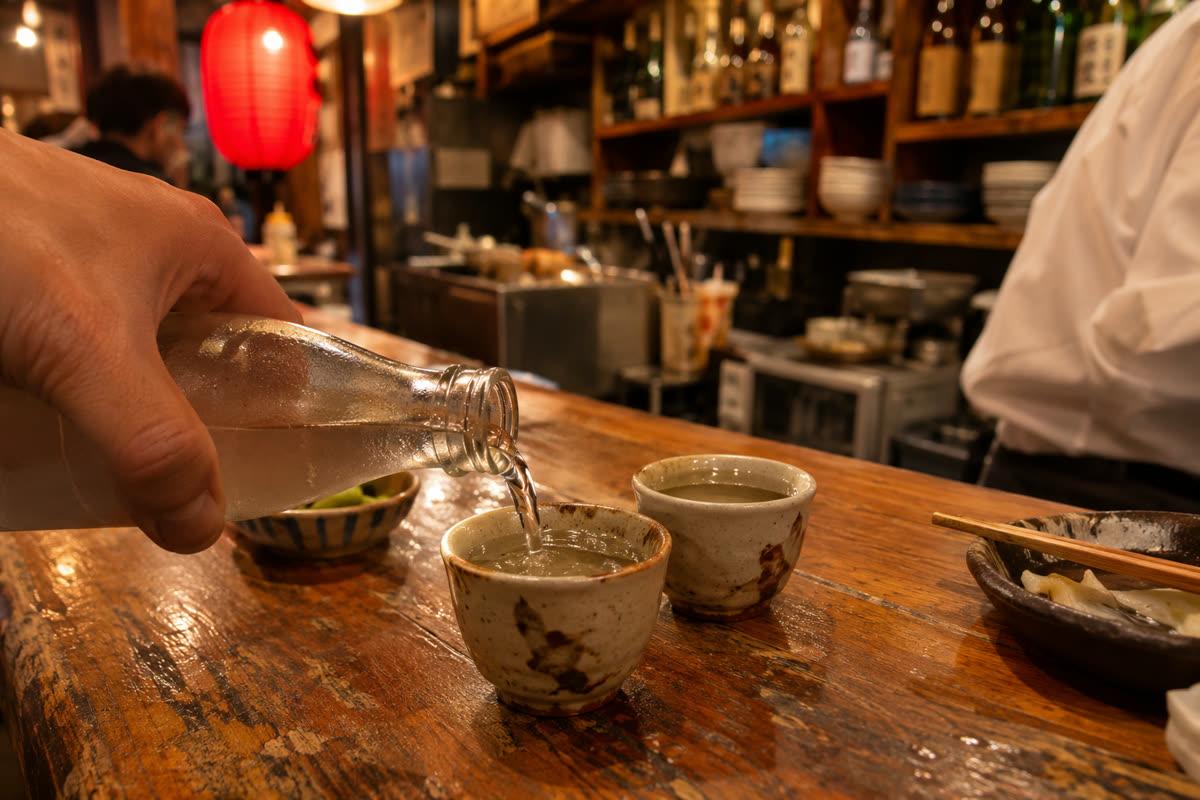 Sake, soju, mead and shochu: what each is made from and what to askWhat sake, soju, mead, shochu and makgeolli are made from, which come in grain-based versions, and what to ask a server or maker.
Related guides
 Malt on a food label: which forms are barley and what to checkWhat malt extract, syrup, flavoring and vinegar on a US label mean for gluten, why the Contains line misses barley, and what to check first.
 “Low gluten”, “gluten removed” and “gluten friendly” on a labelWhat “low gluten”, “gluten removed” and “gluten friendly” mean on a US label, which phrases FDA or TTB define, and what to ask the maker.
 Gluten-free in the UK: allergen rules, the Crossed Grain mark and pub and chip-shop foodHow a British pack and menu differ from a US one: the 20 mg/kg rule, 14 allergens, Crossed Grain versus venue accreditation, and chip-shop condiments.
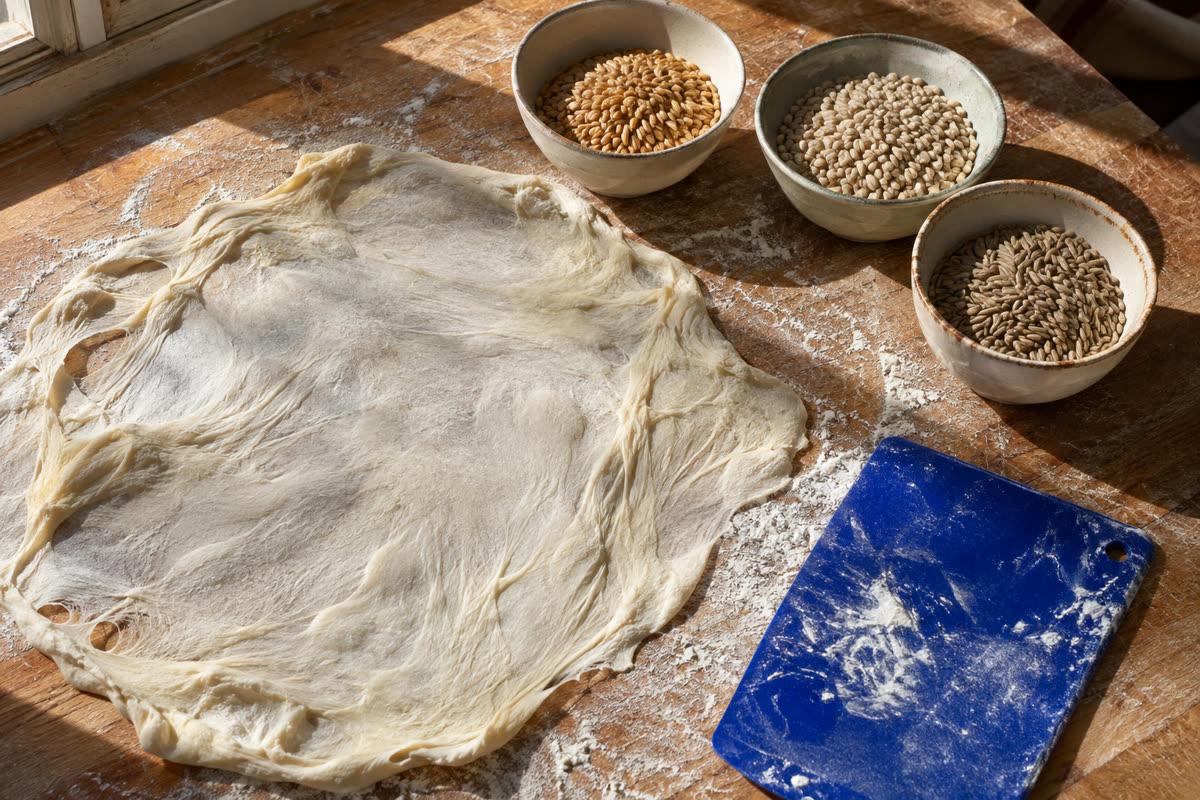 What gluten is, which grains carry it and what “gluten-free” meansA plain definition of gluten, the grains that carry it, look-alike words such as malt and wheat starch, and what a US gluten-free label means.
Sources
- [1, 2] Alcohol and Tobacco Tax and Trade Bureau (TTB), 27 CFR 7.65, Alcohol content (27 CFR 7.65): non-alcoholic, checked Nov 17, 2026.
- [3, 4] Alcohol and Tobacco Tax and Trade Bureau (TTB), 27 CFR 7.145, Malt beverages containing less than 0.5 percent alcohol by volume (27 CFR 7.145), checked Nov 17, 2026.
- [5, 6, 7] Alcohol and Tobacco Tax and Trade Bureau (TTB), TTB Ruling 2020-2: Gluten Content Statements in the Labeling and Advertising of Wine, Distilled Spirits, and Malt Beverages, checked Nov 17, 2026.
- [8, 9] US Food and Drug Administration, Questions and Answers on the Gluten-Free Food Labeling Final Rule, checked Nov 17, 2026.
- [10] US Food and Drug Administration, CPG Sec 515.200 Malt Extract; Malt Syrup; Malted Cereal Syrup; Liquid Malt; Dried Malt, checked Nov 17, 2026.
- [11, 12] National Institute of Diabetes and Digestive and Kidney Diseases (NIDDK), Eating, Diet, & Nutrition for Celiac Disease, checked Nov 17, 2026.
Read on 2026-11-17: the list under “What foods and drinks contain gluten?” names wheat and types of wheat, barley (which it says may be found in malt, malt extract, malt vinegar, and brewer’s yeast), rye, and triticale.
- [13] Frontiers in Microbiology (Yabacı Karaoğlan and Dostálek, 2026), Application of unconventional microorganisms for the production of non-alcoholic beer, checked Nov 17, 2026.
- [14, 15, 16, 17, 35] Athletic Brewing Company, Athletic Brewing FAQ, checked Nov 17, 2026.
Read on 2026-11-17: on the FAQ page, the only gluten statements are the ones for Upside Dawn Golden; the answer on what non-alcoholic beer is, and its ingredients, carries none.
- [18, 19, 20] Heineken USA, Heineken 0.0, checked Nov 17, 2026.
- [21, 22, 23] Go Brewing, Freedom Hazy IPA (no gluten), checked Nov 17, 2026.
- [24, 25, 26, 36] Foods (Kaszuba et al., 2024), Comparison of the Antioxidant and Sensorial Properties of Kvass Produced from Mountain Rye Bread with the Addition of Selected Plant Raw Materials, checked Nov 17, 2026.
- [27, 28, 30] Lidskoe Pivo (Lidski), LIDSKI Bread Kvass, checked Nov 17, 2026.
Read on 2026-11-17: the product page gives ingredients, nutrition values and alcohol content and makes no statement about gluten.
- [29, 31] Kvass USA (store listing for Kvas Taras Traditional Bread Kvass), Kvas Taras Traditional Bread Kvass (500 ml can), checked Nov 17, 2026.
Read on 2026-11-17: the product listing gives the description and ingredients and makes no statement about gluten.
- [32, 33, 34] Goya Foods, Malta Goya (Shop Goya product page), checked Nov 17, 2026.
Read on 2026-11-17: the product page gives the description, ingredients and nutrition facts and makes no statement about gluten.