“Low gluten”, “gluten removed” and “gluten friendly” on a label
Short answer
Only “gluten-free” and its three equivalents (“free of gluten”, “without gluten”, “no gluten”) have an FDA definition1. “Low gluten”, “gluten removed” and “gluten friendly” are not among those four claims1, 14. FDA says other terms regarding the absence of gluten are evaluated case by case2, and TTB lets a malt beverage fermented from gluten grains say it was processed to remove gluten only with a statement that the gluten content cannot be verified20.
- Check whether the label also carries “gluten-free”, “free of gluten”, “without gluten” or “no gluten”; only those have to meet FDA’s limit of less than 20 parts per million1, 11.
- On a malt beverage fermented from gluten grains, look for TTB’s qualifying statement beside a “processed, treated or crafted to remove gluten” claim20.
- On a menu or a package, find the maker’s or venue’s own definition of the phrase.
- Ask what was tested and how; for a fermented product TTB will consider a stated ppm level without an appropriate basis or necessary qualification misleading, pending a scientifically valid method24.
Part of Label reading and gluten-free claims, 17 guides
Key points
- “Gluten-free”, “free of gluten”, “without gluten” and “no gluten” are the claims FDA defines; other wording about the absence of gluten is judged case by case1, 2.
- The text of 21 CFR 101.91 contains neither “friendly” nor “low gluten”14.
- A malt beverage fermented from gluten grains may say it was processed to remove gluten only with a statement that its gluten content cannot be verified20.
- The National Celiac Association says gluten reduced beers should be avoided by those following a gluten-free diet31.
- The EU defines “very low gluten” as no more than 100 mg/kg, for foods with specially processed ingredients34; the text of the US rule does not use the phrase14.
Which of these phrases is a regulated claim?
One of the phrases on a label has a legal definition behind it. The others are wording from the maker. The table sorts them; the sections after it cover the beer, food and menu cases.
| Phrase on the label | Who defines it | What the source says |
|---|---|---|
| “Gluten-free”, “free of gluten”, “without gluten”, “no gluten” | FDA for foods; TTB follows FDA’s definition for alcohol | A food using any of the four has to meet the requirements of the gluten-free claim1. TTB allows them on wine, spirits and malt beverages where the product would qualify under FDA’s definition15. |
| “Low gluten” | No definition in FDA’s rule | FDA says other terms about the absence of gluten are evaluated case by case2. The text of 21 CFR 101.91 does not contain the phrase14. |
| “Very low gluten” | The EU, not the US | EU Regulation 828/2014 allows it for foods with specially processed ingredients and no more than 100 mg/kg of gluten34. It is not in the text of 21 CFR 101.9114. |
| “Processed to remove gluten”; “gluten removed” and “gluten reduced” on beer | TTB, for alcohol made from gluten grains | TTB lets a product fermented from gluten grains say it was “processed (or treated or crafted) to remove gluten” if the claim carries a qualifying statement19. Other gluten wording on alcohol is evaluated case by case22. FDA’s Q&A page does not use “gluten removed” or “gluten reduced”10. |
| “Gluten friendly” | No regulator we found | The phrase is not in the text of 21 CFR 101.9114. SDSU Dining generally defines its “Gluten-Friendly” identifiers as “a gluten-free products made in gluten-containing facilities”43. |
What FDA’s rule defines and what it leaves out
For foods FDA regulates, “gluten-free” means the food is inherently free of gluten or contains no gluten grain, no ingredient made from one that was not processed to remove gluten, and no processed-to-remove-gluten ingredient that leaves 20 parts per million (ppm) or more in the food; any unavoidable gluten must be below 20 ppm11. The same requirements apply to “free of gluten”, “without gluten” and “no gluten”1. Using the claim at all is voluntary3.
Everything else is a separate question. FDA’s Q&A page says other terms regarding the absence of gluten are evaluated under its general misbranding provisions on a case-by-case basis2. The rule’s own text has no definition of “low gluten”, “gluten reduced” or “gluten friendly”; those words are not in it14.
Where “removed” does have a regulated meaning
In food, “processed to remove gluten” describes an ingredient. Wheat starch is the rule’s own example of an ingredient from a gluten grain that has been processed to remove gluten; it can be used in a food labeled gluten-free only if the food ends up below the limit11. When such a food lists wheat in its ingredients or in a “Contains wheat” statement, the rule requires an asterisk that leads to the sentence “The wheat has been processed to allow this food to meet the Food and Drug Administration (FDA) requirements for gluten-free foods.”13 Our wheat starch page covers the ingredient.
Fermented and hydrolyzed foods are a special case. Where no valid test method exists for them, a manufacturer of a food bearing the claim must keep records demonstrating adequate assurance that the food was gluten-free before fermentation or hydrolysis and that the maker evaluated its processing for gluten cross-contact12, and FDA’s page says fermentation is not considered a process to remove gluten4.
“Made with no gluten-containing ingredients” is another phrase outside the claim. FDA says that unless the label also bears a “gluten-free” claim, consumers should not assume the food meets the requirements for it9.
What TTB lets an alcohol label say
Which agency’s rules apply depends on the drink. FDA’s page says TTB regulates the labeling of most alcoholic beverages, including all distilled spirits, wines of 7 percent alcohol by volume or more, and malted beverages made with both malted barley and hops5. TTB’s ruling adds that beers that are not malt beverages, and wines under 7 percent, fall under FDA’s labeling rules26.
Under TTB Ruling 2020-2, “gluten-free” can appear on wine, spirits or malt beverages where the product would qualify under FDA’s definition15, and TTB considers the claim misleading where it would not16. TTB permits it on spirits distilled from gluten-containing grains as long as good manufacturing practices keep gluten-containing material out of the final product17.
Gluten removed on a fermented drink
TTB names malt beverages fermented from gluten-containing grains as one kind of product that does not meet that definition, and says such products may state they were “processed”, “treated” or “crafted” to remove gluten18. Two conditions come with the statement. The label or advertisement must carry, right beside it, this text: “Product fermented from grains containing gluten and [processed or treated or crafted] to remove gluten. The gluten content of this product cannot be verified, and this product may contain gluten.”20 And the maker must submit a detailed description of the method with its label application21.
Any other gluten wording on alcohol, a “low gluten” line for example, has no rule of its own: TTB evaluates gluten-related statements other than “gluten-free” case by case for whether they are truthful and non-misleading22, and treats statements about gluten content as health-related statements23.
On numbers, TTB says labels or advertisements that give, without an appropriate basis or necessary qualification, a specific level of gluten in a fermented finished product, such as “contains x ppm”, will be considered misleading until a scientifically valid method of measuring gluten in such products exists24.
The National Celiac Association notes that labeling of malt beverages can differ from state to state, and that the federal act may not apply to a product brewed and sold in one state33.
Why a test result on a gluten-removed beer does not settle it
Gluten Intolerance Group (GIG) describes one method: some brewers start with barley and add enzymes at the end of brewing that break down residual proteins27. The difficulty is measuring the result. GIG says the enzymes can break down the specific gluten peptide that ELISA kits detect, so commonly used test kits may not see the fragments they are designed to identify28.
GIG adds that more powerful testing, liquid chromatography-mass spectrometry (LCMS), may still detect barley gluten fragments in gluten-removed liquid29. One 2017 study using that method, by Colgrave and colleagues, reported barley gluten (hordeins) in many gluten-reduced beers it analyzed36.
FDA and TTB describe a related limit in their own terms. FDA’s page says conventional analytical methods may not accurately detect and quantify gluten in fermented foods4, and TTB’s 2020 ruling says there is currently no scientifically valid method to quantify gluten in fermented or hydrolyzed foods in terms of equivalent amounts of intact gluten protein25.
What the charities say
The National Celiac Association’s alcohol page says gluten-reduced beers made with barley malt may not be labeled gluten-free, and that they should be avoided by those following a gluten-free diet31. The same page quotes Gluten Free Watchdog’s advice to drink only ciders and beers labeled gluten-free and, at this time, to avoid products labeled “gluten removed”32. In GIG’s 2020 article, the position of the GFCO certification program is that an alcoholic beverage derived from gluten-containing grains and not distilled cannot be certified gluten-free30.
Our guide to gluten-removed beer goes through the treatment and the disputed tests in more detail.
One maker’s own words: Stone Delicious IPA
Stone Brewing’s pages show how the phrases are used on a real beer. Its “Gluten Info” page says that because the beer is brewed with barley it technically does not get the FDA title of “gluten free” and instead qualifies as “gluten reduced” (sometimes referred to as “gluten removed”)37. It names an enzyme, Clarex, as what makes the beer possible38, says that traces of gluten remain39, and says it cannot make claims about the gluten content of the beer served on draft40.
The product page says the beer “qualifies as a ‘gluten-reduced’ ale per the FDA”41. The FDA Q&A page we read has no “gluten reduced” category; it says other terms about the absence of gluten are evaluated case by case10, 2. Neither Stone page we read gives a ppm figure42; TTB’s position on stated levels is described above24.
That is the maker’s description of its beer, quoted so you can see the wording. A label like this is a reason to read the brewer’s own page and ask what the phrase means for that product, not an answer by itself.
“Gluten friendly” on a menu or a package
FDA’s regulation applies to packaged foods, which may be sold in some food-service places such as some carry-out restaurants; for menu claims, FDA recommends that restaurants making a “gluten-free” claim be consistent with its definition8. FDA’s rule does not name “gluten friendly”14, so what the words promise is whatever the venue or maker says they mean.
One example of a venue spelling it out: SDSU Dining says its “Gluten-Friendly” dietary identifiers are generally defined as “a gluten-free products made in gluten-containing facilities”43, and that even with its labeling and preparation methods some degree of cross-contact is unavoidable44. Read each venue’s own definition; do not carry this one to another menu. Our guide to what a gluten-free menu label means sorts the usual kinds of wording.
On a package, the same words can sit beside no gluten-free claim at all. The maker’s page for Rani Falafel Mix has “Gluten Friendly” in its product title45, and the page has no “gluten-free” claim46. Our falafel verdict records what that page and others say.
“Low gluten” and “very low gluten”: what the EU regulates and the US does not
In the European Union, “very low gluten” is a regulated statement. Regulation (EU) No 828/2014 allows it only where the food consists of or contains ingredients made from wheat, rye, barley, oats or their crossbred varieties that were specially processed to reduce the gluten content, with no more than 100 mg/kg of gluten as sold34. “Gluten-free” there means no more than 20 mg/kg35.
That is an EU rule. On a US label, “low gluten” has no number behind it in FDA’s rule14, so do not read the EU figure into it.
What to ask the maker or the venue
A phrase with no regulator’s definition is a question for whoever wrote it. FDA’s page says makers are not required to test for gluten to use the gluten-free claim6, and lists the tools they may choose: in-house testing, a third-party laboratory, certificates of analysis from ingredient suppliers, or a third-party certification program7. So ask which one, if any, stands behind the wording.
- Does the product or dish carry a “gluten-free” claim, or only the other phrase? Only the claim and its three equivalents have FDA’s definition behind them1.
- What does the phrase mean on your own page or menu? Ask for it in writing where you can.
- Was gluten tested, on what, and by what method? For a fermented beer, a ppm figure needs an appropriate basis under TTB’s ruling, so a number alone does not answer the question24.
- Is the product listed by a certifier? As GIG reports it, GFCO’s position is that a non-distilled drink from gluten grains cannot be certified gluten-free30.
- For a venue: how is the item prepared and served, and are shared surfaces or fryers involved?
Our guide to reading a US food label for gluten covers the claim, the Contains line and the ingredient list.
Our verdicts for the drinks behind these labels
We link a verdict instead of restating it. Drinks: beer, whiskey, vodka, wine and ginger beer. For alcohol more broadly, see our gluten-free alcohol guide.
Verdicts in this guide
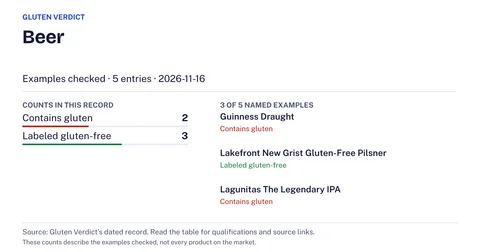 BeerDepends on the product2 of 5 products we checked contain gluten: Guinness Draught and Lagunitas The Legendary IPAchecked Nov 16, 2026
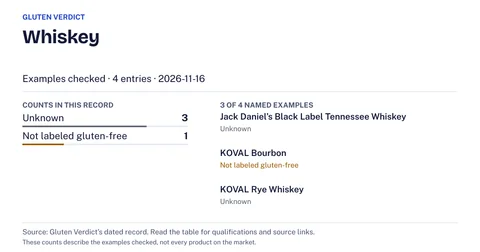 WhiskeyDepends on the productchecked Nov 16, 2026
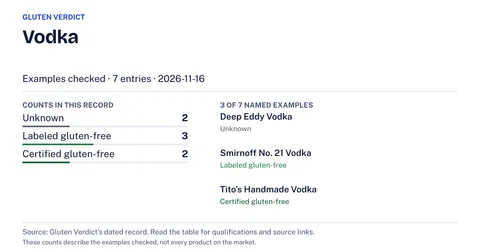 VodkaDepends on the productchecked Nov 16, 2026
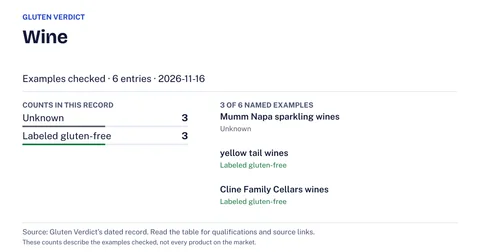 WineNaturally gluten-freechecked Nov 16, 2026
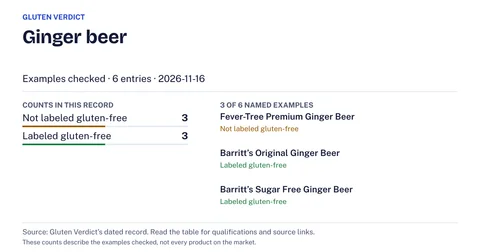 Ginger beerDepends on the productchecked Nov 16, 2026
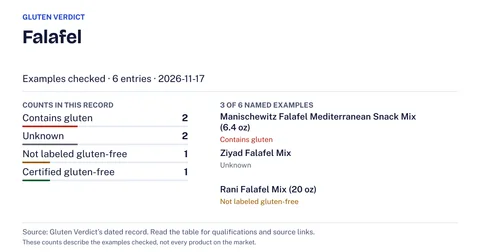 FalafelDepends on the product2 of 6 products we checked contain gluten: Manischewitz Falafel Mediterranean Snack Mix (6.4 oz) and Al’Fez Lebanese Falafel Kit (5.3 oz)checked Nov 17, 2026
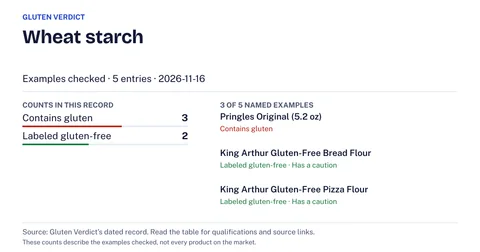 Wheat starchDepends on the product3 of 5 products we checked contain gluten: Pringles Original (5.2 oz), Jiffy Corn Muffin Mix, and Chex Mix Bold Garlic and Herbchecked Nov 16, 2026
Questions people ask
Is gluten-removed beer gluten-free?
Not by its label. TTB lets a malt beverage fermented from gluten grains say it was processed to remove gluten only with a statement that its gluten content cannot be verified and that it may contain gluten20. The National Celiac Association says gluten-reduced beers made with barley malt may not be labeled gluten-free31.
Does “low gluten” mean under 20 ppm?
FDA’s gluten-free rule gives the phrase no number; it is not in the text of 21 CFR 101.9114. The 20 ppm limit belongs to “gluten-free” and its three equivalents1, 11. In the EU, “very low gluten” means no more than 100 mg/kg34.
Is “gluten friendly” the same as gluten-free?
Not under FDA’s rule, which does not use the phrase14. SDSU Dining generally defines its “Gluten-Friendly” identifiers as “a gluten-free products made in gluten-containing facilities”43; ask the maker or venue what it means for theirs.
Why does a gluten-removed beer sometimes say gluten-free?
The sources we read do not explain any single beer’s label. The National Celiac Association notes that malt-beverage labeling can differ from state to state and that the federal act may not apply to a product brewed and sold in one state33. Where TTB’s ruling applies, it considers a gluten-free claim misleading on a product that would not qualify under FDA’s definition16.
More in Label reading and gluten-free claims
 Who regulates a gluten-free claim: FDA, USDA or TTBWhich agency sets the rules for a gluten-free claim on packaged food, meat, eggs, beer, wine and spirits, and what to check when a label is unclear.
 Fermented, hydrolyzed and distilled foods: how a gluten-free claim is checkedHow FDA’s 2020 rule checks a gluten-free claim on fermented, hydrolyzed and distilled foods, why a test cannot settle it, and where TTB takes over.
 How to read a US food label for glutenWhere gluten shows up on a US food label: the gluten-free claim, the Contains line, the ingredient list and may-contain lines, and what each means.
 The FDA gluten-free rule: what 21 CFR 101.91 requires and what 20 ppm measuresWhat FDA’s gluten-free rule requires, which claim words it covers, what 20 ppm means for a portion of food, and how FDA checks that a claim holds.
 A gluten-free label that lists wheat or wheat starch: what it meansHow a US pack can say gluten-free and still list wheat starch or “wheat”, the statement FDA requires, and what to ask the maker.
 When a gluten-free label looks wrong: what to keep, who to tell, where to lookFound wheat, barley or malt in a food labeled gluten-free? What to keep, whom to tell, which US agency takes the report, and where recalls are listed.
Related guides
 Wheat-free, gluten-free and “no gluten ingredients”: what each label statement covers“Wheat-free”, “gluten-free” and “made with no gluten-containing ingredients” are three different statements. What each covers, and what to check.
 Gluten-removed beer: what the treatment does, why the tests are disputed and what the TTB statement saysWhat “crafted to remove gluten” means on a barley beer, why lab results on it are disputed, and what TTB, NCA and GIG say, for your clinician talk.
 What “gluten-free” on a restaurant menu meansFDA’s gluten-free rule is written for packaged food. See what a menu label can mean, and how to tell a recipe from a procedure or an audited program.
 How to look up an alcohol label in TTB’s COLA registryAlcohol labels need not list every ingredient. How to find a bottle in TTB’s COLA registry, what it shows, and what the allergen rules do and do not cover.
Sources
- [1, 2, 3, 4, 5, 6, 7, 8, 9, 10] US Food and Drug Administration, Questions and Answers on the Gluten-Free Food Labeling Final Rule, checked Nov 17, 2026.
Read on 2026-11-17: the Q&A page defines “gluten-free” and three equivalent claims; the phrases “low gluten”, “gluten reduced”, “gluten removed” and “gluten friendly” do not appear on it.
- [11, 12, 13, 14] Electronic Code of Federal Regulations, 21 CFR 101.91, Gluten-free labeling of food, checked Nov 17, 2026.
Read § 101.91 on 2026-11-17 (the public eCFR page, read as page text): the section sets requirements for the claims “gluten-free”, “no gluten”, “free of gluten” and “without gluten”; the words “friendly”, “reduced” and “low gluten” (so also “very low gluten”) do not appear in it.
- [15, 16, 17, 18, 19, 20, 21, 22, 23, 24, 25, 26] Alcohol and Tobacco Tax and Trade Bureau (TTB), TTB Ruling 2020-2: Gluten Content Statements in the Labeling and Advertising of Wine, Distilled Spirits, and Malt Beverages, checked Nov 17, 2026.
- [27, 28, 29, 30] Gluten Intolerance Group, Does Fermentation or Distillation Make a Product Gluten-Free?, checked Nov 17, 2026.
- [31, 32, 33] National Celiac Association, Alcohol on the Gluten-Free Diet, checked Nov 17, 2026.
- [34, 35] European Commission, Commission Implementing Regulation (EU) No 828/2014 on the requirements for the provision of information to consumers on the absence or reduced presence of gluten in food, checked Nov 17, 2026.
- [36] PubMed (US National Library of Medicine), Colgrave et al. 2017, Liquid Chromatography-Mass Spectrometry Analysis Reveals Hydrolyzed Gluten in Beers Crafted To Remove Gluten (J Agric Food Chem), PubMed record, checked Nov 17, 2026.
- [37, 38, 39, 40, 42] Stone Brewing, Stone Brewing Gluten Info: What You Need to Know, checked Nov 17, 2026.
Read on 2026-11-17: the “Stone Brewing Gluten Info” page and the Stone Delicious IPA product page give no gluten figure in parts per million (ppm) for the beer.
- [41] Stone Brewing, Stone Delicious IPA, checked Nov 17, 2026.
- [43, 44] SDSU Dining (Aztec Shops, Ltd.), The Dining Room menu page with SDSU Dining nutritional disclaimer, checked Nov 17, 2026.
- [45, 46] Rani Brand, Rani Falafel Mix (20 oz), checked Nov 17, 2026.
Read the product page on 2026-11-17: it calls the mix “Gluten Friendly” in its title and description; the words “gluten-free” and “gluten free” do not appear anywhere on the page.