How long after eating gluten do symptoms start, and how long do they last?
Short answer
Gluten Intolerance Group says recovery varies from person to person2. In one survey of 105 adults with celiac disease, reactions to suspected gluten exposure had a median onset of 1 hour (range 10 minutes to 48 hours) and a median duration of 24 hours (range 1 hour to 8 days)9, 11, 12. Swelling of the throat or difficulty breathing is on FDA’s list of allergic-reaction symptoms, which is a different question from timing28.
Part of Symptoms, reactions and persistent complaints, 22 guides

Key points
- One survey of adults with celiac disease: median onset 1 hour (range 10 minutes to 48 hours) and median duration 24 hours (range 1 hour to 8 days)9.
- Coeliac UK says the symptoms of eating gluten may last from a few hours to a few days1; Gluten Intolerance Group says recovery varies by person and by how much gluten was ingested2.
- FDA describes food allergy symptoms as typically appearing within a few minutes to a few hours of eating the food25; a review of non-celiac gluten sensitivity says onset can occur within hours or days21.
- The Celiac Disease Foundation’s symptom page gives no duration for fatigue or any other symptom6; none of the sources cited here gives one for fatigue on its own.
- The Celiac Disease Foundation says some people with celiac disease have no symptoms at all4.
Why one timeline does not fit everyone
The Celiac Disease Foundation says celiac disease affects people differently, with more than 200 known symptoms that may occur in the digestive system or other parts of the body3. The National Institute of Diabetes and Digestive and Kidney Diseases (NIDDK) says symptoms vary widely and a person may have several that come and go7.
Recovery varies too. Gluten Intolerance Group says recovery from exposure varies from person to person and depends on how much gluten was ingested2. Coeliac UK, a UK charity, says the symptoms of eating gluten may last from a few hours to a few days1.
Feeling unwell is not the only effect to keep in mind. The Celiac Disease Foundation says some people with celiac disease have no symptoms at all but still test positive on the blood test4, and that the severity of symptoms does not necessarily reflect the severity of intestinal damage5. By that account, how you feel after a meal is an incomplete signal.
What the studies measured
Three studies of celiac disease and one review of non-celiac gluten sensitivity give the most specific timing figures we found. Each measured something different, so they do not add up to one timeline.
| Study | Who and what | Reported timing |
|---|---|---|
| Silvester and colleagues, 2016 (survey) | Adults with biopsy-proven, newly diagnosed celiac disease, surveyed at study entry and at 6 months about reactions to gluten11. Of 105 participants, 66% reported a suspected symptomatic reaction12. | Median time to symptom onset 1 hour (range 10 minutes to 48 hours); median symptom duration 24 hours (range 1 hour to 8 days)9. |
| Tye-Din and colleagues, 2020 (gluten challenge) | 295 adults treated for celiac disease, observed for 6 hours after a set challenge of 10 g of vital wheat gluten in 100 ml of water15. | Onset within 1 hour, with overall severity of moderate to very severe reactions peaking at 3 hours17. Symptom severity peaked at 3 hours16. |
| Leffler and colleagues, 2013 (daily challenge) | 20 adults with biopsy-proven celiac disease who took 3 or 7.5 g of gluten a day for 14 days19. | Gastrointestinal symptoms increased significantly by day 3 and returned to baseline by day 2820. This is repeated daily gluten, not a single exposure. |
| Vazquez-Roque and Oxentenko, 2015 (review of non-celiac gluten sensitivity) | A review published in Mayo Clinic Proceedings22. | The onset of symptoms in non-celiac gluten sensitivity can occur within hours or days of gluten ingestion21. |
Two cautions on reading the table. The survey’s figures describe suspected exposures that participants reported, not confirmed ones12. The challenge study gave a measured dose in water and watched for 6 hours only, which is not the same as a meal with hidden gluten and says nothing about what happened after hour 615.
What about fatigue?
If you are asking how long gluten fatigue lasts: in the survey, among the 69 participants who reported a reaction, fatigue was a reported symptom in 33%, alongside abdominal pain (80%), diarrhoea (52%), headache (30%) and irritability (29%)13, 33. In the challenge study, tiredness was rated among the worst symptoms by almost half of the patients18. The Celiac Disease Foundation lists fatigue among the most common symptoms in adults but gives no duration for any symptom6. The one duration we found is for reactions as a whole, a median of 24 hours with a range of 1 hour to 8 days in the survey9; none of the sources cited here gives a duration for fatigue on its own.
Celiac disease, non-celiac gluten sensitivity and wheat allergy by timing
These three conditions can look alike. The Mayo Clinic Proceedings review says non-celiac gluten sensitivity has clinical features that overlap with those of celiac disease and wheat allergy22, and FDA lists wheat among the major food allergens26.
| Condition | Timing as the sources describe it | Type of reaction as the sources describe it |
|---|---|---|
| Celiac disease | Survey: median onset 1 hour, range 10 minutes to 48 hours9. Challenge study: onset within 1 hour17. Coeliac UK: symptoms may last from a few hours to a few days1. | Described as autoimmune-mediated24. Coeliac UK says the reaction is not the same as an allergic reaction and does not cause anaphylactic shock1. |
| Non-celiac gluten sensitivity | Onset can occur within hours or days of gluten ingestion21. | Thought to work through an innate immune mechanism24. The review says no clinical biomarker is available to diagnose it23. |
| Wheat allergy | FDA, on food allergy in general: symptoms typically appear within a few minutes to a few hours of eating the food25. AAAAI: reactions normally occur within minutes, though they can sometimes appear a few hours later30. The UK’s NHS: symptoms may come straight after eating the food, or days later31. | Described as allergen-mediated24. FDA calls a severe, life-threatening allergic reaction anaphylaxis27. |
The FDA, AAAAI and NHS pages describe food allergy in general; none of them gives a separate timing for wheat allergy25, 30, 31.
Timing alone does not sort these out. Hours after eating appears in the sources for celiac disease9 and non-celiac gluten sensitivity21, and FDA gives hours for food allergy in general25. The review says that excluding celiac disease and wheat allergy is necessary when non-celiac gluten sensitivity is suspected23, and FDA says some of the allergic-reaction symptoms it lists are not always due to a food allergen and that it is important to seek diagnosis from a healthcare provider29.
In one survey, the gluten was often unsuspected
In the survey, gluten consumption was unsuspected until a reaction occurred (63%) or resulted from problems ordering in a restaurant (29%), and the amount of gluten ranged from cross-contact (30%) to a major ingredient (10%)10; those percentages are of the 69 participants who reported a reaction33. The authors conclude that eating at restaurants and other people’s homes remain a risk for unintentional exposure14. NIDDK says that after a person begins a gluten-free diet, symptoms may return if the person consumes small amounts of gluten8.
In that survey most gluten exposures were unsuspected until the reaction10, so the question after a reaction can be which food, not only how long. Our verdicts cover four foods where gluten can come from an ingredient or from how the food is made: French fries, soy sauce, malt vinegar and beer. For how gluten reaches a plate without being an ingredient, see gluten cross-contact at home and eating out with celiac disease.
Signs the sources treat as urgent
FDA’s list of allergic-reaction symptoms includes swelling of the throat and vocal cords, difficulty breathing and loss of consciousness28. FDA says people with a known food allergy who begin experiencing any of these symptoms should stop eating the food immediately, evaluate the need to use emergency medication and seek medical attention29.
On its food allergy page, the UK’s NHS lists signs for which it says to call 999 (the UK emergency number), among them sudden swelling of the lips, mouth, throat or tongue, breathing very fast or struggling to breathe, a tight throat or trouble swallowing, blue, grey or pale skin, sudden confusion or drowsiness, and someone fainting who cannot be woken up32. Those are the sources’ lists, not a way to rule a reaction in or out by when it started.
Verdicts in this guide
 French friesDepends on the product2 of 8 products we checked contain gluten: Arby’s Frozen Seasoned Curly Fries (22 oz) and Checkers Frozen Crispy Seasoned Fries (28 oz)checked Nov 16, 2026
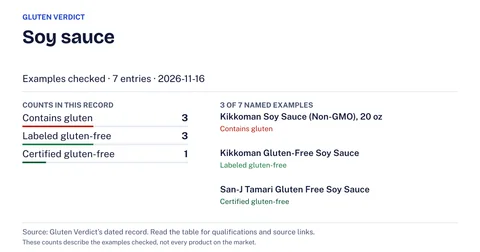 Soy sauceDepends on the product3 of 7 products we checked contain gluten: Kikkoman Soy Sauce (Non-GMO), 20 oz; San-J Organic Shoyu Soy Sauce; and Lee Kum Kee Premium Soy Sauce (No Preservatives Added)checked Nov 16, 2026
 Malt vinegarContains glutenchecked Nov 16, 2026
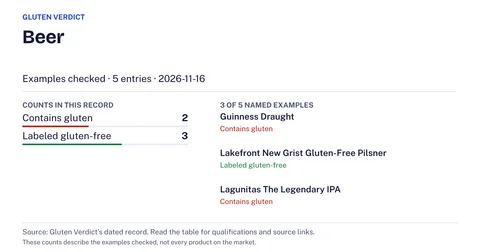 BeerDepends on the product2 of 5 products we checked contain gluten: Guinness Draught and Lagunitas The Legendary IPAchecked Nov 16, 2026
Questions people ask
How long does gluten fatigue last?
The Celiac Disease Foundation’s symptom page gives no duration for fatigue6, and none of the sources cited here gives one for fatigue on its own. In one survey of adults with celiac disease, a reaction as a whole had a median duration of 24 hours, with a range of 1 hour to 8 days9; among participants who reported a reaction, fatigue was a reported symptom in 33%13, 33.
How soon after eating gluten can symptoms start?
In one survey of adults with celiac disease, the median onset was 1 hour and the range 10 minutes to 48 hours9. In a challenge study with a measured dose, onset was within 1 hour17.
Can symptoms start days later?
The review of non-celiac gluten sensitivity says onset can occur within hours or days of gluten ingestion21, and the NHS says food allergy symptoms may come days later31. The longest onset in the celiac survey was 48 hours9.
More in Symptoms, reactions and persistent complaints
 Still having symptoms on a gluten-free diet? Where gluten can still get inA checklist of label, kitchen, restaurant, product and medicine sources of gluten, and what the sources say about when to see a doctor.
 If you think you were glutened: what the celiac organizations say to doWhat the celiac charities, FDA and NIDDK say to do after accidental gluten exposure, when to contact a clinician, and how to trace the cause.
 A food and symptom diary for tracking possible gluten exposureWhat to write in a food and symptom diary on a gluten-free diet, how to read it, a template to copy, and what to bring to a dietitian or doctor.
 Still tired on a gluten-free diet: the causes clinicians checkWhy fatigue can continue on a gluten-free diet: gluten exposure, other gut conditions, iron, B12, thyroid, sleep, mood, and follow-up lists.
 Celiac disease symptoms in adults: what the sources list and who gets testedDigestive and non-digestive celiac symptoms as NIDDK, ACG and Coeliac UK list them, who guidelines say to test, and why gluten stays in the diet first.
 Brain fog with celiac disease: what the research and charities reportWhat research and celiac charities report on brain fog: how it is measured, how long it may last on a gluten-free diet, and other causes the sources name.
All 22 guides in Symptoms, reactions and persistent complaints
Related guides
 What happens in the body when a person with celiac disease eats glutenWhat gluten sets off in the small intestine, what challenge studies measured, and why symptoms and damage do not always match.
 Celiac disease vs gluten intolerance: three conditions, three diagnosesHow celiac disease, non-celiac gluten sensitivity and wheat allergy differ in mechanism, diagnosis and diet, with a source behind every point.
 Gluten reaction or food poisoning? What the sources say about telling them apartHow onset, duration, symptoms and warning signs compare for a gluten reaction and food poisoning, and the signs NIDDK and CDC list for seeing a doctor.
 How to explain celiac disease to friends and familyA three-sentence explanation of celiac disease, then sourced replies to the usual questions: allergy, fad, how strict, and what to cook.
Sources
- [1] Coeliac UK, Symptoms of Coeliac Disease, checked Nov 17, 2026.
- [2] Gluten Intolerance Group, I’ve been “glutened.” How long will it take me to recover, and is there anything I can do to speed up my recovery?, checked Nov 17, 2026.
- [3, 4, 5, 6] Celiac Disease Foundation, Symptoms of Celiac Disease, checked Nov 17, 2026.
Read on 2026-11-17: the list headed “The most common symptoms in adults include:” names abdominal pain; bloating and gas; cognitive impairment; constipation; diarrhea; depression and anxiety; fatigue; headaches or migraines; infertility; iron-deficiency anemia; an itchy, blistery skin rash (dermatitis herpetiformis); joint pain; missed periods; mouth ulcers and canker sores; nausea and vomiting; osteoporosis and osteomalacia; peripheral neuropathy; reduced functioning of the spleen (hyposplenism); and weight loss. The page gives no time of onset and no duration for any symptom.
- [7, 8] National Institute of Diabetes and Digestive and Kidney Diseases (NIDDK), Symptoms & Causes of Celiac Disease, checked Nov 17, 2026.
- [9, 10, 11, 12, 13, 14] Alimentary Pharmacology & Therapeutics, Symptomatic suspected gluten exposure is common among patients with coeliac disease on a gluten-free diet (Silvester et al., 2016), checked Nov 17, 2026.
- [15, 16] BMC Medicine, Patient factors influencing acute gluten reactions and cytokine release in treated coeliac disease (Tye-Din et al., 2020), checked Nov 17, 2026.
- [17, 18] BMC Medicine, Patient factors influencing acute gluten reactions and cytokine release in treated coeliac disease (Tye-Din et al., 2020), full text, checked Nov 17, 2026.
- [19, 20] Gut, Kinetics of the histological, serological and symptomatic responses to gluten challenge in adults with coeliac disease (Leffler et al., 2013), checked Nov 17, 2026.
- [21, 22, 23, 24] Mayo Clinic Proceedings, Nonceliac Gluten Sensitivity (Vazquez-Roque and Oxentenko, 2015), checked Nov 17, 2026.
- [25, 26, 27, 28, 29] US Food and Drug Administration, Food Allergies, checked Nov 17, 2026.
Read on 2026-11-17: the list that follows “Symptoms of allergic reactions can include:” names hives; flushed skin or rash; tingling or itchy sensation in the mouth; face, tongue, or lip swelling; vomiting and/or diarrhea; abdominal cramps; coughing or wheezing; dizziness and/or lightheadedness; swelling of the throat and vocal cords; difficulty breathing; and loss of consciousness.
- [30] American Academy of Allergy, Asthma & Immunology, Food Allergy Symptoms, Diagnosis and Treatment, checked Nov 17, 2026.
- [31, 32] National Health Service (UK), Food allergy, checked Nov 17, 2026.
Read on 2026-11-17: under “Immediate action required: Call 999 if:” the page lists lips, mouth, throat or tongue suddenly becoming swollen; breathing very fast or struggling to breathe; a throat that feels tight or trouble swallowing; skin, tongue or lips turning blue, grey or pale; suddenly becoming very confused, drowsy or dizzy; someone fainting and not being woken up; and a child who is limp, floppy or not responding like they normally do.
- [33] Alimentary Pharmacology & Therapeutics, Symptomatic suspected gluten exposure is common among patients with coeliac disease on a gluten-free diet (Silvester et al., 2016), full text, checked Nov 17, 2026.
Read on 2026-11-17: Table 3 lists “Cross-contact only 30%(20)” and “Major ingredient 10%(7)” under “Amount of gluten consumed”, in a table for the same n=69. Table 4, headed “Factors contributing to suspected gluten ingestion among patients with coeliac disease who reported symptomatic suspected gluten exposure after trying to follow a gluten-free diet for 6 months (n=69)”, lists “Did not know/suspect until reaction 63%(43)” and “Problems ordering in restaurant 29%(20)”. Table 5 has a column headed “Reported reaction to gluten (n=69)” with abdominal pain 80%, diarrhea 52%, fatigue/low energy 33%, bloating 30%, headache 30% and irritability 29%.