Still having symptoms on a gluten-free diet? Where gluten can still get in
Short answer
The National Celiac Association calls gluten exposure the most common reason a person with celiac disease has symptoms despite a gluten-free diet, and Coeliac UK says most of the time that is the cause1, 2. Check these five places, then take what you find to a doctor or dietitian, as NIDDK advises15:
- Packaged-food labels: the ingredient list, not only the claim. NIDDK names additives made with wheat as hidden sources3.
- Your own kitchen: shared toasters and air fryers can pass gluten on4, 5.
- Eating out and other people’s homes, which one study of adults with celiac disease named as a risk for unintentional gluten exposure6.
- Products people overlook: oats, non-food items used near the mouth, and supplements7, 8, 9.
- Medicines, where FDA’s gluten-free rule “only applies to the labeling of foods”10.
Part of Symptoms, reactions and persistent complaints, 22 guides

Key points
- The figures for ongoing symptoms differ by source: about 20 percent of people with celiac disease by NIDDK, around 1 in 3 by Coeliac UK, and 22% pooled in one 2025 meta-analysis11, 2, 12.
- In that meta-analysis, inadvertent gluten exposure was the most common cause of non-responsive celiac disease (33%), ahead of functional gastrointestinal disorders (16%) and refractory celiac disease type II with its sequelae (7%)13.
- Other health problems can cause symptoms like celiac disease, NIDDK says to talk with a doctor or registered dietitian, and Coeliac UK says not to guess the cause14, 15, 16.
- FDA says most oral drug products contain no gluten or virtually none, but its gluten-free food rule applies only to foods17, 10.
- Refractory celiac disease is rare; Coeliac UK puts it at between 4 in 100 and 3 in 1,000 people with coeliac disease18, 19.
How long is “persistent”, and how common is it?
NIDDK says many people see symptoms improve within days to weeks of starting the gluten-free diet20, and Coeliac UK’s page for clinicians says symptoms usually improve within a few weeks21. One 2025 meta-analysis defined non-responsive celiac disease as ongoing symptoms despite 6 to 12 months on the diet22.
How many people are affected depends on whose figure you read. Each source below counts in its own way, so the numbers are not added together or averaged here.
| Source | What it says |
|---|---|
| NIDDK (US National Institutes of Health) | In about 20 percent of people with celiac disease, symptoms continue or come back while following the diet11. |
| Coeliac UK (UK charity) | Ongoing symptoms after starting the diet affect around 1 in 3 people2. |
| 2025 systematic review and meta-analysis (five studies on prevalence) | Pooled prevalence of non-responsive celiac disease of 22% (95% confidence interval 11 to 35%)12. |
The rest of this guide covers the places gluten can still enter, and what the sources say a clinician looks at.
What the sources say is behind ongoing symptoms
NIDDK groups the causes into three: consuming small amounts of gluten, other health problems, and refractory celiac disease23. The National Celiac Association calls accidental or intentional gluten exposure the most common reason1, and Coeliac UK says that most of the time gluten is still getting into the diet2.
The numbers vary with the study. The National Celiac Association says gluten exposure accounts for about 7-30% of persistent symptoms24. In the 2025 meta-analysis, which pooled seven studies on causes, inadvertent exposure was the most common cause of non-responsive celiac disease at 33%, functional gastrointestinal disorders including irritable bowel syndrome were 16%, and refractory celiac disease type II with its premalignant and malignant sequelae was 7%13.
Other causes named by the sources include irritable bowel syndrome, lactose intolerance, microscopic colitis, problems with the pancreas and small intestinal bacterial overgrowth (NIDDK)14, and a longer list from the National Celiac Association25. We have not found a source that ranks which label, kitchen or restaurant source matters most, so this guide does not either.
Label sources: what to check on a packaged food
NIDDK says many food ingredients and additives, such as colorings, flavorings, starches and thickeners, are made from grains that contain gluten26, and its list of hidden sources names additives made with wheat such as modified food starch, malt flavoring, preservatives and stabilizer3. Read the whole ingredient list, every time the product is bought.
Where we have checked an ingredient, our verdict shows what the sources say about it: modified food starch, natural flavors, maltodextrin, soy lecithin, malt vinegar and soy sauce.
A “gluten-free” claim on a food FDA regulates means less than 20 parts per million of gluten27. The claim is voluntary, so a food without it may still be gluten-free28; with no claim, the ingredient list is what you have. FDA also allows a voluntary statement such as “made in a facility that also processes wheat” on a food that carries a gluten-free claim, provided it is truthful and not misleading29.
The rule does not reach foods whose labeling USDA or TTB regulates, which includes meats, poultry, certain egg products and most alcoholic beverages30. For how each part of a label works, see how to read a US food label for gluten, may-contain labels and hidden sources of gluten.
Kitchen sources: where gluten can pass from one food to another
NIDDK defines cross-contact as foods or products that contain gluten coming into contact with gluten-free foods31, and says it can occur at any time, including when food is grown, processed, stored, prepared or served32. Among its suggestions is to store and prepare gluten-free foods separately from other family members’ foods that contain gluten33.
The Gluten Intolerance Group (GIG) gives examples from the equipment itself. Of toasters, it says gluten crumbs can end up on gluten-free bread4; of air fryers, that the fan can blow particles of previously cooked gluten-containing food onto the gluten-free food5. On grills, it adds that gluten cannot be “burned” off by high temperature but can be removed by a thorough cleaning with soap, water and a good metal grill scrubber34.
Our guides cover the other common shared items in a mixed household:
Eating out and other people’s homes
In one study of 105 adults with newly diagnosed celiac disease, 91% reported gluten exposure less than once a month, yet 66% reported a suspected symptomatic reaction to gluten35. In that study, gluten consumption was unsuspected until a reaction occurred (63%) or resulted from problems ordering in a restaurant (29%)36. The authors concluded that restaurants and other people’s homes remain a risk for unintentional exposure6.
GIG says some restaurants offering “gluten-free” menu options may not have the procedures needed to reliably produce gluten-free items37. NIDDK suggests telling the server you have celiac disease and asking about ingredients, how food is prepared and whether there is a gluten-free menu38.
See where gluten hides in restaurant kitchens, eating out with celiac disease, fast-food fryer and prep policies, tracing a reaction after a restaurant meal and our verdict on french fries.
Products people overlook
Oats
GIG’s concern with oats is that they come into contact with gluten grains from the field to processing7. Under FDA’s rule, oats labeled gluten-free must contain less than 20 ppm of gluten39. Our verdicts show how the products we checked read: oatmeal and Quaker Instant Oatmeal. See also gluten-free oats versus regular oats.
Items that are not food
NIDDK says you may take in small amounts of gluten from certain products if you consume them, use them around your mouth, or transfer them from your hands to your mouth by accident40. Its list names modeling dough such as Play-Doh, cosmetics, lipstick, lip gloss and lip balm, skin and hair products, toothpaste and mouthwash, and communion wafers8. See gluten in cosmetics and toiletries and play dough, paste and art supplies.
Drinks, snacks and powders
Our verdicts for beer, chewing gum, protein powder and spices each show how the answer depends on the brand, recipe or preparation.
Vitamins and supplements
The Celiac Disease Foundation says that, unlike packaged foods, dietary supplements are not required to disclose gluten or comply with gluten-free labeling standards9. See are vitamins gluten-free and reading a supplement facts label.
Medicines: ask the pharmacist and the maker
FDA says the majority of orally administered drug products contain no gluten or virtually none17. NIDDK calls medicines rare sources of gluten and says that, even where gluten is present, it is likely to be in quantities too small to cause symptoms41. The Celiac Disease Foundation likewise calls gluten in the inactive ingredients of medications extremely rare42, though it says medications, vitamins and supplements can contain traces of gluten43.
The part that differs from food: FDA’s own question-and-answer page says its gluten-free regulation, 21 CFR 101.91, “only applies to the labeling of foods”10. For drugs, FDA has issued a draft guidance44, and says some people with celiac disease have had difficulty determining whether a drug product contains gluten45.
Where to look: FDA says nonprescription products list ingredients in the “inactive ingredients” section of the Drug Facts label, and prescription products generally list them in the “Description” section of the labeling46. NIDDK says to ask a pharmacist about the ingredients in prescription and over-the-counter medicines and in herbal, vitamin and mineral supplements47. See gluten in medications and how to check a medicine for gluten.
A medicine can also cause symptoms without containing gluten. The Celiac Disease Foundation names olmesartan (Benicar) as a drug that can cause celiac-like enteropathies, though the drug itself contains no gluten48. Medication questions belong with a pharmacist or doctor.
When the sources point to medical follow-up
The sources are consistent on one point. NIDDK says to talk with a doctor or registered dietitian if symptoms continue on the diet15; the National Celiac Association says it is important to see a gastroenterologist49; and Coeliac UK says it is important not to guess what the cause is and to visit your healthcare team16.
The Celiac Disease Foundation’s follow-up list says a physician should assess symptoms at each visit50, and a dietitian should document food and nutrition intake with a comprehensive diet history51 and reassess prescribed and over-the-counter medications and supplements for potential gluten content52.
NIDDK suggests keeping a food journal and talking through your diet and the products you use with a doctor and a registered dietitian53. Our symptom and food diary guide covers what to write down. Related reading: still tired on a gluten-free diet and feeling worse after starting the diet.
What follow-up looks at
This is what the sources say clinicians do, not a plan for anyone to follow alone.
- Dietary review. Coeliac UK’s clinician page says diagnosis of non-responsive disease requires a dietary assessment for ongoing gluten ingestion, a review of the original diagnosis and exclusion of other conditions54. The National Celiac Association says a dietitian skilled in celiac disease first assesses diet and lifestyle to uncover overlooked sources of gluten55.
- Tests. The National Celiac Association says a gastroenterologist’s recommendations may include blood work, breath testing, food allergy testing, an endoscopy with small bowel biopsy and a colonoscopy56. Coeliac UK says that if non-responsive or refractory coeliac disease is suspected, the first step is usually an endoscopy with biopsy57, and the Celiac Disease Foundation’s physician follow-up list includes considering a repeat small intestinal biopsy 1–3 years after diagnosis58.
- Objective checks for gluten. One 2025 review says inadvertent gluten ingestion is the most frequent cause and that testing for gluten immunogenic peptides in stool or urine, with expert dietitian evaluation, is essential before looking for refractory disease59. Another 2025 review says exposure can be hard to detect and that these peptides can give objective evidence60.
- Refractory celiac disease. NIDDK calls it a rare condition in which symptoms and damage to the small intestine continue even on a strict gluten-free diet18. Coeliac UK says persisting villous atrophy usually occurs because of ongoing gluten ingestion, and that it is important this is ruled out before considering alternative diagnoses61.
A one-page checklist to fill in and bring
A worksheet for collecting what a doctor or dietitian will ask about. Filling it in is not a diagnosis, and it does not replace their review.
- Packaged foods: for each food you eat often, note the brand, whether it says gluten-free, and anything on the ingredient list or advisory line that names wheat, barley, rye, malt, oats or a starch or flavor of unknown source.
- Kitchen: note every item shared with anyone who eats gluten, such as the toaster, fryer or air fryer, butter, jam, cutting boards and colander.
- Eating out and visiting: note each meal not made at home, what you told the staff or host, and how you felt afterwards. Our diary guide has a format.
- Overlooked products: list oats, drinks, gum, protein powders, lip products, toothpaste and mouthwash you use.
- Medicines and supplements: list the name and maker of each one, with the inactive ingredients from the Drug Facts label or the Description section46.
- Symptoms: what, when it starts, how long it lasts, and how long you have followed the diet.
- Questions for the clinician: which of the causes in the sections above they will check, and in what order.
Verdicts in this guide
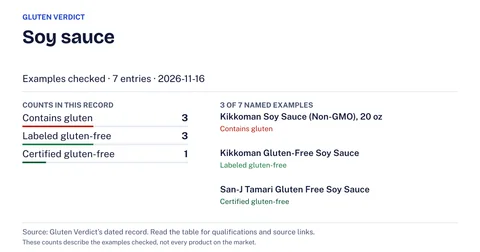 Soy sauceDepends on the product3 of 7 products we checked contain gluten: Kikkoman Soy Sauce (Non-GMO), 20 oz; San-J Organic Shoyu Soy Sauce; and Lee Kum Kee Premium Soy Sauce (No Preservatives Added)checked Nov 16, 2026
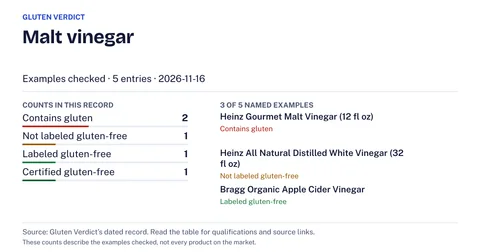 Malt vinegarContains glutenchecked Nov 16, 2026
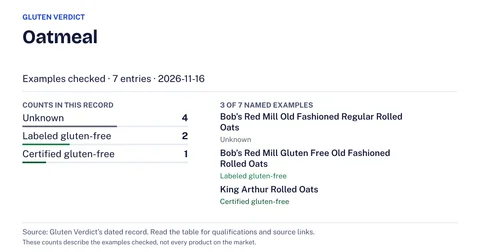 OatmealDepends on the productchecked Nov 16, 2026
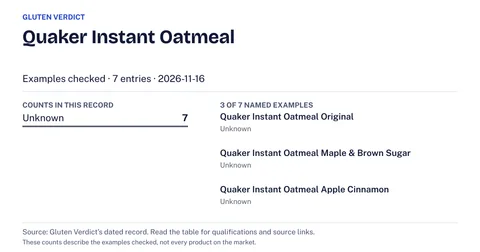 Quaker Instant OatmealUnknownThe Quaker Oats Company · checked Nov 16, 2026
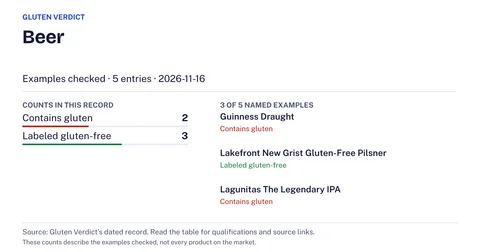 BeerDepends on the product2 of 5 products we checked contain gluten: Guinness Draught and Lagunitas The Legendary IPAchecked Nov 16, 2026
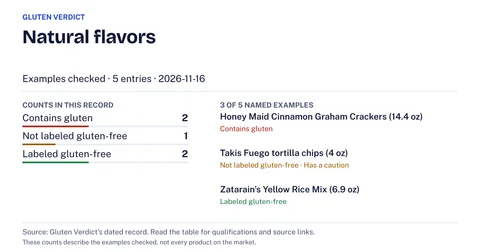 Natural flavorsDepends on the product2 of 5 products we checked contain gluten: Honey Maid Cinnamon Graham Crackers (14.4 oz) and Chex Mix Sour Cream & Onionchecked Nov 16, 2026
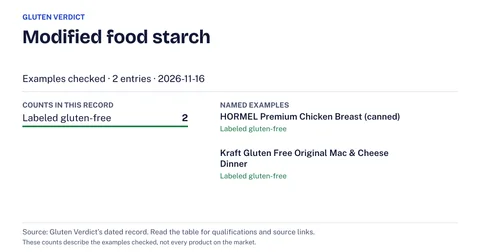 Modified food starchDepends on the productchecked Nov 16, 2026
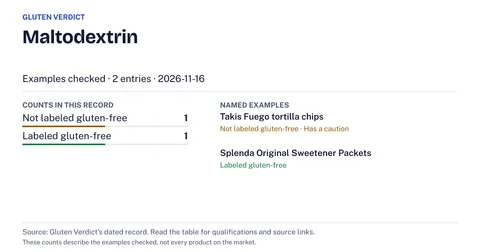 MaltodextrinNaturally gluten-freechecked Nov 16, 2026
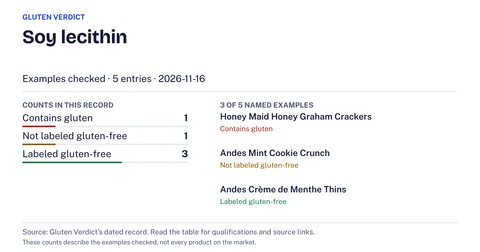 Soy lecithinUnknown1 of 5 products we checked contains gluten: Honey Maid Honey Graham Crackerschecked Nov 16, 2026
 Protein powderDepends on the productchecked Nov 16, 2026
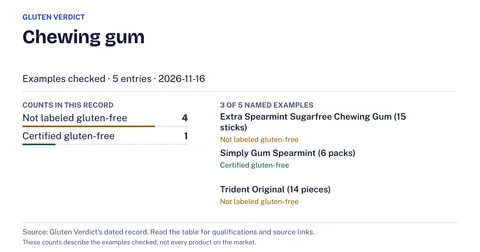 Chewing gumDepends on the productchecked Nov 16, 2026
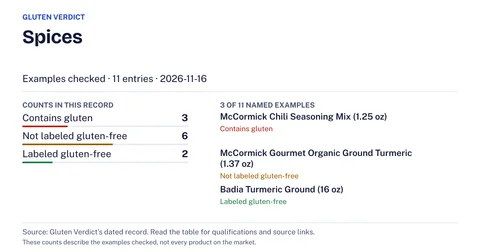 SpicesDepends on the product3 of 11 products we checked contain gluten: McCormick Chili Seasoning Mix (1.25 oz), Lawry’s Chili Spices & Seasonings Mix (1.48 oz), and McCormick Cheesy Taco Seasoning Mix (1.12 oz)checked Nov 16, 2026
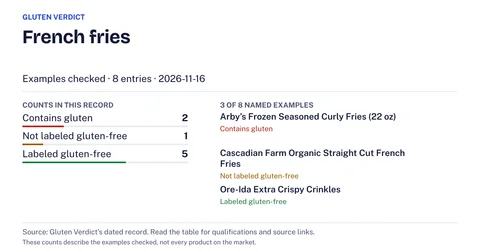 French friesDepends on the product2 of 8 products we checked contain gluten: Arby’s Frozen Seasoned Curly Fries (22 oz) and Checkers Frozen Crispy Seasoned Fries (28 oz)checked Nov 16, 2026
Questions people ask
Can a medicine contain gluten?
Sometimes, but sources call it rare. FDA says the majority of orally administered drug products contain no gluten or virtually none17, and the Celiac Disease Foundation says gluten in inactive ingredients is extremely rare42. NIDDK says to ask a pharmacist about the ingredients47.
Does “gluten-free” on a label mean no gluten at all?
No. On foods FDA regulates it means less than 20 parts per million of gluten27.
Can I still have symptoms if no gluten is getting in?
Sources name other causes. NIDDK lists other health problems that cause symptoms similar to celiac disease, such as irritable bowel syndrome, lactose intolerance and microscopic colitis14, and refractory celiac disease is a rare condition in which symptoms and damage continue on a strict gluten-free diet18.
More in Symptoms, reactions and persistent complaints
 Still tired on a gluten-free diet: the causes clinicians checkWhy fatigue can continue on a gluten-free diet: gluten exposure, other gut conditions, iron, B12, thyroid, sleep, mood, and follow-up lists.
 How long after eating gluten do symptoms start, and how long do they last?Onset and duration after gluten as celiac charities and studies report them, and how sources time celiac disease, gluten sensitivity and wheat allergy.
 If you think you were glutened: what the celiac organizations say to doWhat the celiac charities, FDA and NIDDK say to do after accidental gluten exposure, when to contact a clinician, and how to trace the cause.
 A food and symptom diary for tracking possible gluten exposureWhat to write in a food and symptom diary on a gluten-free diet, how to read it, a template to copy, and what to bring to a dietitian or doctor.
 Celiac disease symptoms in adults: what the sources list and who gets testedDigestive and non-digestive celiac symptoms as NIDDK, ACG and Coeliac UK list them, who guidelines say to test, and why gluten stays in the diet first.
 Constipation and celiac disease: when it is the main symptomWhat studies and guidelines report about constipation in celiac disease, why it is easy to miss, and how diet-related constipation differs.
All 22 guides in Symptoms, reactions and persistent complaints
Related guides
 Where wheat, barley and rye hide in processed food: 15 places to checkFifteen processed foods where wheat, barley or rye turn up, the label step that catches each, and what US allergen law does and does not flag.
 Gluten cross-contact at home: where it happens and what to do about itHow gluten reaches gluten-free food at home, whether to separate, wash or ask for each route, and which rules have lab data behind them.
 Gluten in medications: what the label, DailyMed and a pharmacist can showFDA’s gluten-free food rule does not cover drugs. Use the ingredient list, DailyMed, the maker and a pharmacist, and know what each can show.
 Non-responsive celiac disease: what clinicians check, and in what orderWhat guidelines say clinicians check when celiac disease does not settle on the diet: gluten exposure, antibodies, biopsy, other causes.
Sources
- [1, 24, 25, 49, 55, 56] National Celiac Association, Following a gluten-free diet but still unwell, checked Nov 17, 2026.
Read on 2026-11-17: the page lists as additional causes of non-responsive celiac disease small intestinal bacterial overgrowth (SIBO), irritable bowel syndrome, secondary lactose intolerance, microscopic colitis and disaccharide deficiency, and, to a lesser extent, eating disorders, peptic ulcer disease, gastroparesis, Crohn’s disease, food allergies, common variable immune deficiency, duodenal adenocarcinoma, pancreatic exocrine dysfunction, cow’s milk protein sensitivity and refractory celiac disease.
- [2, 16, 19, 57] Coeliac UK, Non responsive and refractory coeliac disease, checked Nov 17, 2026.
- [3, 8, 11, 14, 15, 18, 20, 23, 40, 41, 47, 53] National Institute of Diabetes and Digestive and Kidney Diseases (NIDDK), Treatment for Celiac Disease, checked Nov 17, 2026.
Read on 2026-11-17: the list that follows “Hidden sources of gluten include additives made with wheat, such as” names modified food starch, malt flavoring, preservatives and stabilizer.
Read on 2026-11-17: the list that follows “Products that may contain gluten include” names children’s modeling dough such as Play-Doh, cosmetics, lipstick, lip gloss and lip balm, skin and hair products, toothpaste and mouthwash, and communion wafers.
Read on 2026-11-17: the list that follows “If you have celiac disease, ask a pharmacist about ingredients in” names herbal and nutritional supplements, prescription and over-the-counter medicines, and vitamin and mineral supplements.
- [4, 5, 34] Gluten Intolerance Group, Appliances: Risks of Cross-Contact, checked Nov 17, 2026.
- [6, 35, 36] PubMed (Aliment Pharmacol Ther, 2016), Symptomatic suspected gluten exposure is common among patients with coeliac disease on a gluten-free diet, checked Nov 17, 2026.
- [7] Gluten Intolerance Group, Are Oats and Oat Flour Gluten-Free?, checked Nov 17, 2026.
- [9, 43, 48] Celiac Disease Foundation, Gluten in Medicine, Vitamins & Supplements, checked Nov 17, 2026.
- [10, 29, 30, 39] US Food and Drug Administration, Questions and Answers on the Gluten-Free Food Labeling Final Rule, checked Nov 17, 2026.
- [12, 13, 22] PubMed (J Gastroenterol Hepatol, 2025), Prevalence and etiologies of non-responsive celiac disease: a systematic review and meta-analysis, checked Nov 17, 2026.
- [17, 44, 45, 46] US Food and Drug Administration, Medications and Gluten, checked Nov 17, 2026.
- [21, 54, 61] Coeliac UK, Ongoing symptoms and complications (for healthcare professionals), checked Nov 17, 2026.
- [26, 31, 32, 33, 38] National Institute of Diabetes and Digestive and Kidney Diseases (NIDDK), Eating, Diet, & Nutrition for Celiac Disease, checked Nov 17, 2026.
- [27, 28] US Food and Drug Administration, Gluten and Food Labeling, checked Nov 17, 2026.
- [37] Gluten Intolerance Group, Restaurant food marked gluten-free but felt glutened: how could this have happened? (FAQ), checked Nov 17, 2026.
- [42, 50, 51, 52, 58] Celiac Disease Foundation, Treatment & Follow-Up, checked Nov 17, 2026.
- [59] PubMed (J Clin Med, 2025), Management Strategy for Non-Responsive and Refractory Celiac Disease in Adults: A Review Article, checked Nov 17, 2026.
- [60] PubMed (Best Pract Res Clin Gastroenterol, 2025), Persistent symptoms and enteropathy in coeliac disease: clinical considerations and therapeutic opportunities, checked Nov 17, 2026.