A food and symptom diary for tracking possible gluten exposure
Short answer
When symptoms continue or come back on a gluten-free diet, NIDDK advises keeping a food journal and talking with a doctor and a registered dietitian about your diet and products you use that might contain gluten1. For every entry, write down:
- The food or drink, its brand and the date you read the label. NIDDK's advice is to talk with a doctor and a registered dietitian about your diet and products you use that might contain gluten1.
- Where it was made. In one study of adults with celiac disease, eating at restaurants and other people's homes remained a risk for unintentional gluten exposure27.
- Every medicine, vitamin and supplement, because these can, rarely, contain traces of gluten38.
- Each symptom, with when it started and how long it lasted. In that same study, onset ranged from 10 minutes to 48 hours after the suspected exposure26.
Part of Symptoms, reactions and persistent complaints, 22 guides

Key points
- A diary records what happened. It cannot say why: NIDDK lists small amounts of gluten, other health problems and refractory celiac disease as possible causes of ongoing symptoms3.
- Symptoms are an imperfect gauge. Some people feel nothing after eating gluten, and the National Celiac Association says gluten still damages the small intestine then19.
- Note the time a symptom started: in one study it ranged from 10 minutes to 48 hours, so the last meal is not the only entry to check26.
- NIDDK says that if you think you might have celiac disease, you should talk with your doctor about testing before beginning a gluten-free diet, because if you avoid gluten before testing the results may not be accurate7.
- The template on this page is our own layout. It is not the validated research diary and has not been tested.
What a diary can and cannot show
NIDDK says that in about 20 percent of people with celiac disease, symptoms continue or come back even on a gluten-free diet2. It names three possible causes: small amounts of gluten, other health problems, or refractory celiac disease3. NIDDK also says symptoms may return if a person consumes small amounts of gluten14. NIDDK suggests a food journal when symptoms continue and small amounts of gluten may be the cause1. A diary shows which foods, brands, places and medicines sat next to the bad days. It cannot sort the three causes apart.
Symptoms alone are also an imperfect gauge. In one study of 53 adults with celiac disease, stool testing for gluten peptides identified gluten exposure that commonly used methods of checking adherence did not always detect29, and the stool results did not correlate with celiac symptom index scores45. The National Celiac Association adds that some people feel nothing after eating gluten, and that gluten still damages the small intestine then19. It also notes that many people with celiac disease are hypervigilant to digestive symptoms and assume they ate gluten whenever they have one22. So log the quiet days as well as the bad ones.
A validated diary does exist, but for research33. The Celiac Disease Symptom Diary 2.1 measures the daily severity of five core symptoms: abdominal pain, bloating, diarrhea, nausea and tiredness32. The Celiac Disease Foundation describes it as designed for use in clinical trials33. The layout below borrows nothing from it except the idea of writing symptoms down daily.
If you have not been diagnosed: NIDDK says that if you think you might have celiac disease, you should talk with your doctor about testing before you begin a gluten-free diet, because if you avoid gluten before testing the results may not be accurate7. The Celiac Disease Foundation's Symptoms Assessment Tool says you must be eating gluten regularly for it to be accurate35.
What to record for each food and drink
The aim is an entry that someone else could check later. A brand and a date let you, a dietitian or the maker look at the same package. Use one row per food or drink, including snacks, drinks and anything you tasted.
| Field | Why it is worth the line |
|---|---|
| Food or drink, and brand | So the product is named on the page when a dietitian or doctor asks about the products you use. |
| Date you read the label, and what it said: a gluten-free claim, the Contains line, the ingredients | A gluten-free claim is voluntary, and a food that carries one has to meet FDA's rule of less than 20 parts per million41, 42. A dated note shows which version of the package you read. Our label guide explains each place to look. |
| Where it was made or bought: home, restaurant, someone else's kitchen, packaged | NIDDK says cross-contact can occur when foods are grown, processed, stored, prepared or served10. |
| What you asked at a restaurant, and the answer | NIDDK suggests asking about ingredients, how the food is prepared and whether a gluten-free menu is available12. The Gluten Intolerance Group suggests asking what procedures are in place to avoid cross-contact44. See how to read a restaurant allergen guide. |
| Medicines, vitamins and supplements, with brand | The Celiac Disease Foundation says that, although rare, medications, vitamins and supplements can contain traces of gluten, and that dietary supplements are not required to disclose gluten38, 39. |
| A photo of the package, or the package itself | For a food you suspect, the National Celiac Association passes on Gluten Free Watchdog's advice: save the original packaging if possible, take clear photos of the whole package including the bar code, and contact the maker25. |
How to log symptoms
NIDDK says celiac disease symptoms vary widely and a person may have several that come and go13. The National Celiac Association notes more than 200 symptoms are associated with celiac disease17. A short tick-box list will miss some, so leave room to write the symptom in your own words.
- What you felt, in your own words.
- The time it started and the time it ended, or "still going".
- How bad it was. Pick a scale and keep to it; the template uses 0 (none) to 3 (severe).
- Anything else that day that could explain it: another illness, a new medicine, a missed meal.
Timing is why the log needs clock times
Onset is not predictable. In the Silvester study of adults with celiac disease on a gluten-free diet, the median time to symptom onset was 1 hour, with a range of 10 minutes to 48 hours, and median symptom duration was 24 hours, with a range of 1 hour to 8 days26. The National Celiac Association describes some people reacting within 2 to 3 hours, others not feeling anything until the next day or a few days later, and some not at all15, 16. In that study, gluten was often unsuspected until a reaction occurred28. When you review a bad day, look back through at least the previous two days of entries, not only the last meal.
How to read the log without guessing
- Mark the bad days and the quiet days. Both carry information.
- For each bad day, list everything in the 48 hours before the symptom started, using the start time you wrote down.
- Look for repeats across several bad days: the same brand, the same restaurant, the same medicine. One bad day is a note, not a pattern.
- If you and your dietitian decide to change one thing, change only that and write the date at the top of the page. Two changes at once cannot be told apart.
- Do not stop at the first match. The National Celiac Association points out that many foods and ingredients other than gluten can cause digestive symptoms for some people23, and NIDDK lists other conditions that cause similar symptoms: irritable bowel syndrome, lactose intolerance, microscopic colitis, problems with the pancreas and small intestinal bacterial overgrowth4.
A diary is self-reported. A 2025 review says the most frequent cause of non-responsive celiac disease is inadvertent gluten ingestion, and that assessment includes expert dietitian evaluation and gluten immunogenic peptide testing in stool or urine, a step for evaluating adherence beyond the patient's self-report30, 31. The National Celiac Association says a registered dietitian will first assess your diet and lifestyle to uncover overlooked sources of gluten20. Your diary gives that review something to start from.
Entries worth marking
NIDDK says many food ingredients and additives are made from gluten-containing grains and are added to processed foods, and that gluten may be found in candy, condiments, hot dogs and sausages, ice cream, salad dressing and soups8. That is a reason to write the brand and read date for packaged foods rather than the food's name alone. Where we have a verdict page for a food, it gives what we found on the date we read it; the foods below are the ones we link.
| Entry | What to write down | Our page |
|---|---|---|
| Fries and other fried food | Whether it was fried in a shared fryer, and what you asked. In one Celiac Disease Foundation-led study, about 11% of 55 fry orders from shared fryers exceeded 20 parts per million of gluten40. | French fries |
| Sauces, condiments and gravy | Brand, the date you read the label, and the ingredient line. | Soy sauce, malt vinegar, gravy |
| Oats and oat products | Brand and whether the label says gluten-free. NIDDK says to make sure oats are gluten-free and that cross-contact between oats and gluten-containing grains is common11. | Oatmeal |
| Bread and baked goods | Brand, the label date, and whether it was packaged or baked in a shared kitchen. | Bread |
| Drinks | Brand and type. NIDDK says beer, lagers, ale, flavored liquors and malt beverages may contain gluten9. | Beer |
| Medicines, vitamins, supplements | Brand, and the "other ingredients" line if you read it. | Not covered by our verdicts |
For where gluten can come into a restaurant kitchen, see where gluten hides in restaurant kitchens; for other sources, see hidden sources of gluten.
What to bring to a dietitian or doctor
NIDDK says a doctor may recommend regular follow-up visits to make sure symptoms and health problems are improving on a gluten-free diet5. The Celiac Disease Foundation has Adult and Pediatric Follow-Up Checklists to download and bring to appointments with a physician and dietitian36, and lists monitoring symptom improvement and addressing persistent symptoms among the purposes of follow-up care37.
- The food log and symptom log, printed or on your phone, covering the same dates.
- The packages or photos of any product you suspect, with the brand and the date you read the label25.
- A list of every medicine, vitamin and supplement you take38.
- Your questions, for example: which entries stand out to you, and what else could cause these symptoms. NIDDK lists several other health problems that cause similar symptoms4.
The National Celiac Association suggests that a registered dietitian who specializes in celiac disease, irritable bowel syndrome or gastrointestinal nutrition can review your food intake and symptoms24.
Printable template
Copy these headings into a notebook or a spreadsheet, or print this page. Our own layout: it has not been tested and it is not the research diary described above.
| Date and time | Food or drink and brand | Label read on (date) and what it said | Where made or bought | Medicine or supplement taken | Notes |
|---|---|---|---|---|---|
| Date | Symptom, in your words | Started at | Ended at | How bad (0 none, 3 severe) | Anything else going on |
|---|---|---|---|---|---|
When an entry is a reason to call
The National Celiac Association says to always contact your healthcare provider if you are experiencing severe symptoms18. NIDDK says that if you keep having symptoms on a gluten-free diet, you should talk with your doctor or a registered dietitian, who can help you find the cause6. The National Celiac Association says that if you are still having symptoms, it is important to see your gastroenterologist21. This page cannot tell you whether an entry is urgent.
If you believe a particular food made you ill, FDA says to seek appropriate medical care first and then contact FDA43. The brand and label date in your food log are the details you will have on hand.
Verdicts in this guide
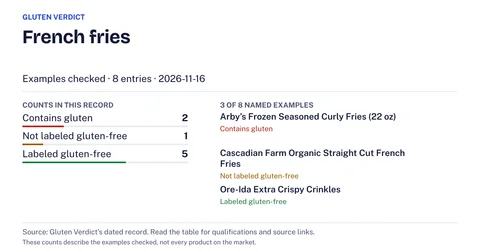 French friesDepends on the product2 of 8 products we checked contain gluten: Arby’s Frozen Seasoned Curly Fries (22 oz) and Checkers Frozen Crispy Seasoned Fries (28 oz)checked Nov 16, 2026
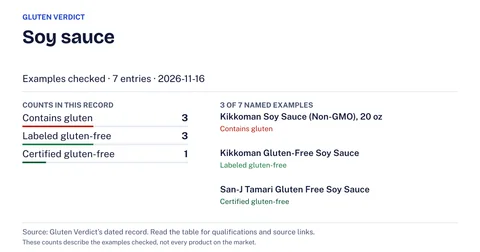 Soy sauceDepends on the product3 of 7 products we checked contain gluten: Kikkoman Soy Sauce (Non-GMO), 20 oz; San-J Organic Shoyu Soy Sauce; and Lee Kum Kee Premium Soy Sauce (No Preservatives Added)checked Nov 16, 2026
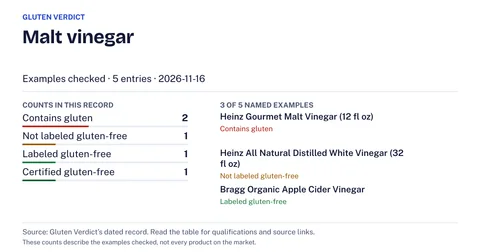 Malt vinegarContains glutenchecked Nov 16, 2026
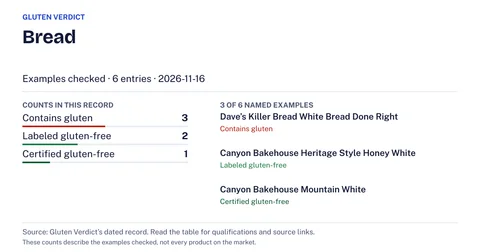 BreadContains glutenchecked Nov 16, 2026
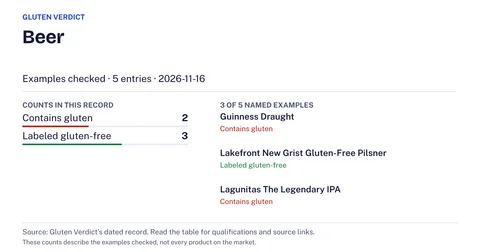 BeerDepends on the product2 of 5 products we checked contain gluten: Guinness Draught and Lagunitas The Legendary IPAchecked Nov 16, 2026
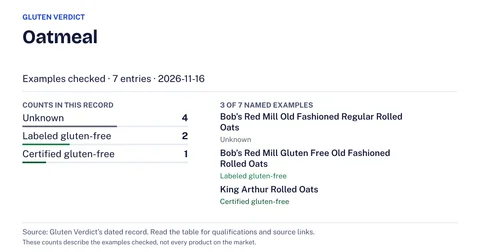 OatmealDepends on the productchecked Nov 16, 2026
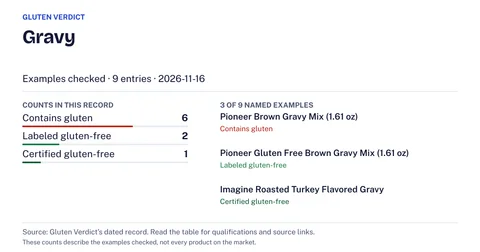 GravyDepends on the product6 of 9 products we checked contain glutenchecked Nov 16, 2026
Questions people ask
Should I keep a food diary before I am tested for celiac disease?
A diary records what you eat and does not change it. NIDDK says that if you think you might have celiac disease, you should talk with your doctor about testing before beginning a gluten-free diet, because avoiding gluten before testing may make the results inaccurate7.
How soon after eating gluten do symptoms start?
It varies. In one study of adults with celiac disease, the median was 1 hour, with a range of 10 minutes to 48 hours26. The National Celiac Association says some people feel nothing until the next day or a few days later, and some not at all16.
More in Symptoms, reactions and persistent complaints
 Still having symptoms on a gluten-free diet? Where gluten can still get inA checklist of label, kitchen, restaurant, product and medicine sources of gluten, and what the sources say about when to see a doctor.
 If you think you were glutened: what the celiac organizations say to doWhat the celiac charities, FDA and NIDDK say to do after accidental gluten exposure, when to contact a clinician, and how to trace the cause.
 Still tired on a gluten-free diet: the causes clinicians checkWhy fatigue can continue on a gluten-free diet: gluten exposure, other gut conditions, iron, B12, thyroid, sleep, mood, and follow-up lists.
 How long after eating gluten do symptoms start, and how long do they last?Onset and duration after gluten as celiac charities and studies report them, and how sources time celiac disease, gluten sensitivity and wheat allergy.
 Constipation and celiac disease: when it is the main symptomWhat studies and guidelines report about constipation in celiac disease, why it is easy to miss, and how diet-related constipation differs.
 Stomach pain after gluten-free bread: what the label can and cannot tell youWhy gluten-free bread can hurt: ingredients that cause gas, how gluten gets in, a one-change log to tell them apart, and when sources say see a doctor.
All 22 guides in Symptoms, reactions and persistent complaints
Related guides
 Where wheat, barley and rye hide in processed food: 15 places to checkFifteen processed foods where wheat, barley or rye turn up, the label step that catches each, and what US allergen law does and does not flag.
 How to read a US food label for glutenWhere gluten shows up on a US food label: the gluten-free claim, the Contains line, the ingredient list and may-contain lines, and what each means.
 A gluten-free meal plan as a shopping template, by meal slotA weekly gluten-free shopping template: staples for each meal slot, the check each packaged item needs, and a ledger of when you last read each label.
 Your first 30 days after a celiac diagnosis: a week-by-week planA week-by-week plan for the first month after a celiac diagnosis: label rules, kitchen changes, a dietitian, follow-up tests and questions for your doctor.
Sources
- [1, 2, 3, 4, 5, 6] National Institute of Diabetes and Digestive and Kidney Diseases (NIDDK), Treatment for Celiac Disease, checked Nov 17, 2026.
- [7, 8, 9, 10, 11, 12] National Institute of Diabetes and Digestive and Kidney Diseases (NIDDK), Eating, Diet, & Nutrition for Celiac Disease, checked Nov 17, 2026.
- [13, 14] National Institute of Diabetes and Digestive and Kidney Diseases (NIDDK), Symptoms & Causes of Celiac Disease, checked Nov 17, 2026.
- [15, 16, 17, 18] National Celiac Association, How quickly after ingesting gluten can a reaction occur?, checked Nov 17, 2026.
- [19] National Celiac Association, Lack of symptoms following consumption of gluten, checked Nov 17, 2026.
- [20, 21] National Celiac Association, Following a gluten-free diet but still unwell, checked Nov 17, 2026.
- [22, 23, 24, 25] National Celiac Association, What should I do if a gluten-free product makes me sick?, checked Nov 17, 2026.
- [26, 27, 28] Alimentary Pharmacology & Therapeutics, Symptomatic suspected gluten exposure is common among patients with coeliac disease on a gluten-free diet (Silvester et al., 2016), checked Nov 17, 2026.
- [29, 45] American Journal of Clinical Nutrition, Comparison of weekly gluten immunogenic peptide measurement and conventional tools to assess adherence to the gluten-free diet in celiac disease (Stefanolo et al., 2023), checked Nov 17, 2026.
- [30, 31] Journal of Clinical Medicine, Management Strategy for Non-Responsive and Refractory Celiac Disease in Adults: A Review Article (Al-Toma, 2025), checked Nov 17, 2026.
- [32] Patient Related Outcome Measures, Psychometric Evaluation of the Celiac Disease Symptom Diary 2.1 Using Data from the Virtual Celiac Symptoms Study (Ghura et al., 2025), checked Nov 17, 2026.
- [33, 34] Celiac Disease Foundation, Advancing Celiac Disease Research: Validating a Daily Symptom Diary for Clinical Trials, checked Nov 17, 2026.
- [35] Celiac Disease Foundation, Symptoms Assessment Tool, checked Nov 17, 2026.
- [36, 37] Celiac Disease Foundation, Adult & Pediatric Follow-Up Checklists, checked Nov 17, 2026.
- [38, 39] Celiac Disease Foundation, Gluten in Medicine, Vitamins & Supplements, checked Nov 17, 2026.
- [40] Celiac Disease Foundation, New Study Quantifies Gluten Cross-Contact Risk in Shared Fryers, checked Nov 17, 2026.
- [41, 42, 43] US Food and Drug Administration, Gluten and Food Labeling, checked Nov 17, 2026.
- [44] Gluten Intolerance Group, I went to a restaurant that had food marked gluten-free on the menu, but I felt glutened after my meal. How could this have happened?, checked Nov 17, 2026.