How to explain celiac disease to friends and family
Short answer
Three sentences cover it: what celiac disease is, what it is not, and what treats it1, 2, 3.
- It is an autoimmune condition: eating gluten, a protein in wheat, barley and rye, damages the lining of the small intestine4, 1.
- It is not an allergy: NIDDK separates it from wheat allergy and from gluten sensitivity2, 5.
- The treatment is a gluten-free diet, and Coeliac UK calls it a lifelong condition with that diet as the only treatment3, 6.
Part of Explaining celiac and everyday social life, 15 guides

Key points
- Autoimmune, not allergy: Coeliac UK calls it an autoimmune disease1, and NIDDK says it differs from a wheat allergy and from gluten sensitivity2, 5.
- Looking well proves little: NIDDK says people with celiac disease who have no symptoms can still develop complications over time without treatment7.
- A US gluten-free label means less than 20 parts per million of gluten, a legal limit8; GIG and Coeliac UK both say even small amounts can be damaging9, 10.
- Give the host something to do: GIG’s suggested reply offers to bring a dish and to help with preparation11.
The thirty-second version
Three sentences, each backed by the sources listed below. Change the words to sound like you; keep the order.
- Celiac disease is an autoimmune condition: when I eat gluten, which is in wheat, barley and rye, it damages the lining of my small intestine4, 1.
- It is not an allergy2, and the treatment is a gluten-free diet3.
- Gluten turns up in more than bread, so I check labels and ask what is in a product12, 13.
The sources use different words for it. Coeliac UK calls it an autoimmune disease1, FDA calls it an auto-immune reaction to eating gluten14, and NIDDK describes a chronic digestive and immune disorder4. Use whichever phrase the listener will follow.
If they ask: is it an allergy?
No, and the sources are direct about it. NIDDK says celiac disease is different from a wheat allergy: both involve the immune system reacting to wheat, but some symptoms of wheat allergies, such as itchy eyes or trouble breathing, are different from celiac disease, and wheat allergies do not cause long-term damage to the small intestine2. Coeliac UK, the UK charity, puts it in one line: not a food allergy or an intolerance, but an autoimmune disease1.
| Condition | What NIDDK says | Damages the small intestine? |
|---|---|---|
| Celiac disease | Triggered by eating foods containing gluten4 | Yes4 |
| Wheat allergy | A type of food allergy; the immune system reacts to wheat2 | No long-term damage2 |
| Gluten sensitivity | May cause symptoms like those of celiac disease, such as abdominal pain and tiredness5 | No5 |
If the other person keeps saying allergy, you do not have to win the point. For whoever is cooking, what matters is what goes on your plate: food without gluten3.
If they say: but you look fine
NIDDK says symptoms of celiac disease vary widely, and a person may have several that come and go15. Coeliac UK says you do not need gut symptoms to have the disease16 and that you can look a normal size and shape and still have it17. NIDDK adds that the disease can affect the body outside the small intestine18.
Feeling well is not the whole picture either. NIDDK says people with celiac disease who have no symptoms can still develop complications over time if they do not get treatment7, and GIG says tiny amounts of gluten can damage the intestinal cells even when there are no obvious immediate symptoms9.
The other side of looking fine: NIDDK says symptoms typically improve and may go away once a person eats a gluten-free diet, and may return if a person consumes small amounts of gluten19. So someone who looks fine may be someone whose symptoms have settled on the diet.
If they ask: isn’t this just a diet?
For celiac disease the diet is the treatment3, 6. GIG’s suggested reply to the fad question runs along the same lines: it says the diet is medically prescribed and that celiac disease is a serious autoimmune condition, just like type 1 diabetes, lupus, or multiple sclerosis20.
On diets in general, GIG says that for the general population, the presence or absence of gluten alone is not related to diet quality21.
As for how common it is, NIDDK says experts estimate about 2 million people in the United States, and about 1 percent of people around the world, have celiac disease, and that many who have it have not been diagnosed22.
If they ask: how strict do you have to be?
This is the question where it is easiest to say too much in one direction, so keep two facts together: the US label limit, and what the charities say about small amounts.
| Source | What it says |
|---|---|
| FDA | Foods labeled gluten-free, no gluten, free of gluten or without gluten must contain less than 20 parts per million of gluten8. FDA calls this the lowest level that can be reliably detected with validated methods, and says most people with celiac disease can tolerate foods with very small amounts23. |
| NIDDK | In the United States, products labelled gluten-free must have less than 20 parts per million, which NIDDK says should not be a problem for the vast majority of people13. It also says symptoms may return if a person consumes small amounts of gluten19. |
| GIG | Even tiny amounts of gluten can damage the intestinal cells of a person with celiac disease, even without obvious immediate symptoms9. |
| Coeliac UK | Even very small amounts can be damaging, so sensible steps to avoid cross contamination are important10. |
An honest answer holds both: a gluten-free label in the US is a legal limit, set at less than 20 parts per million8, and Coeliac UK says sensible steps to avoid cross contamination are important10. Exactly how strict one particular person needs to be is for their own doctor or dietitian to say: NIDDK says a doctor will explain the gluten-free diet and may refer a person to a registered dietitian30, who will teach how to avoid gluten24.
For a host, the practical part is cross-contact. Coeliac UK’s list of tips for avoiding it names:
- separate cooking utensils during preparation and cooking25
- no frying in oil previously used for foods that contain gluten25
- a clean grill, a separate toaster or toaster bags for gluten free toast25
- separate breadboards, washed surfaces and separate condiments such as jam, butter, mustard and mayonnaise25
Our french fries verdict covers the shared-oil question.
If they ask: what can I cook for you?
Three answers you can give, from least work for the host to most:
- Plain food with no gluten in it. FDA lists bottled spring water, fruits, vegetables and eggs as naturally gluten-free, and notes the package may not say so26. Coeliac UK’s cross-contamination tips above, such as separate utensils, are worth following when cooking it25.
- A packaged food labeled gluten-free. In the US the label means less than 20 parts per million8, and the label is voluntary, so a missing claim is not a warning by itself27, 26. If a label does not say what is in a product, NIDDK says to ask the maker for an ingredients list and not to assume it is gluten-free13.
- Let you bring a dish. GIG’s suggested reply says a dish made gluten-free must not have touched any food containing gluten, and offers to bring your own dish and come early to help with preparation11.
Four foods a host may ask about, each with our verdict, the pages we read and the date we read them: bread, soy sauce, french fries and beer.
Adjusting for who is listening
GIG’s advice on these conversations is to keep a serious but informal tone, to say that a gluten-free diet is not embarrassing or shameful, and to choose a quiet, non-rushed place28. It also says people may not fully understand however often you explain, so expect to explain again29.
| Listener | Lead with | Hold back unless asked |
|---|---|---|
| A relative who cooks for you | The dish-and-bring-your-own offer, then the cross-contact tips | The full explanation of the label limit |
| A boss or colleague | That it is a medical condition, and what you need at a work meal | Symptoms and personal detail |
| A new date or friend | The one-sentence version, then where you can eat together | Anything you do not want to share yet |
A message to send before a meal
Each fact in this message is sourced above: autoimmune1, wheat, barley and rye4, the diet as the treatment3, and the offer to bring a dish11. Edit it to your situation.
Hi Sam, looking forward to Saturday. One thing to flag: I have celiac disease, an autoimmune condition, so I avoid anything made with wheat, barley or rye. It is treated with diet, not a diet I picked. Happy to bring a dish so you do not have to think about it, and glad to answer questions.
Verdicts in this guide
 BreadContains glutenchecked Nov 16, 2026
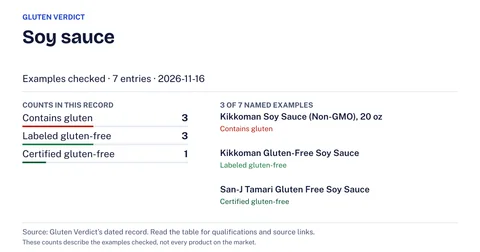 Soy sauceDepends on the product3 of 7 products we checked contain gluten: Kikkoman Soy Sauce (Non-GMO), 20 oz; San-J Organic Shoyu Soy Sauce; and Lee Kum Kee Premium Soy Sauce (No Preservatives Added)checked Nov 16, 2026
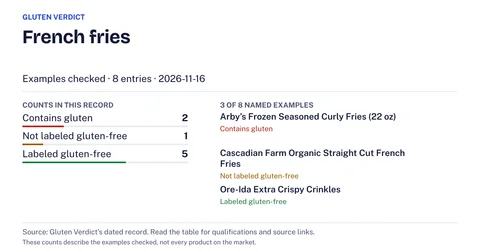 French friesDepends on the product2 of 8 products we checked contain gluten: Arby’s Frozen Seasoned Curly Fries (22 oz) and Checkers Frozen Crispy Seasoned Fries (28 oz)checked Nov 16, 2026
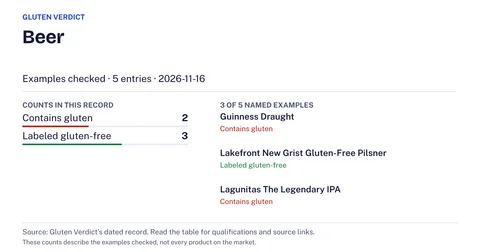 BeerDepends on the product2 of 5 products we checked contain gluten: Guinness Draught and Lagunitas The Legendary IPAchecked Nov 16, 2026
Questions people ask
Does a gluten-free label mean there is no gluten at all?
Not necessarily. The US rule says foods carrying the claim must contain less than 20 parts per million of gluten8.
Is celiac disease the same as gluten sensitivity?
No. NIDDK says gluten sensitivity may cause symptoms like those of celiac disease but does not damage the small intestine5.
Can someone grow out of celiac disease?
Coeliac UK says it is a lifelong condition, with a gluten free diet as the only treatment6.
Does every gluten-free food say so on the package?
No. FDA says the claim is voluntary, and naturally gluten-free foods may not carry it27, 26.
What if they still do not understand?
GIG says people may not fully understand however often you explain, and that you may need to explain again29.
More in Explaining celiac and everyday social life
 What to say to someone with celiac disease, and what to skipSentences to use, and ones to skip, when you cook for, eat out with or work beside someone with celiac disease, each tied to the fact behind it.
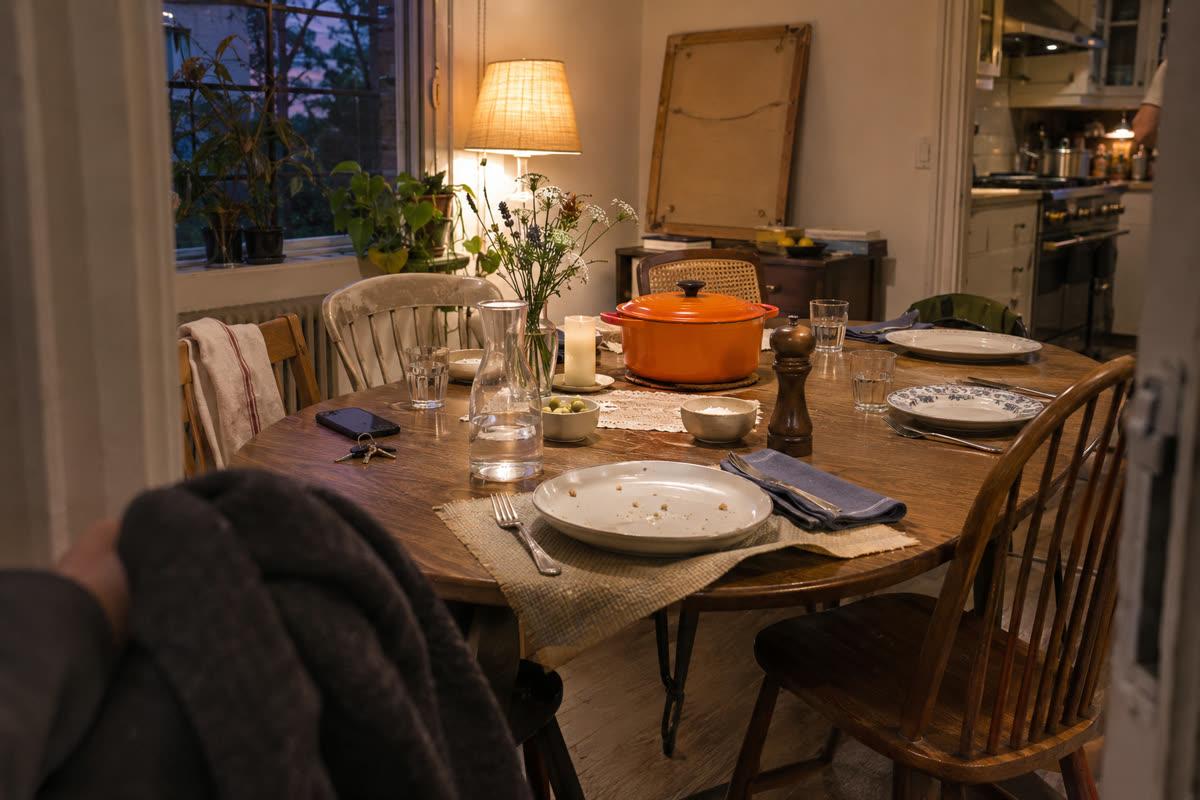 How to tell a host or relative you have celiac diseaseWhat to send a host before the meal, the cross-contact rule in one sentence, questions to ask about a dish, bringing your own, and how to pass on a dish.
 When your partner has celiac disease: gluten-free home or split kitchenChoose between a gluten-free home and a split kitchen, and find what to say at restaurants and to family, with NIH and charity sources.
 When a relative says a little gluten won’t hurt: what to say, and what to let goOne-line replies for the relative who scrapes off croutons or says one bite is fine, each with its source, plus what to push back on and what to let go.
 Dating with celiac disease: when to tell, what to say, and what has been published about kissingWhen people with celiac disease tell a date, how to word the message, and what GIG and a 2026 study report about kissing, each quoted.
 Gluten-free meals in a nursing home or assisted living: the rules and what to askWhich meal rules cover a nursing home or assisted living, what to ask on a tour, how to get a gluten-free diet into the care plan, and where to complain.
Related guides
 Celiac disease vs gluten intolerance: three conditions, three diagnosesHow celiac disease, non-celiac gluten sensitivity and wheat allergy differ in mechanism, diagnosis and diet, with a source behind every point.
 How the 20 ppm gluten-free limit was chosen, and by whomWho set the 20 ppm gluten-free limit and when: the 2004 law, FDA's 2013 rule and its stated reasons, the 2020 follow-up rule, and Codex and EU wording.
 Gluten-free myths about labels and food, checked against the rulesNatural, organic, zero gluten, fermenting and oats: each gluten-free myth checked against the page that states the rule, with the wording and read date.
 How long after eating gluten do symptoms start, and how long do they last?Onset and duration after gluten as celiac charities and studies report them, and how sources time celiac disease, gluten sensitivity and wheat allergy.
Sources
- [1, 6, 10, 16, 17, 25] Coeliac UK, Common Coeliac Disease Myths Debunked, checked Nov 17, 2026.
Read on 2026-11-17: the list headed “Top tips to avoid cross contamination” names keeping cooking utensils separate during food preparation and cooking; not frying food in oil previously used to cook foods that contain gluten; using a clean grill, a separate toaster or toaster bags to make gluten free toast; using separate breadboards and washing surfaces thoroughly; and using separate condiments such as jam, butter, mustard and mayonnaise.
- [2, 4, 5, 12, 18, 22] NIDDK (National Institutes of Health), Definition & Facts for Celiac Disease, checked Nov 17, 2026.
- [3, 13, 24, 30] NIDDK (National Institutes of Health), Treatment for Celiac Disease, checked Nov 17, 2026.
- [7, 15, 19] NIDDK (National Institutes of Health), Symptoms & Causes of Celiac Disease, checked Nov 17, 2026.
- [8, 14, 23, 26, 27] US Food and Drug Administration, Gluten and Food Labeling, checked Nov 17, 2026.
- [9, 21] Gluten Intolerance Group, The Gluten-Free Diet: Facts and Myths, checked Nov 17, 2026.
- [11, 20, 28, 29] Gluten Intolerance Group, Talking to Friends & Family About Living Gluten-Free, checked Nov 17, 2026.