Hydrolyzed protein, yeast extract and wheat starch on a US food label
Short answer
Look for the source in the name, and ask the maker when it is not there:
- Hydrolyzed protein: a US label has to name the food source of the protein, so “hydrolyzed wheat protein” shows wheat and “hydrolyzed vegetable protein” alone is not an acceptable name1, 2.
- Wheat starch: it is derived from wheat, and a food labeled gluten-free may use it only if the finished food stays under 20 parts per million of gluten3.
- Yeast extract: it may be made from spent brewer’s yeast, and a US label does not have to say whether barley is behind it4, 5.
Part of Hidden gluten in ingredients, sauces and processed foods, 21 guides
Key points
- A US label has to name the food source of a hydrolyzed protein, and “hydrolyzed vegetable protein” on its own is not an acceptable name1, 2.
- Yeast extract can come from spent brewer’s yeast, and a US label does not have to say whether barley is behind it4, 5.
- Wheat starch is allowed in a food labeled gluten-free only when the finished food has less than 20 ppm of gluten, and the label then carries a wheat statement3, 6.
- Codex describes a similar kind of wheat-derived ingredient processed to remove gluten, with a limit of 20 mg/kg7.
Three names, three different label situations
All three turn up in ingredient lists. What differs is how, or whether, the grain shows up on a US label.
| Ingredient | What it can come from | Does a US label name the grain? |
|---|---|---|
| Hydrolyzed protein | A plant protein, such as soy or wheat: FDA lists hydrolyzed soy protein and hydrolyzed wheat protein as examples of hydrolyzed foods8. | Yes. The name has to include the food source of the protein1. |
| Yeast extract | Spent brewer’s yeast, a beer by-product, or yeast grown on sugar beets4, 9. | Not necessarily. Manufacturers are not required to declare barley on the label5. |
| Wheat starch | Wheat: FDA’s rule describes it as an ingredient derived from a gluten-containing grain3. | Wheat is in the name, and wheat is on the list of major food allergens10. |
The sections below take them one at a time, then compare US wheat starch with the Codex standard, and end with what to ask the maker. How a maker proves a gluten-free claim on a fermented or hydrolyzed ingredient is a separate rule; the one-line version is in the questions at the end.
Hydrolyzed protein: the source has to be named
In a hydrolyzed food, a food’s proteins are broken into smaller compounds by reaction with water, often sped up by enzymes11. FDA’s description of its 2020 gluten-free rule names hydrolyzed plant proteins used to improve flavor or texture in processed foods such as soups, sauces and seasonings12. Our verdicts for foods in those aisles include chicken broth.
What the naming rule says
Under 21 CFR 102.22, the name of a protein hydrolysate must be specific and must include the food source of the protein1. The same rule says “hydrolyzed vegetable protein” and “hydrolyzed protein” are not acceptable names because they do not identify the source2. “Hydrolyzed wheat gluten” and “hydrolyzed soy protein” are examples of acceptable ones13.
A hydrolysate used for its effect on flavor also cannot be declared simply as “flavor”, “natural flavor” or “flavoring”14. That rule bars “natural flavor” as the name for a hydrolyzed protein used for its taste14.
Where the wheat declaration comes from
Wheat is on the US list of major food allergens10, and an ingredient that contains protein derived from wheat counts as one15. A maker names wheat in a line that begins with “Contains” next to the ingredient list16, or in parentheses after the ingredient’s name17. The parentheses are not needed when the ingredient’s own name already uses the source, as “hydrolyzed wheat protein” does18.
What it looks like on a package
Pioneer’s Gluten Free Brown Gravy Mix lists “HYDROLYZED VEGETABLE PROTEIN (CORN; SOY)”19. Its Brown Gravy Mix lists “HYDROLYZED VEGETABLE PROTEIN (CORN; SOY; AND/OR WHEAT)”20 and its allergen line begins “CONTAINS ALLERGENS: WHEAT”21. Hormel’s Chili No Beans names the grain inside the ingredient, as “Hydrolyzed Soy, Corn, and Wheat Protein”22.
Our hydrolyzed vegetable protein verdict lists the products we checked and what each maker’s page said.
FDA says hydrolysis is not considered a process to remove gluten, and it gives hydrolyzed wheat protein as one of its examples of a hydrolyzed food8.
Yeast extract: the source is the open question
Yeast extract and autolyzed yeast extract may be made from spent brewer’s yeast, or grown on sugar beets, which are gluten-free4. Spent brewer’s yeast is a by-product of beer brewing and can be contaminated with small amounts of gluten-containing grain and malt9.
A US label cannot settle which one it is. Barley is not on the list of major food allergens10, so the Contains line does not have to mention it. Gluten Free Watchdog (GFWD) says there is no way to know from the label whether yeast extract contains barley protein unless barley is voluntarily declared23. The National Celiac Association (NCA) says the same: manufacturers are not required to declare barley5.
GFWD contrasts this with Canada: under Health Canada regulations, it notes, all gluten sources, including barley, must be declared in packaged food24.
GFWD also reports that FDA told it yeast extract cannot be hidden under “natural flavor” and must be declared25. FDA’s naming rule lists “autolyzed yeast extract” as an acceptable name13.
| Yeast ingredient | NCA’s grouping |
|---|---|
| Baker’s yeast, yeast, autolyzed yeast, nutritional yeast, torula yeast | Gluten-Free26 |
| Yeast extract, autolyzed yeast extract | May Contain Gluten26 |
| Brewer’s yeast | Contains Gluten26 |
What the charities advise
NCA says to check with the manufacturer when yeast extract is listed on a food that is not labeled gluten-free5. On a yeast extract food that is not labeled gluten-free, GFWD recommends that people with celiac disease avoid it unless the manufacturer confirms the source is gluten-free27, and it says it does not know how often yeast extract is spent brewer’s yeast28. The Gluten Intolerance Group (GIG) tells readers to look for yeast extracts and products labeled or third-party certified as gluten-free29.
On a food that does carry the claim, GFWD says that, generally speaking, it does not want people to start worrying about yeast extract27. It has also reported a labeled gluten-free product with the ingredient: a Kirkland Signature turkey breast whose yeast extract, per Costco, may be brewer’s yeast from beer brewing30. GFWD’s page quotes the GFCO manual as saying certified products cannot contain yeast extract grown on culture media that contained proteins from wheat, rye, barley or oats31.
On a package, Zatarain’s Yellow Rice Mix shows what the ingredient list leaves out. McCormick’s page lists “Gluten free”32 and, in the ingredients, yeast extract and hydrolyzed soy protein with no source given for the yeast extract33. Our yeast extract verdict records the products we checked.
Wheat starch: wheat in the name, a statement beside the claim
FDA’s gluten-free rule uses wheat starch as its example of an ingredient derived from a gluten-containing grain and processed to remove gluten. Such an ingredient is allowed in a food labeled gluten-free only if its use does not leave the food at 20 parts per million (ppm) of gluten or more3. GFWD describes wheat starch as an allowed ingredient in US foods labeled gluten-free, considered an ingredient processed to remove gluten34.
Without the claim, the picture changes. Based on testing through GFWD, wheat starch not labeled gluten-free may contain gluten well above 20 ppm35. GIG likewise points out that FDA allows wheat starch in a product labeled gluten-free if the finished product has less than 20 ppm36.
The wheat statement
When a food names wheat in the ingredient list or a Contains statement and also makes a gluten-free claim, the rule treats the food as misbranded unless the word “wheat” is followed by an asterisk that points to this sentence near the ingredient statement: “The wheat has been processed to allow this food to meet the Food and Drug Administration (FDA) requirements for gluten-free foods.”6
On a gluten-free food made with processed wheat, then, the word “wheat” and that sentence can both appear6. King Arthur’s page for its Gluten-Free Bread Flour says it is made with gluten-free wheat starch37.
What GFWD found when it tested
GFWD’s commissioned testing of labeled gluten-free wheat starch and foods made with it found at most 17 ppm of gluten with the competitive R5 ELISA and 6 ppm with the sandwich R5 ELISA38. Its opinion is that wheat starch for gluten-free products should be tested with both methods unless the supplier confirms that no hydrolytic enzymes are used in making the water-washed starch39. GFWD reports that, per GFCO, wheat starch in certified products must be water washed only and test at no more than 5 ppm of gluten with a sandwich ELISA40.
For packages we have checked, see our wheat starch verdict and the Pringles verdict.
Codex wheat starch and the US rule
The Codex standard for foods for people intolerant to gluten (CODEX STAN 118-1979) covers, among its gluten-free foods, those consisting of one or more ingredients from wheat41 that have been specially processed to remove gluten, with a gluten level not above 20 mg/kg in the food as sold7. That resembles the US rule’s category of an ingredient derived from a gluten-containing grain and processed to remove gluten, and the US rule uses the same figure, 20 mg of gluten per kg of food3. The fao.org copy we read is the version amended in 2015; we did not check for later amendments.
The Codex labeling clause says the term “gluten-free” shall be printed in the immediate proximity of the product name for the products described in section 2.1.142. The US rule has a separate requirement, the wheat statement described above, for a label that names wheat and makes the claim6.
Italy as an example
The Italian celiac society AIC says that contamination in the wheat starch then on the market led Italy’s Ministry of Health to exclude the ingredient for years from gluten-free products made for people with celiac disease43. It says a wheat starch it calls “deglutinato” is now available that allows products with a gluten content below 20 ppm44, and that products labeled “senza glutine” made with wheat starch can be found in Italy45. AIC adds that wheat starch that is not “deglutinato”, as commonly used in ordinary food production, remains unsuitable for people with celiac disease46.
A gluten-free claim and a wheat starch line can appear on the same package, in the US6 and in Italy45 alike. Read the ingredient list for “wheat starch” even when the front of a domestic or imported package carries a claim.
At the shelf: what to check and what to ask
- Read the whole ingredient list, not only the Contains line. Barley, which can sit behind yeast extract47, is not on the US allergen list10.
- If the label says only “hydrolyzed vegetable protein” or “hydrolyzed protein”, no source is named; FDA’s rule says those names are not acceptable2. Look for the source in parentheses17 or in the Contains line16.
- If wheat starch is listed, look for a gluten-free claim and the asterisked sentence that goes with it6.
- If yeast extract is listed on a food with no gluten-free claim, NCA says to check with the manufacturer5. GFWD says it is important to ask whether spent yeast is the source48.
For wheat starch in a gluten-free food, GFWD suggests asking the maker either of two questions: whether the wheat starch is tested with both a sandwich and a competitive ELISA, or whether the supplier has confirmed that no hydrolytic enzymes are used in making the water-washed starch49.
See also our verdicts for soy sauce and miso. For soy sauce, FDA says that in general soy sauce made from soybeans and wheat, or another gluten-containing grain, may not bear a gluten-free claim50. Recipes change, so the package in your hand has the final word.
Verdicts in this guide
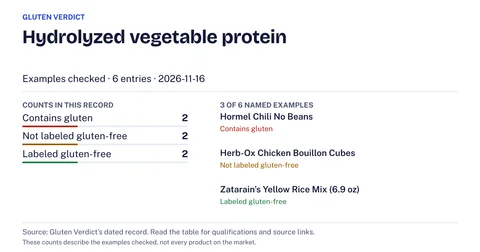 Hydrolyzed vegetable proteinDepends on the product2 of 6 products we checked contain gluten: Hormel Chili No Beans and Pioneer Brown Gravy Mix (1.61 oz)checked Nov 16, 2026
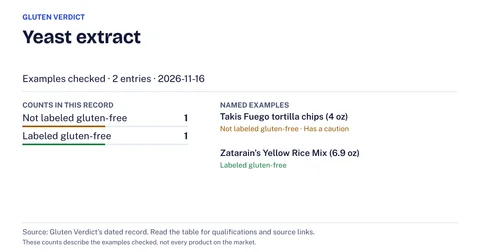 Yeast extractDepends on the productchecked Nov 16, 2026
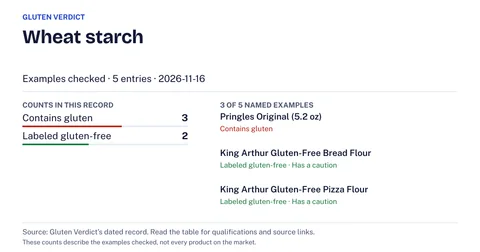 Wheat starchDepends on the product3 of 5 products we checked contain gluten: Pringles Original (5.2 oz), Jiffy Corn Muffin Mix, and Chex Mix Bold Garlic and Herbchecked Nov 16, 2026
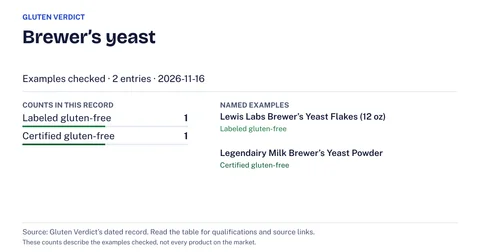 Brewer’s yeastDepends on the productchecked Nov 16, 2026
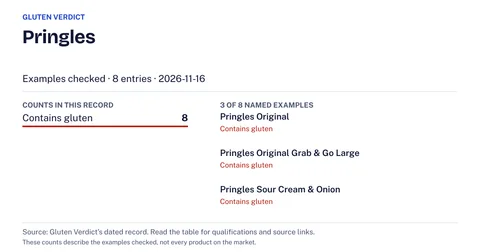 PringlesContains glutenPringles · checked Nov 16, 2026
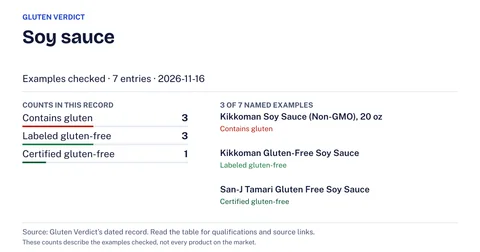 Soy sauceDepends on the product3 of 7 products we checked contain gluten: Kikkoman Soy Sauce (Non-GMO), 20 oz; San-J Organic Shoyu Soy Sauce; and Lee Kum Kee Premium Soy Sauce (No Preservatives Added)checked Nov 16, 2026
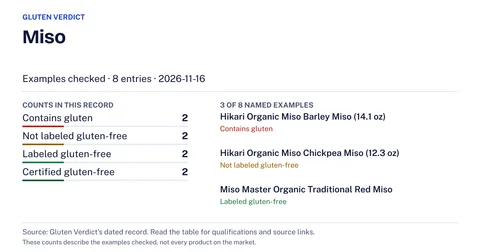 MisoDepends on the product2 of 8 products we checked contain gluten: Hikari Organic Miso Barley Miso (14.1 oz) and Hikari Miso Soup Akadashi (12 servings, 7.0 oz)checked Nov 16, 2026
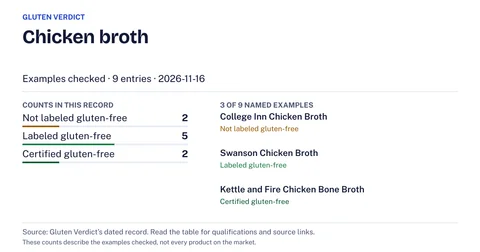 Chicken brothDepends on the productchecked Nov 16, 2026
Questions people ask
Is hydrolyzed vegetable protein gluten-free?
The name alone does not say. A US label has to name the food source of the protein1. FDA lists hydrolyzed soy protein and hydrolyzed wheat protein as examples of hydrolyzed foods and says hydrolysis is not considered a process to remove gluten8.
Can a hydrolyzed product made from wheat carry a gluten-free claim?
FDA says a hydrolyzed or fermented food product made from gluten-containing grains may not bear a gluten-free claim unless the grains were processed to remove gluten and the use of the ingredient resulted in less than 20 ppm gluten in the food before hydrolysis or fermentation51.
Is autolyzed yeast extract different from yeast extract?
NCA says both may contain gluten from barley47. Its table lists plain autolyzed yeast under gluten-free26.
Why would a gluten-free food say “wheat”?
A food that names wheat and makes the claim must carry a sentence saying the wheat has been processed to meet FDA’s gluten-free requirements6.
More in Hidden gluten in ingredients, sauces and processed foods
 Gravy, jarred pasta sauce and cheese sauce: where flour and starch thicken the potHow to read a gravy packet, gravy jar, cheese sauce or pasta sauce for wheat flour, wheat gluten and starch, with maker pages read on 2026-11-17.
 Wheat, barley and rye on an ingredient list: the names to look forLook up wheat, barley and rye names on a US ingredient list, from durum to malt, and sort each as contains gluten, depends on the maker, or lookalike.
 Plant-based meat, tofu and seitan: finding the wheat glutenSeitan and some meat substitutes are made from wheat gluten. How to spot it on a plant-based label, with ingredient lists from maker pages.
 Where wheat, barley and rye hide in processed food: 15 places to checkFifteen processed foods where wheat, barley or rye turn up, the label step that catches each, and what US allergen law does and does not flag.
 Miso, gochujang and other fermented pastes: where barley and wheat are usedHow to pick a miso or gochujang jar: read the koji grain, the full ingredient list and the maker’s gluten-free statement.
 Seasoning packets, bouillon cubes and spice blends: where wheat entersWhy a packet, cube or blend can list wheat flour or barley when a single spice lists one item, and the order to read the label in.
All 21 guides in Hidden gluten in ingredients, sauces and processed foods
Related guides
 Natural flavors, caramel color and modified food starch: which can carry glutenWhich additives on a US label can come from a gluten grain, which sources describe as gluten free, and what the maker has to disclose.
 Fermented, hydrolyzed and distilled foods: how a gluten-free claim is checkedHow FDA’s 2020 rule checks a gluten-free claim on fermented, hydrolyzed and distilled foods, why a test cannot settle it, and where TTB takes over.
 Is yeast gluten-free? What yeast and sourdough starter labels sayCheck a yeast packet and the maker’s statement, tell baker’s yeast from brewer’s yeast and yeast extract, and read a sourdough starter seller’s page.
 Gluten-free high-protein foods: where gluten hides in bars, powders, jerky and marinadesCheck each protein product type for its gluten trap: seitan, jerky, bars, powders, sausage and broth, with what makers say on their own pages.
Sources
- [1, 2, 13] Electronic Code of Federal Regulations, 21 CFR 102.22 Protein hydrolysates, checked Nov 17, 2026.
- [3, 6] Electronic Code of Federal Regulations, 21 CFR 101.91 Gluten-free labeling of food, checked Nov 17, 2026.
- [4, 9] National Celiac Association, Yeast Extract & Autolyzed Yeast Extract, checked Nov 17, 2026.
- [5, 26, 47] National Celiac Association, Autolyzed yeast extract and Brewer's yeast, checked Nov 17, 2026.
Read on 2026-11-17: the table on the page has three columns. Under “Gluten-Free” it lists baker’s yeast, yeast, autolyzed yeast, nutritional yeast and torula yeast; under “May Contain Gluten” it lists yeast extract and autolyzed yeast extract; under “Contains Gluten” it lists brewer’s yeast.
- [7, 41, 42] Codex Alimentarius, Standard for Foods for Special Dietary Use for Persons Intolerant to Gluten (CODEX STAN 118-1979), checked Nov 17, 2026.
- [8, 11, 12, 50, 51] US Food and Drug Administration, Questions and Answers on the Gluten-Free Food Labeling Final Rule, checked Nov 17, 2026.
- [10, 16, 17, 18] US Food and Drug Administration, Food Allergen Labeling and Consumer Protection Act of 2004 (FALCPA), checked Nov 17, 2026.
- [14] Electronic Code of Federal Regulations, 21 CFR 101.22 Foods; labeling of spices, flavorings, colorings and chemical preservatives, checked Nov 17, 2026.
- [15] US Food and Drug Administration, Questions and Answers Regarding Food Allergens, Including the Food Allergen Labeling Requirements (Edition 5), checked Nov 17, 2026.
- [19] Pioneer Brand, Gluten Free Brown Gravy Mix (1.61 oz), checked Nov 17, 2026.
- [20, 21] Pioneer Brand, Brown Gravy Mix (1.61 oz), checked Nov 17, 2026.
- [22] Hormel Foods, Chili No Beans, checked Nov 17, 2026.
- [23, 24, 48] Gluten Free Watchdog, Ingredient Information: Yeast Extract & Barley (May 17, 2017), checked Nov 17, 2026.
- [25] Gluten Free Watchdog, Yeast Extract: Can it be “hidden” under natural flavor? (August 22, 2025), checked Nov 17, 2026.
- [27, 28] Gluten Free Watchdog, Yeast extract confusion redux (January 30, 2024), checked Nov 17, 2026.
- [29, 36] Gluten Intolerance Group, Are Maltose, Maltodextrin, Glucose Syrup, Yeast Extracts, and Wheat Starch Gluten-Free?, checked Nov 17, 2026.
- [30, 31] Gluten Free Watchdog, Kirkland Signature Roasted Turkey Breast and Yeast Extract (October 6, 2025), checked Nov 17, 2026.
- [32, 33] McCormick (Zatarain's), Zatarain's Yellow Rice Mix, 6.9 oz, checked Nov 17, 2026.
- [34, 35, 38, 39, 40, 49] Gluten Free Watchdog, Wheat Starch in Gluten-Free Foods in 2023: An Update from Gluten Free Watchdog, checked Nov 17, 2026.
- [37] King Arthur Baking Company, Gluten-Free Bread Flour, checked Nov 17, 2026.
- [43, 44, 45, 46] Associazione Italiana Celiachia (AIC), L’amido di frumento contiene glutine? E gli amidi modificati? (FAQ 28), checked Nov 17, 2026.