Is yeast gluten-free? What yeast and sourdough starter labels say
Short answer
The Gluten Intolerance Group says baking yeast is gluten-free9, but Red Star Yeast lists some of its own yeasts as not gluten free2, so the exact packet decides. Three checks settle most yeast and starter questions:
- Baker’s yeast: read the maker’s own statement for the exact product, because one brand can sell gluten-free and not-gluten-free yeasts side by side1, 2.
- Brewer’s yeast and yeast extract are different ingredients: Gluten Free Watchdog says brewer’s yeast used as an ingredient in a food not labeled gluten-free may contain gluten from malt and grain3, and the National Celiac Association says yeast extract may contain gluten from barley4.
- A sourdough starter begins as flour and liquid5, so the flour decides it, and a seller’s page should name that flour, as Cultures for Health’s does for its gluten-free starter6.
Part of Gluten-free baking technique, 11 guides
Key points
- Red Star Yeast’s own FAQ lists its Active Dry, Quick-Rise and Saf-Instant yeasts as gluten free and its Platinum, Platinum Instant Sourdough and Organic Instant Yeast products as not gluten free1, 2.
- The word “instant” does not decide it: Red Star’s Organic Instant Yeast page carries a “Contains: Wheat” line7, while its Quick-Rise Instant Yeast page lists yeast, sorbitan monostearate and ascorbic acid14.
- The Gluten Intolerance Group says baking yeast and nutritional yeast are gluten-free and that brewer’s yeast is the one to be concerned about9.
- FDA’s rule does not let a fermented food made from gluten-containing grains carry a “gluten-free” claim unless the grains were processed to remove gluten and the ingredient’s use left less than 20 ppm of gluten in the food before fermentation or hydrolysis10.
- A Contains line without wheat says nothing about barley or rye, which are not on the US major-allergen list11.
Baker’s yeast: read the maker’s statement for the exact product
The Gluten Intolerance Group says baking yeast is gluten-free9. The packet in your hand can still differ from the plain case, so the maker’s page for that product is the better check.
Red Star Yeast’s FAQ states that its Active Dry Yeast, Quick-Rise Yeast and Saf-Instant Yeast are gluten free1 and that its Fresh Cake Yeast is gluten-free12. The same answer says its Platinum, Platinum Instant Sourdough and Organic Instant Yeast products are not2.
| Red Star product | What its page lists | Gluten statement on Red Star’s site |
|---|---|---|
| Active Dry Yeast, 4 oz jar | Ingredients: yeast, sorbitan monostearate8 | Page says gluten-free13 |
| Quick-Rise Instant Yeast, 4 oz jar | Ingredients: yeast, sorbitan monostearate, ascorbic acid14 | FAQ lists Quick-Rise yeast as gluten free1 |
| Organic Instant Yeast, packet | Ingredients: organic yeast, ascorbic acid, with a “Contains: Wheat” line7 | FAQ says not gluten free2 |
| Platinum Instant Sourdough | Page carries a “Contains: Wheat and Rye” line15 | FAQ says not gluten free2 |
Bob’s Red Mill sells a yeast it names Gluten Free Active Dry Yeast16.
We could not read Fleischmann’s pages: its site answered our requests with a bot-check page, which we did not try to get around. This guide says nothing about Fleischmann’s products. For any brand we have not read, use its packet and its maker’s page for that product.
What to read on a yeast packet
- Which packet it is. The brand name is not enough, as Red Star’s split above shows.
- The ingredient list. Red Star’s Active Dry Yeast jar lists yeast and sorbitan monostearate8; a wheat or rye flour in a list would be the first thing to look for.
- The Contains line. Wheat is on the US list of major food allergens; barley and rye are not11. A Contains line that names no wheat therefore says nothing about barley or rye, so read the whole list.
- A gluten-free statement, on the packet and on the maker’s page. A gluten-free claim on a US food is voluntary17, and a food labeled “gluten-free” cannot be intentionally made with any amount of wheat, rye, barley or their crossbred hybrids like triticale, or an ingredient derived from them that was not processed to remove gluten18.
- The facility line. FDA allows a voluntary advisory statement such as “made in a facility that also processes wheat” on a food that also carries a gluten-free claim, provided it is truthful and not misleading19. Red Star’s Active Dry Yeast page carries a line about allergen cross-contact mitigation procedures8.
Brewer’s yeast, nutritional yeast and yeast extract are different ingredients
Gluten Free Watchdog explains that the term brewer’s yeast can refer both to the live yeast used to make beer and to the spent yeast left over from brewing20. When brewer’s yeast is used in food as a flavoring agent it is typically spent yeast, which Gluten Free Watchdog says may be contaminated with small amounts of gluten-containing grain and malt21.
The National Celiac Association states that brewer’s yeast is not gluten-free and contains barley22. It also says nutritional yeast is a different product: not a byproduct of beer production, typically grown on molasses from sugar beets or cane, and gluten-free23.
Yeast extract is a separate ingredient again. The National Celiac Association says yeast extract and autolyzed yeast extract may contain gluten from barley, and that manufacturers are not required to declare barley on the label, so it advises checking with the manufacturer when the product is not labeled gluten-free4. The Gluten Intolerance Group says some yeast extracts may be grown in barley and advises choosing one labeled gluten-free or GFCO third-party certified24.
| Name on the label | What the sources say |
|---|---|
| Baker’s or baking yeast | The Gluten Intolerance Group says it is gluten-free9; check the maker’s statement for the product (above) |
| Nutritional yeast | Gluten-free according to the Gluten Intolerance Group and the National Celiac Association9, 23 |
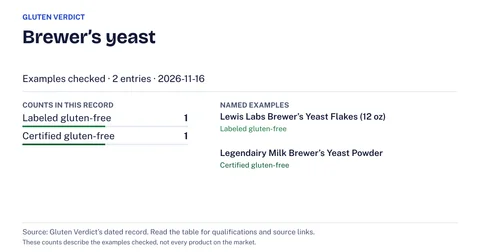
| Brewer’s yeast | Not gluten-free and contains barley, says the National Celiac Association22; may contain gluten from malt and grain when in a food not labeled gluten-free, says Gluten Free Watchdog3 |
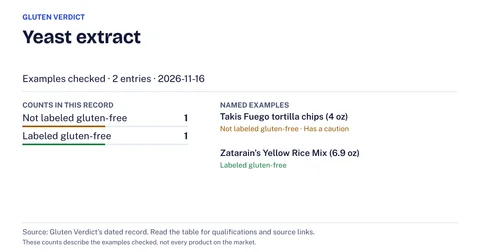
| Yeast extract and autolyzed yeast extract | May contain gluten from barley4; some are grown in barley24 |
For the wider family of flavoring ingredients, see hydrolyzed protein, yeast extract and wheat starch.
A starter is only as gluten-free as its flour
King Arthur Baking describes starter as a combination of flour and liquid, ranging from a stiff starter made entirely with rye flour and water to a liquid batter of milk and cornmeal5. Wheat and rye are two of the grains a food labeled gluten-free cannot be intentionally made with18. So the flour a starter is made and fed with is the question to put to a seller or a friend who hands you a jar.
Fermentation does not turn a wheat sourdough into a gluten-free one
FDA’s rule says a fermented or hydrolyzed food made from gluten-containing grains cannot carry a “gluten-free” claim unless the grains were processed to remove gluten and the ingredient’s use left less than 20 ppm of gluten in the food before fermentation or hydrolysis10.
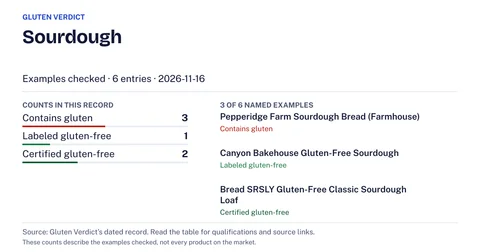
In a February 2018 report, Gluten Free Watchdog described testing three artisanal sourdough breads for gluten25. One country sourdough measured 104,000 parts per million on its sandwich R5 ELISA26, and Gluten Free Watchdog’s conclusion was that wheat-based sourdough bread, including bread from small artisanal bakeries, “contains a lot of gluten”27.
The Gluten Intolerance Group, writing about alcohol, says fermentation might break down some gluten proteins but does not remove all the gluten28. Our verdicts on sourdough and bread show the sources we read for each.
Reading a starter seller’s page
Before you buy or accept a starter, look for four things on the seller’s page:
- The flour in the starter, named in an ingredient list.
- The flour it tells you to activate or feed it with.
- A gluten-free statement, and whose statement it is.
- The facility line: what else is made where the starter is made.
Cultures for Health’s page for its Gluten-Free Sourdough Starter Culture is an example of a seller stating the flour, the feeding flour and the facility. It describes a packet of dehydrated starter and says to activate it with gluten-free brown rice flour and water29. It lists the culture’s ingredients as organic brown rice flour and live active cultures6. It also says the current product listing states that the culture is manufactured in a facility that processes products containing gluten30. Its gluten-free statement is the product name, “Gluten-Free Sourdough Starter Culture”29; the page gives no certification or test result for it31.
That is the seller’s own statement, read on 2026-11-17; we have not tested the starter. A page that is silent on the flour, the facility or any gluten-free statement leaves the question open: ask the seller, using what to ask a manufacturer about gluten.
Shared jars, spoons and a kitchen that also bakes wheat
A yeast or starter label covers the product, not your kitchen. A jar, spoon or counter shared with wheat flour is a cross-contact question, covered in cross-contamination and setting up a gluten-free kitchen. For dough that will not rise or crumbles, see gluten-free bread: rise, crumb and bake temperature.
Verdicts in this guide

Questions people ask
Is yeast gluten-free?
The Gluten Intolerance Group says baking yeast is gluten-free9. Check the maker’s statement for the exact product, because Red Star Yeast lists some of its yeasts as not gluten free2.
Is brewer’s yeast the same as baker’s yeast?
No. Gluten Free Watchdog explains that brewer’s yeast can mean the live yeast used to make beer or the spent yeast left over from brewing20, and the National Celiac Association states that brewer’s yeast is not gluten-free and contains barley22.
Is nutritional yeast gluten-free?
The Gluten Intolerance Group says yes, and names brewer’s yeast as the type to be concerned about9. The National Celiac Association says nutritional yeast is typically grown on molasses from sugar beets or cane23.
Does fermenting sourdough remove the gluten?
In the three artisanal sourdough breads Gluten Free Watchdog tested25, its conclusion was that wheat-based sourdough bread contains a lot of gluten27. FDA’s rule also bars a gluten-free claim on fermented food made from gluten-containing grains unless the grains were processed to remove gluten10.
More in Gluten-free baking technique
 Why gluten-free bread crumbles: binder, rise, oven and storageWhat flour, mix and yeast makers and a 2026 review say about crumbly gluten-free bread: binder, rise, oven setting, cooling and storage.
 High-altitude gluten-free baking: what extension services and flour makers sayWhat Colorado State Extension, King Arthur and Bob's Red Mill publish for baking above 3,000 feet, and where no source covers gluten-free flours.
 1-to-1, all-purpose and bread flour blends: what each maker’s page says the bag is forWhat King Arthur and Bob’s Red Mill say their 1-to-1, all-purpose, bread and pizza gluten-free flours are for, and which bakes each sends elsewhere.
 Gluten-free flours for baking: what rice, sorghum, tapioca, almond and coconut flour each doWhat makers say rice, sorghum, millet, tapioca, potato starch, almond and coconut flour do in a bake, and which bags say gluten-free on the label.
 Gluten-free flour cups to grams: the weights makers print on their labelsGrams per cup for gluten-free flours, copied from King Arthur’s chart and the Bob’s Red Mill, Krusteaz and Pamela’s panels, with where each figure sits.
 Gluten-free binders: what makers say about xanthan, guar, psyllium and flaxWhich gluten-free flours already list xanthan gum, what makers say about adding more, and how xanthan, guar, psyllium and flax are each described.
Related guides
 Hydrolyzed protein, yeast extract and wheat starch on a US food labelWhich grain is behind hydrolyzed protein, yeast extract and wheat starch, what a US label must name, and what to ask the maker.
 Baking gluten-free in a home where someone else bakes with wheat flourA baking-day plan for a shared kitchen: order, counters, flour storage, tools and oven, and which timing rules have no published source.
 Fine on bread in Europe? What it does and does not showWhat a trip where bread felt fine does and does not show about celiac disease, and how EU and US gluten-free label rules compare.
 How to check whether a packaged food is gluten-freeA four-step check for one packaged food: the claim, the ingredient and allergen lines, the maker’s dated page and the certifier’s directory.
Sources
- [1, 2, 12] Red Star Yeast, Frequently asked questions, checked Nov 17, 2026.
- [3, 20, 21] Gluten Free Watchdog, Brewer’s Yeast and Gluten (May 29, 2018), checked Nov 17, 2026.
- [4, 22, 23] National Celiac Association, Autolyzed yeast extract and Brewer’s yeast, checked Nov 17, 2026.
- [5] King Arthur Baking, Sourdough guide, checked Nov 17, 2026.
- [6, 29, 30, 31] Cultures for Health, Gluten-Free Sourdough Starter Culture product page, checked Nov 17, 2026.
Read on 2026-11-17: no gluten-free certification, gluten test result or parts-per-million figure for the starter on the page; its only testing line is a general statement about testing its cultures, not a gluten test.
- [7] Red Star Yeast, Organic Instant Yeast packet product page, checked Nov 17, 2026.
- [8, 13] Red Star Yeast, Active Dry Yeast (4 oz jar) product page, checked Nov 17, 2026.
- [9] Gluten Intolerance Group, Is nutritional yeast gluten-free?, checked Nov 17, 2026.
- [10, 17, 18, 19] US Food and Drug Administration, Questions and Answers on the Gluten-Free Food Labeling Final Rule, checked Nov 17, 2026.
- [11] US Food and Drug Administration, Food Allergen Labeling and Consumer Protection Act of 2004 (FALCPA), checked Nov 17, 2026.
- [14] Red Star Yeast, Quick-Rise Instant Yeast (4 oz jar) product page, checked Nov 17, 2026.
- [15] Red Star Yeast, Platinum Instant Sourdough yeast culture product page, checked Nov 17, 2026.
- [16] Bob's Red Mill, Active Dry Yeast product page, checked Nov 17, 2026.
- [24] Gluten Intolerance Group, Is yeast extract a concern when on a gluten-free diet?, checked Nov 17, 2026.
- [25, 26, 27] Gluten Free Watchdog, Report on sourdough wheat bread (February 19, 2018), checked Nov 17, 2026.
- [28] Gluten Intolerance Group, Does Fermentation or Distillation Make a Product Gluten-Free? (December 9, 2020), checked Nov 17, 2026.