Ordering gluten-free at an Italian restaurant
Short answer
A gluten-free pasta line on the menu tells you what the restaurant offers, not how it is cooked. Ask these four things before you order:
- Where the gluten-free pasta is boiled: in a restaurant-scale test at a typical restaurant portion, gluten built up in shared pasta water, and the authors advise a separate cooking vessel12, 13.
- What thickens the sauces and soups: roux is flour and fat, and the flour is often wheat flour23.
- Whether anything on the plate is breaded or fried in oil shared with breaded food21.
- Whether the kitchen will check the package of any sauce or mix it cannot name29.
Part of Eating out and chain restaurant policies, 25 guides
Key points
- FDA’s gluten-free rule applies to packaged foods; for restaurant menus FDA only recommends that a “gluten-free” claim match its definition2, 1.
- In one crowd-sourced US data set, gluten was detected in 50.8% of pasta samples labeled gluten-free at restaurants, with caveats about the device and about which foods were tested39, 6, 7, 40.
- The pasta pot is the question that matters most: the 2021 pot study found gluten rising with each batch in shared water at a typical restaurant portion12.
- Shared fryers are not all alike: in one 2026 observational study, every sample from establishments reporting daily oil changes measured under 20 ppm36.
What a gluten-free line on the menu does and does not promise
FDA’s gluten-free regulation applies to packaged foods, which may be sold in some carry-out restaurants2. FDA recommends that a restaurant that puts “gluten-free” on its menu be consistent with the federal definition, but that is a recommendation2, 1. FDA also notes that state and local governments play an important role in overseeing restaurants3.
So a menu line is the restaurant’s own promise, and the useful question is what stands behind it. GIG, a celiac charity, says not all food establishment staff have enough awareness or training regarding gluten-free ingredients or how to strictly avoid cross-contact41. It advises asking how gluten-free items are prepared and what procedures are in place to avoid cross-contact9. The NIDDK gives similar advice: let the server know you have celiac disease and ask about ingredients, how food is prepared, and whether a gluten-free menu is available4.
Pasta is where this shows up in the numbers. A study of crowd-sourced results from a portable gluten-detection device, collected across the United States, found gluten in 32% of restaurant foods labeled gluten-free, and in 50.8% of the pasta samples labeled gluten-free39, 5, 6. The authors note the device is highly sensitive and may detect gluten below 20 parts per million (ppm), of unknown clinical significance7. They also note the study did not test restaurant foods systematically, and the foods tested could have been chosen because of doubts about their gluten-free status40. Read it as a reason to ask, not as a rate for any one restaurant.
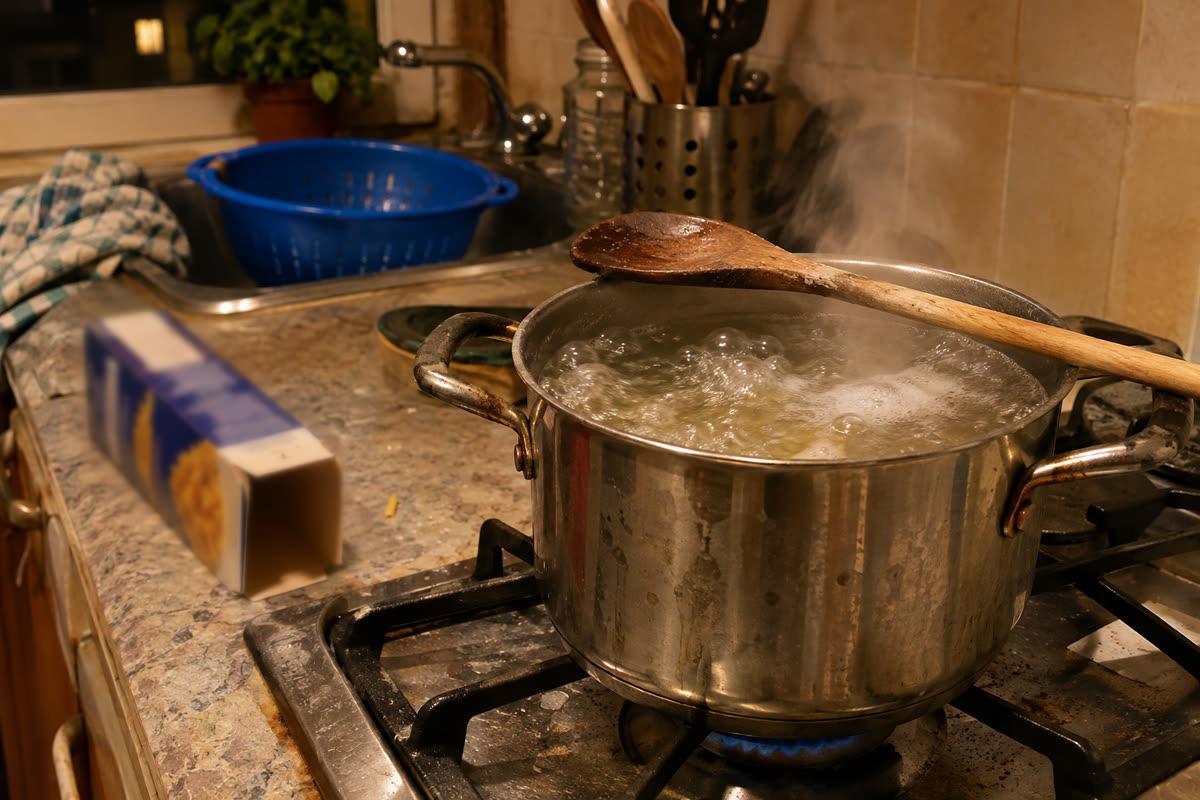
Pasta water, colander, pan and spoon
In restaurants, several pasta dishes are often cooked at once in large pots with multiple compartments and shared cooking water10. A 2021 restaurant-scale study tested that setup with a four-compartment pot holding three batches of regular penne and one of gluten-free penne38, over five batches11.
With the recommended 52 g serving, gluten stayed under 20 ppm through five batches38, 11. With 140 g, which the study calls a typical restaurant portion, gluten in the gluten-free pasta approached 20 ppm by the fourth batch and reached nearly 40 ppm after the fifth38, 12. The authors’ conclusion: gluten transfer does not occur at a high rate, but gluten-free pasta should be prepared in a separate cooking vessel in restaurants13.
A 2024 mini-review of five studies reports the same direction for shared pasta water, with levels above 20 ppm. It also reports that rinsing the pasta under running water for a few seconds brought gluten under 20 ppm17, 14, 15. That is a finding about samples in a study, not a step to ask a kitchen to improvise.
Colanders and spoons
The same review found that shared utensils and equipment, among them the spoon, ladle and colander, did not lead to significant contamination in controlled experiments16. GIG, in a section on home kitchens, lists colanders among items that are more difficult to clean thoroughly31.
What to ask about the pasta
The question GIG suggests is short and specific: is the gluten-free pasta boiled in fresh water, or in the same water used for regular pasta19? Add the pan: GIG also suggests asking whether the meal can be cooked in a separate pan from gluten foods25. If the server is not sure, ask them to check with the kitchen.
Sauces, soups and stock
In soups, the thickener can be where wheat hides. GIG lists soup thickened with roux among foods where gluten may be hidden, and explains that roux is a mixture of fat and flour37. Its restaurant FAQ puts it as a question to ask: does this contain flour or roux, since the flour used is often wheat flour23.
GIG also suggests asking whether the sauces are certified gluten-free and, if made in-house, whether the kitchen knows if they contain gluten24. Its hidden-gluten list names broth and stock too, since some powdered or packaged broths contain gluten27. Our pesto verdict shows what we found for jarred versions.
If a server cannot name an ingredient, GIG’s advice is to ask to see the package of any questionable ingredient, and says most eating establishments can accommodate the request29.
Meatballs, breaded dishes and baked pasta
For meatballs and chicken or veal cutlets, ask what is in or on them: whether the meatballs contain breadcrumbs and whether the cutlet is breaded. Our verdicts for meatballs and breadcrumbs show what we read on packaged products; a restaurant’s own recipe is what you are asking about.
For baked dishes, the 2024 mini-review reports that simultaneous cooking of gluten-containing and gluten-free pizzas in shared ovens has demonstrated a low risk of contamination18. That is a finding about pizza ovens; for a baked pasta, ask what the dish is built on, and whether it is assembled in a clean pan. Our verdicts for lasagna and ravioli cover packaged versions.
Risotto, polenta and gnocchi
Each of the three has its own question. For risotto it is the stock: some powdered or packaged broths can contain gluten27. Ask what stock it is made with and whether anything thickens or finishes it. For polenta, ask what it is cooked and served with, and whether it is grilled on a surface shared with breaded food. For gnocchi, ask what it is made from; our verdict shows it depends on the product.
Our verdict pages cover each: risotto, polenta and gnocchi. They describe the products we read, not a restaurant’s kitchen, so use them to know what to ask.
Fried starters: calamari and mozzarella sticks
GIG’s suggested questions are whether there is a dedicated fryer for gluten-free foods and whether items share oil with breaded ones26, 22.
What the studies say about shared fryers is mixed, and both studies below tested fries (the 2026 study also tortilla chips), not breaded starters32, 34. In a 2021 pilot, 20 orders of fries were bought from 10 restaurants, each of which confirmed its fryer was used to cook wheat-containing foods32. One test method found gluten in 9 of 20 orders and another in 3 of 2033. A 2026 observational study of 98 samples of fries and tortilla chips found six over 20 ppm34, 35.
| Study | What was tested | Result |
|---|---|---|
| Thompson et al., 2021 (pilot)32 | 20 orders of fries from 10 restaurants32 | Gluten in 9/20 by one test, 3/20 by another33 |
| Weisbrod et al., 202634 | 98 samples: fries and tortilla chips34 | Six samples (6.1%) over 20 ppm35 |
| Weisbrod et al., 2026, by oil change36 | Samples from establishments reporting daily oil changes (39 of the 98)42 | All under 20 ppm; weekly oil changes gave higher and more variable results36 |
The 2026 result gives a practical question: how often is the oil changed36? For calamari and mozzarella sticks, ask first whether the dish is breaded at all and whether a gluten-free version exists; the fryer question comes second.
Salads, croutons and dressings
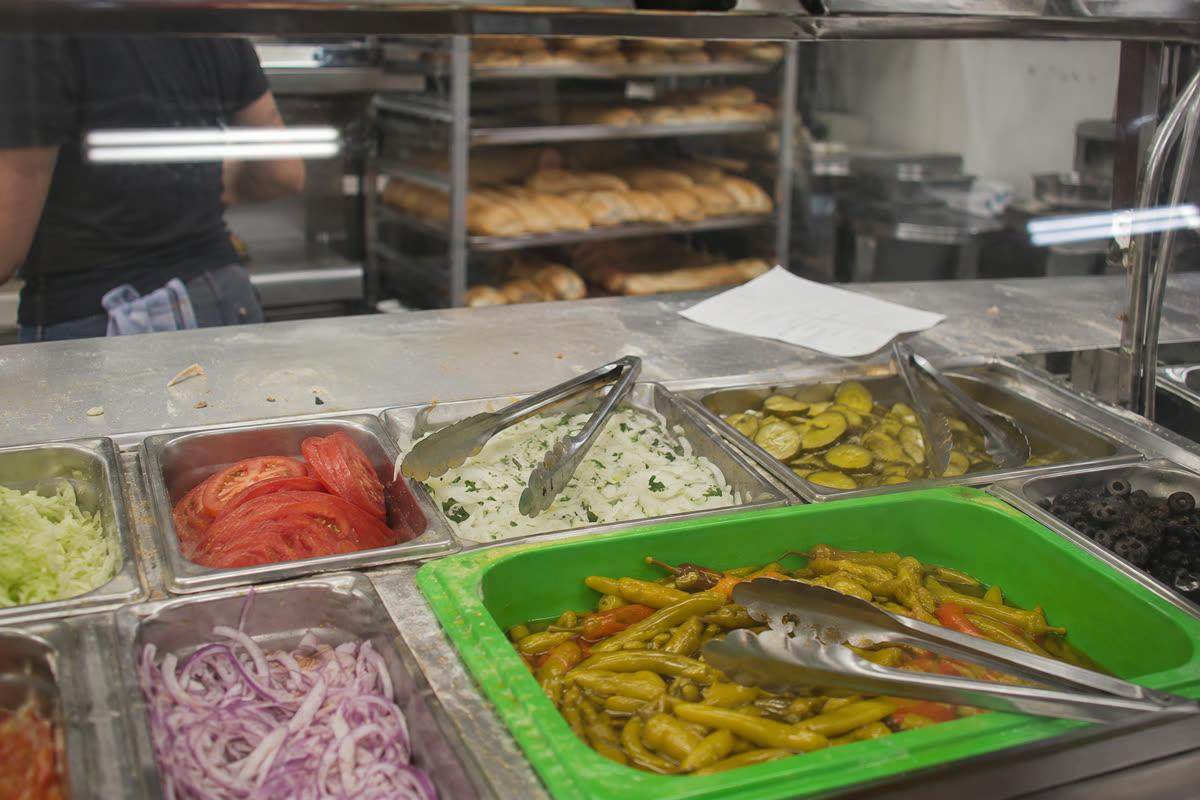
A salad bar often puts naturally gluten-free vegetables beside croutons, crackers and some salad dressings, and its serving utensils might inadvertently be used in both30. Dressings can contain malt vinegar, soy sauce or flour28.
At the table, ask for no croutons and ask whether the dressing is made in house and what goes into it. For a Caesar, our Caesar dressing verdict shows what we found on bottled versions; a restaurant may make its own.
How to ask, and when to order something else
If you can, call when the kitchen is not busy. GIG advises doing research in advance, calling or visiting when the restaurant may be less busy, and asking how gluten-free items are prepared8.
| Dish | Ask | Why |
|---|---|---|
| Gluten-free pasta | Is it boiled in fresh water, or the same water as regular pasta? Which pan and spoon?19, 25 | Shared pasta water raised gluten in a restaurant-scale test12 |
| Soups and sauces | Does this contain flour or roux?23 | The flour used is often wheat flour23 |
| Risotto and stock | What stock is it made with?27 | Some powdered or packaged broths can contain gluten27 |
| Fried starters | Is there a dedicated fryer? Do items share oil with breaded ones?26, 22 | Shared oil with breaded items is a GIG red flag21 |
| Salads | Is the dressing made in house? Can the croutons stay off?28 | Dressings can contain malt vinegar, soy sauce or flour28 |
Consider eating elsewhere if staff will not check labels on packaged sauces or mixes, or confirm that gluten-free food shares oil or grill space with heavily breaded items; GIG lists both among its red flags20, 21. For more on where wheat sits in a restaurant kitchen, see where gluten hides in restaurant kitchens and eating out with celiac disease.
Verdicts in this guide
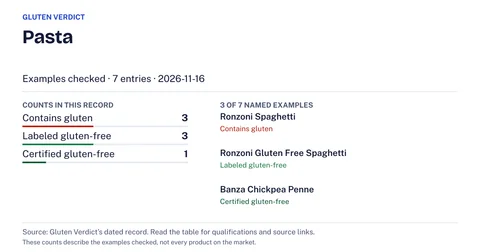 PastaContains glutenchecked Nov 16, 2026
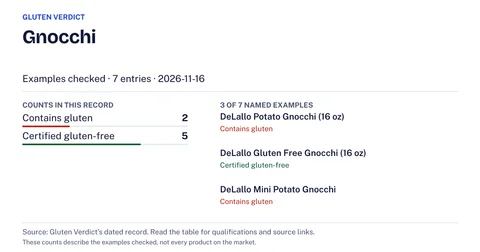 GnocchiDepends on the product2 of 7 products we checked contain gluten: DeLallo Potato Gnocchi (16 oz) and DeLallo Mini Potato Gnocchichecked Nov 16, 2026
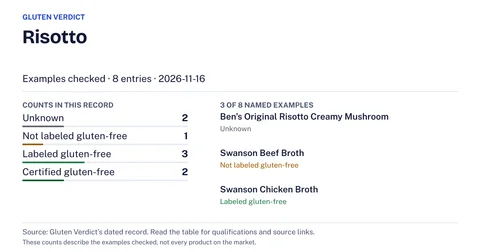 RisottoDepends on the productchecked Nov 16, 2026
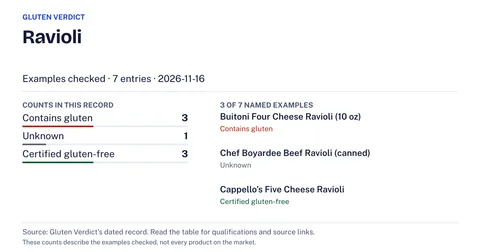 RavioliContains glutenchecked Nov 16, 2026
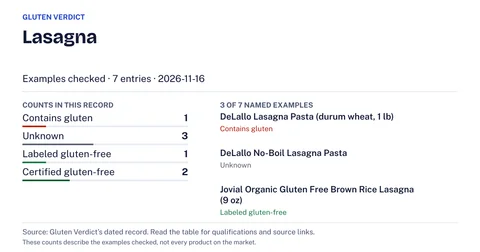 LasagnaContains glutenchecked Nov 16, 2026
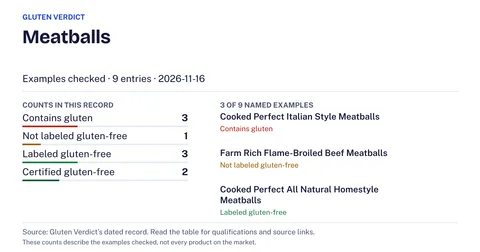 MeatballsDepends on the product3 of 9 products we checked contain gluten: Cooked Perfect Italian Style Meatballs, Cooked Perfect Restaurant Style Meatballs, and Farm Rich Homestyle Meatballschecked Nov 16, 2026
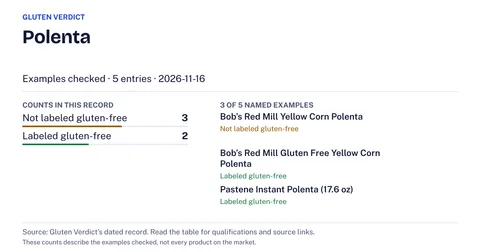 PolentaNaturally gluten-freeBuy it labeled gluten-freechecked Nov 16, 2026
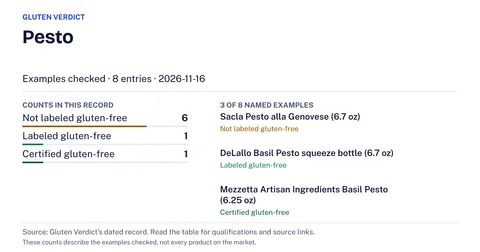 PestoDepends on the productchecked Nov 16, 2026
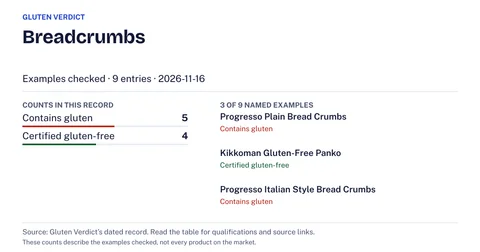 BreadcrumbsContains glutenchecked Nov 16, 2026
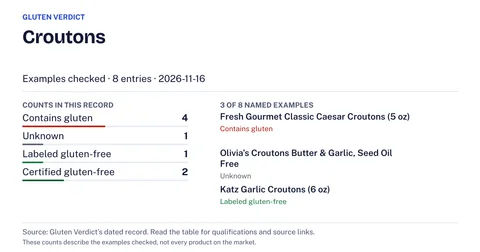 CroutonsContains glutenchecked Nov 16, 2026
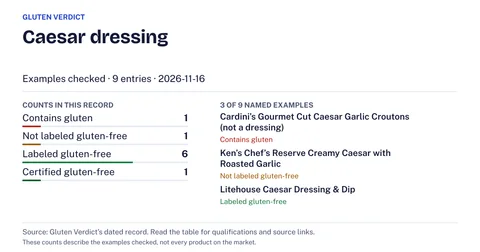 Caesar dressingDepends on the product1 of 9 products we checked contains gluten: Cardini’s Gourmet Cut Caesar Garlic Croutons (not a dressing)checked Nov 16, 2026
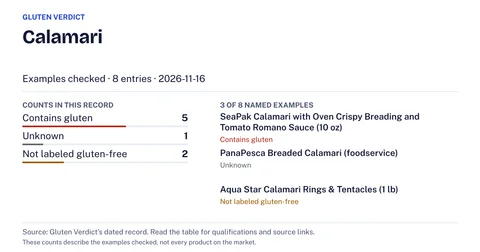 CalamariDepends on the product5 of 8 products we checked contain glutenchecked Nov 16, 2026
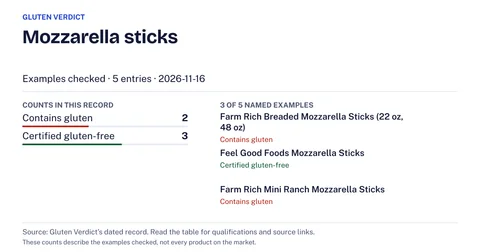 Mozzarella sticksDepends on the product2 of 5 products we checked contain gluten: Farm Rich Breaded Mozzarella Sticks (22 oz, 48 oz) and Farm Rich Mini Ranch Mozzarella Stickschecked Nov 16, 2026
Questions people ask
Does a restaurant have to meet FDA’s gluten-free rule?
FDA’s regulation applies to packaged foods, which may be sold in some carry-out restaurants. FDA recommends that restaurants making a “gluten-free” menu claim be consistent with its definition2, 1.
Can gluten-free pasta be boiled in the same water as regular pasta?
In a restaurant-scale test with 140 g portions, gluten in the gluten-free pasta reached nearly 40 ppm by the fifth batch in shared water; with 52 g servings it stayed under 20 ppm through five batches. The authors advise a separate cooking vessel12, 11, 13.
Is risotto gluten-free?
It depends on the stock and anything added: some powdered or packaged broths can contain gluten27. See our risotto verdict.
More in Eating out and chain restaurant policies
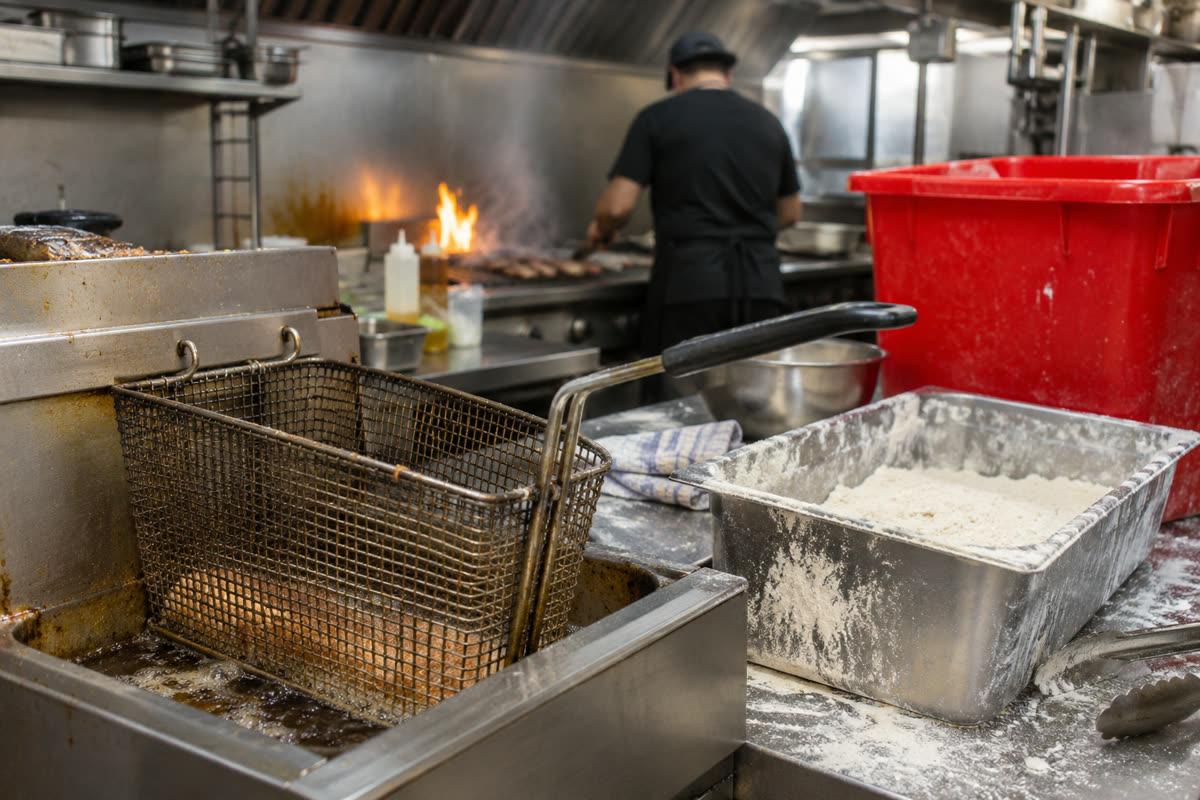 Where gluten hides in a restaurant kitchen, and the question to ask about each sourceFryers, sauces, roux, marinades, grills, pasta water and eggs: how gluten reaches restaurant food and the question GIG lists for each source.
 Casual-dining chains and gluten: what nine chains’ own allergen documents sayWhat Olive Garden, Outback, Applebee’s, Texas Roadhouse, Red Lobster, Chili’s and others say in writing about fryers, gluten menus and cross-contact.
 Ordering gluten-free pizza at a pizza place: what to ask the kitchenWhat to ask a pizza place before you order a gluten-free crust: flour, oven, cutter, sauce and toppings, with what studies and charities say.
 Sandwich and sub chains and gluten: what Subway, Panera, Jersey Mike’s and others say in writingWhat Subway, Jersey Mike’s, Jimmy John’s, Firehouse, Potbelly and Panera say in their own documents about gluten-free bread, shared equipment and dates.
 When a restaurant gets your gluten-free order wrong or says no: what to do at the table and afterwardWhat to check on the plate, how to ask for a remake, when to leave, and who to report a restaurant gluten mistake to: manager, chain, health department.
 Ordering steak and burgers with celiac disease: marinades, sides, fryers and bunsWhat to ask about marinades, seasoning, butters, grills, fryers, sides and buns when you order steak or a burger with celiac disease.
Related guides
 Eating out with celiac disease: what to check, ask and watch forPlan a restaurant meal with celiac disease: what to check before you go, the questions to ask in order, how to read the answers, and what studies measured.
 Gluten-free in Italy: what the AIC program covers and what to askWhat “senza glutine” means in Italy, what AIC’s restaurant program asks of a kitchen, and the questions to ask in a restaurant, pharmacy or shop.
 Gluten-free pasta and noodles: what to read on the boxHow to read a pasta or noodle box: the gluten-free claim, the ingredient list, same-brand wheat twins, and why soba and udon need a close read.
 Cooking gluten-free pasta and rice noodles: what makers’ directions sayCompare what Jovial, Banza, Tinkyada, Lotus Foods and Thai Kitchen print for water, stirring, rinsing and time, then match the directions to your pasta.
Sources
- [1, 2] US Food and Drug Administration, Questions and Answers on the Gluten-Free Food Labeling Final Rule, checked Nov 17, 2026.
- [3] US Food and Drug Administration, Gluten and Food Labeling, checked Nov 17, 2026.
- [4] National Institute of Diabetes and Digestive and Kidney Diseases (NIDDK), Eating, Diet, & Nutrition for Celiac Disease, checked Nov 17, 2026.
- [5, 6, 7, 39, 40] American Journal of Gastroenterology (Lerner et al., 2019), Detection of Gluten in Gluten-Free Labeled Restaurant Food: Analysis of Crowd-Sourced Data, checked Nov 17, 2026.
- [8, 9, 41] Gluten Intolerance Group, FAQ: felt glutened after a menu item marked gluten-free, checked Nov 17, 2026.
- [10, 11, 12, 13, 38] Journal of Food Protection (Korth et al., 2021), Gluten Cross-Contact in Restaurant-Scale Pasta Cooking, checked Nov 17, 2026.
- [14, 15, 16, 17, 18] Nutrients (Damasceno et al., 2024), Risk of Gluten Cross-Contamination Due to Food Handling Practices: A Mini-Review, checked Nov 17, 2026.
- [19, 20, 21, 22] Gluten Intolerance Group, Questions to Ask When Eating Out (September 8, 2026), checked Nov 17, 2026.
- [23, 24, 25, 26] Gluten Intolerance Group, FAQ: most important questions to ask the wait staff or management of a restaurant, checked Nov 17, 2026.
- [27, 28, 37] Gluten Intolerance Group, Foods Where Gluten May Be “Hidden”, checked Nov 17, 2026.
- [29, 30, 31] Gluten Intolerance Group, 25 Ways Cross-Contact Could Happen (And How to Avoid It), checked Nov 17, 2026.
- [32, 33] Frontiers in Nutrition (Thompson et al., 2021), Gluten-Free Foods Cooked in Shared Fryers With Wheat: A Pilot Study Assessing Gluten Cross Contact, checked Nov 17, 2026.
- [34, 35, 36, 42] Nutrients (Weisbrod et al., 2026), Shared Fryers May Not Always Be as Risky for Gluten Cross-Contact in Celiac Disease as Dietary Guidance Suggests, checked Nov 17, 2026.