Gluten-free in Italy: what the AIC program covers and what to ask
Short answer
Italy follows the EU rule, under which “senza glutine” means no more than 20 mg of gluten per kg of food1. For restaurants, AIC, the Italian celiac society, runs a voluntary program of trained, inspected venues2, 3, 4. Check in this order:
- Packaged food: look for “senza glutine”, which the EU rule allows only at 20 mg/kg or less1, and for AIC’s Spiga Barrata (crossed-grain) mark, which AIC backs with annual audits of the maker5.
- Restaurants: look for an AIC program venue, whose kitchen follows AIC’s rules and is inspected at least once a year6, 4. Visitors who are not members can buy short-term app access to the list7.
- Everywhere else: tell the staff about the diet, ask for the ingredients of each dish and skip a dish you are unsure of, as AIC advises8.
- Pasta, pizza, bread and sweets: AIC’s English food list marks versions made with prohibited cereals, wheat among them, as forbidden9, 10. For a version meant to be gluten-free, ask about cooking water, ovens, fryers and the coffee machine11, 12, 13, 14.
- Gluten-free limit
- No more than 20 mg of gluten per kg of food as sold1; the regulation is directly applicable in every EU member state30
- Set by
- Commission Implementing Regulation (EU) No 828/201428
- Oats
- In a food presented as gluten-free, oats must be specially produced to avoid contamination by wheat, rye, barley or their crossbred varieties, and their gluten content cannot exceed 20 mg/kg37
- Celiac society
- Associazione Italiana Celiachia (AIC)
Part of Travel: Europe, 19 guides

Key points
- EU law names cereals containing gluten, including barley, rye and oats, in its allergen list15; the US list names wheat but not barley or rye16.
- AIC says the “senza glutine” figure is the same in Italy, Europe and the United States: less than 20 parts per million17.
- The “senza glutine” claim is voluntary, so a maker can leave it off18, and AIC says EU allergen law does not oblige makers to print “may contain” wording19.
- Joining AIC’s restaurant program is voluntary2; for commercial restaurants, AIC reports that national law provides for celiac training modules20.
- In AIC’s own 2023 survey, 22% of the venues outside its program had taken specific training on celiac disease or food intolerances21.
What the “easiest country” reputation rests on
AIC’s travel page says the New York Times called Italy “il paradiso dei celiaci”, because much of the restaurant sector pays high attention to celiac customers and trains for it, and AIC adds that much remains to be done22.
The legal side, as AIC reports it: Italy’s law 123/2005 requires gluten-free meals on request in school, hospital and public-body canteens23. For commercial restaurants, the same law (article 5) provides for celiac information modules in the professional training that local public health runs for restaurateurs and hoteliers20.
Some regions have rules of their own. AIC lists Basilicata, Calabria, Emilia Romagna, Liguria, Piemonte, Puglia, Toscana and Umbria as having rules for venues that offer gluten-free food, which in general require trained operators, public health checks and technical requirements24.
AIC also commissioned a 2023 survey25, run by phone with 400 program venues and 2,400 restaurants, hotels and other businesses outside the program26. Among those outside, only 22% had taken specific training on celiac disease or food intolerances21, and 68% do not use the “senza glutine” wording, whether or not they prepare gluten-free dishes27. These are AIC’s figures from its own survey.
The rest of this guide takes the rules and tools in the order you meet them: the pack, the allergen label, the program, the shop, then the dishes.
What “senza glutine” means on an Italian pack
Regulation (EU) No 828/201428 allows the statement ‘gluten-free’ only when the food as sold to the final consumer contains no more than 20 mg/kg of gluten1. The Italian text of the rule gives the wording as «senza glutine»29. The regulation is directly applicable in every member state30.
A second EU wording, «con contenuto di glutine molto basso» (‘very low gluten’ in the English text), is allowed only on food made from or containing wheat, rye, barley or oats ingredients that were specially processed to reduce gluten, at no more than 100 mg/kg31, 32. It is a different statement from «senza glutine». A maker may also add «adatto ai celiaci» (‘suitable for coeliacs’ in the English text)33, 34.
| United States (FDA) | Italy (EU rules) | |
|---|---|---|
| Gluten-free claim | Any unavoidable gluten in the food must be less than 20 ppm35 | No more than 20 mg/kg of gluten in the food as sold1 |
| Oats | Oats labeled gluten-free must contain less than 20 ppm; certification is not required36 | Oats in a gluten-free food must be specially produced to avoid contamination and cannot exceed 20 mg/kg37 |
| Allergen list | Wheat is on the list; barley and rye are not16 | “Cereals containing gluten”: wheat, rye, barley, oats or their hybridised strains15 |
| “May contain” wording | Voluntary, and allowed beside a gluten-free claim if truthful and not misleading38 | AIC says the EU allergen rule does not oblige makers to print it19 |
AIC says the number is the same: in Italy, Europe and the United States the “senza glutine” wording applies to products with less than 20 parts per million of gluten, which equals 20 mg in 1 kg of food17.
The claim is voluntary. AIC says a maker may leave it off because the product is not suitable for celiacs or because the maker does not want to declare it18. For foods AIC classes as “a rischio” (at risk), its advice is to eat only those that carry the “senza glutine” wording39.
How an Italian label flags gluten
Regulation (EU) No 1169/2011 names the allergens that must be declared. Its Annex II entry reads “Cereals containing gluten”: wheat (such as spelt and khorasan wheat), rye, barley, oats or their hybridised strains, and products thereof15.
On a pack with an ingredient list, the allergen’s name has to be emphasised in a typeset that clearly distinguishes it from the rest of the list, for example by font, style or background colour40. With no ingredient list, the pack has to say ‘contains’ followed by the name41.
Annex II carves out four items from that entry: wheat based glucose syrups including dextrose, wheat based maltodextrins, glucose syrups based on barley, and cereals used for making alcoholic distillates42.
Food sold without prepackaging is covered as well. Where food is offered to the final consumer or to mass caterers without prepackaging, the particulars in Article 9(1)(c) are mandatory43; those are the allergen particulars, meaning any Annex II ingredient or processing aid still present in the finished product44. Each member state may adopt national measures on the means through which they are made available45, so at a venue, ask where its allergen information is.
What AIC’s restaurant program requires
AIC runs the Programma Alimentazione Fuori Casa senza glutine (AFC), a network of venues informed about celiac disease49. Joining is voluntary2. Apart from a few special projects with their own routes46, a venue in the program has to:
- have taken a course on celiac disease and the gluten-free diet run by local AIC branches, health authorities (ASL) or partner bodies3;
- complete its training with follow-up visits to the venue by the local AIC47;
- follow all of AIC’s rules for preparing and serving gluten-free food, to avoid contamination6;
- use only gluten-free ingredients48;
- allow periodic checks, including at least one in-depth inspection a year by the local AIC4.
AIC’s June 2024 press release counts more than 4,000 program venues, marked by window stickers49. Beyond restaurants and pizzerias, the program lists bars, bakeries, pastry shops, gelaterie, hotels, B&Bs and cruise ships among its types50.
What the kitchen rules ask for
- Cooking water used for foods that contain gluten is not to be used11, and in mixed preparations multi-cook baskets are not to be used51.
- Oil already used to fry foods with gluten is not to be used13.
- The gluten-free dish must carry a clear distinguishing sign that the customer can recognise52, and the same server should not carry a gluten-free dish together with a dish that has gluten53.
- At the start of service, the table is checked for crumbs54.
AIC describes this list as a summary of fuller rules that the venue learns in AIC’s course and on-site training55, and says the procedures can be stricter in some regions, under their own rules56.
What AIC tells diners to do themselves
The program page gives diners three pieces of advice of its own. It says to:
- book ahead, because some venues need it for the kitchen to plan57;
- say you are celiac before ordering58;
- never lower your level of attention59.
A venue names a “Referente”, the person responsible for the gluten-free service, but the owner must make sure all staff are informed about it60. AIC also says it does not pass its venue database to other websites and is not responsible for how reliable or current other gluten-free dining sites are; the official list is on its own site and on some local AIC sites61.
Finding program venues as a visitor
AIC says its members can consult the up-to-date list on its website, in the AIC Mobile app and in the printed AFC guide, and that non-members can buy app access for short periods7. The Coeliac Youth of Europe’s Travel Net page for Italy describes a temporary version of the app, valid for 15 days, called AIC Mobile Welcome62; check the app store for the current terms.
The app also has an open version, free for everyone, with basic services63. AIC says the free parts include its ABC food classification and a traffic-light list of permitted, at-risk and forbidden products64.
Hotels, B&Bs and holiday villages are in the program too, and AIC says to tell them you are celiac when you book65.
Where there is no program venue nearby, AIC says to tell the staff about the diet and the ingredients to avoid, ask for the ingredients of the dishes you plan to eat, skip a dish if in doubt, and briefly remind them of the preparation rules8.
Pharmacies, supermarkets and the free-from shelf
Travel Net says gluten-free products are now in almost every Italian supermarket and in many pharmacies66. AIC Mobile’s database also lists retailers, including pharmacies, parapharmacies and specialist gluten-free shops67.
On a pack, look for the wording in the table above or for AIC’s Spiga Barrata mark. AIC says it inspects the plants and processes of makers who carry the mark through annual audits5, and that the mark issued by the Italian AIC is red on white or white on red, with the prefix IT in its product code68.
AIC Mobile carries AIC’s Prontuario, its list of products it has assessed as suitable, and can scan a barcode to check one69. Whether a visitor’s temporary access includes it is something to check in the app. AIC says its ABC food classification is specific to the Italian market and can differ from lists in other countries70.
AIC’s kitchen rules name products specifically formulated for celiacs that are in the Ministry of Health’s national register of gluten-free products as one accepted source of ingredients for a program kitchen71. We have not read the ministry’s own register page, so we say no more about it than AIC does.
AIC’s shopping page also points to the monthly vouchers that the national health service guarantees to people with a diagnosis72. They belong to Italy’s health system and are outside this guide.
Pasta, pizza and bread
AIC’s English food list puts first courses made with prohibited cereals, naming pasta and stuffed pasta, in its forbidden group9. It does the same for bread and baked goods made with them, naming loaf bread, flat bread, pizza, piadine, taralli, biscuits, pastries and cakes10. For how we check these foods in US products, see our pages on pasta, pizza, bread and lasagna.
For pasta, the cooking-water and basket rules in the list above are the ones to ask about.
Pizza ovens
In a program pizzeria, AIC allows an oven used only for gluten-free pizza, or an oven also used for pizza with gluten under set precautions12, or a kitchen oven where no gluten pizza is baked, cleaned before the gluten-free pizza goes in73.
In the shared-oven set-up, the pizza goes in a high-sided tray with no baking paper, making and baking of gluten pizzas is paused, the pizza is carried covered to the oven mouth, and no peel movements are made that could drop flour onto the tray74. Toppings for the gluten-free pizza must be its own and not taken from the regular pizza counter75, and AIC suggests gluten-free flour for dusting every pizza, regular ones too76.
AIC names Emilia Romagna, Lombardia and Piemonte as the regions that require a double oven and a double gelato tub77. A takeaway-only pizzeria can join the program only if it is dedicated, or if it also makes gluten pizzas in a clearly separate area and uses dusting flour for all pizzas78.
Bread and bakeries
Bakeries, pastry shops, pasta makers and rosticcerie join the program only if dedicated: production and sale only gluten-free, or in physically separate rooms79. So for bread, the question is whether the workshop itself is dedicated.
Risotto, polenta, gnocchi and sauces
For rice, corn and potato dishes, what the cook adds decides. Travel Net’s card puts it this way: foods with rice, corn, potatoes, vegetables, fruit, eggs, cheese, milk, meat and fish are fine as long as they were not prepared with forbidden flours, breadcrumbs, batter, croutons or sauces made with forbidden starches and flours80. Our pages on risotto, polenta and gnocchi show how each is checked in US products.
AIC’s English list names polenta in its forbidden group only where buckwheat flour is mixed with wheat flour81. It names potato dumplings and Roma-style dumplings among first courses made with prohibited cereals9, and ready-made risottos (bagged, frozen, flavoured) among the foods to check on the label82.
Wheat starch turns up in Italian gluten-free products too. AIC says a “deglutinato” (gluten removed) wheat starch now allows products under 20 ppm, and that Italian products can be labeled «senza glutine» with it83. Ordinary wheat starch, modified or not, remains unsuitable unless it is the deglutinated kind84. See our page on wheat starch.
Gelato, coffee bars and pastry
AIC says that for gelato, the cone is not the only thing that has to be gluten-free85: ice cream can include processed ingredients AIC treats as at-risk, such as semi-finished products, ready-made bases, toppings and decorations86. In a program gelateria, the gluten-free portion is scooped with a dedicated scoop from different points of the shared tub, or from tubs dedicated to celiac customers87. A packaged gelato should carry “senza glutine” on the label or the Spiga Barrata mark88.
Coffee has its own trap. For barley coffee (caffè d’orzo), AIC’s rules prefer dedicated machines, or dedicated, clearly recognisable machine parts (the “braccetti”) that are detached and rinsed under running water after each barley coffee14. In AIC’s survey, about half of the venues outside the program said espresso never has contamination problems and only 30% raised a shared barley-coffee machine, while 7 in 10 program venues named it89.
Pastry shops follow the same dedicated-workshop rule as bakeries to join the program79.
An ordering card in Italian
The Coeliac Youth of Europe’s Travel Net page for Italy prints an Italian text for explaining the diet, with an English translation. The sentences below are reproduced as that page prints them; the translation, including its quirks, is Travel Net’s and not ours.
| Italian | English (Travel Net’s translation) |
|---|---|
| Sono affetto da celiachia (intolleranza al glutine), devo seguire una dieta assolutamente priva di glutine.90 | I suffer from celiac disease (gluten intolerance), I must follow a strictly gluten-free diet.91 |
| Qualsiasi cibo contenente farina/amido di grano (frumento), segale, orzo, avena, farro, spelta, kamut e triticale può causarmi gravi malori. Mi può dire se questo piatto li contiene? Se non è sicuro degli ingredienti di questa pietanza la prego di informarsi in cucina e di dirmelo.92 | Any food containing flour/starch from wheat, rye, barley, oats, spelt, spelt, kamut and triticale can cause me serious illness. Can you tell me if this dish contains them? If you are not sure about the ingredients of this dish, please inquire in the kitchen and tell me.93 |
| Mi raccomando, anche piccole tracce di glutine sono pericolose per la mia salute! È importante quindi utilizzare pentole pulite, mescolare con cucchiai che non siano stati utilizzati per mescolare cibi con glutine, non riutilizzare l’acqua o l’olio di cottura di preparazioni con glutine.94 | Please remind, even small traces of gluten are dangerous for my health! It is therefore important to use clean pans, mix with spoons that have not been used to mix foods with gluten, and to not reuse cooking water or oil from preparations with gluten.95 |
Questions to ask before you sit down
- Are you an AIC program venue? Look for the window sticker49, or check the list in the AIC Mobile app7.
- Who is tonight’s gluten-free contact (the “Referente”), and have all the staff been told?60
- Pasta: is the cooking water fresh, and are shared multi-cook baskets kept out of it?11, 51
- Pizza: is the oven dedicated, or is the shared-oven procedure followed (covered tray, gluten pizza paused)?12, 74
- Frying: is the oil used only for gluten-free food?13
- Espresso: is it made on a machine that also makes barley coffee?14
- Gelato: is there a dedicated scoop taken from a different point of the tub, or a dedicated tub?87
- Serving: how will the dish be marked at the table, and who carries it?52, 53
- Not a program venue: ask for the ingredients of each dish and skip it if in doubt8.
Verdicts in this guide
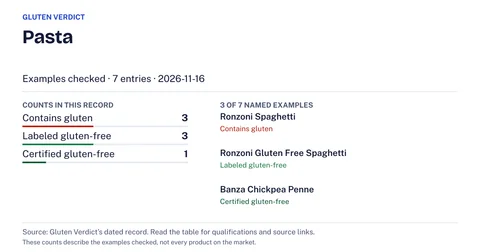 PastaContains glutenchecked Nov 16, 2026
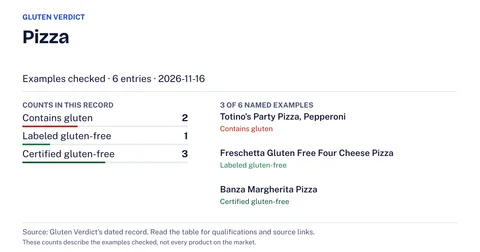 PizzaContains glutenchecked Nov 16, 2026
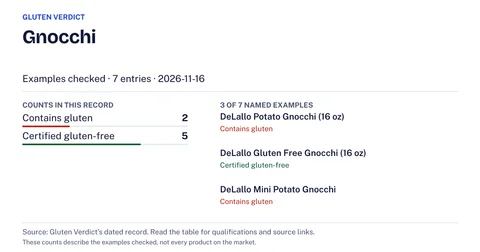 GnocchiDepends on the product2 of 7 products we checked contain gluten: DeLallo Potato Gnocchi (16 oz) and DeLallo Mini Potato Gnocchichecked Nov 16, 2026
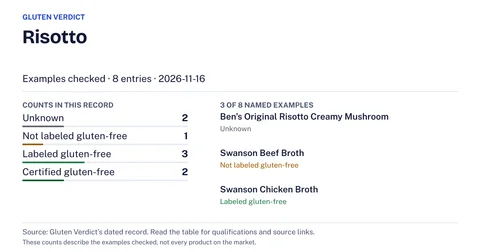 RisottoDepends on the productchecked Nov 16, 2026
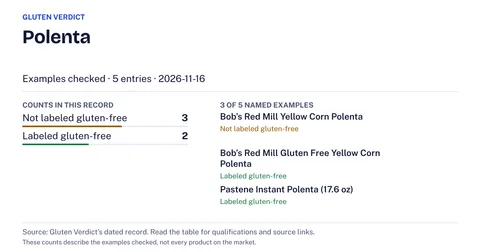 PolentaNaturally gluten-freeBuy it labeled gluten-freechecked Nov 16, 2026
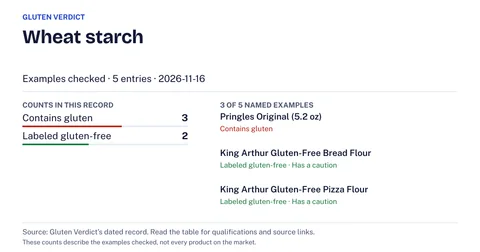 Wheat starchDepends on the product3 of 5 products we checked contain gluten: Pringles Original (5.2 oz), Jiffy Corn Muffin Mix, and Chex Mix Bold Garlic and Herbchecked Nov 16, 2026
 BreadContains glutenchecked Nov 16, 2026
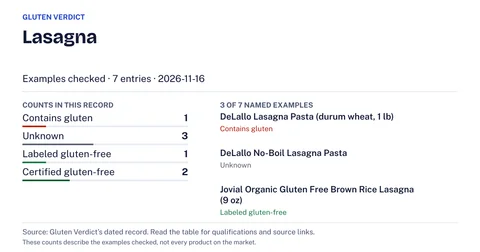 LasagnaContains glutenchecked Nov 16, 2026
Questions people ask
Is Italy’s “senza glutine” the same as gluten-free in the United States?
Both rules use a 20 figure: FDA says any unavoidable gluten must be less than 20 ppm35, and the EU rule allows «senza glutine» at no more than 20 mg/kg1. AIC says it is the same 20 ppm in Italy, Europe and the United States17.
Do I have to be an AIC member to use its restaurant list?
AIC says members can consult the list, and that non-members can buy app access for short periods7. Travel Net describes a 15-day temporary version62.
Does Italian law make restaurants offer gluten-free dishes?
AIC reports that law 123/2005 requires gluten-free meals on request in school, hospital and public-body canteens23. For commercial restaurants it provides for training modules20, and some regions have their own rules24.
Can I buy gluten-free food at a pharmacy in Italy?
Travel Net says gluten-free products are sold in many Italian pharmacies66, and AIC Mobile lists pharmacies and parapharmacies among its retailers67.
Does AIC vouch for gluten-free restaurant lists on other websites?
AIC says it does not pass its venue database to other sites and is not responsible for how reliable or current they are61.
More in Travel: Europe
 Gluten-free in Croatia and the Balkans: which rule applies where, and where wheat enters the dishesWhich gluten-free rule applies in Croatia, Serbia, Bosnia and Montenegro, how to read the claim, and where wheat enters burek, ćevapi and palačinke.
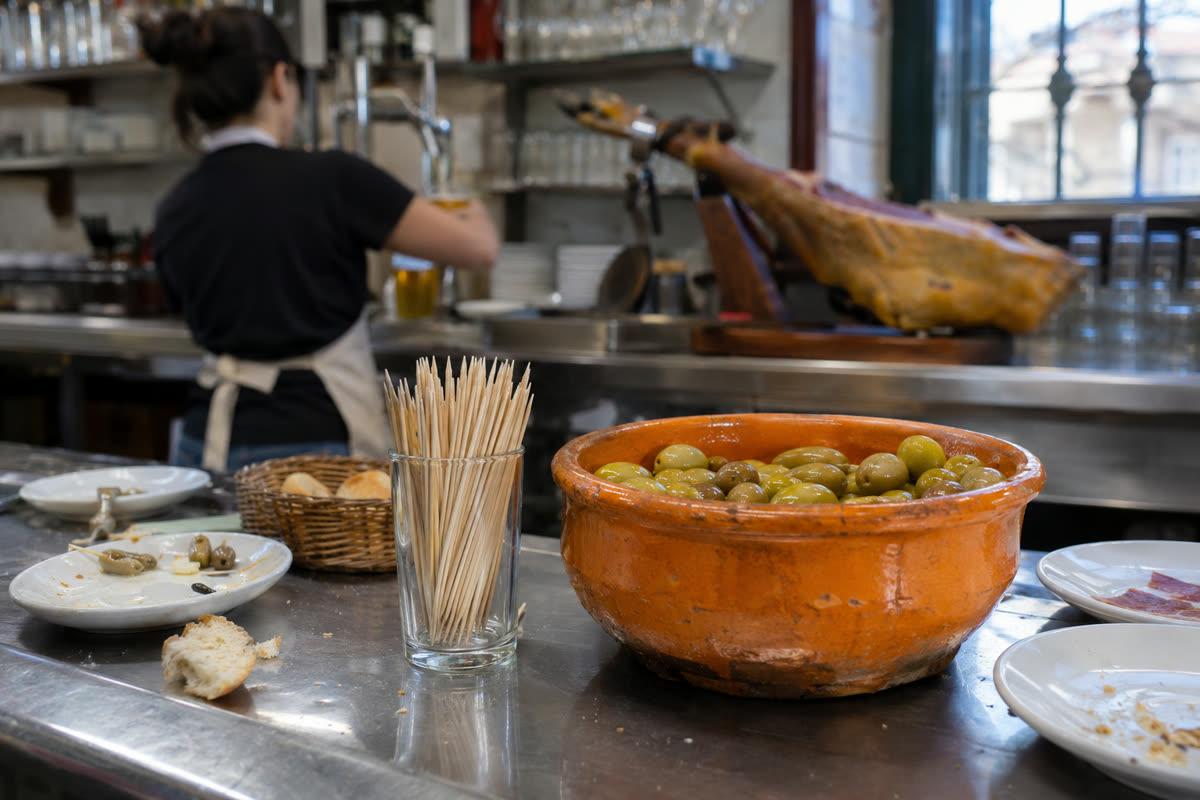 Gluten-free in Spain: what “sin gluten” means and what FACE coversWhat “sin gluten” means in Spain, what FACE’s marks and restaurant program say they cover, and which tapas need a question before you order.
 Gluten-free in Central Europe: the rules in five countries and where wheat hides in the dishesWhich gluten-free rule covers a pack in Austria, Czechia, Hungary, Poland and Switzerland, and where wheat enters schnitzel, dumplings and sauces.
 Gluten-free in France: reading a pack, a menu and a “sans gluten” signWhat «sans gluten» means on a French pack, how restaurants must give allergen information, and what a bakery’s “sans gluten” sign does not promise.
 Gluten-free in Greece: what the label and the taverna promise, and what to askWhat “gluten-free” means in Greece, where wheat hides in Greek dishes such as gyro, orzo and pies, and what to ask at a taverna.
 Gluten-free ranges at European supermarkets, as the chains describe themWhat Mercadona, Carrefour, Tesco, Sainsbury’s, Albert Heijn and Migros say about their gluten-free lists, filters and marks, read from their own pages.
Related guides
 Gluten-free and very low gluten on EU labels, and how allergens are highlightedWhat EU “gluten-free” and “very low gluten” claims permit, how cereals containing gluten are highlighted in ingredient lists, and the rules for loose food.
 Fine on bread in Europe? What it does and does not showWhat a trip where bread felt fine does and does not show about celiac disease, and how EU and US gluten-free label rules compare.
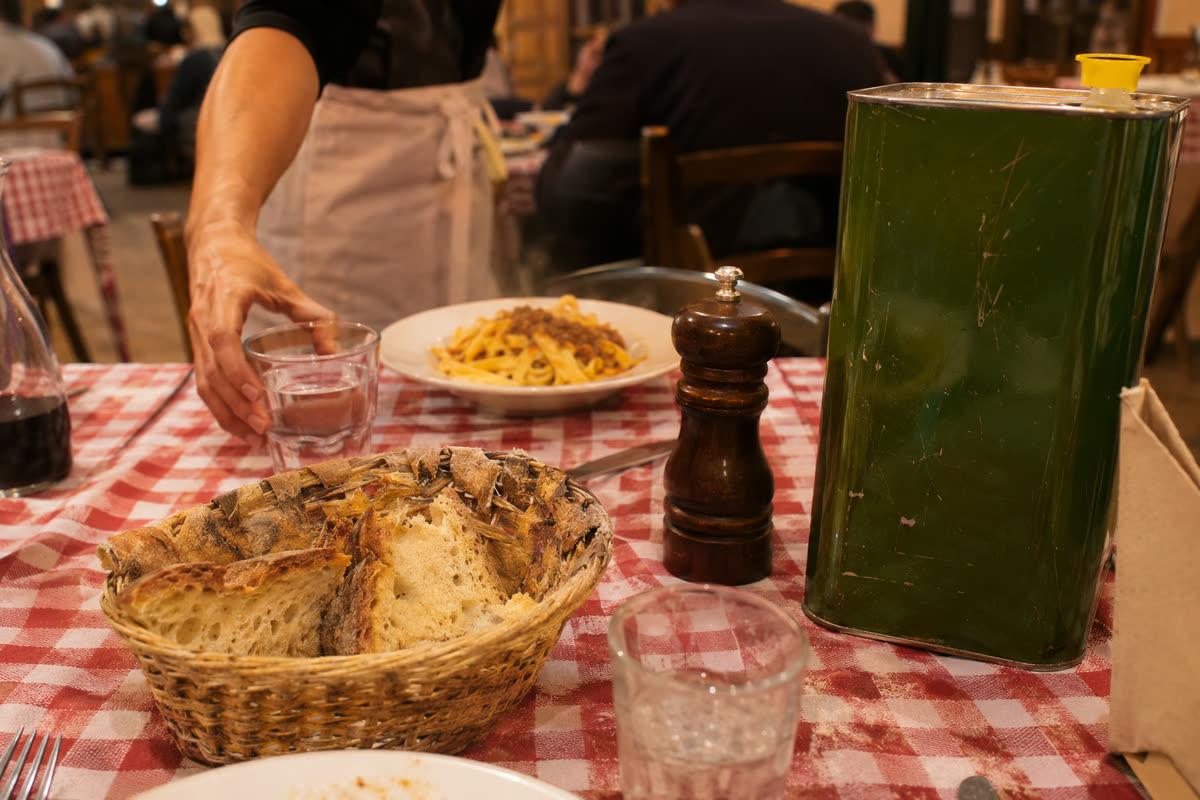 Ordering gluten-free at an Italian restaurantBefore you order at an Italian restaurant: where the gluten-free pasta is boiled, what thickens the sauces, and what is breaded or fried.
 Gluten words on European food labels, language by languageFind the ingredient list, the gluten-cereal name and the gluten-free claim on a European pack in 11 languages, using words from the EU’s own texts.
Sources
- [1, 28, 30, 31, 33, 37] European Union (EUR-Lex), Regulation (EU) No 828/2014: gluten-free and very low gluten statements, checked Nov 17, 2026.
- [2, 3, 4, 6, 46, 47, 48, 50, 57, 58, 59, 60, 61] Associazione Italiana Celiachia (AIC), Programma Alimentazione Fuori Casa (AFC), checked Nov 17, 2026.
- [5] Associazione Italiana Celiachia (AIC), Cosa comunica il marchio Spiga Barrata, checked Nov 17, 2026.
- [7, 17, 49, 64, 85, 86, 88] Associazione Italiana Celiachia (AIC), Consigli per una vacanza senza glutine (press release, 12 June 2024), checked Nov 17, 2026.
- [8, 24] Associazione Italiana Celiachia (AIC), FAQ 10: venues outside the AFC program, checked Nov 17, 2026.
- [9, 10, 70, 81, 82] Associazione Italiana Celiachia (AIC), “ABC” of the Gluten-free diet (English page), checked Nov 17, 2026.
Read on 2026-11-17: in the cereals section of AIC’s English “ABC” page, the list of foods AIC marks as forbidden (the list that begins with wheat) includes the entry “First courses prepared with prohibited cereals (pasta, stuffed pasta, potato dumplings Roma-style dumplings, pizzocheri (pasta from Valtellina), pancakes)”.
Read on 2026-11-17: in the cereals section of AIC’s English “ABC” page, the list of foods AIC marks as forbidden (the list that begins with wheat) includes the entry “Bread and baked substitutes, sweets and salted, prepared with not allowed cereals (loaf bread, bread crumbs, flat bread, pizza,piadine, panzerotti, breadsticks, crackers, rusks, taralli, toasted bread, pretzels, cracotte, biscuits, snacks, pastries, cakes)”.
Read on 2026-11-17: in the cereals section of AIC’s English “ABC” page, the list of foods AIC marks as forbidden (the list that begins with wheat) includes the entry “Polenta (if the buckwheat flour is mixed with wheat flour)”.
Read on 2026-11-17: in the cereals section of AIC’s English “ABC” page, the list of foods to check on the label (the list that begins with “Allowed grains mix, allowed grains and legumes mix”) includes the entry “Readymade risottos (bagged, frozen, flavoured)”.
- [11, 12, 13, 14, 51, 52, 53, 54, 55, 56, 71, 73, 74, 75, 76, 87] Associazione Italiana Celiachia (AIC), Regole fondamentali AFC (AIC’s fundamental rules for gluten-free eating out), checked Nov 17, 2026.
- [15, 40, 41, 42, 43, 44, 45] European Union (EUR-Lex), Regulation (EU) No 1169/2011 on food information to consumers (consolidated text), checked Nov 17, 2026.
Read on 2026-11-17: in Annex II of the consolidated text, the entry “Cereals containing gluten” is followed by four exceptions: wheat based glucose syrups including dextrose; wheat based maltodextrins; glucose syrups based on barley; and cereals used for making alcoholic distillates including ethyl alcohol of agricultural origin.
- [16] US Food and Drug Administration, Food Allergen Labeling and Consumer Protection Act of 2004 (FALCPA), checked Nov 17, 2026.
- [18, 19, 39, 72] Associazione Italiana Celiachia (AIC), Fare la spesa (shopping for a gluten-free diet), checked Nov 17, 2026.
- [20, 23] Associazione Italiana Celiachia (AIC), Mangiare fuori casa (rights and rules), checked Nov 17, 2026.
- [21, 25, 26, 27, 89] Associazione Italiana Celiachia (AIC), Ristorazione e Celiachia: un’indagine rivela 5 gap fra locali aderenti al network AFC e locali non AFC (18 May 2023), checked Nov 17, 2026.
- [22, 65] Associazione Italiana Celiachia (AIC), Celiachia in viaggio, checked Nov 17, 2026.
- [29, 32, 34] European Union (EUR-Lex), Regolamento di esecuzione (UE) n. 828/2014 (Italian text), checked Nov 17, 2026.
- [35, 36, 38] US Food and Drug Administration, Questions and Answers on the Gluten-Free Food Labeling Final Rule, checked Nov 17, 2026.
- [62, 66, 80, 90, 91, 92, 93, 94, 95] Coeliac Youth of Europe (CYE), Travel Net: Gluten-free in Italy, checked Nov 17, 2026.
- [63, 67, 69] Associazione Italiana Celiachia (AIC), Applicazione AIC mobile, checked Nov 17, 2026.
- [68] Associazione Italiana Celiachia (AIC), Il marchio Spiga Barrata in Europa, checked Nov 17, 2026.
- [77] Associazione Italiana Celiachia (AIC), FAQ 11: ovens in pizzerias and tubs in gelaterias, checked Nov 17, 2026.
- [78, 79] Associazione Italiana Celiachia (AIC), AFC per il ristoratore (how a venue joins the program), checked Nov 17, 2026.
- [83, 84] Associazione Italiana Celiachia (AIC), FAQ 28: does wheat starch contain gluten?, checked Nov 17, 2026.