Cooking gluten-free pasta and rice noodles: what makers’ directions say
Short answer
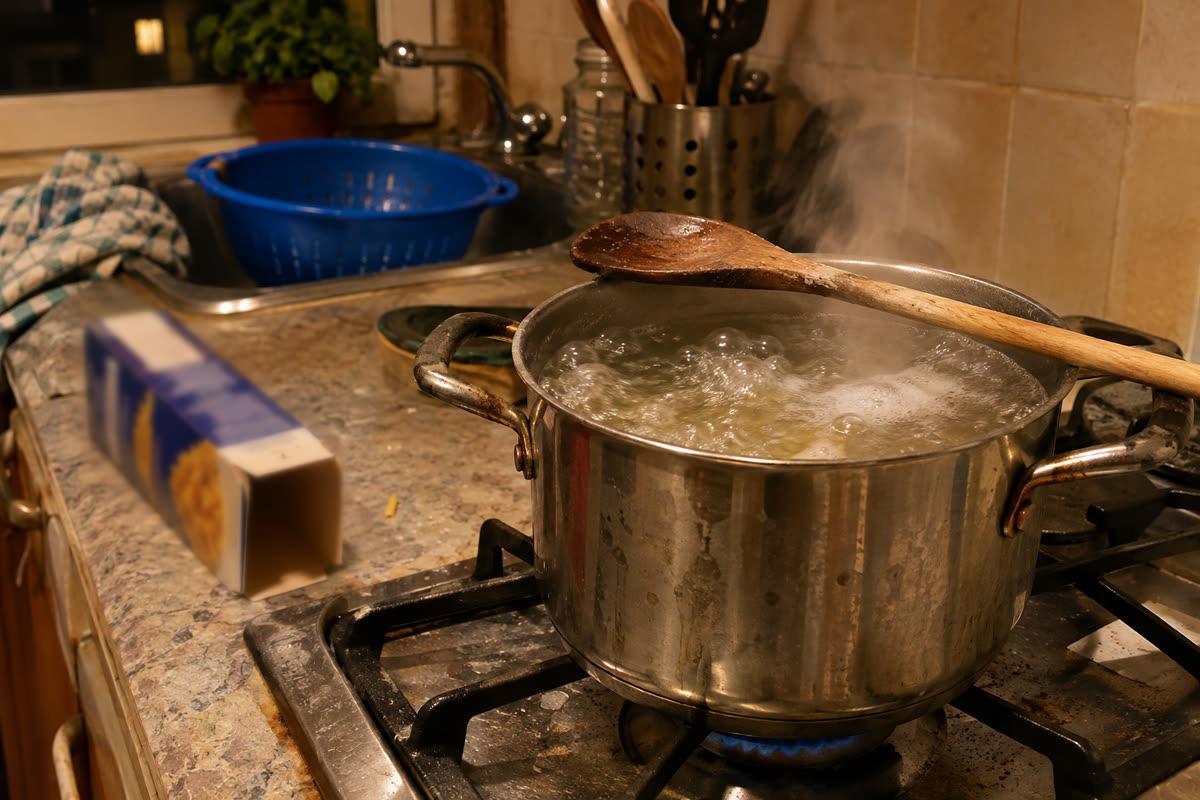
Gluten-free pasta and rice noodles do not share one set of directions: on the maker pages we read, water, stirring, rinsing and standing time differ by product, so the directions for the pasta in your pot come first1, 2, 6, 8. Check these four things against your box:
- Water and stirring: Jovial says abundant water and minimal stirring for its brown rice pasta1, while Banza says stirring frequently for its chickpea pasta2.
- Doneness: Jovial says taste testing is the only way to be sure the pasta is cooked to your preferred doneness3.
- Rinse or sauce: Banza, Explore Cuisine and Lotus Foods say to rinse4, 5, 6; Jovial says to toss lightly in sauce after draining7.
- Standing: Jovial says pasta left in its cooking liquid keeps absorbing it and turns softer7; some rice noodles are soaked off the heat rather than boiled8.
Part of Grains, flours and substitutes, 13 guides
Key points
- Makers differ on stirring: Jovial says to minimize it1, Banza says to stir frequently2, Lotus Foods says occasionally6.
- Rinsing is not settled: Banza, Explore Cuisine and Lotus Foods say to rinse4, 5, 6, Thai Kitchen’s thin rice noodles page says to rinse gently with warm water if noodles become sticky9, and Jovial’s cooking answer says to toss in sauce after draining7.
- Rice noodles may be boiled or soaked, and one maker does both: Lotus Foods boils its Pad Thai noodles for 7 minutes6 and soaks its Pho noodles in boiling water10.
- Pasta left sitting in its cooking liquid keeps absorbing it, which Jovial says leaves it softer, delicate pasta that may break when stirred7.
Why one set of directions will not fit every box
Jovial’s FAQ says gluten-free pasta should not be cooked or treated the same as semolina pasta1. The boxes we read are not made of the same thing either: organic brown rice flour and water at Jovial11, rice as the only grain at Tinkyada12, chickpeas, pea starch, tapioca and xanthan gum at Banza13, organic chickpea flour and organic brown rice flour at Explore Cuisine14, and rice and water in Thai Kitchen’s stir-fry noodles15.
The tables below put each maker’s own directions side by side, from the product pages and FAQs we read on 2026-11-17. They are a sample, not every maker. Barilla and Ronzoni are not in them: their websites blocked our page request that day and we did not work around the block. Our verdicts on Barilla, Ronzoni and pasta in general cover whether those boxes contain gluten; for the cooking, the box in your hand is the source.
Dry pasta: what four makers’ pages say
Not every page gives a water amount, so compare the direction (more water, less stirring, cover the pot) rather than the number.
| Product and flour | Directions on the page | What else the page says |
|---|---|---|
| Tinkyada rice pasta (rice is the only grain the maker handles12) | Bring water to a boil, add the pasta, boil 2 minutes, then cover the pot for 12-16 minutes16. A graphic on the same page reads “12-15 mins”36. | The FAQ says the traditional method works too, and that the covered time follows the package for that pasta style17. It also says the pastas can withstand quite a bit of over-cooking17. |
| Jovial Organic Gluten Free Brown Rice Spaghetti (organic brown rice flour, water11) | Cook in abundant water, minimize stirring to prevent breakage, and taste to judge doneness1, 3. | After draining, toss lightly in sauce and serve right away; do not let the pasta sit in the cooking liquid7. The cooking answer does not mention rinsing18. |
| Banza Chickpea Elbows (chickpeas, pea starch, tapioca, xanthan gum13) | Salted water at a rolling boil (about 8 cups), add the pasta, stir, reduce to a simmer, cook to desired firmness, stirring frequently, about 7-9 minutes (expect foam), then strain and rinse with water4. | The page’s tips say the water should keep a steady rolling boil2, while its numbered steps say to reduce to a simmer4. Read the box for which one it means. |
| Explore Cuisine Chickpea Fusilli (organic chickpea flour, organic brown rice flour14) | Bring 8 cups (2 liters) of water to a boil, add the box, reduce the heat and simmer 4-6 minutes, rinse with cold water, drain and serve5. | The page says rinse with cold water; Banza’s step says only “rinse with water”5, 4. |
Stirring, rinsing and standing: where makers split
Stirring
- Minimize it, to prevent breakage: Jovial1.
- Stir frequently so it cooks evenly: Banza2.
- Stir occasionally: Lotus Foods6, Cappello’s frozen gnocchi19. Stir gently: Conte’s frozen ravioli20.
Rinsing
- Rinse: Banza (“rinse with water”)4, Explore Cuisine (cold water)5, Lotus Foods (cold water, for both its Pad Thai and Pho noodles)6, 10.
- Drain well and toss immediately with sauce or add to soup: Thai Kitchen’s stir-fry noodles8. Its thin noodles carry a tip: if they become sticky, rinse gently with warm water to separate them9.
- Toss lightly in sauce after draining: Jovial; its cooking answer does not mention rinsing7, 18.
Standing and holding
Tinkyada’s method has you cover the pot for 12-16 minutes after a 2-minute boil16. Thai Kitchen has you take the pot off the heat and let the noodles stand 8 to 10 minutes (stir-fry noodles)8 or 3 to 5 minutes (thin noodles)21. Jovial warns against the other kind of standing: pasta left in its cooking liquid keeps absorbing it7.
Time and doneness: the numbers makers print
The times printed on the pages we read include 4-6 minutes for Explore Cuisine’s chickpea fusilli5, about 5-6 minutes for Conte’s frozen ravioli20, about 7-9 minutes for Banza’s elbows4, 7 minutes for Lotus Foods’ Pad Thai noodles6 and 10 minutes for Taste Republic’s frozen egg noodles22. Those are different products, so the spread says little about any one box.
Jovial’s FAQ points to tasting: it says taste testing is the only way to be sure the pasta is cooked to your preferred doneness3. Banza’s step is also written as “cook to desired firmness”4.
Rice noodles: boil them, or soak them
The packs we read tell you to boil6, to take the pot off the heat8, or to soak in a bowl10. The same maker can do both: Lotus Foods boils its Pad Thai noodles6 and soaks its Pho noodles10. Check the pack, not the noodle’s name. For which noodles are wheat-based and which are rice, see our guide to soba, udon and rice noodles; our verdicts are on rice noodles and pad Thai.
| Product and flour | Method and time | After |
|---|---|---|
| Lotus Foods Organic Traditional Pad Thai Rice Noodles (organic white rice flour23) | Boil in 4-5 quarts of water for 7 minutes or until tender, stirring occasionally6. | Drain and rinse under cold water; serve hot or cold6. |
| Lotus Foods Organic Traditional Pho Rice Noodles | Cover the noodles completely with boiling water in a bowl, cover, let sit 2 minutes, stir, re-cover and let sit 2 more minutes10. | Drain and rinse under cold water; serve hot or cold10. |
| Thai Kitchen Stir Fry Rice Noodles (rice, water15) | Bring a large pot of water to a boil, remove from heat, add the noodles and let stand 8 to 10 minutes, stirring occasionally, until soft but firm8. | Drain well and immediately toss with sauce or add to soup just before serving8. |
| Thai Kitchen Thin Rice Noodles | Same method, standing 3 to 5 minutes21. | If they are not used right away, cover with plastic wrap or leave soaking in cold water; if they become sticky, rinse gently with warm water9. |
Holding, storing and reheating cooked pasta
Two makers speak to leftovers and make-ahead pasta. Banza: for pasta salad or meal prep, cook to the lower end of the time range, toss with a little olive oil before it goes in the fridge, store the pasta alone and add sauce right before eating24. Thai Kitchen: noodles not used right after softening can be covered with plastic wrap or left soaking in cold water9.
Reheating: Banza’s page, the one here that covers fridge storage, gives no reheating directions25. If you reheat often, ask the maker how it advises doing so for that pasta.
Frozen pasta, gnocchi and lasagna sheets
Fresh, frozen and filled products have their own clocks. Our verdicts: gnocchi, ravioli, egg noodles, lasagna. For boxed mac and cheese, the box has its own directions.
| Product and what it is made of | Directions on the page |
|---|---|
| Conte’s Gluten-Free Butternut Squash Ravioli, frozen (dough: rice flour, corn starch, water, whole eggs, canola oil, xanthan gum, salt, guar gum26) | Add 1 1/2 teaspoons of salt to 2 quarts of water, bring to a boil, gently add the frozen pasta, stir gently, simmer about 5-6 minutes, drain well20. |
| Taste Republic Gluten-Free Egg Noodles, frozen (water, brown rice flour, potato starch, tapioca starch, whole egg, egg white, xanthan gum, salt27) | Bring 3-4 quarts of salted water to a boil, add the frozen noodles and stir, cook 10 minutes or until the texture you want, drain22. |
| Cappello’s Gnocchi, frozen (potato flakes, water, almond flour, eggs, tapioca starch, sea salt28) | At least 3 quarts of water, at least 6 inches deep, at a rolling boil; add frozen gnocchi, cook 4 minutes until they begin to float, stirring occasionally; drain, then pan-brown 3-4 minutes in 1-2 teaspoons of butter or oil19. |
| DeLallo Gluten Free Gnocchi (85% potato and rice flour29) | The page says it cooks up in 2 minutes29. |
| Nuovo Pasta Classic Potato Gnocchi Gluten-Free | The page lists a cook time of 1 minute30. |
| DeLallo Gluten Free Lasagna Pasta (corn and rice flour31) | The sheets are oven-ready and need no par-boiling or cooking before layering32. |
| Tinkyada lasagne and Grand (Jumbo) shells | Direct to oven: the FAQ answers yes for lasagne and no for the Grand shell33. |
Gnocchi cook times on these pages run from 1 minute (Nuovo30) to 4 minutes from frozen (Cappello’s19), so the pack in your hand sets the clock.
Pot, strainer and spoon: texture is one question, gluten is another
Everything above is about how the pasta cooks. Whether your pot, water and tools carry gluten from other food is a separate question. The Gluten Intolerance Group says strainers, colanders and flour sifters hold gluten in crevices that are very difficult to clean, posing a significant threat for cross-contact34.
Our guides on cooking gluten-free pasta in a mixed kitchen and what the shared-kitchen evidence shows go through pots, water and tools; the pasta and noodle label guide covers the box itself.
When it goes wrong: what the makers’ pages answer
- Noodles stuck together: Thai Kitchen’s thin rice noodles page says to rinse gently with warm water to separate them9.
- Foam in the pot: Banza’s step list says to expect it4.
- Pasta turned soft or breaks when stirred: Jovial links this to pasta sitting in cooking liquid and says to minimize stirring7, 1.
- Lasagne or shells in the oven: Tinkyada’s FAQ answers yes to direct-to-oven for its lasagne and no for its Grand shell33; DeLallo’s gluten-free sheets are oven-ready32.
If the box and your result still disagree, the maker knows its own recipe. Tinkyada’s FAQ page carries a “Contact us / Message Box”35; look for the same on your pasta’s maker site and have the box, with its date code, in hand. For plain rice on its own, see our verdict on rice.
Verdicts in this guide
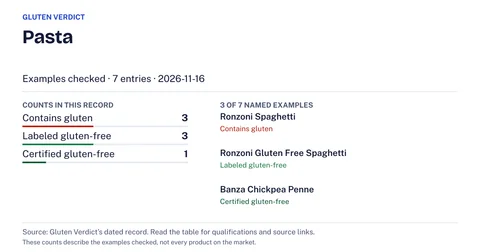 PastaContains glutenchecked Nov 16, 2026
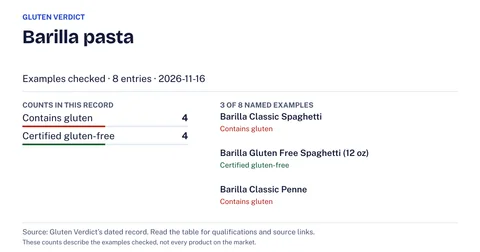 Barilla pastaContains glutenBarilla America, Inc. · checked Nov 16, 2026
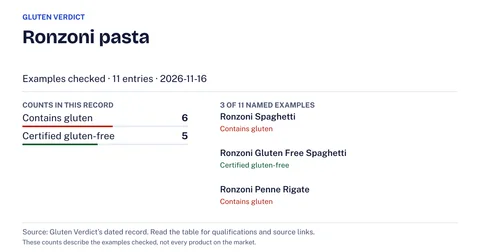 Ronzoni pastaContains glutenRonzoni · checked Nov 16, 2026
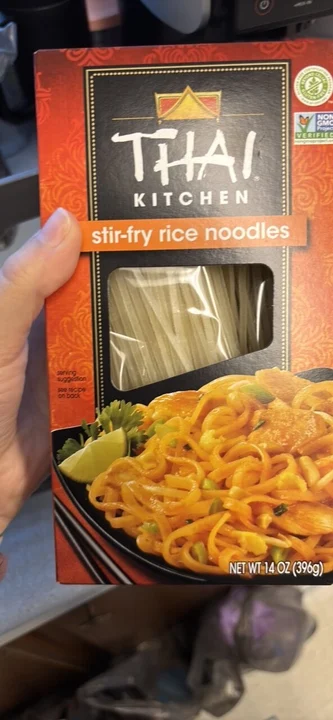 Rice noodlesNaturally gluten-free2 of 9 products we checked contain gluten: Annie Chun’s Pad Thai Noodle Bowl with Vegetables and Annie Chun’s Pho Soup Bowl with VegetablesBuy it labeled gluten-freechecked Nov 16, 2026
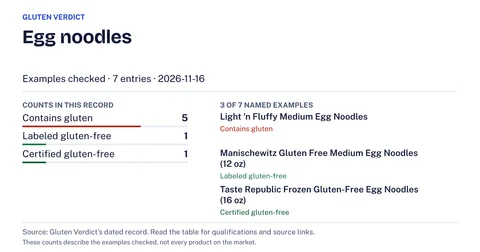 Egg noodlesContains glutenchecked Nov 16, 2026
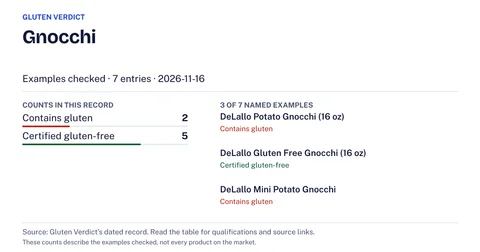 GnocchiDepends on the product2 of 7 products we checked contain gluten: DeLallo Potato Gnocchi (16 oz) and DeLallo Mini Potato Gnocchichecked Nov 16, 2026
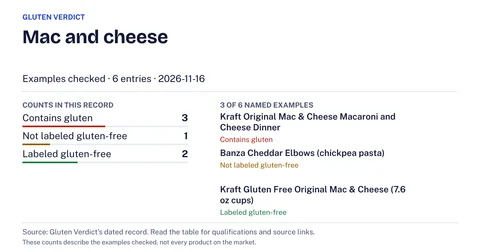 Mac and cheeseContains glutenchecked Nov 16, 2026
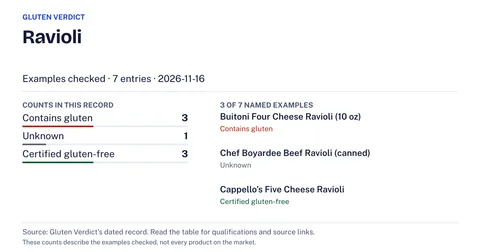 RavioliContains glutenchecked Nov 16, 2026
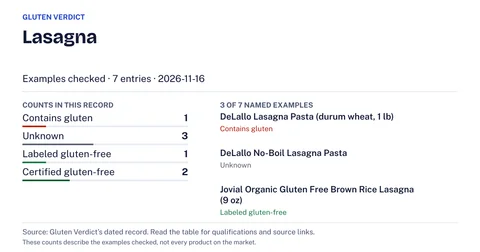 LasagnaContains glutenchecked Nov 16, 2026
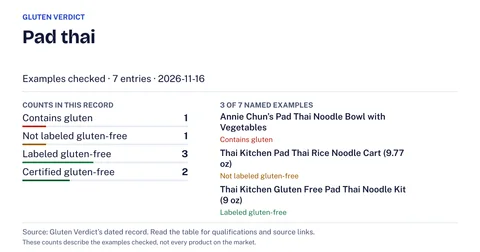 Pad thaiDepends on the product1 of 7 products we checked contains gluten: Annie Chun’s Pad Thai Noodle Bowl with Vegetableschecked Nov 16, 2026
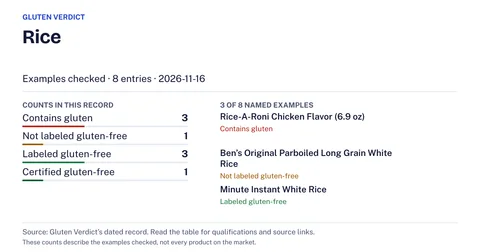 RiceNaturally gluten-free3 of 8 products we checked contain gluten: Rice-A-Roni Chicken Flavor (6.9 oz), Near East Original Rice Pilaf, and Ben’s Original Ready Rice Rice PilafBuy it labeled gluten-freechecked Nov 16, 2026
Questions people ask
Should I rinse gluten-free pasta?
Makers differ. Banza, Explore Cuisine and Lotus Foods say to rinse4, 5, 6. Thai Kitchen’s thin rice noodles page says to rinse gently with warm water if noodles become sticky9. Jovial’s cooking answer says to toss lightly in sauce after draining and does not mention rinsing7, 18.
How much water does gluten-free pasta need?
It depends on the product. Jovial says abundant water1; Banza gives about 8 cups in its steps4; Explore Cuisine gives 8 cups (2 liters)5; Lotus Foods gives 4-5 quarts for Pad Thai noodles6; Cappello’s asks for at least 3 quarts for frozen gnocchi19.
More in Grains, flours and substitutes
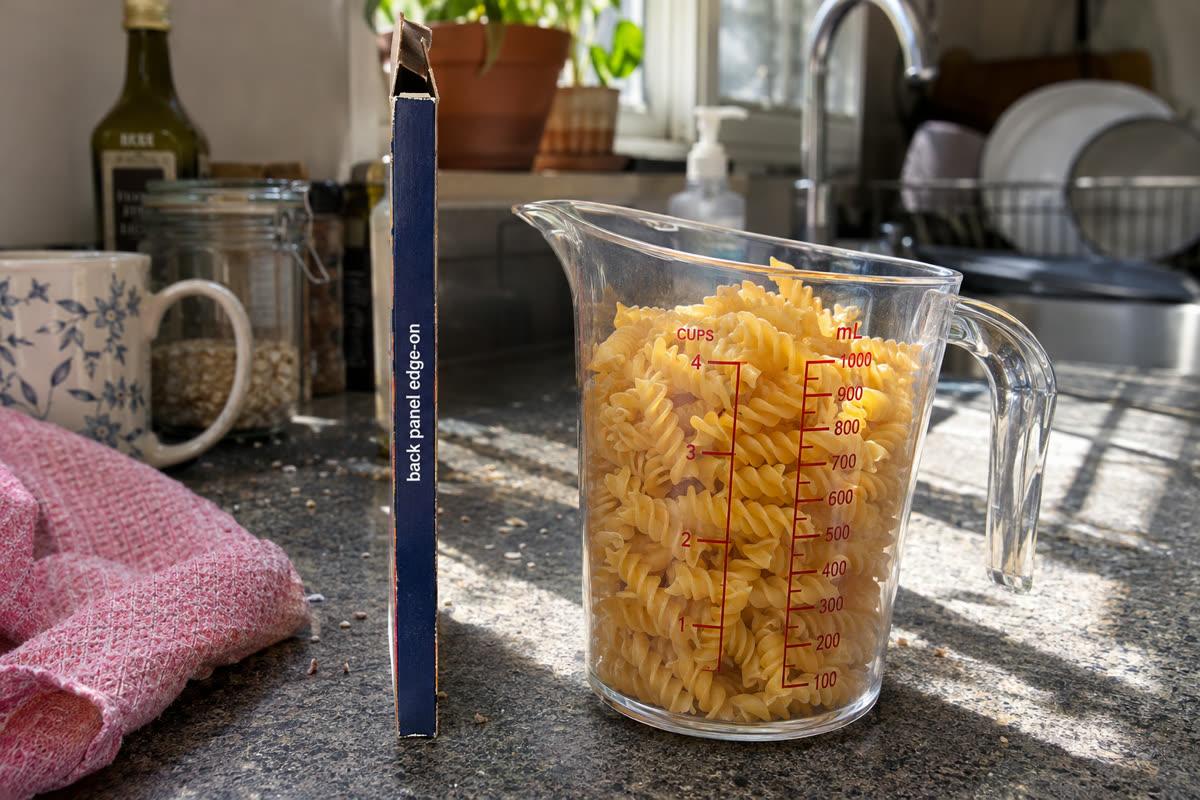 Gluten-free pasta and noodles: what to read on the boxHow to read a pasta or noodle box: the gluten-free claim, the ingredient list, same-brand wheat twins, and why soba and udon need a close read.
 Gluten-free substitutes: the swap for each wheat ingredient and the label check it needsA lookup table of gluten-free swaps for wheat flour, pasta, bread, soy sauce, beer and more, with the one label check each swap needs.
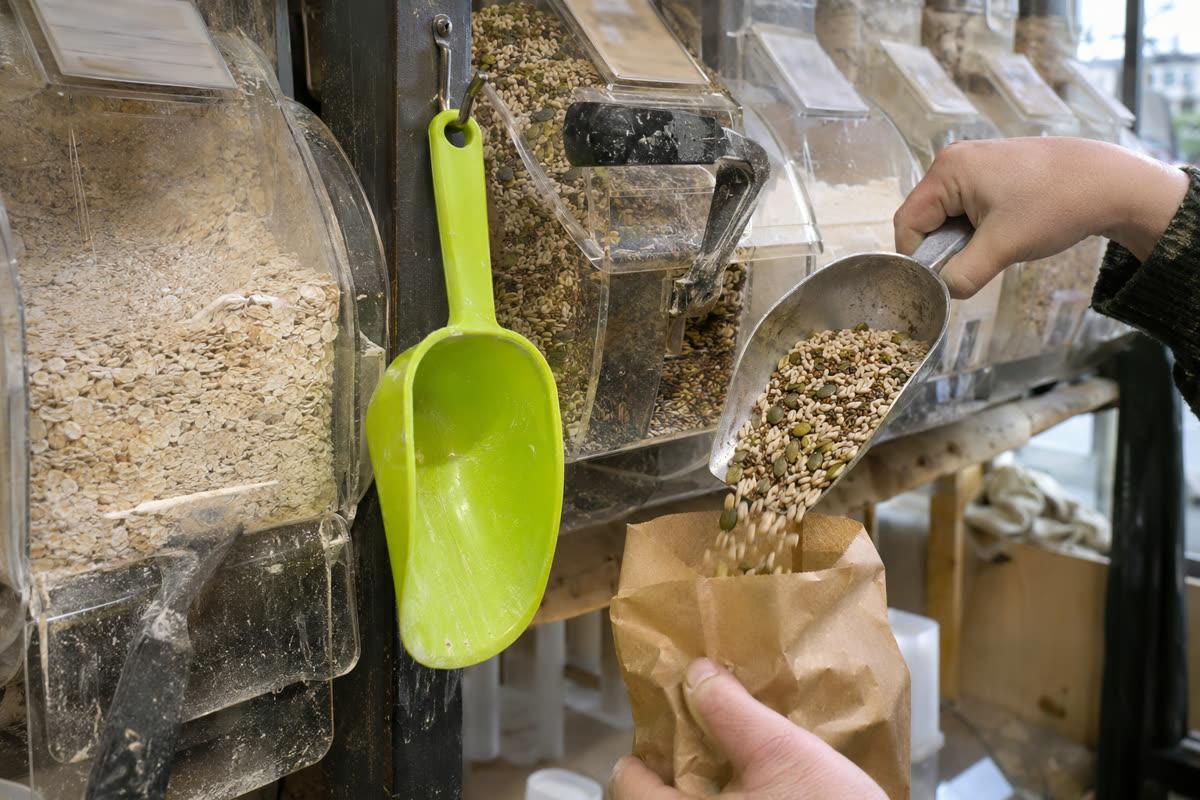 Millet, sorghum, quinoa, buckwheat, teff, amaranth and wild rice: what the bag has to sayWhich grains and seeds are gluten-free plants, what makers and certifiers say about seven of them, and the cross-contact checks for bags, bins and blends.
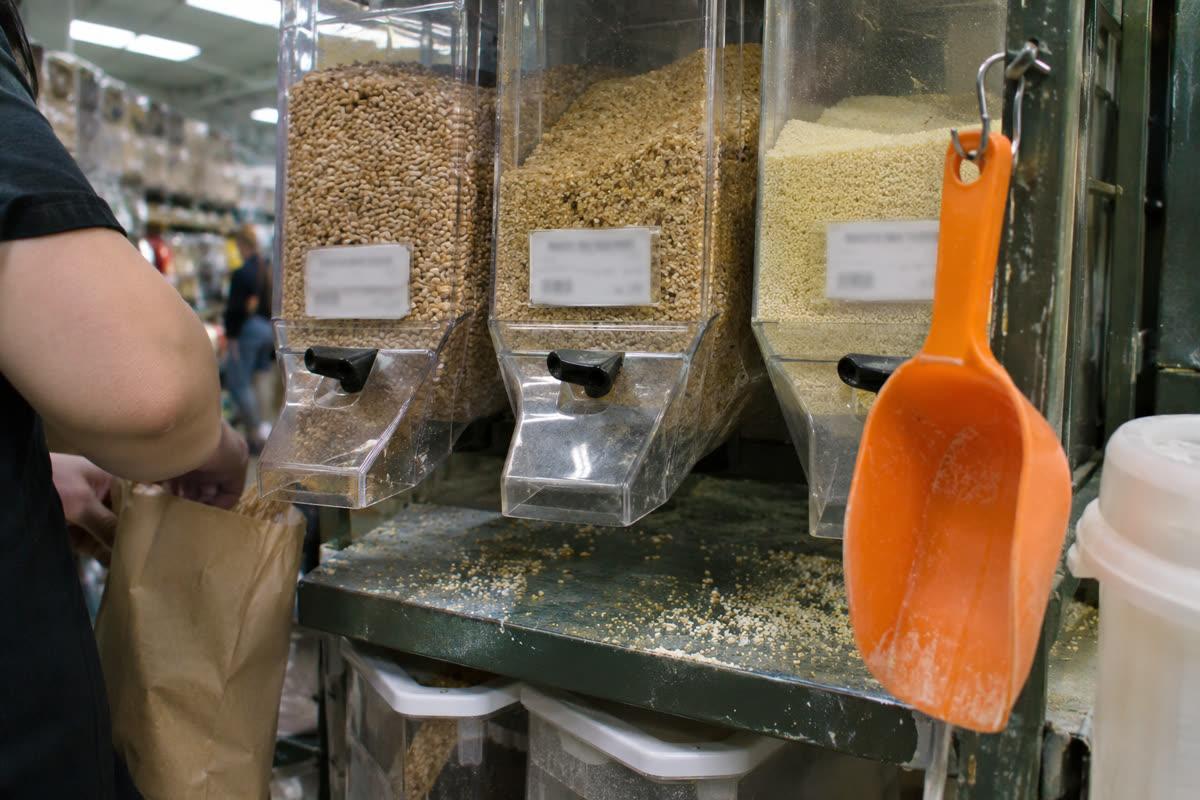 Spelt, farro, Kamut, bulgur, couscous and freekeh: wheat under other namesWhich shop and menu names are wheat: spelt, farro, Kamut, einkorn, bulgur, couscous, freekeh and more, and what FDA’s rules say about them.
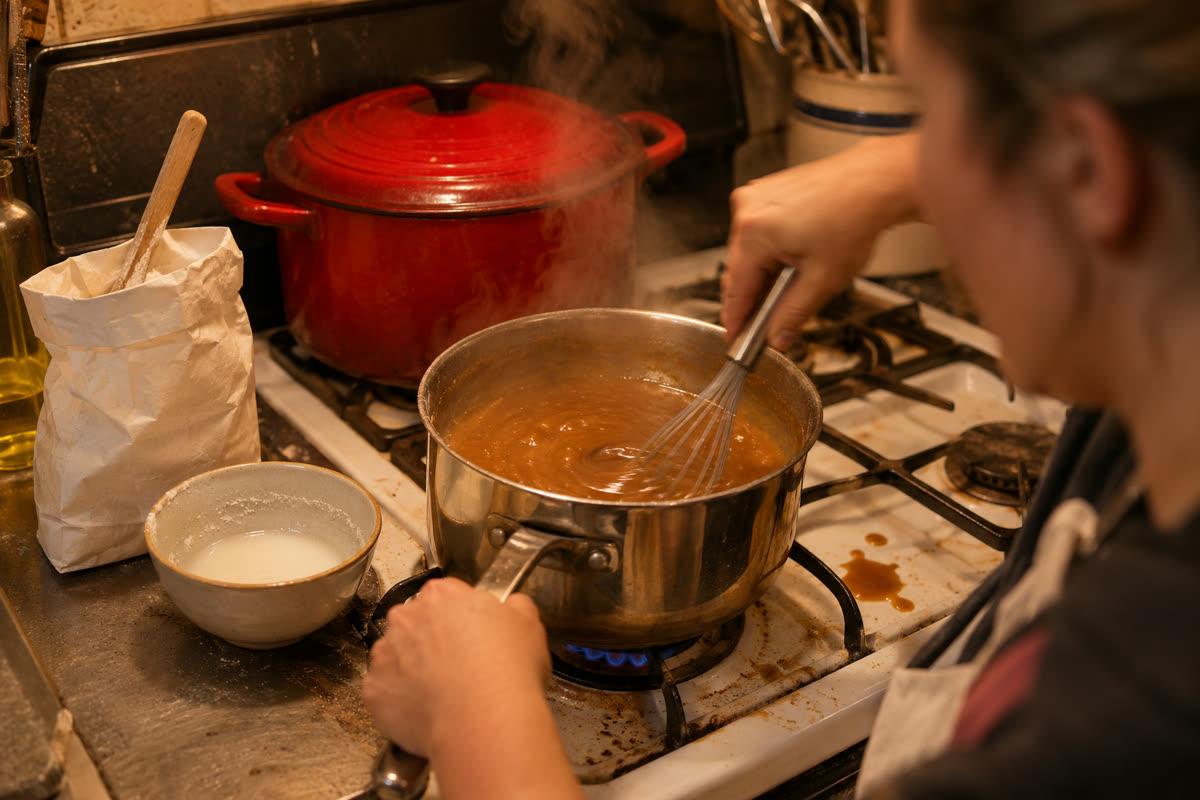 Gluten-free thickeners: cornstarch, tapioca, arrowroot, potato starch and rice flourPick a gluten-free thickener for gravy, soup or pie filling, follow the maker's directions, choose slurry or roux, and spot wheat thickeners.
 Gluten-free cereal: how to check a cereal boxCheck a cereal box in order: the gluten-free claim, malt and wheat in the ingredient list, the oats, then the maker’s own page for that flavour.
Related guides
 Cooking gluten-free pasta in a kitchen that also cooks regular pastaSet up a pasta night where gluten-free and regular pasta share a kitchen: what one small study found on shared water and pots, and what charities advise.
 What studies measured in shared kitchens: pasta water, toasters, knives and spreadsWhat four experimental studies measured when gluten-free food met shared pots, toasters, knives and spreads: samples, results, and what went untested.
 Soba vs udon vs rice noodles: which noodle holds wheatUdon is wheat, soba can be a buckwheat and wheat mix, and rice noodles are rice. How to read a package and ask about the broth and dipping sauce.
 How to check whether a packaged food is gluten-freeA four-step check for one packaged food: the claim, the ingredient and allergen lines, the maker’s dated page and the certifier’s directory.
Sources
- [1, 3, 7, 18] Jovial Foods, Frequently Asked Questions (gluten free pasta), checked Nov 17, 2026.
Read on 2026-11-17: the answer headed “How do you cook your brown rice pasta for best results?” covers cooking in abundant water, minimal stirring, tasting for doneness and tossing lightly in sauce after draining; it does not mention rinsing.
- [2, 4, 13, 24, 25] Banza, Chickpea Elbows (cooking tips), checked Nov 17, 2026.
Read on 2026-11-17: the page’s cooking tips and numbered steps cover rolling boil, stirring, rinsing, storing in the fridge with a little olive oil, and keeping the sauce separate; no reheating directions appear.
- [5, 14] Explore Cuisine, Chickpea Fusilli (directions), checked Nov 17, 2026.
- [6, 23] Lotus Foods, Organic Traditional Pad Thai Rice Noodles (directions), checked Nov 17, 2026.
- [8, 15] McCormick (Thai Kitchen), Thai Kitchen Gluten Free Stir Fry Rice Noodles (directions), checked Nov 17, 2026.
- [9, 21] McCormick (Thai Kitchen), Thai Kitchen Gluten Free Thin Rice Noodles (tip), checked Nov 17, 2026.
- [10] Lotus Foods, Organic Traditional Pho Rice Noodles (directions), checked Nov 17, 2026.
- [11] Jovial Foods, Organic Gluten Free Brown Rice Spaghetti, checked Nov 17, 2026.
- [12, 17, 33, 35] Tinkyada, FAQ (rice only), checked Nov 17, 2026.
- [16, 36] Tinkyada, Energy-saving 2 minute boil, checked Nov 17, 2026.
- [19, 28] Cappello’s, Gnocchi (cooking instructions), checked Nov 17, 2026.
- [20, 26] Conte’s Pasta Company, Gluten-Free Butternut Squash Ravioli (directions), checked Nov 17, 2026.
- [22, 27] Taste Republic, Family-Size Frozen Gluten-Free Egg Noodles (directions), checked Nov 17, 2026.
- [29] DeLallo, Gluten Free Gnocchi (Potato & Rice Flour), checked Nov 17, 2026.
- [30] Nuovo Pasta, Classic Potato Gnocchi Gluten-Free, checked Nov 17, 2026.
- [31, 32] DeLallo, Gluten Free Lasagna Pasta (what it is made of), checked Nov 17, 2026.
- [34] Gluten Intolerance Group, Cross-contact, checked Nov 17, 2026.