Protein shakes, energy drinks and kombucha: what to read for gluten
Short answer
Whether a shake, energy drink or kombucha is gluten-free depends on the product and on how its maker words it, and makers differ21, 24, 25. Check four things, in this order:
- A gluten-free claim, which on FDA-regulated products requires any unavoidable gluten to be under 20 parts per million1.
- The ingredient list, for grains and what is made from them, such as malt, and for oats and barley grass in shakes and powders9, 6, 12, 11.
- The maker’s own page, because the wording differs: some makers say gluten-free, some say only that no ingredient comes from grains or flours linked to gluten sensitivity, and one says its shakes have not been tested21, 24, 25.
- The certifier’s directory, if the pack shows a seal: a listing counts only together with the mark on the package37, 38.
Part of Drinks and alcohol, 18 guides
Key points
- Maker wording differs: Ensure and fairlife Core Power say their shakes are gluten-free, Muscle Milk says it makes no gluten-free label claims, and Gatorade says its Recover shakes have not been tested to be gluten-free21, 22, 24, 25.
- One brand can differ from its own line: Alani Nu says all its products are gluten-free except Munchies Whey Protein27.
- Kombucha that is never at or above 0.5% alcohol by volume must follow FDA regulations; at or above that level at any time, TTB regulates it as an alcohol beverage18, 19.
- A certifier directory listing counts only when the product also carries the mark, and a search that finds nothing says only that it found no listing37, 38, 39.
Where gluten can come from in a drink
What is in a shake, an energy drink or a kombucha is where the label check starts. NIDDK says many food ingredients and additives, such as colorings, flavorings, starches and thickeners, are made from grains that contain gluten9, and it lists vitamin and nutrient supplements among products that contain gluten10. The ingredient types below are the ones to look for on these labels.
| On the label | What the sources say |
|---|---|
| Oats | The Celiac Disease Foundation says oats are often harvested and processed with the same equipment used for wheat12. Oats labeled gluten-free must contain less than 20 ppm gluten7. |
| Wheatgrass or barley grass (green and “greens” blends) | The Celiac Disease Foundation says pure wheat grass and barley grass are gluten-free but the seeds carry gluten, and there is a risk of contamination if they are not harvested or processed correctly11. More in our wheatgrass and green powders guide. |
| Malt, malt extract, malt syrup | FDA says malt extract and malt syrup are derived from barley that has not been processed to remove gluten6. |
| Hydrolyzed wheat protein | FDA’s rule covers hydrolyzed foods and names hydrolyzed wheat protein as an example of one3, 5. Our hydrolyzed vegetable protein verdict covers the vegetable version. |
| Natural flavors | The Gluten Intolerance Group says that on a product not labeled or certified gluten-free, “natural flavors” could be made using a gluten-containing ingredient such as yeast extract grown on barley15. If a natural flavor in an FDA-regulated product contains wheat, it must be stated on the label16. Our verdict: natural flavors. |
| Maltodextrin | The Gluten Intolerance Group says maltodextrin can be derived from corn, potato, rice or wheat, and that even when derived from wheat it is so highly processed that it is gluten-free14. Our verdict: maltodextrin. |
What a gluten-free claim on a drink means
A “gluten-free” claim is voluntary2. On a product FDA regulates, the food must either be inherently gluten free or not contain a gluten grain, an ingredient made from one that has not been processed to remove gluten, or one that has been processed to remove it if its use results in 20 ppm or more gluten in the food, and any unavoidable gluten must be under 20 ppm1. The rule applies to FDA-regulated packaged foods, including dietary supplements and fermented and hydrolyzed foods3.
A different statement is “made with no gluten-containing ingredients”. FDA says unless the label also bears a “gluten-free” claim, consumers should not assume the food meets all FDA requirements for the claim8. Keep that difference in mind when you read the makers’ wording below.
More on the rule: How to read a US food label for gluten.
Ready-to-drink shakes: what each maker says
On the pages we read on 2026-11-17, five makers of ready-to-drink shakes worded their answers differently.
| Maker | What the page says |
|---|---|
| Ensure (Abbott) | “Yes, Ensure ready-to-drink shakes and drinks are gluten-free.”21 |
| fairlife Core Power | “Yes, all Core Power products are gluten-free.”22 |
| Premier Protein | For its Ultimate 42g shake, gluten-free is not listed as an approved claim, and the page tells consumers with celiac disease or gluten sensitivity to review the full ingredient list and contact customer support23. |
| Muscle Milk | Its products do not currently make gluten-free label claims, and none of the ingredients in its powders or shakes are derived from grains or flours linked to gluten sensitivity24. |
| Gatorade Recover Protein Shakes | None of the ingredients are derived from grains or flours linked to gluten sensitivity, but the products “have NOT been tested to be gluten-free”, and the page says there is a possibility ingredients were exposed to or stored next to gluten-containing foods during processing25. |
Read the verbs. “Gluten-free” is the term FDA regulates1. Muscle Milk and Gatorade describe their ingredients, and Gatorade separates “not formulated using gluten-containing ingredients” from “tested to be gluten-free”25. Premier Protein’s statement is about one product, the Ultimate 42g, so it is not a statement about the rest of its shakes23.
Our verdicts for the product types: protein powder and smoothies. Makers change recipes, so the package in your hand has the final word.
Protein powders and mixes
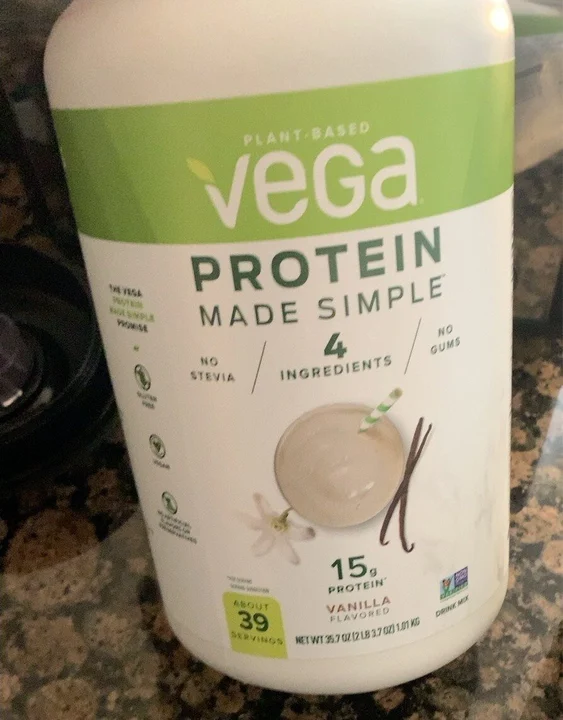
Check a powder for the grass blends, oats and flavors from the table above; the maker’s page and the full ingredient list both matter. Orgain’s plant-based vanilla bean protein page lists “Vegan, Gluten-free”26. Alani Nu’s FAQ says all of its products are gluten-free excluding Munchies Whey Protein27, which is why you read the product, not the brand. The Muscle Milk and Gatorade statements above cover their powders as well as their shakes24, 25.
- If the powder is a “greens” or grass blend, check which grass and whether the maker says how it was harvested and processed11.
- If it lists oats, look for a gluten-free claim on the pack: oats labeled gluten-free must contain less than 20 ppm gluten7.
- If the flavor is “natural flavors”, the maker’s statement is the check: the Gluten Intolerance Group says that on a product not labeled or certified gluten-free a natural flavor could be made with yeast extract grown on barley15, and that wheat in a natural flavor in an FDA-regulated product must be stated on the label16.
Also in our guides: hidden sources of gluten and our verdict for soy lecithin.
Energy drinks: what each maker’s page says
| Maker | What the page says |
|---|---|
| Celsius | Its FAQ lists “Gluten Free” among the drink’s key attributes28. |
| Alani Nu | “All of our products are gluten-free, excluding Munchies Whey Protein.”27 |
| Red Bull | Red Bull Energy Drink “is manufactured to be gluten-free, lactose-free and dairy-free”, in other words it contains no ingredients derived from gluten or dairy29. The statement names Red Bull Energy Drink. |
| Rockstar Energy | It does not currently make gluten-free label claims, and none of its ingredients are derived from grains or flours linked to gluten sensitivity30. |
| Zevia | Says all its products are gluten-free and certified by the Gluten Intolerance Group31. |
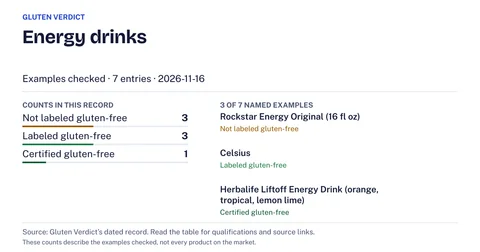
The five pages use four different kinds of statement: a gluten-free statement (Celsius, Alani Nu), a statement about how the drink is manufactured (Red Bull), an ingredient statement with no claim (Rockstar) and a third-party certification (Zevia)28, 27, 29, 30, 31. A certification is the kind a certifier’s directory can also be checked against (see the last section)37.
For brands we have checked, our verdicts are in one place: energy drinks, Monster and Red Bull.
Kombucha: tea, sugar, a culture and the flavor added
TTB says “kombucha” generally refers to a fermented beverage made from steeped tea and sugar combined with a culture of yeast strains and bacteria, with fruit juice or other flavors added in some products17. The part of the label to read is whatever is added for flavor.
FDA says fermentation is not considered a process to remove gluten, and that conventional analytical methods may not accurately detect and quantify gluten in fermented foods4. So the ingredient list and the maker’s statement carry the weight.
| Maker and page | What it says |
|---|---|
| GT's Classic Kombucha Original | The page lists the ingredients as kombucha culture, black tea, green tea and cane sugar32. |
| Health-Ade (Pink Lady Apple page) | Every flavor contains organic black and green tea, water, organic cane sugar, live kombucha cultures and acids from fermentation, and each flavor adds juice or extracts from organic produce33. A banner on the page repeats “Non-GMO • Vegan • Gluten-Free • Organic”34, and GFCO’s directory lists Health-Ade kombucha (see the last section)40. |
| Brew Dr. Kombucha | Its FAQ says all of its flavors are USDA Certified Organic, non-GMO, gluten free, vegan and kosher35. |
Who regulates it: FDA or TTB
Kombucha at or above 0.5% alcohol by volume at any time during production, at bottling or afterward is an alcohol beverage under TTB’s rules18. Kombucha that is never at or above that level must comply with FDA regulations19. For alcohol, TTB authorizes “gluten-free” if the product would be entitled to the claim under FDA’s definition20. Our alcohol guide covers the rest.
Sports and electrolyte drinks
The Celiac Disease Foundation says most beverages are gluten-free, including juices, sodas and sports drinks13. “Most” is not “all”, and makers word it differently. Gatorade’s FAQ says its ready-to-drink Gatorade has not been tested to be gluten-free, as it says of its Recover shakes above25. Powerade’s FAQ answers “Is POWERADE gluten free?” with “Yes”36.
Reading a certifier directory entry
The Gluten-Free Certification Organization (GFCO) runs a Product Finder. It says products are considered certified if they appear on its list and carry one of its certification marks37, and that a product on the list whose packaging does not carry the mark is not certified38. So the directory and the pack have to agree.
A search that returns nothing is not a finding about the drink. On 2026-11-17 a search for “Celsius” returned “No products found”39, which says that search found no listing, and nothing more; Celsius’s own page makes its claim28. A search for “kombucha” returned a first page of 25 Health-Ade products40.
How to do the check step by step: check a gluten-free seal in a certifier directory.
Verdicts in this guide
 Protein powderDepends on the productchecked Nov 16, 2026
 Energy drinksDepends on the productchecked Nov 16, 2026
 Monster EnergyNot labeled gluten-freeMonster Beverage Corporation · checked Nov 16, 2026
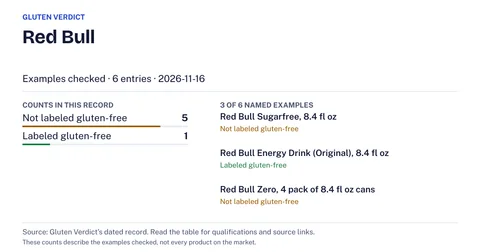 Red BullLabeled gluten-freeRed Bull · checked Nov 16, 2026
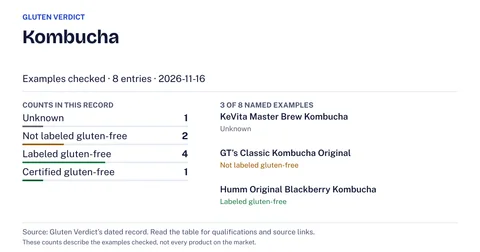 KombuchaDepends on the productchecked Nov 16, 2026
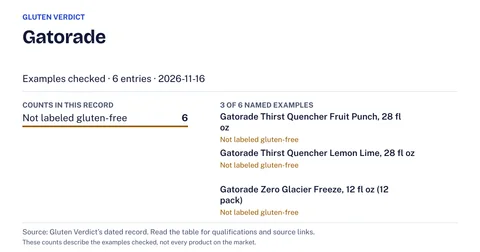 GatoradeNot labeled gluten-freePepsiCo · checked Nov 16, 2026
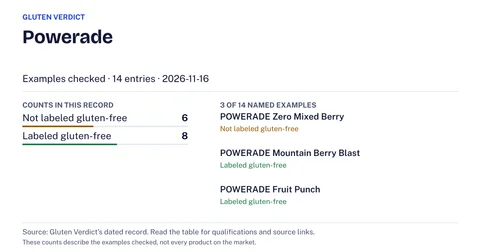 PoweradeLabeled gluten-freeThe Coca-Cola Company · checked Nov 16, 2026
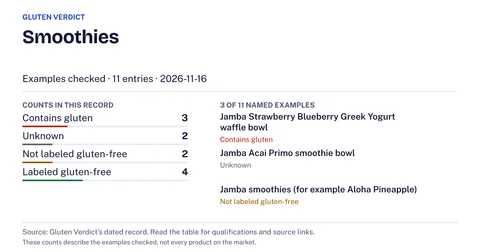 SmoothiesDepends on the product3 of 11 products we checked contain gluten: Jamba Strawberry Blueberry Greek Yogurt waffle bowl, Planet Smoothie Mountain Man Crunch, and Planet Smoothie Cookie Crusherchecked Nov 16, 2026
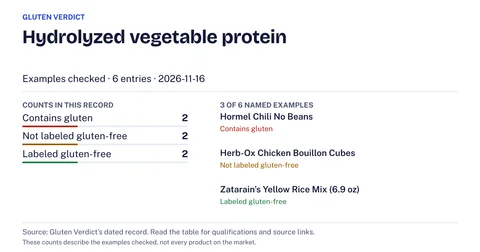 Hydrolyzed vegetable proteinDepends on the product2 of 6 products we checked contain gluten: Hormel Chili No Beans and Pioneer Brown Gravy Mix (1.61 oz)checked Nov 16, 2026
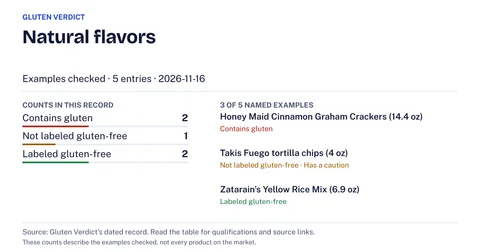 Natural flavorsDepends on the product2 of 5 products we checked contain gluten: Honey Maid Cinnamon Graham Crackers (14.4 oz) and Chex Mix Sour Cream & Onionchecked Nov 16, 2026
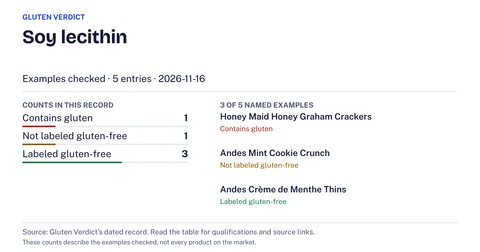 Soy lecithinUnknown1 of 5 products we checked contains gluten: Honey Maid Honey Graham Crackerschecked Nov 16, 2026
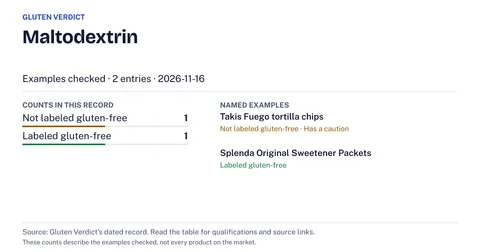 MaltodextrinNaturally gluten-freechecked Nov 16, 2026
Questions people ask
Are energy drinks gluten-free?
It depends on the drink. Celsius, Alani Nu, Red Bull Energy Drink and Zevia state gluten-free on their own pages, while Rockstar says it does not make gluten-free label claims28, 27, 29, 31, 30.
Is kombucha gluten-free?
Kombucha is made from tea, sugar and a culture, and some products add fruit juice or other flavors17. GT’s Classic Original lists culture, teas and cane sugar32, and Health-Ade’s page banner lists “Gluten-Free” and Brew Dr. says all its flavors are gluten free34, 35. Read the bottle you are buying.
Does a protein shake with no gluten-free claim contain gluten?
Not necessarily. Muscle Milk says it makes no gluten-free label claims and that none of the ingredients in its powders or shakes are derived from grains or flours linked to gluten sensitivity24, and Gatorade says its Recover shakes have not been tested to be gluten-free25. The ingredient list and the maker’s page are the check.
Does fermentation remove gluten from kombucha?
FDA says fermentation is not considered a process to remove gluten4.
More in Drinks and alcohol
 Wheatgrass, green powders and smoothie add-ins: what to check for glutenHow to check wheatgrass, barley grass, green powders, granola, cookie pieces and protein boosts for gluten on a smoothie menu or label.
 How to look up an alcohol label in TTB’s COLA registryAlcohol labels need not list every ingredient. How to find a bottle in TTB’s COLA registry, what it shows, and what the allergen rules do and do not cover.
 Reading the label of a flavored syrup, sauce or cookie topping for glutenHow to read coffee and bar syrup, sauce and cookie-topping labels for gluten, and what Torani, Monin and DaVinci Gourmet say on their own pages.
 Gluten in coffee-shop drinks: milk, syrups, toppings and shared toolsTake a coffee-shop drink apart: base, milk, syrup, topping and shared tools. See which label or maker page to read for each part.
 Non-alcoholic beer, kvass and malta: what the grain means for glutenHow non-alcoholic beer, kvass and malta are made, what US labels let them say about alcohol and gluten, and what to check on each can or bottle.
 Liqueurs and cream liqueurs: what a maker’s page can and cannot tell youSplit a liqueur into base spirit, flavors, sugar and cream, read what each maker’s own page says about gluten, and know what to ask when it says nothing.
Related guides
 How to check a gluten-free seal in the certifier's own directorySearch GFCO's Product Finder by brand, product or UPC, read what an entry shows, and learn what a missing listing means for the seal on your pack.
 Where wheat, barley and rye hide in processed food: 15 places to checkFifteen processed foods where wheat, barley or rye turn up, the label step that catches each, and what US allergen law does and does not flag.
 Are vitamins gluten-free? What a bottle’s claim, mark and ingredient list showWhat “gluten-free” on a vitamin bottle rests on (FDA rule, certifier listing or nothing) and how to read Other Ingredients for binders and fillers.
 Gluten-free fuel for training and race day: gels, bars, protein powder and aid stationsHow to check gels, chews, bars, protein powder and drinks for gluten, read sport-certification marks, and plan aid-station and pre-race food.
Sources
- [1, 2, 3, 4, 5, 6, 7, 8] US Food and Drug Administration, Questions and Answers on the Gluten-Free Food Labeling Final Rule, checked Nov 17, 2026.
- [9] National Institute of Diabetes and Digestive and Kidney Diseases (NIDDK), Eating, Diet, & Nutrition for Celiac Disease, checked Nov 17, 2026.
- [10] National Institute of Diabetes and Digestive and Kidney Diseases (NIDDK), Definition & Facts for Celiac Disease, checked Nov 17, 2026.
- [11, 12, 13] Celiac Disease Foundation, Gluten-Free Foods, checked Nov 17, 2026.
- [14] Gluten Intolerance Group, Are maltose and maltodextrin gluten-free?, checked Nov 17, 2026.
- [15, 16] Gluten Intolerance Group, Are natural flavors a concern if I’m gluten-free?, checked Nov 17, 2026.
- [17, 18, 19] Alcohol and Tobacco Tax and Trade Bureau (TTB), Kombucha, checked Nov 17, 2026.
- [20] Alcohol and Tobacco Tax and Trade Bureau (TTB), TTB Ruling 2020-2: Gluten Content Statements in the Labeling and Advertising of Wine, Distilled Spirits, and Malt Beverages, checked Nov 17, 2026.
- [21] Abbott (Ensure), Nutrition Questions & Answers | Ensure, checked Nov 17, 2026.
- [22] fairlife, Frequently Asked Questions, checked Nov 17, 2026.
- [23] Premier Protein, Frequently Asked Questions, checked Nov 17, 2026.
- [24] Muscle Milk (PepsiCo), Muscle Milk FAQs, checked Nov 17, 2026.
- [25] Gatorade (PepsiCo), FAQs, checked Nov 17, 2026.
- [26] Orgain, Organic Protein Plant Based Protein Powder, Vanilla Bean, checked Nov 17, 2026.
- [27] Alani Nu, FAQ, checked Nov 17, 2026.
- [28] Celsius, Frequently Asked Questions, checked Nov 17, 2026.
Read on 2026-11-17: the answer to “Why is CELSIUS a better alternative to other traditional, sugary energy drinks?” lists “Gluten Free” among its KEY ATTRIBUTES, beside No Sugar, Kosher and Soy Free.
- [29] Red Bull, Is Red Bull Energy Drink gluten-free, lactose-free and dairy-free?, checked Nov 17, 2026.
- [30] Rockstar Energy, FAQ, checked Nov 17, 2026.
- [31] Zevia, FAQs, checked Nov 17, 2026.
- [32] GT's Living Foods, GT's Classic Kombucha Original, checked Nov 17, 2026.
- [33, 34] Health-Ade, Pink Lady Apple Kombucha, checked Nov 17, 2026.
Read on 2026-11-17: a banner under the “Real Fruit Juice” heading repeats “Non-GMO • Vegan • Gluten-Free • Organic”; it is a page-wide banner, not a statement written for this one flavor.
- [35] Brew Dr. Kombucha, Brew Dr. Kombucha FAQ, checked Nov 17, 2026.
- [36] The Coca-Cola Company (Powerade), Powerade FAQs, checked Nov 17, 2026.
Read on 2026-11-17: the FAQ entry “Is POWERADE gluten free?” is answered “Yes”, with no further wording.
- [37, 38] Gluten-Free Certification Organization, GFCO Product Finder, checked Nov 17, 2026.
- [39] Gluten-Free Certification Organization, GFCO Product Finder search: Celsius, checked Nov 17, 2026.
Read the GFCO Product Finder results for the search “Celsius” on 2026-11-17: the results table showed “No products found”.
- [40] Gluten-Free Certification Organization, GFCO Product Finder search: kombucha, checked Nov 17, 2026.
Read the GFCO Product Finder results for the search “kombucha” on 2026-11-17: the first page of results (page 1 of 2) lists 25 products, all Health-Ade kombucha, among them “Organic Pink Lady Apple Kombucha (16 fl oz)”.