What to use instead of soy sauce when you eat gluten-free
Short answer
Soy sauce is ordinarily made by fermenting soybeans and wheat1, so look for a replacement whose own label or maker says gluten-free: a tamari or soy sauce marked that way, coconut aminos, or liquid aminos2, 3, 4, 5. The word “tamari” alone does not settle it, because formulations vary by brand6.
Part of Hidden gluten in ingredients, sauces and processed foods, 21 guides
Key points
- Regular soy sauce is out: FDA says it is ordinarily made with soybeans and wheat, and Beyond Celiac advises anyone with celiac disease or gluten sensitivities to eat only soy sauce labeled gluten-free1, 7.
- Beyond Celiac calls tamari the most common gluten-free substitute for soy sauce52, but it says formulations vary by brand and San-J says some tamari brands can contain wheat, so the gluten-free statement is what to look for6, 8.
- Coconut aminos contain no soy or wheat; tamari and liquid aminos are made from soybeans9, 10, 11.
- Swapping the sauce does not fix the rest of the plate: ramen and udon noodles are made with wheat flour, and tempura is not traditionally gluten-free12, 13.
Why regular soy sauce is out
FDA says soy sauce is ordinarily made by fermenting a mixture of soybeans and wheat, and that in general a soy sauce made from soybeans and wheat, or any other gluten-containing grain, may not carry a “gluten-free” claim1. Kikkoman says it brews its traditional soy sauces from wheat, soybeans, salt and water14.
Beyond Celiac says wheat is a primary ingredient in soy sauce, and advises that anyone with celiac disease or gluten sensitivities eat only soy sauce that is labeled gluten-free7. The Celiac Disease Foundation lists soy sauce among foods that must be verified by reading the label or checking with the manufacturer15, 16.
For the bottles we have read, see our soy sauce verdict.
Is tamari gluten-free? Why the label decides
Beyond Celiac describes tamari as a Japanese-style soy sauce made primarily from fermented soybeans, typically with little or no wheat, and says it works as a 1:1 substitute in most recipes17. San-J, which sells a tamari, says shoyu is typically brewed with about equal parts soybeans and wheat, while tamari is brewed with all soybeans or only very small amounts of wheat18.
The “little or no” is the catch. Beyond Celiac says most tamari is made without wheat but formulations vary by brand, so check that the product is labeled gluten-free before buying6. San-J says some tamari brands can contain wheat8. The Celiac Disease Foundation words it conditionally: tamari made without wheat is gluten-free16.
FDA’s rule gives the claim its meaning. A soy sauce not made using wheat or any other gluten-containing grain can carry a gluten-free claim19. FDA also says fermentation is not a process that removes gluten and that conventional test methods may not accurately detect gluten in fermented foods20; a maker of a fermented food that carries a gluten-free claim must make and keep records that give adequate assurance of several things, including that the food had less than 20 ppm gluten before fermentation or hydrolysis21. So look for the claim itself, not just the word “tamari”.
“Wheat-free” is a different statement. The Celiac Disease Foundation says products labeled wheat-free are not necessarily gluten-free22.
What the makers’ own pages say
These are statements from each maker’s page, read on 17 November 2026, not our testing. Formulas change, so the bottle in your hand has the final word.
| Product | Ingredients listed on the page | Gluten-free statement on the page |
|---|---|---|
| San-J Gluten Free Tamari Soy Sauce | Water, soybeans, salt, alcohol10 | Calls it verified by the Gluten-Free Certification Organization23 |
| Kikkoman Gluten-Free Tamari Soy Sauce (Non-GMO) | Water, soybeans, salt and sugar2 | Certified gluten-free by the Gluten Intolerance Group (GIG)2 |
| Kikkoman Gluten-Free Soy Sauce | Water, soybeans, rice and salt, with rice in place of wheat3 | Certified gluten free by the Gluten Intolerance Group of North America (GIG)3 |
| Yamasa Tamari Organic Gluten-Free | Water, organic soybeans, salt, organic alcohol24 | Lists “Gluten-Free” among its descriptors25 |
| Nutiva Organic Original Coconut Aminos (Coconut Secret is now Nutiva26) | Organic coconut tree sap, sea salt27 | Says it has no soy or gluten4 |
| Bragg Liquid Aminos | Vegetable protein from soybeans, water11 | Calls it a gluten-free seasoning5 |
Kikkoman also sells a regular soy sauce brewed with wheat14, so read the product name on the bottle: the gluten-free ones are separate products. Gluten Intolerance Group says traditional soy sauce contains wheat and that tamari soy sauce is now widely available from a variety of well-known brands28. Its page on Asian cuisine offers “a selection of GFCO-certified gluten-free soy sauce” from Iron Chef, Kikkoman, Lee Kum Kee, Pekin, San-J, TH Foods and Yasama, as it spells them29. Check the specific bottle, not just the brand.
Coconut aminos: no wheat and no soy
Beyond Celiac says coconut aminos are made from the fermented sap of coconut palm trees and contain no soy or wheat, with a slightly sweeter, milder flavor than soy sauce or tamari, which makes them a good option for people avoiding both gluten and soy9. The maker’s page lists two ingredients: organic coconut tree sap and sea salt27.
Beyond Celiac still advises checking the label on any packaged product to make sure it is gluten-free30.
Liquid aminos: gluten-free where the maker says so, and made from soybeans
Bragg describes its Liquid Aminos as a savory, vegan, gluten-free seasoning made from non-GMO verified soybeans5, lists vegetable protein from soybeans and water as the ingredients11, and tells you to use it as a gluten-free stand-in for soy sauce31. Another brand sold as “liquid aminos” is a different product, so apply the same test: the maker’s gluten-free statement.
Tamari and liquid aminos both start from soybeans10, 11, 17, and San-J’s tamari page says the product contains soy ingredients32. Coconut aminos contain no soy9.
What changes in taste, saltiness and cooking
Tamari: Beyond Celiac says it has a richer, deeper flavor than traditional soy sauce and works as a 1:1 substitute in most recipes17. San-J says the taste of its tamari does not flash off when heated33. Kikkoman says its gluten-free soy sauce delivers the same rich, savory taste and umami flavor as its traditional soy sauce34.
Coconut aminos: the maker says they can be a direct 1:1 replacement in any recipe, and that with less sodium and a slightly sweeter profile you may want to adjust the seasoning to taste35.
Sodium: the serving sizes printed on these pages differ, so compare like with like. San-J lists 980 mg of sodium per 1 Tbsp (18 g)36. Kikkoman lists 980 mg per 1 Tbsp for its tamari37 and 960 mg per 1 Tbsp for its gluten-free soy sauce38. Bragg lists 310 mg per 1 tsp39. Nutiva says its coconut aminos have far less sodium than the leading soy sauce brand and puts the difference at 72%, without naming that brand on the page40.
The flavor and cooking notes here are the makers’ and Beyond Celiac’s; we have not cooked with these products.
Sushi, ramen and stir-fry: the swap and the questions
Sushi
Beyond Celiac lists soy sauce as an area of concern in sushi, because most soy sauces are made with wheat, and names gluten-free tamari or coconut aminos as alternatives41. It also says to watch for rolls that include soy sauce in their preparation, marinated eel (unagi) or other fish, and fried or breaded ingredients such as tempura42.
Beyond Celiac says it is always best to reach out to the restaurant or chef ahead of time to discuss which rolls or sashimi are gluten-free43. The BIDMC Celiac Center’s handout for Japanese restaurants says to avoid the soy sauce unless it is gluten-free44, and its advice for Chinese restaurants is to bring your own gluten-free soy sauce or other gluten-free sauces45.
More on what to ask: our sushi and Japanese restaurant ordering guide, and the verdicts for sushi, poke and edamame.
Ramen and Japanese cooking at home
Gluten Intolerance Group says soy sauce (shoyu) is a condiment that contains wheat unless otherwise noted, and to use a gluten-free version or tamari instead46. The sauce is only part of a ramen or udon bowl: the same page says udon, somen and ramen noodles are made with wheat flour12, and that tempura and karaage are not traditionally gluten-free13.
Stir-fry and restaurant Asian food
At home, a 1:1 swap with tamari or coconut aminos is what the sources above describe, with seasoning adjusted for coconut aminos17, 35. At a restaurant, Beyond Celiac advises asking the staff whether the dish includes soy sauce and, if it does, making sure it is gluten-free47. Our Chinese restaurant ordering guide goes further.
Other soy-based sauces to check next
A new bottle of soy sauce does not clean up the rest of the pantry. The BIDMC handout’s avoid list for Chinese restaurants names soy sauce (unless labeled gluten-free), oyster sauce and hoisin sauce48, and its Japanese list names teriyaki49. Gluten Intolerance Group says miso made with barley must be avoided50, and the Celiac Disease Foundation lists salad dressings and marinades that may contain soy sauce51.
Verdicts in this guide
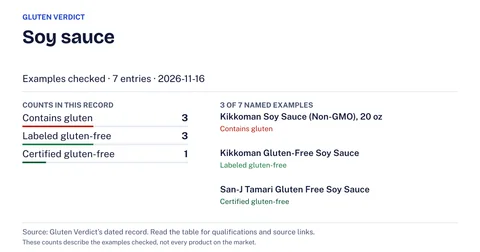 Soy sauceDepends on the product3 of 7 products we checked contain gluten: Kikkoman Soy Sauce (Non-GMO), 20 oz; San-J Organic Shoyu Soy Sauce; and Lee Kum Kee Premium Soy Sauce (No Preservatives Added)checked Nov 16, 2026
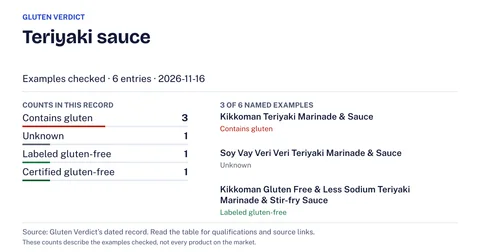 Teriyaki sauceDepends on the product3 of 6 products we checked contain gluten: Kikkoman Teriyaki Marinade & Sauce, Kikkoman Teriyaki Marinade & Stir-fry Sauce – Roasted Garlic, and Kikkoman Teriyaki BBQ Sauce – Originalchecked Nov 16, 2026
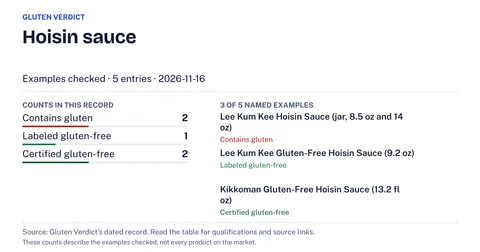 Hoisin sauceDepends on the product2 of 5 products we checked contain gluten: Lee Kum Kee Hoisin Sauce (jar, 8.5 oz and 14 oz) and Kikkoman Hoisin Sauce (9.3 oz)checked Nov 16, 2026
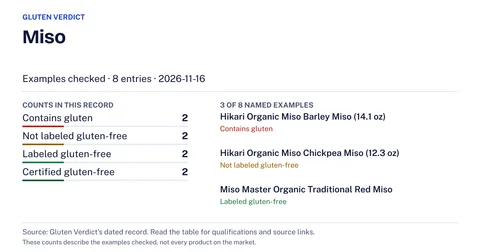 MisoDepends on the product2 of 8 products we checked contain gluten: Hikari Organic Miso Barley Miso (14.1 oz) and Hikari Miso Soup Akadashi (12 servings, 7.0 oz)checked Nov 16, 2026
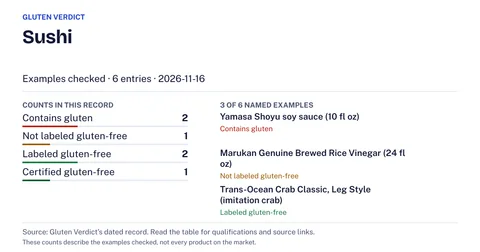 SushiDepends on the product2 of 6 products we checked contain gluten: Yamasa Shoyu soy sauce (10 fl oz) and Lee Kum Kee Less Sodium Soy Saucechecked Nov 16, 2026
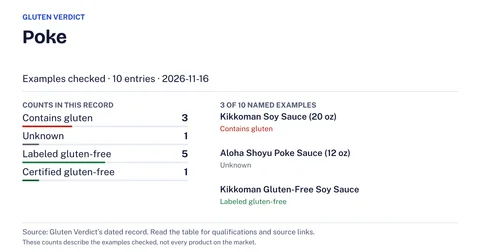 PokeDepends on the product3 of 10 products we checked contain gluten: Kikkoman Soy Sauce (20 oz), Pokeworks Umami Shoyu sauce, and Pokeworks Seaweed Salad toppingchecked Nov 16, 2026
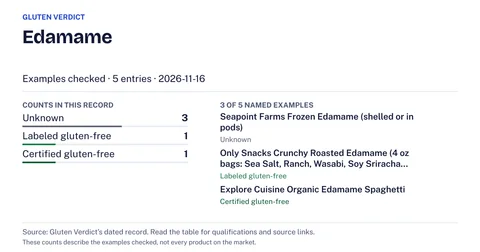 EdamameNaturally gluten-freechecked Nov 16, 2026
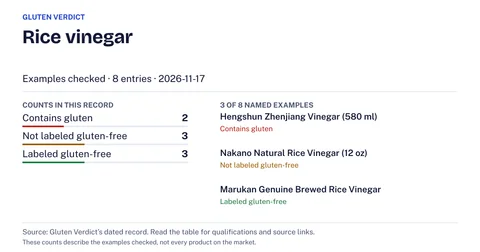 Rice vinegarDepends on the product2 of 8 products we checked contain gluten: Hengshun Zhenjiang Vinegar (580 ml) and Gold-Plum Chinkiang Vinegar (18.6 fl oz)checked Nov 17, 2026
Questions people ask
Is tamari always gluten-free?
No. Beyond Celiac says most tamari is made without wheat but formulations vary by brand, so check that the product is labeled gluten-free6.
Are coconut aminos gluten-free?
Beyond Celiac says they contain no soy or wheat9, and Nutiva’s page lists organic coconut tree sap and sea salt27. Beyond Celiac still advises checking the label30.
Can I swap coconut aminos for soy sauce one to one?
The maker says yes in any recipe, adjusting to taste because it has less sodium and a slightly sweeter profile35.
Is “wheat-free” soy sauce the same as gluten-free?
No. The Celiac Disease Foundation says products labeled wheat-free are not necessarily gluten-free22.
More in Hidden gluten in ingredients, sauces and processed foods
 Soy, hoisin, oyster, teriyaki and fish sauce: which bottles carry wheatSoy, hoisin, oyster, teriyaki and fish sauce compared by the ingredient lists of Kikkoman, Lee Kum Kee, San-J and Red Boat, plus what to ask at a counter.
 BBQ sauce, dry rub and marinade labels: which state gluten-free and which list wheatSort a BBQ sauce, dry rub or marinade label into three groups: maker states gluten-free, no grain listed, or wheat listed.
 Miso, gochujang and other fermented pastes: where barley and wheat are usedHow to pick a miso or gochujang jar: read the koji grain, the full ingredient list and the maker’s gluten-free statement.
 Gravy, jarred pasta sauce and cheese sauce: where flour and starch thicken the potHow to read a gravy packet, gravy jar, cheese sauce or pasta sauce for wheat flour, wheat gluten and starch, with maker pages read on 2026-11-17.
 Plant-based meat, tofu and seitan: finding the wheat glutenSeitan and some meat substitutes are made from wheat gluten. How to spot it on a plant-based label, with ingredient lists from maker pages.
 Hydrolyzed protein, yeast extract and wheat starch on a US food labelWhich grain is behind hydrolyzed protein, yeast extract and wheat starch, what a US label must name, and what to ask the maker.
All 21 guides in Hidden gluten in ingredients, sauces and processed foods
Related guides
 Gluten-free substitutes: the swap for each wheat ingredient and the label check it needsA lookup table of gluten-free swaps for wheat flour, pasta, bread, soy sauce, beer and more, with the one label check each swap needs.
 Ordering sushi and Japanese food when you avoid glutenWhich sushi, ramen and hibachi items carry wheat, what to ask about soy sauce, imitation crab, tempura and shared fryers, and a first-visit order.
 Gluten-free in Japan: soy sauce, miso, barley tea and the allergen boxWhat to check in Japan: wheat in soy sauce, barley in miso and barley tea, and what the Japanese allergen box covers and leaves out.
 Reading a US label for gluten and another food allergyHow to read a US food label for gluten and a second allergen: what the Contains line, gluten-free claim and may-contain lines each cover.
Sources
- [1, 19, 20, 21] US Food and Drug Administration, Questions and Answers on the Gluten-Free Food Labeling Final Rule, checked Nov 17, 2026.
- [2, 14, 37] Kikkoman USA, Gluten-Free Tamari Soy Sauce (Non-GMO), checked Nov 17, 2026.
Read on 2026-11-17: the Nutrition Facts panel on the page gives serving size 1 Tbsp (15mL) and sodium 980mg.
- [3, 34, 38] Kikkoman USA, Gluten-Free Soy Sauce, checked Nov 17, 2026.
Read on 2026-11-17: the Nutrition Facts panel on the page gives serving size 1 Tbsp (15mL) and sodium 960mg.
- [4, 26, 27, 35, 40] Nutiva (Coconut Secret), Organic Original Coconut Aminos, checked Nov 17, 2026.
- [5, 11, 31, 39] Bragg, Liquid Aminos, checked Nov 17, 2026.
Read on 2026-11-17: the Nutrition Facts panel on the page for the 6oz bottle gives serving size 1 tsp and sodium 310mg.
- [6, 7, 9, 17, 30, 47, 52] Beyond Celiac, Is Soy Gluten-Free?, checked Nov 17, 2026.
- [8, 18] San-J, Is Soy Sauce Gluten Free?, checked Nov 17, 2026.
- [10, 23, 32, 33, 36] San-J, Gluten Free Tamari Soy Sauce, checked Nov 17, 2026.
Read on 2026-11-17: the Nutrition Facts panel on the page gives serving size 1 Tbsp. (18g) and sodium 980mg.
- [12, 13, 46, 50] Gluten Intolerance Group, Japanese Cuisine When You’re Eating Gluten-Free, checked Nov 17, 2026.
- [15, 16, 22, 51] Celiac Disease Foundation, Sources of Gluten, checked Nov 17, 2026.
- [24, 25] Yamasa Corporation USA, Yamasa Tamari Organic Gluten-Free, checked Nov 17, 2026.
- [28, 29] Gluten Intolerance Group, Explore Asian Cuisine – Gluten-Free, checked Nov 17, 2026.
Read on 2026-11-17: the list under “You can choose from a selection of GFCO-certified gluten-free soy sauce for:” names Iron Chef, Kikkoman, Lee Kum Kee, Pekin, San-J, TH Foods and Yasama (spelled that way on the page).
- [41, 42, 43] Beyond Celiac, Is Sushi Gluten-Free?, checked Nov 17, 2026.
- [44, 45, 48, 49] BIDMC Celiac Center (Beth Israel Deaconess Medical Center), Dining Out With Celiac Disease Tips (CeliacNow handouts), checked Nov 17, 2026.