Feeling worse after going gluten-free: what the sources say to check first
Short answer
Clinical sources describe symptoms improving within days to weeks of starting a gluten-free diet1, 2, but Coeliac UK calls ongoing symptoms quite common and says most of the time gluten is still getting into the diet3, 4. None of the clinical pages we read describes a “gluten withdrawal” phase5, 6. Those sources are about people with celiac disease, and Coeliac UK and NIDDK both point readers with ongoing symptoms to a clinician7, 53.
Part of Newly diagnosed: the first weeks, 8 guides

Key points
- NIDDK says many people see symptoms improve within days to weeks, and also that some symptoms take longer than others1, 9.
- Ongoing symptoms are not rare: Coeliac UK says they affect around 1 in 3 people, NIDDK says about 20 percent of people with celiac disease; these are the two sources’ own figures3, 10.
- NIDDK lists additives such as modified food starch and malt flavoring among hidden sources of gluten11.
- Other conditions can cause the same symptoms: NIDDK names irritable bowel syndrome, lactose intolerance, microscopic colitis, pancreas problems and small intestinal bacterial overgrowth12.
- Coeliac UK says to speak to your healthcare team if symptoms have not improved or have got worse since starting the diet8.
What do the clinical sources say about feeling no better, or worse?
NIDDK says many people see symptoms improve within days to weeks of starting the diet1. Coeliac UK’s page for clinicians says most people with coeliac disease report a rapid improvement and that symptoms usually improve within a few weeks2. NIDDK adds that some symptoms take longer to get better than others, and some need additional help9.
Not everyone follows that pattern. Coeliac UK uses “non responsive” for people who do not feel better after starting the diet, or who feel better at first and then have symptoms again13. It calls ongoing symptoms quite common, around 1 in 3 people3; NIDDK puts it at about 20 percent of people with celiac disease10. We have not reconciled the two figures, so each is given as that source’s own.
The American College of Gastroenterology’s 2023 guideline uses the same idea: its abstract defines nonresponsive celiac disease as persistent or recurrent symptoms despite being on a gluten-free diet, and says most patients have an excellent clinical response14, 15.
All of these sources are about people with celiac disease. NIDDK says doctors do not recommend starting a gluten-free diet before diagnostic testing, because the diet can affect test results16. Whether any of this applies to you is a question for your own clinician.
Is it “gluten withdrawal”?
We looked for a clinical source that describes a gluten withdrawal syndrome, or a timeline for one, and did not find it. NIDDK’s Treatment page and Coeliac UK’s page on non-responsive disease both discuss what happens after starting the diet5, 6, and neither describes a withdrawal syndrome or a timeline for feeling worse.
That is not proof that nothing of the kind happens. It means we have no source to report, so this page gives no timeline. In the research literature the phrase also has a plainer meaning: one study’s abstract uses “gluten withdrawal” for taking gluten out of the diet17.
That same study looked at a different question in a different group. It was a double-blind crossover challenge of 59 people on a self-instituted gluten-free diet, with celiac disease excluded18. The authors found that fructans induced symptoms19, and they note that foods with gluten often contain fructans20. It is one study in people with self-reported non-celiac gluten sensitivity17. Its participants were already on a gluten-free diet18, so it is not a study of people who have just stopped gluten.
Which hidden sources of gluten can you check yourself?
Coeliac UK says that most of the time, ongoing symptoms on the diet are because gluten is still getting into it4. NIDDK says that if symptoms continue or come back after you start the diet, you may still be eating or drinking a small amount of gluten21, and that symptoms may return if a person consumes small amounts of gluten22.
NIDDK names these hidden sources: additives made with wheat, such as modified food starch, malt flavoring, preservatives and stabilizer11. It also says many food ingredients and additives, such as colorings, flavorings, starches and thickeners, are made from grains that contain gluten23, and that gluten may be found in candy, condiments, hot dogs and sausages, ice cream, salad dressing and soups24.
| Where to look | What the source says | Our verdict |
|---|---|---|
| Soy sauce | FDA: in general, when soy sauce is made from soybeans and wheat, or another gluten-containing grain, it may not bear a “gluten-free” claim25. | Soy sauce |
| Malt ingredients | FDA: malt extract and malt syrup are derived from barley that has not been processed to remove gluten26. | Malt extract · Malt vinegar |
| Soups and broths | NIDDK lists soups among the foods where gluten may be found24. | Soup · Chicken broth |
| Seasonings, spice blends and flavors | NIDDK says many food ingredients and additives, such as colorings, flavorings, starches and thickeners, are made from grains that contain gluten23. | Spices · Taco seasoning · Natural flavors |
| Protein additives | See our verdict for what FDA and the Gluten Intolerance Group say about its source. | Hydrolyzed vegetable protein |
NIDDK also says medicines are rare sources of gluten, and that if gluten is present in one it is likely to be in quantities too small to cause symptoms27. Recipes change, so the label on the package in your hand decides; see how to read a US food label for gluten and hidden sources of gluten.
Do oats, a shared toaster or kitchen tools matter?
FDA says oats labeled gluten-free must contain less than 20 ppm gluten, and that they do not have to be certified to carry the claim28. The Gluten Intolerance Group’s concern is that oats come into contact with gluten grains from the field to processing29. NIDDK says to talk with your doctor or a registered dietitian about whether to include oats in your diet and how much30.
Our verdicts show what the sources we read say for oatmeal, Cheerios and Quaker Instant Oatmeal. For the long version of the oats question, see gluten-free oats vs regular oats.
At home, NIDDK says cross-contact can occur at any time, including when foods are prepared31, and advises storing and preparing gluten-free foods separately from family members’ foods that contain gluten32. The Gluten Intolerance Group asks whether you need a whole new toaster, and says gluten crumbs can end up on your gluten-free bread33. It also says cross-contact can happen in your home kitchen34. Our kitchen setup guide and cross-contact guide go through the rest.
Can the new way of eating be the cause?
NIDDK says that if you start avoiding gluten without advice from a doctor or a registered dietitian, your diet may not provide enough of the nutrients you need, such as fiber, iron and calcium, and that some packaged gluten-free foods may be higher in fat and sugar than the same foods that contain gluten35. It says a registered dietitian will teach you how to avoid gluten while following a healthy diet36.
Neither NIDDK’s Treatment page nor Coeliac UK’s page on non-responsive disease mentions headache, fatigue or constipation5, 6, so we do not attribute any particular symptom to the change in diet. A clinician and a dietitian can say what, if anything, is down to it.
Which causes only a clinician can sort out?
The 2023 ACG abstract says people with nonresponsive disease need a systematic workup to rule out specific conditions, especially unintentional gluten contamination14. What the sources list:
- Other conditions and reasons for ongoing symptoms. NIDDK names irritable bowel syndrome, lactose intolerance, microscopic colitis, problems with the pancreas and small intestinal bacterial overgrowth12; Coeliac UK’s clinician page also lists inflammatory bowel disease, functional bowel disorders, giardiasis and a slow response to treatment37.
- Checking the diagnosis. Coeliac UK says that when non-responsive or refractory disease is suspected, the first step is usually an endoscopy with biopsy, and that one reason might be to make sure the diagnosis is correct38; NIDDK says a doctor may order tests to confirm the diagnosis and check for other health problems39.
- Gluten that is hard to spot. A 2025 review says inadvertent gluten intake is a leading cause and can be difficult to detect, and that measuring gluten immunogenic peptides in urine or stool can provide objective evidence of exposure40. The Gluten Intolerance Group says high antibody levels can indicate gluten exposure and incomplete healing41; NIDDK says antibody levels typically return to normal after treatment42.
- Slow healing. A 2022 review says persistent villous atrophy is common even after many years of a gluten-free diet43, and that low-level gluten intake is common despite strict attempts at adherence44.
- Nutrient levels. NIDDK says a doctor may test for low levels of certain vitamins and minerals45; Coeliac UK’s check-ups page lists iron, folate, vitamin B12, vitamin D and calcium among those to assess and monitor46.
- Refractory celiac disease. NIDDK describes it as a rare condition in which symptoms and damage continue or come back even on a strict gluten-free diet47, and Coeliac UK also calls it a rare complication48. A 2024 review separates it from nonresponsive disease in general, which it calls relatively common, generally attributed to persistent gluten exposure and resolving after correction of diet errors49; it adds that other complications and look-alike disorders need to be excluded50.
A 2022 review says that with systematic follow-up a cause is usually found51. Coeliac UK says a diagnosis of non-responsive disease needs a dietary assessment for ongoing gluten intake, a review of the original diagnosis and the exclusion of other conditions52.
What do the sources say should prompt a call to a clinician?
Coeliac UK says that if symptoms have not improved or have got worse since starting the gluten-free diet, speak to your healthcare team8. On ongoing symptoms, it says it is important not to guess the cause and to visit your local healthcare team7. NIDDK says to talk with your doctor or a registered dietitian, who can help you find the cause53.
Coeliac UK’s clinician page names persistent severe diarrhoea, abdominal pain and sudden unexplained weight loss as symptoms of refractory coeliac disease54, which it calls a rare complication48.
None of the pages we read gives a list of emergency signs for the first weeks of the diet55. What counts as urgent for you is a question for a clinician or your local emergency service, not for a web page.
What to bring to the appointment
NIDDK suggests keeping a food journal and talking with your doctor and a registered dietitian about your diet and the products you use that might contain gluten56. Coeliac UK says a review assesses your diet and adherence to the gluten-free diet57.
Our suggestion for what to write down, so the clinician sees what a review looks at:
- Each food and drink, with the brand and a photo of the ingredient list. Our gluten scanner reads a photo of a label or pasted text.
- Oats eaten, and which package they came from.
- Shared toaster, pans, cutting boards or oven used on the same day as gluten-containing food.
- New foods or substitutes you started that week.
- Symptoms, with the date and time they began and what you ate before.
- Medicines and supplements you take.
Verdicts in this guide
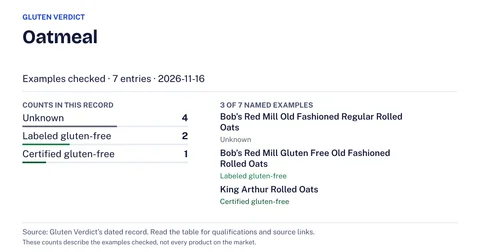 OatmealDepends on the productchecked Nov 16, 2026
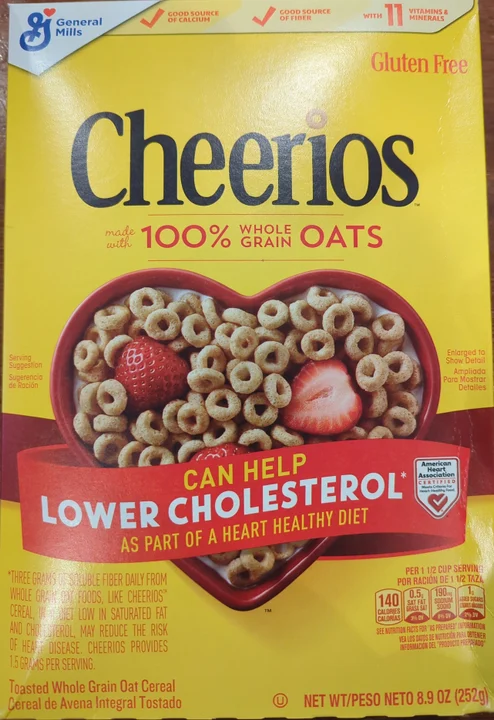 CheeriosLabeled gluten-freeWheat warning on 1 of 8 varieties we checkedGeneral Mills · checked Nov 16, 2026
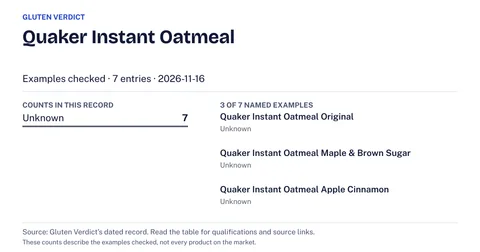 Quaker Instant OatmealUnknownThe Quaker Oats Company · checked Nov 16, 2026
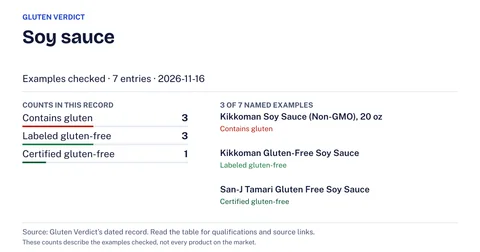 Soy sauceDepends on the product3 of 7 products we checked contain gluten: Kikkoman Soy Sauce (Non-GMO), 20 oz; San-J Organic Shoyu Soy Sauce; and Lee Kum Kee Premium Soy Sauce (No Preservatives Added)checked Nov 16, 2026
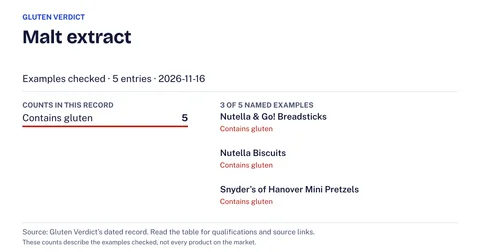 Malt extractContains glutenchecked Nov 16, 2026
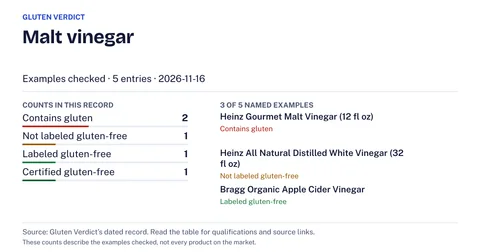 Malt vinegarContains glutenchecked Nov 16, 2026
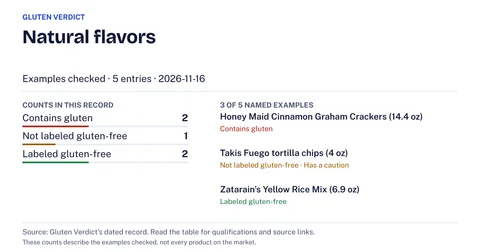 Natural flavorsDepends on the product2 of 5 products we checked contain gluten: Honey Maid Cinnamon Graham Crackers (14.4 oz) and Chex Mix Sour Cream & Onionchecked Nov 16, 2026
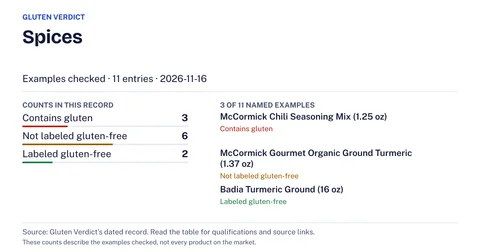 SpicesDepends on the product3 of 11 products we checked contain gluten: McCormick Chili Seasoning Mix (1.25 oz), Lawry’s Chili Spices & Seasonings Mix (1.48 oz), and McCormick Cheesy Taco Seasoning Mix (1.12 oz)checked Nov 16, 2026
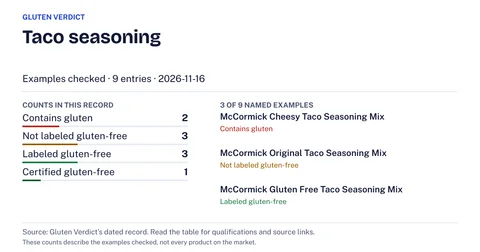 Taco seasoningDepends on the product2 of 9 products we checked contain gluten: McCormick Cheesy Taco Seasoning Mix and Lawry’s Taco Seasoning Mixchecked Nov 16, 2026
 SoupDepends on the product3 of 8 products we checked contain gluten: Campbell’s Condensed Tomato Soup (10.75 oz), Campbell’s Condensed Cream of Mushroom Soup (10.5 oz), and Progresso Traditional Chicken Noodlechecked Nov 16, 2026
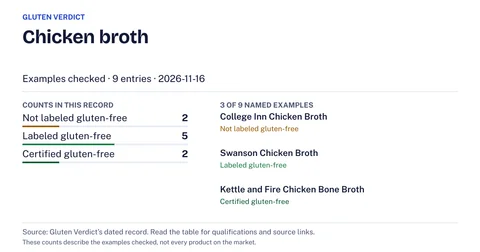 Chicken brothDepends on the productchecked Nov 16, 2026
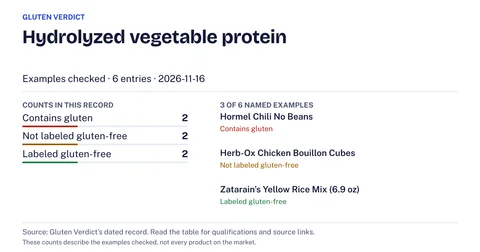 Hydrolyzed vegetable proteinDepends on the product2 of 6 products we checked contain gluten: Hormel Chili No Beans and Pioneer Brown Gravy Mix (1.61 oz)checked Nov 16, 2026
Questions people ask
How long does it take to feel better on a gluten-free diet?
NIDDK says many people see symptoms improve within days to weeks1, and Coeliac UK’s clinician page says symptoms usually improve within a few weeks2. NIDDK also says some symptoms take longer9. A 2022 review says persistent villous atrophy is common even after many years of a gluten-free diet43.
More in Newly diagnosed: the first weeks
 How long until you feel better on a gluten-free diet?What NIH, celiac charities and studies report on when symptoms, antibody levels and the gut lining recover after a celiac diagnosis, and why they differ.
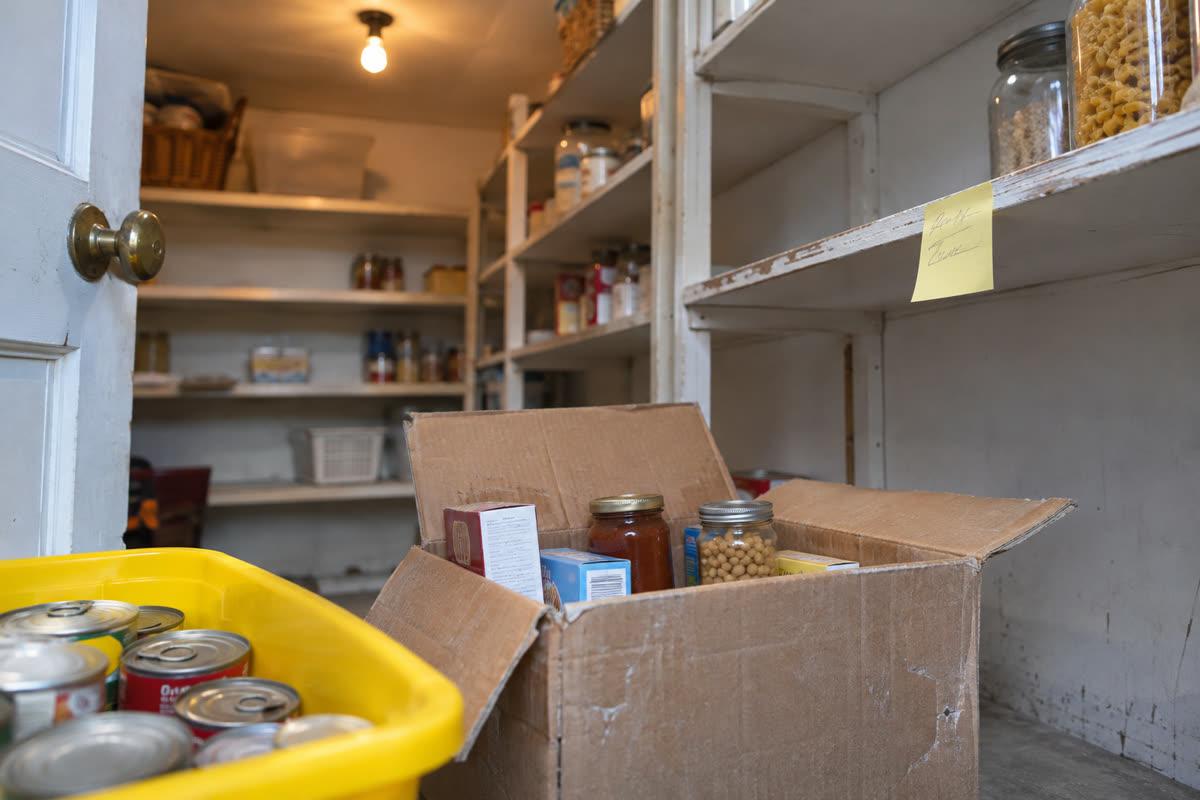 Going gluten-free: what to remove and what to keep in your pantry and kitchenSort a full pantry into foods to remove, labels to read and plain foods to keep, then decide on shared jars, toasters and pans.
 Starting a gluten-free diet: testing first, then labels, oats and the kitchenWhat NIH and the celiac charities say about starting a gluten-free diet: testing first, which foods to start with, a US label check, oats and the kitchen.
 Your first 30 days after a celiac diagnosis: a week-by-week planA week-by-week plan for the first month after a celiac diagnosis: label rules, kitchen changes, a dietitian, follow-up tests and questions for your doctor.
 Your first restaurant meal after a celiac diagnosisHow to pick a place, call ahead, ask the kitchen the right questions and decide what to do when answers are vague, for a first meal out.
 Grieving foods after a celiac diagnosis: what people describe and where to get helpSadness or anger about food after a celiac diagnosis: what charities and research report, small steps the sources name, and when to call a provider or 988.
Related guides
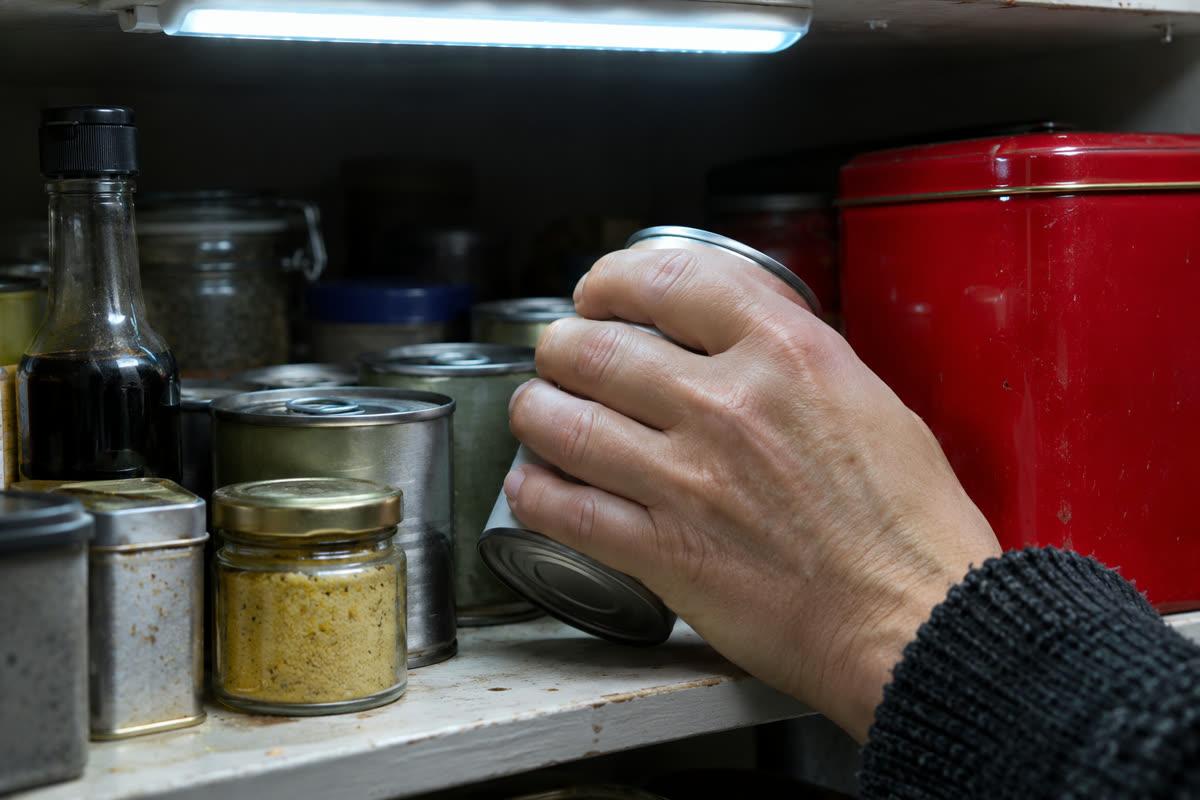 Where wheat, barley and rye hide in processed food: 15 places to checkFifteen processed foods where wheat, barley or rye turn up, the label step that catches each, and what US allergen law does and does not flag.
 Gluten cross-contact at home: where it happens and what to do about itHow gluten reaches gluten-free food at home, whether to separate, wash or ask for each route, and which rules have lab data behind them.
 Setting up a gluten-free kitchen: what to replace, wash or shareWalk each kitchen zone and decide, item by item, what to replace, what to wash and what a mixed household can keep sharing, with charity sources.
 Follow-up testing after a celiac diagnosis: what the guidelines listWhat celiac guidelines and charities list for follow-up: antibody checks, repeat biopsy, nutrient tests, and what is checked if symptoms continue.
Sources
- [1, 5, 9, 10, 11, 12, 21, 27, 36, 39, 42, 45, 47, 53, 55, 56] National Institute of Diabetes and Digestive and Kidney Diseases (NIH), Treatment for Celiac Disease, checked Nov 17, 2026.
Read on 2026-11-17: the page covers the gluten-free diet, follow-up and “What if a gluten-free diet isn't working?”. The words withdrawal, headache, fatigue and constipation do not appear on the page, and it gives no timeline for feeling worse.
Read on 2026-11-17: under “Consuming small amounts of gluten”, the list headed “Hidden sources of gluten include additives made with wheat, such as” names modified food starch, malt flavoring, preservatives and stabilizer.
Read on 2026-11-17: the section “What if a gluten-free diet isn't working?” tells readers to talk with a doctor or registered dietitian, and names no urgent or emergency symptoms.
- [2, 37, 52, 54] Coeliac UK, Ongoing symptoms and complications (for healthcare professionals), checked Nov 17, 2026.
Read on 2026-11-17: under “Non-responsive coeliac disease”, the list of other reasons for ongoing symptoms names co existent inflammatory bowel disease, microscopic or inflammatory colitis, small bowel bacterial overgrowth, lactose intolerance, functional bowel disorders, giardiasis and slow response to treatment.
- [3, 4, 6, 7, 13, 38, 48] Coeliac UK, Non responsive and refractory coeliac disease, checked Nov 17, 2026.
Read on 2026-11-17: the page defines non responsive and refractory coeliac disease, describes the endoscopy and biopsy and the two types of refractory disease. The words withdrawal, headache, fatigue and constipation do not appear on the page, and it gives no timeline for feeling worse.
- [8, 46, 57] Coeliac UK, Check-ups after a coeliac disease diagnosis, checked Nov 17, 2026.
- [14, 15] PubMed (abstract): American College of Gastroenterology, American College of Gastroenterology Guidelines Update: Diagnosis and Management of Celiac Disease (Am J Gastroenterol, 2023), checked Nov 17, 2026.
- [16] National Institute of Diabetes and Digestive and Kidney Diseases (NIH), Diagnosis of Celiac Disease, checked Nov 17, 2026.
- [17, 18, 19, 20] PubMed (abstract): Skodje and colleagues, Fructan, Rather Than Gluten, Induces Symptoms in Patients With Self-Reported Non-Celiac Gluten Sensitivity (Gastroenterology, 2018), checked Nov 17, 2026.
- [22] National Institute of Diabetes and Digestive and Kidney Diseases (NIH), Symptoms and Causes of Celiac Disease, checked Nov 17, 2026.
- [23, 24, 30, 31, 32, 35, 58] National Institute of Diabetes and Digestive and Kidney Diseases (NIH), Eating, Diet, & Nutrition for Celiac Disease, checked Nov 17, 2026.
- [25, 26, 28] US Food and Drug Administration, Questions and Answers on the Gluten-Free Food Labeling Final Rule, checked Nov 17, 2026.
- [29] Gluten Intolerance Group, Are Oats and Oat Flour Gluten-Free?, checked Nov 17, 2026.
- [33] Gluten Intolerance Group, Appliances: Risks of Cross-Contact, checked Nov 17, 2026.
- [34] Gluten Intolerance Group, Gluten in Your Food: Cross-Contact or Cross-Contamination?, checked Nov 17, 2026.
- [40] PubMed (abstract): D’heedene, Tye-Din and Wauters, Persistent symptoms and enteropathy in coeliac disease: clinical considerations and therapeutic opportunities (Best Pract Res Clin Gastroenterol, 2025), checked Nov 17, 2026.
- [41] Gluten Intolerance Group, Follow-up appointments after a celiac disease diagnosis (FAQ), checked Nov 17, 2026.
- [43, 44, 51] PubMed (abstract): Tye-Din, Review article: Follow-up of coeliac disease (Aliment Pharmacol Ther, 2022), checked Nov 17, 2026.
- [49, 50] PubMed (abstract): Malamut and colleagues, Advances in Nonresponsive and Refractory Celiac Disease (Gastroenterology, 2024), checked Nov 17, 2026.