How long until you feel better on a gluten-free diet?
Short answer
Symptoms, antibody levels and the intestinal lining recover on three different clocks. NIDDK says many people with celiac disease see symptoms improve within days to weeks1, but in a Mayo Clinic study of adults, clinical response to the diet was not a reliable marker that the lining had healed2.
- Symptoms: many people see improvement within days to weeks, and some symptoms take longer1, 3.
- Antibody blood tests: they typically return to normal after treatment4, but in one 5-year study of adults, tissue transglutaminase IgA was still elevated in 44% at 1 year5.
- Gut lining: in one Mayo Clinic study of adults with a follow-up biopsy, the estimated rate of confirmed recovery was 34% at 2 years and 66% at 5 years6.
Part of Newly diagnosed: the first weeks, 8 guides

Three clocks, not one
Three different things recover after gluten is removed, and studies measure them separately: how you feel, antibody levels in the blood, and the lining of the small intestine. NIDDK describes follow-up in the same terms: checking that symptoms are improving, blood tests for antibodies, and in some cases biopsies to find out whether the small intestine has healed10, 4.
Everything on this page comes from sources about people with a celiac disease diagnosis. None of it was measured for other reasons to avoid gluten.
How fast symptoms improve
NIDDK says symptoms greatly improve for most people with celiac disease who stick to a gluten-free diet, and that many people see symptoms improve within days to weeks1. It adds that some symptoms take longer to get better than others, and some may need additional help3.
One prospective study followed 132 newly diagnosed adults with questionnaires at diagnosis and at 3, 6 and 12 months on treatment11. Its authors report a rapid and significant improvement in symptomatic cases, but not in patients without symptoms at diagnosis, and 1-year scores in all subgroups similar to those of healthy controls12.
The rash of dermatitis herpetiformis runs on a longer clock. NIDDK says dermatitis herpetiformis may not go away until a person has been following the diet for 6 months to 2 years13.
What antibody blood tests show
NIDDK says antibody levels, which are higher in untreated celiac disease, typically return to normal after treatment4. The American Gastroenterological Association’s 2019 practice update says follow-up serology should be performed 6 and 12 months after diagnosis, and yearly thereafter14.
Normal numbers are not always quick. In one 5-year study of adults, dietary compliance was rated very good to excellent in all but one patient, yet tissue transglutaminase IgA was persistently elevated in 44% at 1 year and 30% at 5 years, and it was poorly predictive of mucosal disease5.
The AGA update also says a negative result does not settle the question: negative serology in a treated patient does not guarantee that the intestinal mucosa has healed, while persistently positive serology usually indicates ongoing intestinal damage and gluten exposure14. The Gluten Intolerance Group says high antibody levels can indicate gluten exposure and incomplete healing15.
How long the intestinal lining takes
Follow-up biopsies give the clearest timelines for the lining, and they show a wide spread. In a Mayo Clinic study, 241 adults had both a diagnostic and a follow-up biopsy; the estimated rate of confirmed mucosal recovery was 34% at 2 years and 66% at 5 years6.
A multicenter prospective study (CADER) enrolled adults with symptoms at diagnosis and scheduled clinical visits and dietary surveillance every 6 months for 2 years16. Of 76 who completed it, persistent villous atrophy was seen in 53%, even though 72.5% were asymptomatic and 75% had negative serology7. The authors call that rate high for adults on an intentionally strict diet17. Detectable gluten immunogenic peptides (f-GIP) were found in at least one stool sample from 69% of the patients18.
A larger cohort of adults had a lower figure: of 694 with a follow-up duodenal biopsy, 157 (23%) had persistent villous atrophy19.
A meta-analysis of studies in both children and adults44 reported considerable heterogeneity across studies in the mucosal recovery achieved by a gluten-free diet, and said that several patients fail to achieve complete recovery even on a strict diet20. The 5-year study above found that body fat improved within 1 year, while correction of the mucosal lesion took longer21.
The Mayo study reports the share of patients recovered at fixed follow-up points, 2 years and 5 years6, not a single number of weeks.
In the same Mayo study, 82% of patients had some clinical response to the diet, but clinical response was not a reliable marker of mucosal recovery, while serological response was associated with confirmed recovery2.
What was linked to slower progress
Studies in people with celiac disease link slower recovery to several features. Each is an association found in a group of patients in that study, and the studies do not all point to the same ones:
- Mayo Clinic study: poor compliance with the diet, severe disease defined by diarrhea and weight loss, and total villous atrophy at diagnosis were strongly associated with persistent mucosal damage22.
- CADER study: only older age was associated with persistent villous atrophy on multivariate analysis, at 32% for ages 16 to 30 and 67% for those over 3023.
- A multicenter cohort built a risk score from age at diagnosis of 45 or older, a classical pattern of disease, lack of clinical response to the diet and poor adherence24.
- A meta-analysis pooling children and adults44 reported that younger age at diagnosis, less severe initial histologic damage and male gender predispose to mucosal recovery25.
Gluten that is still getting in, and other conditions
NIDDK lists three possible causes when symptoms continue or come back on the diet: consuming small amounts of gluten, other health problems, or refractory celiac disease26. It names additives made with wheat, such as modified food starch and malt flavoring, among the hidden sources27. It lists irritable bowel syndrome, lactose intolerance, microscopic colitis, pancreas problems and small intestinal bacterial overgrowth as conditions with similar symptoms that may occur along with celiac disease28.
One referral-center study defined non-response as a failure to respond to at least 6 months on the diet, or the return of symptoms or laboratory abnormalities while still on it29. Gluten exposure was the most common cause (36%), followed by irritable bowel syndrome (22%), refractory celiac disease (10%), lactose intolerance (8%) and microscopic colitis (6%)8.
Each verdict shows what its sources said and the date we read them: oatmeal, Cheerios, natural flavors and soy sauce. Our guides on hidden sources of gluten and cross-contamination cover where else it turns up.
When progress stalls: what the sources say
NIDDK says that if you continue to have celiac disease symptoms while following a gluten-free diet, talk with your doctor or a registered dietitian, who can help find the cause9. Its figure is that symptoms continue or come back in about 20 percent of people with celiac disease9. Other sources count differently:
- One referral-center study put non-responsive celiac disease at 10% to 19% of celiac patients30.
- Coeliac UK says ongoing symptoms after starting the diet affect around 1 in 3 people, and that most of the time gluten is still getting into the diet31.
Coeliac UK says it is important not to guess the cause and to visit the healthcare team32. The American College of Gastroenterology’s 2023 guideline defines nonresponsive celiac disease as persistent or recurrent symptoms despite the diet and says these patients require a systematic workup, especially for unintentional gluten contamination33. The AGA update says patients with persistent or relapsing symptoms and no other obvious explanation should undergo endoscopic biopsies to determine healing, even with negative TG2-IgA34.
Coeliac UK describes what a biopsy can show: if the gut looks normal, other causes such as irritable bowel syndrome or lactose intolerance are considered; if damage continues, the diet is reviewed for accidental gluten, and a slow response to the diet is one of the other possibilities35. NIDDK calls refractory celiac disease rare36.
What NIDDK suggests bringing to the appointment
NIDDK suggests keeping a food journal and talking with a doctor and a registered dietitian about the diet and the products used that might contain gluten37. NIDDK says a registered dietitian will teach how to avoid gluten while following a healthy diet38.
Follow-up care: what guidelines and charities describe
- American College of Gastroenterology (2023): treatment requires strict adherence to a gluten-free diet and lifelong medical follow-up39.
- American Gastroenterological Association (2019): follow-up serology at 6 and 12 months after diagnosis and yearly thereafter14.
- British Society of Gastroenterology, as Coeliac UK reports it: regular follow-up in the first two years after diagnosis40, and long-term follow-up for people who are poorly adherent, at risk of poor adherence, have not responded to the diet or have developed complications41.
- Gluten Intolerance Group: more frequent follow-ups are generally recommended during the first year, then annual follow-ups to discuss with the healthcare team42.
On repeat biopsies, Coeliac UK says the need and type of long-term follow-up, including whether to have a repeat biopsy, should be discussed and agreed between the patient and clinician, and that a validated 5-point score in the BSG guidance can help determine the risk of persistent villous atrophy43.
Verdicts in this guide
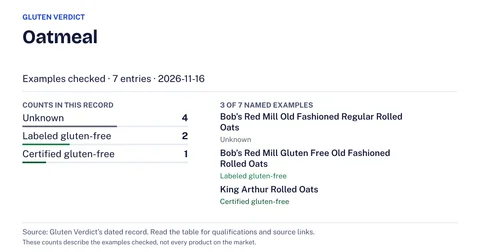 OatmealDepends on the productchecked Nov 16, 2026
 CheeriosLabeled gluten-freeWheat warning on 1 of 8 varieties we checkedGeneral Mills · checked Nov 16, 2026
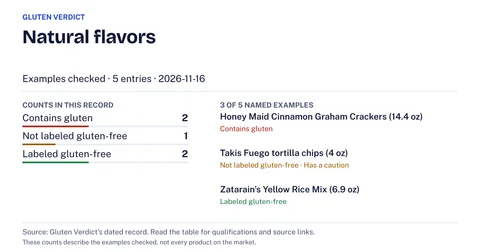 Natural flavorsDepends on the product2 of 5 products we checked contain gluten: Honey Maid Cinnamon Graham Crackers (14.4 oz) and Chex Mix Sour Cream & Onionchecked Nov 16, 2026
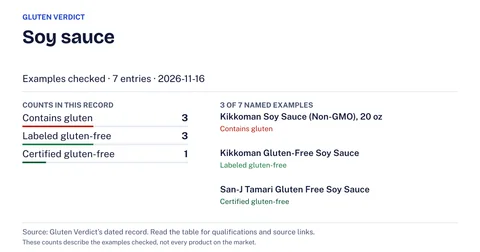 Soy sauceDepends on the product3 of 7 products we checked contain gluten: Kikkoman Soy Sauce (Non-GMO), 20 oz; San-J Organic Shoyu Soy Sauce; and Lee Kum Kee Premium Soy Sauce (No Preservatives Added)checked Nov 16, 2026
Questions people ask
Is it common to still have symptoms on a gluten-free diet?
NIDDK reports that symptoms continue or come back in about 20 percent of people with celiac disease9. Coeliac UK calls ongoing symptoms after starting the diet quite common and says they affect around 1 in 3 people31. Coeliac UK says it is important not to guess the cause and to visit the healthcare team32.
If I feel fine, has my gut healed?
Not necessarily. In a Mayo Clinic study of adults, most patients had some clinical response to the diet, but clinical response was not a reliable marker of mucosal recovery2.
More in Newly diagnosed: the first weeks
 Feeling worse after going gluten-free: what the sources say to check firstWhat NIDDK, Coeliac UK and clinical reviews say about symptoms that do not improve or get worse on a gluten-free diet, and which causes you can check.
 Starting a gluten-free diet: testing first, then labels, oats and the kitchenWhat NIH and the celiac charities say about starting a gluten-free diet: testing first, which foods to start with, a US label check, oats and the kitchen.
 Your first 30 days after a celiac diagnosis: a week-by-week planA week-by-week plan for the first month after a celiac diagnosis: label rules, kitchen changes, a dietitian, follow-up tests and questions for your doctor.
 Going gluten-free: what to remove and what to keep in your pantry and kitchenSort a full pantry into foods to remove, labels to read and plain foods to keep, then decide on shared jars, toasters and pans.
 Your first restaurant meal after a celiac diagnosisHow to pick a place, call ahead, ask the kitchen the right questions and decide what to do when answers are vague, for a first meal out.
 Grieving foods after a celiac diagnosis: what people describe and where to get helpSadness or anger about food after a celiac diagnosis: what charities and research report, small steps the sources name, and when to call a provider or 988.
Related guides
 Follow-up testing after a celiac diagnosis: what the guidelines listWhat celiac guidelines and charities list for follow-up: antibody checks, repeat biopsy, nutrient tests, and what is checked if symptoms continue.
 Where wheat, barley and rye hide in processed food: 15 places to checkFifteen processed foods where wheat, barley or rye turn up, the label step that catches each, and what US allergen law does and does not flag.
 Gluten cross-contact at home: where it happens and what to do about itHow gluten reaches gluten-free food at home, whether to separate, wash or ask for each route, and which rules have lab data behind them.
 How long celiac healing takes: symptoms, antibodies and the gut liningWhat studies report on how long symptoms, blood antibodies and the intestinal lining take to recover on a gluten-free diet, and what to ask your care team.
Sources
- [1, 3, 4, 9, 10, 13, 26, 27, 28, 36, 37, 38] US National Institute of Diabetes and Digestive and Kidney Diseases (NIDDK), Treatment for Celiac Disease, checked Nov 17, 2026.
Read on 2026-11-17: under “Hidden sources of gluten include”, the page lists additives made with wheat, such as modified food starch, malt flavoring, preservatives and stabilizer.
- [2, 6, 22] PubMed, Rubio-Tapia et al. 2010: mucosal recovery and mortality in adults (Am J Gastroenterol), checked Nov 17, 2026.
- [5, 21] PubMed, Newnham et al. 2016: 5-year study from diagnosis (J Gastroenterol Hepatol), checked Nov 17, 2026.
- [7, 16, 17, 18, 23] PubMed, Fernandez-Banares et al. 2021: CADER study (Am J Gastroenterol), checked Nov 17, 2026.
- [8, 29, 30] PubMed, Leffler et al. 2007: nonresponsive celiac disease (Clin Gastroenterol Hepatol), checked Nov 17, 2026.
- [11, 12] PubMed, Nachman et al. 2009: quality of life after starting a gluten-free diet (Dig Liver Dis), checked Nov 17, 2026.
- [14, 34] PubMed, AGA Clinical Practice Update on diagnosis and monitoring of celiac disease (Gastroenterology, 2019), checked Nov 17, 2026.
- [15, 42] Gluten Intolerance Group, Do I need follow-up appointments after a recent diagnosis?, checked Nov 17, 2026.
- [19, 24] PubMed, Schiepatti et al. 2023: persistent villous atrophy (Gut), checked Nov 17, 2026.
- [20, 25, 44] PubMed, Szakacs et al. 2017: meta-analysis of mucosal recovery (PLoS One), checked Nov 17, 2026.
- [31, 32, 35] Coeliac UK, Non responsive and refractory coeliac disease, checked Nov 17, 2026.
- [33, 39] PubMed, ACG Guidelines Update: Diagnosis and Management of Celiac Disease (Am J Gastroenterol, 2023), checked Nov 17, 2026.
- [40, 41, 43] Coeliac UK, Follow up after diagnosis (healthcare professionals), checked Nov 17, 2026.