Gluten-free grocery shopping: what to check at the shelf, the bulk bins and the checkout
Short answer
Check four places on each pack, in this order. FDA’s gluten-free rule applies to packaged foods1, and GIG advises staying clear of the bulk section2:
- A “gluten-free” claim: on food FDA regulates it means less than 20 parts per million (ppm) of gluten3.
- The whole ingredient list, claim or no claim. The Academy of Nutrition and Dietetics says to read every label each time you buy, because a maker may change an ingredient4.
- The Contains line, if the pack has one, which names wheat but not barley or rye5, 6.
- Any may-contain or shared-equipment line, which makers add voluntarily7, 17.
Part of Grocery shopping and meal planning, 15 guides
Key points
- On an FDA-regulated food, “gluten-free”, “no gluten”, “free of gluten” and “without gluten” all mean less than 20 ppm of gluten3. The claim is voluntary, so a plain pack of naturally gluten-free food may not carry it8.
- The Contains line covers wheat but not barley or rye, so it does not replace the ingredient list6.
- A pack that names wheat and still claims gluten-free has to carry FDA’s statement that the wheat has been processed9.
- FDA’s gluten-free rule applies to packaged food, and Gluten Intolerance Group (GIG) advises staying clear of bulk bins1, 2.
- At home, GIG advises putting gluten-free packages above gluten-containing ones in a shared fridge or cupboard, keeping them securely packaged10, and, in a home that is not fully gluten-free, keeping designated areas for gluten-free food storage and prep11.
What a pack can say, and who stands behind it
Five different kinds of statement turn up on grocery packs. The first is the claim that FDA’s rule defines12; the table says what stands behind each of the others.
| On the pack | What it is | What it tells you |
|---|---|---|
| “Gluten-free”, “no gluten”, “free of gluten”, “without gluten” | A voluntary claim that FDA’s rule defines, with the maker responsible for using it accurately12 | On an FDA-regulated food, less than 20 ppm of gluten3 |
| A certification logo | A third-party program’s mark. FDA does not endorse, accredit or recommend any particular program13 | Whatever that program requires. GIG says every product with a GFCO mark has met 80 requirements before it qualifies for GFCO certification14, and that GFCO requires 10 ppm or less, which it calls more stringent than FDA’s limit15 |
| “Made with no gluten-containing ingredients” | A statement that FDA’s regulations do not prohibit if it is truthful and not misleading, but it is not the gluten-free claim46 | FDA says that unless the label also bears a gluten-free claim, consumers should not assume the food meets all FDA requirements for the claim16 |
| “May contain wheat”, “made in a facility that also processes wheat” | A voluntary advisory statement. FDA does not prohibit one beside a gluten-free claim if it is truthful and not misleading7 | GIG says these statements are not required or regulated by FDA17 |
| “Wheat-free” | A different claim from gluten-free18 | GIG says a wheat-free product can still contain gluten from rye or barley18 |
FDA sets no place on the pack for the gluten-free claim19, so check the front, the back and the ingredient panel.
The reading order at the shelf
Use the same sequence on every pack.
- Claim or mark. A claim means the maker has taken on FDA’s definition and is responsible for using it accurately12. It is the quickest sort, but not the last step.
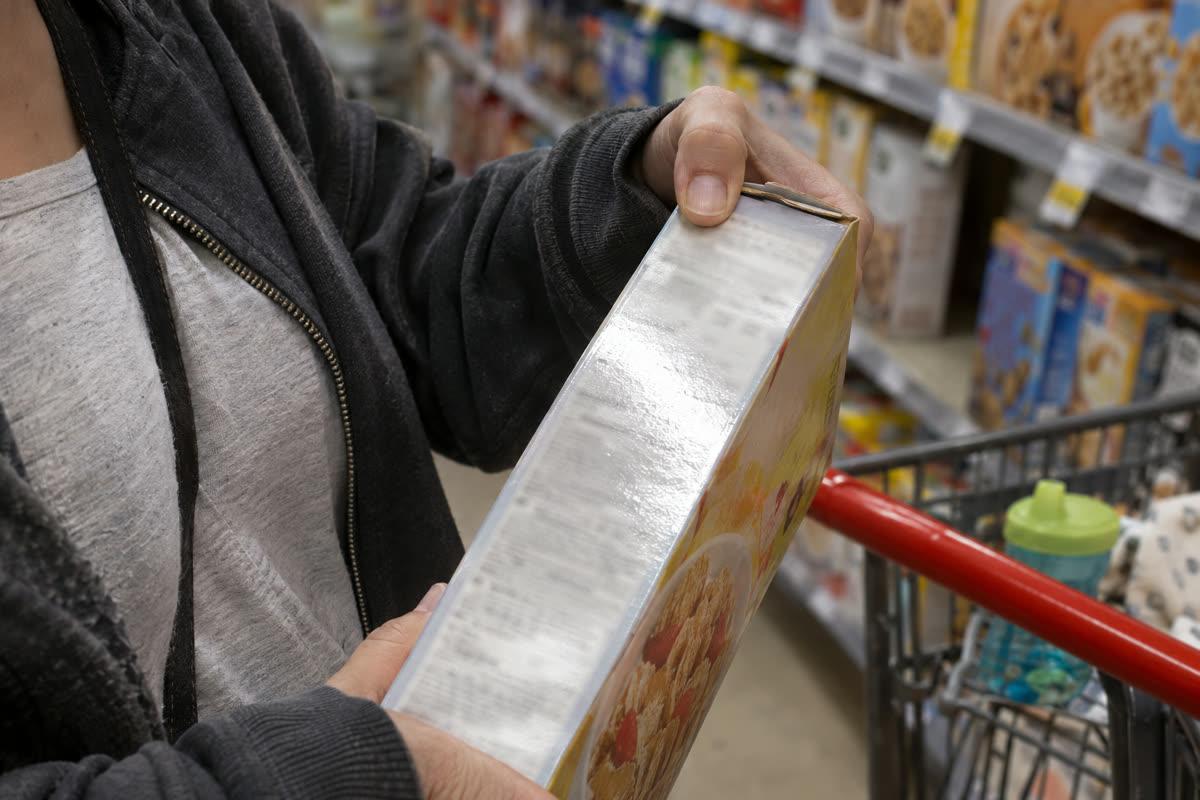
- The whole ingredient list. FDA’s answer for consumers with celiac disease is to read and scrutinize labels to avoid gluten ingredients20. On a pack with no claim, the Academy of Nutrition and Dietetics says to look for wheat, rye, barley, oats and malt21.
- The Contains line. US allergen law names wheat among the major food allergens and does not name barley or rye6. A Contains line with no wheat therefore leaves barley, rye and malt in the ingredient list unaddressed.
- The maker’s statement. A shared-facility or shared-equipment line is the maker’s voluntary note7, 17. A claim on the same pack still has to meet FDA’s rule22.
- Every time. The Academy says to read each label each time you buy, even for a product you have bought before4.
When a line is unclear, open the product’s page in our verdicts, A to Z or point our gluten scanner at the label. The full method, with the ingredient names to look for, is in how to read a US food label for gluten. Our grocery list is a starting point for what to put in the cart.
The gluten-free section and the rest of the store
The claim is printed on the pack, not on the shelf, so read the pack wherever the product sits. FDA says foods that are naturally gluten-free, such as fruits, vegetables and eggs, may carry no claim even though the food is gluten-free8.
A claim speaks for the pack it is printed on. FDA notes that a maker may make a wide variety of foods, both gluten-free and containing gluten23.
Plain-looking grains, beans and seeds deserve a second look. FDA says that on foods that are gluten-free by nature but at higher risk of cross-contact, such as products made from grains, legumes and seeds, a gluten-free claim creates the expectation that any gluten is below 20 ppm24. GIG lists oats, lentils and milled products from grains, beans, seeds or legumes as riskier when they are not certified or labeled gluten-free25.
| Item | What to read on the pack | Our verdict |
|---|---|---|
| Oats, oatmeal, granola bars | GIG says that without the words “gluten-free” or a certification mark on the oats package, oats may not be gluten-free26. Oats labeled gluten-free must contain less than 20 ppm gluten27. | Oatmeal, granola bars |
| Cereal and crackers | The claim, then the ingredient list. Our verdicts show which of the boxes we read carry a claim. | Cereal, crackers |
| Soy sauce | FDA says that, in general, soy sauce made from soybeans and wheat may not bear a gluten-free claim28. | Soy sauce |
| Broth, bouillon and sauces | The Academy lists bouillon cubes, gravy, salad dressings and soups among foods where gluten may appear29. | Chicken broth |
| Salsa and dips | The claim, then the list; the jar or tub decides, not the type of food. | Salsa, hummus |
Wheat starch and other “wheat” mentions on a gluten-free pack
FDA’s definition names wheat starch as an example of an ingredient derived from a gluten-containing grain and processed to remove gluten. Using it counts against a gluten-free claim if it leaves the food at 20 ppm or more gluten30.
Wheat is a major allergen6, and the regulation refers to the word “wheat” in the ingredient list or Contains statement as required by the allergen law9. A food that names wheat in its ingredient list or in a Contains wheat statement and also claims gluten-free is misbranded unless the wheat mention points to this statement: “The wheat has been processed to allow this food to meet the Food and Drug Administration (FDA) requirements for gluten-free foods.”9
With no claim on the pack, the advice changes. The Academy of Nutrition and Dietetics says: “Do not eat foods containing wheat starch that are not labeled gluten-free.”31 GIG says wheat starch in a product that is not certified or labeled gluten-free is a concern and should be avoided32. See our entries for wheat starch and modified food starch.
Meat, poultry and mixed products
The rule above is FDA’s. FDA says its gluten-free rule does not apply to foods whose labeling USDA regulates, which generally means meat, poultry and certain egg products33. GIG describes USDA-regulated products as not required to follow the allergen labeling law, and estimates that 80-90% do so voluntarily34. It counts mixed products that generally contain more than 3% raw or 2% cooked meat, such as some soups and frozen entrees, among those USDA regulates35.
On modified food starch, GIG says it is commonly made from corn in the United States and that wheat must be declared on US labels when it is the source36. This guide states no USDA rule of its own on wheat starch or modified food starch; on a meat-containing pack, read the list and any claim and use the verdict pages.
Frozen and refrigerated cases
The Academy of Nutrition and Dietetics names deli meats, hot dogs, French fries, modified food starch, rice mixes, salad dressings and soups among foods where gluten may appear, and adds that many of them are also made gluten-free, so it is important to always check the label29.
| Item | Where to look on the pack | Our verdict |
|---|---|---|
| Frozen French fries | The whole ingredient list, then any claim | French fries |
| Hot dogs | The claim first, then the whole ingredient list | Hot dogs |
| Pre-packaged sliced deli meat | The claim and the list on the pack | Deli meat |
| Frozen entrees and soups | GIG says USDA regulates mixed products that generally contain more than 3% raw or 2% cooked meat35; read the list and any claim | Soup |
| Refrigerated dips such as hummus | The list on the tub, and what is sold beside it as dippers | Hummus |
Bulk bins, deli counters and sample tables
FDA’s gluten-free rule applies to packaged foods1. The reading order above starts from a pack; scooped, sliced-to-order or loose food does not come in one.
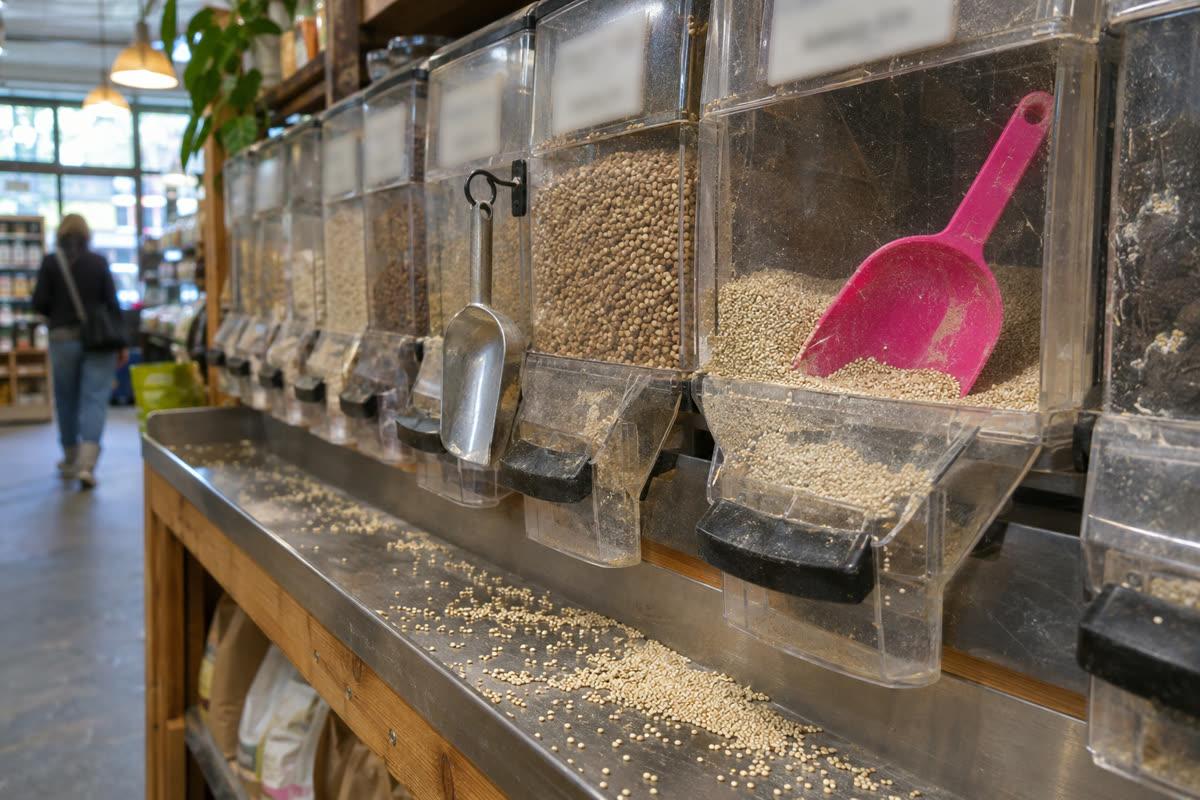
GIG advises staying clear of the bulk section, because gluten-containing ingredients could linger on scoops or surrounding bins2. Even a scoop sitting in a gluten-free bin could carry gluten particles from a previous bin or from gluten-containing food elsewhere in the bulk area37.
None of the pages cited in this guide covers deli slicers, bakery cases or sample tables, so this guide gives no rule for them. Our guide to deli, bakery and bulk-bin counters covers the counters.
From the belt to the shelf at home
None of the pages cited in this guide covers conveyor belts, bagging or self-checkout, so the checkout has no sourced rule here. Keeping your gluten-free packs together in one bag is a habit that makes the next step easier, not a requirement.
At home, the concern is cross-contact. GIG defines it as gluten crumbs or particles getting into gluten-free ingredients or food in amounts that could cause an adverse reaction38. GIG’s advice for storage:
- In a home that is not fully gluten-free, keep designated areas for gluten-free food storage and prep11.
- In a shared fridge or cupboard, put gluten-free packages above gluten-containing ones and keep them securely packaged10.
- When in doubt, label food items, even utensils and cookware39.
- Do not double-dip: GIG calls using the same serving utensil in both types of food one of the most common ways gluten crumbs get into gluten-free food40.
The room-by-room version is in our guides to setting up a gluten-free kitchen and clearing the pantry.
When a pack looks wrong or the list is unclear
The Academy of Nutrition and Dietetics puts it this way: “When in doubt, check with the food manufacturer or go without.”41
A claim is not backed by a mandatory test. FDA says the rule does not require makers to test starting ingredients or finished foods, but makers are responsible for making sure a food bearing the claim complies42.
FDA says suspected foodborne illness or labeling concerns may be reported to it43. Its list of what to include has the name and address of the place where the product was bought44 and photos of the product, label, ingredient statement and lot code45. For an illness a person links to a food, FDA also says to keep any food packages because they may contain important information47.
Verdicts in this guide
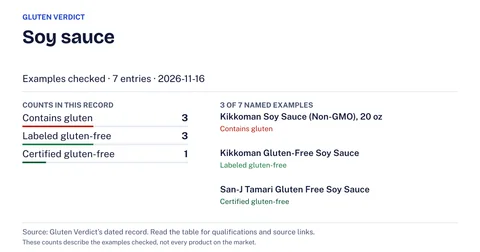 Soy sauceDepends on the product3 of 7 products we checked contain gluten: Kikkoman Soy Sauce (Non-GMO), 20 oz; San-J Organic Shoyu Soy Sauce; and Lee Kum Kee Premium Soy Sauce (No Preservatives Added)checked Nov 16, 2026
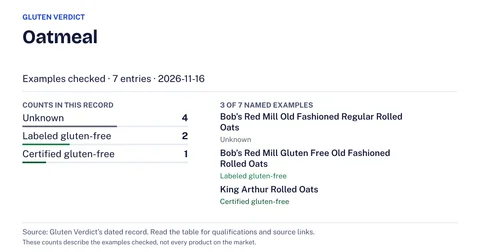 OatmealDepends on the productchecked Nov 16, 2026
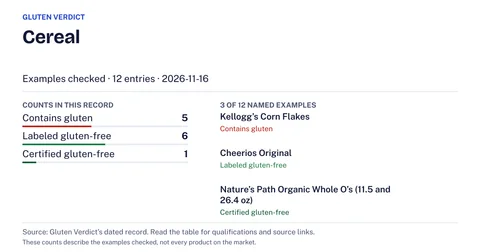 CerealDepends on the product5 of 12 products we checked contain glutenchecked Nov 16, 2026
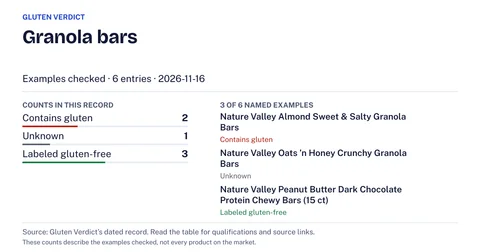 Granola barsDepends on the product2 of 6 products we checked contain gluten: Nature Valley Almond Sweet & Salty Granola Bars and Nature Valley Cinnamon Brown Sugar Soft-baked Oatmeal Squareschecked Nov 16, 2026
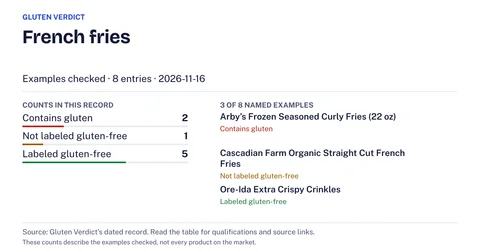 French friesDepends on the product2 of 8 products we checked contain gluten: Arby’s Frozen Seasoned Curly Fries (22 oz) and Checkers Frozen Crispy Seasoned Fries (28 oz)checked Nov 16, 2026
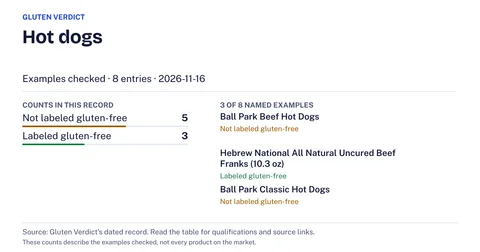 Hot dogsDepends on the productchecked Nov 16, 2026
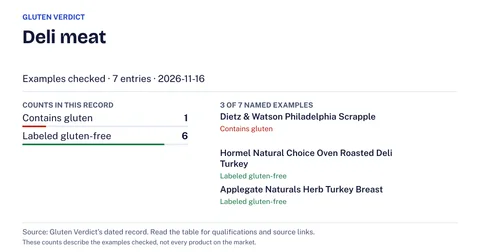 Deli meatDepends on the product1 of 7 products we checked contains gluten: Dietz & Watson Philadelphia Scrapplechecked Nov 16, 2026
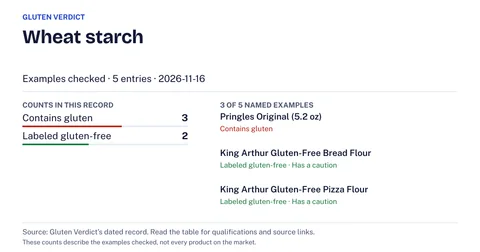 Wheat starchDepends on the product3 of 5 products we checked contain gluten: Pringles Original (5.2 oz), Jiffy Corn Muffin Mix, and Chex Mix Bold Garlic and Herbchecked Nov 16, 2026
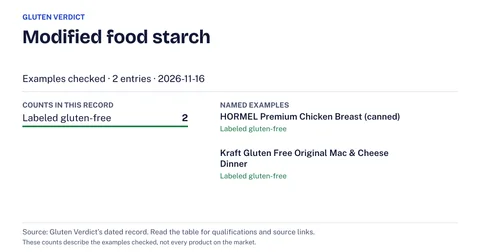 Modified food starchDepends on the productchecked Nov 16, 2026
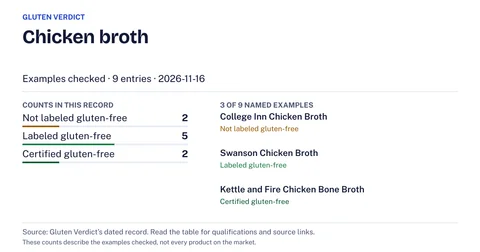 Chicken brothDepends on the productchecked Nov 16, 2026
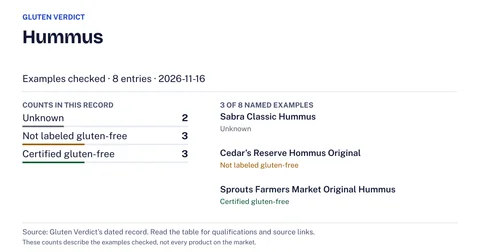 HummusDepends on the productchecked Nov 16, 2026
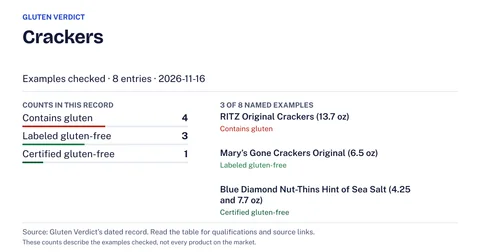 CrackersDepends on the product4 of 8 products we checked contain glutenchecked Nov 16, 2026
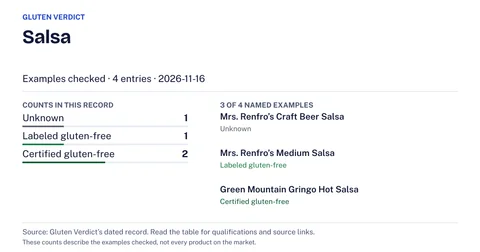 SalsaDepends on the productchecked Nov 16, 2026
Questions people ask
Does a gluten-free claim mean I can skip the ingredient list?
Asked whether people with celiac disease should only search for foods labeled gluten-free, FDA answers “Not necessarily” and says they should read and scrutinize labels to avoid gluten ingredients20. Read the claim and the list together.
Is food without a gluten-free claim off limits?
Not by that fact alone. FDA says naturally gluten-free foods may carry no claim8. On a processed food with no claim, the Academy of Nutrition and Dietetics says to look for wheat, rye, barley, oats and malt in the ingredient list21.
Do I need to re-read a label on something I buy every week?
The Academy says to read all product labels each time you buy, because a maker may change an ingredient4.
What does “made in a facility that also processes wheat” mean on a pack?
It is a voluntary advisory statement, and FDA does not prohibit it on a food that also claims gluten-free if it is truthful and not misleading7. A food with the claim must comply with the rule either way22.
What about the bulk bins?
GIG advises staying clear of the bulk section because gluten-containing ingredients could linger on scoops or surrounding bins2.
More in Grocery shopping and meal planning
 How to check a grocery listing for gluten before you orderRead an online grocery listing for gluten in a fixed order, tell a store tag from a maker claim and a certifier mark, and re-check on reorders.
 A gluten-free grocery list by aisle for US supermarketsAn aisle-by-aisle gluten-free grocery list for US stores: what needs no label, what needs a check, and what stays off the list.
 Gluten-free grocery pickup and delivery: setting substitutions and checking swapsHow to set no-substitution choices on Instacart, Target and Whole Foods orders, check each swapped item at the door, and report a swap that fails.
 Deli, bakery and bulk-bin counters on a gluten-free dietFor each store counter (deli, bakery, bulk bins, bars): skip it, ask first, or buy the packaged item, and what a store’s own statement tells you.
 A starter gluten-free pantry: 30 shelf items and the label check for eachThirty shelf items for a first gluten-free pantry, tagged by the label check each needs, plus how to keep jars, toaster and colander apart at home.
 A gluten-free meal plan as a shopping template, by meal slotA weekly gluten-free shopping template: staples for each meal slot, the check each packaged item needs, and a ledger of when you last read each label.
Related guides
 Store-brand gluten-free: what the tag, claim or seal rests onSort a store-brand item into certified, maker-stated or ingredient-only, see what each lets you conclude, and know what to ask the store.
 How to check whether a packaged food is gluten-freeA four-step check for one packaged food: the claim, the ingredient and allergen lines, the maker’s dated page and the certifier’s directory.
 A gluten-free label that lists wheat or wheat starch: what it meansHow a US pack can say gluten-free and still list wheat starch or “wheat”, the statement FDA requires, and what to ask the maker.
 Gluten-free at Sprouts: the collection, bulk bins and wording that is not a claimWhat Sprouts says about gluten on its own pages, how its collection and bulk bins differ from a package claim, and what organic or wheat-free leaves open.
Sources
- [1, 7, 16, 20, 22, 23, 24, 27, 28, 33, 42, 43, 44, 45, 46, 47] US Food and Drug Administration, Questions and Answers on the Gluten-Free Food Labeling Final Rule, checked Nov 17, 2026.
- [2, 10, 11, 37, 38, 39, 40] Gluten Intolerance Group, 25 Ways Cross-Contact Could Happen and How to Avoid It, checked Nov 17, 2026.
- [3, 8, 12, 13, 19] US Food and Drug Administration, Gluten and Food Labeling, checked Nov 17, 2026.
- [4, 21, 29, 31, 41] Academy of Nutrition and Dietetics (eatright.org), Gluten-Free Diet: Building the Grocery List, checked Nov 17, 2026.
- [5, 6] US Food and Drug Administration, Food Allergen Labeling and Consumer Protection Act of 2004 (FALCPA), checked Nov 17, 2026.
- [9, 30] eCFR (US Government Publishing Office and National Archives), 21 CFR 101.91, Gluten-free labeling of food (text as of 2026-11-01), checked Nov 17, 2026.
- [14, 15, 17, 32] Gluten Intolerance Group, Do All Wheat Mentions on Food Labels Mean Not Gluten-Free?, checked Nov 17, 2026.
- [18, 26, 34, 35] Gluten Intolerance Group, 3 Tips for Gluten-Free Label Reading, checked Nov 17, 2026.
- [25] Gluten Intolerance Group, FAQ: products judged by their ingredient list when not certified or labeled gluten-free, checked Nov 17, 2026.
- [36] Gluten Intolerance Group, Advanced Label-Reading Tips, checked Nov 17, 2026.