Starting a gluten-free diet: testing first, then labels, oats and the kitchen
Short answer
If you think you might have celiac disease, NIDDK says to talk with a doctor about testing before beginning a gluten-free diet, because if you avoid gluten before testing, the test results may not be accurate2, 1. Once that is settled, the first week comes down to five things:
- Learn the grains that carry gluten: wheat, barley, rye and crossbreeds such as triticale12, 14.
- Start from foods that are naturally gluten-free, such as meat, fish, fruits, vegetables, rice and potatoes without additives or some seasonings22.
- Read every label, every time: the gluten-free claim, the ingredient list and the allergen line, which covers wheat but not barley or rye30, 32, 34.
- Treat oats as their own decision: NIDDK says to talk with a doctor or dietitian about them and, if you eat them, to make sure they are gluten-free43, 44.
- Keep gluten foods apart in the kitchen: GIG says toasters, strainers and flour sifters should not be shared49.
Part of Newly diagnosed: the first weeks, 8 guides

Key points
- NIDDK says doctors do not recommend starting the diet before diagnostic testing, because it can affect test results3; GIG says starting without complete testing makes a later diagnosis difficult4.
- “Gluten-free”, “no gluten”, “free of gluten” and “without gluten” on an FDA-regulated food all mean less than 20 parts per million of gluten30.
- The US allergen list names wheat but not barley or rye, so a clean-looking allergen line does not replace reading the ingredient list34.
- The gluten-free rule does not cover meat, poultry, some egg products or most alcoholic drinks41.
- NIDDK says a registered dietitian will teach you how to avoid gluten while following a healthy diet65.
Should you start before you are tested?
NIDDK, part of the National Institutes of Health, answers no. If you think you might have celiac disease, it says to talk with your doctor about testing before you begin a gluten-free diet2. Its reason is that if you avoid gluten before testing, the test results may not be accurate1.
NIDDK’s diagnosis page adds that doctors most often use blood tests and biopsies of the small intestine to diagnose or rule out celiac disease, and that they do not recommend starting the diet first because it can affect the results3. The American College of Gastroenterology’s 2023 guideline update calls antibody detection in the blood very helpful for initial screening, and says an intestinal biopsy is required in most patients to confirm the diagnosis6.
The Gluten Intolerance Group (GIG) says starting the diet without complete testing makes a later diagnosis difficult4, and that for a valid diagnosis gluten would need to be reintroduced for at least several weeks before testing5.
This page reports what NIH and the celiac charities say. It cannot tell you whether you need testing or when testing is finished; that is a conversation with a clinician.
NIDDK also says that if you do not have celiac disease or another health problem related to gluten, a doctor may not recommend the diet9, and that researchers have found no evidence it promotes better health or weight loss for the general population10. For people with celiac disease, NIDDK says the diet is followed for life11.
On nutrition, NIDDK says that starting without advice from a doctor or a registered dietitian can leave a diet short of nutrients such as fiber, iron and calcium, and that some packaged gluten-free foods may be higher in fat and sugar than the versions with gluten8.
What the diet removes
FDA describes gluten as occurring naturally in wheat, rye, barley and crossbreeds of these grains14. NIDDK’s list names types of wheat and the forms barley may take, such as malt and brewer’s yeast12, and GIG lists the wheat varieties: durum, spelt, semolina, couscous, bulgur, emmer, farina, farro and einkorn13. Where we have checked a food, it links to our verdict.
| On the label or the menu | What the sources say |
|---|---|
| Bread, cakes, cereals, pasta | FDA says foods that typically contain gluten include breads, cakes, cereals, pastas and many other grain-based foods14. Our verdicts: bread, pasta, cereal. |
| Barley, malt, malt extract, malt vinegar, brewer’s yeast | NIDDK says barley may be found in malt, malt extract, malt vinegar and brewer’s yeast12. FDA says malt extract and malt syrup are derived from barley that has not been processed to remove gluten18, and that malt vinegar cannot be used in a food labeled gluten-free19. |
| Wheat starch | Under 21 CFR 101.91, a food labeled gluten-free cannot contain an ingredient that comes from a gluten-containing grain and has been processed to remove gluten, such as wheat starch, if using it leaves the food with 20 parts per million or more of gluten21. |
| Soy sauce | FDA says that, in general, when soy sauce is made from soybeans and wheat or another gluten grain, it may not carry a gluten-free claim20. |
| Beer, lagers, ale, malt beverages, flavored liquors | NIDDK says these drinks may contain gluten15. |
| Candy, condiments, sausages, ice cream, dressings, soups | NIDDK says gluten may be found in these foods16, because many ingredients and additives, such as colorings, flavorings, starches and thickeners, are made from grains that contain gluten17. Our verdicts on two such ingredients: natural flavors and maltodextrin. |
Foods you can start with
NIDDK lists meat, fish, fruits, vegetables, rice and potatoes, without additives or some seasonings, as naturally gluten-free22. GIG’s advice is to start at the edges of the grocery store with vegetables, fruits, fish, poultry, meat and dairy, in their natural forms and without added flavorings or ingredients that may contain gluten23.
GIG adds fruit and vegetables, fresh meat, poultry and fish, legumes, nuts, seeds and plain dairy, and notes that processed or flavored versions may have gluten-containing ingredients24. Its list of naturally gluten-free grains and flours includes rice, corn, potato, sorghum, quinoa, millet, buckwheat, amaranth and teff27, and it names corn tortillas, salsa, guacamole and beans26.
Our verdicts for the plain forms: rice, quinoa, potatoes, eggs and corn tortillas. Each shows what the maker or charity pages said, with the date we read them.
A missing gluten-free claim on these foods is not a warning by itself: FDA says the claim is not required, so it may not appear even on a food that is gluten-free25.
On cost, NIDDK says packaged gluten-free foods tend to cost more than the same foods with gluten, and restaurants may charge more for gluten-free versions28.
The label check, step by step
Steps 1 to 3 follow the order of GIG’s starter guide; step 4 is added from FDA’s allergen-law page. Our full label guide goes further.
- Look for a third-party certification mark. GIG’s guide says that if a product is certified gluten-free, you can stop at this step29.
- Look for a gluten-free claim. On an FDA-regulated food, “gluten-free”, “no gluten”, “free of gluten” and “without gluten” must all mean less than 20 parts per million of gluten30. Makers use the claim voluntarily31.
- Read the ingredient list when a food has neither. GIG calls this essential for products that are neither certified nor labeled gluten-free32, and its list to watch for is wheat, rye, barley, malt, brewer’s yeast and oats that are not certified gluten-free33.
- Read the allergen statement, but not on its own. The US allergen list names wheat but not barley or rye34, so a line that does not say wheat does not rule out barley malt in the ingredient list. One way the law lets a maker name an allergen is a “Contains” line printed right after or beside the ingredient list35.
One wording trap: a food that carries a gluten-free claim and also names wheat in its ingredient list or a Contains statement has to add a statement that the wheat has been processed to meet FDA’s gluten-free requirements36.
Recipes change, and GIG says to read labels every time you shop37. Our gluten scanner looks for these names in a photo of a label or in pasted text.
What “gluten-free” on a label means, and what it does not
The limit is 20 parts per million (ppm). FDA says that is the lowest level that can be reliably detected in foods using scientifically validated methods, and that most people with celiac disease can tolerate foods with very small amounts of gluten38. NIDDK says the amount is too small to cause problems in most people with celiac disease39.
FDA reports that in 2017 it analyzed 702 samples from more than 250 products labeled gluten-free, and only one did not comply with the labeling requirements40.
Two limits to know. First, the rule does not apply to foods regulated by USDA, including meat, poultry and some egg products, or to most alcoholic beverages41. Second, GIG points out that a gluten-free claim under the FDA definition is not third-party verified, and that GFCO’s certification standard is 10 ppm or less42.
Oats need their own decision
NIDDK says to talk with a doctor or a registered dietitian about whether to include oats and how much43, and that if you do eat oats, they should be gluten-free44. GIG says that although oats are not considered a source of gluten in many countries, the concern is contact with gluten grains between the field and processing45, 46.
FDA’s rule treats oats like any other grain that does not contain gluten: oats labeled gluten-free must contain less than 20 ppm, and they do not have to be certified to carry the claim47.
Our verdicts: oatmeal and Cheerios. GIG’s own advice is to consult a physician or dietitian before adding oats48.
The kitchen in week one
NIDDK defines cross-contact as foods or products that contain gluten coming into contact with gluten-free foods54, and lists storing and preparing gluten-free foods separately from family members’ gluten foods among the things to do at home55. GIG’s starter guide names the first places to look:
- Hard-to-clean equipment: toasters, strainers and flour sifters should not be shared49.
- Spreads: shared containers can be a source of cross-contact51; GIG suggests squeeze containers where you can52.
- Frying: foods cooked in oil also used for breaded products should be avoided, GIG says50.
- Flour in the air: wheat flour can stay airborne for many hours and land on exposed surfaces, utensils or uncovered gluten-free food53.
For a room-by-room list, see our kitchen setup guide and the pantry clean-out guide; hidden sources of gluten covers foods that do not look like grain.
Medicines, vitamins and drinks people forget
GIG says gluten is uncommon as a medication ingredient but that medications must also be evaluated for it56. It adds that medications, prescription or over-the-counter, are outside the FDA gluten-free labeling regulation for food58, and that if you have doubts you can consult a pharmacist or the manufacturer57.
NIDDK tells people with celiac disease to ask a pharmacist about ingredients in medicines and supplements60, and calls medicines rare sources of gluten, likely to hold such small quantities that they would not cause symptoms59. FDA’s drug page says the vast majority of oral drug products contain no gluten or virtually none61; the page is marked current as of December 201762.
On drinks, GIG says most beers, ales, lagers and malted beverages are not gluten-free because they are made from gluten-containing grains, while distilled alcoholic beverages are63. It says beers labeled “gluten-removed” may not be gluten-free64; see our beer verdict and the gluten-removed beer guide.
After week one
NIDDK says a registered dietitian will teach you how to avoid gluten while following a healthy diet65, and that a doctor may recommend regular follow-up visits66. The American College of Gastroenterology’s guideline describes treatment as strict adherence to the diet with lifelong medical follow-up7.
If symptoms continue on the diet, NIDDK says to talk with a doctor or registered dietitian67; the ACG guideline defines nonresponsive celiac disease as persistent or recurrent symptoms despite being on the diet, and says these patients require a systematic workup to rule out conditions that may cause them, especially unintentional gluten contamination68.
For shopping, our grocery list and the verdict index, A to Z are the next stops. The package in your hand has the final word.
Verdicts in this guide
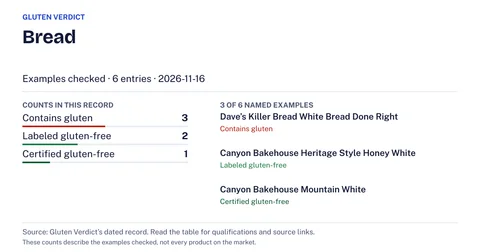 BreadContains glutenchecked Nov 16, 2026
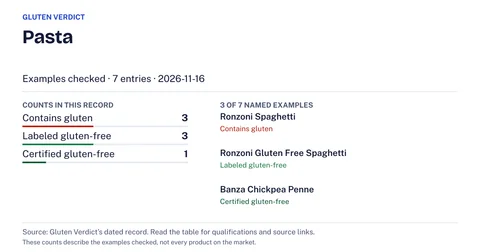 PastaContains glutenchecked Nov 16, 2026
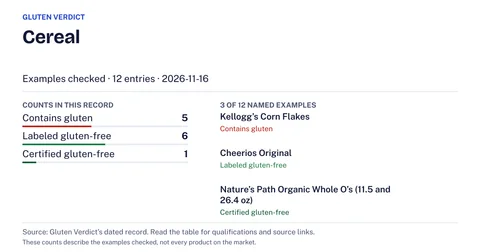 CerealDepends on the product5 of 12 products we checked contain glutenchecked Nov 16, 2026
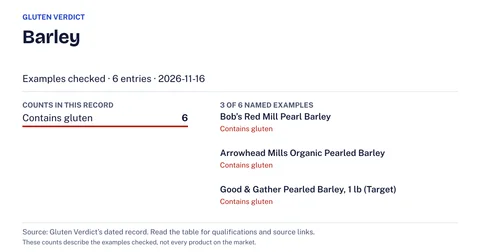 BarleyContains glutenchecked Nov 16, 2026
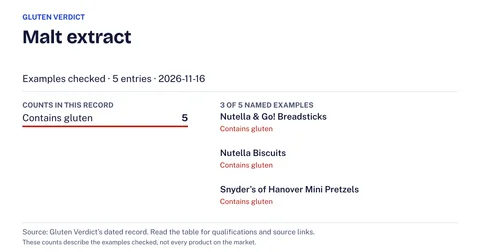 Malt extractContains glutenchecked Nov 16, 2026
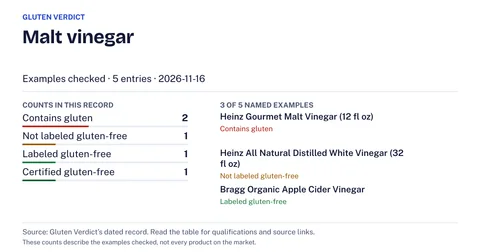 Malt vinegarContains glutenchecked Nov 16, 2026
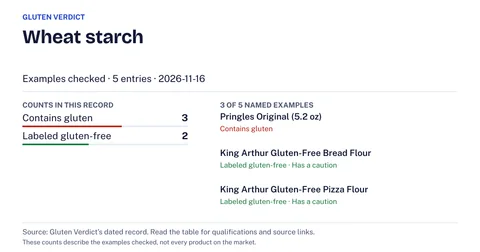 Wheat starchDepends on the product3 of 5 products we checked contain gluten: Pringles Original (5.2 oz), Jiffy Corn Muffin Mix, and Chex Mix Bold Garlic and Herbchecked Nov 16, 2026
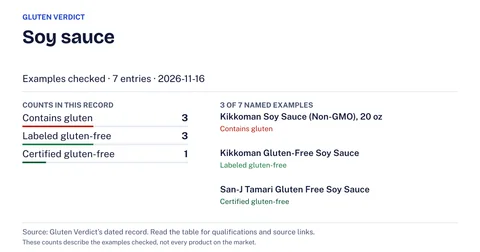 Soy sauceDepends on the product3 of 7 products we checked contain gluten: Kikkoman Soy Sauce (Non-GMO), 20 oz; San-J Organic Shoyu Soy Sauce; and Lee Kum Kee Premium Soy Sauce (No Preservatives Added)checked Nov 16, 2026
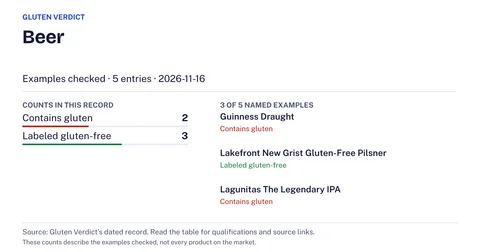 BeerDepends on the product2 of 5 products we checked contain gluten: Guinness Draught and Lagunitas The Legendary IPAchecked Nov 16, 2026
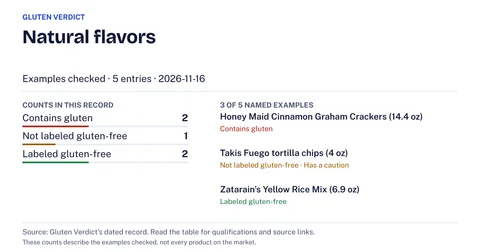 Natural flavorsDepends on the product2 of 5 products we checked contain gluten: Honey Maid Cinnamon Graham Crackers (14.4 oz) and Chex Mix Sour Cream & Onionchecked Nov 16, 2026
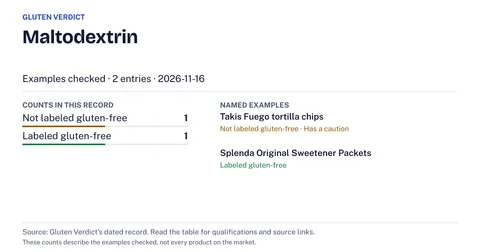 MaltodextrinNaturally gluten-freechecked Nov 16, 2026
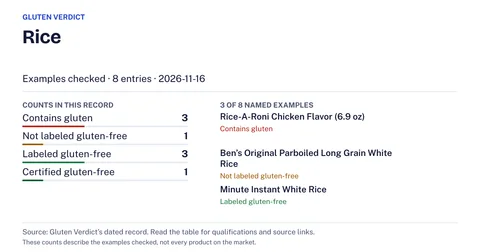 RiceNaturally gluten-free3 of 8 products we checked contain gluten: Rice-A-Roni Chicken Flavor (6.9 oz), Near East Original Rice Pilaf, and Ben’s Original Ready Rice Rice PilafBuy it labeled gluten-freechecked Nov 16, 2026
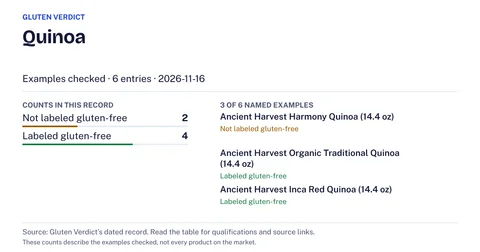 QuinoaNaturally gluten-freeBuy it labeled gluten-freechecked Nov 16, 2026
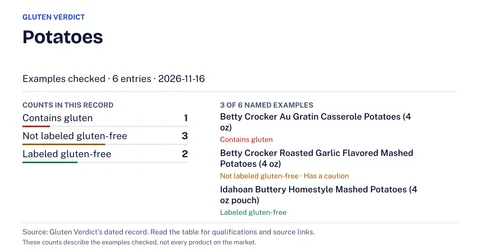 PotatoesNaturally gluten-free1 of 6 products we checked contains gluten: Betty Crocker Au Gratin Casserole Potatoes (4 oz)checked Nov 16, 2026
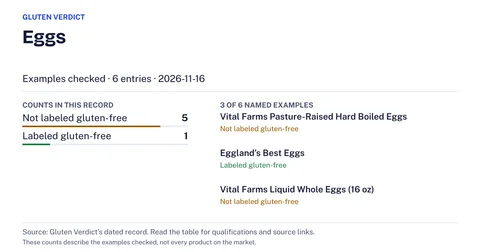 EggsNaturally gluten-freechecked Nov 16, 2026
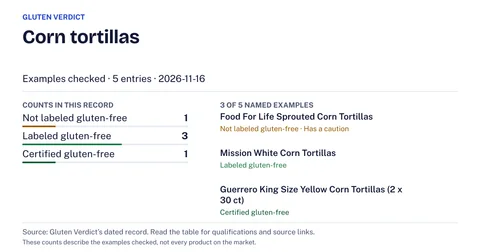 Corn tortillasDepends on the productchecked Nov 16, 2026
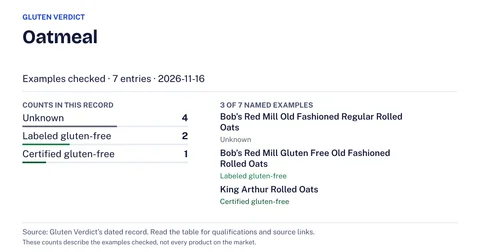 OatmealDepends on the productchecked Nov 16, 2026
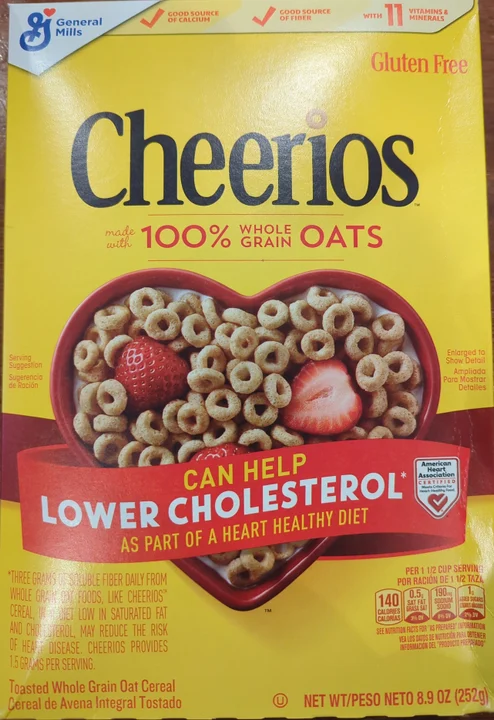 CheeriosLabeled gluten-freeWheat warning on 1 of 8 varieties we checkedGeneral Mills · checked Nov 16, 2026
Questions people ask
Can I try gluten-free for a few weeks first to see whether it helps?
NIDDK says no if you think you might have celiac disease: talk with your doctor about testing first, because if you avoid gluten before testing, the test results may not be accurate2, 1. GIG says gluten would need to be reintroduced for at least several weeks before testing5.
Does gluten-free mean there is no gluten at all?
No. On FDA-regulated foods it means less than 20 parts per million30, which FDA says is the lowest level that can be reliably detected with validated methods38.
Does a food need a gluten-free claim to be gluten-free?
No. FDA says the claim is not required, so it may not appear even on a food that is gluten-free25.
More in Newly diagnosed: the first weeks
 Your first 30 days after a celiac diagnosis: a week-by-week planA week-by-week plan for the first month after a celiac diagnosis: label rules, kitchen changes, a dietitian, follow-up tests and questions for your doctor.
 Feeling worse after going gluten-free: what the sources say to check firstWhat NIDDK, Coeliac UK and clinical reviews say about symptoms that do not improve or get worse on a gluten-free diet, and which causes you can check.
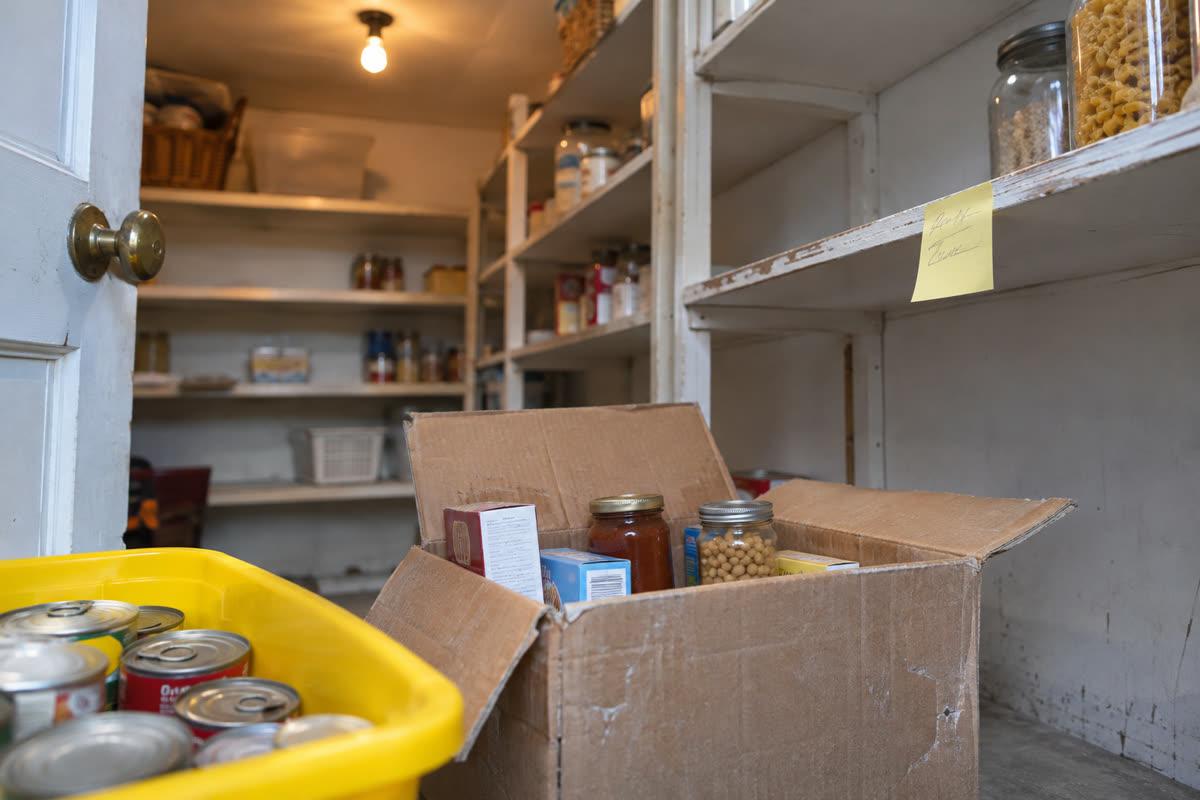 Going gluten-free: what to remove and what to keep in your pantry and kitchenSort a full pantry into foods to remove, labels to read and plain foods to keep, then decide on shared jars, toasters and pans.
 Grieving foods after a celiac diagnosis: what people describe and where to get helpSadness or anger about food after a celiac diagnosis: what charities and research report, small steps the sources name, and when to call a provider or 988.
 How long until you feel better on a gluten-free diet?What NIH, celiac charities and studies report on when symptoms, antibody levels and the gut lining recover after a celiac diagnosis, and why they differ.
 Your first restaurant meal after a celiac diagnosisHow to pick a place, call ahead, ask the kitchen the right questions and decide what to do when answers are vague, for a first meal out.
Related guides
 How to read a US food label for glutenWhere gluten shows up on a US food label: the gluten-free claim, the Contains line, the ingredient list and may-contain lines, and what each means.
 Setting up a gluten-free kitchen: what to replace, wash or shareWalk each kitchen zone and decide, item by item, what to replace, what to wash and what a mixed household can keep sharing, with charity sources.
 Gluten cross-contact at home: where it happens and what to do about itHow gluten reaches gluten-free food at home, whether to separate, wash or ask for each route, and which rules have lab data behind them.
 A gluten-free grocery list by aisle for US supermarketsAn aisle-by-aisle gluten-free grocery list for US stores: what needs no label, what needs a check, and what stays off the list.
Sources
- [1, 2, 8, 9, 10, 11, 12, 15, 16, 17, 22, 28, 39, 41, 43, 44, 54, 55] NIDDK (National Institutes of Health), Eating, Diet, & Nutrition for Celiac Disease, checked Nov 17, 2026.
Read on 2026-11-17: under “What foods and drinks contain gluten?” the list names wheat and types of wheat such as durum, emmer, semolina and spelt; barley, which may be found in malt, malt extract, malt vinegar and brewer’s yeast; rye; and triticale, a cross between wheat and rye.
- [3] NIDDK (National Institutes of Health), Diagnosis of Celiac Disease, checked Nov 17, 2026.
- [4, 5, 13, 23, 24, 26, 27, 29, 32, 33, 37, 42, 48, 49, 50, 51, 52, 53, 63, 64] Gluten Intolerance Group, Getting Started on a Gluten-Free Diet: A Step-By-Step Guide, checked Nov 17, 2026.
Read on 2026-11-17: the list under “Check the list of ingredients” names wheat (including all types of wheat such as spelt), rye, barley, oats unless the oats or oat-containing products are certified gluten-free, malt, and brewer’s yeast.
- [6, 7, 68] American College of Gastroenterology (Rubio-Tapia and colleagues, 2023), via Europe PMC, American College of Gastroenterology Guidelines Update: Diagnosis and Management of Celiac Disease (abstract), checked Nov 17, 2026.
- [14, 25, 30, 38, 40] US Food and Drug Administration, Gluten and Food Labeling, checked Nov 17, 2026.
- [18, 19, 20, 31, 47] US Food and Drug Administration, Questions and Answers on the Gluten-Free Food Labeling Final Rule, checked Nov 17, 2026.
- [21, 36] Electronic Code of Federal Regulations, 21 CFR 101.91 Gluten-free labeling of food, checked Nov 17, 2026.
- [34, 35] US Food and Drug Administration, Food Allergen Labeling and Consumer Protection Act of 2004 (FALCPA), checked Nov 17, 2026.
- [45, 46] Gluten Intolerance Group, Are Oats and Oat Flour Gluten-Free?, checked Nov 17, 2026.
- [56, 57, 58] Gluten Intolerance Group, Medications and the Gluten-Free Diet, checked Nov 17, 2026.
- [59, 60, 65, 66, 67] NIDDK (National Institutes of Health), Treatment for Celiac Disease, checked Nov 17, 2026.
Read on 2026-11-17: under “Avoiding medicines and other products that may contain gluten” NIDDK says to ask a pharmacist about ingredients in herbal and nutritional supplements, prescription and over-the-counter medicines, and vitamin and mineral supplements, and lists children’s modeling dough, cosmetics, lipstick, lip gloss and lip balm, skin and hair products, toothpaste and mouthwash, and communion wafers as products that may contain gluten.
- [61, 62] US Food and Drug Administration, Medications and Gluten (Questions and Answers about Gluten and Oral Drug Products), checked Nov 17, 2026.
Read on 2026-11-17: the foot of the page reads “Content current as of: 12/12/2017”.