Gluten-free at Target: claims, badges and ingredient lists on Good & Gather and Favorite Day
Short answer
Sort each Target item by what its own page and package say: a gluten-free claim, no claim with no gluten grain listed, or a gluten grain listed. A gluten-free claim brings FDA’s rule with it: on FDA-regulated foods, any unavoidable gluten in a food bearing the claim must be under 20 parts per million2, 1.
- Look for the claim in the product name, bullets or Dietary Needs line on Target’s page and on the package; FDA treats the claim as voluntary3.
- Read Target’s Gluten Free badge as Target defines it: a third-party certification or an on-pack statement, so the badge alone does not say which16.
- With no claim, read the whole ingredient list: allergen labeling names wheat but not barley or rye12.
- Check the package you hold: Target says the product information on its pages comes from manufacturers and that it does not warrant it is accurate or complete34.
Part of Store guides: warehouse, discount and natural grocers, 8 guides
Key points
- A gluten-free claim puts FDA’s rule behind a product; a food that carries the claim and misses the rule is misbranded9.
- On Target’s pages the claim shows up in different places from item to item: the product name, a bullet, the Dietary Needs line, or several of these15, 20, 23.
- FDA endorses no particular third-party gluten-free certification program, so a Certified Gluten-Free line carries no FDA endorsement of a program5.
- No claim and no gluten grain in the list is a different thing from a claim: FDA says shoppers should not assume a food whose label says “made with no gluten-containing ingredients” meets the claim’s requirements unless the label also bears the claim6.
- A missing Contains line does not clear barley, because the major allergen list names wheat and not barley or rye12.
What a gluten-free claim looks like on Target’s pages
These are Good & Gather product pages we read on 2026-11-17. Each carries gluten-free wording, but in a different place, which is why one glance at the product name is not enough.
| Item | Where the page says gluten-free |
|---|---|
| Gluten Free Penne, 12 oz | In the product name and in the Dietary Needs line, which reads “Gluten-Free, Certified Gluten-Free”15 |
| Gluten Free Flour Blend, 16 oz | In the product name; the Dietary Needs line reads “Certified Gluten-Free, Non-GMO Project Verified, SQF Certified”18 |
| Gluten Free Plain Bread Crumbs, 9 oz | In the product name, a Dietary Needs line reading “Gluten-Free”, and a bullet that says the crumbs are certified gluten free19 |
| Gluten Free Traditional Crust Frozen Cheese Pizza, 21.1 oz | In the product name and in the first bullet, “Gluten-free frozen cheese pizza”20 |
| Gluten Free Multi-grain with Flax Rice Crackers, 3.5 oz | In the product name and in a bullet, “Gluten-free crackers can be enjoyed by all”21 |
| Organic Super Firm Gluten Free Tofu, 14 oz | In the product name, while the Dietary Needs line reads “Organic Certified, Vegan” with no gluten entry22 |
| Whole Grain Brown Rice Microwavable Cups, 8.8 oz | Not in the product name; one bullet reads “Gluten free”23 |
The words mean the same thing wherever they sit. On a packaged food FDA regulates, “gluten-free” means the food either inherently has no gluten, or has no gluten grain as an ingredient and no ingredient made from one unless it was processed to remove gluten and the food stays under 20 parts per million (ppm); any unavoidable gluten must also be under 20 ppm1, 2. A food that carries the claim and fails that test is misbranded9.
FDA says its rule covers FDA-regulated packaged foods2. A product page tells you what Target shows; the package tells you what the maker printed. Compare the two.
What the badge, “Certified” and the claim each tell you
Target’s product pages show a Gluten Free badge. Target’s own description of it is “A product that has an unqualified independent third-party certification, or carries an on-pack statement relating to the finished product being gluten-free.”16 The badge therefore covers two different situations, and it does not tell you which one applies to the item in front of you.
The Dietary Needs line is separate. On the penne page it reads “Gluten-Free, Certified Gluten-Free”15, and on the flour blend page it adds “SQF Certified”18. The text of the penne and flour blend pages names no gluten-free certifier17.
A certification logo is its own thing
FDA lets a maker print a gluten-free certification logo if its use is truthful and not misleading, and FDA itself endorses no particular program5. Gluten Intolerance Group makes a related point about a plain claim: a gluten-free mention next to a “May contain” statement should meet FDA’s definition, “but this claim is not third-party verified”14. If a certifier matters to you, look for its mark on the package, then read certified versus naturally gluten-free.
Favorite Day: one bakery item with a claim, others that list wheat
The Spring Gluten Free Blueberry Muffins page carries gluten-free wording in the product name and a bullet24. In Target’s product sitemap it is the only Favorite Day address we found with gluten-free in it25.
Other Favorite Day pages we read list wheat and say so on the label:
- Oatmeal Raisin Cookies: wheat flour is the first ingredient, and the page reads “CONTAINS EGG, SOY AND WHEAT, MAY CONTAIN MILK, PEANUT, SESAME AND TREE NUTS”26.
- Gingerbread Mini Cupcakes: the cake lists wheat flour, and the page reads “CONTAINS EGG, MILK, SOY AND WHEAT”27.
- Variety Mini Muffins Pack: the page reads “CONTAINS EGG, MILK, SOY AND WHEAT”28.
A claimed item can still name wheat. FDA’s rule deems a food misbranded if it carries the claim and “wheat” in its ingredient list or a “Contains wheat” statement, unless that word is followed immediately by an asterisk that refers to this statement near the ingredient list: “The wheat has been processed to allow this food to meet the Food and Drug Administration (FDA) requirements for gluten-free foods.”11 Our verdict pages for cookies and bread show what the makers we checked say.
No claim, and no gluten grain in the list
Some Good & Gather staples carry no gluten wording at all. Three we read on 2026-11-17:
| Item | What the page lists |
|---|---|
| Organic Long Grain White Rice, 30 oz | One ingredient, organic white rice; no gluten wording on the page29 |
| Marinara Sauce, 15 oz | Tomatoes, olive oil, garlic, salt, cane sugar, basil and crushed red pepper; no gluten wording on the page30 |
| Quick Oats, 18 oz | Whole grain rolled oats, plus a label warning line that reads MAY CONTAIN WHEAT; no gluten wording on the page31 |
Leaving the claim off is allowed: FDA describes the claim as voluntary3 and says producers of foods that are gluten-free by nature may choose not to label them gluten-free4. But the claim is a separate thing from what the list shows: FDA says that unless a label stating “made with no gluten-containing ingredients” also bears a gluten-free claim, shoppers should not assume the food meets all the requirements for the claim6.
Oats are the case to slow down on. Oats labeled gluten-free must contain less than 20 ppm of gluten8, and the Quick Oats page carries no such label and a MAY CONTAIN WHEAT line31. Our guide on gluten-free oats versus regular oats covers the difference. For rice, see our rice verdict.
FDA does not prohibit a voluntary advisory line, such as “made in a facility that also processes wheat,” on a label that also carries a gluten-free claim, provided it is truthful and not misleading7, so read both.
When the page lists a gluten grain
FDA’s rule lists the gluten grains as wheat, rye and barley, including their crossbred hybrids such as triticale10. Two Good & Gather pages show them plainly:
- Rotini lists semolina (wheat) and the page reads “contains wheat and is processed in a facility handling egg ingredients”33.
- Pearled Barley lists one ingredient, pearled barley, and the page shows no Contains statement32.
The barley page is the one to remember. A Contains statement names the source of a major food allergen13, and that list includes wheat but not barley or rye12. A page with no Contains line has not cleared barley or rye: the ingredient list is what shows them. Our guide to wheat, barley and rye names on ingredient lists lists the names to look for.
Reading a Target product page
Work down the page in this order, then compare it with the package:
- The product name and bullets, for gluten-free wording.
- The Dietary Needs line in the details, if the page has one.
- The ingredient list, for wheat, barley, rye and malt, and any Contains or may-contain line.
- The package itself, before you buy or eat.
The last step matters because of Target’s own disclaimer. It says Target does not represent or warrant that the ingredient and allergen information on its sites is accurate or complete, since it comes from the product manufacturers34; that manufacturers may change their formulas and update their labels36; and that Target recommends you not rely solely on the page, but review the product’s label or contact the manufacturer directly if you have specific product concerns or questions35.
Our verdicts for pantry staples
For the packaged foods we have checked, each verdict shows what the maker’s own pages say and the date we read them: pasta, bread, cereal, granola bars, chips, rice, cheese, cookies, tortillas and popcorn. To turn a cart into a list, use our grocery list or the gluten scanner on a photo of the label.
Verdicts in this guide
 PastaContains glutenchecked Nov 16, 2026
 BreadContains glutenchecked Nov 16, 2026
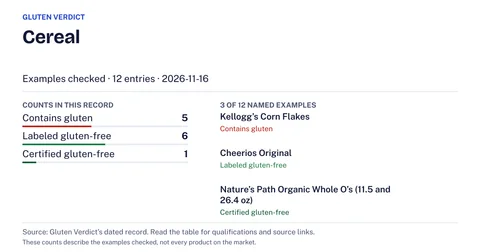 CerealDepends on the product5 of 12 products we checked contain glutenchecked Nov 16, 2026
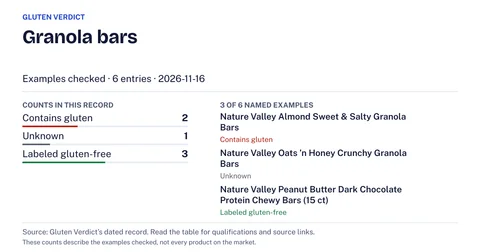 Granola barsDepends on the product2 of 6 products we checked contain gluten: Nature Valley Almond Sweet & Salty Granola Bars and Nature Valley Cinnamon Brown Sugar Soft-baked Oatmeal Squareschecked Nov 16, 2026
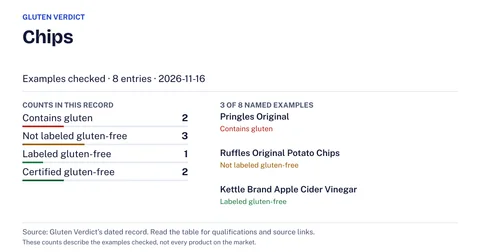 ChipsDepends on the product2 of 8 products we checked contain gluten: Pringles Original and Pringles Salt & Vinegarchecked Nov 16, 2026
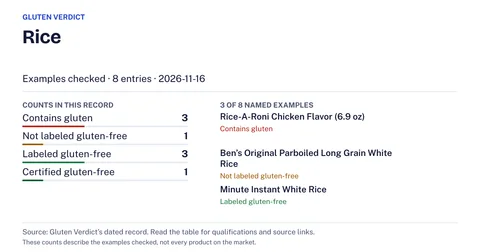 RiceNaturally gluten-free3 of 8 products we checked contain gluten: Rice-A-Roni Chicken Flavor (6.9 oz), Near East Original Rice Pilaf, and Ben’s Original Ready Rice Rice PilafBuy it labeled gluten-freechecked Nov 16, 2026
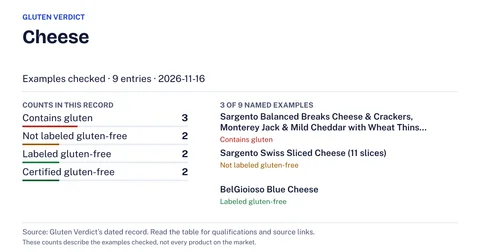 CheeseNaturally gluten-free3 of 9 products we checked contain gluten: Sargento Balanced Breaks Cheese & Crackers, Monterey Jack & Mild Cheddar with Wheat Thins Mini (6-pack); Farm Rich Mozzarella Sticks; and Farm Rich Cheddar Cheese Curdschecked Nov 16, 2026
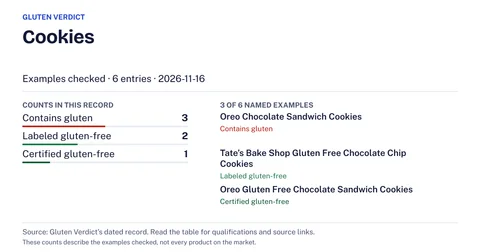 CookiesContains glutenchecked Nov 16, 2026
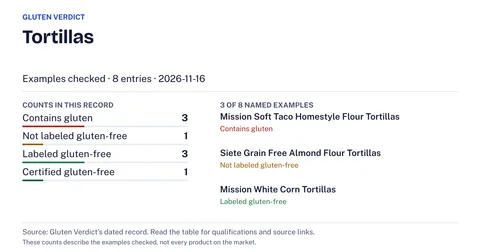 TortillasDepends on the product3 of 8 products we checked contain gluten: Mission Soft Taco Homestyle Flour Tortillas, Guerrero Riquisimas Soft Taco Flour Tortillas (24 ct), and Guerrero Corn and Wheat Tortillaschecked Nov 16, 2026
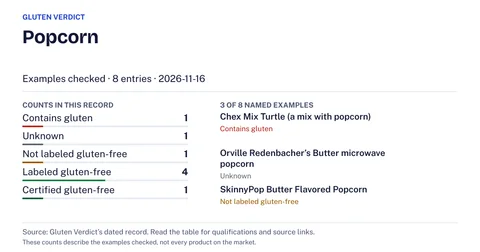 PopcornNaturally gluten-free1 of 8 products we checked contains gluten: Chex Mix Turtle (a mix with popcorn)checked Nov 16, 2026
Questions people ask
Does Target label all of its Good & Gather food gluten-free?
No. The white rice, marinara and quick oats pages we read carry no gluten wording29, 30, 31, and the rotini page lists wheat33.
What does Target’s Gluten Free badge mean?
Target describes it as a product with a third-party certification or an on-pack statement that the finished product is gluten-free16.
Is a Certified Gluten-Free line the same as FDA approval?
FDA does not endorse, accredit or recommend any particular third-party gluten-free certification program, so the line is not an FDA endorsement of a program5.
Can a gluten-free item name wheat on its label?
Wheat in the ingredient list or a Contains wheat statement is allowed with the claim only when an asterisk after the word points to FDA’s statement that the wheat has been processed to meet the gluten-free requirements11.
More in Store guides: warehouse, discount and natural grocers
 Costco and gluten: which items make a claim and which only list ingredientsSort a Costco cart into claim, ingredient list only, or nothing to read, using Costco’s own item pages and what FDA’s gluten-free rule requires.
 Gluten-free at Walmart: Great Value claims, certification and substituted itemsHow to check a Walmart or Great Value gluten-free claim against the pack, tell a claim from a certification, and handle a substitute on pickup or delivery.
 Whole Foods and gluten: 365 labels, the hot bar, bulk bins and the countersRead a Whole Foods 365 gluten-free claim against FDA’s rule, and see what the store itself states about bulk bins, the hot bar and counters.
 Gluten-free at dollar stores, drugstores and small chains: what the chain says and what the pack saysWhat Dollar General, Dollar Tree, Five Below, CVS, Walgreens, Lidl, The Fresh Market and Natural Grocers say about gluten, and how to read a pack.
 Sam’s Club and gluten: reading a listing, a bulk pack and the café sheetHow to use Sam’s Club’s gluten-free page as a shortlist, read the pack in your cart, and tell sealed packs from café food and sample tables.
 Wegmans and gluten: what the Wellness Keys and in-store labels meanWhat Wegmans says its Gluten Free Wellness Key means, how in-store food is labeled, and how to check any other Wegmans item before you buy.
All 8 guides in Store guides: warehouse, discount and natural grocers
Related guides
 Store-brand gluten-free: what the tag, claim or seal rests onSort a store-brand item into certified, maker-stated or ingredient-only, see what each lets you conclude, and know what to ask the store.
 Wheat-free, gluten-free and “no gluten ingredients”: what each label statement covers“Wheat-free”, “gluten-free” and “made with no gluten-containing ingredients” are three different statements. What each covers, and what to check.
 Vegan, organic, non-GMO, natural and keto labels do not mean gluten-freeVegan, organic, non-GMO, natural, plant-based and keto labels describe other things. What each claims, and which gluten claim or source to check instead.
 Certified or naturally gluten-free: when a seal mattersWhich naturally gluten-free foods are worth buying with a claim or seal: produce, grains, flours, oats and processed foods, with FDA rules and test data.
Sources
- [1, 2, 3, 4, 5, 6, 7, 8] US Food and Drug Administration, Questions and Answers on the Gluten-Free Food Labeling Final Rule, checked Nov 17, 2026.
- [9, 10, 11] Electronic Code of Federal Regulations, 21 CFR 101.91 Gluten-free labeling of food, checked Nov 17, 2026.
- [12, 13] US Food and Drug Administration, Food Allergen Labeling and Consumer Protection Act of 2004 (FALCPA), checked Nov 17, 2026.
- [14] Gluten Intolerance Group, Do All Wheat Mentions on Food Labels Mean Not Gluten-Free?, checked Nov 17, 2026.
- [15, 16, 17] Target, Good & Gather Gluten Free Penne, 12 oz (product page), checked Nov 17, 2026.
Read the page on 2026-11-17 (title, bullets, Dietary Needs line, label and review text, with images not read): the text names no gluten-free certifier. The words GFCO, Gluten-Free Certification Organization, NSF, CSA, Celiac Support Association, Beyond Celiac and Gluten Intolerance Group do not appear on it. The Good & Gather Gluten Free Flour Blend page (A-78016490) read the same way names none either; it names SQF, which is not a gluten-free program name we searched for.
- [18] Target, Good & Gather Gluten Free Flour Blend, 16 oz (product page), checked Nov 17, 2026.
- [19] Target, Good & Gather Gluten Free Plain Bread Crumbs, 9 oz (product page), checked Nov 17, 2026.
- [20] Target, Good & Gather Gluten Free Traditional Crust Frozen Cheese Pizza, 21.1 oz (product page), checked Nov 17, 2026.
- [21] Target, Good & Gather Gluten Free Multi-grain with Flax Rice Crackers, 3.5 oz (product page), checked Nov 17, 2026.
- [22] Target, Good & Gather Organic Super Firm Gluten Free Tofu, 14 oz (product page), checked Nov 17, 2026.
- [23] Target, Good & Gather Whole Grain Brown Rice Microwavable Cups, 8.8 oz (product page), checked Nov 17, 2026.
- [24] Target, Favorite Day Spring Gluten Free Blueberry Muffins, 14 oz (product page), checked Nov 17, 2026.
- [25] Target, Target product-page sitemap (sitemap_pdp-index.xml.gz and its files), checked Nov 17, 2026.
Read all 106 sitemap files that Target’s product-page index lists (each returned HTTP 200), on 2026-11-17, for product addresses containing favorite-day: the only one that also contains gluten-free is Spring Gluten Free Blueberry Muffins (A-92338728). The files list the addresses Target publishes, so this shows what we found, not that no other Favorite Day item carries a claim.
- [26] Target, Favorite Day Oatmeal Raisin Cookies, 10.5 oz (product page), checked Nov 17, 2026.
- [27] Target, Favorite Day Gingerbread Mini Cupcakes, 10 oz (product page), checked Nov 17, 2026.
- [28] Target, Favorite Day Variety Mini Muffins Pack, 11.9 oz (product page), checked Nov 17, 2026.
- [29] Target, Good & Gather Organic Long Grain White Rice, 30 oz (product page), checked Nov 17, 2026.
Read the page on 2026-11-17: the ingredient list reads ORGANIC WHITE RICE. The word gluten appears nowhere on the page (title, bullets, details, label text and badges), and no Contains statement is shown.
- [30] Target, Good & Gather Marinara Sauce, 15 oz (product page), checked Nov 17, 2026.
Read the page on 2026-11-17: the ingredient list reads TOMATOES (TOMATOES, SALT, CITRIC ACID), EXTRA VIRGIN OLIVE OIL, GARLIC, SALT, CANE SUGAR, BASIL, CRUSHED RED PEPPER. The word gluten appears nowhere on the page (title, bullets, details, label text and badges), and no Contains statement is shown.
- [31] Target, Good & Gather Quick Oats, 18 oz (product page), checked Nov 17, 2026.
Read the page on 2026-11-17: the ingredient list reads WHOLE GRAIN ROLLED OATS. The page’s label warning line reads MAY CONTAIN WHEAT. The word gluten appears nowhere on the page (title, bullets, details, label text and badges).
- [32, 34, 35, 36] Target, Good & Gather Pearled Barley, 1 lb (product page), checked Nov 17, 2026.
Read the page on 2026-11-17: the ingredient list reads PEARLED BARLEY. No Contains statement, may-contain line or gluten wording appears anywhere on the page apart from Target’s general disclaimer.
- [33] Target, Good & Gather Rotini, 16 oz (product page), checked Nov 17, 2026.